

- Free Word Problems to 20 Worksheets for Grade 1 – Math
- Word problems to 20 (start here)
- Addition word problems (Set 1)
- Subtraction word problems (Set 2)
- Which number sentence? (Set 3)
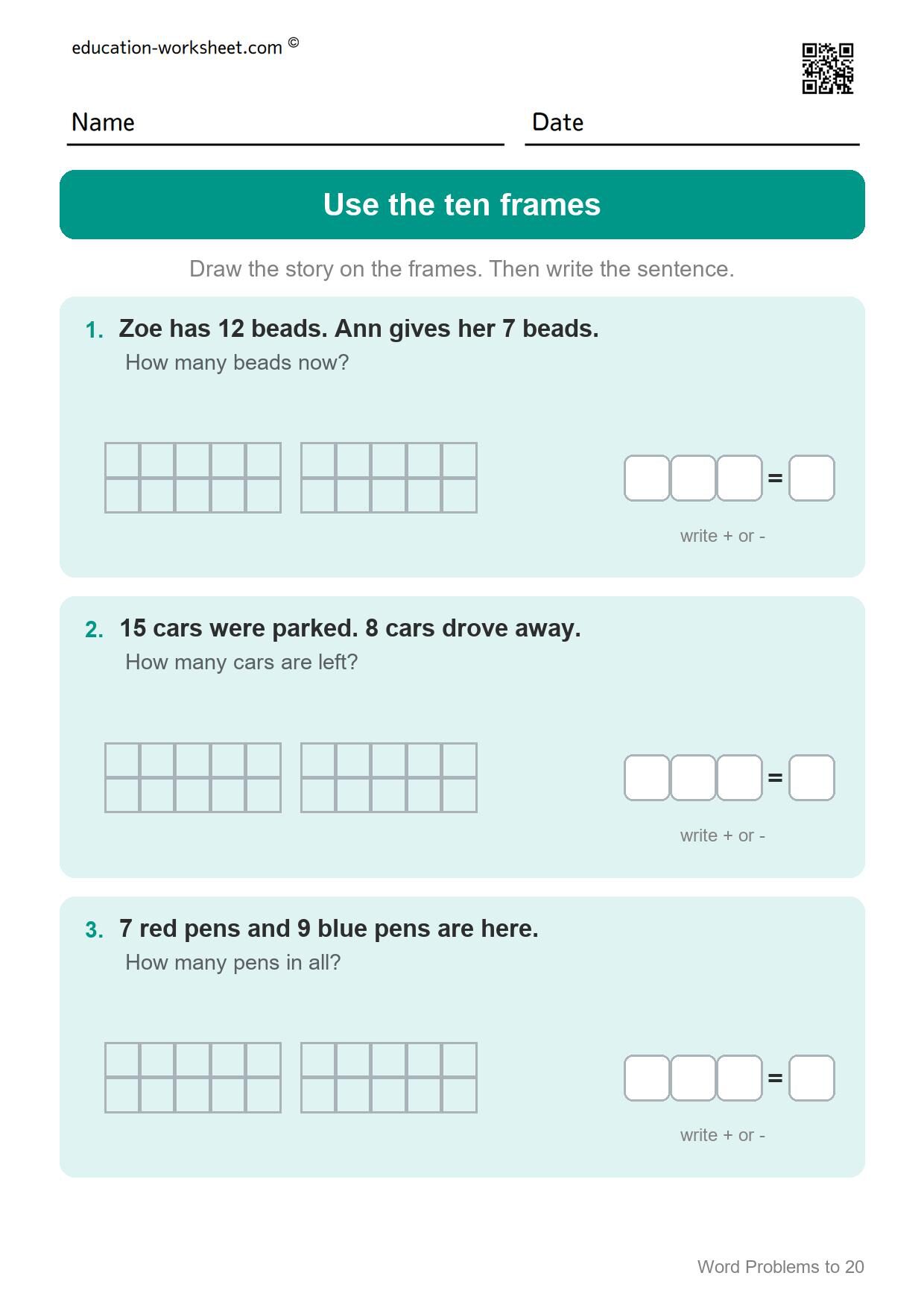
- Use the ten frames (Set 4)
- Addition word problems (Set 5)
- Subtraction word problems (Set 6)
- Which number sentence? (Set 7)
- Use the ten frames (Set 8)
- Addition word problems (Set 9)
- Subtraction word problems (Set 10)
- Which number sentence? (Set 11)
- Use the ten frames (Set 12)
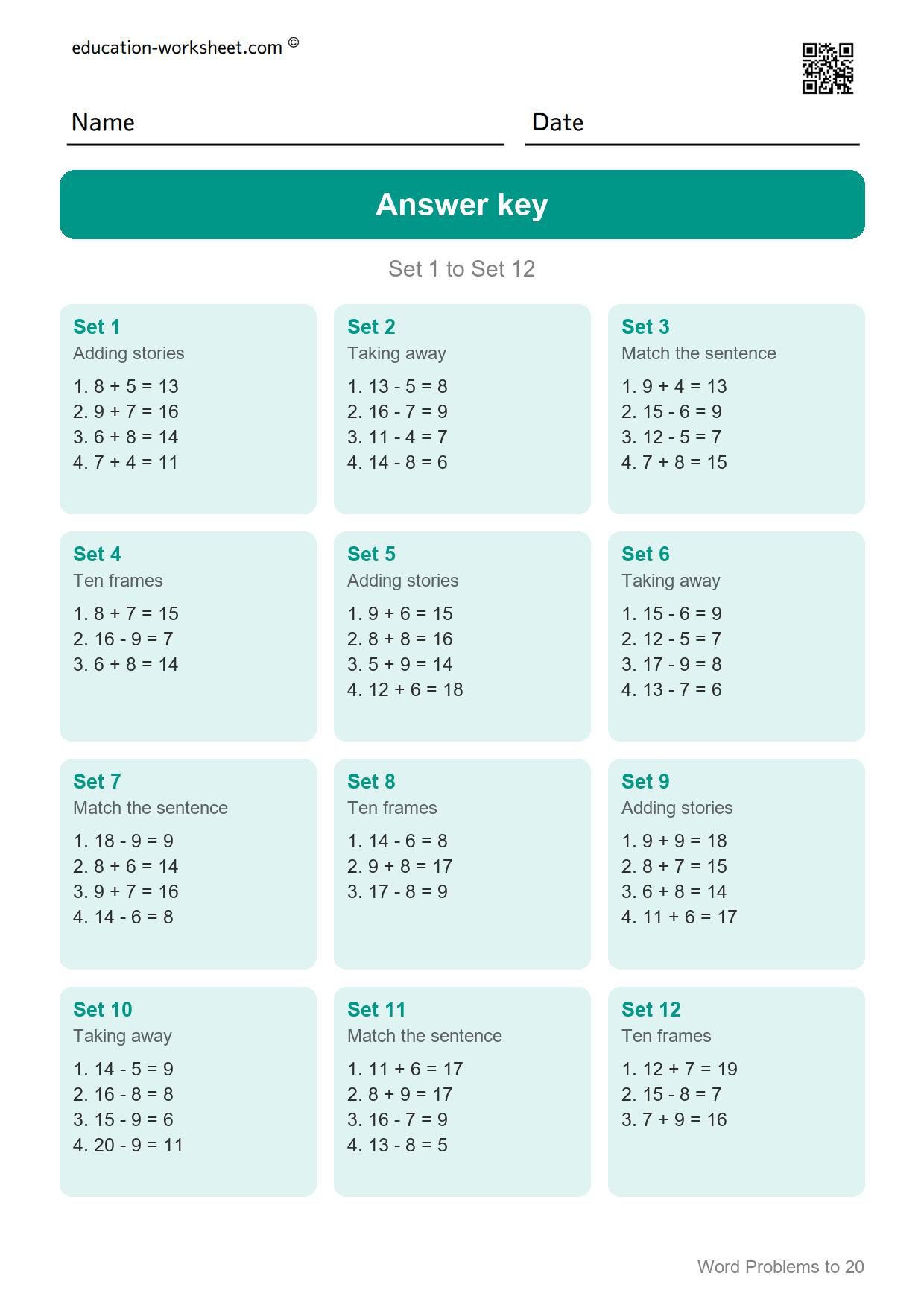
- Answer key
- Word problems: teaching children to read the story, not hunt for keywords
Free Word Problems to 20 Worksheets for Grade 1 – Math
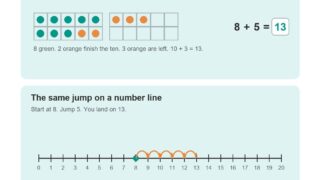
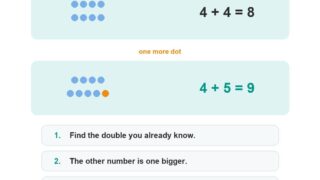
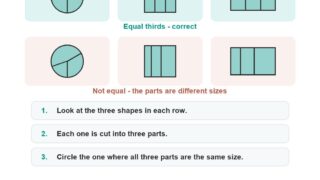
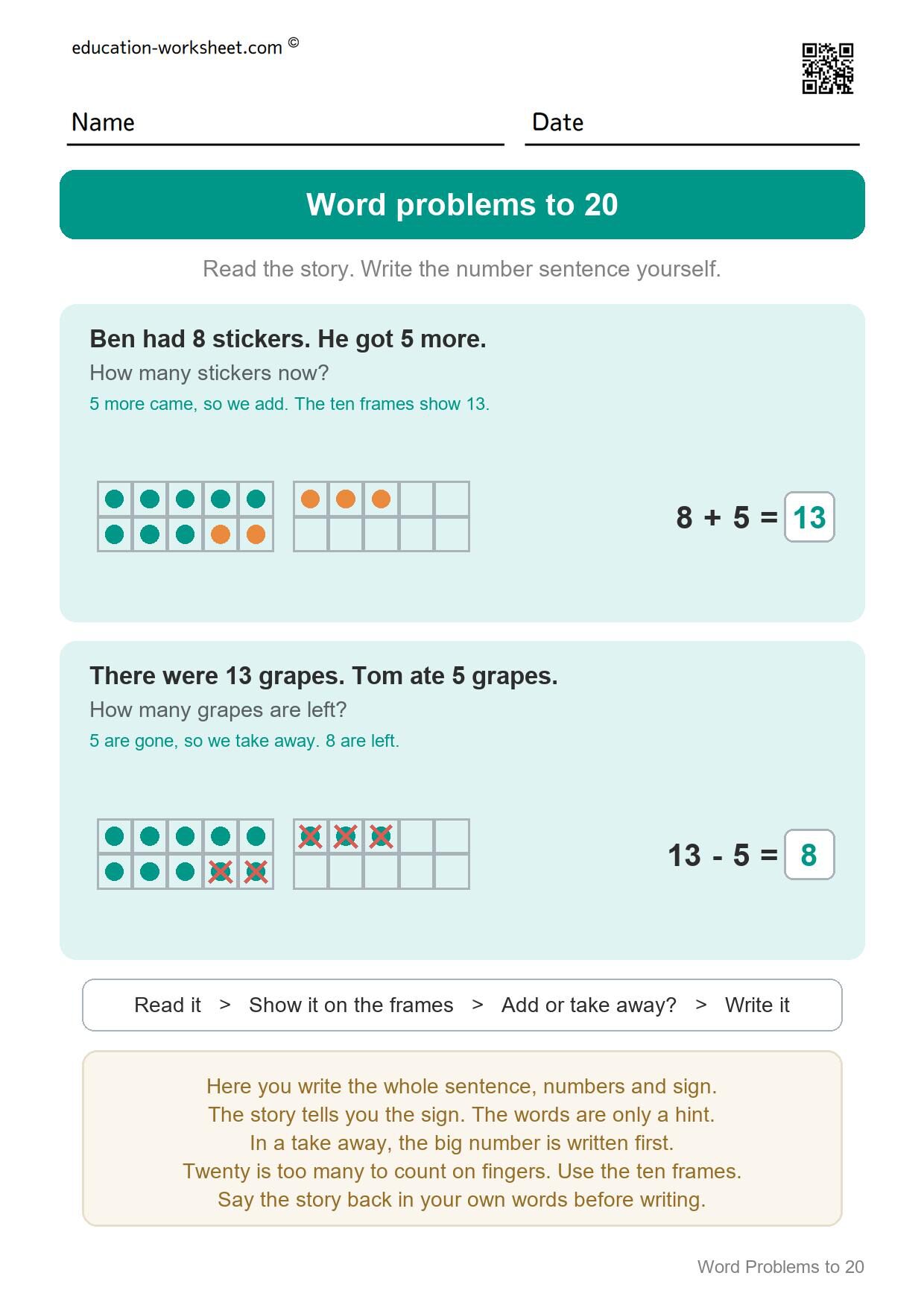
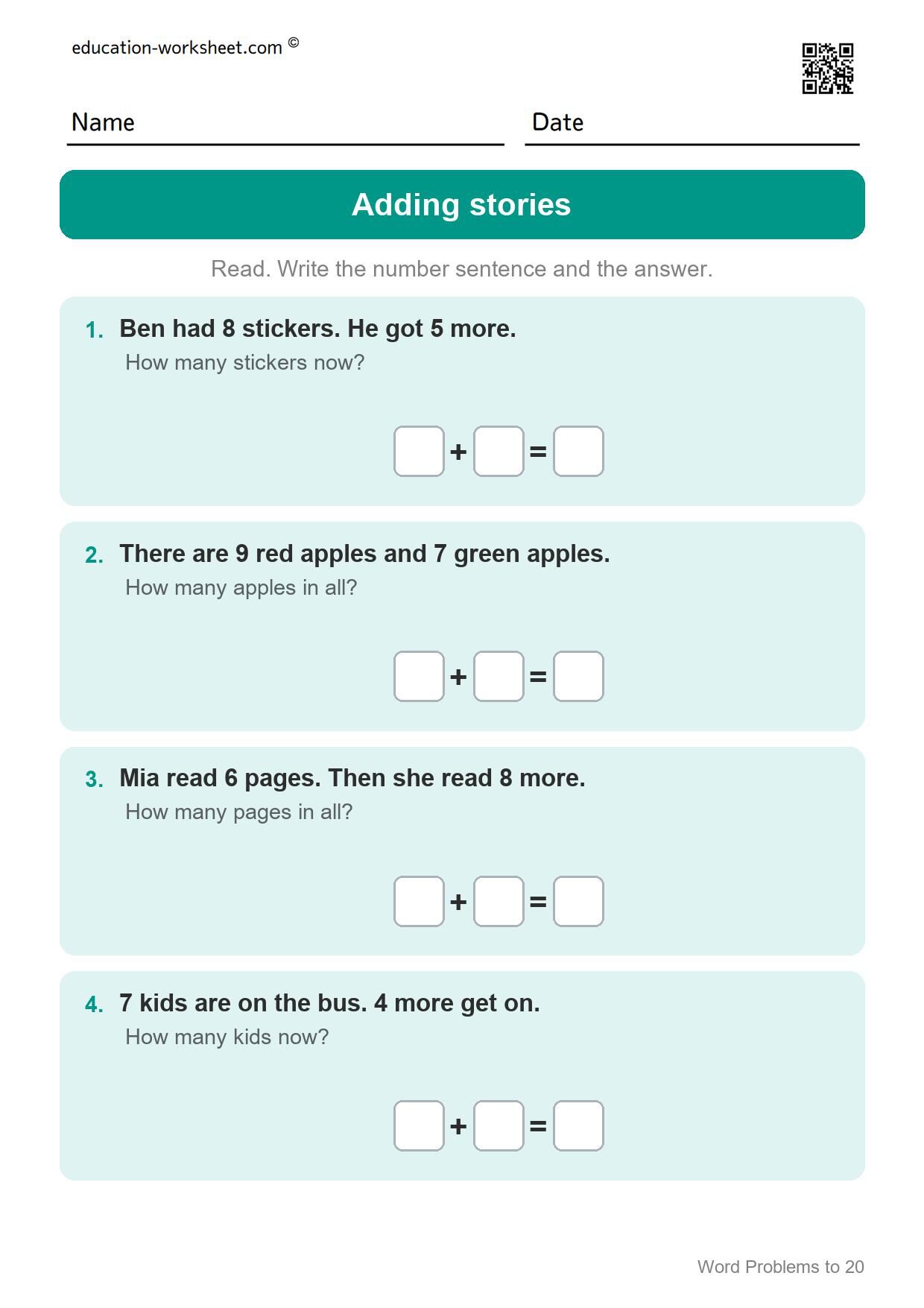
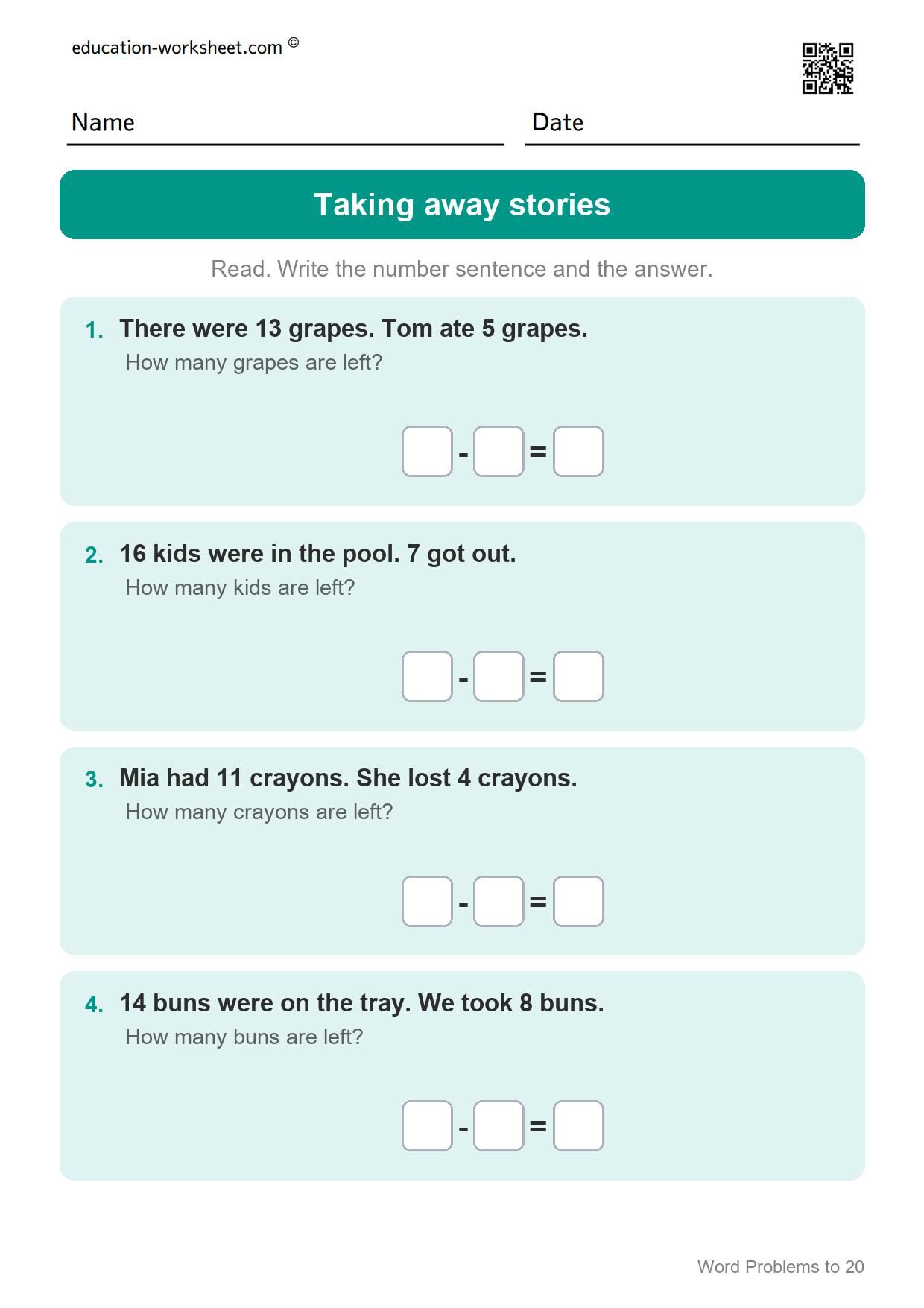
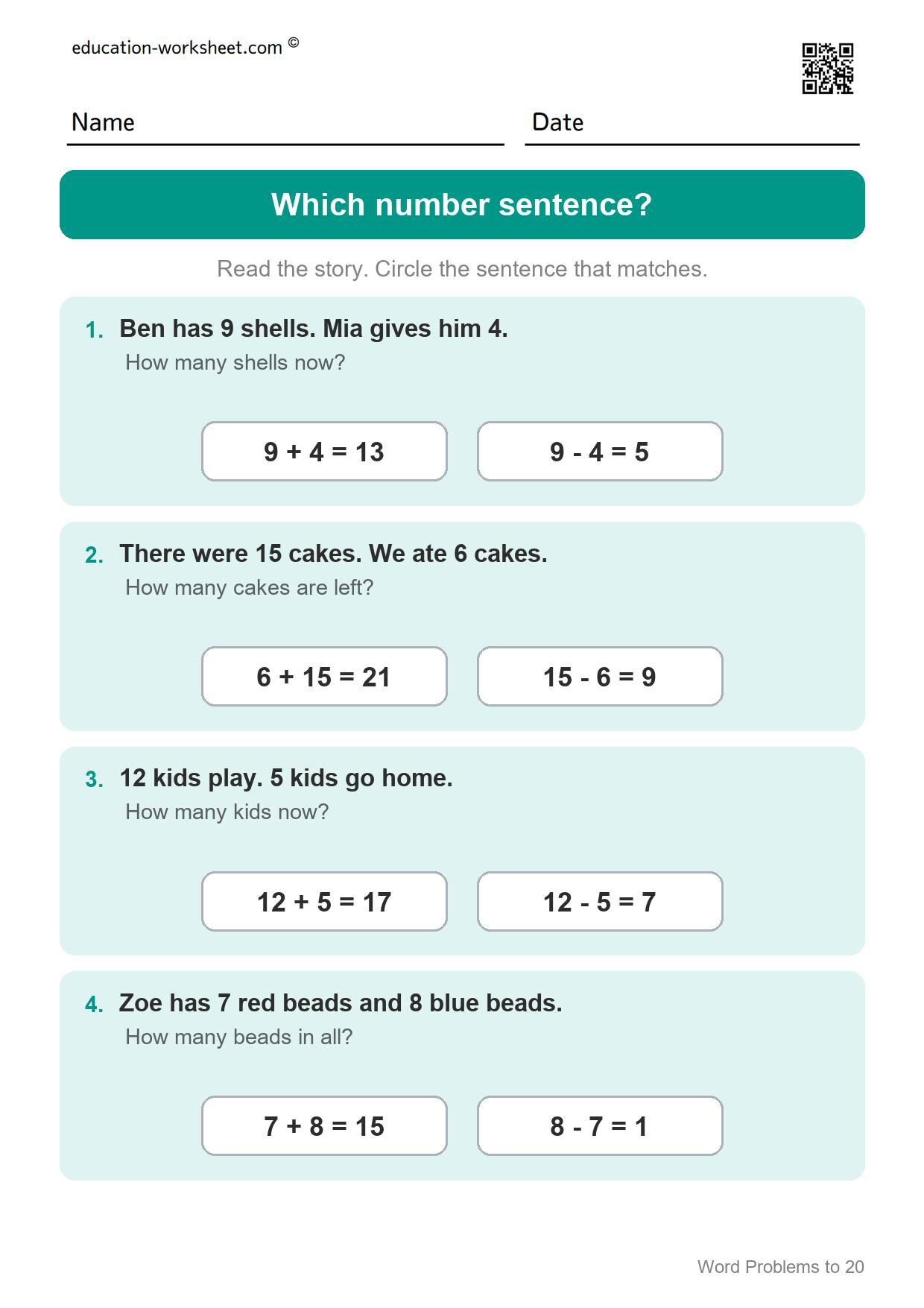
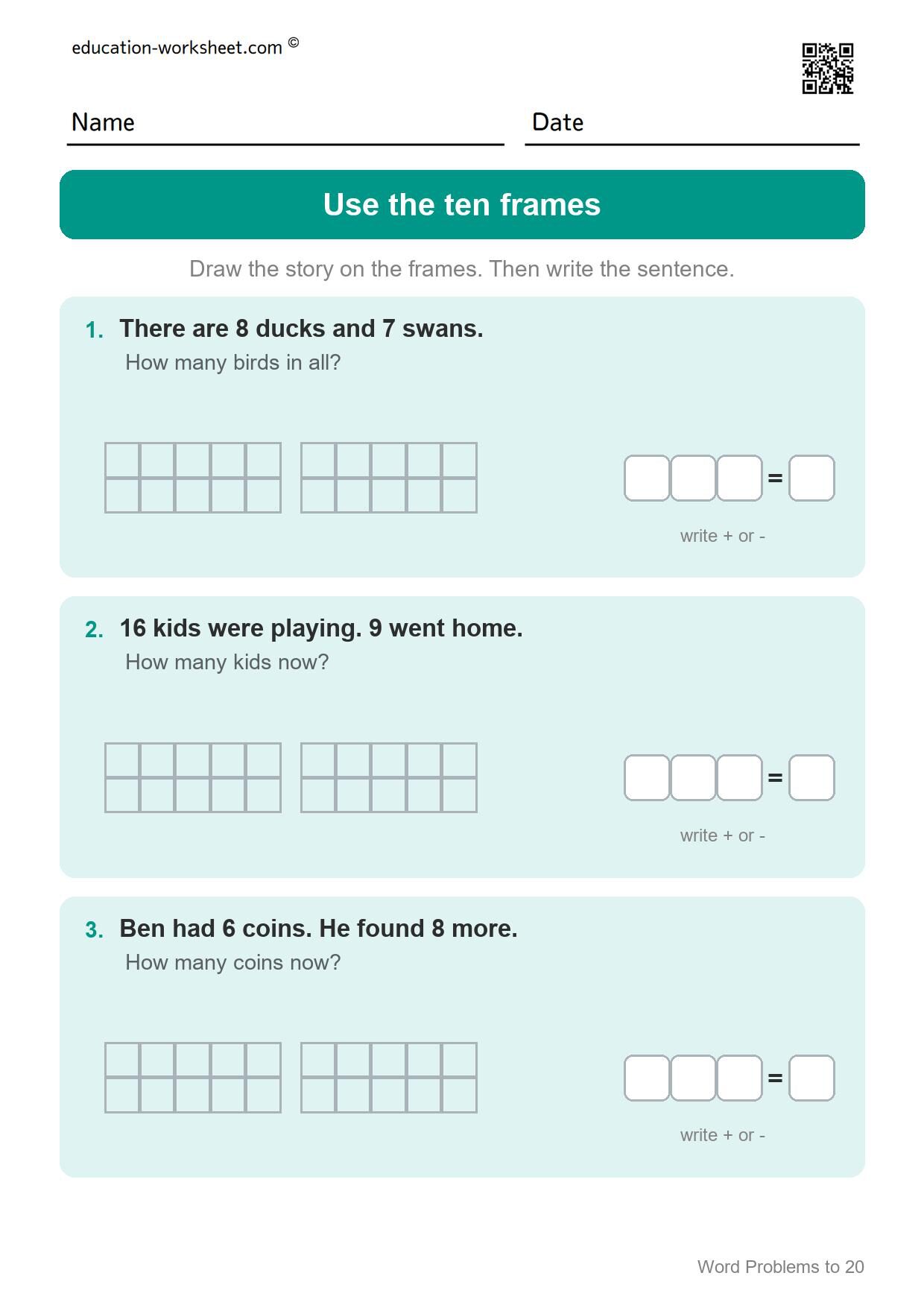
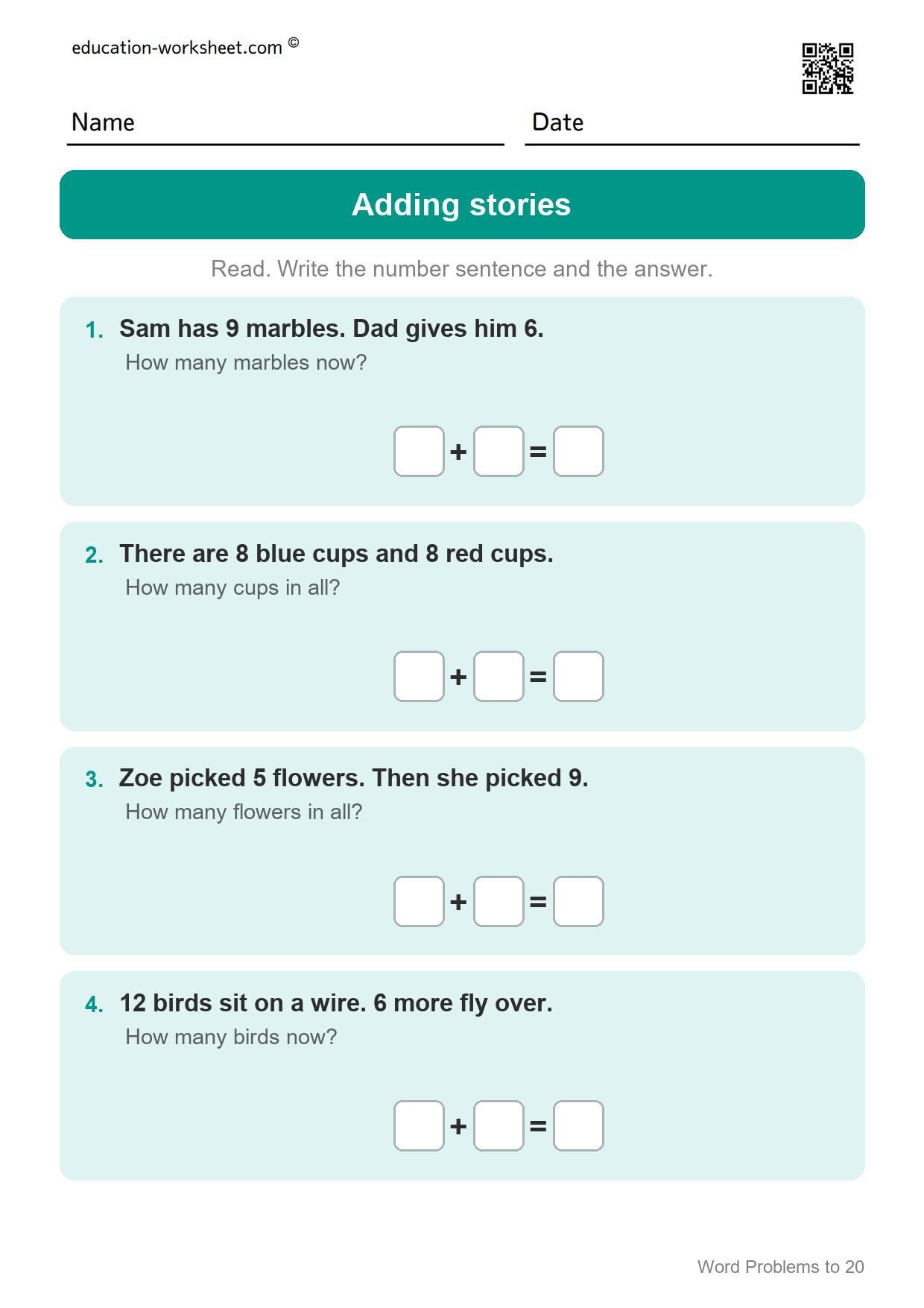
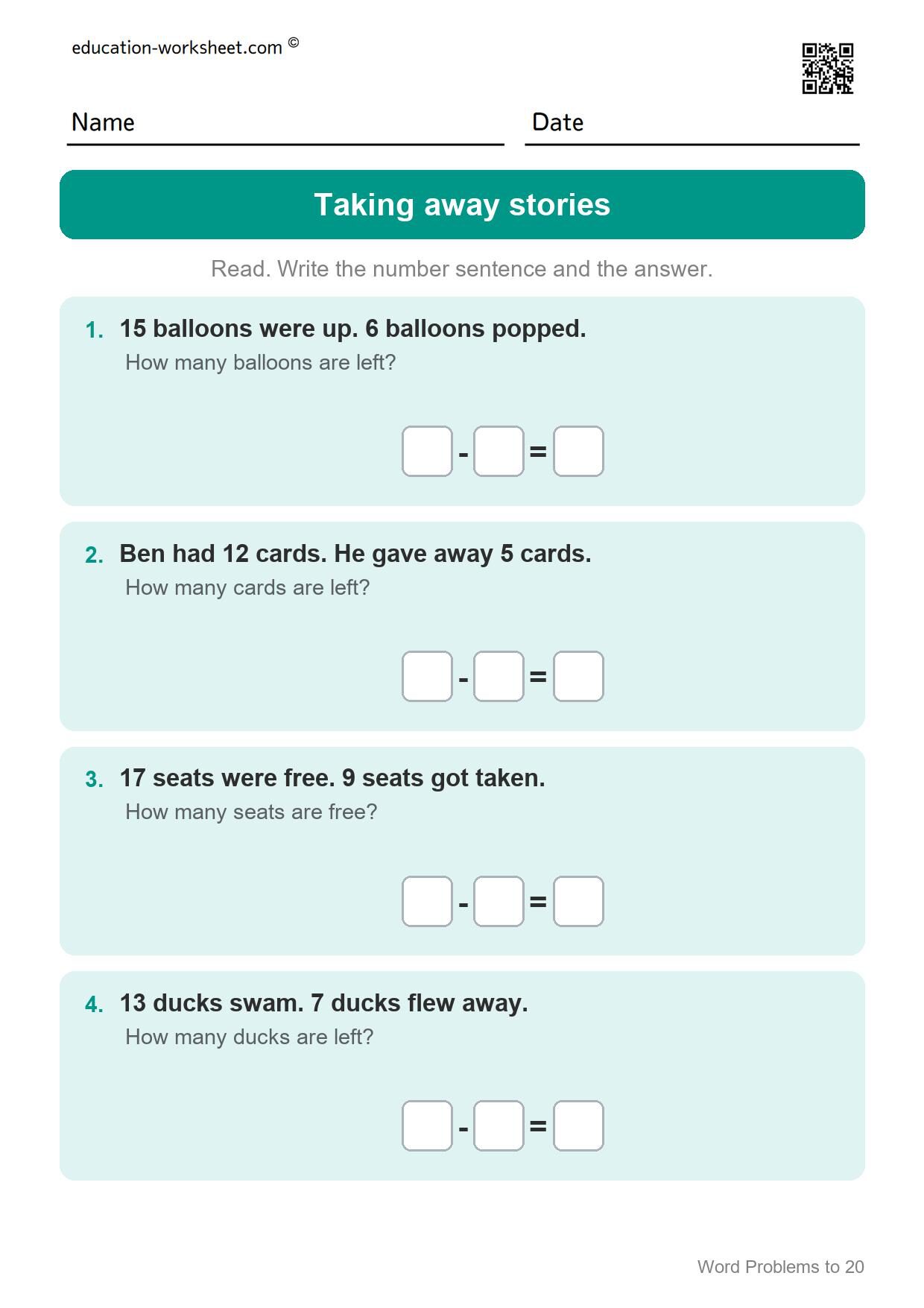
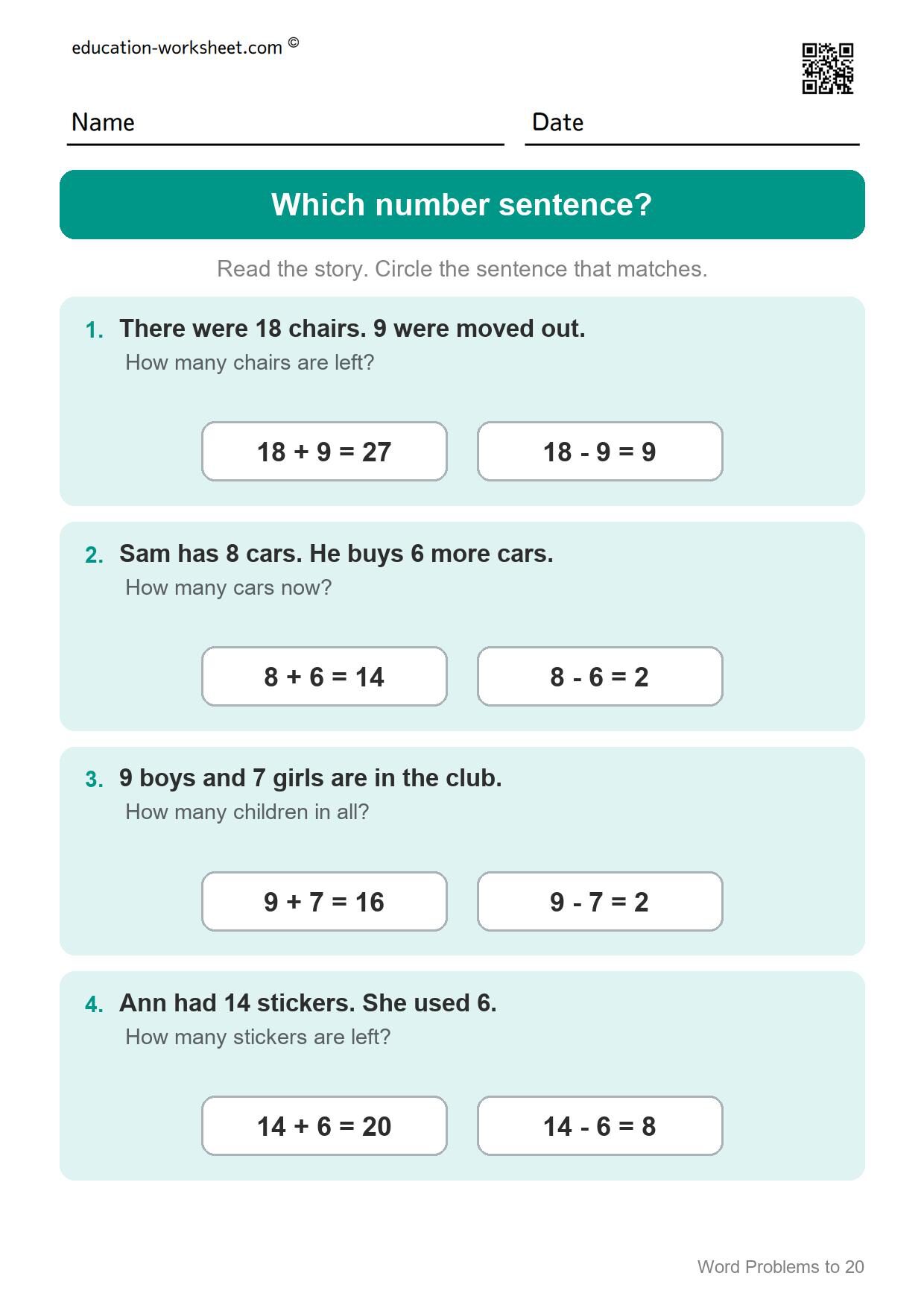
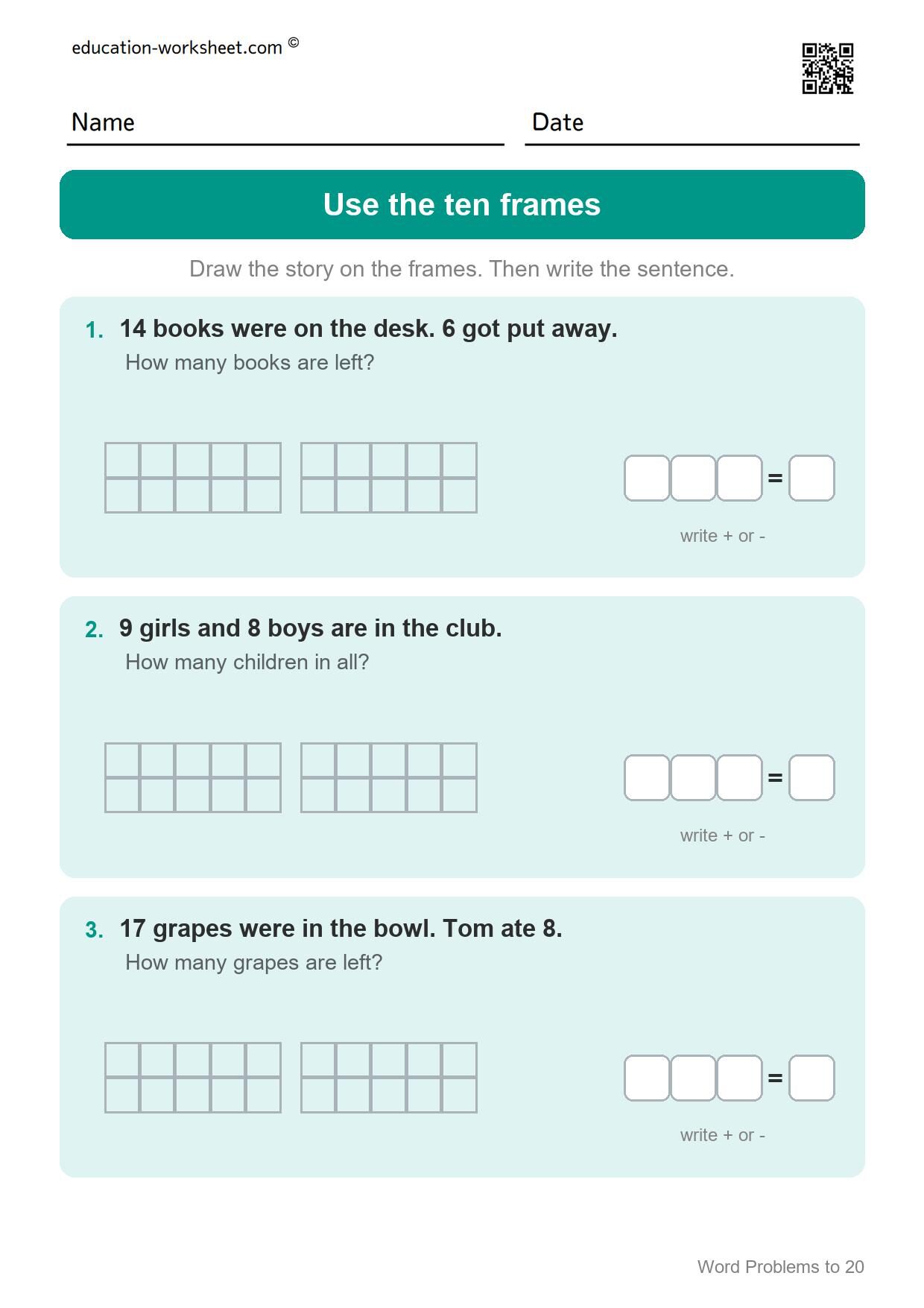
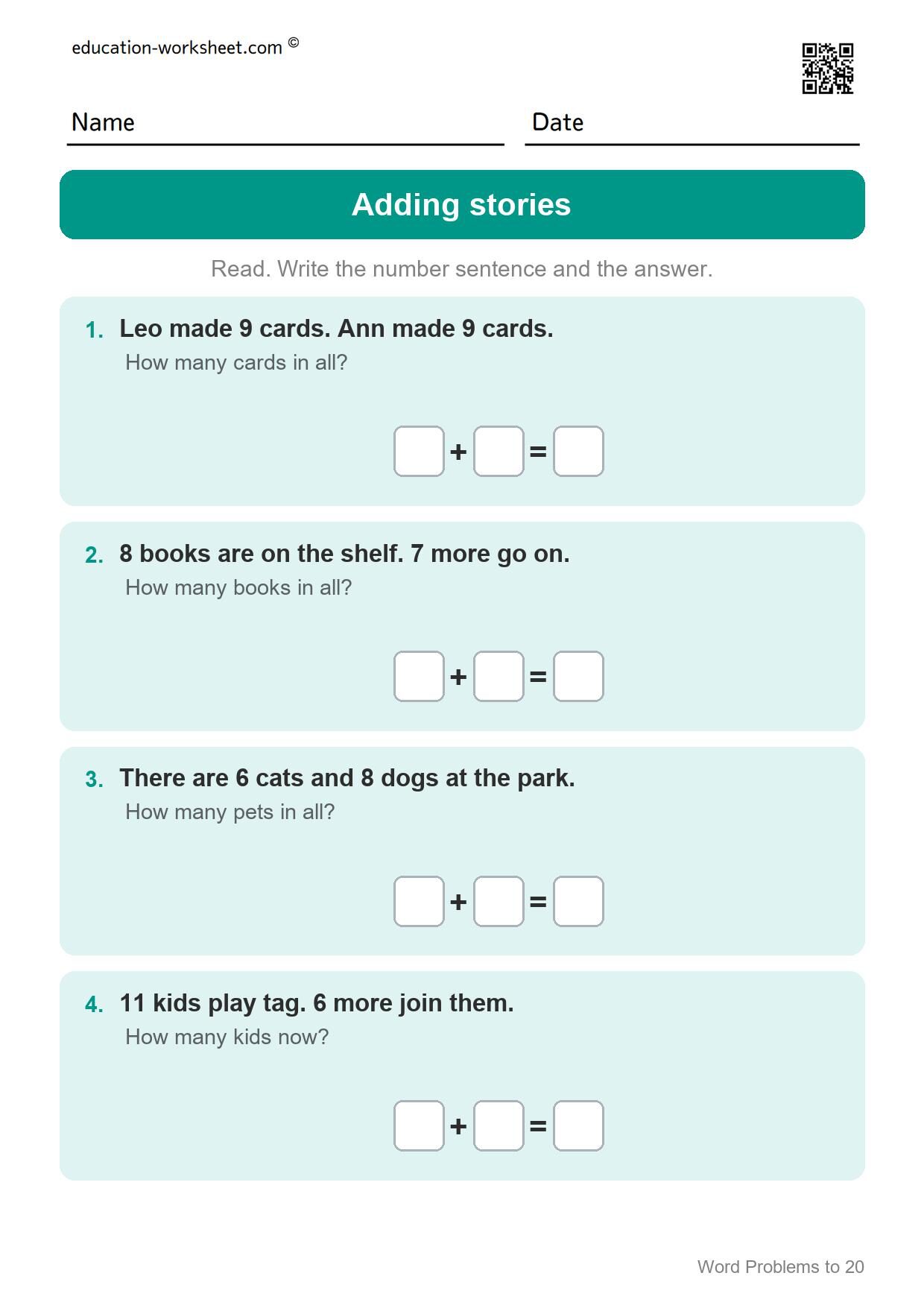
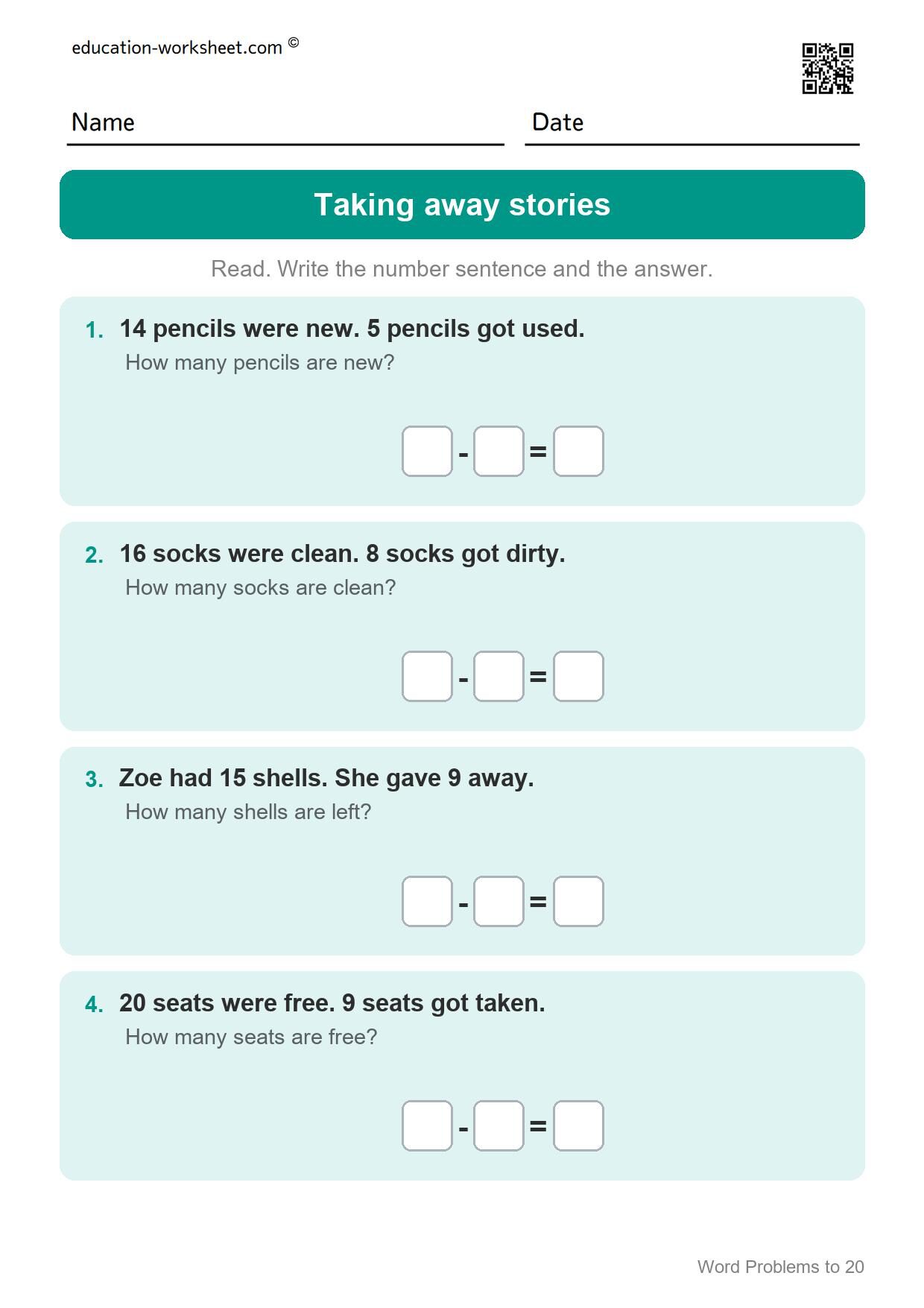
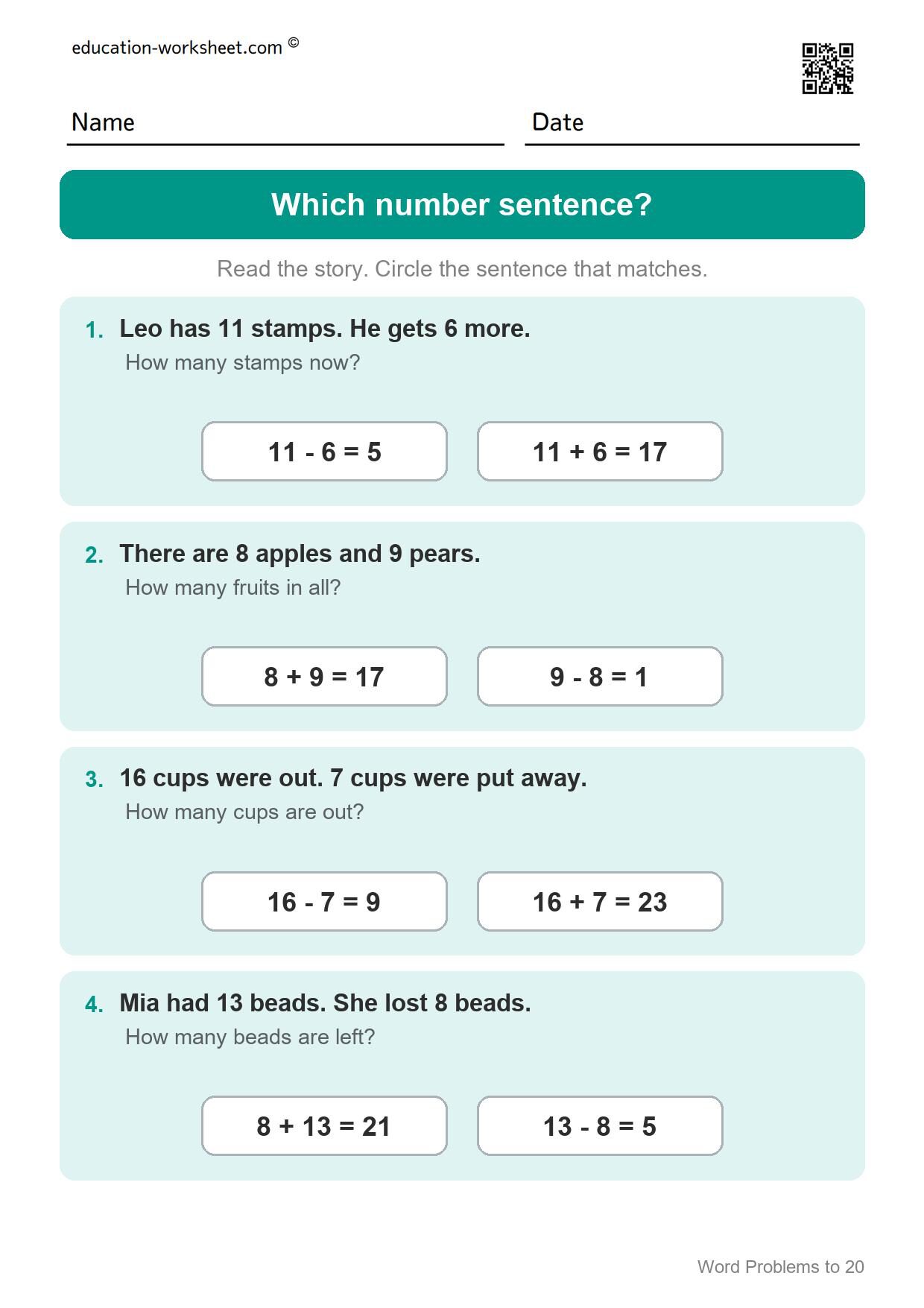
These free printable word problem worksheets move first graders past the numbers they can count on their fingers. Everything here works with numbers up to twenty, and the child writes the whole number sentence, both numbers and the sign, rather than filling a gap in a sentence that is already printed. That one change is the step up from our kindergarten word problem sets. The pages rotate through four tasks three times: stories where something is added, stories where something is taken away, a page that shows two number sentences and asks which one matches the story, and a page with empty ten frames as a working space so the child can build the numbers before writing anything. The matching page is the one worth doing slowly, because both sentences on it are correct arithmetic and only one of them tells the right story, so the child cannot get it right by calculating, only by understanding. The stories avoid relying on keyword tricks, and the notes on the first sheet remind the child that in a take away the bigger number is written first. The last sheet is an answer key for all twelve pages. Just download, print, and read the stories together!
Word problems to 20 (start here)
Addition word problems (Set 1)
Subtraction word problems (Set 2)
Which number sentence? (Set 3)
Use the ten frames (Set 4)
Addition word problems (Set 5)
Subtraction word problems (Set 6)
Which number sentence? (Set 7)
Use the ten frames (Set 8)
Addition word problems (Set 9)
Subtraction word problems (Set 10)
Which number sentence? (Set 11)
Use the ten frames (Set 12)
Answer key
Word problems: teaching children to read the story, not hunt for keywords
The arithmetic in a first grade word problem is easy. The difficulty is entirely in working out what is being asked. Many children are taught to scan for keywords — altogether means add, left means subtract — and it works until it does not, because plenty of problems use those words for the opposite operation.
What your child is actually learning
First grade word problems come in a small number of shapes, and knowing the shapes is more useful than knowing keywords. Some problems join two amounts. Some take an amount away. Some compare two amounts to ask how many more. Some give a total and one part and ask for the other. That last kind is the hardest, because the answer is found by subtracting even though the story sounds like addition.
How to work through these pages
Read the problem twice before touching a pencil. The first reading is for the story, the second for the numbers. Then ask three questions in order: what do we know, what are we trying to find, and is the answer going to be bigger or smaller than what we started with. That last question catches most errors before they happen. Acting the problem out with counters is not babyish; it is how children build the mental image they will later work from.
The mistakes to expect
- Grabbing the two numbers and adding them without reading the question.
- Relying on a keyword that misleads. “Tom has 12 marbles altogether and 5 are blue” contains altogether and needs subtraction.
- Answering a different question from the one asked, such as giving the total when asked for the difference.
- Writing a bare number with no unit. Ask for the answer as a short sentence, because it forces a check against the question.
What to teach next
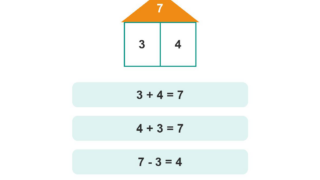
Problems with the unknown in different positions are the next step: 5 + ? = 12 rather than 5 + 7 = ?. After that come two-step problems, though those usually belong to second grade. Fact families support all of this, since they show that the same three numbers can be arranged into whichever sentence the story needs.
Questions parents ask
Should I stop teaching keywords entirely?
Use them as hints, never as rules. Say that altogether often means adding but that the story has to be checked. Children taught keywords as rules stop reading the problem at all.
My child can do the sums but not the word problems. Why?
Because they are two different skills. Calculating is arithmetic; word problems are reading comprehension with arithmetic attached. If reading is the sticking point, read the problem aloud for your child and see whether the maths then flows.
Should my child draw a picture?
Yes, and a rough one is fine. A quick sketch of the situation is the most reliable way through a problem a child cannot picture, and it stays useful for many years.