These free printable fall following directions worksheets turn listening into a short, seasonal game. An adult reads a direction such as “Circle the owl” or “Color the box under the pumpkin orange,” and the child does it on a page of eight fall pictures. There are twelve pages and 52 directions, moving from one step to two and three steps, with basic concepts like first, last, top, bottom, next to and between along the way.
The pack was designed by a speech-language-hearing therapist. Following directions is one of the most common goals in speech and language therapy, because it brings together listening, vocabulary, concepts and memory. These sheets are for practice at home, in class or in therapy sessions. They cannot diagnose a language or listening difficulty.
Fall is a natural theme for September to November, and every page uses the same eight pictures, so the child can spend their effort on listening rather than on new vocabulary.
- What Is in This Free Fall Following Directions Pack
- The 12 Fall Following Directions Worksheets
- Start Here – The Eight Fall Pictures and How to Use the Pack
- Page 1 – One Step
- Page 2 – One Step
- Page 3 – One Step
- Page 4 – Basic Concepts: First and Last
- Page 5 – Basic Concepts: Top and Bottom
- Page 6 – Basic Concepts: Next To and Between
- Page 7 – Two Steps
- Page 8 – Two Steps with Concepts
- Page 9 – Two Steps
- Page 10 – Three Steps
- Page 11 – Three Steps with Concepts
- Page 12 – Before and After
- Answer Key – Every Page Finished
- How the Directions Are Built
- Why Following Directions Matters
- When Children Are Ready for These Worksheets
- How to Use These Worksheets
- Three Things to Watch For
- Printing Tips
- Frequently Asked Questions
- What age are these following directions worksheets for?
- Why are the directions upside down?
- Can older children read the directions themselves?
- What do first and last mean on these pages?
- Is this a test for a language disorder?
- Do I need to sign up to download these?
- Can I use these in my classroom or therapy room?
- More Free Listening and Concept Worksheets
What Is in This Free Fall Following Directions Pack
- Twelve printable pages with 52 directions and 78 actions in all.
- Eight fall pictures on every page: leaf, pumpkin, apple, corn, owl, tree, fox and hoodie.
- One-step directions (pages 1 to 3) and basic concepts (pages 4 to 6).
- Two-step directions (pages 7 to 9), three-step directions (pages 10 and 11) and before and after (page 12).
- A guide page for adults and a picture answer key showing every finished page.
- A separate PDF for every page, free to download and print.
The 12 Fall Following Directions Worksheets
Every direction is printed upside down at the bottom of the page. An adult sitting across the table can read it the right way up, and a child who can read cannot read ahead. That keeps the task about listening, which is the point.
Start Here – The Eight Fall Pictures and How to Use the Pack
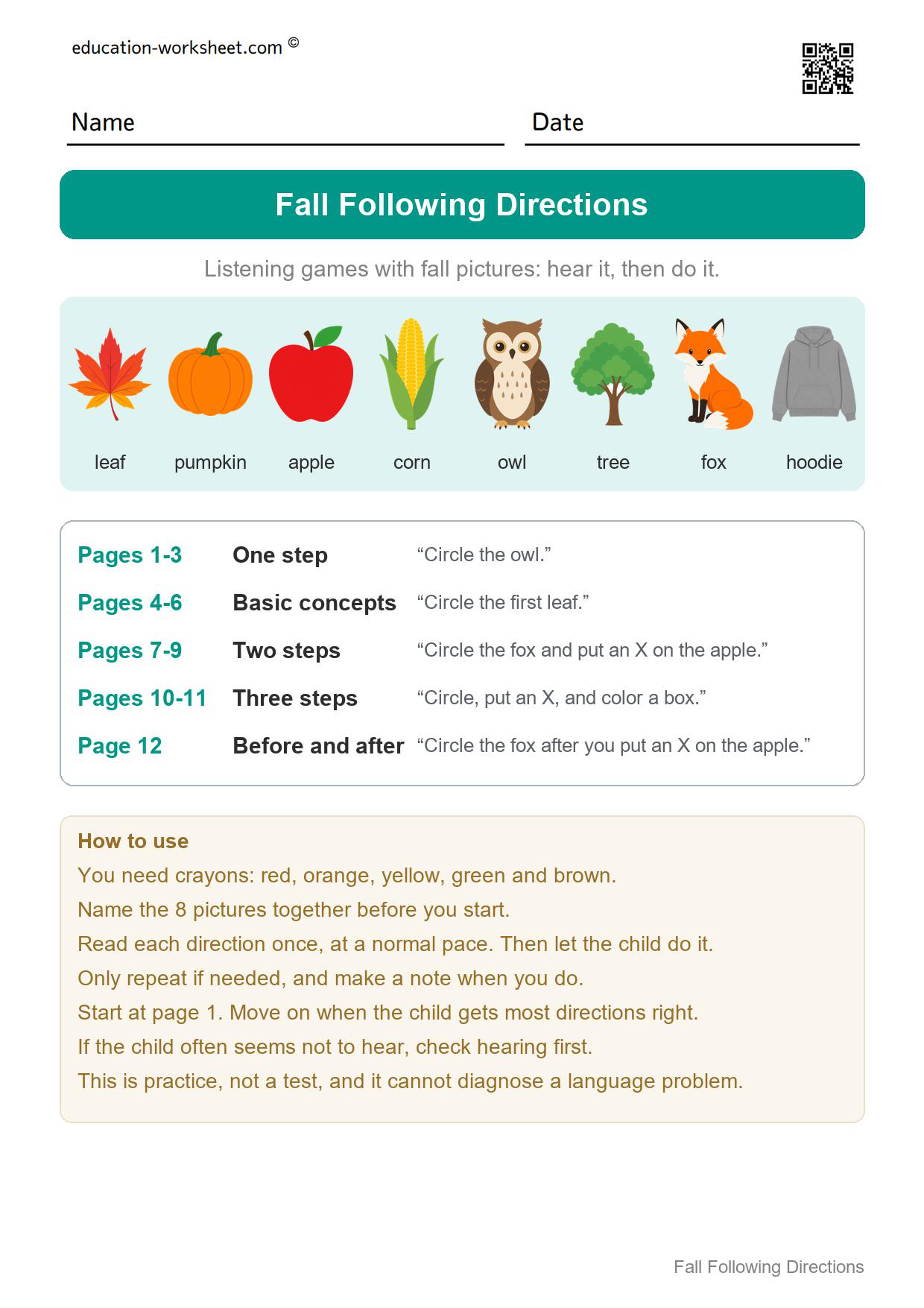
The first page shows the eight fall pictures used throughout the pack – a leaf, a pumpkin, an apple, corn, an owl, a tree, a fox and a hoodie – and the five levels. Name the pictures together before you start. A child cannot follow “circle the hoodie” if they call it a sweater and have never heard the word.
Page 1 – One Step
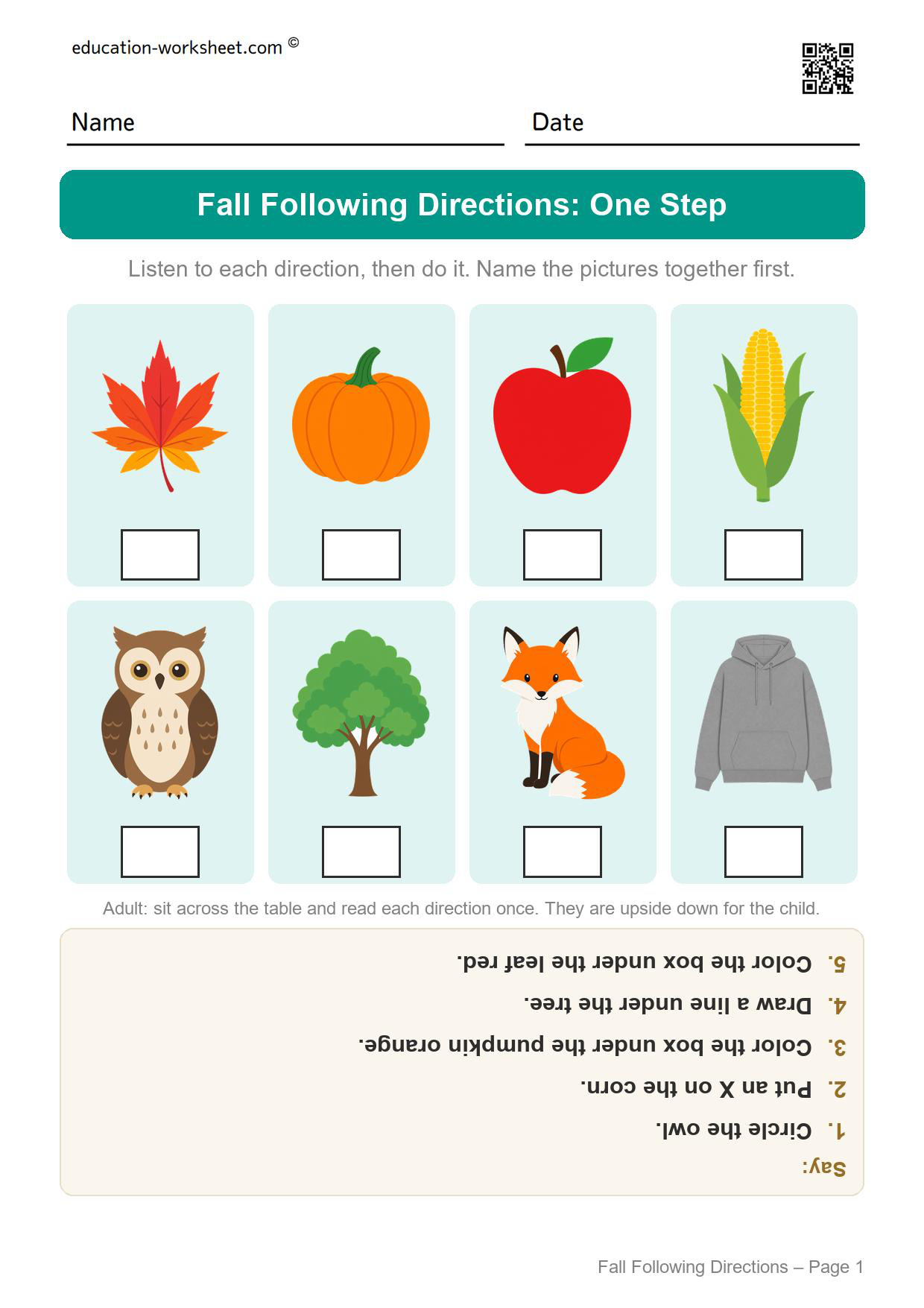
Five one-step directions, such as “Circle the owl.” and “Color the box under the pumpkin orange.” Each direction uses one of the four actions in the pack: circle, put an X on, draw a line under, or color the box under a picture.
The pictures are already in color, so the coloring happens in the small box under each picture. That keeps the page clean and makes it easy to check later.
Page 2 – One Step
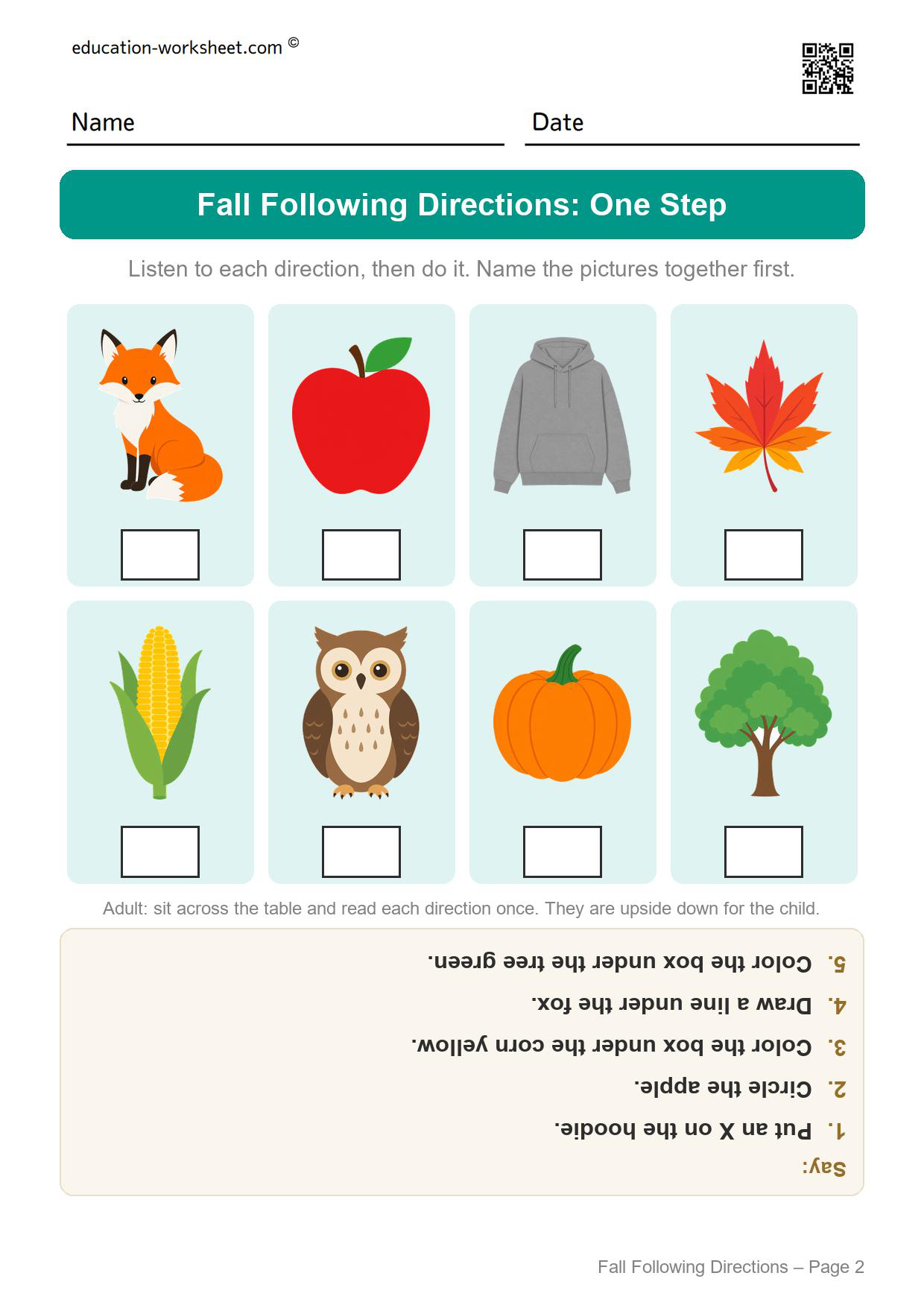
The same eight pictures in a new order, with five new directions. Moving the pictures around stops a child from remembering where the owl was last time.
Page 3 – One Step
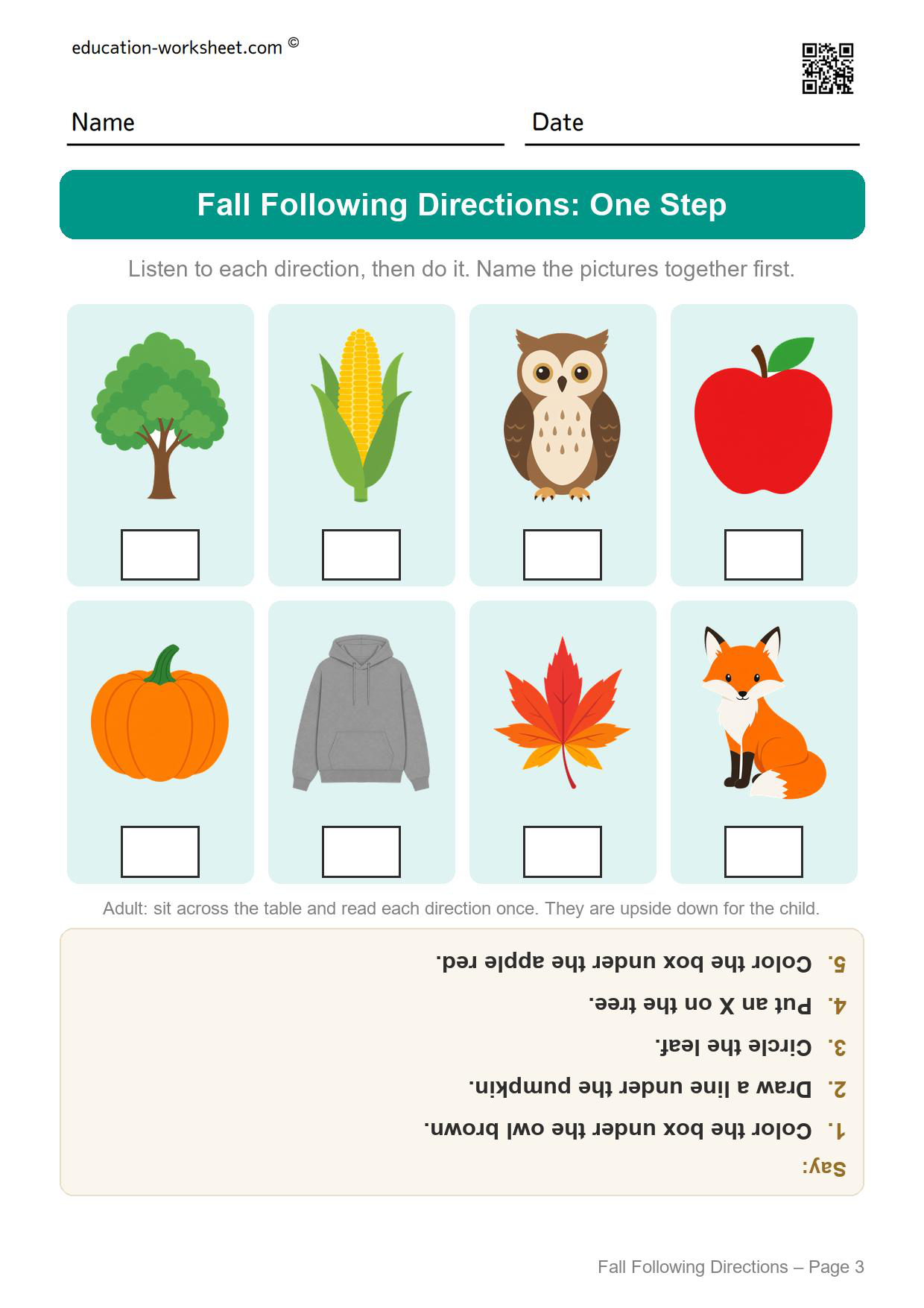
The last one-step page. If the child is getting four or five directions right without a repeat, move on to the concept pages.
Page 4 – Basic Concepts: First and Last
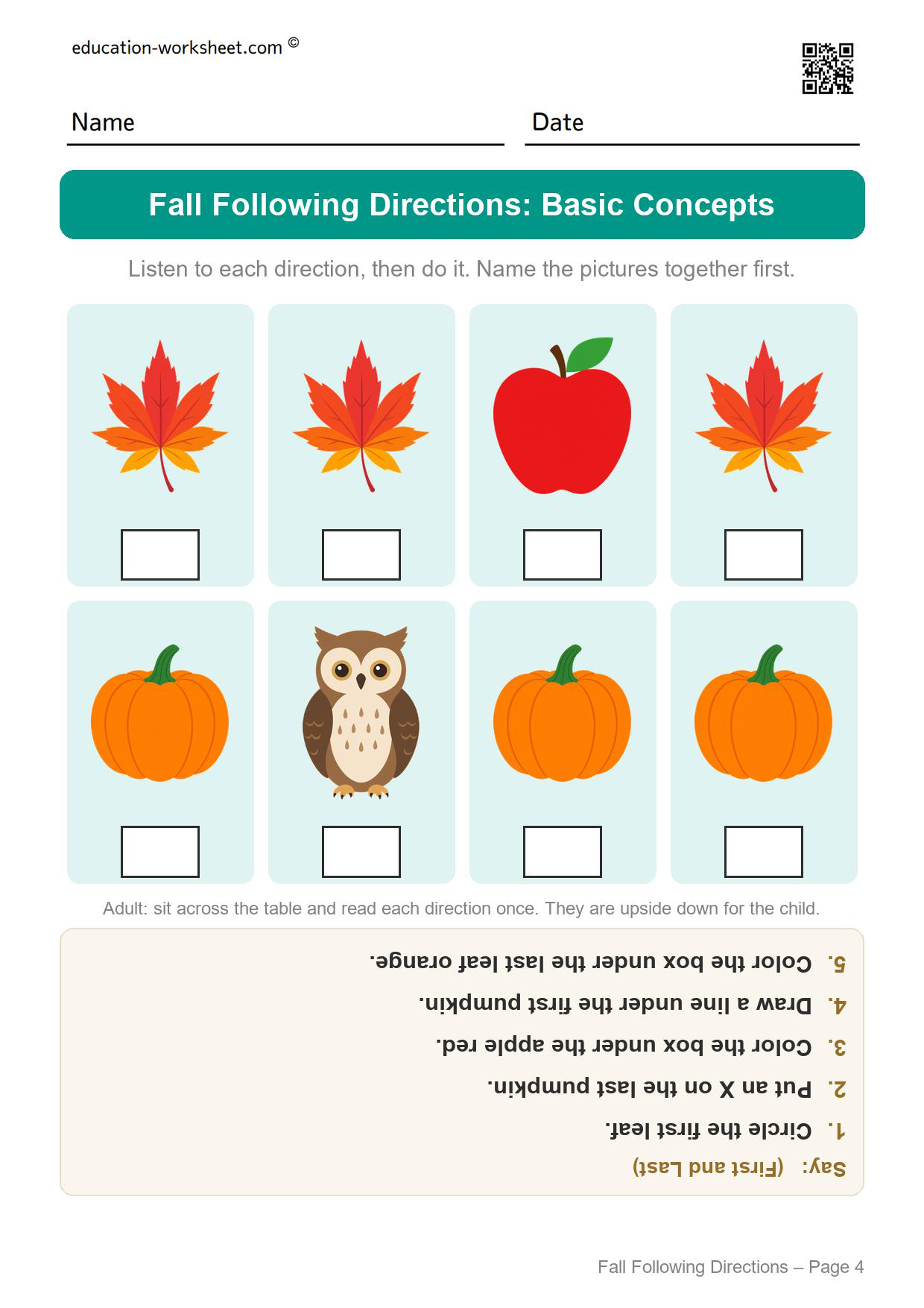
Now some pictures appear more than once. There are three leaves in the top row and three pumpkins in the bottom row, so “circle the leaf” is no longer enough. The child has to listen for “first” and “last”.
First and last always mean reading order: left to right along a row. Every repeated picture on this page sits in a single row, so there is never any doubt about which one is first.
Page 5 – Basic Concepts: Top and Bottom
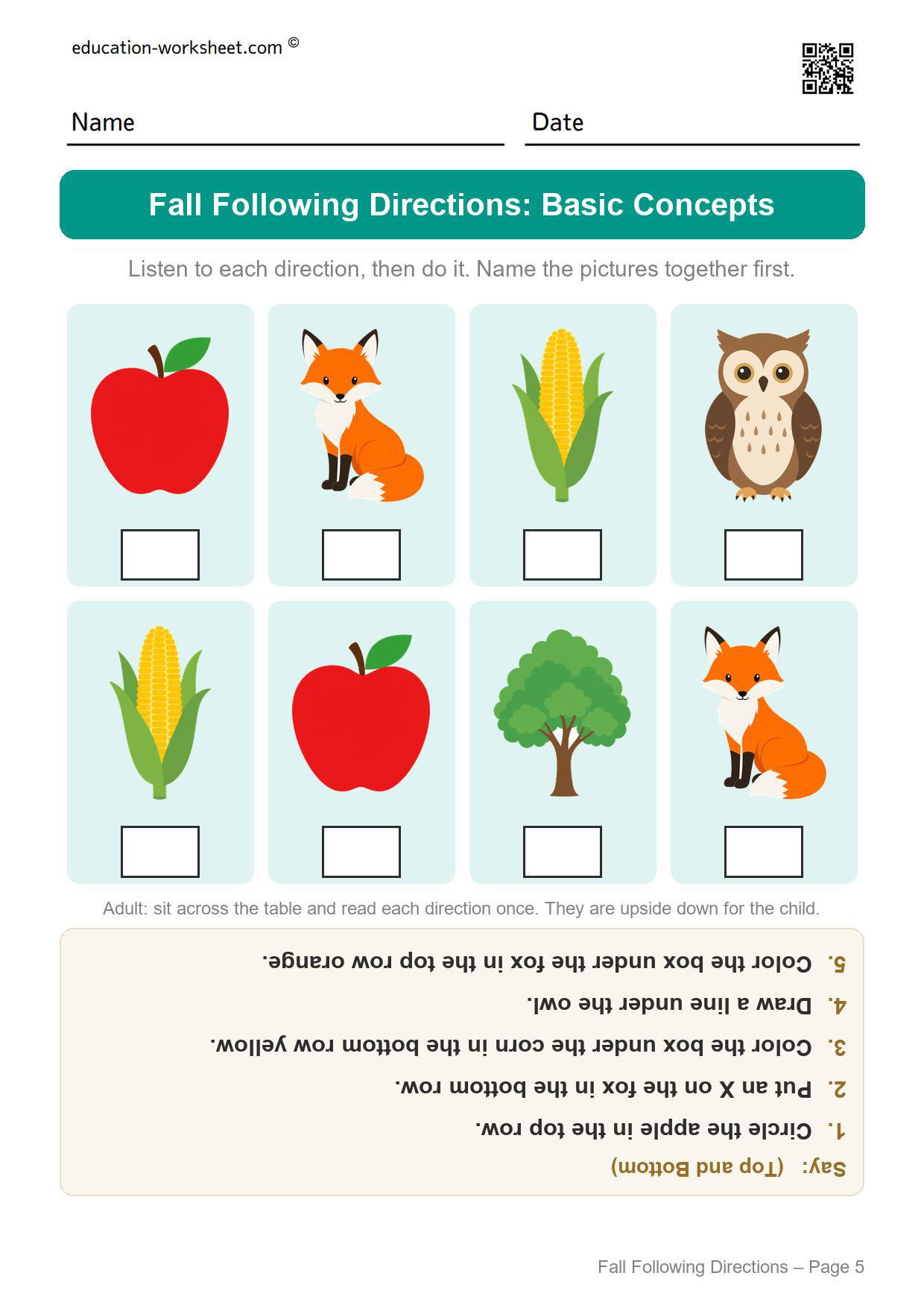
Two apples, two ears of corn and two foxes, one of each in each row. Directions such as “Put an X on the fox in the bottom row” teach the child to hold a picture name and a position in mind at the same time.
Page 6 – Basic Concepts: Next To and Between
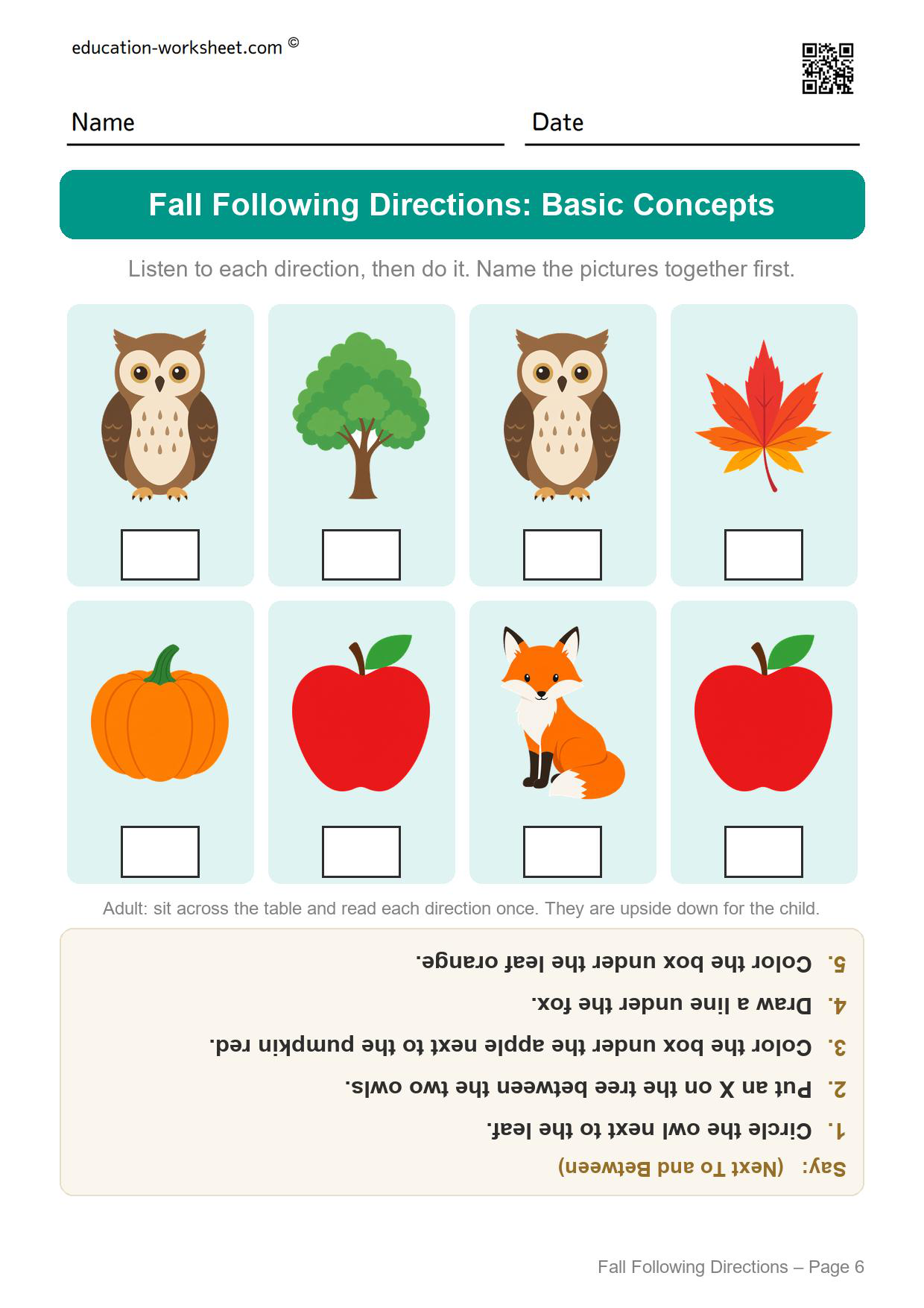
Two owls with a tree between them, and two apples in the bottom row. “Put an X on the tree between the two owls” and “the apple next to the pumpkin” can each point to only one picture. Next to always means side by side in the same row.
Page 7 – Two Steps
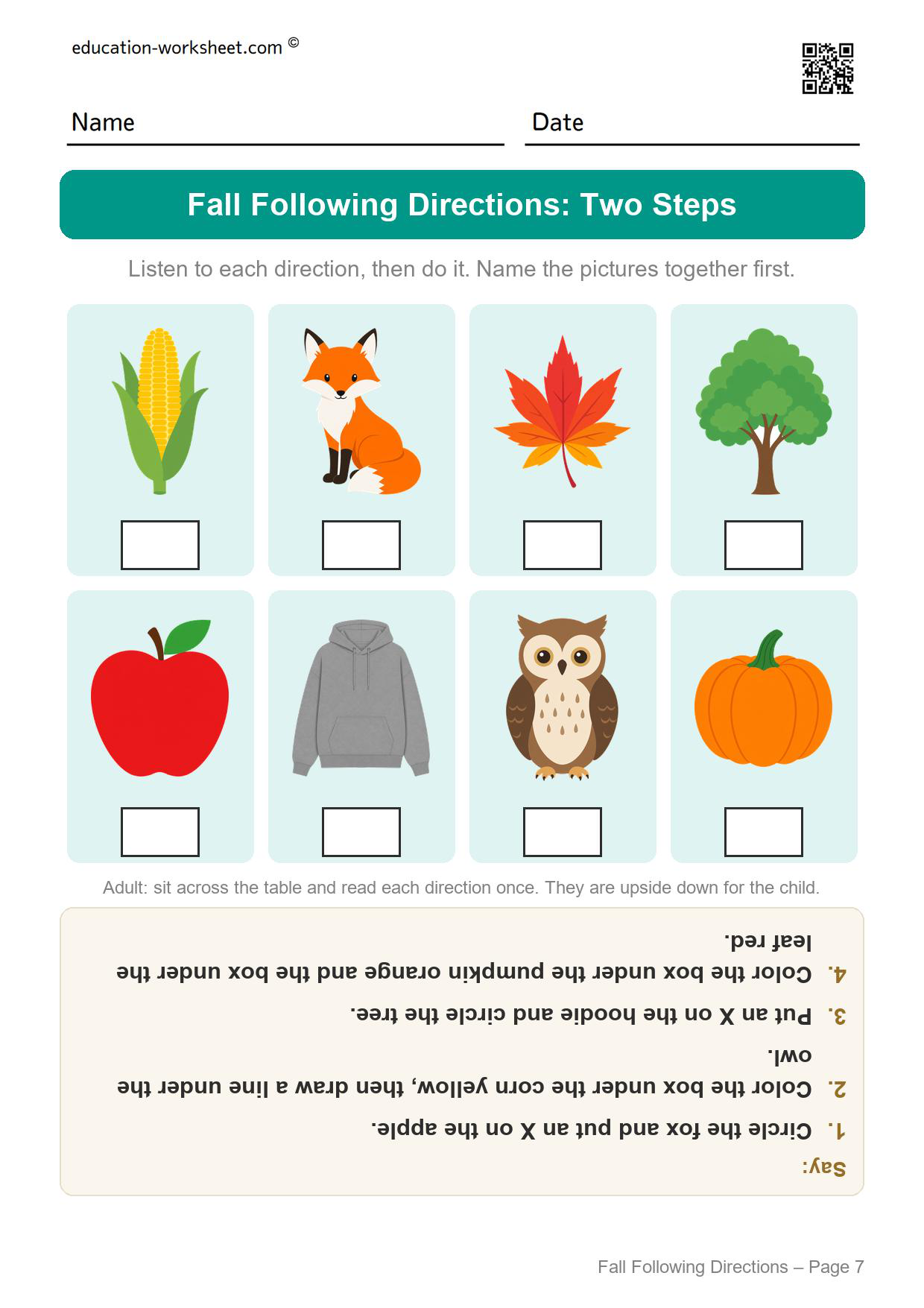
Two actions in one direction: “Circle the fox and put an X on the apple.” From this page on, every picture is used exactly once on each page, so nothing is left over and nothing gets two marks.
Page 8 – Two Steps with Concepts
Two steps and the concepts from pages 4 and 5 together, for example “Put an X on the last apple and circle the fox.” This is noticeably harder than page 7, so expect a few more repeats.
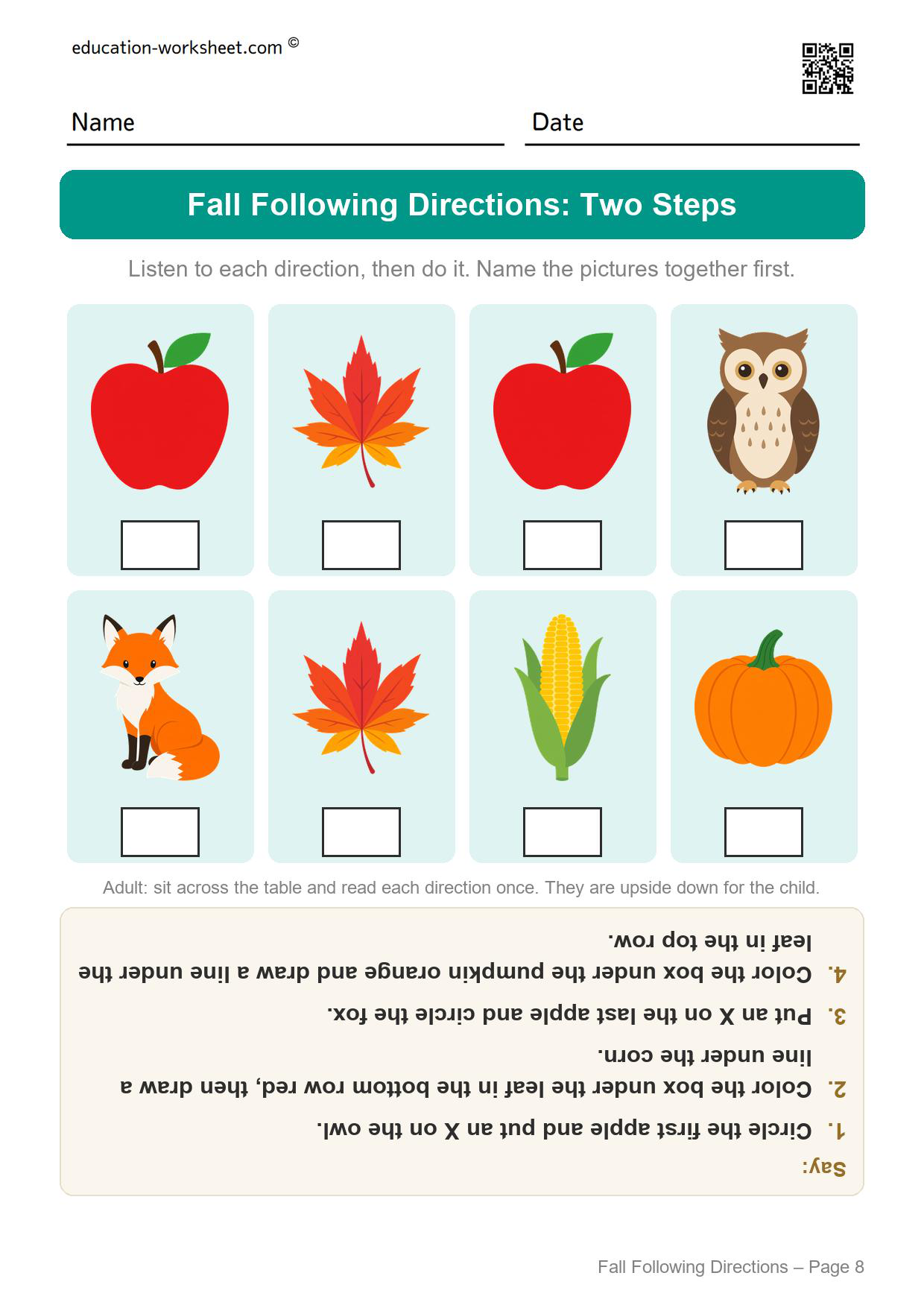
Page 9 – Two Steps
Back to single pictures, with a fresh mix of two-step directions. A good page to check that two steps have really settled before going on.
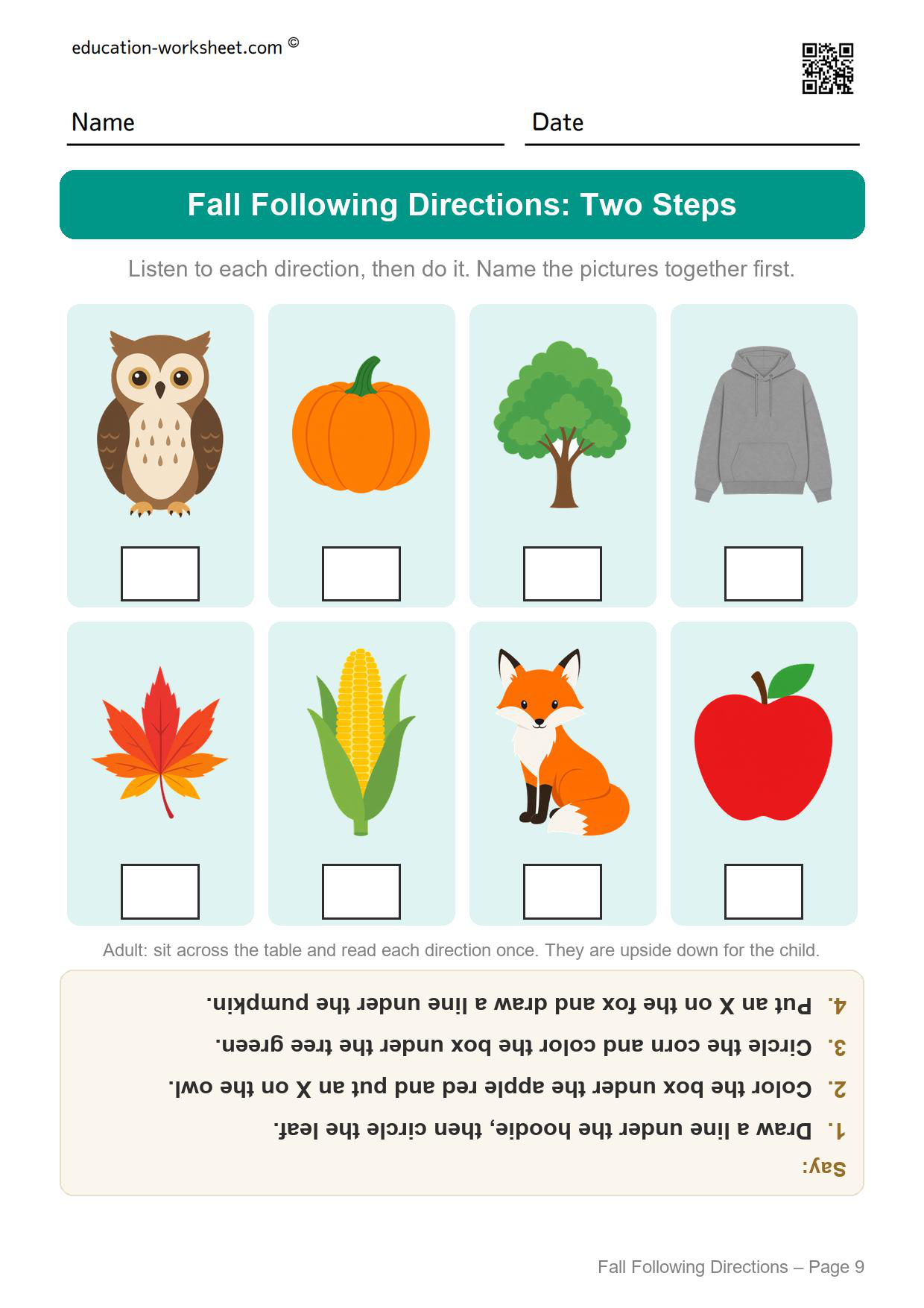
Page 10 – Three Steps
Three actions in one breath: “Circle the owl, put an X on the corn, and color the box under the leaf red.” Holding three steps is a real stretch for many five-year-olds, and it is fine for this to take several tries.
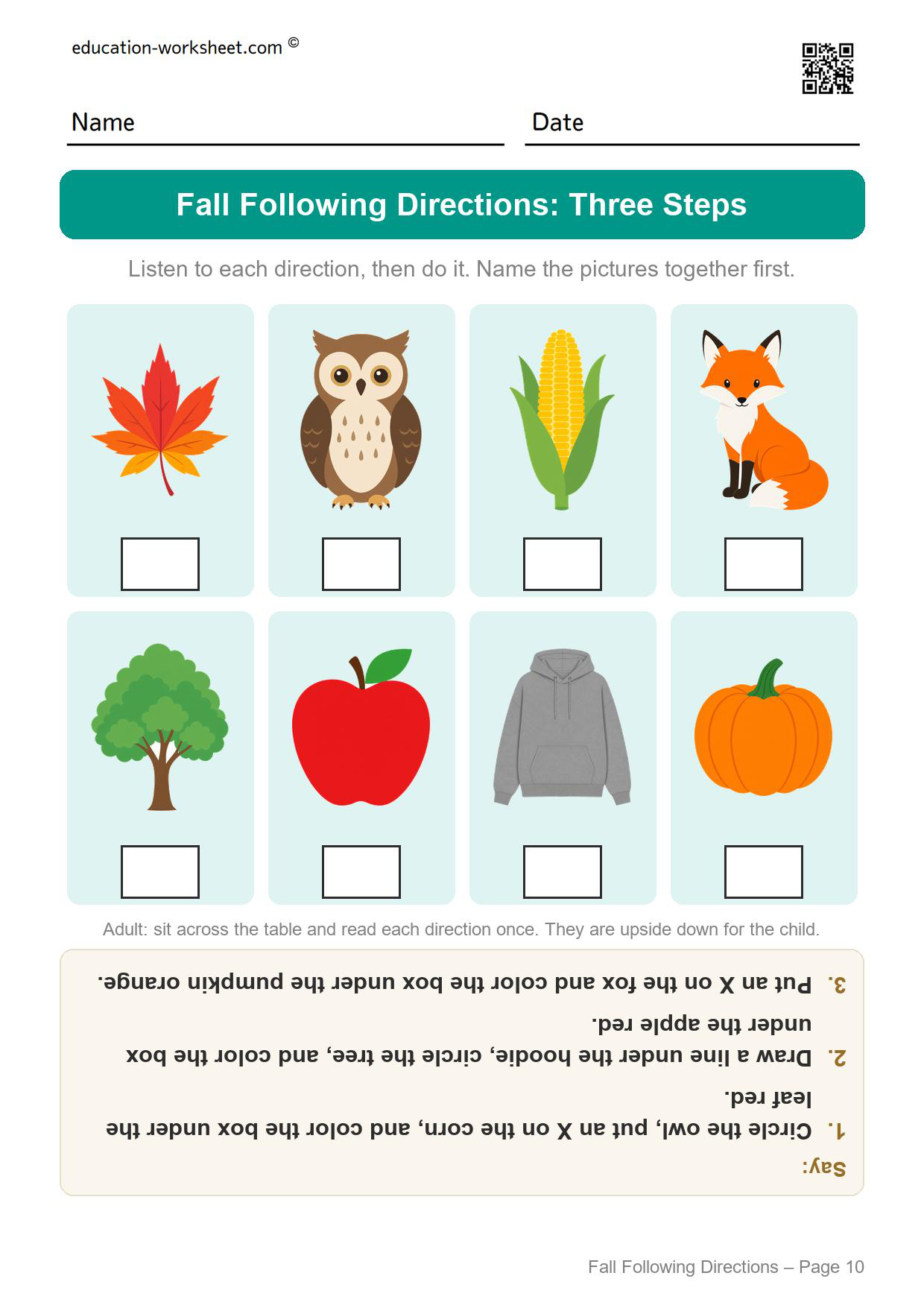
Page 11 – Three Steps with Concepts
Three steps with first, last, top row and bottom row mixed in. This is the most demanding page in the pack for listening and memory together.
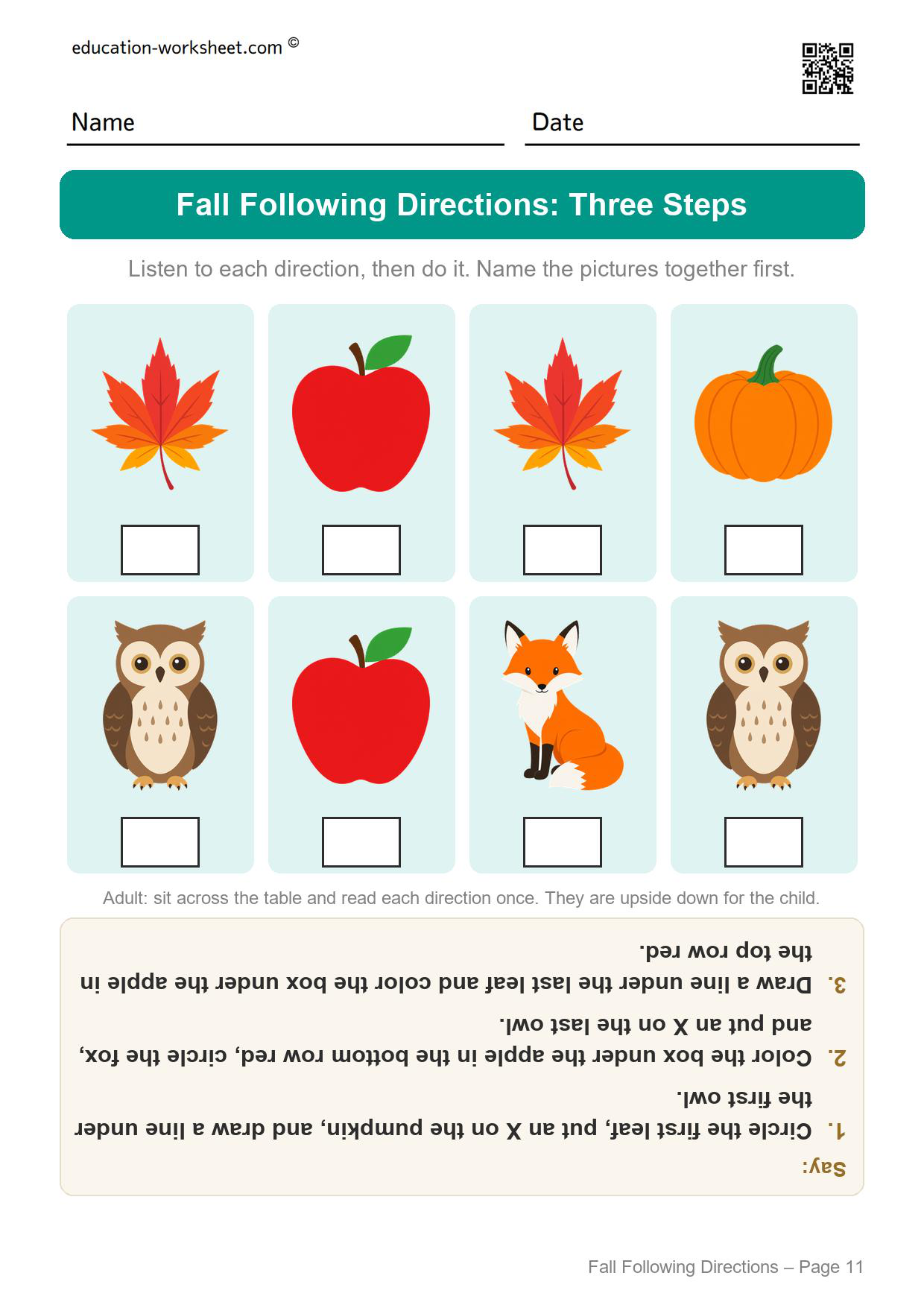
Page 12 – Before and After
The order you hear is not the order you do. In “Before you circle the pumpkin, put an X on the tree,” the tree comes first even though it is mentioned last. Watch the order the child works in, not only the finished page.
Understanding before and after is one of the later language skills, often still developing in the first years of school, which is why it comes last here.
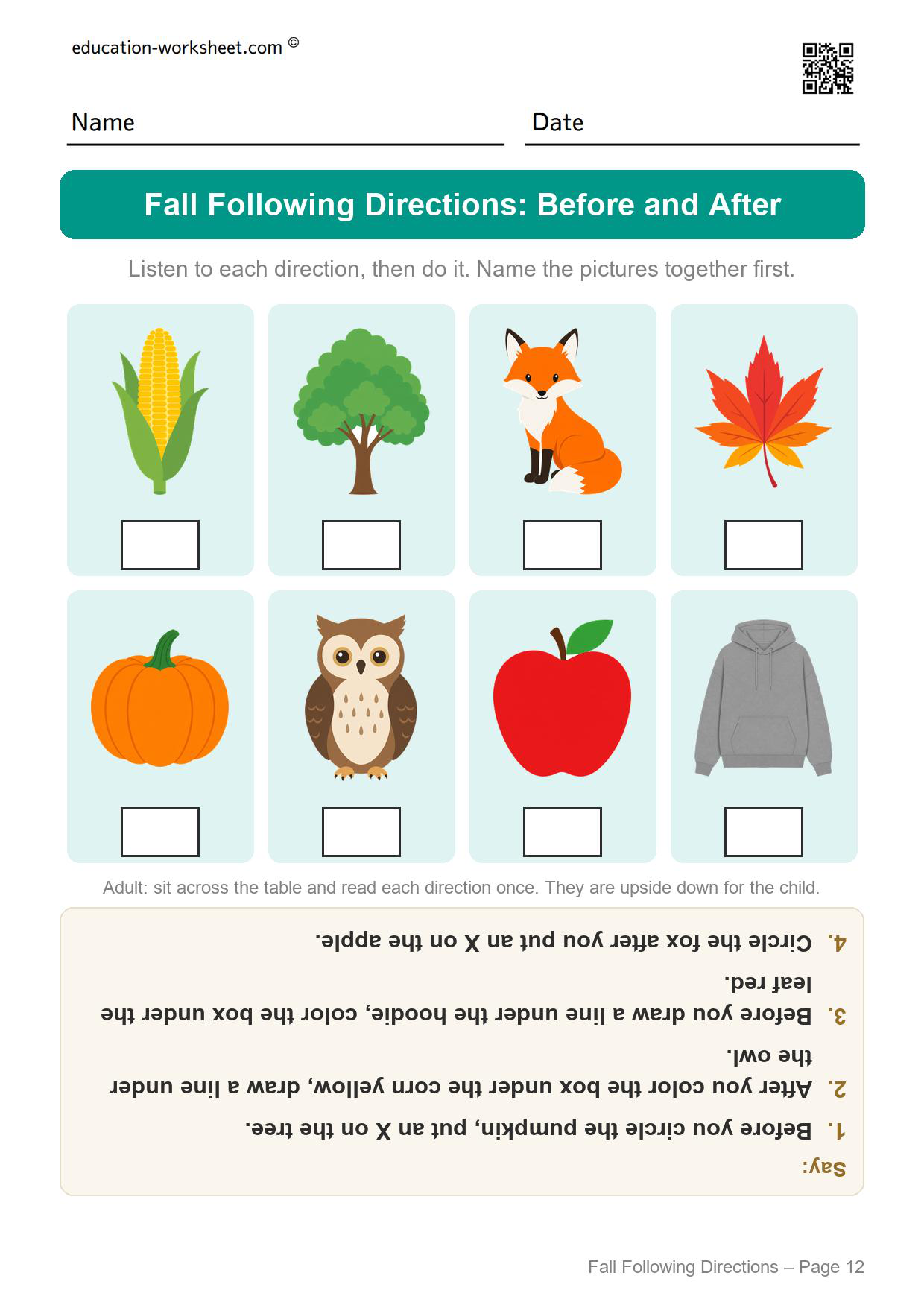
Answer Key – Every Page Finished
Instead of a list of words, the answer key shows a small picture of every page as it should look when all the directions are done. Hold it next to the child’s page and the differences are easy to spot. On page 12, remember that the order matters too.
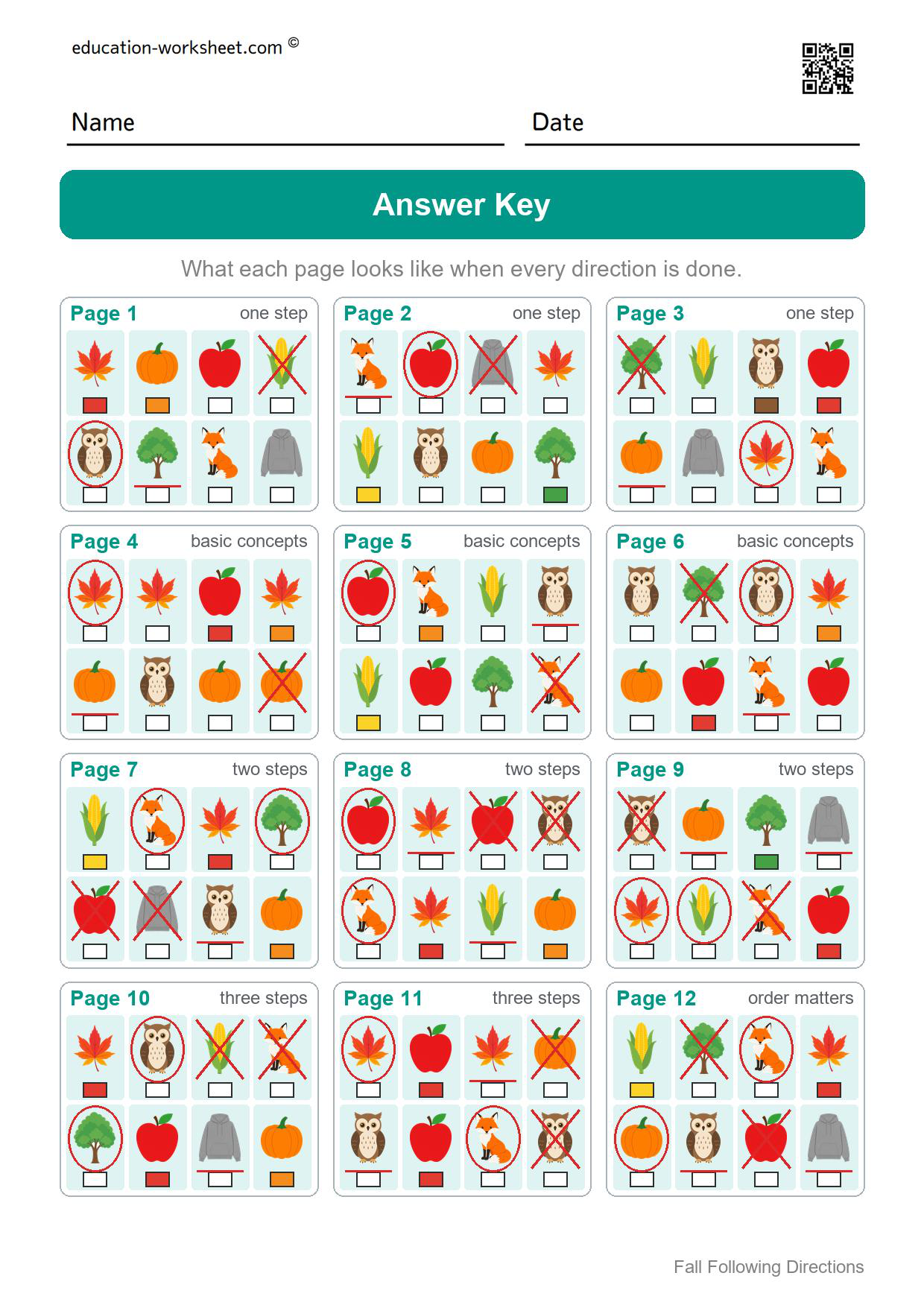
How the Directions Are Built
A direction only practices listening if it has one clear answer. Every page in this pack was checked by a small program before it was printed.
- Every direction points to exactly one picture. When a picture appears more than once, the direction always says which one: first, last, top row, bottom row, next to or between.
- No picture gets two marks on the same page, so a child is never asked to circle something they have already crossed out.
- Four actions only: circle (18 times), put an X on (18), draw a line under (16) and color the box under (26). Learning a few actions well leaves more attention for listening.
- Five crayon colors: red, orange, yellow, green and brown, always chosen to match the picture, such as a red box under the apple.
- The pictures move. Their order changes on every page, so a child cannot work from memory of the last page.
Why Following Directions Matters
To follow “Put an X on the last apple and circle the fox,” a child has to hear every word, know what “last” means, hold two actions in mind and then carry them out in order. That is why following directions is such a useful window on a child’s language. When a child gets a direction wrong, it is worth noticing which part failed: a word they did not know, a concept such as between, or simply too many steps to hold at once.
If a child often struggles to follow simple directions at home and at school, check hearing first, and then talk to the child’s teacher or a speech-language pathologist. These worksheets can support practice, but they cannot tell you why the difficulty is there.
When Children Are Ready for These Worksheets
- Age: about four to seven – preschool to first grade. Start with page 1 whatever the age.
- Before starting: the child should know the eight picture names and be able to hold a crayon and draw a circle and an X.
- SL.K.2 and SL.1.2 – understand information presented orally, and ask about details that are not clear.
- K.G.A.1 – describe the relative positions of objects using terms such as above, below, beside and next to. Pages 4 to 6 practice exactly this kind of language.
How to Use These Worksheets
- Name the eight pictures together on the guide page.
- Sit across the table from the child, so you can read the upside-down directions.
- Read one direction at a normal pace, then let the child do it before you read the next one.
- Try not to repeat. If you do repeat a direction, make a small note so you can see progress later.
- Move to the next level when the child gets most directions right without repeats.
- Check the page with the answer key, and on page 12 check the order the child worked in as well.
Three Things to Watch For
1. Doing only the last step. On two- and three-step pages, many children do the final action they heard and forget the first. If this keeps happening, go back a level for a while rather than pushing on.
2. Doing the steps in the order heard. On page 12, “Before you circle the pumpkin, put an X on the tree” tempts a child to circle the pumpkin first. That shows the words before and after are not secure yet, which is very common.
3. Starting before the direction ends. Quick children sometimes grab the crayon at the first picture name. Ask them to keep their hands in their lap until you finish, then go.
Printing Tips
- Print at 100 percent, actual size, on A4 or US Letter.
- Print in color: the pictures are part of the task, and a black and white pumpkin is hard to tell from an apple.
- Give the child their own copy, and keep a second copy of each page for yourself if you want to read the directions the right way up.
Frequently Asked Questions
What age are these following directions worksheets for?
About four to seven. Younger children can do the one-step pages, and older children can work up to the three-step and before and after pages.
Why are the directions upside down?
So that an adult sitting across the table can read them while a child who can read cannot read ahead. If you sit beside the child, simply turn the page around while you read.
Can older children read the directions themselves?
Yes. Turned the right way up, the pages also work as reading practice for children in first grade and beyond. The listening version is still the best place to start.
What do first and last mean on these pages?
Reading order: left to right along a row. On every page, pictures that appear more than once sit in the same row, so first and last always point to one picture.
Is this a test for a language disorder?
No. These are practice sheets with no scores or norms. If you are worried about a child’s understanding, check hearing first and talk to a speech-language pathologist.
Do I need to sign up to download these?
No. Every PDF downloads immediately, with no account, no email address and no cost.
Can I use these in my classroom or therapy room?
Yes, they are free to print for home, classroom and therapy use. Please do not sell them or re-host the files elsewhere.
More Free Listening and Concept Worksheets
- Free Auditory Memory Worksheets for Kids – Listen and Repeat
- Free Position Words Worksheets for Kindergarten – In, On, Under, Next To
- Free Ordinal Numbers Worksheets for Kindergarten – First, Second, Third, Fourth and Fifth
- Free Behind and In Front Worksheets for Kindergarten – Find It
- Free Four Seasons Worksheets for Kindergarten – Science
- Free Final Consonant Deletion Worksheets – Minimal Pairs PDF
- Free Final Consonant Deletion Minimal Pairs Set 2 – S, Z and CH