These free final consonant deletion worksheets are the second set of minimal pairs, for children who leave off the ending sounds s, z and ch. A child might say “pea” for peach, “no” for nose or “eye” for ice. Each page uses pairs of words that differ only in that last sound, so the child can hear, and then show, why it matters.
A speech-language-hearing therapist designed this set as the next step after Set 1, which practices the early ending sounds t, d, k and n. It follows the order used in speech therapy: listen first, then say single words, then sentences and games. Use it for practice at home, in class or between therapy sessions. It is not a test.
Why a separate set? Sounds such as s, z and ch usually take longer to learn than t or n. If a child who leaves off ending sounds is asked for a hard sound in that position straight away, they face two problems at once: remembering to close the word, and making a sound that is still new. Starting with Set 1 and moving to these pairs keeps each step small.
- What Is in This Free Minimal Pairs Set
- The 12 Final Consonant Deletion Worksheets
- Start Here – A Guide for the Adult
- Page 1 – Meet the Pairs
- Page 2 – Listen and Point, Set 1
- Page 3 – Listen and Point, Set 2
- Page 4 – Listen and Point, Set 3
- Page 5 – Say It, I’ll Point, Set 1
- Page 6 – Say It, I’ll Point, Set 2
- Page 7 – Say It, I’ll Point, Set 3
- Page 8 – Say It in a Sentence, Set 1
- Page 9 – Say It in a Sentence, Set 2
- Page 10 – Minimal Pairs Bingo, Board 1
- Page 11 – Minimal Pairs Bingo, Board 2
- Page 12 – Picture Cards to Cut Out
- Progress Record
- How the Five Pairs Were Chosen
- When the Ending Sound Is There but Not Quite Right
- How to Respond When the Sound Is Left Off
- When to Get Help
- Who These Worksheets Are For
- How to Use These Worksheets
- Three Things to Watch For
- Printing Tips
- Frequently Asked Questions
- Should my child finish Set 1 first?
- Why does the pea appear in two pairs?
- What if my child calls the pea pod “peas”?
- My child says nose with an s sound at the end. Is that OK?
- Can these worksheets replace speech therapy?
- Do I need to sign up to download these?
- Can I use these in my classroom or therapy room?
- More Free Speech and Language Worksheets
What Is in This Free Minimal Pairs Set
- Five minimal pairs: eye – ice, no – nose, pea – peach, pea – piece, moo – moose.
- Ending sounds s (ice, piece, moose), z (nose) and ch (peach).
- A guide page for adults, a Meet the Pairs page and three Listen and Point pages with ten words each.
- Three Say It, I’ll Point pages and two sentence pages.
- Two bingo boards, ten picture cards to cut out, and a progress record.
- Fourteen separate PDFs, free to download and print.
The 12 Final Consonant Deletion Worksheets
Go through the pages in order. Each step uses the same five pairs, so the child never has to learn new pictures and a new skill on the same day.
Start Here – A Guide for the Adult
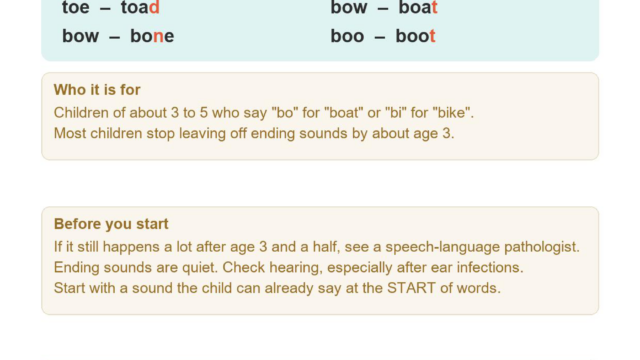
The first page lists the five pairs and explains when to use this set: after Set 1, once the child is starting to put t, d, k and n at the ends of words. It also covers hearing, how long to practice, and what to do when the ending sound is there but not quite right.
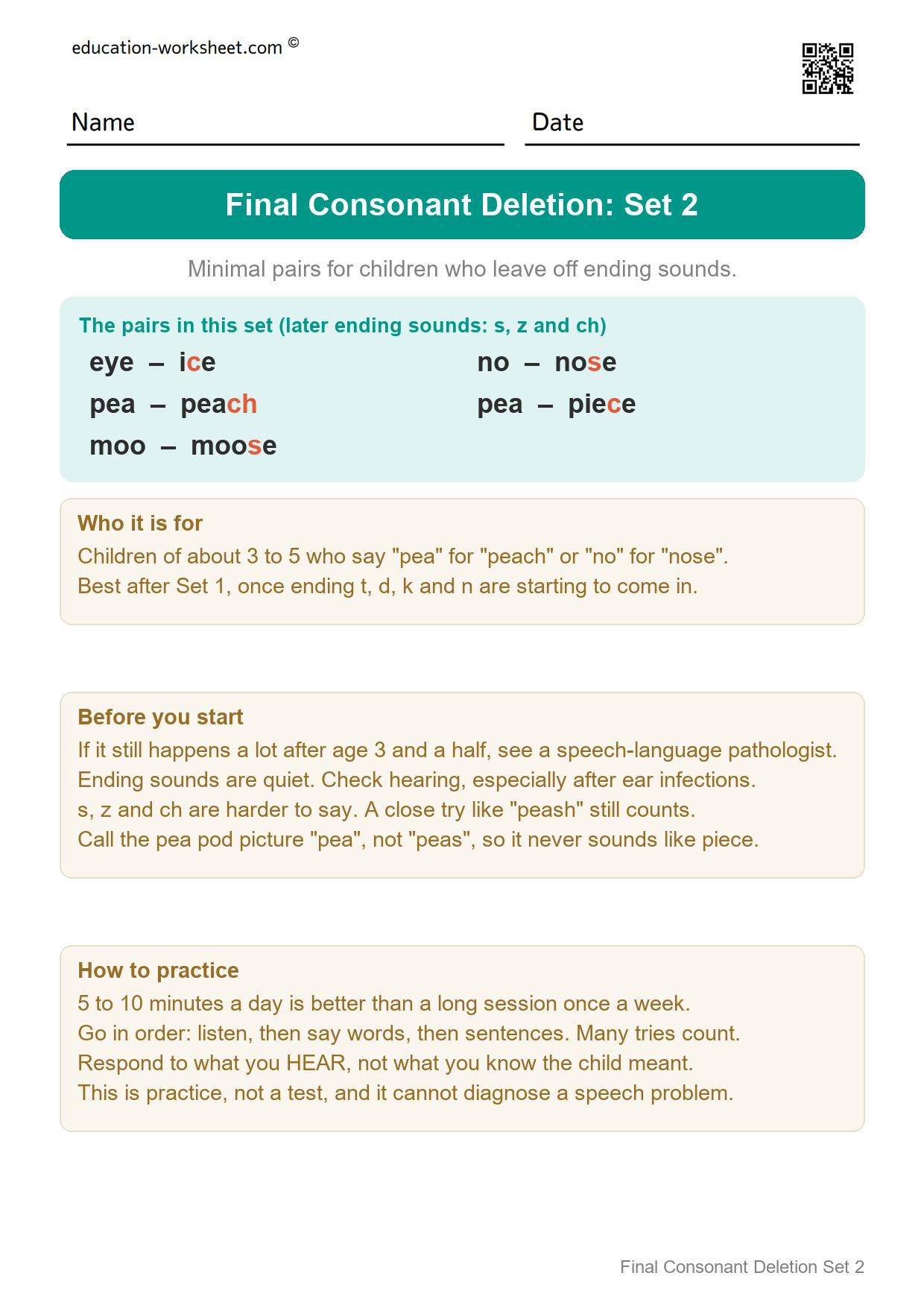
Page 1 – Meet the Pairs
All five pairs side by side: eye – ice, no – nose, pea – peach, pea – piece and moo – moose. The child only listens on this page. Say both words in a row and ask whether they sound the same.
The letters that make the ending sound are printed in red: the c in ice and piece, the s in nose and moose, and the ch in peach. The silent e at the end of four of these words stays black, because it makes no sound.
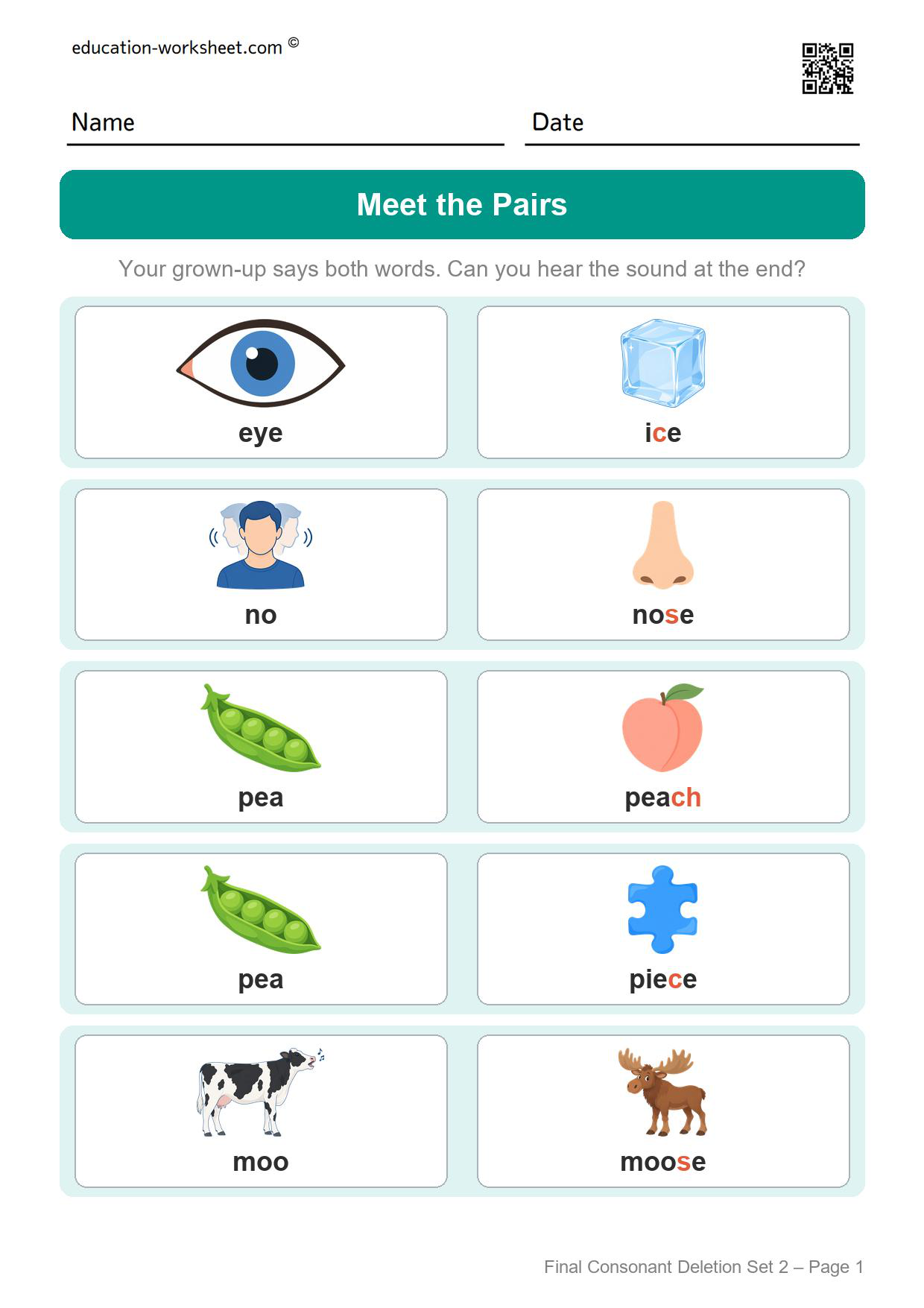
Page 2 – Listen and Point, Set 1
Five rows of picture pairs and ten words for the adult to say, one for each picture. The list is printed upside down so it faces an adult sitting across the table.
Two rules keep the page fair: the same row is never called twice in a row, and the same word is never called twice in a row. Pea belongs to two pairs, so it is called twice on each page, once in each of its rows.
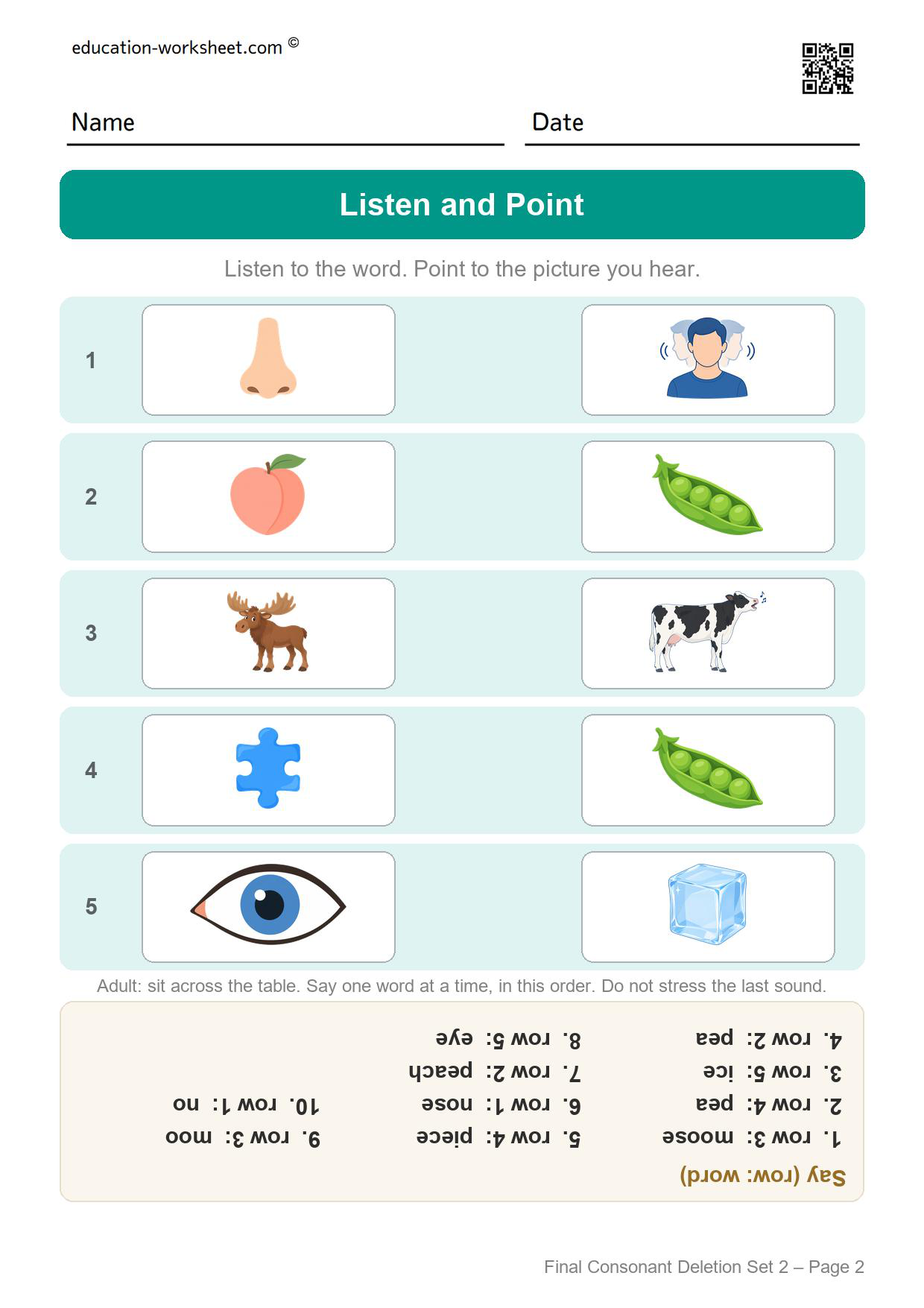
Page 3 – Listen and Point, Set 2
The same five pairs with the rows and the left and right pictures shuffled, and a new list of ten words. Remembering page 2 does not help here.
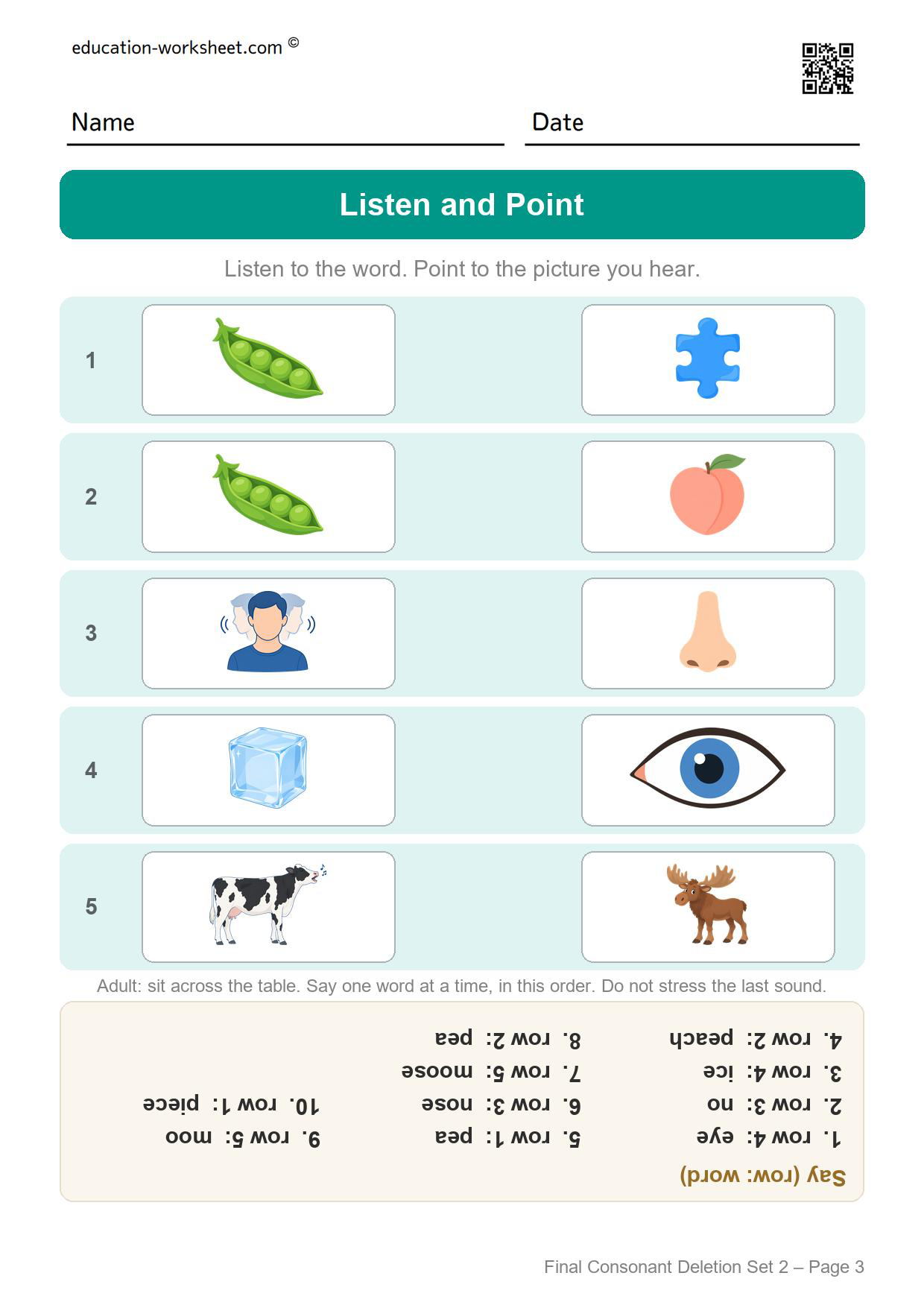
Page 4 – Listen and Point, Set 3
The last listening page. When the child points to the right picture nearly every time, they can hear s, z and ch at the end of a word and are ready to say the words.
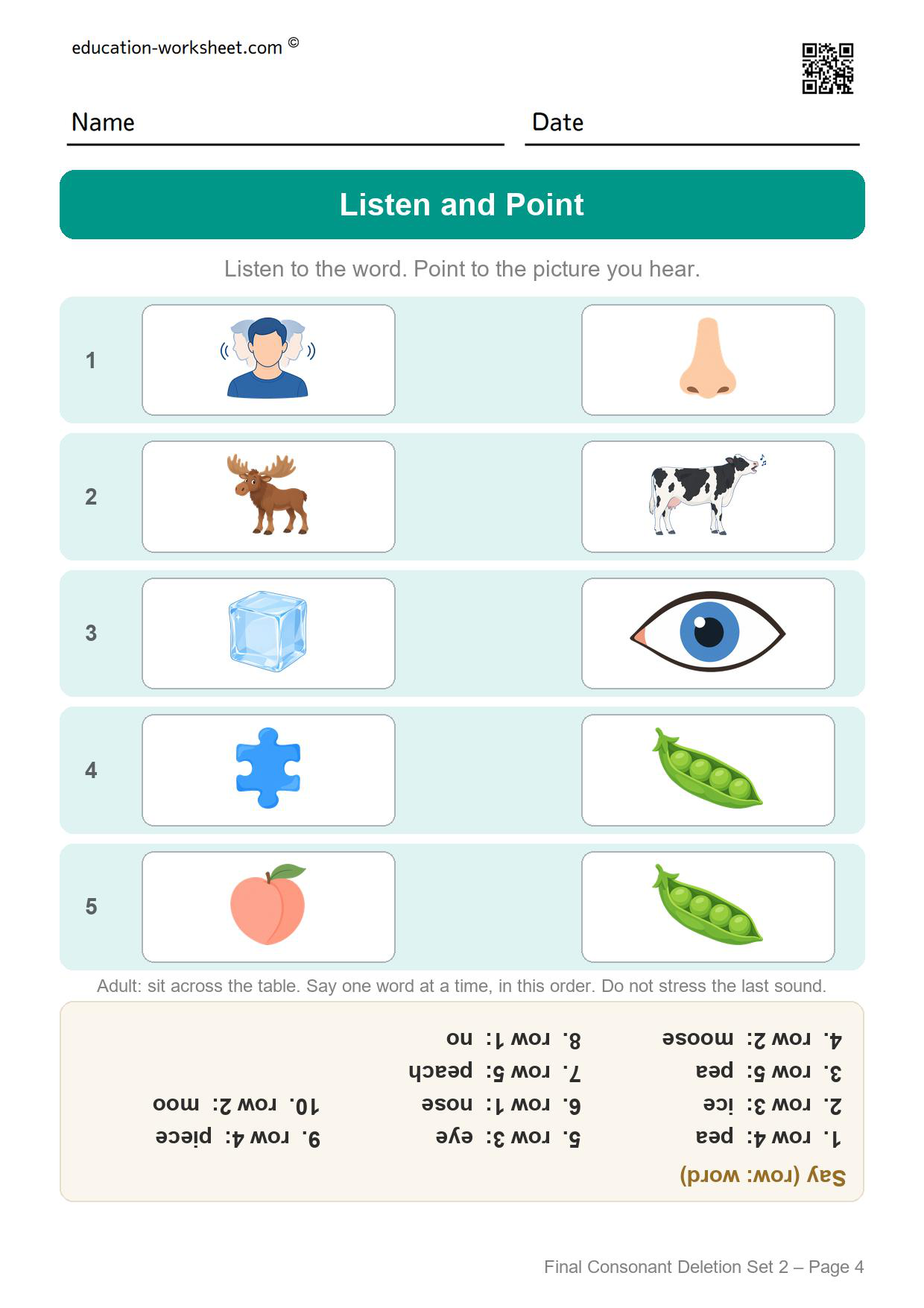
Page 5 – Say It, I’ll Point, Set 1
One picture in each row has a star. The child says that word and you point to the picture you heard, even if it is not the one they meant. On this page the star words are eye, nose, peach, pea and moose.
If you hear “pea” for peach, you point to the pea. That moment of “That’s not what I wanted!” is how the child finds out that the last sound changes the word.
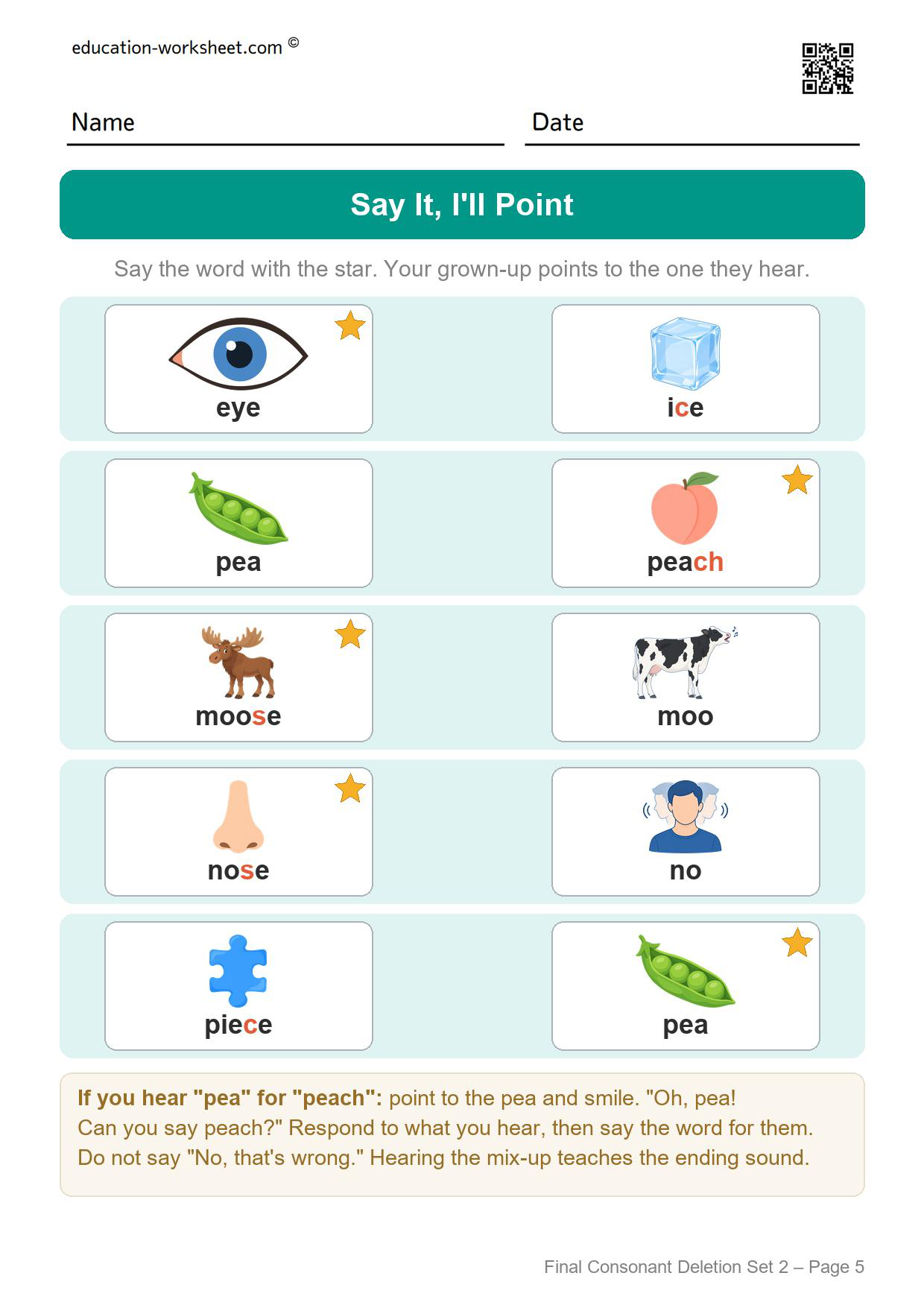
Page 6 – Say It, I’ll Point, Set 2
Every star moves to the other word of its pair: ice, no, pea, piece and moo. Pages 5 and 6 together give the child a turn at all ten pictures.
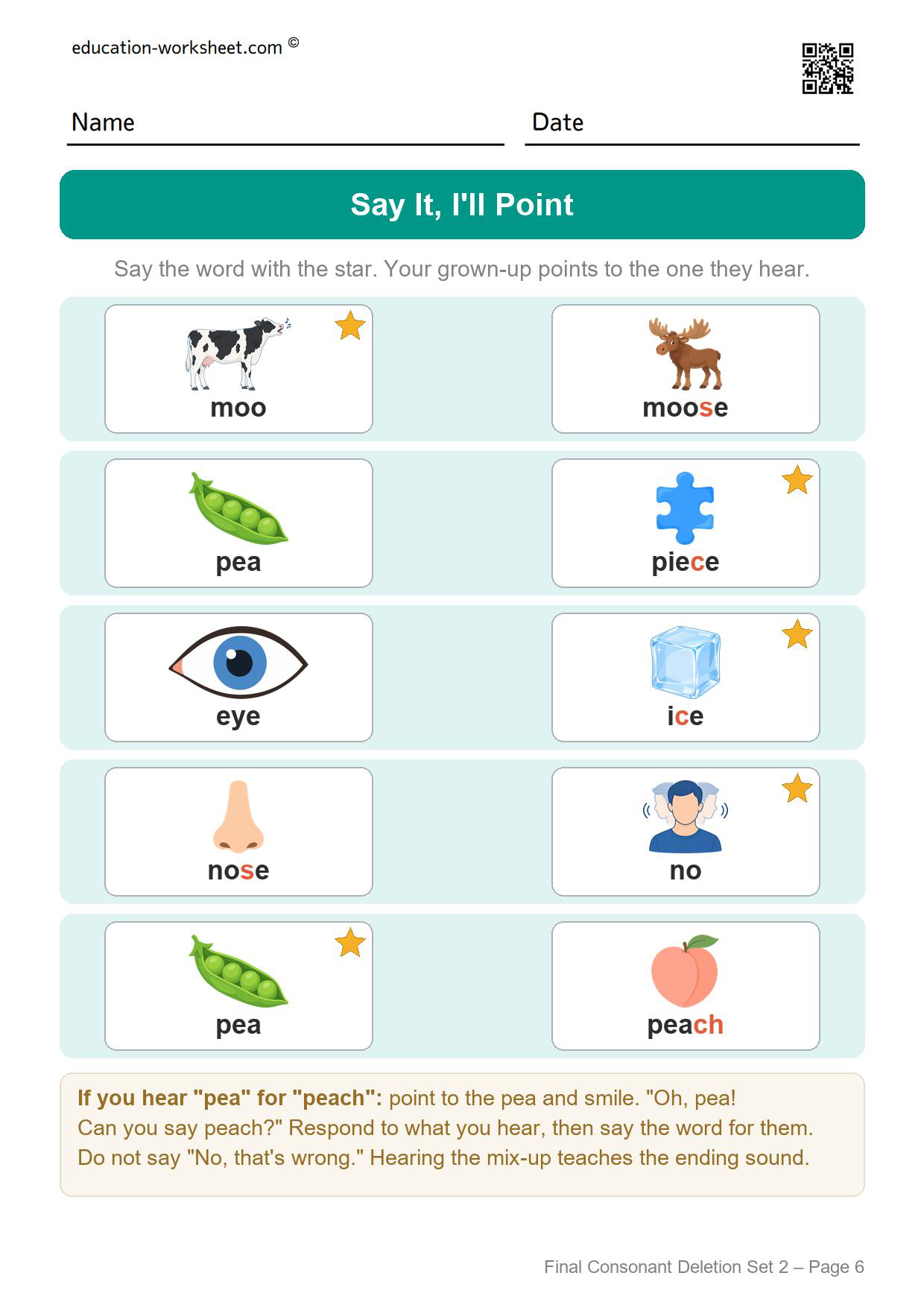
Page 7 – Say It, I’ll Point, Set 3
A new mix that matches neither page 5 nor page 6: eye, nose, pea, piece and moose. Print it more than once; frequent short practice is what moves a sound into everyday speech.
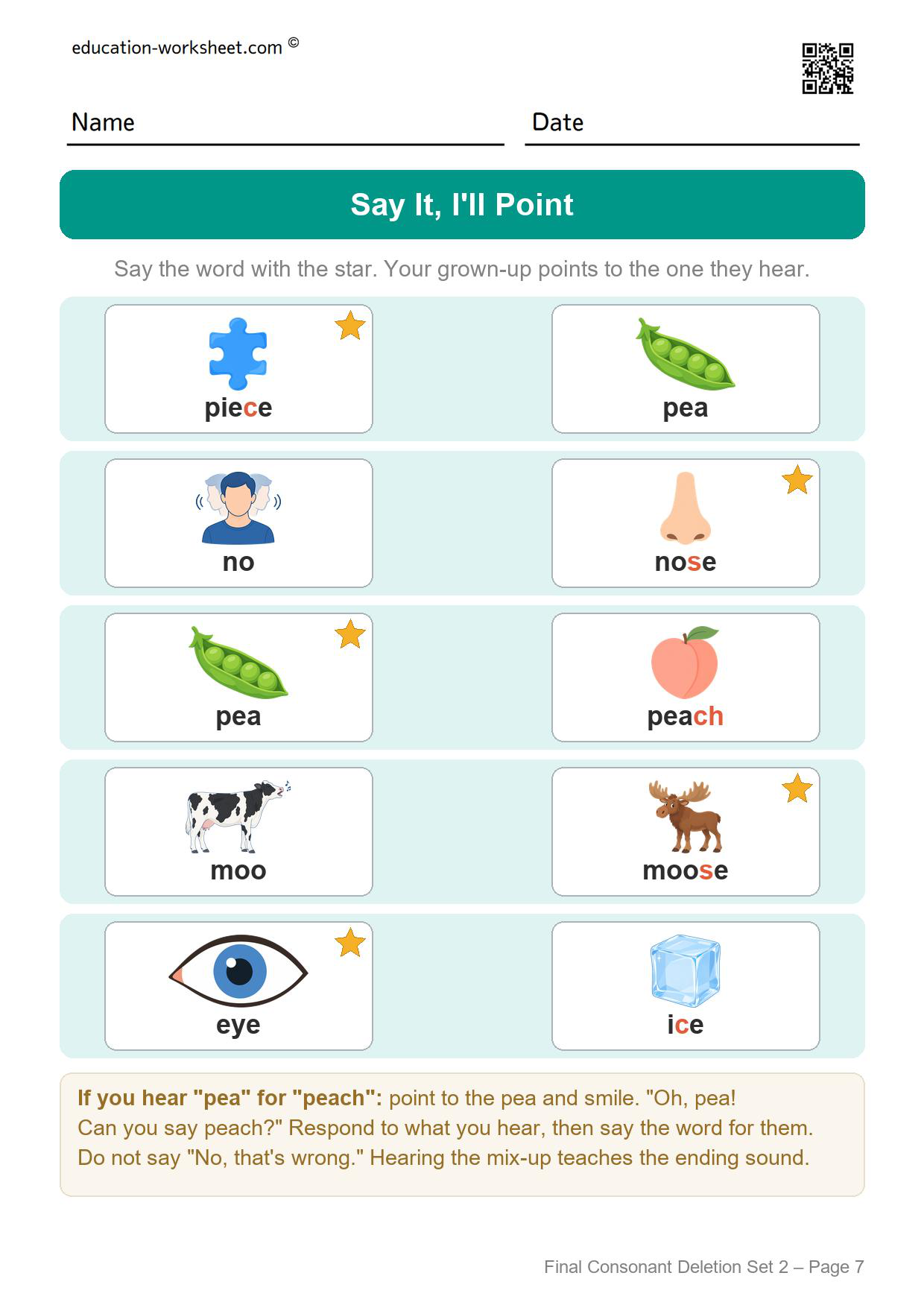
Page 8 – Say It in a Sentence, Set 1
Five short sentences: “I close one eye,” “I wipe my nose,” “I eat a pea,” “Here is one piece” and “The cow says moo.” The star word always ends the sentence, so its last sound is not blurred into the next word.
Use this page only once the child says the single words correctly most of the time.
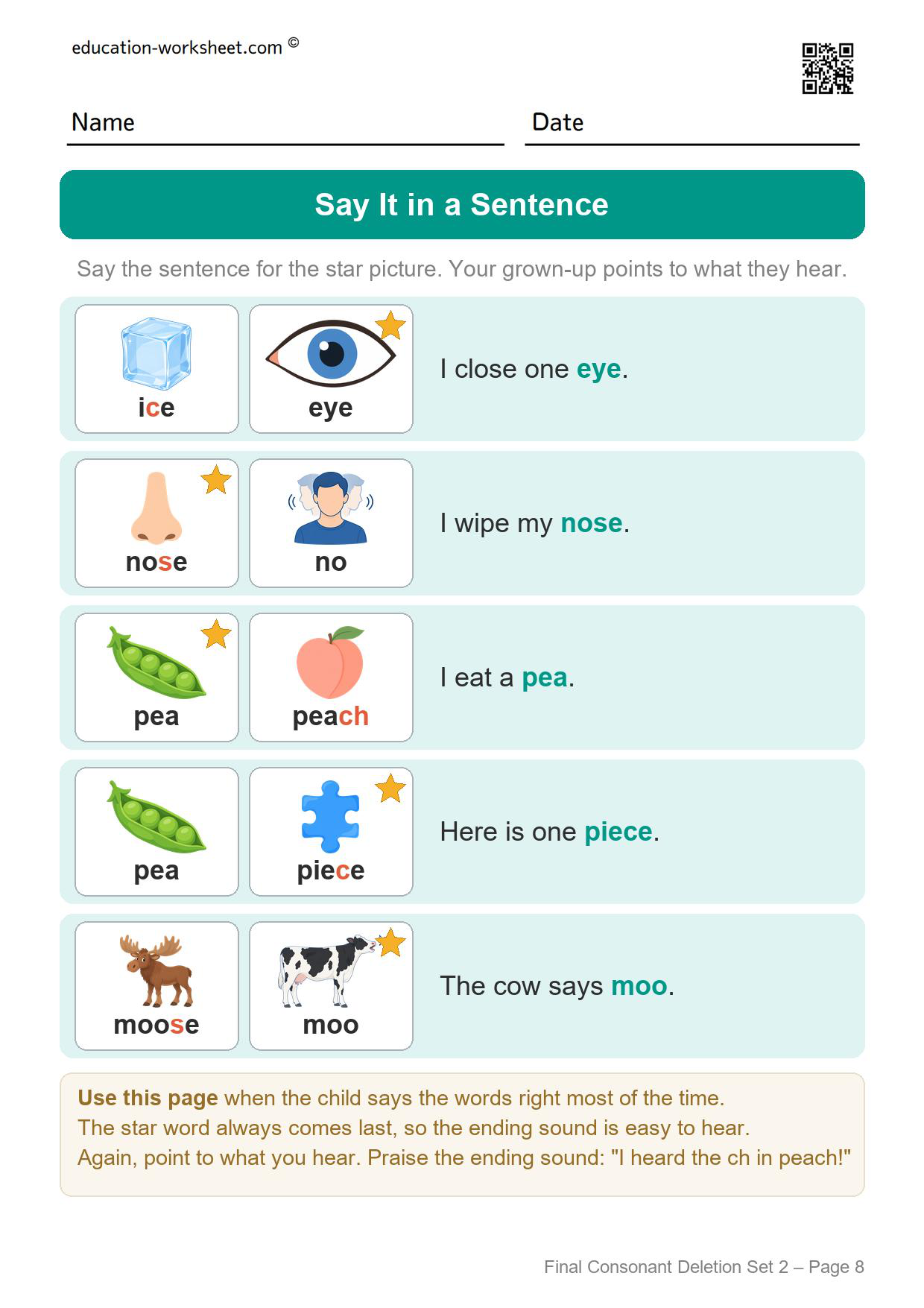
Page 9 – Say It in a Sentence, Set 2
The partner sentences for the other word in each pair: “My cup has ice,” “I shake my head no,” “I eat a peach,” “Here is one pea” and “I see a moose.” Two pairs use matching sentences on purpose, such as “I eat a pea” and “I eat a peach,” so the only difference is the final sound.
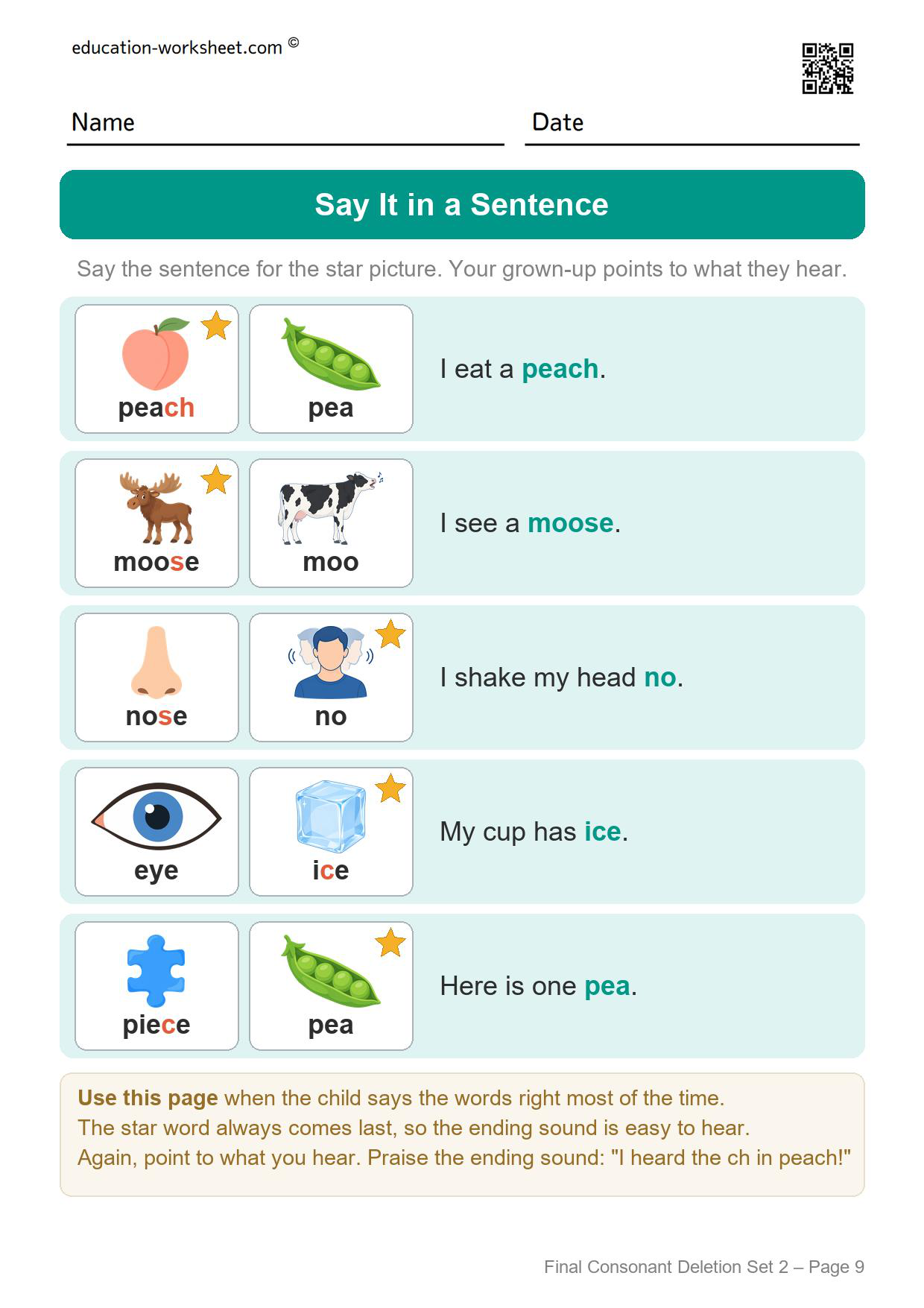
Page 10 – Minimal Pairs Bingo, Board 1
This set has exactly nine different words, so every word fits on the three-by-three board. Every pair is complete on the board, which means covering the right square always depends on the ending sound.
Play it as a listening game, where you call and the child covers, or as a talking game, where the child calls and you cover exactly what you hear.
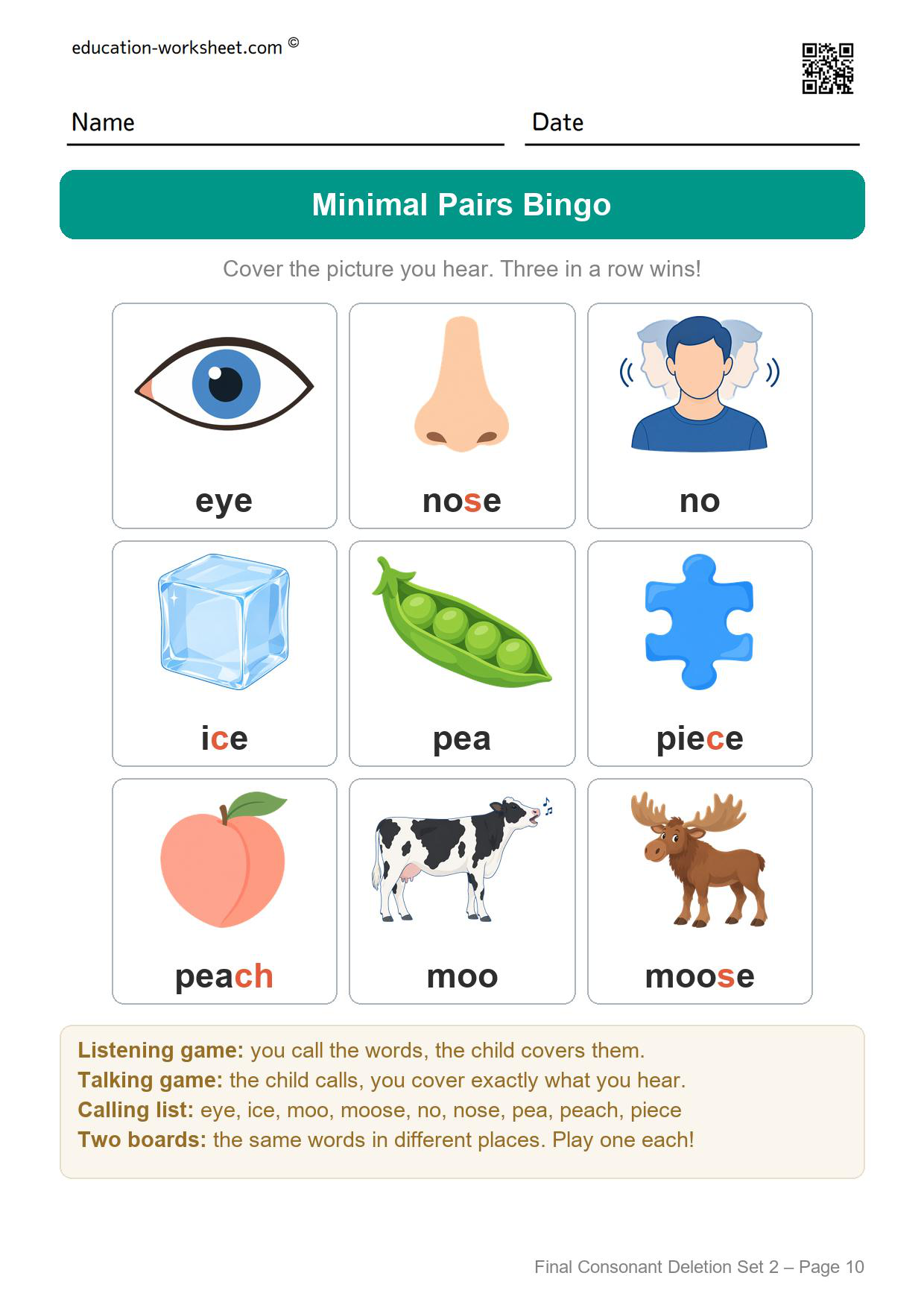
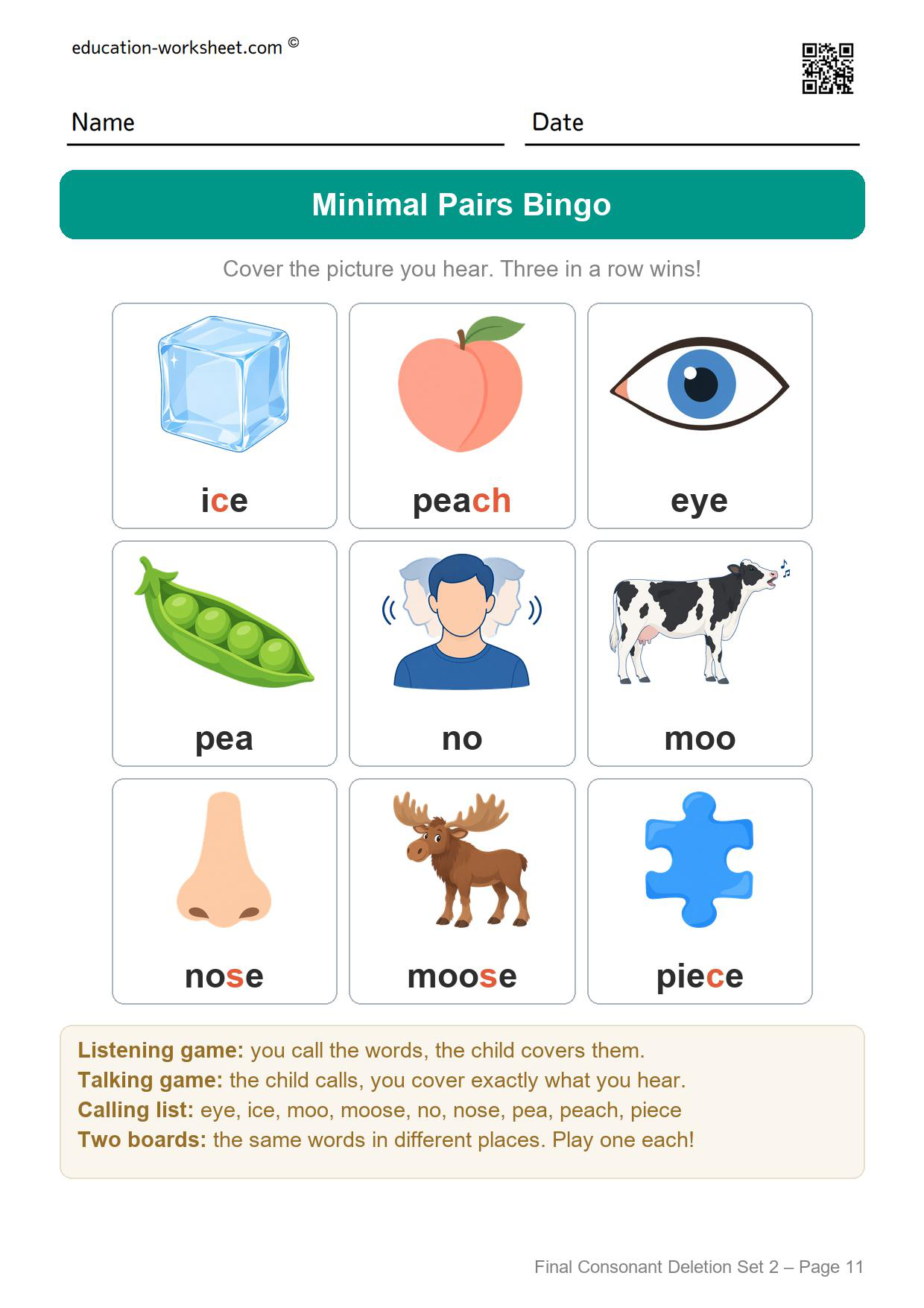
Page 11 – Minimal Pairs Bingo, Board 2
The same nine words in different squares, so two players can each have a board and race to three in a row.
Page 12 – Picture Cards to Cut Out
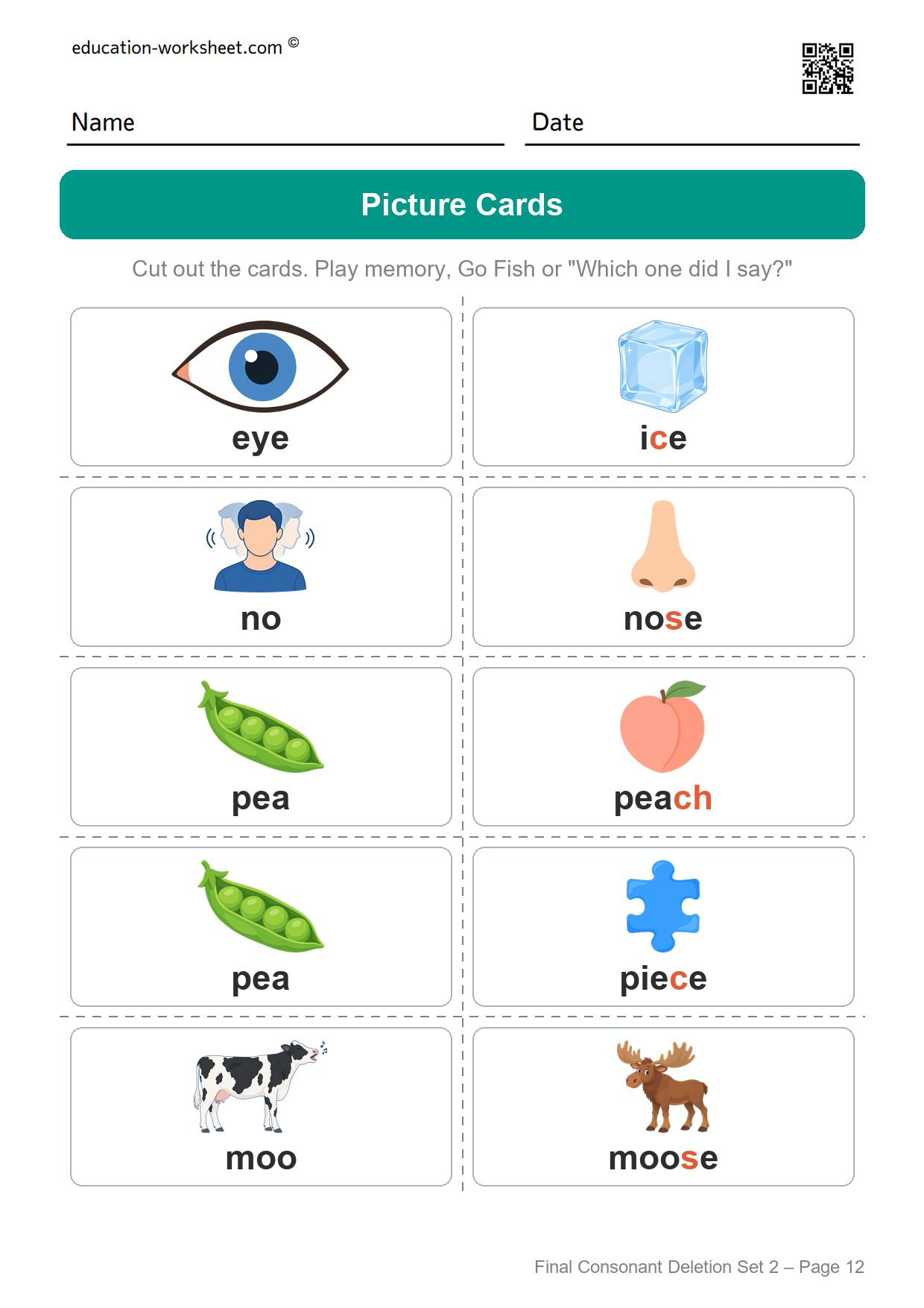
Ten cards, one for each picture in each pair, with the pea printed twice because it belongs to two pairs. Use them for memory, Go Fish (“Do you have the moose?”) or a quick game of “Which one did I say?” with two cards on the table.
Progress Record
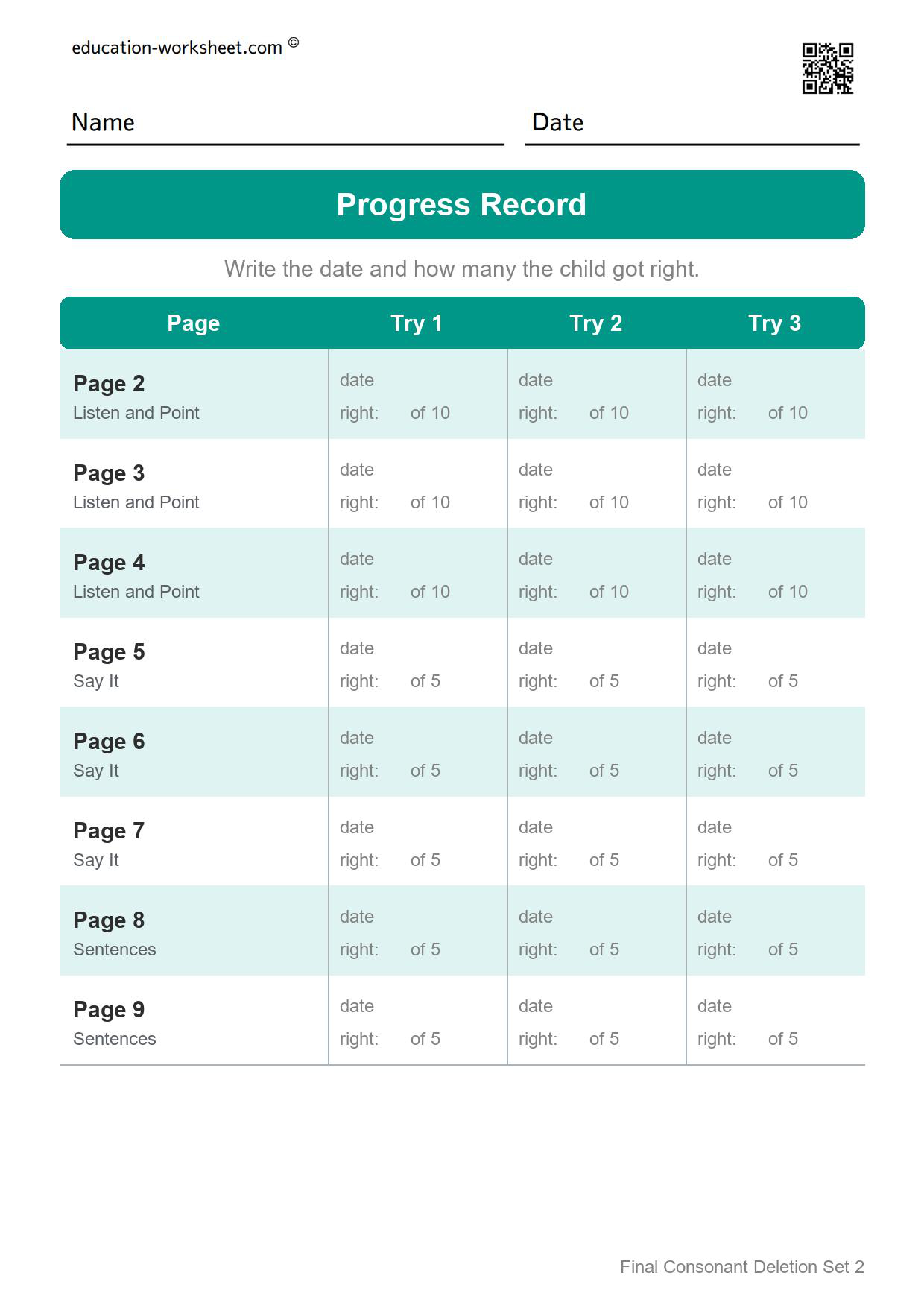
Room for three tries on each of the eight practice pages. Write the date and the number right: out of 10 on the listening pages and out of 5 on the saying and sentence pages.
How the Five Pairs Were Chosen
Every word is short and easy to picture. Each pair has one open word, ending in a vowel, and one word that adds a single sound. The open words are familiar to young children: an eye, saying no, a pea, a cow that says moo.
Pea appears in two pairs, pea – peach and pea – piece. That gives two different endings, ch and s, against the same open word, and it means the set has nine different words, exactly enough for a full bingo board.
The pictures were drawn so that each has one obvious name. The piece is a single jigsaw piece, because a finished jigsaw would be called a puzzle. The moose has large, flat antlers so that it is not mistaken for a deer. The pea is drawn as an open pod, because one pea on its own is too small to recognize.
About that pod. A child may look at it and say “peas.” Peas ends in a z sound, which is almost the same as the s in piece, and that would undo the contrast. Agree on the name “pea” on the first page and use it every time.
When the Ending Sound Is There but Not Quite Right
With later sounds, many children close the word before they can make the sound perfectly. They might say “peash” for peach, or end nose with an s sound instead of a z. At this stage that is real progress. The word now has an ending, and a listener can tell it apart from pea or no.
So when you hear a close try, point to the word the child was aiming for and praise the ending: “I heard something at the end of peach!” Then say the word once yourself, clearly and at a normal speed. Polishing the exact sound is a separate goal, best guided by a speech-language pathologist.
How to Respond When the Sound Is Left Off
Point to what you hear, not to what you know the child meant. If the child looks at the moose and says “moo,” point to the cow and say warmly, “Oh, the cow says moo! Can you say moose?” Avoid “No, that’s wrong.” The surprise of getting the wrong picture teaches far more than a correction does.
Keep your own speech natural. Stretching the end of a word, as in “moose-sss,” can make the sound seem like an extra piece rather than part of the word.
When to Get Help
If a child still leaves off ending sounds often after about three and a half, or if people outside the family often cannot understand them, talk to a speech-language pathologist. A worksheet can give practice, but it cannot tell you why a child is making the error.
Check hearing too. S and z are some of the quietest, highest-pitched sounds in speech. They are often the first to be missed when hearing is reduced, for example after ear infections or with fluid behind the eardrum.
Who These Worksheets Are For
- Age: about three to five, or older children who still leave off ending sounds.
- Best timing: after Set 1, once the child is beginning to put t, d, k and n at the ends of words.
- Related standard: RF.K.2.D asks kindergartners to isolate the final sound in three-sound words. Hearing the end of a word clearly is part of that skill.
- Speech-language pathologists can send pages home as practice between sessions.
How to Use These Worksheets
- Read the guide page. On page 1, say both words in each row and ask, “Same or different?”
- On pages 2 to 4, sit across the table, read the upside-down list one word at a time, and let the child point.
- When pointing is right nearly every time, move on to pages 5 to 7. The child says the star word and you point to what you heard.
- When single words are right most of the time, try the sentences on pages 8 and 9.
- Use bingo and the picture cards for extra turns that feel like play.
- Practice 5 to 10 minutes a day and note the results on the progress record.
Three Things to Watch For
1. Adding an ending to everything. Once a child learns that endings matter, they may start saying “eyes” or “moos” for the open words. That is why the stars land on the short words about as often as the long ones: knowing when not to add a sound is part of the skill.
2. Only the easy endings coming in. Some children close words with a t for every sound, as in “peat” for peach. The word now has an ending, which is good, but it may be time for more practice on the listening pages, or for advice from a speech-language pathologist.
3. Words fine, sentences not yet. A child may say nose perfectly on its own and then drop the z in “I wipe my nose.” That is a normal stage. Stay with the sentence pages a little longer.
Printing Tips
- Print at 100 percent, actual size, on US Letter or A4 paper.
- Print in color, especially the bingo boards and picture cards.
- Card stock makes the picture cards last longer and stops them showing through when face down.
Frequently Asked Questions
Should my child finish Set 1 first?
Usually, yes. Set 1 uses early sounds such as t and n. Once the child is starting to put those at the ends of words, this set moves on to the harder endings s, z and ch.
Why does the pea appear in two pairs?
So the same open word can be practiced against two endings, ch in peach and s in piece. It also makes nine different words, which fill a bingo board exactly.
What if my child calls the pea pod “peas”?
Agree on the name pea before you start. Peas sounds almost like piece, so using pea keeps the pairs clear.
My child says nose with an s sound at the end. Is that OK?
At this stage, yes. The important change is that the word now has an ending. The exact sound can come later.
Can these worksheets replace speech therapy?
No. They are practice pages. A speech-language pathologist can find out why a child leaves off sounds and plan the right help.
Do I need to sign up to download these?
No. Every PDF downloads straight away, free, with no account or email address.
Can I use these in my classroom or therapy room?
Yes, you are welcome to print them for home, classroom and therapy use. Please do not sell them or upload the files to another site.
More Free Speech and Language Worksheets
- Free Final Consonant Deletion Worksheets – Minimal Pairs PDF
- Free Auditory Memory Worksheets for Kids – Listen and Repeat
- Free Rapid Automatic Naming Worksheets – RAN Letters and Numbers
- Free Fall Following Directions Worksheets – 1, 2 and 3 Steps
- Free Ending Sounds Worksheets for Kindergarten – Phonics
- Free Rhyming Words Worksheets for Kindergarten – Words That Rhyme