These free printable ending sounds worksheets give kindergarten children twenty pictures and one question each time: what is the last sound you hear? The child says the word, listens to the end of it, and circles one of three letters.
Ending sounds are harder than beginning sounds, and the reason is simple. The first sound of a word arrives while the child is still paying attention. The last one arrives after the word is already over, so the child has to replay it in their head. That is why this pack comes after beginning sounds rather than beside it.
Twenty rows, five pages, no answer key needed – the word list for every page is written out below, so you can check a sheet at a glance.
- What Is in This Free Ending Sounds Worksheet Pack
- The 5 Ending Sounds Worksheets
- What the Three Letters Are Doing
- When Children Are Ready for Ending Sounds
- How to Use These Worksheets
- Three Things to Watch For
- Printing Tips
- Frequently Asked Questions
- What age are these ending sounds worksheets for?
- Is there an answer key?
- What are the twenty words?
- Do the pages get harder?
- My child keeps giving the first sound instead of the last. Is that normal?
- Does the child need to be able to write?
- Do I need to sign up to download these?
- Can I use these in my classroom?
- More Free Phonics Worksheets
What Is in This Free Ending Sounds Worksheet Pack
- Five printable worksheets with four pictures on each page – twenty words in all.
- Three letter choices per row, printed in circles for the child to ring.
- Every answer is a consonant. A vowel is never the last sound in this pack.
- The words get longer as the pages go on, from four one-syllable words on page 1 to three two-syllable words on page 5.
- No writing needed, so a child who cannot yet form letters can still do the whole pack.
- A separate PDF for every page, free to download and print.
The 5 Ending Sounds Worksheets
The pictures have no captions, which is deliberate and worth knowing about before you print. A picture of an animal could be named two ways by two different children, so the word list matters. Each sheet below lists the word we mean, row by row. Say that word with the child before they look at the letters.
Worksheet 1 – Four Short Words to Start
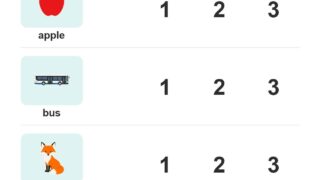
The words are cat, dog, sun and bus, and the answers are T, G, N and S.
Every word on this page has one syllable and three letters, which is exactly what a first page should look like. It is also the only page in the pack where not one of the twelve letter choices is a vowel, so nothing distracts from listening to the end of the word.

Worksheet 2 – Sounds You Can Hold, and One You Cannot
Foot, owl, fox and moon. The answers are T, L, X and N.
Three of these endings can be stretched out and held – the l in owl, the n in moon, the s sound at the end of fox. The t in foot cannot: it stops dead. Children who are told to “say the last sound slowly” can do it for three of these four rows and not the fourth, and that difference is worth naming out loud.
Watch the last row. The word is moon and one of the three choices is M, which is the sound moon starts with. A child who is still thinking about beginning sounds will pick it.
Worksheet 3 – Longer Words, Same Question
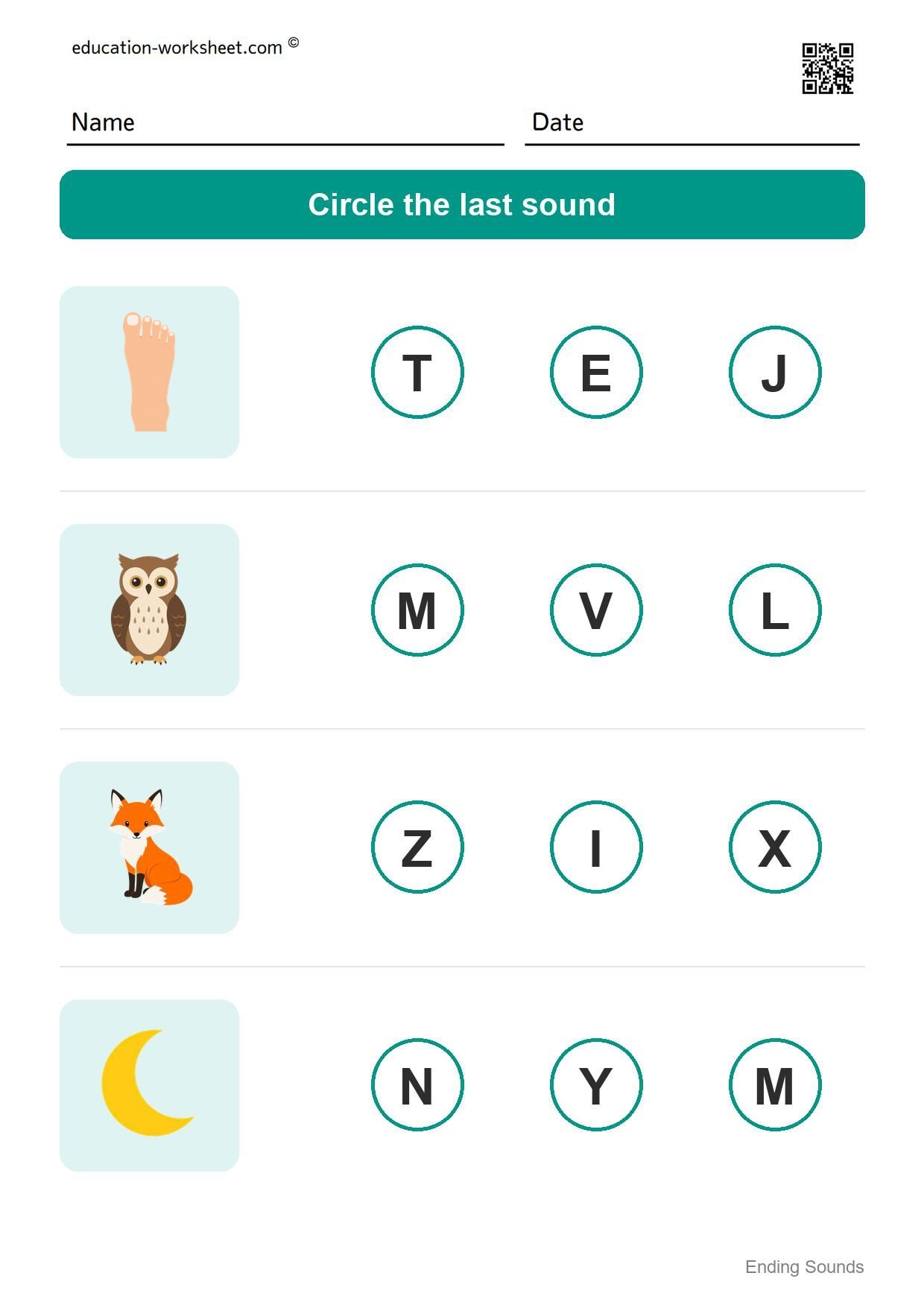
Lion, train, milk and lamp, answering N, N, K and P.
Lion is the first two-syllable word in the pack. Holding a longer word in mind while hunting for its last sound is a real step up, and it is the reason this page belongs third rather than first.
The milk row is the sharpest question on the sheet. The choices are H, K and L, and the l in milk is easy to hear because it comes right before the ending. A child who says the word too slowly, mil-k, often lands on L.
Worksheet 4 – Two Syllables Twice
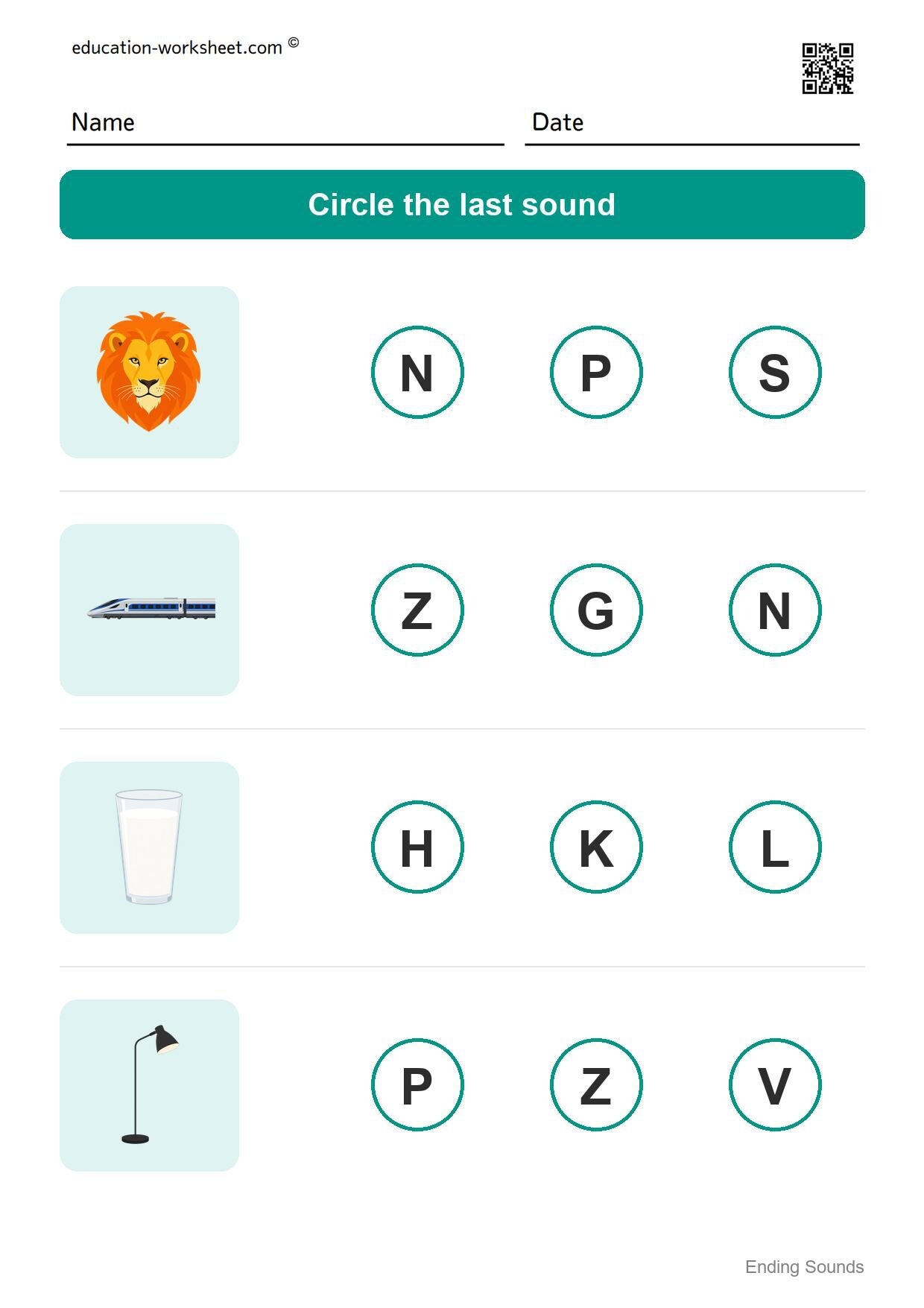
Hand, rabbit, house and penguin: D, T, S, N.
Two of the four words have two syllables now, up from one on page 3. Hand is also the first word whose ending is a pair of consonants pushed together, n and d, and children often hear only the n.
The house row offers H, S and I. H is the sound the word begins with, so this row and the moon row on page 2 test the same confusion from opposite ends.

Worksheet 5 – The Hardest Page
Carrot, grape, donut and giraffe, answering T, P, T and F.
Three of the four words have two syllables – more than any other page. The pack never announces this, but the count of long words per page runs 0, 0, 1, 2, 3 from the first sheet to the last. That is the difficulty ladder, and it is the reason to work through the pages in order.
Giraffe is the only word in the pack ending in F, and grape is the only one where a silent letter sits at the end. A child who knows their letters may look for E because they can picture the spelling. The question is about the sound, and the sound is p.

What the Three Letters Are Doing
The two wrong letters in each row are not filler. In four of the twenty rows, one of them is another sound from the same word: M for moon, H for house, L for milk, N for donut. Those four rows are the ones that tell you whether a child is really listening to the end of the word or just to the word.
Vowels appear as choices, but a vowel is never the answer. Eight of the twenty rows offer one – an I, an A, a U, an E – and all twenty answers are consonants. Pages 1 and 3 offer none at all. This is a genuine shortcut a child can find on their own, and finding it is a good sign rather than cheating.
Two answers come up far more often than the rest: N appears five times (sun, moon, lion, train, penguin) and T five times (cat, foot, rabbit, carrot, donut). Together they account for half the pack, which suits children who are working on those two sounds and is worth knowing if you are not.
One row is different from all the others. Fox ends in a sound the child hears as s, but the letter that spells it is X. The choices are Z, I and X, so the closest sound-alike, Z, is sitting right there. If a child picks Z, they heard correctly and matched the wrong letter – which is a different conversation from not hearing the ending at all.
When Children Are Ready for Ending Sounds
- Age: about four to six – late pre-K through kindergarten.
- Before starting: the child should already be able to tell you the first sound in a word, and should know most letter sounds by name.
- RF.K.2.D – isolate and pronounce the initial, medial vowel and final sounds in three-phoneme words. The final sound is the part this pack practices.
- RF.K.3.A – know the sound each consonant letter makes. Every answer here is a consonant, so the pack leans on this the whole way through.
- Blending those sounds into whole written words comes next, with CVC word building.
How to Use These Worksheets
- Name the picture together first, using the word list above. If the child calls it something else, use their word only if its last sound matches one of the three letters.
- Say the word, then say it again stretching the end: sunnn, buss, catuh-t. The stretch is what makes the last sound audible.
- Have the child say the last sound on its own before they look at the circles. Choosing a letter first and checking afterwards is the habit to avoid.
- Cover the two wrong letters with a finger once the child has answered, and ask them to say the sound that letter makes. It turns a lucky guess into an answer.
- Do one page a day rather than all five at once. Listening work tires children faster than coloring does.
- Come back to page 1 after page 5. Words that felt hard in week one usually sound obvious in week three, and the child notices the difference themselves.
Three Things to Watch For
1. Answering with the beginning sound. This is the standard mistake, and the pack has traps for it on purpose: moon offers M, house offers H. If a child picks those, they are not guessing at random – they are answering the question they are used to being asked.
2. Circling the first letter every time. The correct answer happens to be the first of the three circles in ten of the twenty rows, so a child who always picks the left-hand circle scores about half. If a page comes back suspiciously fast and suspiciously right, ask the child to say the sound out loud before they circle anything.
3. Endings made of two consonants. Hand ends with n and d run together, and lamp with m and p. Children hear the first of the pair and miss the second. Say the word slowly and ask what comes after the n, rather than asking for the last sound again.
Printing Tips
- Print at 100 percent, actual size, on A4 or US Letter.
- Color printing helps here more than on most worksheets – the pictures are what carry the word, and an orange carrot reads faster than a gray one.
- One page per sitting is plenty. Print the set, keep it in a folder, and use a page whenever there are ten quiet minutes.
Frequently Asked Questions
What age are these ending sounds worksheets for?
About four to six years old, usually late pre-K and kindergarten. Children should already be confident with beginning sounds.
Is there an answer key?
There is no separate key. The word and the answer for every row are listed above, page by page, which is quicker to use than a key.
What are the twenty words?
Page 1: cat, dog, sun, bus. Page 2: foot, owl, fox, moon. Page 3: lion, train, milk, lamp. Page 4: hand, rabbit, house, penguin. Page 5: carrot, grape, donut, giraffe.
Do the pages get harder?
Yes. The words get longer: page 1 and page 2 are all one-syllable words, page 3 has one two-syllable word, page 4 has two and page 5 has three.
My child keeps giving the first sound instead of the last. Is that normal?
Completely normal, and it is the reason this pack exists. Say the word, then say just the ending on its own, and ask which one sounds the same. It passes with practice.
Does the child need to be able to write?
No. Every answer is circled, so no letter formation is needed.
Do I need to sign up to download these?
No. Every PDF downloads immediately, with no account, no email address and no cost.
Can I use these in my classroom?
Yes, they are free to print for home and classroom use. Please do not sell them or re-host the files elsewhere.
More Free Phonics Worksheets
- Free Beginning Sounds Worksheets for Kindergarten – Phonics
- Free Middle Sounds Worksheets for Kindergarten – Short Vowels
- Free Ending Letter Worksheets for Kindergarten – Write the Last Letter
- Free CVC Word Building Worksheets for Kindergarten – Make Three Letter Words
- Free Word Family Worksheets for Kindergarten – CVC Words and Phonics
- Free Rhyming Words Worksheets for Kindergarten – Words That Rhyme
- Free Final Consonant Deletion Worksheets – Minimal Pairs PDF
- Free Final Consonant Deletion Minimal Pairs Set 2 – S, Z and CH