
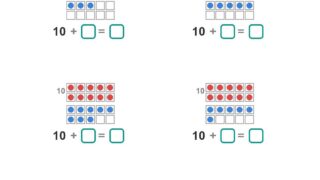
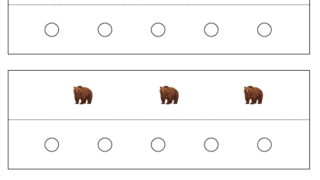
These free printable subtraction worksheets give kindergarten children sixty take-away problems, six to a page, each one drawn on a ten frame. The counters are already in the frame and the ones being taken away already carry an X. The child counts what is left and writes it in the box.
The crossing out is done for you, and that matters. This is not a pack where a child works out which counters to remove – it is one where they see the removal and count the remainder. That makes it a first subtraction pack rather than a practice one.
Every problem stays within ten, and the ten frame is the same one every time.
- What Is in This Free Subtraction Worksheet Pack
- The 11 Subtraction Worksheets
- Worksheet 1 – 5-4, 4-1, 2-2, 4-4, 2-1, 3-3
- Worksheet 2 – 3-2, 3-1, 5-1, 2-2, 2-1, 4-1
- Worksheet 3 – 4-3, 4-4, 2-1, 4-2, 3-3, 5-4
- Worksheet 4 – 7-2, 3-1, 5-3, 2-1, 3-2, 6-4
- Worksheet 5 – 5-3, 3-2, 5-1, 6-1, 3-1, 3-3
- Worksheet 6 – 2-2, 6-5, 3-1, 10-8, 6-6, 9-1
- Worksheet 7 – 9-6, 2-1, 6-2, 5-4, 4-3, 9-7
- Worksheet 8 – 8-8, 6-1, 8-1, 8-7, 3-2, 4-1
- Worksheet 9 – 4-2, 9-5, 10-7, 5-1, 8-2, 5-5
- Worksheet 10 – 2-1, 10-2, 10-9, 4-4, 9-9, 6-1
- Answer Key – All 60 Problems
- Why a Ten Frame and Not a Picture
- When Children Are Ready for Subtraction Within 10
- How to Use These Worksheets
- Three Things to Watch For
- Printing Tips
- Frequently Asked Questions
- More Free Addition and Subtraction Worksheets
What Is in This Free Subtraction Worksheet Pack
- Ten printable worksheets with six problems on each – sixty in all.
- A ten frame above every number sentence, with the counters to take away already crossed out.
- Pages 1 to 3 stay within 5, pages 4 and 5 reach 6 and 7, and pages 6 to 10 go to 10.
- Answers from 0 to 8, with 0 and 1 between them accounting for thirty-one of the sixty.
- An eleventh page with every answer written out.
- A separate PDF for every page, free to download and print.
The 11 Subtraction Worksheets
This pack is weighted heavily towards small answers. Eighteen of the sixty problems leave 1, and thirteen leave nothing at all. Only four problems in the whole pack have an answer bigger than five.
That is a reasonable way to introduce subtraction – taking one away and taking everything away are the two ideas children meet first – but it is worth knowing before you print. A child who finishes all ten pages has had a great deal of practice at 0 and 1 and rather little at anything else.
Worksheet 1 – 5-4, 4-1, 2-2, 4-4, 2-1, 3-3
The six problems are 5-4, 4-1, 2-2, 4-4, 2-1, 3-3.
Nothing on this page starts higher than five, and three of the six problems take everything away: 2-2, 4-4 and 3-3 all leave nothing at all.
Zero is the hardest answer on a first page. An empty ten frame is a strange thing to count, and writing 0 in the box is a real step for a five-year-old.

Worksheet 2 – 3-2, 3-1, 5-1, 2-2, 2-1, 4-1
The six problems are 3-2, 3-1, 5-1, 2-2, 2-1, 4-1.
Six problems, all starting at five or less, and four of them take away just one.
Taking one away is the easiest subtraction there is and the one children can do before they can read the sentence. It is the right thing to repeat.

Worksheet 3 – 4-3, 4-4, 2-1, 4-2, 3-3, 5-4
The six problems are 4-3, 4-4, 2-1, 4-2, 3-3, 5-4.
Still nothing above five. 4-4 and 3-3 both leave zero again, and 5-4 leaves one.
Three pages at this level is generous, and it is the reason the pack works for a child who is genuinely at the beginning.

Worksheet 4 – 7-2, 3-1, 5-3, 2-1, 3-2, 6-4
The six problems are 7-2, 3-1, 5-3, 2-1, 3-2, 6-4.
The first page to go past five: 7-2 opens it and 6-4 closes it. Both use the bottom row of the ten frame for the first time.
A number above five means counters in two rows, and that changes the counting from a glance into a count.

Worksheet 5 – 5-3, 3-2, 5-1, 6-1, 3-1, 3-3
The six problems are 5-3, 3-2, 5-1, 6-1, 3-1, 3-3.
Back down to six as the highest starting number, with 6-1 the only problem that uses the second row.
The pack steps up and then steps back, which is kinder than a straight climb and worth knowing if you are choosing pages rather than working through.

Worksheet 6 – 2-2, 6-5, 3-1, 10-8, 6-6, 9-1
The six problems are 2-2, 6-5, 3-1, 10-8, 6-6, 9-1.
Ten arrives. 10-8 leaves two, and 9-1 leaves eight – the biggest answer in the pack so far.
6-6 takes everything away from a full six, which looks very different from 2-2 on page 1 even though both answers are zero.

Worksheet 7 – 9-6, 2-1, 6-2, 5-4, 4-3, 9-7
The six problems are 9-6, 2-1, 6-2, 5-4, 4-3, 9-7.
9-6, 6-2, 9-7: three problems where the counting starts high and the answer is small.
There is no 10 on this page, but two nines. Nine counters is one short of a full frame, and children often count it as ten at a glance.

Worksheet 8 – 8-8, 6-1, 8-1, 8-7, 3-2, 4-1
The six problems are 8-8, 6-1, 8-1, 8-7, 3-2, 4-1.
8-8 leaves nothing from a nearly full frame, and 8-1 leaves seven – the second largest answer in the pack.
Watch the two eights side by side. 8-8 and 8-1 look almost identical on the page and could hardly be further apart in what they ask.

Worksheet 9 – 4-2, 9-5, 10-7, 5-1, 8-2, 5-5
The six problems are 4-2, 9-5, 10-7, 5-1, 8-2, 5-5.
10-7, 9-5 and 8-2 all sit in the upper half, and 5-5 leaves zero.
This is the hardest page in the pack by the size of the numbers, and the only one where four of the six problems start at eight or more.

Worksheet 10 – 2-1, 10-2, 10-9, 4-4, 9-9, 6-1
The six problems are 2-1, 10-2, 10-9, 4-4, 9-9, 6-1.
The pack ends with 10-2 and 10-9 on the same page. One leaves eight and the other leaves one, from an identical starting frame.
9-9 and 4-4 both leave zero. Thirteen of the sixty problems in this pack take everything away, and two of them are here.

Answer Key – All 60 Problems
The eleventh sheet writes out every problem with its answer, six to a page.
The ten frame answers most of them for you anyway: the counters without an X are the answer, and they are there to be counted.

Why a Ten Frame and Not a Picture
A ten frame is two rows of five. Counters fill the top row first, so any number up to five is one row and any number above five is a full row plus some – and that is visible before anything is counted.
For subtraction that structure does something a row of apples cannot. When six counters have two crossed out, the four that remain sit in a shape the child has seen before. Over sixty problems the shapes start to be recognized rather than counted, and recognizing four as a shape is the beginning of knowing four.
It also makes zero visible. An empty frame is a real thing to look at, which is more than can be said for an empty space on the page.
When Children Are Ready for Subtraction Within 10
- Age: about five to six – kindergarten, once counting to ten and addition within five are comfortable.
- Before starting: the child should be able to count to ten and write the numerals 0 to 9.
- K.OA.A.1 – represent subtraction with objects, fingers, drawings or equations.
- K.OA.A.2 – solve subtraction word problems and subtract within 10.
- K.OA.A.5 – fluently add and subtract within 5. Pages 1 to 3 are exactly that.
How to Use These Worksheets
- Count the counters in the frame first, before looking at the crossed ones. That is the first number in the sentence and it should be said out loud.
- Then count the X marks. That is the second number, and matching it to the sentence makes the sentence mean something.
- Count what is left last. Point at each uncrossed counter rather than counting from memory.
- Do not skip the zero problems. Writing 0 in a box is harder than it looks and thirteen problems in this pack ask for it.
- Stop at page 3 for a child who is new to subtraction. Those three pages stay within five and are a complete lesson on their own.
- Compare 10-2 and 10-9 on the last page side by side. Same frame, opposite answers.
Three Things to Watch For
1. Counting the crossed-out counters too. The X marks are still visible, and children who count everything in the frame get the starting number instead of the answer. Ask them to cover the crossed ones with a finger.
2. Writing nothing instead of zero. An empty frame often produces an empty box. Zero is a number and it needs writing, and this pack asks for it thirteen times.
3. Never getting past small answers. Thirty-one of the sixty problems leave 0 or 1. A child can finish this pack and still be unpracticed at, say, 9-3. It is a starting pack rather than a complete one.
Printing Tips
- Print at 100 percent, actual size, on A4 or US Letter.
- Color helps: the counters are red and the X marks are dark, and the contrast between them is the whole page.
- Print pages 1 to 3 as a set for a beginner, and keep 6 to 10 for later.
Frequently Asked Questions
What age are these subtraction worksheets for?
About five to six years old. A child needs to count to ten and write the numerals; the ten frame does the rest.
Does my child have to cross the counters out?
No. The X marks are already printed. The child counts the counters that do not have one.
How big do the numbers get?
Ten. Pages 1 to 3 stay within five, pages 4 and 5 reach six and seven, and pages 6 to 10 go up to ten.
Is there an answer key?
Yes, page 11 lists all sixty problems with their answers.
Why are so many answers 0 or 1?
Because taking one away and taking everything away are the two ideas children meet first. Thirty-one of the sixty problems are one or the other, which makes this a first subtraction pack rather than a fluency one.
Do I need to sign up to download these?
No. Every PDF downloads immediately, with no account, no email address and no cost.
Can I use these in my classroom?
Yes, they are free to print for home and classroom use. Please do not sell them or re-host the files elsewhere.
More Free Addition and Subtraction Worksheets
- Free Ten Frame Worksheets for Kindergarten – Count to 10
- Free Addition Worksheets for Kindergarten – Add Up to 10
- Free Number Line Addition Worksheets for Kindergarten – Add by Jumping
- Free Number Bonds Worksheets for Kindergarten – Numbers to 10
- Free Fact Family Worksheets for Kindergarten – Add and Subtract
- Free Make 10 Worksheets for Kindergarten – Ways to Make Ten