These free printable rapid automatic naming worksheets, often called RAN charts, give children practice saying the names of familiar letters and numbers quickly and correctly. Each page has fifty symbols in five rows of ten, and the child names them aloud from left to right while an adult times it with a phone. There are twelve sets: five letter pages, five number pages and two pages that mix letters and numbers.
These sheets were designed by a speech-language-hearing therapist, and they are built for practice, not testing. They do not come with a target time, and they cannot tell you whether a child has a reading difficulty. What they can do is give a child a short, repeatable task and give you a simple way to see whether their own naming is getting quicker and more accurate over the weeks.
Rapid naming has been studied since the 1970s, when researchers first timed children naming rows of colors, objects, letters and digits. How quickly a child can name familiar symbols turns out to be closely linked to how fluently they later read. That link is the reason teachers and specialists pay attention to naming speed, and the reason these charts exist.
- What Is in This Free Rapid Naming Worksheet Pack
- The 12 Rapid Naming Charts
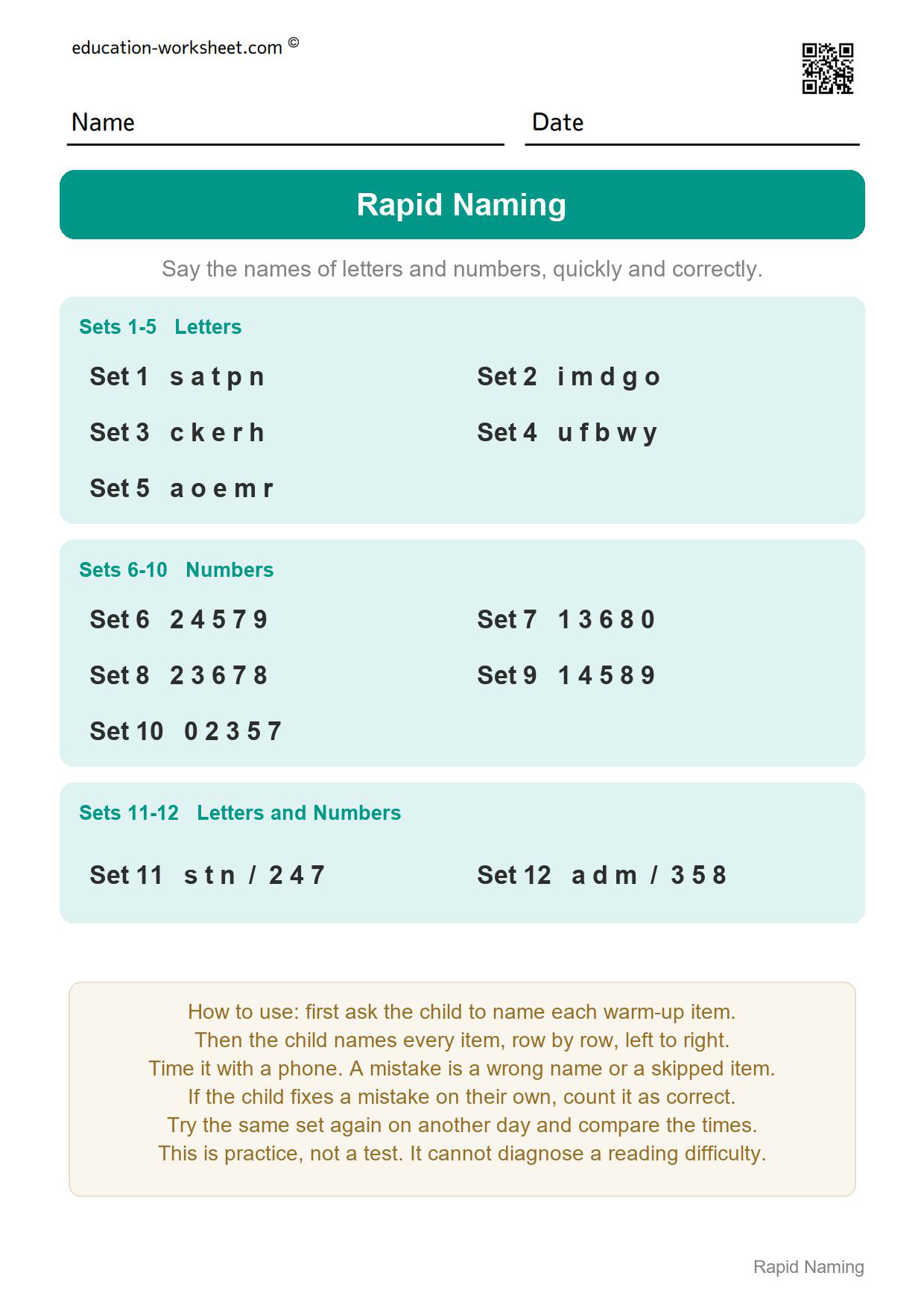
- Start Here – How the 12 Sets Are Arranged
- Set 1 – Letters s, a, t, p, n
- Set 2 – Letters i, m, d, g, o
- Set 3 – Letters c, k, e, r, h
- Set 4 – Letters u, f, b, w, y
- Set 5 – Letters a, o, e, m, r
- Set 6 – Numbers 2, 4, 5, 7, 9
- Set 7 – Numbers 1, 3, 6, 8, 0
- Set 8 – Numbers 2, 3, 6, 7, 8
- Set 9 – Numbers 1, 4, 5, 8, 9
- Set 10 – Numbers 0, 2, 3, 5, 7
- Set 11 – Letters and Numbers Mixed: s, t, n and 2, 4, 7
- Set 12 – Letters and Numbers Mixed: a, d, m and 3, 5, 8
- Progress Record – Three Tries for Every Set
- How the Rows Are Built
- What Rapid Naming Practice Can and Cannot Do
- When Children Are Ready for Rapid Naming
- How to Use These Worksheets
- Three Things to Watch For
- Printing Tips
- Frequently Asked Questions
- More Free Letter and Number Worksheets
What Is in This Free Rapid Naming Worksheet Pack
- Twelve printable naming charts with fifty symbols on each – six hundred in all.
- Sets 1 to 5: lowercase letters. Sets 6 to 10: the numbers 0 to 9. Sets 11 and 12: letters and numbers alternating.
- A warm-up row at the top of every page, so you can check the child knows all five names before timing anything.
- A box for three timed tries at the bottom of every page.
- An introduction page for adults and a progress record for all twelve sets.
- A separate PDF for every page, free to download and print.
The 12 Rapid Naming Charts
The pack moves from easy to harder in three steps. The letter pages start with letters many children learn first and end with a page of look-alike round letters. The number pages come next. The two mixed pages come last, because switching between letters and numbers adds a demand of its own.
Start Here – How the 12 Sets Are Arranged
The first page lists every set in the pack and gives the adult the five rules that matter: check the warm-up first, read across each row, time it, count wrong names and skipped items as mistakes, and compare the child only with their own earlier tries.
Set 1 – Letters s, a, t, p, n
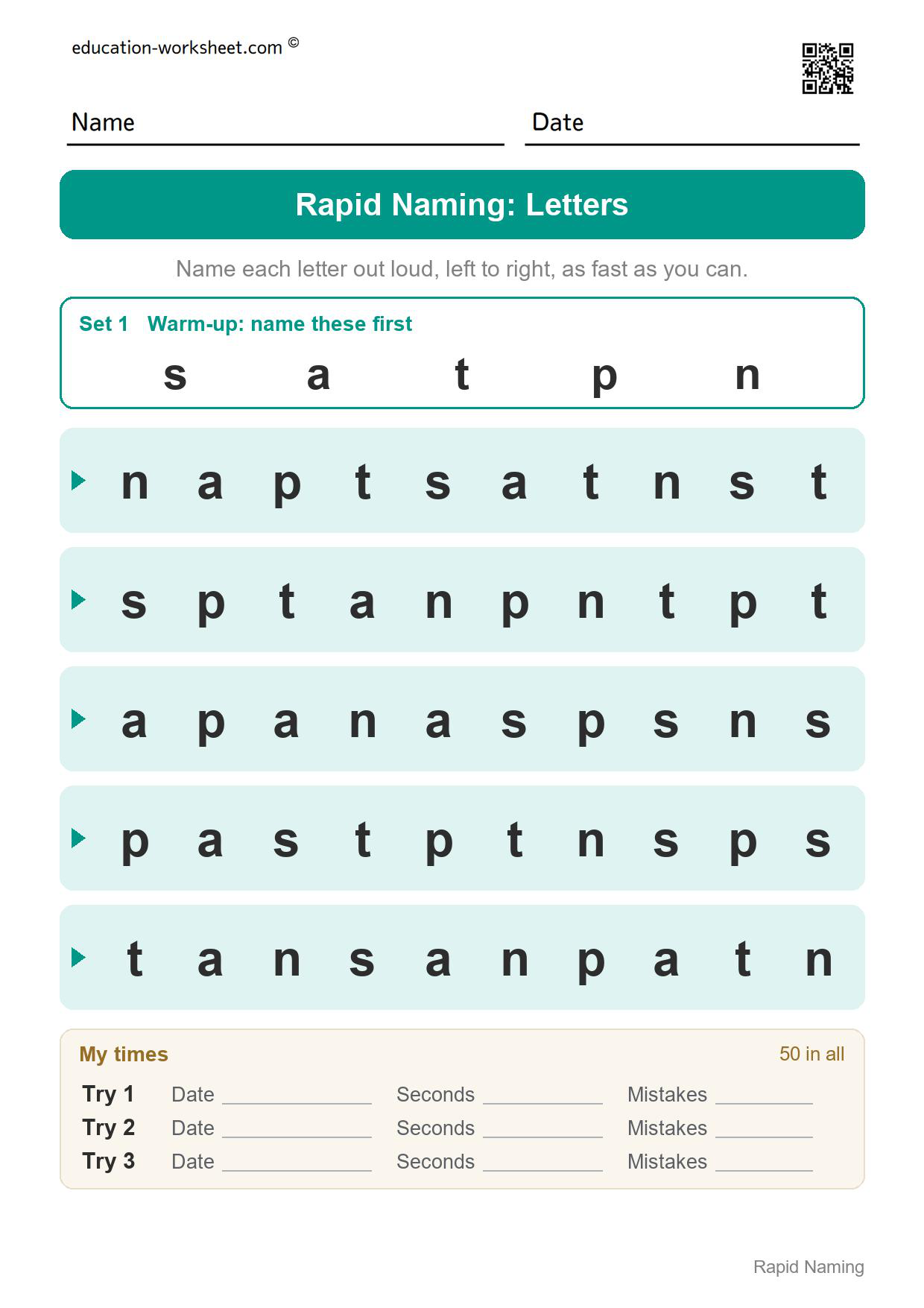
These are among the first letters many phonics programs teach, so almost every child who has started school will know their names. That makes Set 1 the page to learn the routine on: warm-up, then fifty letters, then the time.
None of the five looks like another. The only round letter is a, and there is no b, d or p-and-q problem to slow anyone down.
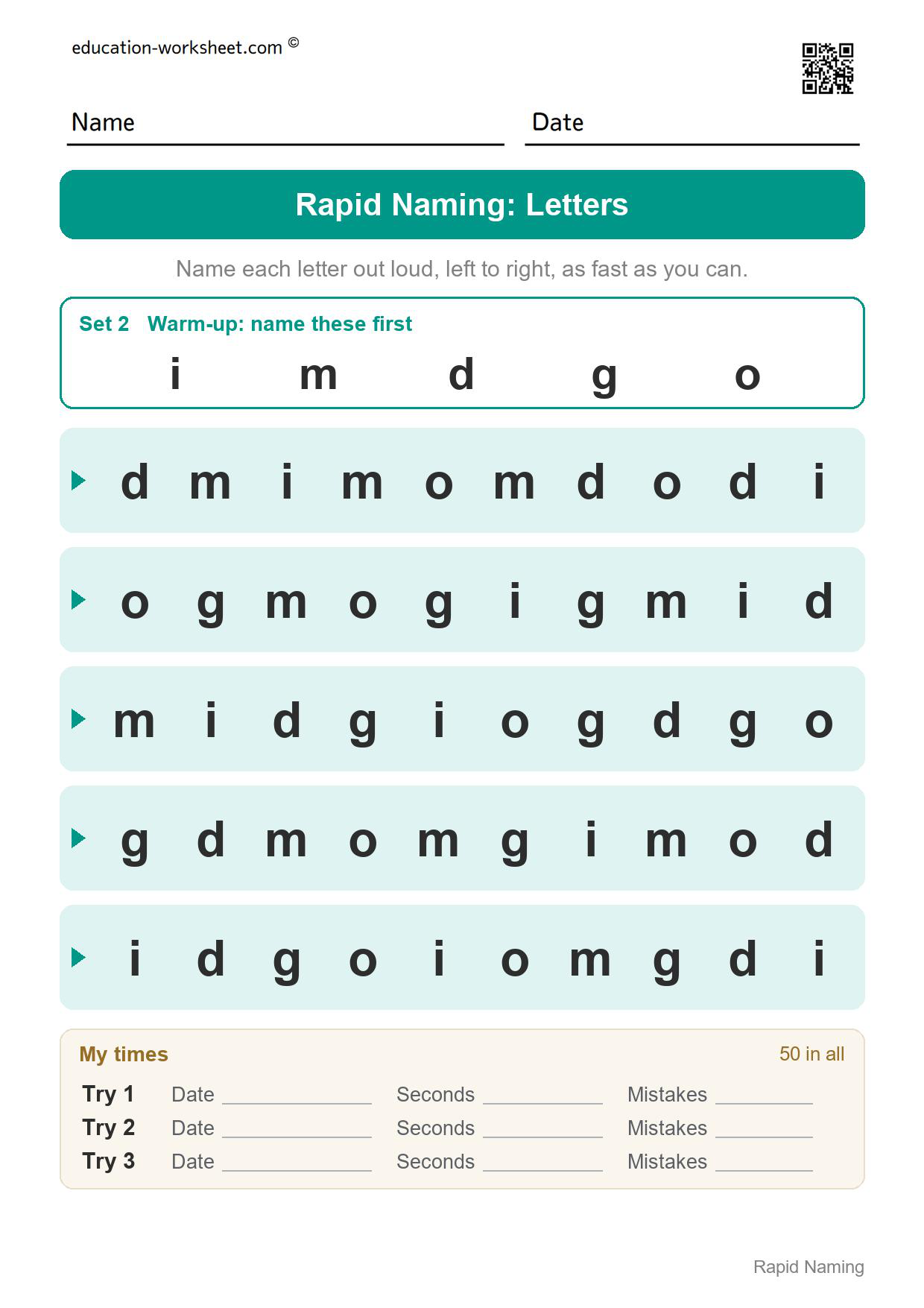
Set 2 – Letters i, m, d, g, o
The next letters in a typical phonics order. The letter d appears here without b, so the child can name it without having to decide which way it faces.
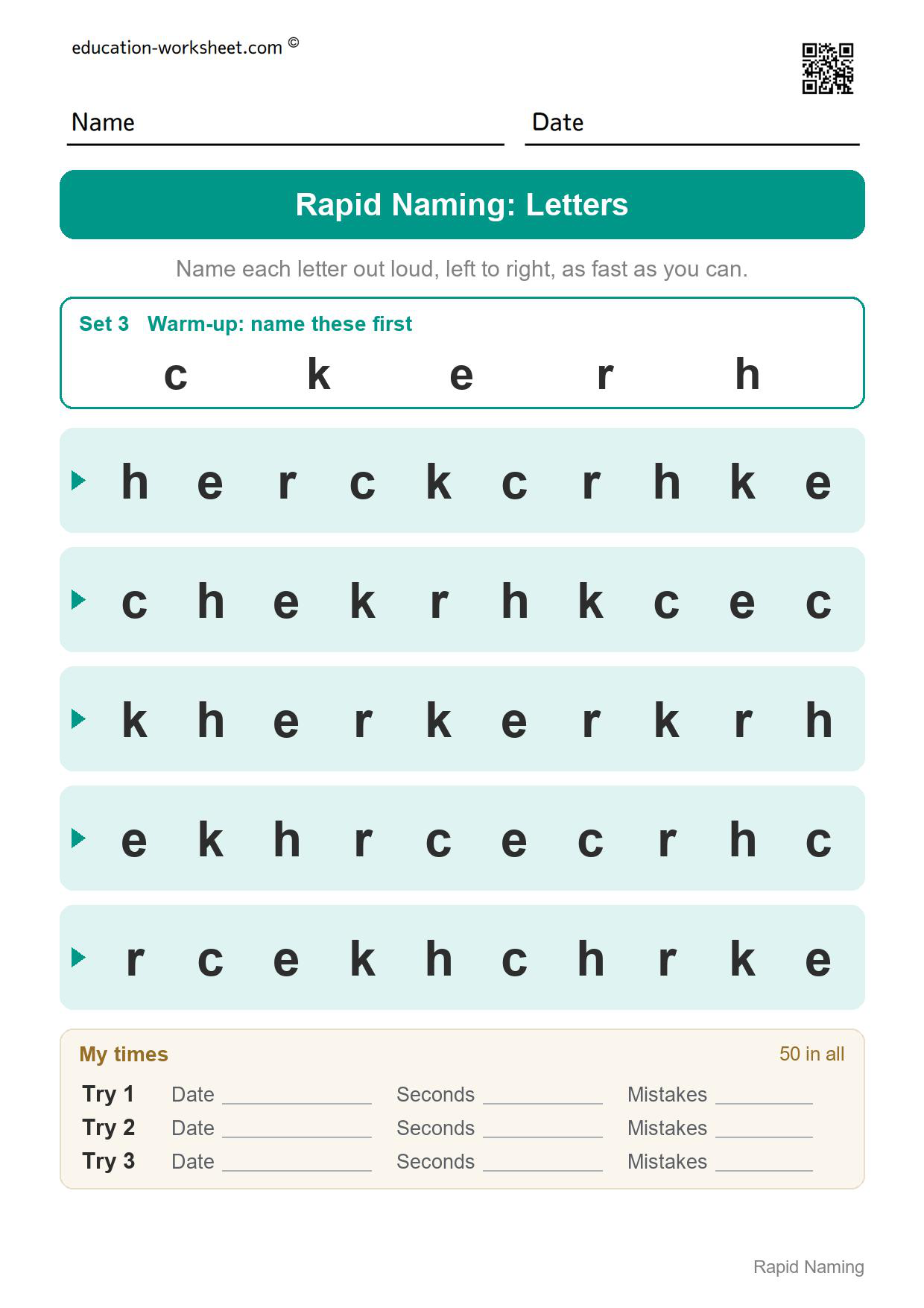
Set 3 – Letters c, k, e, r, h
c and k make the same sound in many words, but their names are different, and this page only asks for names. A child who says “k” for c is mixing up sounds and names, which is useful to notice.
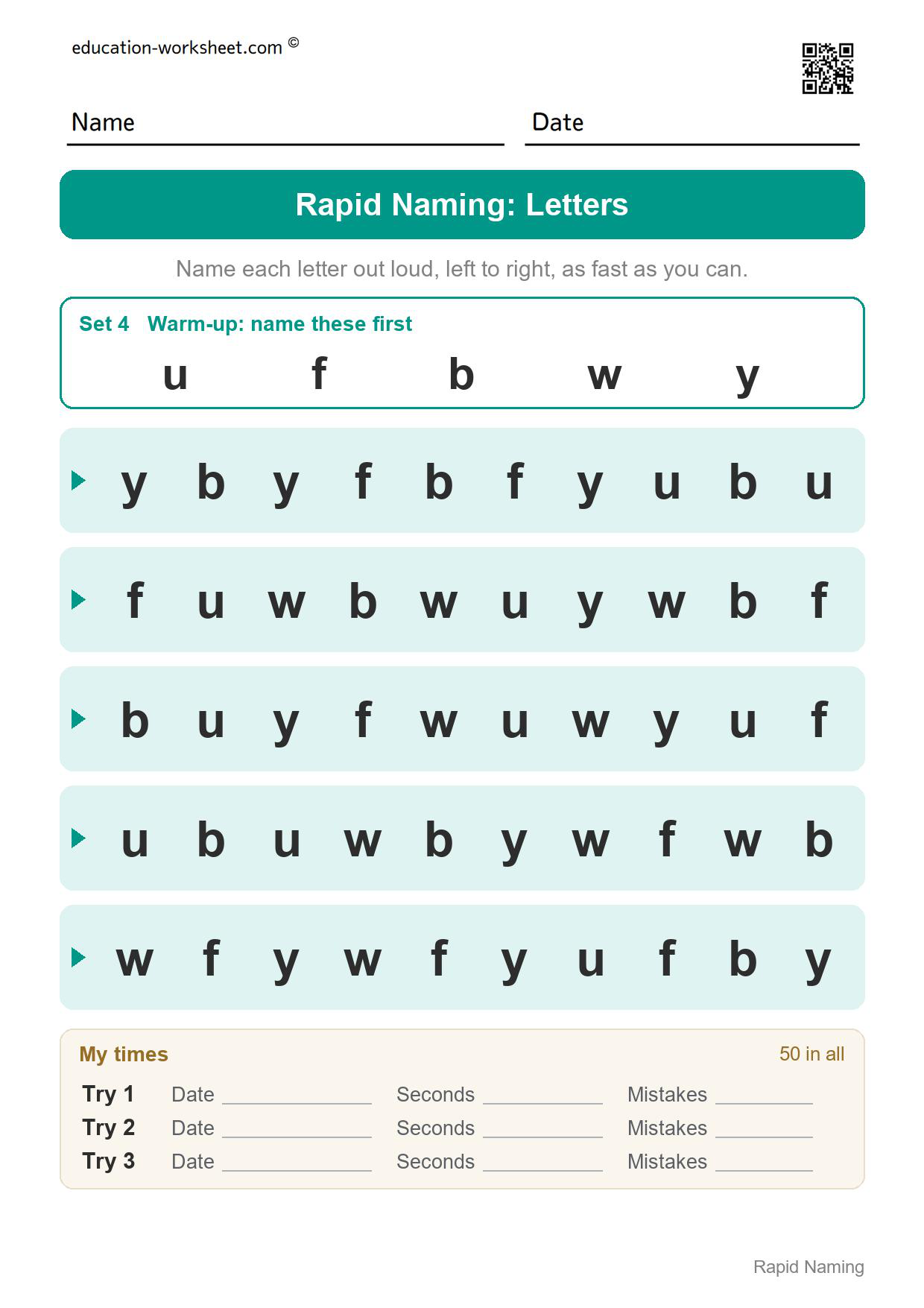
Set 4 – Letters u, f, b, w, y
Expect this page to be slower, and not because it is harder to read. The name of w, “double-u”, has three syllables. Ten of them on one page add real time even for a fluent reader. This is the clearest example of why times should only be compared on the same set.
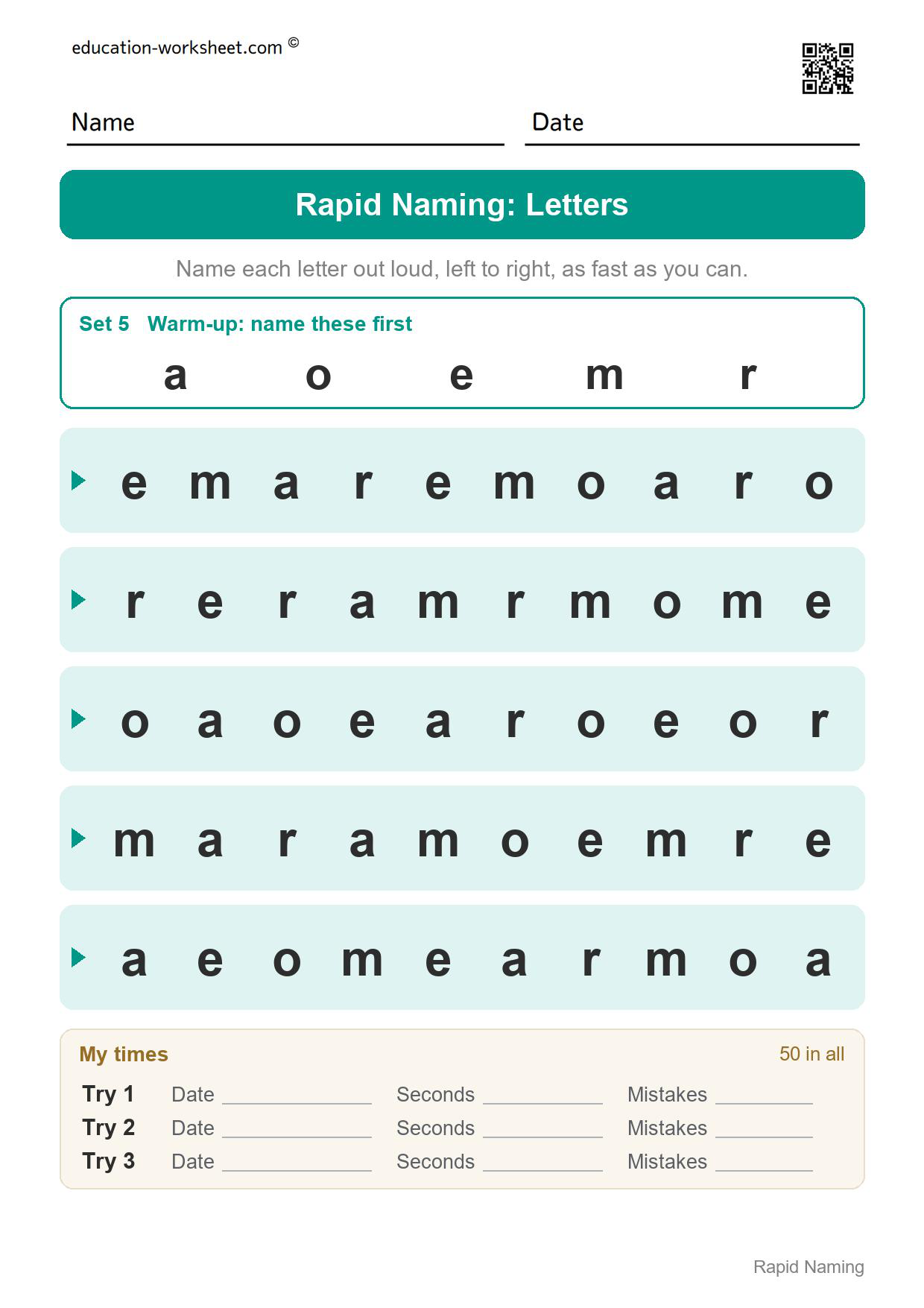
Set 5 – Letters a, o, e, m, r
The last letter page mixes letters from earlier sets, and puts the three round letters a, o and e together on purpose. They differ by a small tail or a short line, so this set asks the eyes to work harder than Sets 1 to 4.
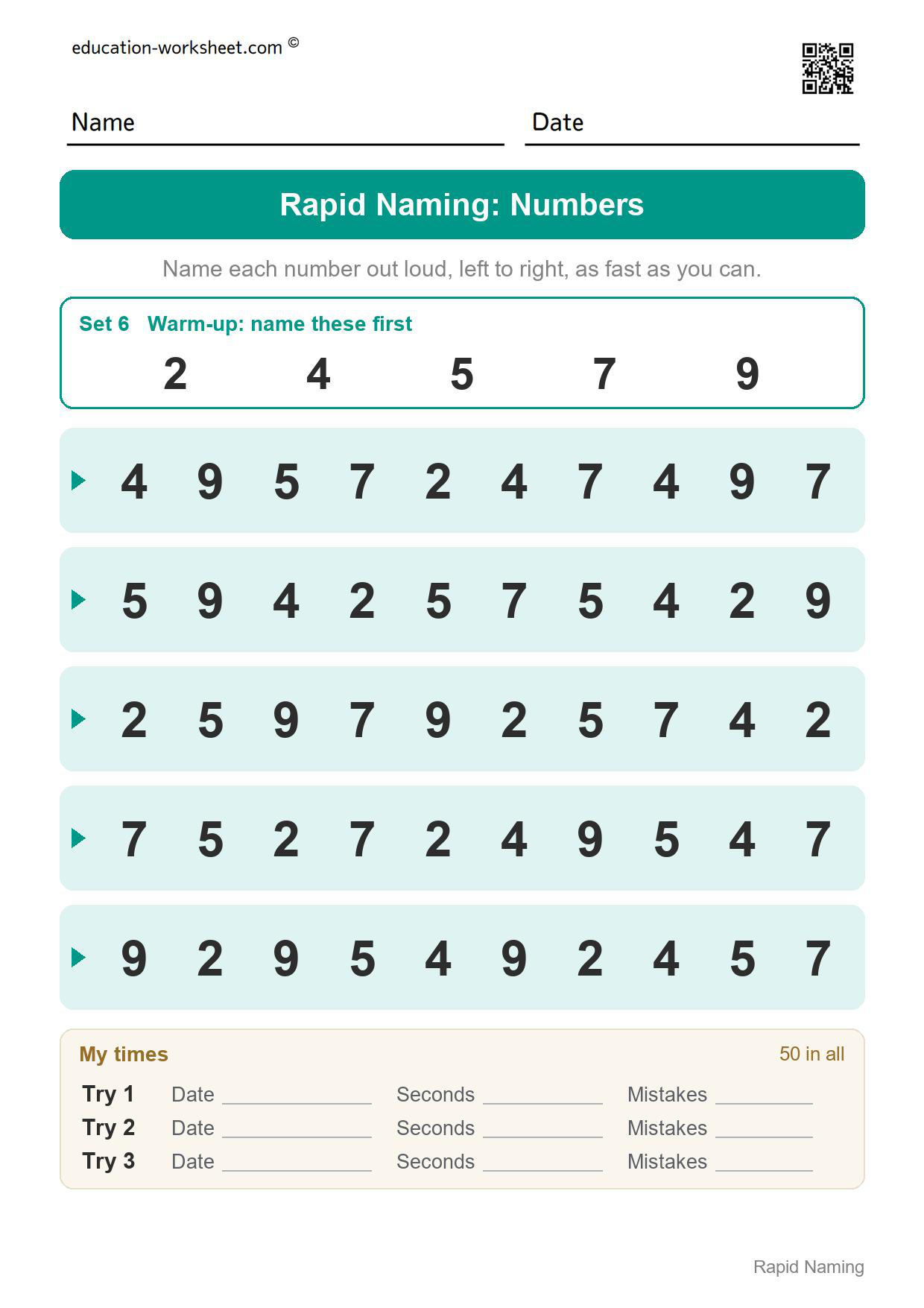
Set 6 – Numbers 2, 4, 5, 7, 9
The first number page. Single digits only, so the child names each one as a word: two, four, five, seven, nine. Seven is the only name with two syllables.
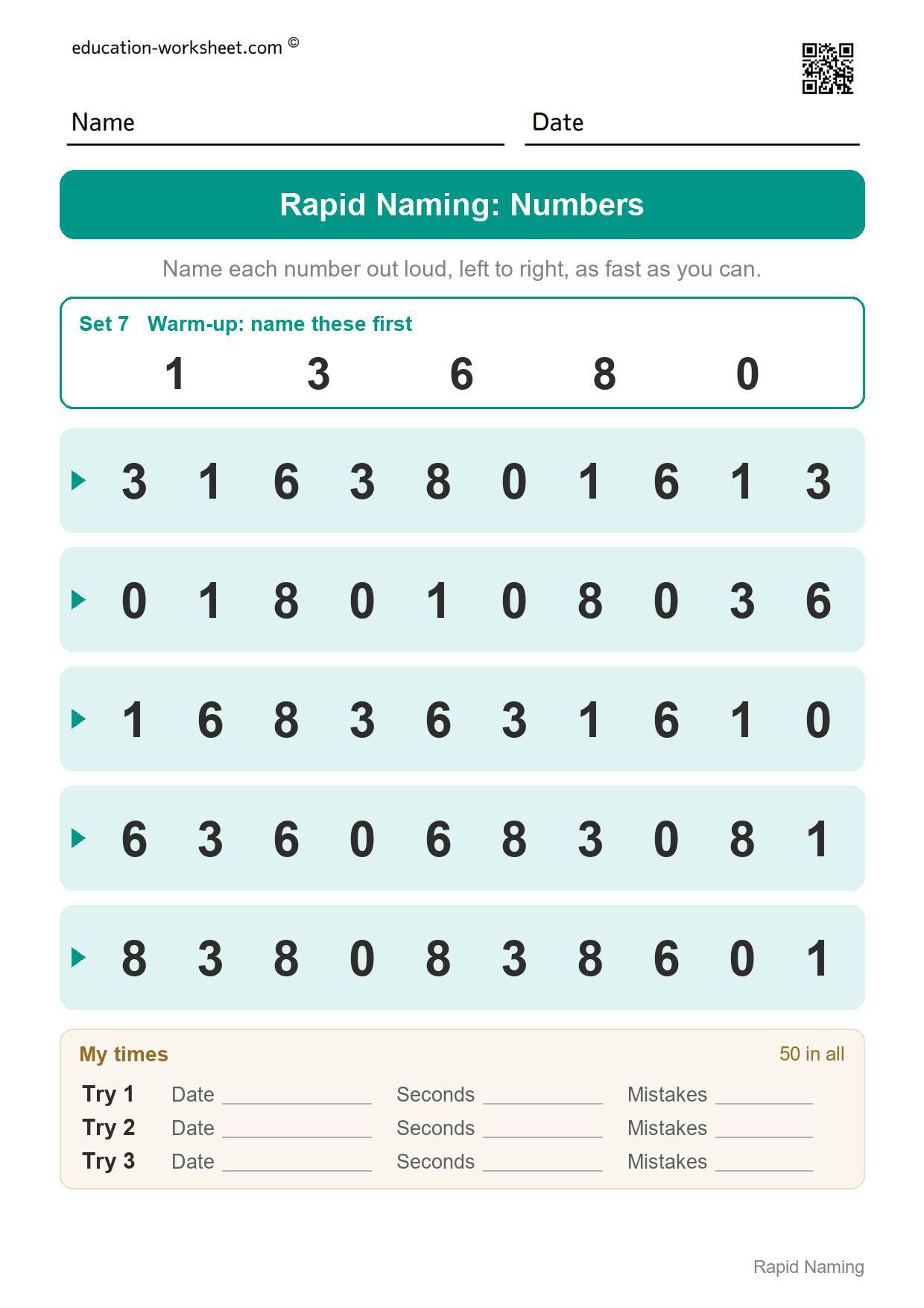
Set 7 – Numbers 1, 3, 6, 8, 0
This is the only page with 0. Decide before you start whether “zero” and “oh” are both fine; most adults accept either. The letter o never appears on the same page as the number 0 anywhere in the pack, so there is no doubt about which one is meant.
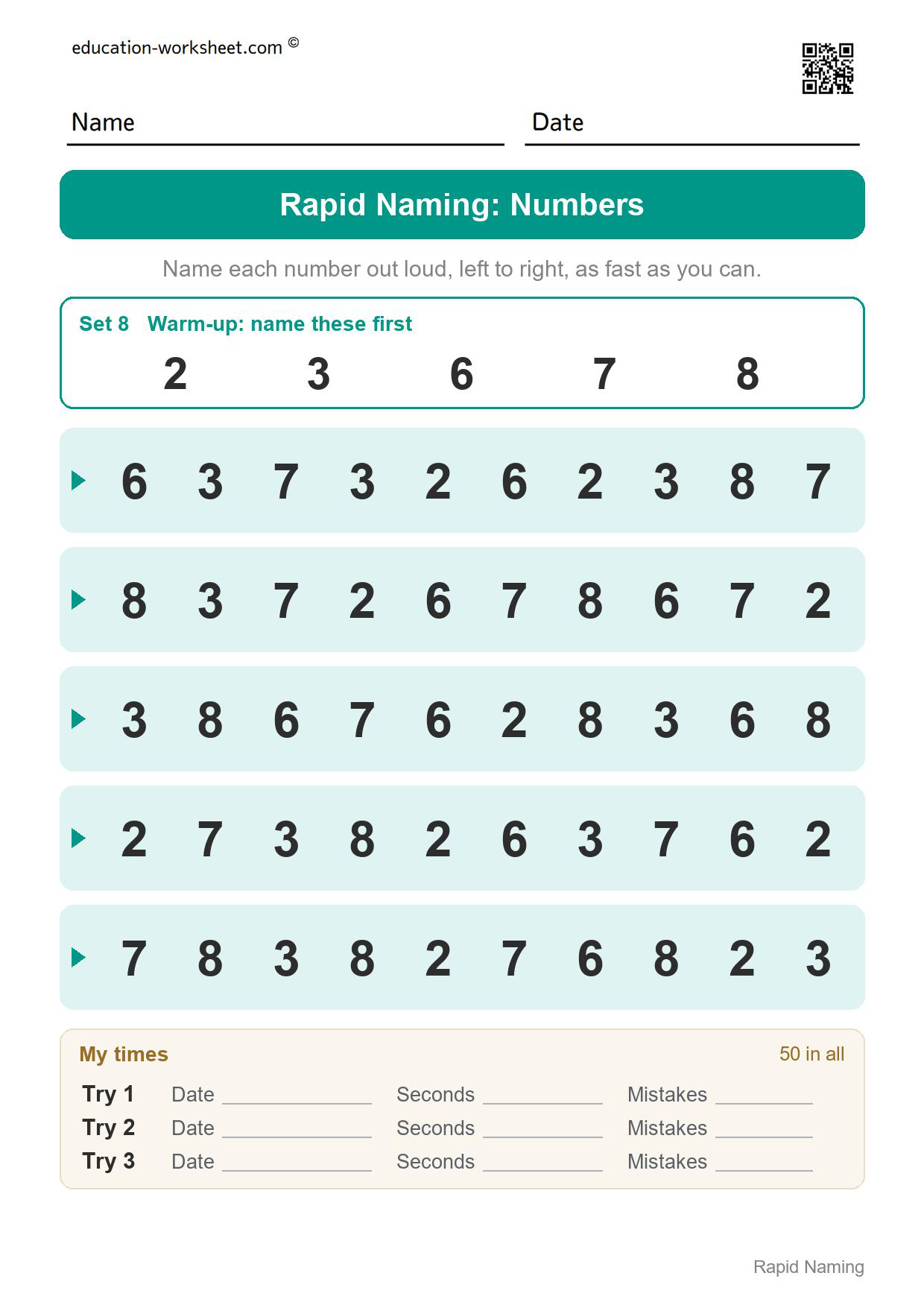
Set 8 – Numbers 2, 3, 6, 7, 8
Three of these five, 3, 6 and 8, are made almost entirely of curves, which makes the page look busier than Set 6. The digit 9 is left out on purpose: 6 and 9 are never on the same page.
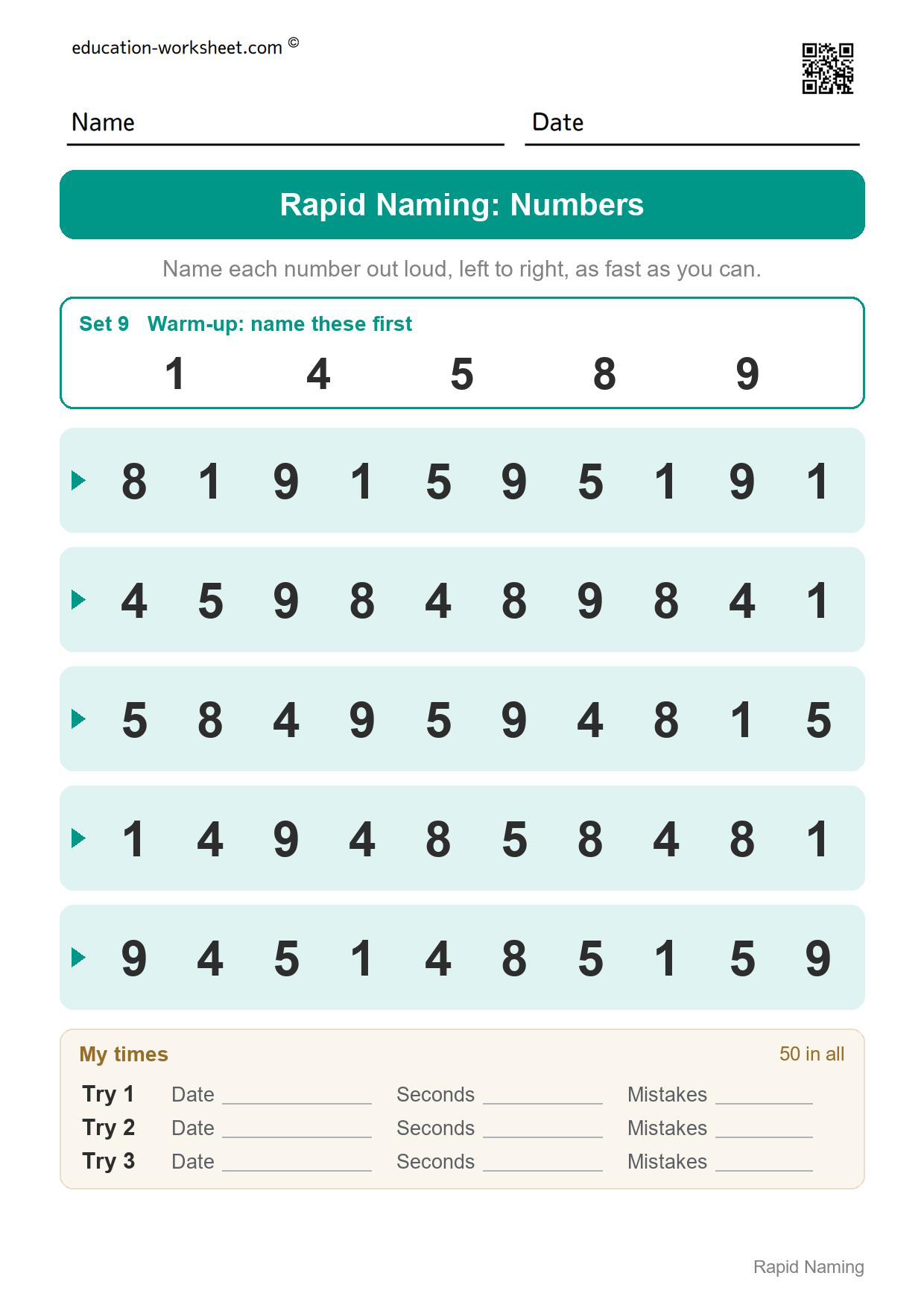
Set 9 – Numbers 1, 4, 5, 8, 9
Now 9 appears, and 6 does not. Together, Sets 8 and 9 give every digit from 1 to 9 at least one more turn.
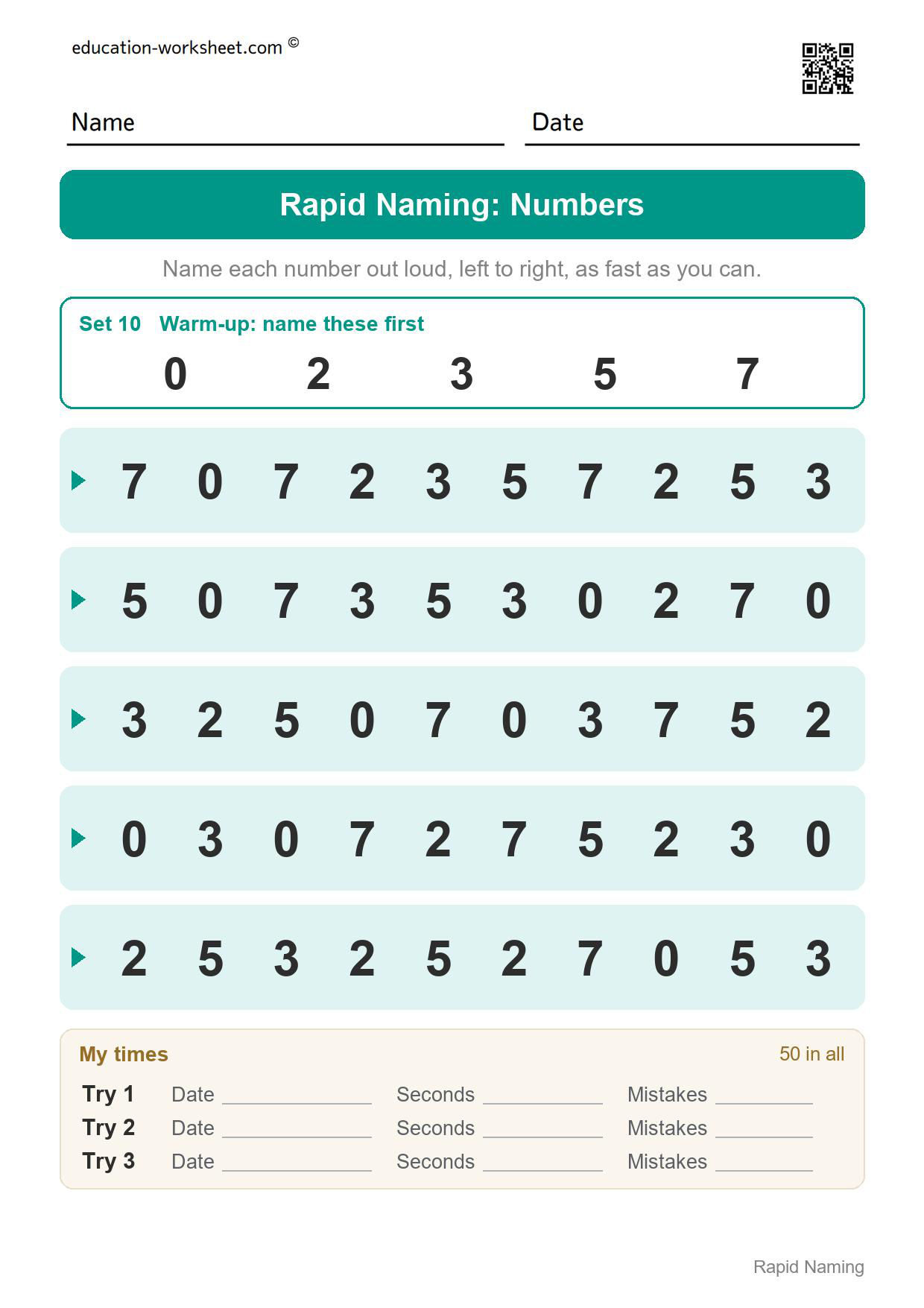
Set 10 – Numbers 0, 2, 3, 5, 7
The last number page brings 0 back alongside two two-syllable names, seven and zero. A child who was quick on Set 6 may be a little slower here, and that is expected.
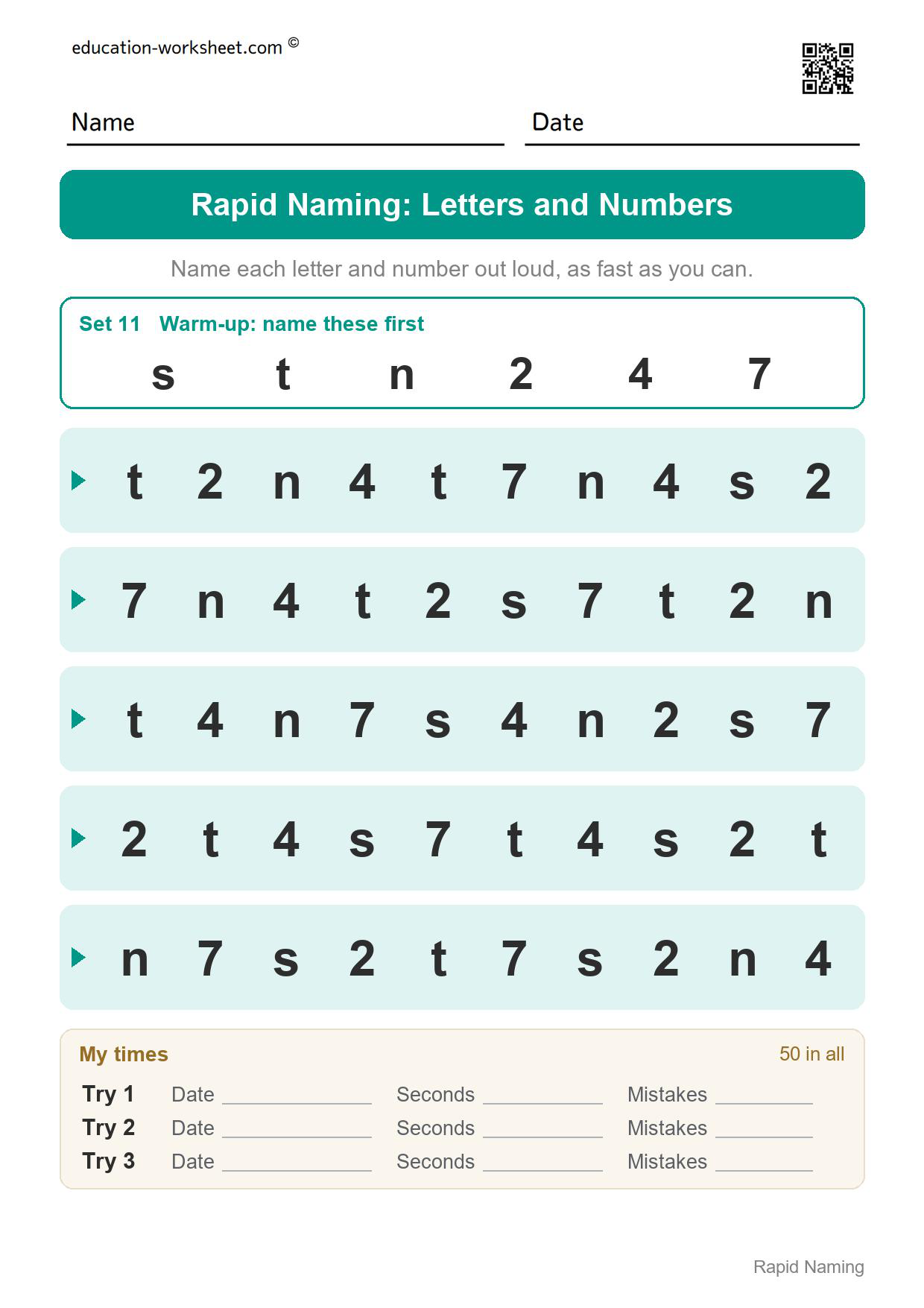
Set 11 – Letters and Numbers Mixed: s, t, n and 2, 4, 7
Every row alternates: letter, number, letter, number. Switching between the two kinds of symbol is a separate skill, and most children slow down here even though every symbol on the page is easy on its own.
The first row starts with a letter, the second with a number, and so on, so the switch never settles into a fixed rhythm.
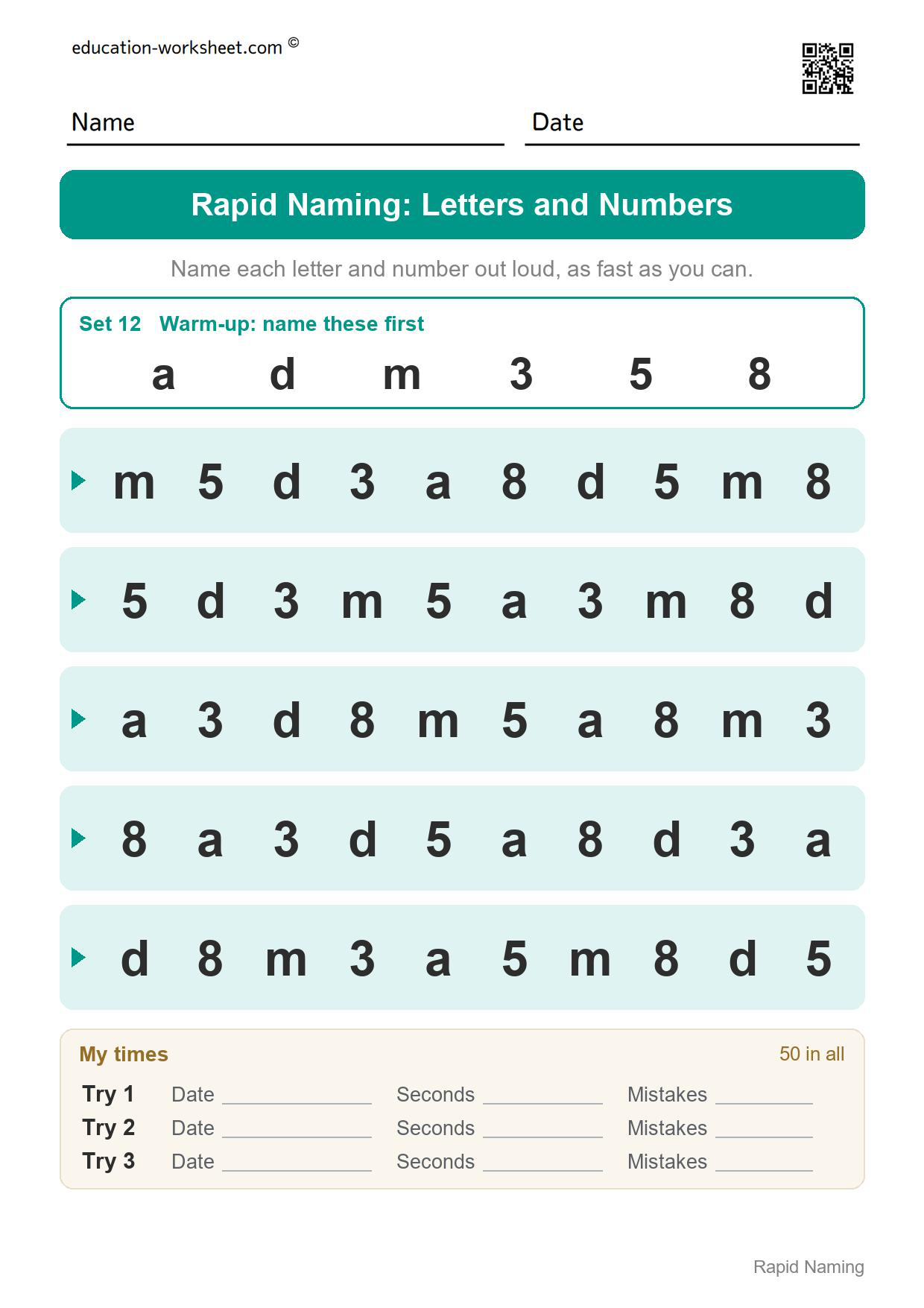
Set 12 – Letters and Numbers Mixed: a, d, m and 3, 5, 8
The second mixed page. As on Set 11, no letter is ever followed two places later by the same letter, and no number by the same number, so the child cannot coast on a pattern.
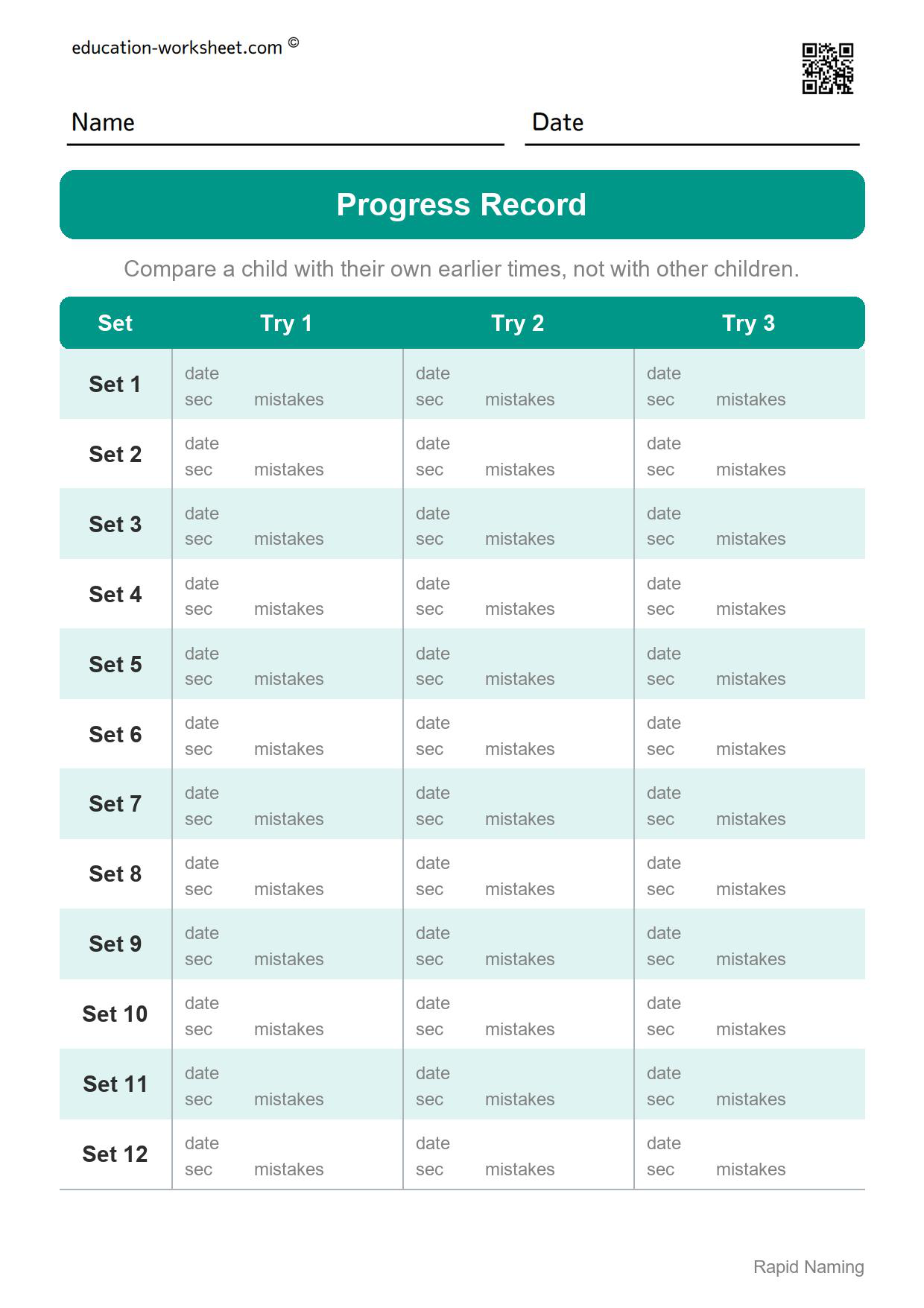
Progress Record – Three Tries for Every Set
There is no answer key, because every answer is printed on the page. Instead, the last sheet is a record with room for three tries on each of the twelve sets. Each worksheet also has its own three-try box at the bottom, so you can use whichever is easier.
How the Rows Are Built
A naming chart only works if the child has to look at every symbol. If a row can be said from memory, or in a rhythm, it stops measuring naming and starts measuring memory. So every page in this pack was generated and then checked against a set of rules before it was printed.
- Every symbol appears exactly ten times on the letter and number pages. On the mixed pages there are twenty-five letters and twenty-five numbers.
- No symbol ever appears twice in a row, including from the end of one row to the start of the next.
- On the letter and number pages, the five rows start with five different symbols, so the first item of a row is never a guess.
- No run of four symbols is repeated anywhere on a page, and no run of three appears more than twice.
- No back-and-forth patterns such as 5, 1, 5, 1. These are easy to say in a rhythm without really looking.
- Letters that are easy to confuse are never on the same page: b, d, p and q; 6 and 9; the letter o and the number 0.
The letters are printed in a plain book-style typeface, with the two-story a that children see in most books. The order of the warm-up row is not the order of the chart below it, so a child who memorizes the warm-up gains nothing.
What Rapid Naming Practice Can and Cannot Do
It can make the names of letters and numbers more automatic, give a child a short task they can see themselves improving at, and give you a record that is far more reliable than a general impression. Many children enjoy trying to beat their own time.
It cannot diagnose dyslexia or any other reading difficulty, and research has not shown that practicing naming charts, on its own, makes children better readers. Reading also depends on knowing letter sounds, blending them into words and understanding what the words mean. Use these sheets alongside that work, not instead of it.
If a child still cannot name the letters of the alphabet by the end of kindergarten, or if naming is very slow and effortful and reading is also a struggle, talk to their teacher, a reading specialist or a speech-language professional. They can look at the whole picture in a way that a worksheet cannot.
When Children Are Ready for Rapid Naming
- Age: about five to seven – kindergarten and first grade. Older children who read slowly can also use the sheets.
- Before starting: the child should know the names of every symbol on the page. Check with the warm-up row; if a name is missing, teach it first and come back to that set later.
- RF.K.1.D – recognize and name all upper- and lowercase letters of the alphabet. The letter sets practice the lowercase half of this standard.
- RF.1.4 – read with sufficient accuracy and fluency to support comprehension. Quick, accurate naming is one of the building blocks of fluency.
- Reading the numerals 0 to 9 is assumed throughout kindergarten counting and cardinality work (K.CC).
How to Use These Worksheets
- Start with Set 1. Point to each symbol in the warm-up row and ask the child to name it. If any name is wrong, stop and teach it before going on.
- Show the child the arrow at the start of each row and explain that they will read across, like a book, and then go to the next row.
- Say “Ready, go” and start a stopwatch. Stop it when the child names the last symbol on the page.
- Count mistakes: a wrong name or a skipped symbol. If the child corrects a mistake straight away without help, count it as correct.
- Write the date, the seconds and the mistakes in the first box at the bottom of the page.
- Repeat the same set on another day, not straight away, and fill in the next box. Move on to the next set when the child is naming smoothly with few mistakes.
Three Things to Watch For
1. Speed bought with mistakes. A faster time with more mistakes is not progress. If the mistakes go up, ask the child to slow down a little; accuracy comes first, and speed follows from it.
2. Losing the place. Skipping a row or reading one twice is common at this age and says more about tracking than about naming. Letting the child slide a finger under each row, or covering the rows below with a card, usually fixes it.
3. Comparing with other children. These sheets have no target times, and times are not comparable between sets either: Set 4 has three-syllable w and Set 7 has two-syllable zero. Compare each child only with their own earlier tries on the same set.
Printing Tips
- Print at 100 percent, actual size, on A4 or US Letter. The symbols are large enough to read at arm’s length.
- Black and white printing works perfectly; nothing on the charts depends on color.
- If you plan to use a page many times, put it in a plastic sleeve and write the times on the progress record instead.
Frequently Asked Questions
What is rapid automatic naming?
It is the ability to look at a row of familiar symbols, such as letters, numbers, colors or pictures, and say their names quickly and accurately. Researchers often call it RAN. It is closely linked to reading fluency, which is why teachers and specialists pay attention to it.
What age are these rapid naming worksheets for?
About five to seven years old, in kindergarten and first grade. The child needs to know the names of the letters or numbers on a page before using it.
Is this a RAN test?
No. Published RAN tests use fixed materials and comparison data and are given by trained examiners. These sheets are for practice and for tracking a child’s own progress, and they cannot diagnose anything.
How fast should my child be?
There is no target time on these sheets. Times depend on the set, the child and even the time of day. What matters is whether the same child becomes quicker and more accurate on the same set over several weeks.
Can practicing rapid naming improve reading?
Naming practice can make letter and number names more automatic, but research has not shown that it improves reading on its own. It works best as one small part of reading practice that also includes letter sounds and decoding words.
Do I need to sign up to download these?
No. Every PDF downloads immediately, with no account, no email address and no cost.
Can I use these in my classroom or therapy room?
Yes, they are free to print for home, classroom and therapy use. Please do not sell them or re-host the files elsewhere.
More Free Letter and Number Worksheets
- Free Find the Letter Worksheets for Kindergarten – Letter Recognition
- Free Uppercase and Lowercase Letters Worksheets for Kindergarten – Match the Letters
- Free Vowels Worksheets for Kindergarten – Circle the Vowels A, E, I, O, U
- Free Sight Words Worksheets for Kindergarten – 12 Words to Trace, Write and Find
- Free CVC Word Building Worksheets for Kindergarten – Make Three Letter Words
- Free Number Tracing Worksheets 1-10 for Kindergarten – Trace, Count and Write
- Free Auditory Memory Worksheets for Kids – Listen and Repeat
- Free Final Consonant Deletion Worksheets – Minimal Pairs PDF