
These free printable word family worksheets give kindergarten and first grade children sixty short words to read and write, six at a time. Each page takes one word ending – -at, -ig, -ug and seven more – and puts a different letter in front of it six times over.
The answer is printed on the page. The child sees c and -at side by side and writes cat on the line. Nothing is hidden, and that is deliberate: the work here is blending two pieces into one word and getting it down on paper, not solving a puzzle.
Ten families, sixty words, every one of them three letters long and no word repeated.
- What Is in This Free Word Family Worksheet Pack
- The 11 Word Family Worksheets
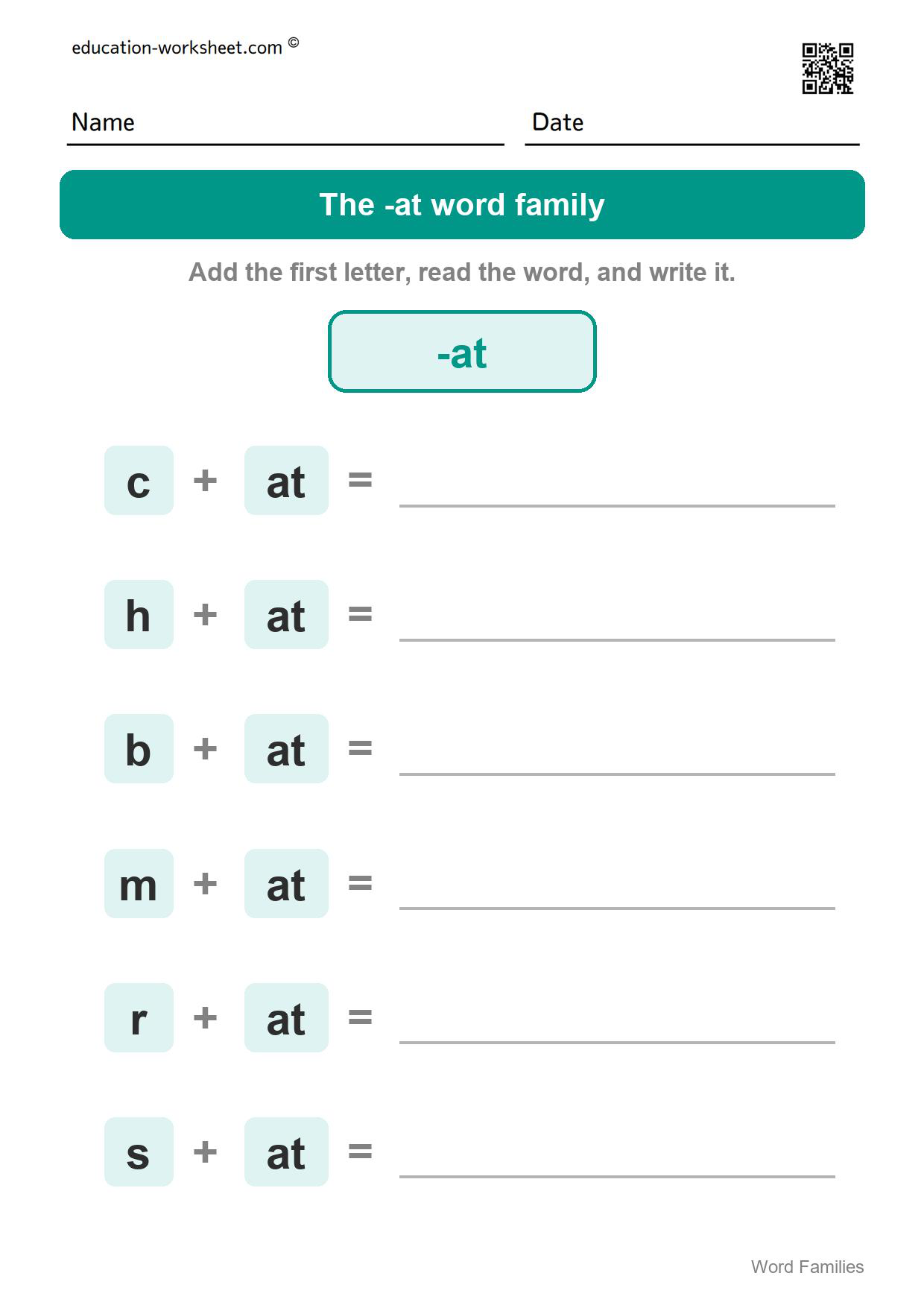
- The -at Family – cat, hat, bat, mat, rat, sat
- The -an Family – can, man, pan, ran, fan, van
- The -ap Family – cap, map, nap, tap, lap, gap
- The -ig Family – big, dig, fig, pig, wig, jig
- The -ip Family – dip, hip, lip, rip, sip, tip
- The -ot Family – cot, dot, hot, pot, not, lot
- The -og Family – dog, fog, hog, jog, log, bog
- The -ug Family – bug, hug, jug, mug, rug, tug
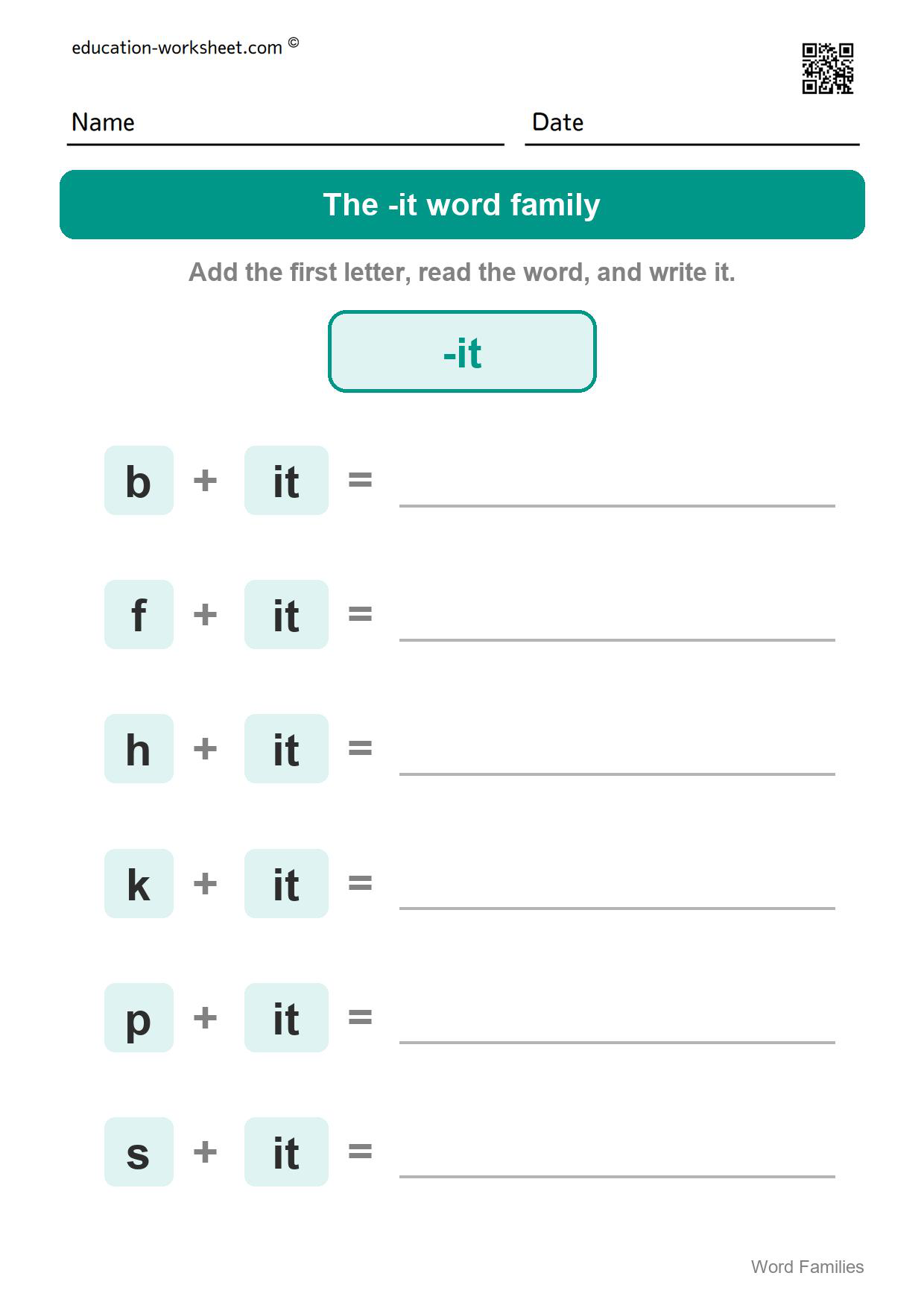
- The -it Family – bit, fit, hit, kit, pit, sit
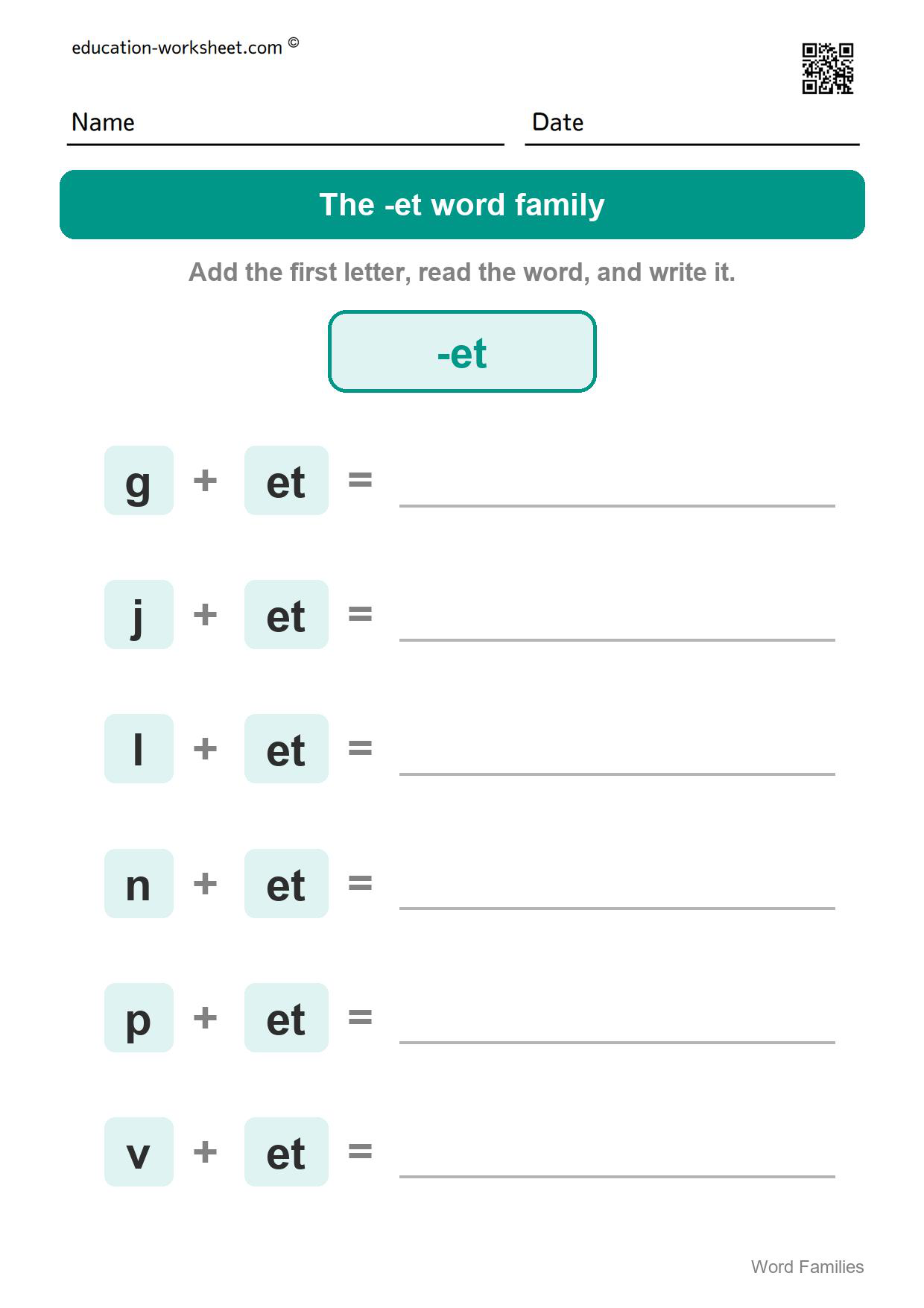
- The -et Family – get, jet, let, net, pet, vet
- Answer Key – All 60 Words
- What the Sixty Words Are Made Of
- When Children Are Ready for Word Families
- How to Use These Worksheets
- Three Things to Watch For
- Printing Tips
- Frequently Asked Questions
- More Free Phonics and Reading Worksheets
What Is in This Free Word Family Worksheet Pack
- Ten printable worksheets, one word family on each: -at, -an, -ap, -ig, -ip, -ot, -og, -ug, -it and -et.
- Six words per page – sixty in total, all three letters, all different.
- A writing line for every word, so the child reads it and then writes it.
- An eleventh page listing all sixty words as an answer key.
- All five short vowels, and every consonant except q, x, y and z.
- A separate PDF for every page, free to download and print.
The 11 Word Family Worksheets
The order of the pages is an order of vowels, and it is not a tidy one. Short a runs for three pages, short i for two, short o for two, then short u gets a single page, then short i comes back, and short e closes the pack with one page of its own.
Written out, the vowel order is a, a, a, i, i, o, o, u, i, e. A child working through in order settles into a sound, changes, settles again, and then has to change twice in the last two pages. If that is one shift too many, do pages 1 to 8, then come back for 9 and 10 another day.
The -at Family – cat, hat, bat, mat, rat, sat
c, h, b, m, r and s, each added to -at. Five of the six are things a child can picture, which is why -at is where almost every reading scheme starts.
This is the page to do first and the page to come back to. If a child can write all six of these without help, the other nine families are the same job with a different ending.
The -an Family – can, man, pan, ran, fan, van
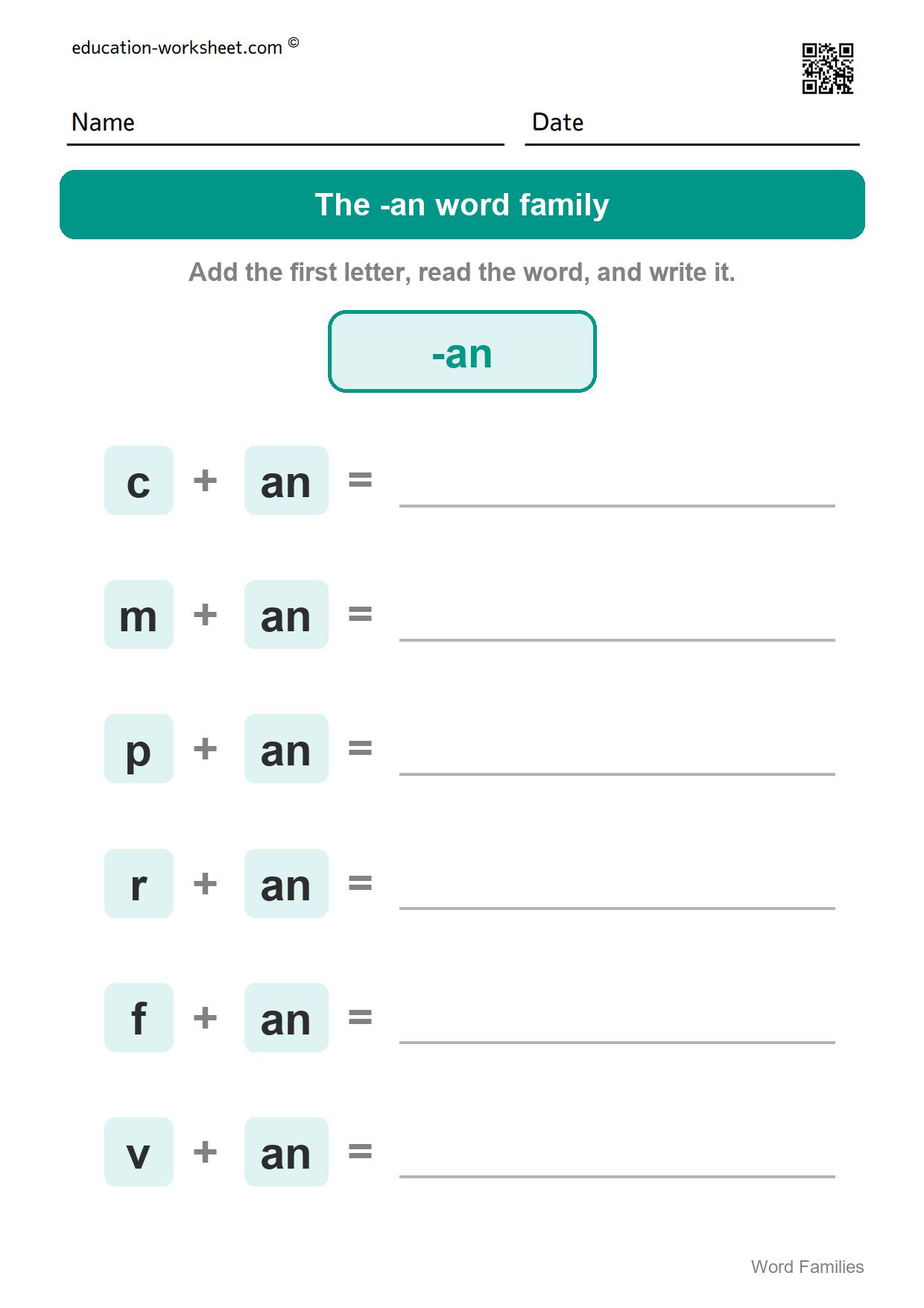
c, m, p, r, f and v with -an. Still short a, so the vowel sound has not moved since page 1 – only the consonant at the end.
Ran is the first word in the pack that is not a thing. A child can draw a fan and a van; running has to be acted out.
The -ap Family – cap, map, nap, tap, lap, gap
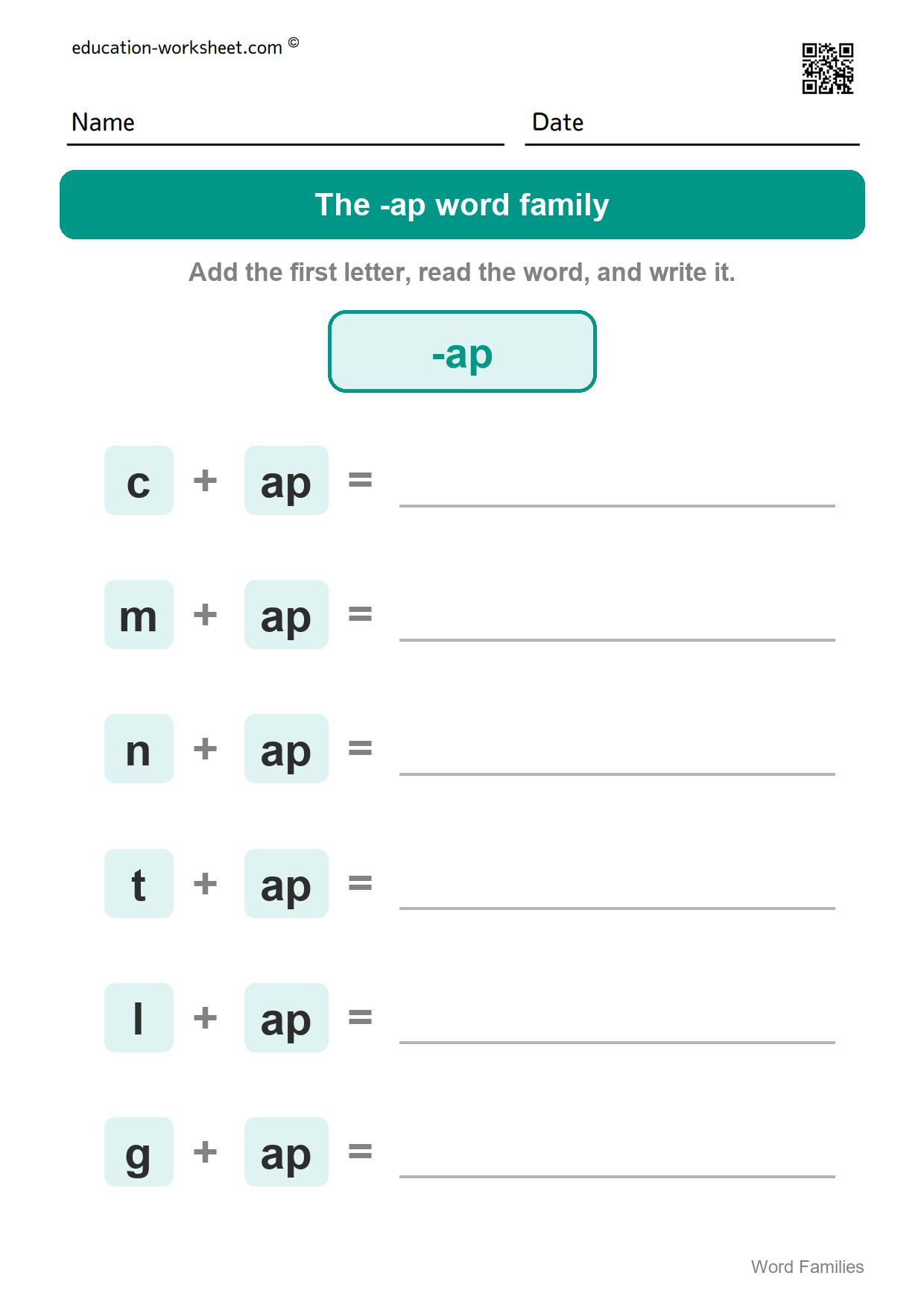
c, m, n, t, l and g with -ap, the third and last short-a family.
Gap and lap are the two to talk about before the child starts. Both are ordinary words for an adult and neither is obvious to a five-year-old. Say them in a sentence first: the gap between two teeth, sitting on someone’s lap.
The -ig Family – big, dig, fig, pig, wig, jig
b, d, f, p, w and j with -ig. The vowel changes here for the first time, from short a to short i, which is the real step on this page.
Fig and jig are the hardest two words in the pack. A fig is a fruit most children have not eaten and a jig is a dance almost nobody mentions any more. They are genuine words and they rhyme correctly, but do not expect them to be read from meaning.
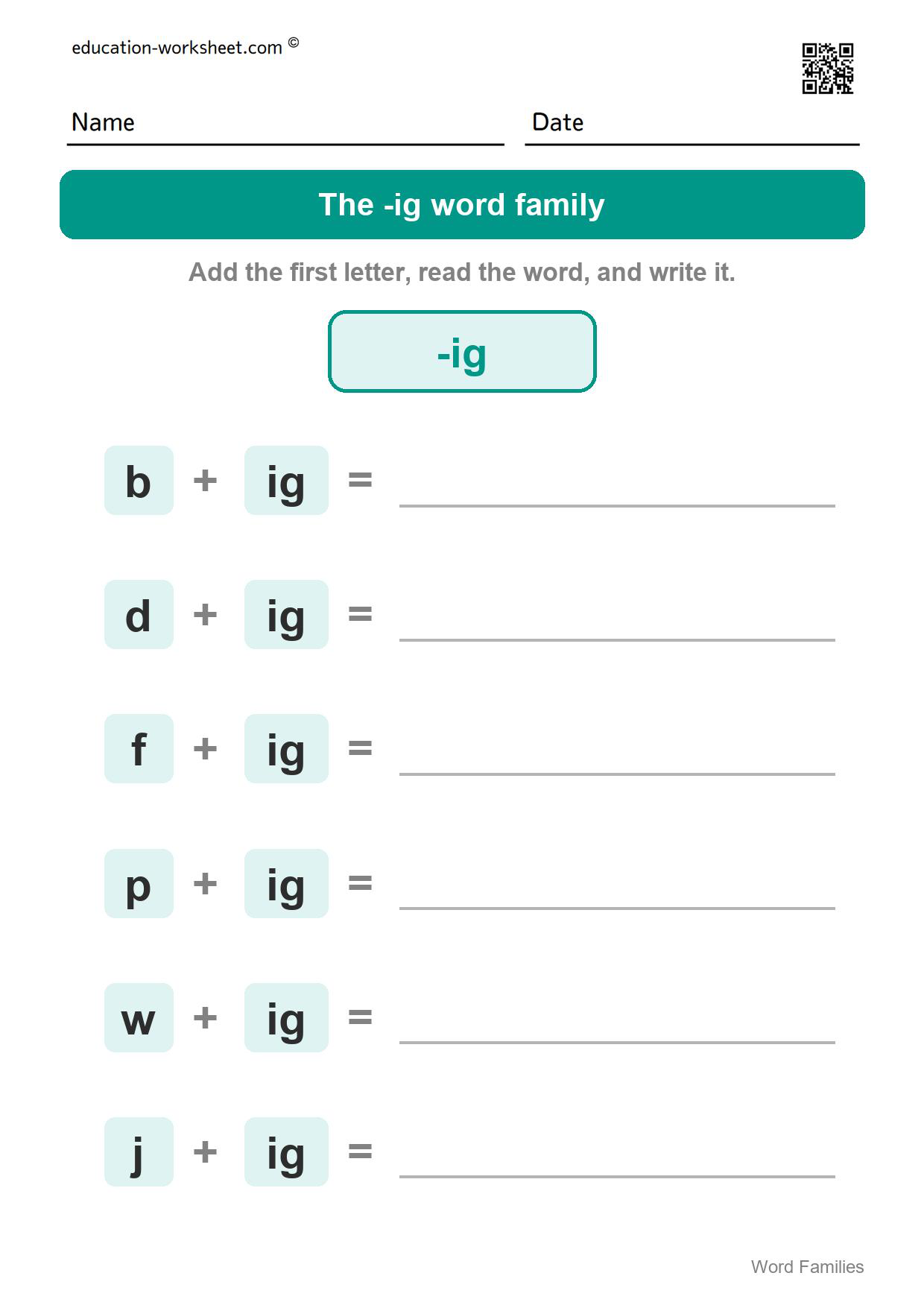
The -ip Family – dip, hip, lip, rip, sip, tip
d, h, l, r, s and t with -ip, and the first letters happen to run in alphabetical order.
Four of these six are actions – dip, rip, sip, tip. Word families are about how words are spelled, not about what can be drawn, and this is the page where that becomes obvious.
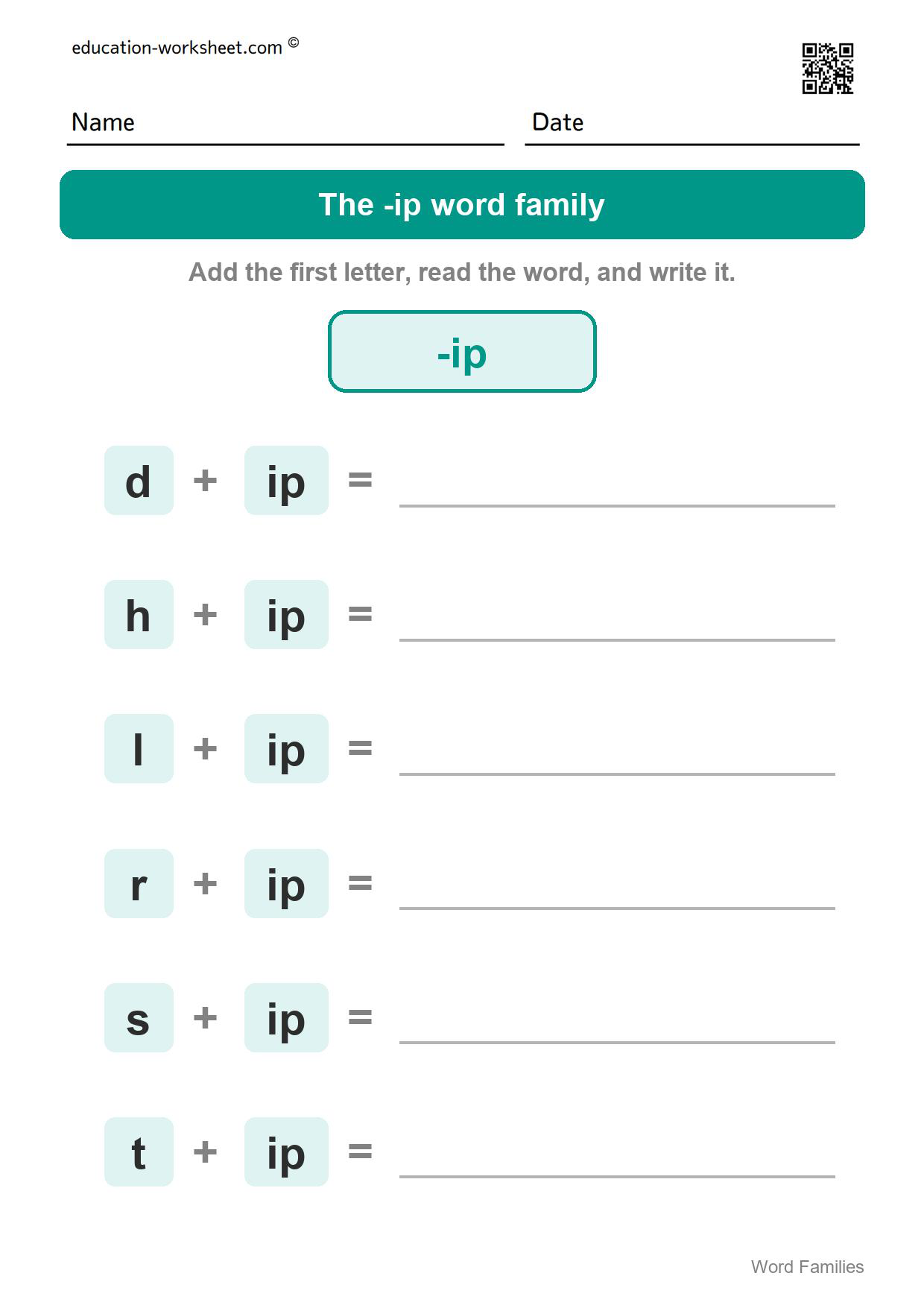
The -ot Family – cot, dot, hot, pot, not, lot
c, d, h, p, n and l with -ot. Short o arrives, the third vowel of the pack.
Not and lot are the first words here that mean nothing on their own, and they matter more than the picturable ones: those are the words a child will meet in every sentence they ever read.
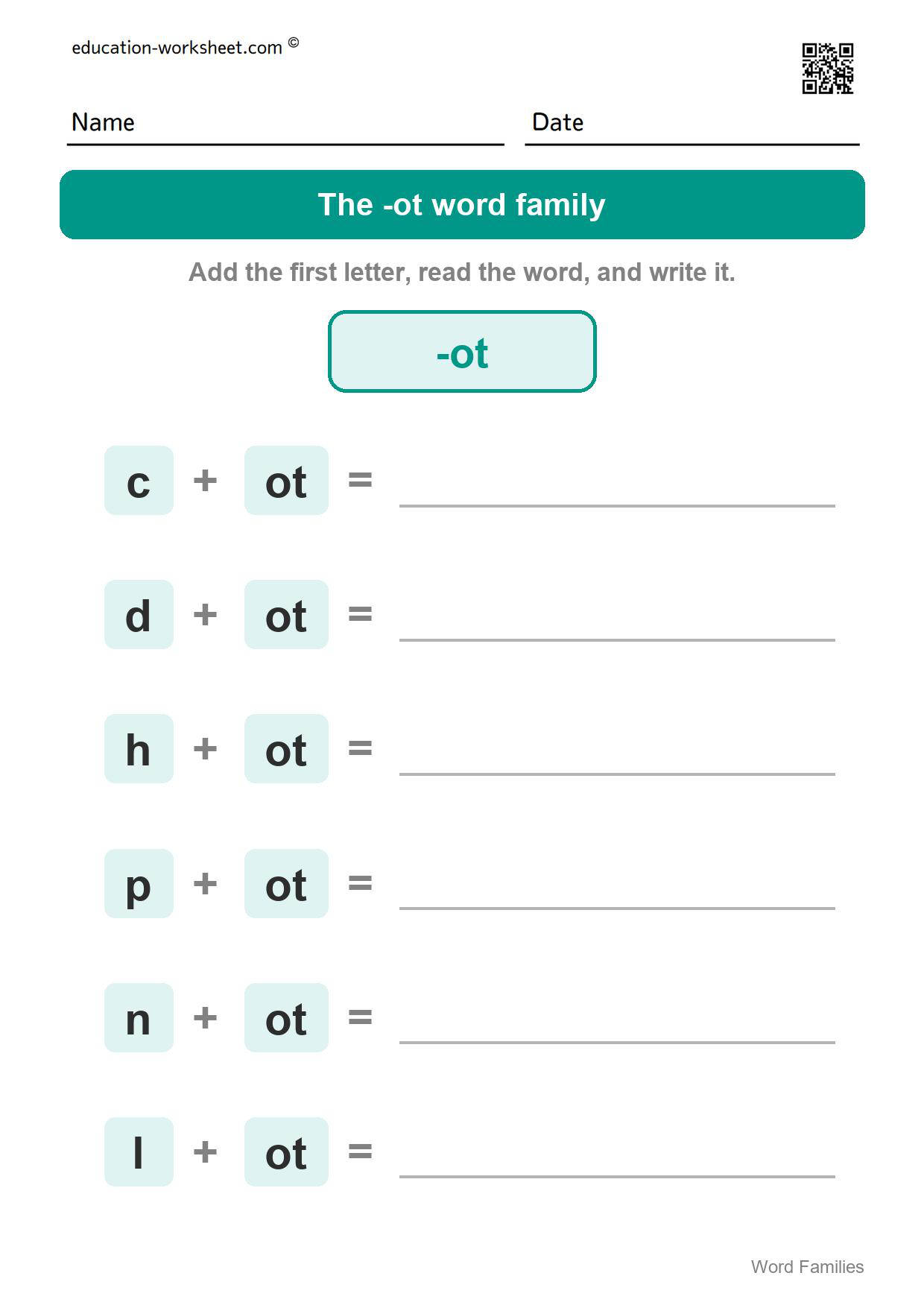
The -og Family – dog, fog, hog, jog, log, bog
d, f, h, j, l and b with -og. It opens with dog, which every child can read, and closes with bog, which almost none can.
Bog and hog are worth a sentence each before starting. The words are correct and they rhyme, but a child who does not know them will sound them out and then look at you, which is the right thing to do.
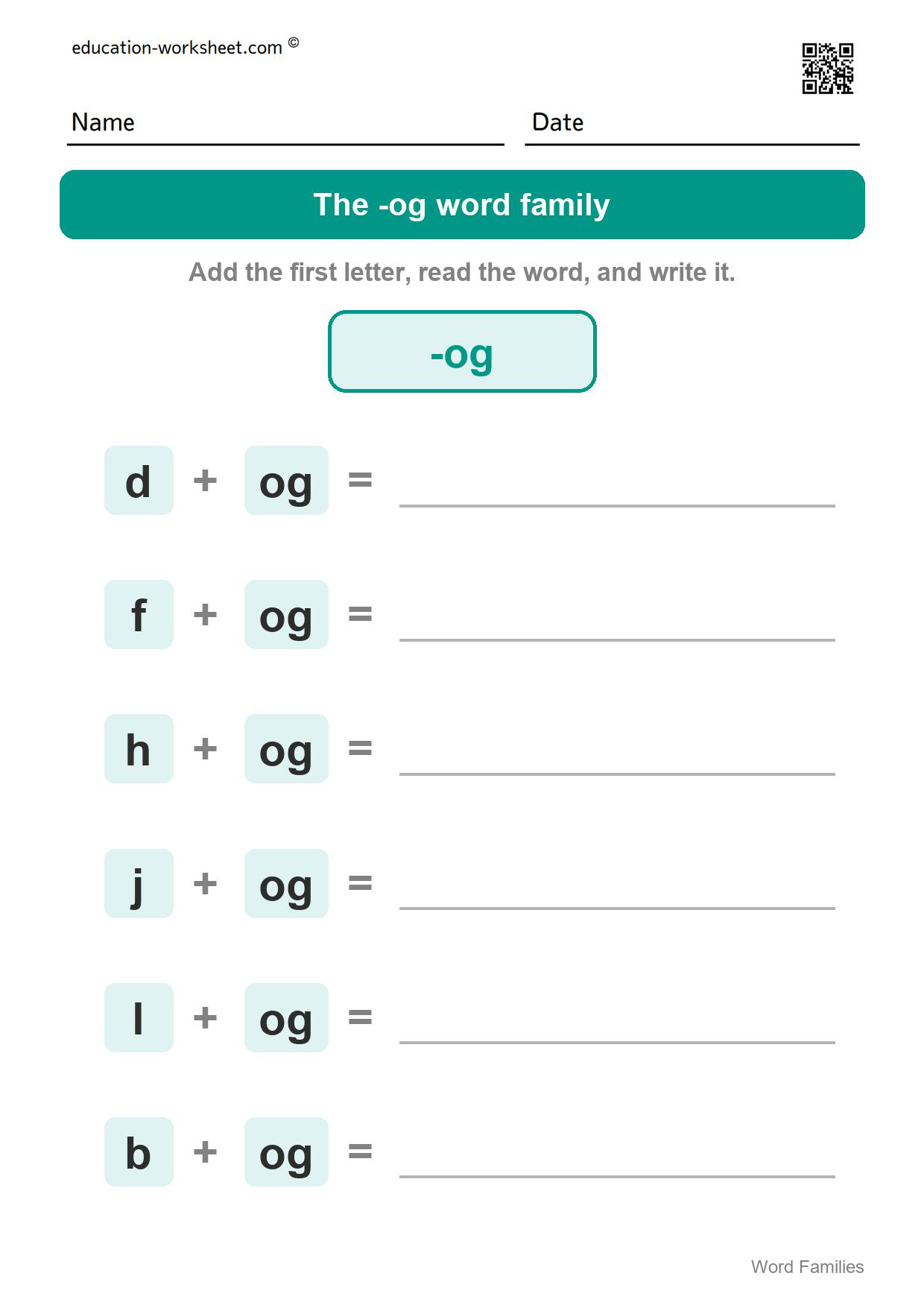
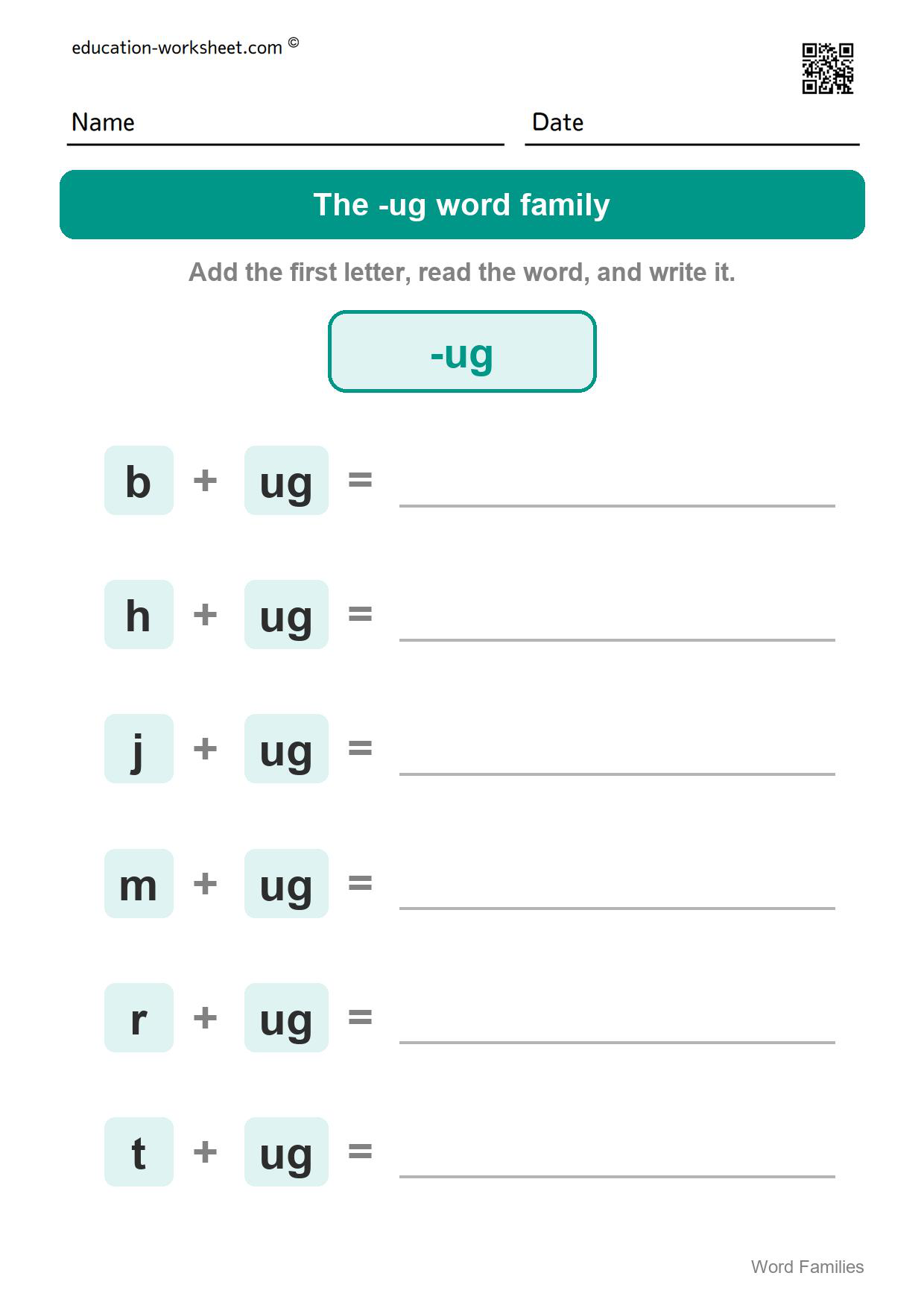
The -ug Family – bug, hug, jug, mug, rug, tug
b, h, j, m, r and t with -ug, in alphabetical order again. Short u appears here and nowhere else in the pack.
A jug and a mug on the same page, one letter apart, is a useful accident. Read them one after the other and the child hears exactly what the first letter is doing.
The -it Family – bit, fit, hit, kit, pit, sit
b, f, h, k, p and s with -it. This is the only k in the whole pack.
The vowel goes back to short i here, after short u on page 8. The families are not grouped by vowel all the way through, so a child who has settled into one sound has to shift twice near the end.
The -et Family – get, jet, let, net, pet, vet
g, j, l, n, p and v with -et. Short e, the fifth and final vowel, and it only gets this one page.
Get and let are among the most common words in written English, and they are sitting on the last page of a pack most people stop doing by page 6. Worth reaching.
Answer Key – All 60 Words
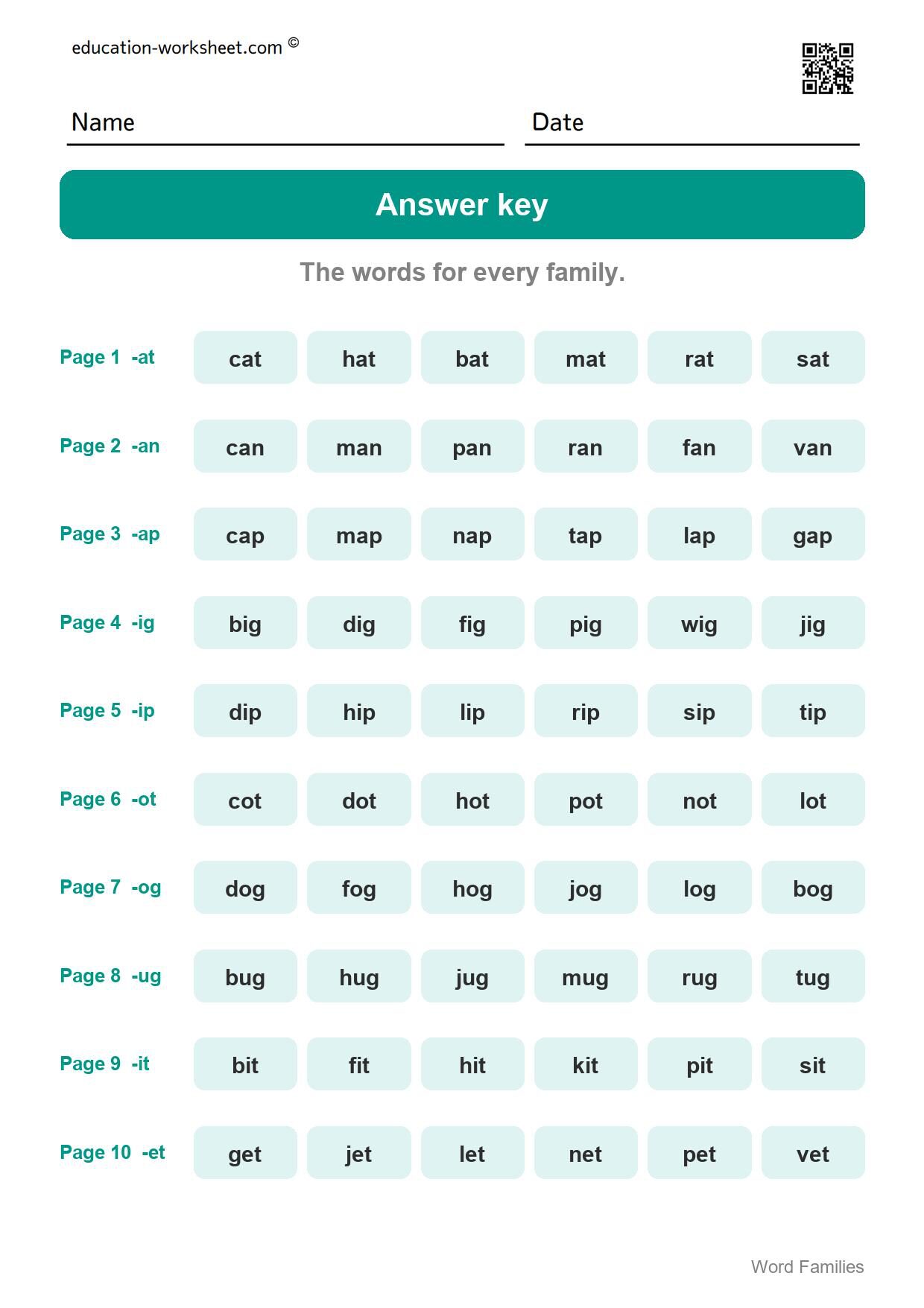
All sixty words, six to a family, on one page. Useful for checking spelling at a glance and useful as a reading list on its own.
Every word in the pack is three letters long and no word appears twice.
What the Sixty Words Are Made Of
Count the letters that start the words and you get seventeen of them: every consonant except q, x, y and z. The letter h does the most work, starting six words across six different families – hat, hip, hot, hog, hug, hit. Read those six in a row and a child hears one consonant sound attached to six different endings, which is the whole idea of the pack in one line.
Many of the sixty words are not things. Ran, sat, dip, rip, sip, tip, not, lot, jog, hug, tug, bit, fit, hit, sit, get and let cannot be drawn, and that is not a flaw. Word families teach a spelling pattern, and the words a child meets most often in real sentences are exactly the ones with nothing to picture.
Four of the ten pages happen to list their first letters in alphabetical order – the -ip, -ug, -it and -et pages. The other six do not. It is not signposted anywhere, and it makes no difference to the work, but a child who notices it has been reading the page rather than copying it.
When Children Are Ready for Word Families
- Age: about five to seven – kindergarten and the first half of first grade.
- Before starting: the child should know most letter sounds and be able to write letters without help, since every answer has to be written out.
- RF.K.2.A – recognize and produce rhyming words. Every page is six words that rhyme.
- RF.K.3.A – know the sound each consonant makes. That is the piece the child supplies.
- RF.1.3.B – decode regularly spelled one-syllable words. Sixty of them, here.
- L.K.2.D – spell simple words phonetically. The writing line is what makes this a spelling sheet and not just a reading one.
How to Use These Worksheets
- Say the ending on its own first – just at – and have the child say it back before any letter is added.
- Read the row out loud as a sum: c, at, cat. The point is to hear the join, so say the two pieces close together rather than as separate words.
- Write the word only after it has been read aloud. Writing first turns the page into copying.
- When the page is finished, read the six words down the column. They rhyme, and hearing six rhymes in a row is what makes the pattern stick.
- Pre-teach the unfamiliar ones: gap, lap, fig, jig, bog, hog, cot, tug. A sentence each is enough.
- Keep the answer key. It doubles as a sixty-word reading list once the writing is done.
Three Things to Watch For
1. Copying without reading. The whole answer is on the page, so a child can fill in all six lines correctly without ever saying a word aloud. If the page comes back perfect and silent, ask them to read it back to you.
2. Losing the vowel when it changes. After three pages of short a, the -ig page asks for a different vowel and children often carry the old sound over, reading bag for big. Say the ending on its own before starting each new family.
3. Stopping at words they do not know. Fig, jig, bog, hog, cot and gap are real words that a five-year-old may never have heard. A child who sounds one out correctly and then asks what it means has done the reading part perfectly. Answer the question and move on.
Printing Tips
- Print at 100 percent, actual size, on A4 or US Letter. The writing lines need their full height.
- Black and white is fine – there is nothing on these pages that depends on color.
- Print two copies of pages 1 and 8. The -at and -ug families are the two most children want to do again, and repeating them costs nothing.
Frequently Asked Questions
What is a word family?
A group of words that end the same way and rhyme, such as cat, hat and bat. Change the first letter and you have a new word, which means one pattern gives a child several words at once.
What age are these word family worksheets for?
About five to seven years old. The child needs to know letter sounds and be able to write letters, because every word has to be written on the line.
Which families are included?
Ten of them, in this order: -at, -an, -ap, -ig, -ip, -ot, -og, -ug, -it and -et. That covers all five short vowels.
Is there an answer key?
Yes, page 11 lists all sixty words family by family.
Some of the words are unusual. Is that a mistake?
No. Fig, jig, bog, hog, cot and gap are all real words that fit their family exactly. Say each one in a sentence before the child starts that page.
Should we do the pages in order?
Yes. The vowel changes as you go, and the order moves from the easiest sound to the least practiced one.
Do I need to sign up to download these?
No. Every PDF downloads immediately, with no account, no email address and no cost.
Can I use these in my classroom?
Yes, they are free to print for home and classroom use. Please do not sell them or re-host the files elsewhere.
More Free Phonics and Reading Worksheets
- Free CVC Word Building Worksheets for Kindergarten – Make Three Letter Words
- Free Word Family Worksheets for Kindergarten – Silent E Families
- Free Rhyming Words Worksheets for Kindergarten – Words That Rhyme
- Free Beginning Sounds Worksheets for Kindergarten – Phonics
- Free Ending Sounds Worksheets for Kindergarten – Phonics
- Free Middle Sounds Worksheets for Kindergarten – Short Vowels