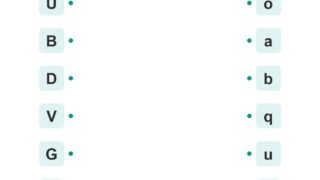
These free printable letter matching worksheets give preschool and kindergarten children twenty-six pages of practice, one for every letter of the alphabet. Each page shows a single large capital letter and three lowercase letters in circles underneath. The child circles the lowercase letter that goes with the capital.
One letter per page is deliberate. A grid of twenty-six pairs to match at once looks efficient to an adult and overwhelming to a four year old, and children who get lost in it end up guessing. A page with one capital and three choices can be finished in under a minute, which means it can be done on the days when nobody has the patience for more.
- What Is in This Free Letter Matching Worksheet Pack
- Why Some Letters Are Much Harder Than Others
- The 26 Letter Matching Worksheets
- Aa – Circle the Matching Lowercase Letter
- Bb – Circle the Matching Lowercase Letter
- Cc – Circle the Matching Lowercase Letter
- Dd – Circle the Matching Lowercase Letter
- Ee – Circle the Matching Lowercase Letter
- Ff – Circle the Matching Lowercase Letter
- Gg – Circle the Matching Lowercase Letter
- Hh – Circle the Matching Lowercase Letter
- Ii – Circle the Matching Lowercase Letter
- Jj – Circle the Matching Lowercase Letter
- Kk – Circle the Matching Lowercase Letter
- Ll – Circle the Matching Lowercase Letter
- Mm – Circle the Matching Lowercase Letter
- Nn – Circle the Matching Lowercase Letter
- Oo – Circle the Matching Lowercase Letter
- Pp – Circle the Matching Lowercase Letter
- Qq – Circle the Matching Lowercase Letter
- Rr – Circle the Matching Lowercase Letter
- Ss – Circle the Matching Lowercase Letter
- Tt – Circle the Matching Lowercase Letter
- Uu – Circle the Matching Lowercase Letter
- Vv – Circle the Matching Lowercase Letter
- Ww – Circle the Matching Lowercase Letter
- Xx – Circle the Matching Lowercase Letter
- Yy – Circle the Matching Lowercase Letter
- Zz – Circle the Matching Lowercase Letter
- When Children Are Ready for These Worksheets
- How to Use These Worksheets
- Three Things to Watch For
- Printing Tips
- Frequently Asked Questions
- More Free Alphabet Worksheets
What Is in This Free Letter Matching Worksheet Pack
- Twenty-six printable worksheets, one for each letter from A to Z.
- A large capital letter at the top of every page.
- Three lowercase letters to choose from, only one of which matches.
- Distractors chosen to be genuinely different, so a correct answer means something.
- No reading, counting or writing needed – the child only circles.
- A separate PDF for every letter – no sign-up, no email address, no cost.
Why Some Letters Are Much Harder Than Others
English uses two alphabets and expects children to treat them as one. For eight letters that is barely a problem: C, O, S, U, V, W, X and Z keep the same shape in both cases and differ only in size. A child who can see that a small circle and a big circle are both circles already has Oo.
Another seven – J, K, M, N, P, T and Y – are recognisably related, usually differing by a tail that drops below the line or a rounded corner.
The remaining eleven are the work: A, B, D, E, F, G, H, I, L, Q and R have capitals and lowercase forms that share nothing except a name. There is no rule to learn and no shortcut to teach – these pairs simply have to be met often enough to be remembered, which is exactly what a one-page-per-letter pack is for.
The 26 Letter Matching Worksheets
The pages run A to Z. If your child is just starting, do the eight same-shape letters first – C, O, S, U, V, W, X and Z – and come back to the rest.
Aa – Circle the Matching Lowercase Letter
A and a share nothing but a name. One of the hardest pairs in the alphabet, and the reason this page comes first. (different shapes)

Bb – Circle the Matching Lowercase Letter
B and b are unrelated shapes, and b is also the letter most often written as its mirror image, d. (different shapes)

Cc – Circle the Matching Lowercase Letter
C and c are the same shape at two sizes – one of the eight easy pairs. (same shape)

Dd – Circle the Matching Lowercase Letter
D and d look nothing alike, and d is the other half of the famous b/d mix-up. (different shapes)

Ee – Circle the Matching Lowercase Letter
E has three arms, e has a loop. Completely different shapes for the commonest letter in English. (different shapes)

Ff – Circle the Matching Lowercase Letter
F and f are different, though both keep the crossbar, which is a useful thing to point out. (different shapes)

Gg – Circle the Matching Lowercase Letter
G and g are unrelated, and g is one of the letters that hangs below the line. (different shapes)

Hh – Circle the Matching Lowercase Letter
H and h are different, but the tall left-hand stroke survives in both. (different shapes)

Ii – Circle the Matching Lowercase Letter
Capital I is a plain stroke; lowercase i gains a dot. The dot is the thing to look for. (different shapes)

Jj – Circle the Matching Lowercase Letter
J and j are nearly the same shape – the lowercase one simply picks up a dot. (similar shapes)

Kk – Circle the Matching Lowercase Letter
K and k keep the same arrangement of arms at two sizes. (similar shapes)

Ll – Circle the Matching Lowercase Letter
L has a foot, l does not. Lowercase l is also easy to confuse with capital I and the digit 1. (different shapes)

Mm – Circle the Matching Lowercase Letter
M and m both have humps, though the capital has points and the lowercase one is rounded. (similar shapes)

Nn – Circle the Matching Lowercase Letter
N and n both have a single hump or diagonal, which makes them easier than they look. (similar shapes)

Oo – Circle the Matching Lowercase Letter
O and o are the same shape at two sizes, and usually the first pair a child gets right. (same shape)

Pp – Circle the Matching Lowercase Letter
P and p are the same shape, except that p drops below the line. That drop is the whole difference. (similar shapes)

Qq – Circle the Matching Lowercase Letter
Q and q are different shapes, and q is one of the four letters children reverse most often. (different shapes)

Rr – Circle the Matching Lowercase Letter
R and r are unrelated, and lowercase r keeps only a small hook of the capital. (different shapes)

Ss – Circle the Matching Lowercase Letter
S and s are the same shape at two sizes. (same shape)

Tt – Circle the Matching Lowercase Letter
T and t both have a crossbar, though the lowercase one curves at the foot. (similar shapes)

Uu – Circle the Matching Lowercase Letter
U and u are the same shape – one of the easy pairs. (same shape)

Vv – Circle the Matching Lowercase Letter
V and v are the same shape at two sizes. (same shape)

Ww – Circle the Matching Lowercase Letter
W and w are the same shape, and one of the last letters children learn to say. (same shape)

Xx – Circle the Matching Lowercase Letter
X and x are the same shape, and the only letter where size is genuinely the only difference for most children. (same shape)

Yy – Circle the Matching Lowercase Letter
Y and y look alike, except that the lowercase one hangs below the line. (similar shapes)

Zz – Circle the Matching Lowercase Letter
Z and z are the same shape at two sizes, and a good page to finish on. (same shape)

When Children Are Ready for These Worksheets
These pages suit children from about three and a half to six years old. A child does not need to know any letter sounds – this is a looking task, not a reading one – though knowing a few letter names makes it more enjoyable.
In American classrooms this is a kindergarten reading foundation standard: recognising and naming all upper- and lowercase letters of the alphabet (Common Core RF.K.1.D). It is one of the strongest early predictors of later reading, which is why it gets so much classroom time.
How to Use These Worksheets
- Print one page and name the capital letter out loud together.
- Point at each of the three choices and let your child say which one matches.
- Circle it. If they are unsure, cover the two wrong answers and put them back one at a time.
- Keep finished pages in a folder in alphabetical order – the growing stack is its own reward.
- Do one letter a day rather than several. Twenty-six days is a reasonable pace.
Three Things to Watch For
b and d
The most famous confusion in early reading, and completely normal until about seven. Neither page tries to teach the difference; they simply give repeated, low-pressure exposure, which is what actually works.
Choosing by size instead of shape
Some children learn that the answer is “the small one”, which works on every page because all three choices are lowercase. If you suspect this, ask why they chose it – a child who says “because it is little” has spotted a pattern in the worksheet rather than in the alphabet.
Letters that hang below the line
g, j, p, q and y drop below the writing line, and children often read them as upside down or wrong. Pointing out that the tail is meant to hang down usually settles it in one conversation.
Printing Tips
- Choose Actual size or Fit to page so the letters and pictures stay large.
- Each page fills one sheet and works on both US Letter and A4 paper.
- Slip a page into a plastic wallet and use a dry-wipe pen to reuse it with more than one child.
- These pages are black and white and use very little ink, so printing all twenty-six at once is cheap.
Frequently Asked Questions
What age are these letter matching worksheets for?
About three and a half to six years old – preschool, pre-K and kindergarten.
Does my child need to know letter sounds first?
No. Matching the shapes comes before the sounds, and this pack only asks a child to look.
Which letters should we start with?
C, O, S, U, V, W, X and Z – the eight whose capital and lowercase forms are the same shape.
Is there a page for every letter?
Yes, all twenty-six from A to Z, each as its own PDF.
Do I need to sign up to download these?
No. Every PDF downloads immediately, with no account, no email address and no cost.
Can I use these in my classroom?
Yes, they are free to print for home and classroom use. Please do not sell them or re-host the files elsewhere.
More Free Alphabet Worksheets
- Free Uppercase and Lowercase Letters Worksheets – Mixed Practice
- Free Trace the Alphabet Worksheets A to Z
- Free Find the Letter Worksheets – Letter Recognition
- Free Missing Letters Worksheets – Alphabet Order
- Free ABC Order Worksheets – Alphabetical Order Practice
- Free Letter Tracing Worksheets A to Z