These free printable pattern worksheets give preschool and kindergarten children ten pages of practice working out what comes next. Each page shows a row of colored shapes with the last one missing, and three answers to choose from underneath. The child says the row out loud, decides what belongs in the empty box, and circles it.
The pack works through five different pattern structures, in order of difficulty: AB, ABC, AAB, ABB and AABB. That progression is the whole point. A child who only ever meets AB patterns learns a rule that sounds like “they take turns”, and that rule breaks the moment an item repeats itself. Meeting AAB and ABB early replaces it with the right idea: a chunk repeats, and the chunk can be any length.
- What Is in This Free Pattern Worksheet Pack
- The 10 Pattern Worksheets
- Worksheet 1 – AB Pattern: What Comes Next?
- Worksheet 2 – AB Pattern: What Comes Next?
- Worksheet 3 – AB Pattern: What Comes Next?
- Worksheet 4 – ABC Pattern: What Comes Next?
- Worksheet 5 – ABC Pattern: What Comes Next?
- Worksheet 6 – AAB Pattern: What Comes Next?
- Worksheet 7 – ABB Pattern: What Comes Next?
- Worksheet 8 – AABB Pattern: What Comes Next?
- Worksheet 9 – AB Pattern: What Comes Next?
- Worksheet 10 – ABB Pattern: What Comes Next?
- AB, ABC, AAB, ABB: What the Letters Mean
- When Children Are Ready for These Worksheets
- How to Use These Worksheets
- Three Things to Watch For
- Printing Tips
- Frequently Asked Questions
- More Free Shape and Pattern Worksheets
What Is in This Free Pattern Worksheet Pack
- Ten printable worksheets, one pattern on each page.
- Five structures covered: AB (four pages), ABC (two), AAB (one), ABB (two) and AABB (one).
- Three answer choices under every pattern, so there is always something to circle.
- Shapes and colors only – no reading required, so the pages suit children who are not yet reading.
- A name and date line at the top of every page.
- A separate PDF for every page – no sign-up, no email address, no cost.
The 10 Pattern Worksheets
The pages are arranged so the structures get harder, then ease off again at the end. One page is a complete session for most four year olds.
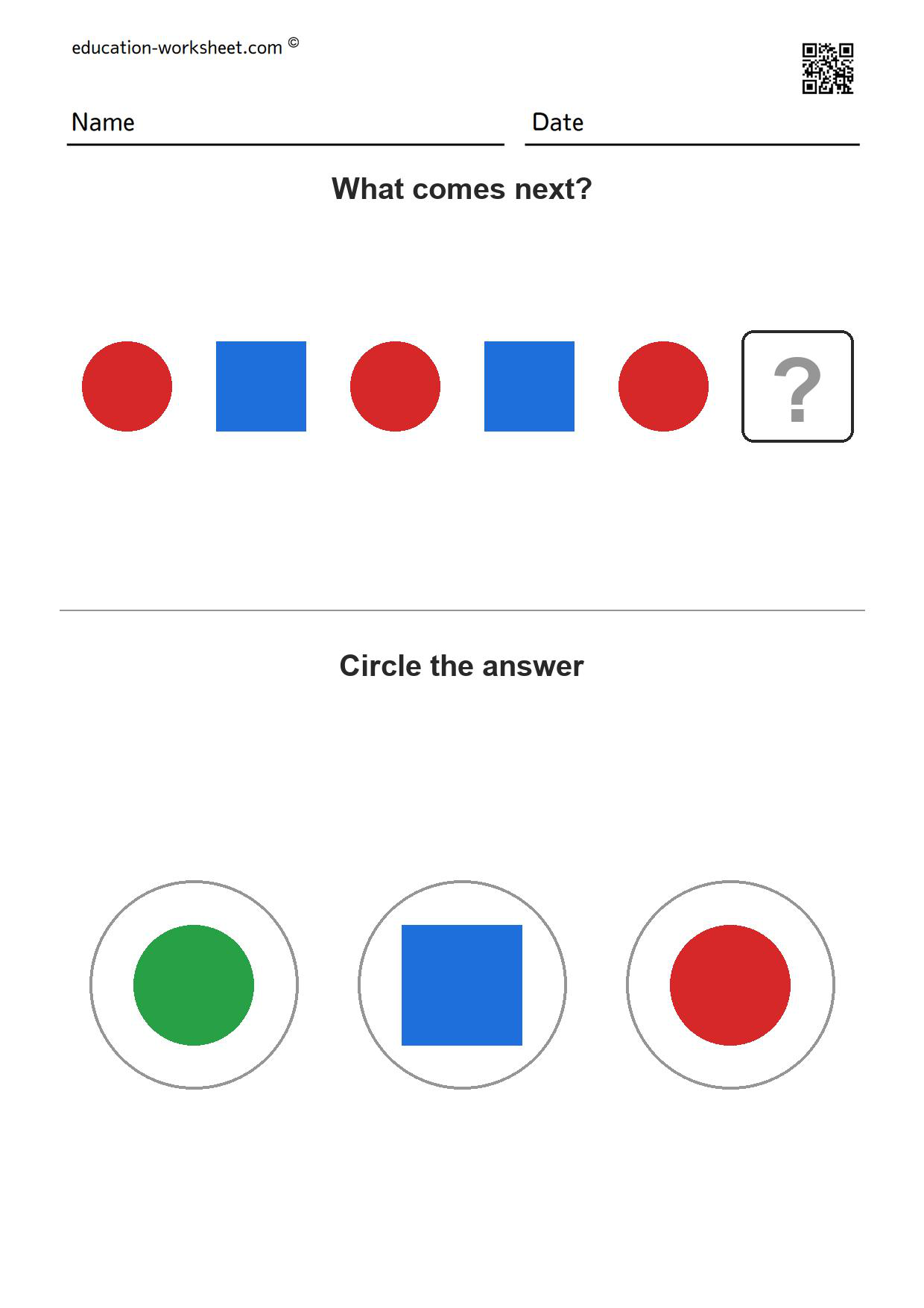
Worksheet 1 – AB Pattern: What Comes Next?
The simplest repeating pattern there is: two items taking turns. Most children can say what comes next out loud long before they can explain why, and that is fine – saying it is the first step. The row shows red circle, blue square, red circle, blue square, red circle.
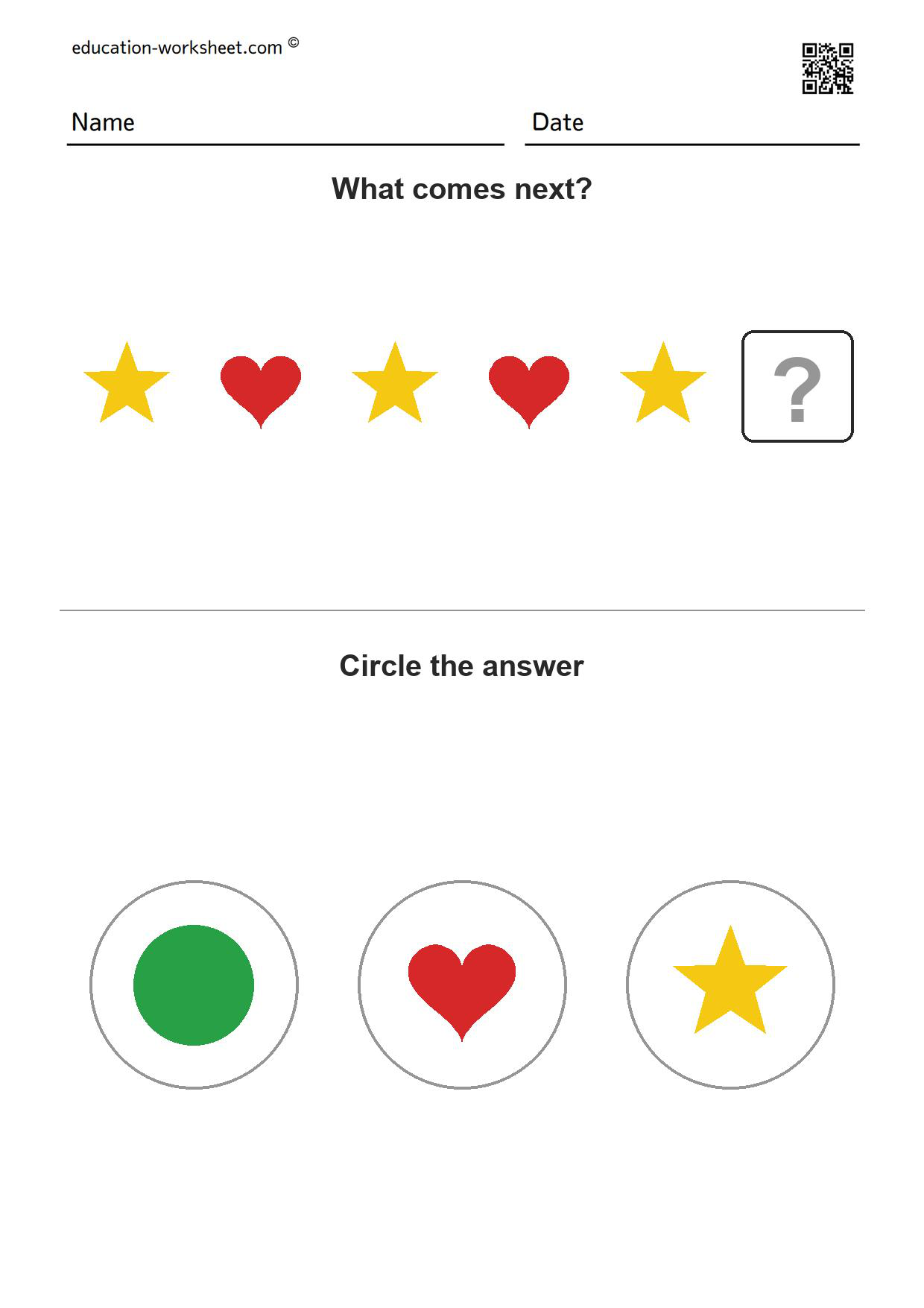
Worksheet 2 – AB Pattern: What Comes Next?
The same AB structure with different pictures. Meeting the same pattern in new clothes is what turns a lucky guess into an idea a child can use again. The row shows yellow star, red heart, yellow star, red heart, yellow star.
Worksheet 3 – AB Pattern: What Comes Next?
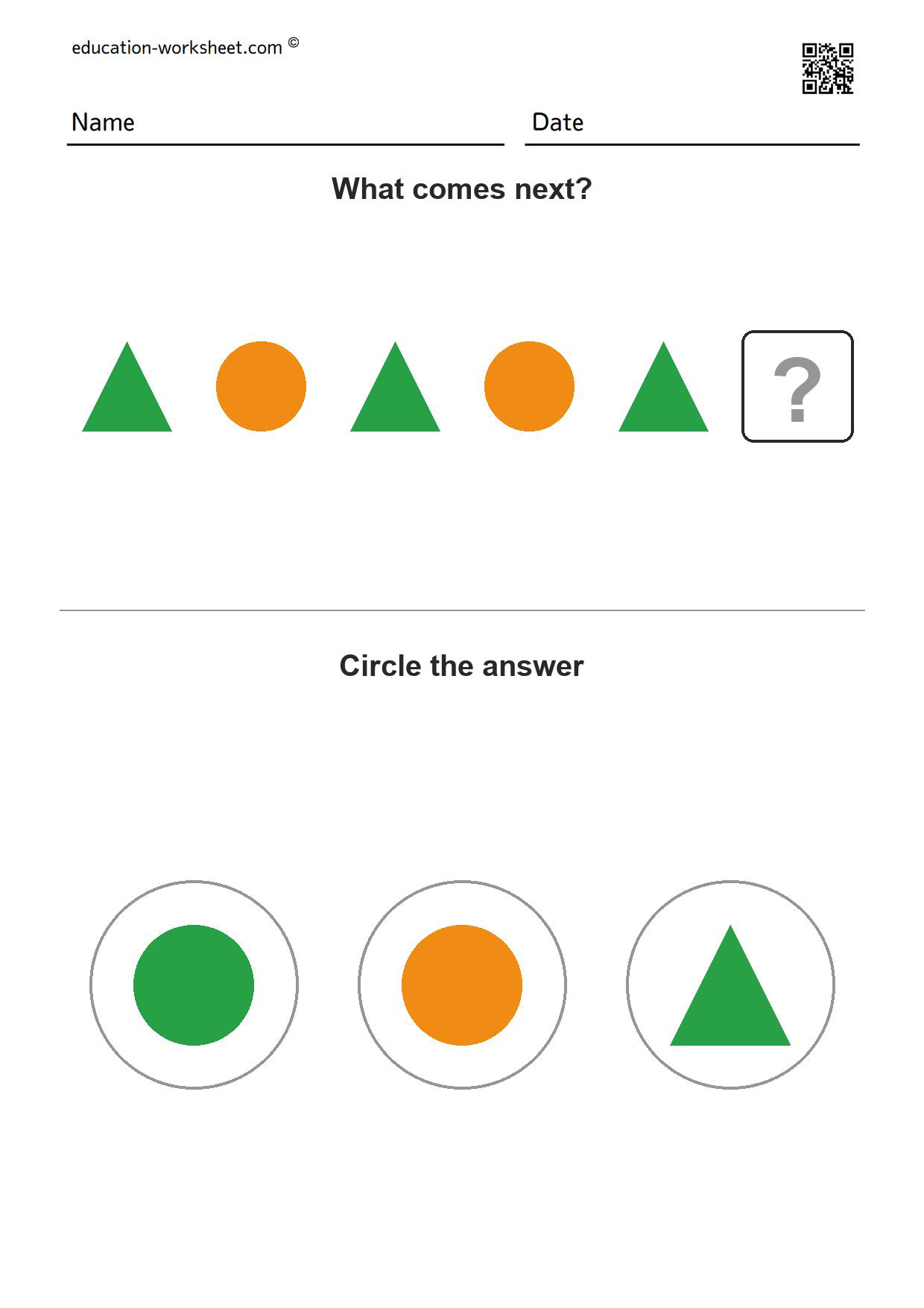
AB once more. Three pages on the easiest pattern is deliberate – a child who is solid here will pick up the harder ones quickly, and one who is not will struggle with everything that follows. The row shows green triangle, orange circle, green triangle, orange circle, green triangle.
Worksheet 4 – ABC Pattern: What Comes Next?
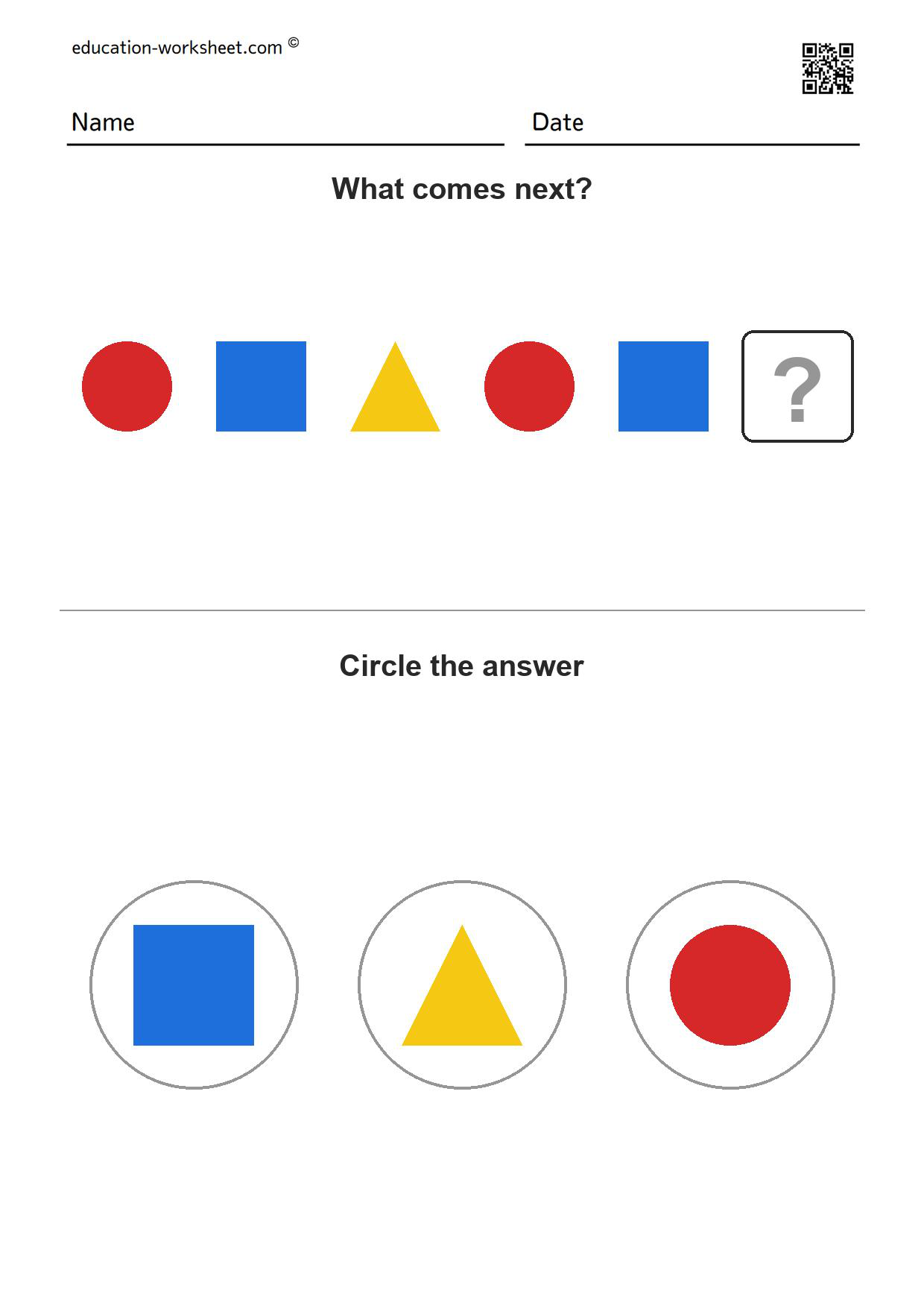
Three items in the repeat instead of two. This is a real jump: a child now has to hold three things in mind and work out where in the cycle the row has stopped. The row shows red circle, blue square, yellow triangle, red circle, blue square.
Worksheet 5 – ABC Pattern: What Comes Next?
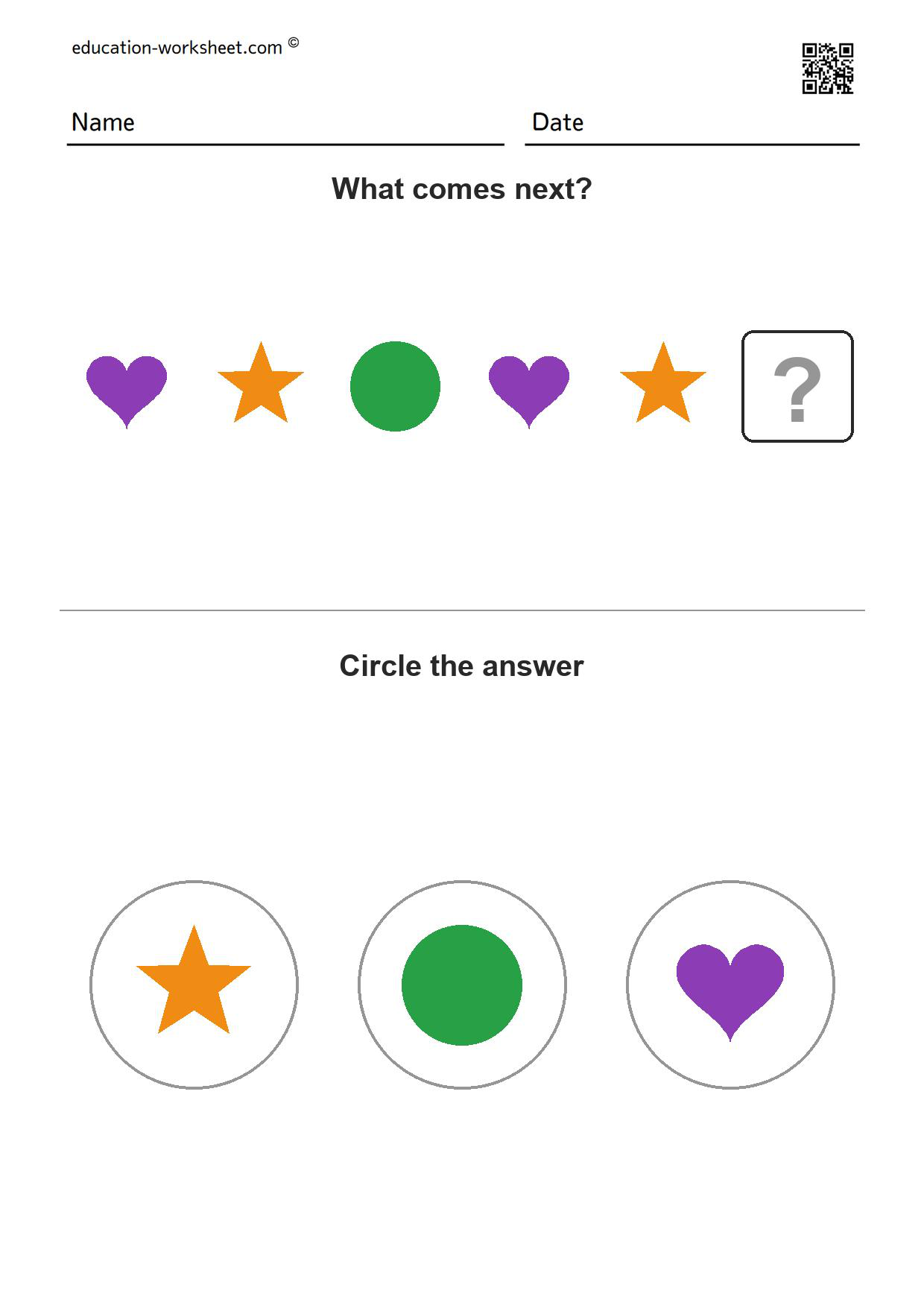
ABC again. If your child stalls, cover everything except the last three pictures and ask what came just before them. The row shows purple heart, orange star, green circle, purple heart, orange star.
Worksheet 6 – AAB Pattern: What Comes Next?
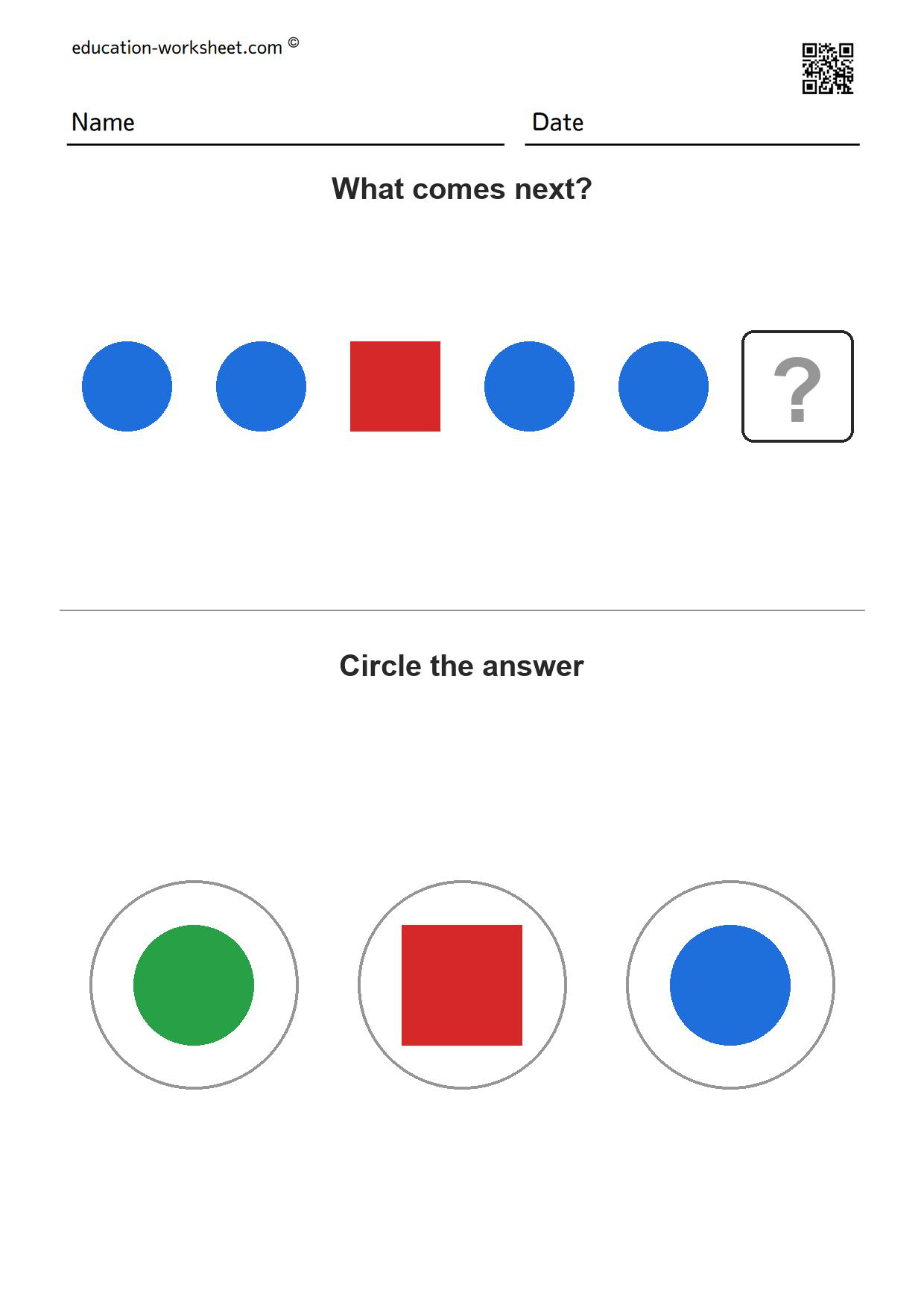
The first pattern where an item repeats inside the unit. Children who have learned “take turns” as a rule often answer this one wrong on the first try, which is exactly why it is here. The row shows blue circle, blue circle, red square, blue circle, blue circle.
Worksheet 7 – ABB Pattern: What Comes Next?
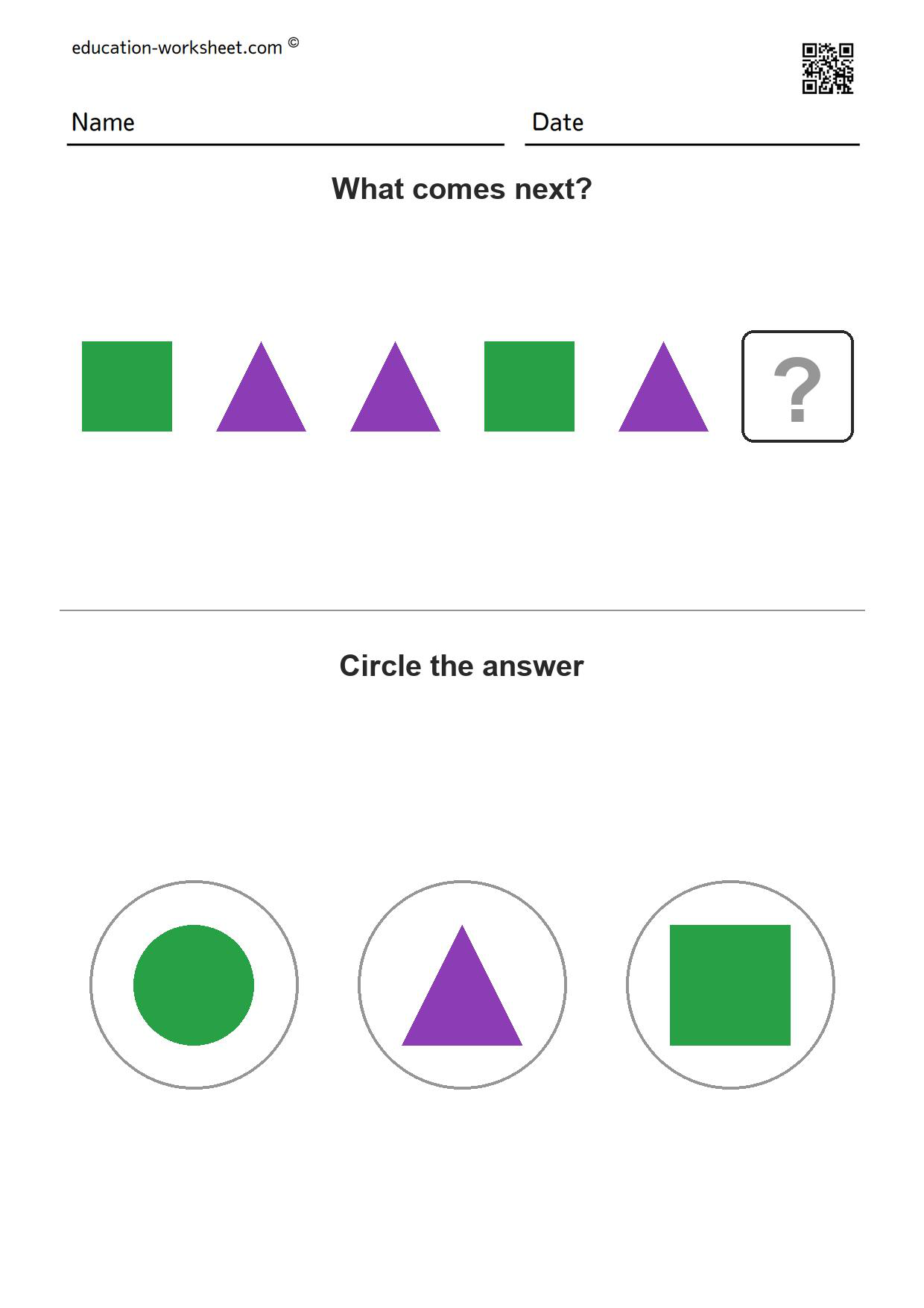
The mirror image of the page before. Comparing these two pages side by side is the fastest way to show a child that the unit is what repeats, not any single picture. The row shows green square, purple triangle, purple triangle, green square, purple triangle.
Worksheet 8 – AABB Pattern: What Comes Next?
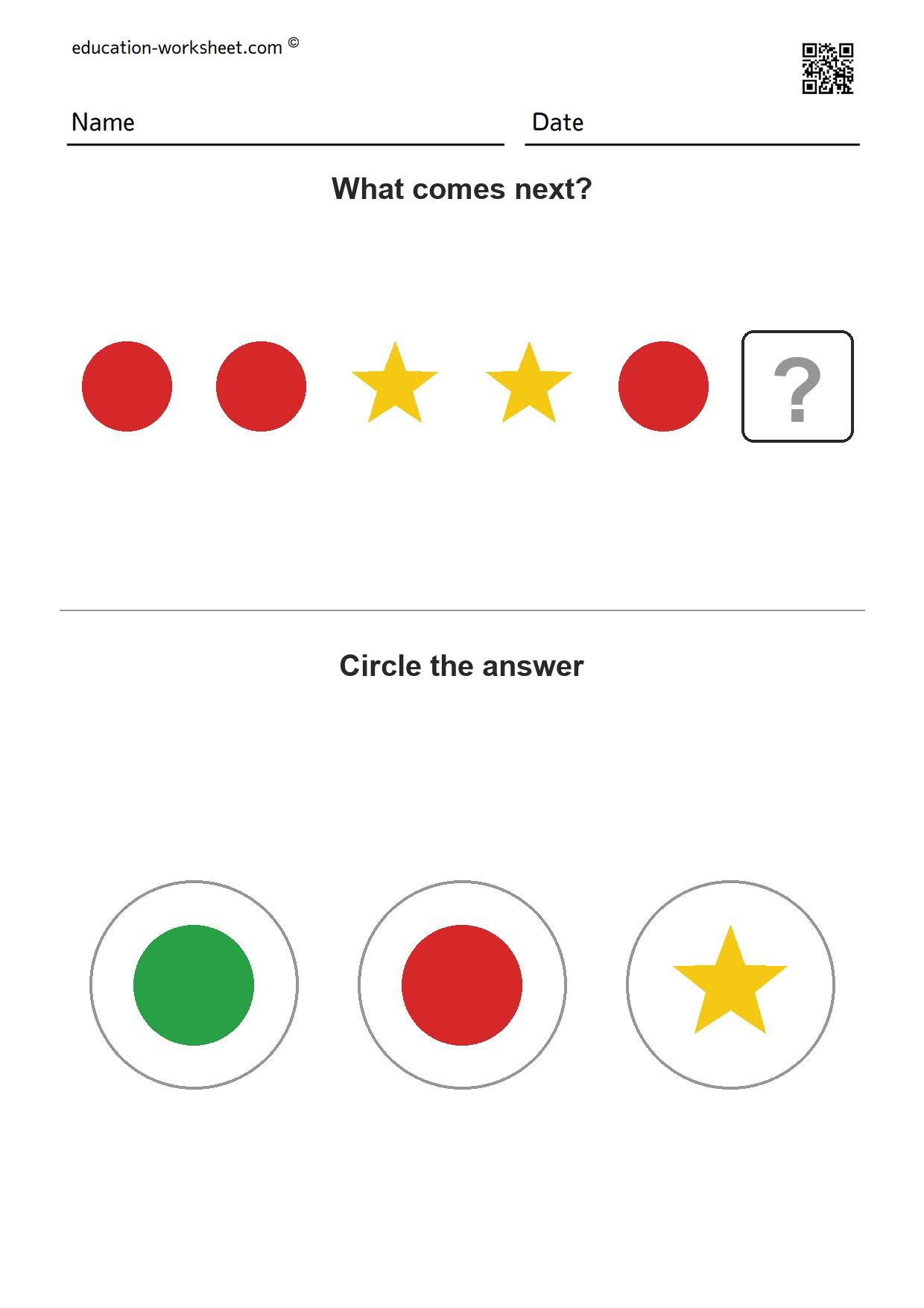
Four pictures in the repeating unit, in two pairs. This is the hardest page in the pack and the one most worth doing slowly. The row shows red circle, red circle, yellow star, yellow star, red circle.
Worksheet 9 – AB Pattern: What Comes Next?
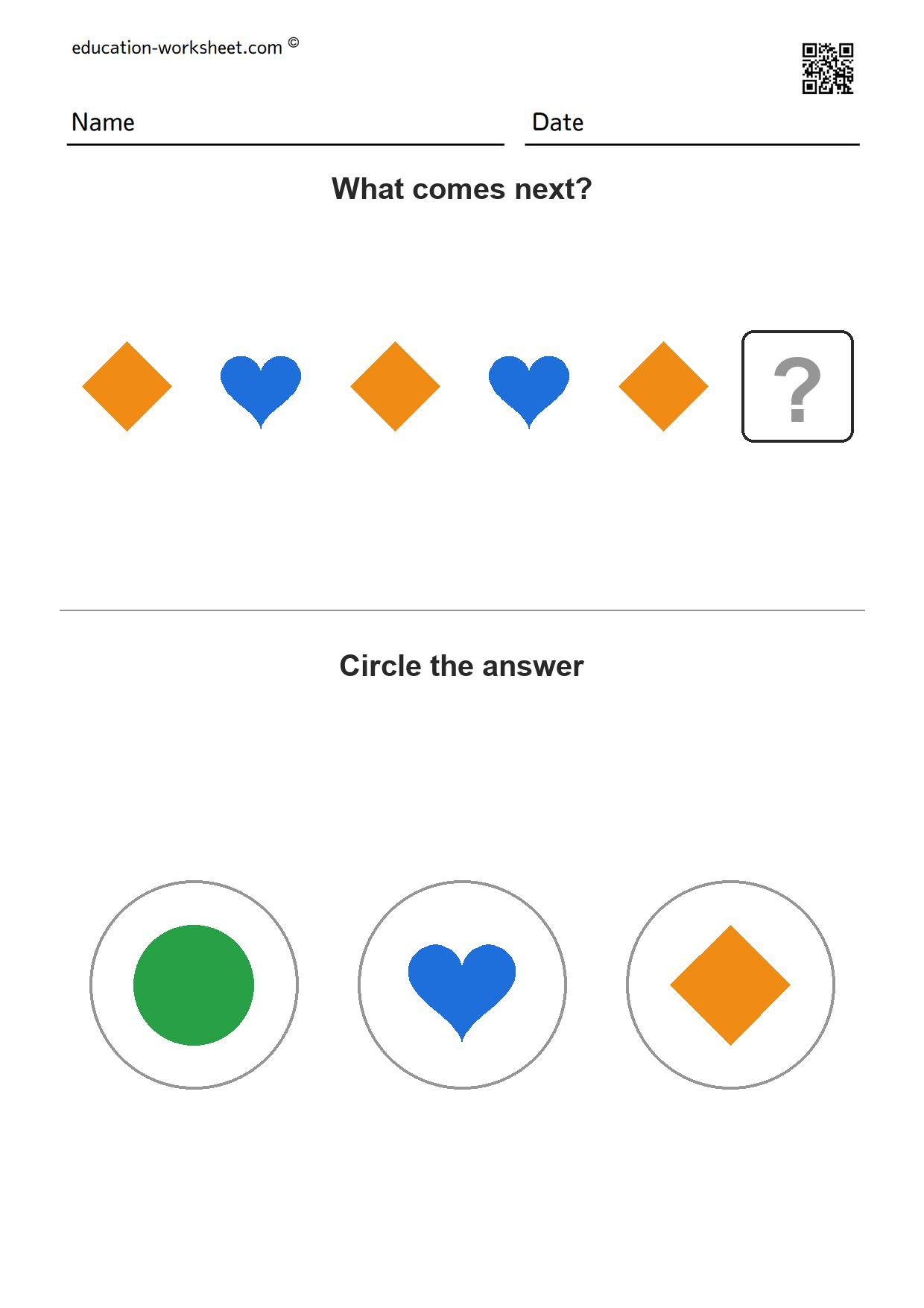
Back to AB, with two shapes a child has not seen much of yet. Returning to an easy structure after a hard page is good for confidence and costs nothing. The row shows orange diamond, blue heart, orange diamond, blue heart, orange diamond.
Worksheet 10 – ABB Pattern: What Comes Next?
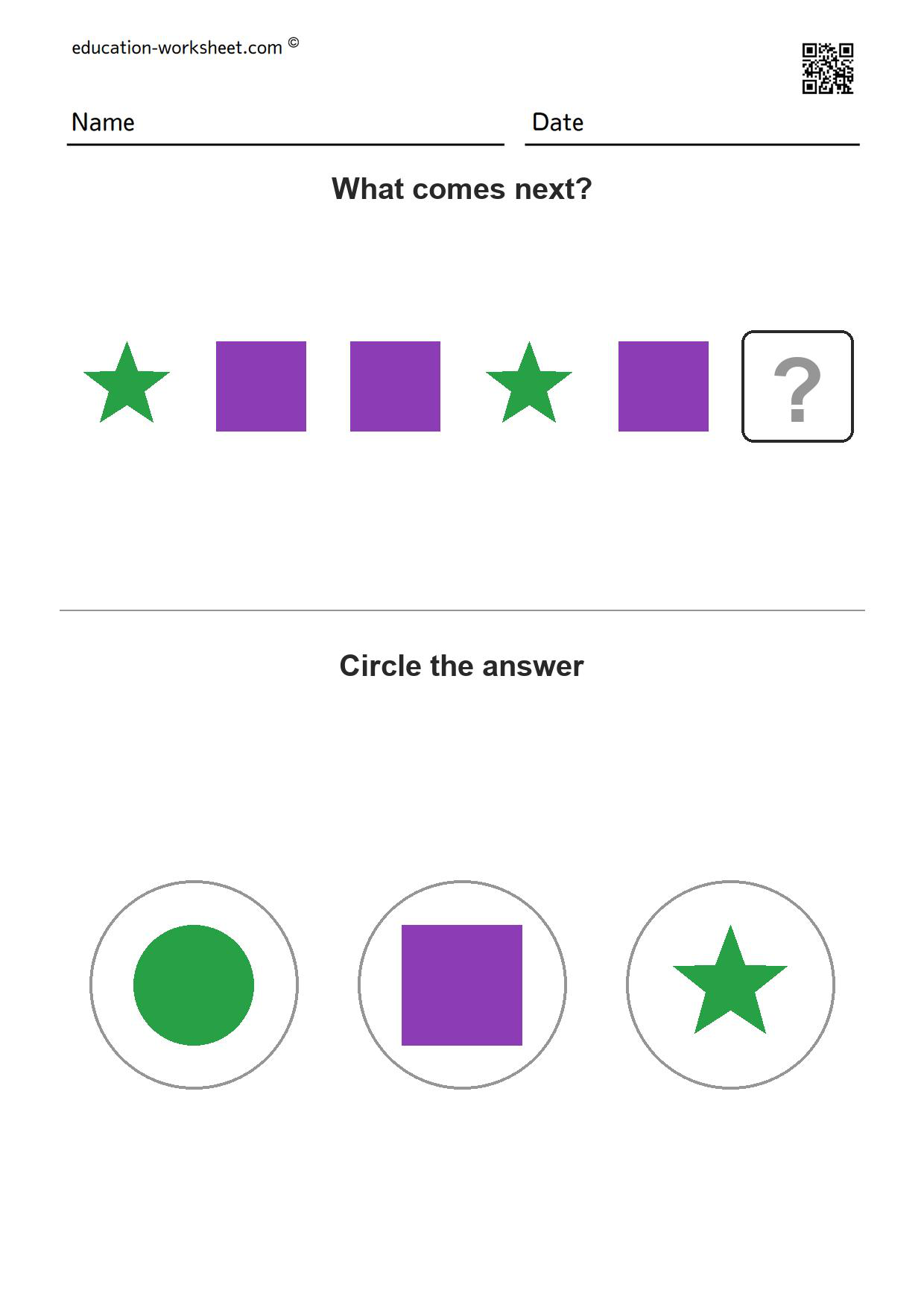
ABB one last time, to finish. By now most children stop counting the pictures and start saying the pattern out loud, which is the behaviour you are hoping for. The row shows green star, purple square, purple square, green star, purple square.
AB, ABC, AAB, ABB: What the Letters Mean
Teachers label repeating patterns with letters, one letter per distinct item in the repeating unit. A red-blue-red-blue row is AB. Red-blue-yellow repeating is ABC. A row where the first item comes twice before the second is AAB, and the reverse is ABB. Two of each makes AABB.
The labels are for adults, not children – there is no need to teach a four year old the word “ABB”. They are useful to you because they tell you what a child has and has not met yet. If your child breezes through AB and falls apart on AAB, nothing is wrong; they simply have not seen a unit with a repeat inside it before.
When Children Are Ready for These Worksheets
These pages suit children from about three and a half to six years old. No reading, counting or writing is needed – a child only has to look, and to circle. That makes patterning one of the first things a young child can do genuinely well on paper.
It is worth knowing that repeating patterns are not part of the Common Core kindergarten mathematics standards, even though almost every kindergarten curriculum teaches them and many state standards require them. Patterning earns its place anyway: noticing structure and predicting what comes next is the same habit of mind that later shows up in skip counting, in place value, and eventually in algebra.
How to Use These Worksheets
- Print one page on ordinary paper.
- Ask your child to point to each picture and say it out loud – “circle, square, circle, square”. Saying the row is what makes the pattern audible.
- Let them carry on saying it past the end of the row. The answer usually falls out of their own mouth.
- Circle the matching picture underneath.
- Ask “how did you know?” on at least one page. Explaining the rule is harder and more valuable than getting it right.
Three Things to Watch For
Copying the last picture in the row
A child who circles whatever came immediately before the empty box is not reading the pattern at all. Cover the whole row except the first repeat and build it up again together.
“They take turns” breaking on AAB
This is the most common stumble in the pack, and it is a sign of progress rather than a problem – the child has formed a rule, and the rule is about to get better. Put pages 6 and 7 side by side and say the two rows out loud one after the other.
Getting it right without being able to say why
Perfectly normal at this age. Recognition comes well before explanation, and the explanation arrives on its own if you keep asking the question without pushing for an answer.
Printing Tips
- Choose Actual size or Fit to page so the shapes keep their proportions.
- Each page fills one sheet and works on both US Letter and A4 paper.
- Slip a page into a plastic wallet and use a dry-wipe pen to reuse it with more than one child.
- Greyscale printing works, though the colors do some of the teaching on these pages.
Frequently Asked Questions
What age are these pattern worksheets for?
About three and a half to six years old – preschool, pre-K and kindergarten.
Does my child need to read or count to do these?
No. The pages use only colored shapes, so a child who cannot yet read or count can still work through the whole pack.
What pattern types are included?
AB, ABC, AAB, ABB and AABB – ten pages in all.
Is there an answer key?
No separate key. Saying the row out loud together settles any disagreement, and doing that is the exercise.
Do I need to sign up to download these?
No. Every PDF downloads immediately, with no account and no cost.
Can I use these in my classroom?
Yes, they are free to print for home and classroom use. Please do not sell them or re-host the files elsewhere.
More Free Shape and Pattern Worksheets
- Free Shape Pattern Worksheets – Draw AB, ABB and ABC Patterns
- Free Trace the Shapes Worksheets for Preschool – Shape Tracing Practice
- Free Same or Different Worksheets – Odd One Out
- Free Sorting Worksheets – Sort by Color and Shape
- Free Color by Shape Worksheets for Kindergarten
- Free Shape Recognition Worksheets – Circle the Shapes