
These free printable worksheets introduce the numbers 1 to 10 three different ways: as red dots, as pictures, and as colored dots. On every row a child sees a group in a ten frame, reads the printed numeral beside it, traces a grey copy, and then writes the number once on their own. There are six pages in all.
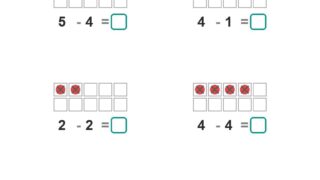
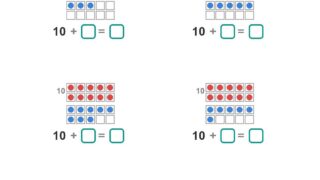
Every group sits inside a ten frame – two rows of five boxes. It is the single most useful picture in early number work, because it shows two things at once: how many there are, and how many more would make ten. A child who meets seven as a full row of five plus two is far better placed later on than one who only ever meets it as the word after six.
What Is in This Free Learn the Numbers 1 to 10 Pack
- Six printable worksheets, five numbers on each page.
- The numbers 1 to 10 shown as dots, as pictures, and as colored dots.
- A ten frame on every row, so the amount is always seen as five-and-some.
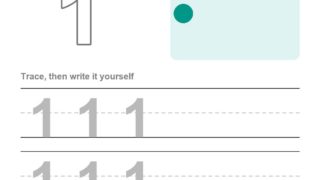
- A printed numeral to read, a grey numeral to trace, and a box to write in.
- A name and date line at the top of every page.
- Six separate PDFs – no sign-up, no email address, no cost.
The 6 Worksheets
The pages below build up in the order shown. Dots first, because nothing distracts from the quantity; pictures next; colors last.
Worksheet 1 – Dots 1 to 5
Five rows, one for each number from 1 to 5. A ten frame filled with red dots sits on the left, the printed numeral in the middle, and a grey numeral to trace with an empty box after it.

Worksheet 2 – Dots 6 to 10
The same layout carried on from 6 to 10. Because the frame holds exactly ten, a child can see at a glance how many spaces are still empty – which is the beginning of knowing what makes ten.

Worksheet 3 – Pictures 1 to 5
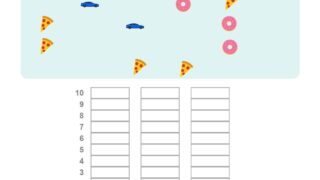
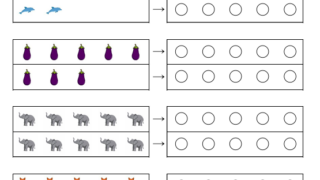
The dots are replaced by pictures – apples, bananas, cars, cats and frogs. Swapping the objects proves that five is five whatever is being counted, which is not obvious to a four year old.

Worksheet 4 – Pictures 6 to 10
Grapes, hamburgers, horses, oranges and shopping carts, from six to ten. The pictures are smaller than the dots, so this page also asks for more careful looking.

Worksheet 5 – Colors 1 to 5
Each row uses a different color of dot. Changing the color from row to row stops a child sliding into autopilot and makes them look afresh at every line.

Worksheet 6 – Colors 6 to 10
The last page, six to ten in mixed colors. By this point most children stop counting the top row and simply say “five and three”.

Why the Same Numbers Three Times Over
It looks like repetition, and to an adult it is. To a young child it is not. Knowing that five red dots means five does not automatically mean knowing that five cats means five – the idea that a number describes the count and not the things themselves has to be built, and the only way to build it is to meet the same number wearing different clothes.
That is why the dots page comes first and the picture page second. If your child sails through the dots but hesitates over the apples, nothing has gone wrong; you have simply found the edge of what they understand, which is the useful thing to know.
When Children Are Ready for These Worksheets
These pages suit children from about four to six years old. Tracing the grey numerals is enough at first – there is no need to wait until a child can form the numbers on their own before starting.
In American classrooms this covers two kindergarten strands at once: writing the numbers 0 to 20 and matching a written numeral to a count of objects (Common Core K.CC.A.3), and counting to tell how many there are (K.CC.B.5).
How to Use These Worksheets
- Print one page. Five rows is a full session for most four year olds.
- Count the filled boxes in the ten frame out loud together.
- Ask how many empty boxes are left. This is the question that builds number bonds to ten, and it costs nothing to ask.
- Trace the grey numeral, then write the last one in the empty box.
- If a numeral comes out back to front, leave it. Reversals are normal until about seven years old.
Printing Tips
- Choose Actual size or Fit to page so the circles stay big enough for crayons.
- Each page fills one sheet and works on both US Letter and A4 paper.
- Printing in greyscale saves ink, though the pictures are easier to tell apart in color.
- Slip a page into a plastic wallet and use a dry-wipe pen to reuse it with more than one child.
Frequently Asked Questions
What age are these number worksheets for?
About four to six years old – preschool, pre-K and kindergarten.
What is a ten frame?
Two rows of five boxes. Filling it from the left means every number from 6 to 10 is seen as a full row of five plus a few more, which makes the amounts much easier to hold in mind.
Does my child need to write the numbers?
Not at first. Tracing the grey numeral is enough, and the writing box can be left empty until they are ready.
Do I need to sign up to download these?
No. Every PDF downloads immediately, with no account, no email address and no cost.
Can I use these in my classroom?
Yes, they are free to print for home and classroom use. Please do not sell them or re-host the files elsewhere.
More Free Number Worksheets
- Free Counting 1 to 10 Worksheets – Count and Write
- Free Ten Frame Worksheets for Kindergarten – Count to 10
- Free Number Tracing Worksheets 1-10 for Kindergarten
- Count and Color the Circles 1-5
- Free Number Words Worksheets – Match Numbers 1 to 10
- Free Connect the Numbers in a Circle Worksheets – Number Order 1 to 12