
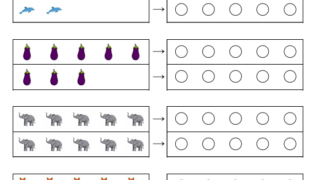
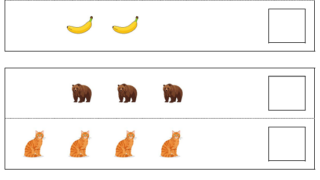
These free count and color worksheets give preschool and kindergarten children five pages of practice with the numbers 6 to 10. On every row a child counts a group of pictures and then colors in the same number of circles beside it. There is nothing to write and nothing to remember – the answer stays on the page as something the child can see.
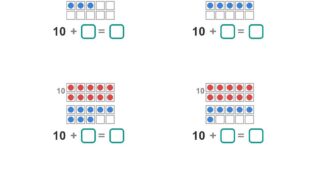
The pictures are not arranged in a straight line. Each group is laid out as a full row of five with the rest underneath, so eight cars appear as five and three more. That layout is deliberate: it is the same five-and-some structure used by ten frames in kindergarten classrooms, and children who get used to it stop counting from one every single time.
- What Is in This Free Count and Color 6 to 10 Worksheet Pack
- The 5 Count and Color Worksheets
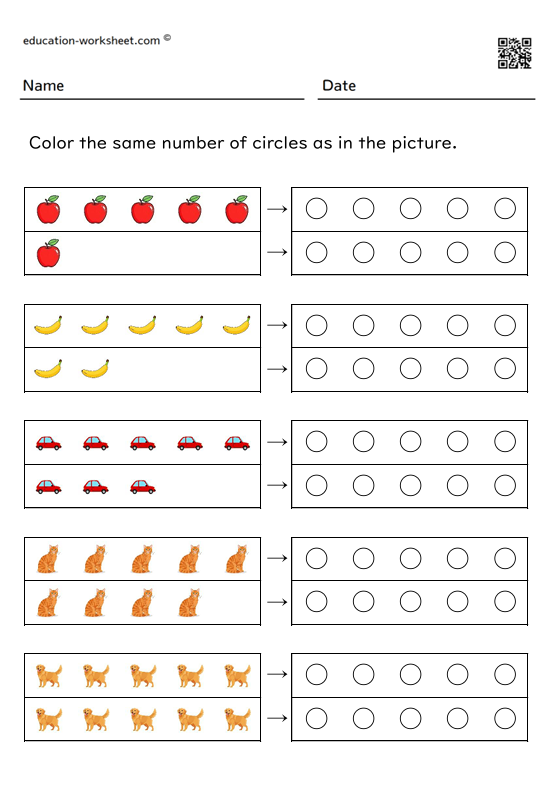
- Worksheet 1 – Count and Color: Apples, bananas, cars, cats and dogs
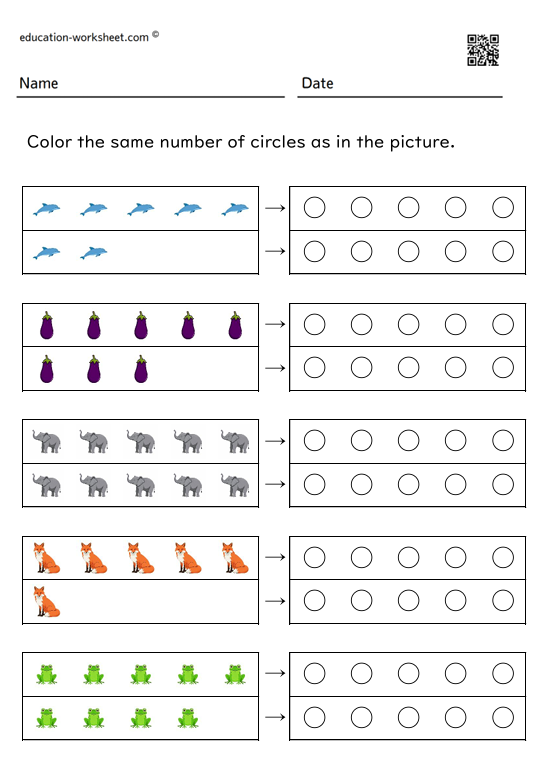
- Worksheet 2 – Count and Color: Dolphins, eggplants, elephants, foxes and frogs
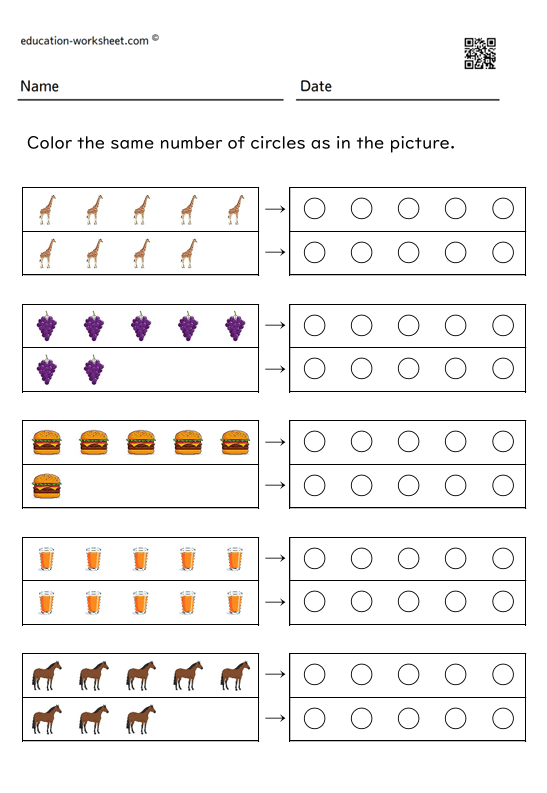
- Worksheet 3 – Count and Color: Giraffes, grapes, hamburgers, juice and horses
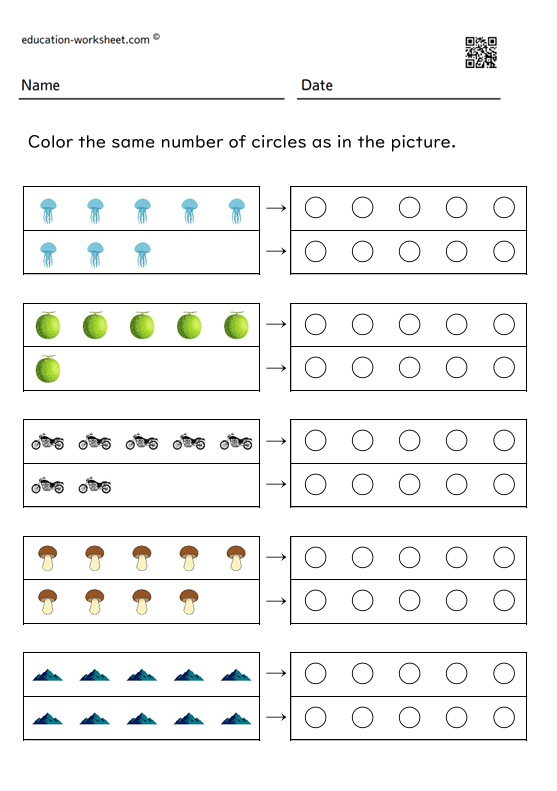
- Worksheet 4 – Count and Color: Jellyfish, apples, motorbikes, mushrooms and mountains
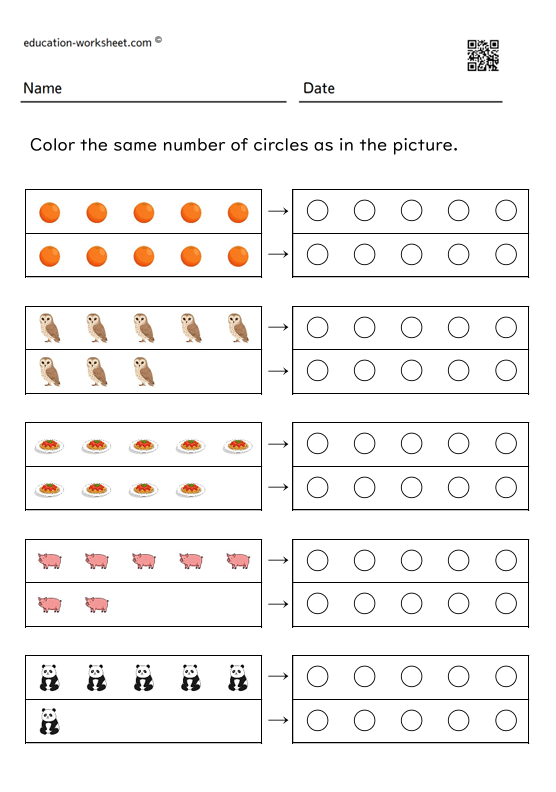
- Worksheet 5 – Count and Color: Oranges, owls, pancakes, pigs and pandas
- Why Coloring Circles Beats Writing the Number
- When Children Are Ready for These Worksheets
- How to Use These Worksheets
- Three Things to Watch For
- Printing Tips
- Frequently Asked Questions
- Each Worksheet on Its Own Page
- More Free Counting Worksheets
What Is in This Free Count and Color 6 to 10 Worksheet Pack
- Five printable worksheets, each with five rows to count and color.
- Every page covers all five numbers from 6 to 10, with different pictures each time.
- Groups laid out as five in a row plus the remainder, ready for ten-frame work later.
- Ten circles beside each row, so a child can also see how far the number is from ten.
- A name and date line at the top of every page.
- Five separate PDFs – no sign-up, no email address, no cost.
The 5 Count and Color Worksheets
The pages get harder in a small but real way: page 1 runs in order from 6 to 10, and every page after that shuffles the numbers.
Worksheet 1 – Count and Color: Apples, bananas, cars, cats and dogs
The first page runs straight through in order: six apples, seven bananas, eight cars, nine cats and ten dogs. Starting in order lets a child see the amount growing by one each time, which is worth noticing before the numbers get mixed up.
Worksheet 2 – Count and Color: Dolphins, eggplants, elephants, foxes and frogs
From here the numbers are shuffled. This page asks for seven dolphins, eight eggplants, ten elephants, six foxes and nine frogs, so a child cannot work down the page by guessing that each row is one more than the last.
Worksheet 3 – Count and Color: Giraffes, grapes, hamburgers, juice and horses
A mixed page with food and animals. The same five numbers appear again in a new order, which is what turns recognition into real counting.
Worksheet 4 – Count and Color: Jellyfish, apples, motorbikes, mushrooms and mountains
Some of the pictures on this page are small and detailed, so it is a slightly harder page to count accurately. If your child rushes here, ask them to point at each picture out loud.
Worksheet 5 – Count and Color: Oranges, owls, pancakes, pigs and pandas
The last page. By now most children have stopped counting the top row one by one and start saying “five and two more”, which is exactly the habit these sheets are designed to build.
Why Coloring Circles Beats Writing the Number
Most counting worksheets ask a child to write a numeral in a box. That is a fine exercise, but it hides the mistake: if a child writes 7 when there are eight pictures, nothing on the page shows them they were wrong.
Coloring circles leaves the answer visible. A child who colored seven circles for eight elephants can put the sheet next to the pictures and see the mismatch. It also separates two skills that are easy to confuse – knowing how many there are, and being able to write the numeral – so a child who cannot yet form a 9 is not held back from the counting itself.
When Children Are Ready for These Worksheets
Numbers 6 to 10 usually come after a child is comfortable counting to five. If counting five objects is still uncertain, start with the 1 to 5 pack linked at the bottom of this page and come back to these.
In American classrooms this is kindergarten counting work: counting objects to say how many there are, and understanding that the last number counted is the total (Common Core K.CC.B.4 and K.CC.B.5). No writing is required, so the pages suit children who are still learning to hold a pencil.
How to Use These Worksheets
- Print one page. One page is a complete session for most four and five year olds.
- Ask your child to count the pictures in the first row out loud, touching each one.
- Before coloring, ask “so how many circles will you color?” The answer should come without recounting.
- Let them color the circles from left to right, one for each picture.
- When the page is finished, look at the colored circles together and ask which row has the most.
Three Things to Watch For
Coloring circles at random
Some children color the right number of circles but scatter them across the row. It is not wrong, but coloring from the left in order makes the amounts easy to compare between rows afterwards, which is where the real learning is.
Counting the second row from one again
When a group is five plus three, a child who starts again at one for the bottom row is doing more work than they need to. Try covering the top row with your hand and saying “that is five, keep going”.
Losing count in the middle
If your child regularly lands one out, the problem is almost always the pointing rather than the numbers. Ask them to cross each picture out with a pencil as it is counted.
Printing Tips
- Choose Actual size or Fit to page so the circles stay big enough for crayons.
- Each page fills one sheet and works on both US Letter and A4 paper.
- Slip the page into a plastic wallet and use a dry-wipe pen to reuse it with more than one child.
- Greyscale printing works fine – the pictures stay easy to tell apart.
Frequently Asked Questions
What age are these count and color worksheets for?
About four to six years old – preschool, pre-K and kindergarten. Children who can already count to five reliably are ready.
Does my child need to be able to write numbers?
No. There is nothing to write on these pages, which is why they work well for children whose pencil control is still developing.
Do I need to sign up to download them?
No. Every PDF downloads immediately, with no account and no cost.
Can I use these in my classroom?
Yes, they are free to print for home and classroom use. Please do not sell them or re-host the files elsewhere.
What comes after 6 to 10?
Writing the numerals, and then comparing two groups to say which has more. Both are linked below.
Each Worksheet on Its Own Page
If you only want one sheet, each page has its own page on this site with a note about what to watch for while your child works through it.
More Free Counting Worksheets
- Free Count and Color Worksheets 1-5 for Preschool – Color the Circles
- Free Counting 1 to 10 Worksheets for Preschool and Kindergarten – Count and Write
- Free More or Fewer Worksheets for Kindergarten – Compare Two Groups
- Free Circle the Larger Number Worksheets for Kindergarten – Compare Two Numbers
- Free Count and Graph Worksheets for Kindergarten – Picture Graphs