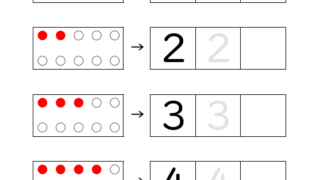

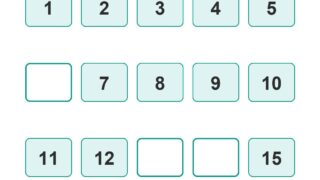
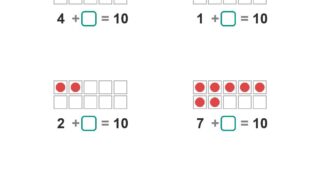
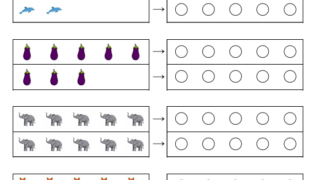

These free printable counting worksheets ask a child to count a group of pictures and then color in that many circles. There are 10 pages with three rows on each, covering the numbers 1 to 5, and every row gives 5 circles to color from.
The pictures are scattered along the row rather than lined up neatly, and that is the point. When objects sit in a tidy row of five a child can learn the shape of the group and answer without counting. Spread them out unevenly and the shortcut disappears: the only way to get the answer is to touch each picture once and keep track. These pages are a check on counting itself, not on pattern recognition.
- What Is in This Free Worksheet Pack
- Why the Circles Matter More Than a Written Answer
- The 10 Worksheets
- Worksheet 1 – Count and Color the Circles
- Worksheet 2 – Count and Color the Circles
- Worksheet 3 – Count and Color the Circles
- Worksheet 4 – Count and Color the Circles
- Worksheet 5 – Count and Color the Circles
- Worksheet 6 – Count and Color the Circles
- Worksheet 7 – Count and Color the Circles
- Worksheet 8 – Count and Color the Circles
- Worksheet 9 – Count and Color the Circles
- Worksheet 10 – Count and Color the Circles
- When Children Are Ready for These Worksheets
- How to Use These Worksheets
- Three Things to Watch For
- Printing Tips
- Frequently Asked Questions
- More Free Counting Worksheets
What Is in This Free Worksheet Pack
- 10 printable worksheets, three counting rows on each page.
- Numbers 1 to 5, in a different order on every page so nothing can be predicted.
- Pictures spaced irregularly, so a child has to count rather than recognise a pattern.
- 5 circles beside every row to color in.
- A name and date line at the top, ready for classroom use.
- A separate PDF for every page – no sign-up, no email address, no cost.
Why the Circles Matter More Than a Written Answer
Writing a numeral in a box hides mistakes. A child who writes 7 when there are eight pictures has left nothing behind that shows the error, and an adult has to recount the row to find it.
Coloring circles leaves the answer sitting on the page in a form the child can compare directly against the pictures. It also separates two skills that get tangled together at this age: knowing how many there are, and being able to write the numeral for it. A child who cannot yet form an 8 can still prove that they know what eight means.
The 10 Worksheets
One page is a complete session for most four and five year olds. There is no need to work through them in order.
Worksheet 1 – Count and Color the Circles
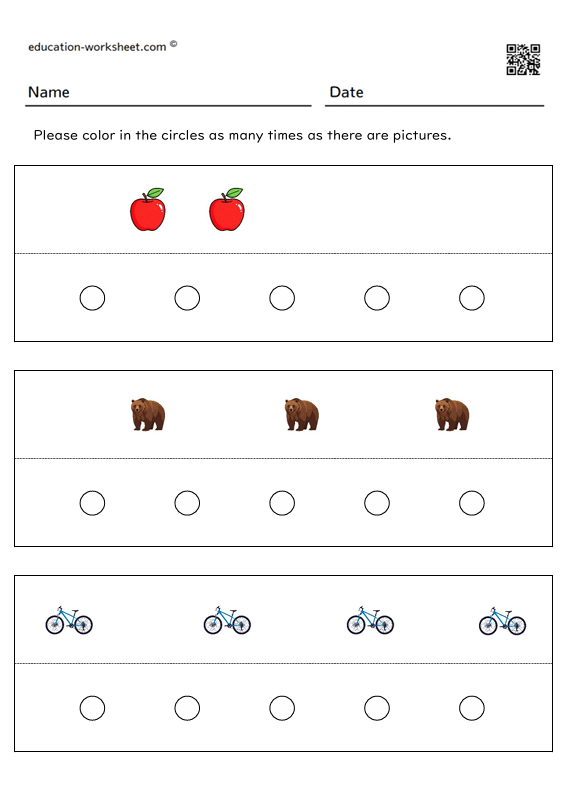
Worksheet 2 – Count and Color the Circles
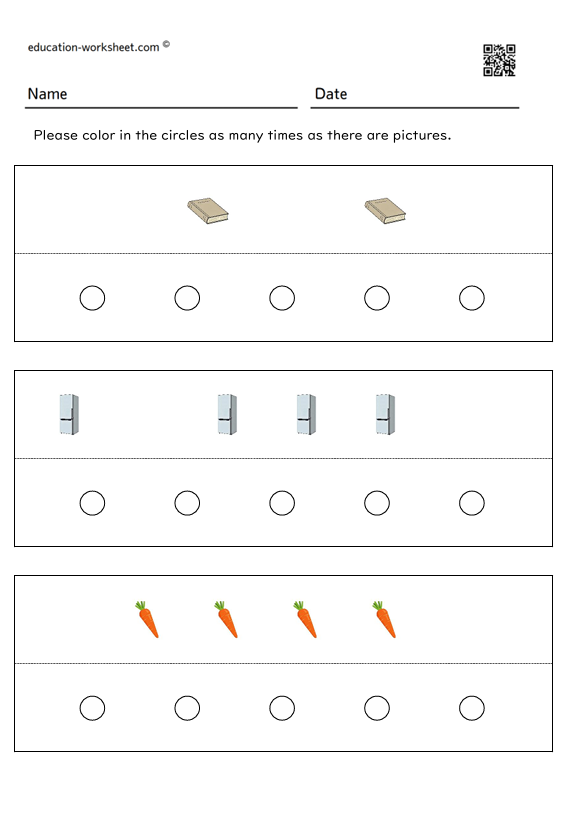
Worksheet 3 – Count and Color the Circles
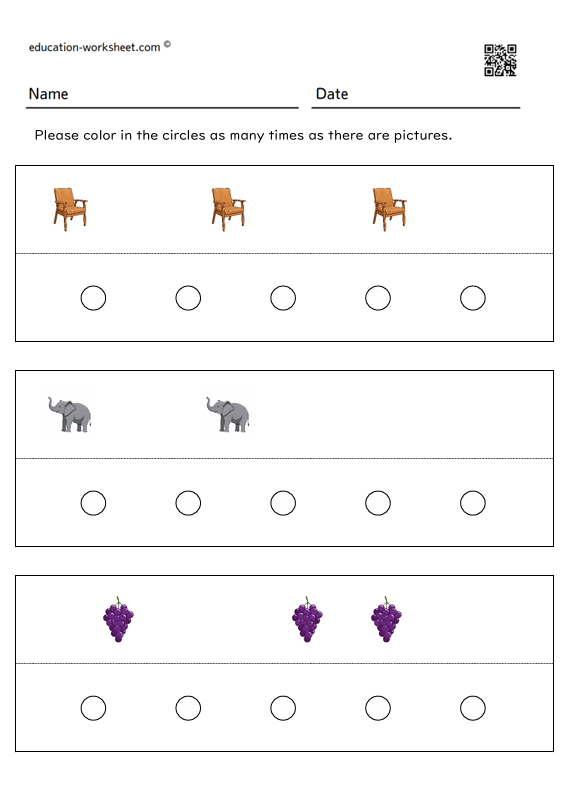
Worksheet 4 – Count and Color the Circles
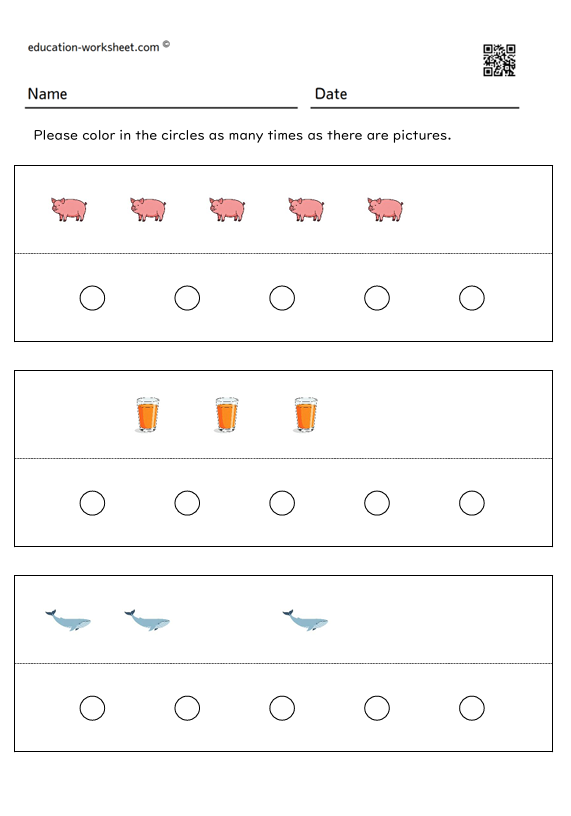
Worksheet 5 – Count and Color the Circles
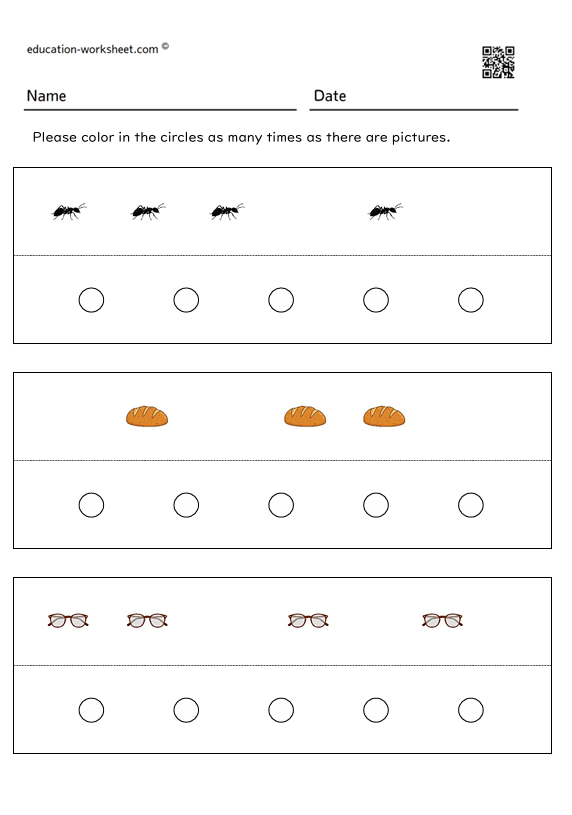
Worksheet 6 – Count and Color the Circles
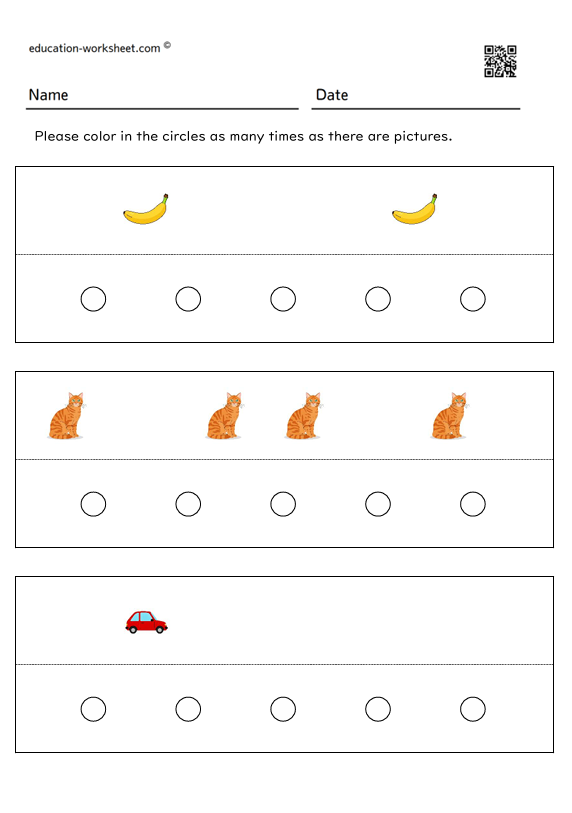
Worksheet 7 – Count and Color the Circles
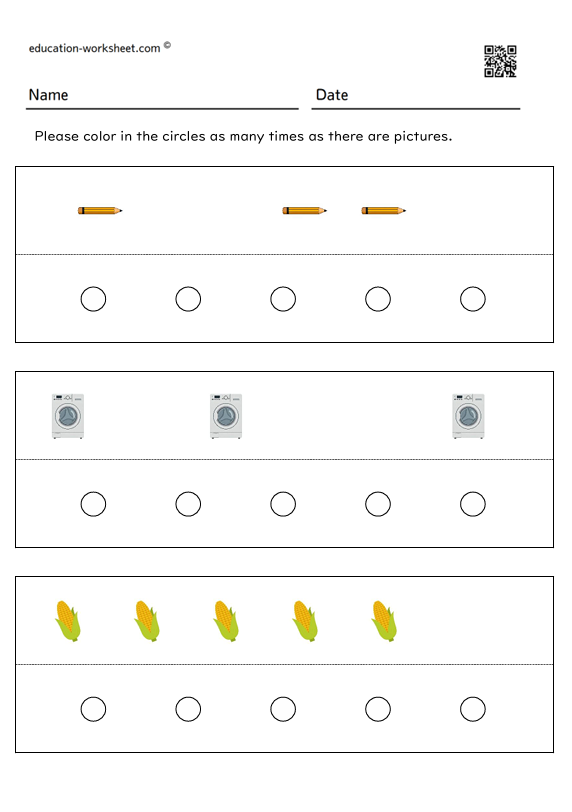
Worksheet 8 – Count and Color the Circles
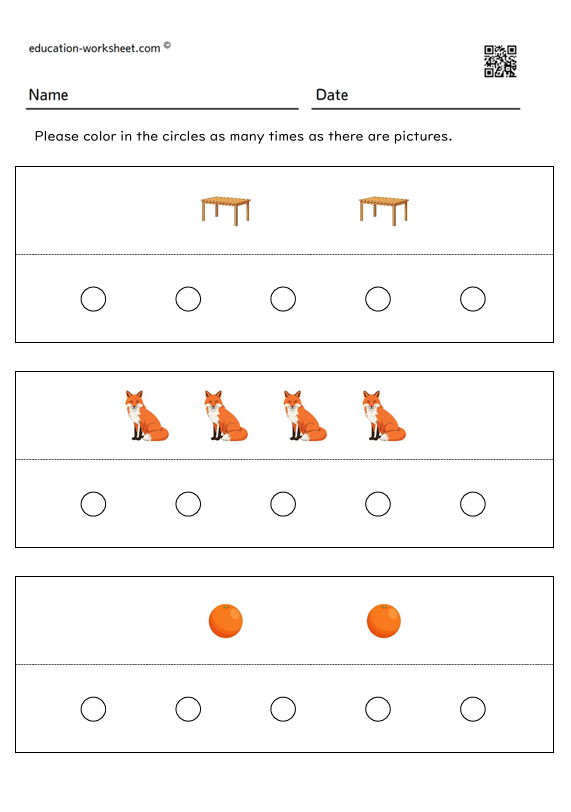
Worksheet 9 – Count and Color the Circles
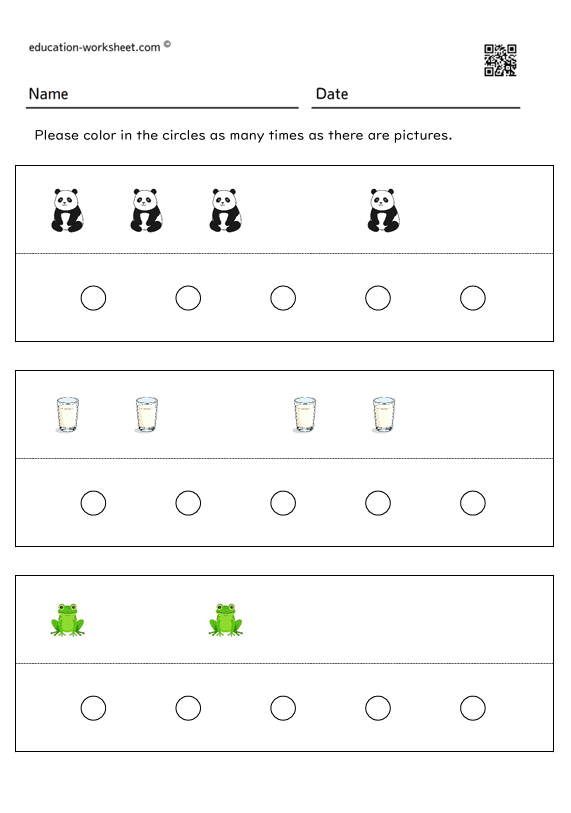
Worksheet 10 – Count and Color the Circles
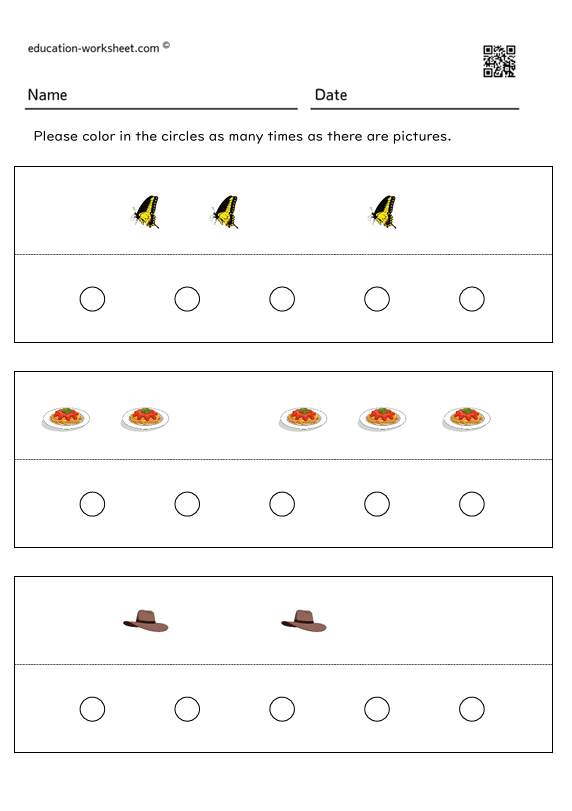
When Children Are Ready for These Worksheets
These pages suit children from about three and a half to five years old. A child only needs to be able to say the number words in order; the worksheets teach the rest. This is usually the first counting pack a child can finish without an adult sitting beside them the whole time.
In American classrooms this is kindergarten counting work: counting objects to say how many there are, and understanding that the last number counted gives the total (Common Core K.CC.B.4 and K.CC.B.5). Nothing has to be written, so the pages suit children who are still learning to hold a pencil.
How to Use These Worksheets
- Print one page on ordinary paper.
- Ask your child to count the pictures out loud, touching each one as they go.
- Before the crayon comes out, ask “so how many circles?” The answer should come without recounting.
- Color the circles from the left, one for each picture.
- Look at the finished rows together and ask which row had the most.
Three Things to Watch For
Counting a scattered picture twice
This is the mistake these pages are designed to expose. Because the pictures are unevenly spaced, a child who is not tracking carefully will double back. Ask them to cross each picture out with a pencil as it is counted.
Coloring circles at random
Coloring the right number but scattering them across the row is not wrong, but filling from the left makes it possible to compare rows afterwards, and comparing is where the next piece of learning is.
Answering by the length of the row
Some children judge by how far along the row the last picture sits. Two rows on these pages are deliberately similar in width but different in count, so this shows up quickly.
Printing Tips
- Choose Actual size or Fit to page so the circles stay big enough for crayons.
- Each page fills one sheet and works on both US Letter and A4 paper.
- Printing in greyscale saves ink, though the pictures are easier to tell apart in color.
- Slip a page into a plastic wallet and use a dry-wipe pen to reuse it with more than one child.
Frequently Asked Questions
What age are these counting worksheets for?
About three and a half to five years old.
Does my child need to write anything?
No. There is nothing to write, only circles to color.
Why are the pictures not in a neat row?
On purpose. Evenly spaced groups can be recognised by their shape without counting, which defeats the exercise.
Do I need to sign up to download these?
No. Every PDF downloads immediately, with no account, no email address and no cost.
Can I use these in my classroom?
Yes, they are free to print for home and classroom use. Please do not sell them or re-host the files elsewhere.
More Free Counting Worksheets
- Count and Color the Circles 6-10 – the next step up
- Free Count and Color Worksheets 1-5 – pictures arranged in fives
- Free Counting 1 to 10 Worksheets – Count and Write
- Free Learn the Numbers 1 to 10 Worksheets – Ten Frames and Tracing
- Free More or Fewer Worksheets for Kindergarten – Compare Two Groups
- Free Ten Frame Worksheets for Kindergarten – Count to 10