

These free printable tally marks worksheets give kindergarten children sixty tally questions. On the first five pages the marks are printed and the child writes the number; on the last five the number is given and the child draws the marks.
That turn in the middle is the whole pack. Reading a tally is counting; drawing one is a small piece of organizing. A child has to decide when to stop a group at four and lay the fifth mark across it, and doing that is what teaches the grouping.
Every page prints the rule at the top: every 5th mark goes across the group of four.
- What Is in This Free Tally Marks Worksheet Pack
- The 11 Tally Marks Worksheets
- Worksheet 1 – 4, 9, 3, 10, 11, 6 (count)
- Worksheet 2 – 8, 6, 9, 4, 5, 11 (count)
- Worksheet 3 – 3, 5, 11, 7, 9, 6 (count)
- Worksheet 4 – 7, 11, 15, 12, 20, 16 (count)
- Worksheet 5 – 16, 12, 11, 7, 6, 5 (count)
- Worksheet 6 – 6, 4, 10, 5, 11, 12 (draw)
- Worksheet 7 – 7, 4, 10, 6, 5, 3 (draw)
- Worksheet 8 – 6, 4, 10, 3, 9, 11 (draw)
- Worksheet 9 – 13, 12, 11, 18, 15, 9 (draw)
- Worksheet 10 – 18, 5, 12, 11, 15, 20 (draw)
- Answer Key – All 60 Answers
- Why Tally Marks Are Worth Teaching
- When Children Are Ready for Tally Marks
- How to Use These Worksheets
- Three Things to Watch For
- Printing Tips
- Frequently Asked Questions
- More Free Counting Worksheets
What Is in This Free Tally Marks Worksheet Pack
- Ten printable worksheets with six questions on each – sixty in all.
- Pages 1 to 5: count the tally marks and write the number.
- Pages 6 to 10: read the number and draw the tally marks.
- Numbers from 3 to 20, with 11 the most common at nine appearances.
- An eleventh page with every answer, written as the number and its marks.
- A separate PDF for every page, free to download and print.
The 11 Tally Marks Worksheets
The hard pages are 4, 9 and 10. Each of those has five of its six numbers above ten, where every other page has at most three. Page 7 is the opposite: nothing on it is above ten at all.
Fifteen of the sixty numbers are exact multiples of five, which means fifteen answers are drawn as complete groups with nothing left over. Those are the ones to point at when a child is learning why the fifth mark goes sideways.
Worksheet 1 – 4, 9, 3, 10, 11, 6 (count)
The six numbers on this page are 4, 9, 3, 10, 11, 6.
Four of the six numbers are ten or under, and the largest is eleven. A child who can count to twelve can finish this page.
The 10 is worth stopping on: two complete groups of five and nothing left over, which is the clearest picture of what the diagonal mark is for.
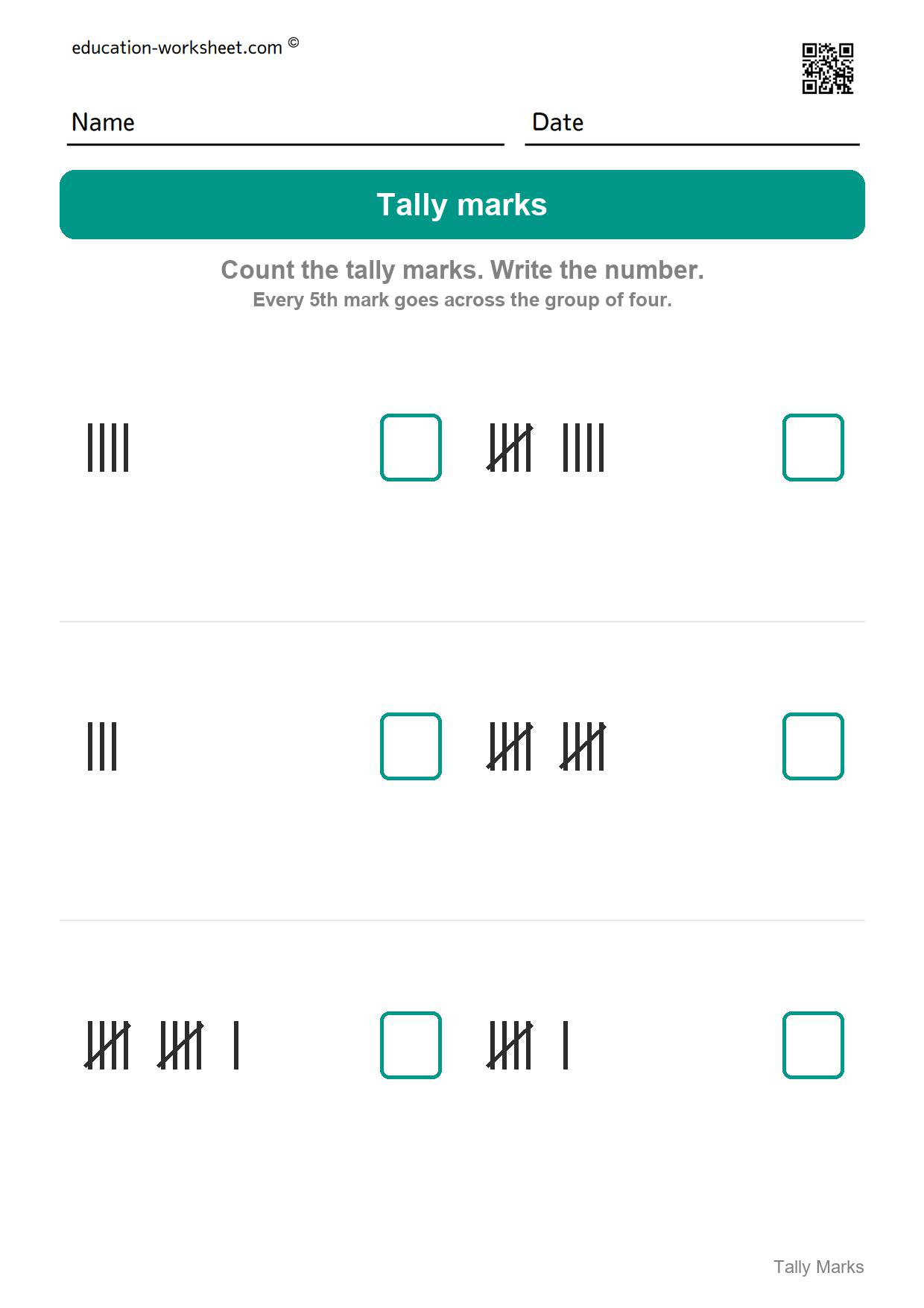
Worksheet 2 – 8, 6, 9, 4, 5, 11 (count)
The six numbers on this page are 8, 6, 9, 4, 5, 11.
Every number on this page except one is under ten. The 11 at the end is the only one that needs three groups.
The 8 here is the only 8 in the whole pack.
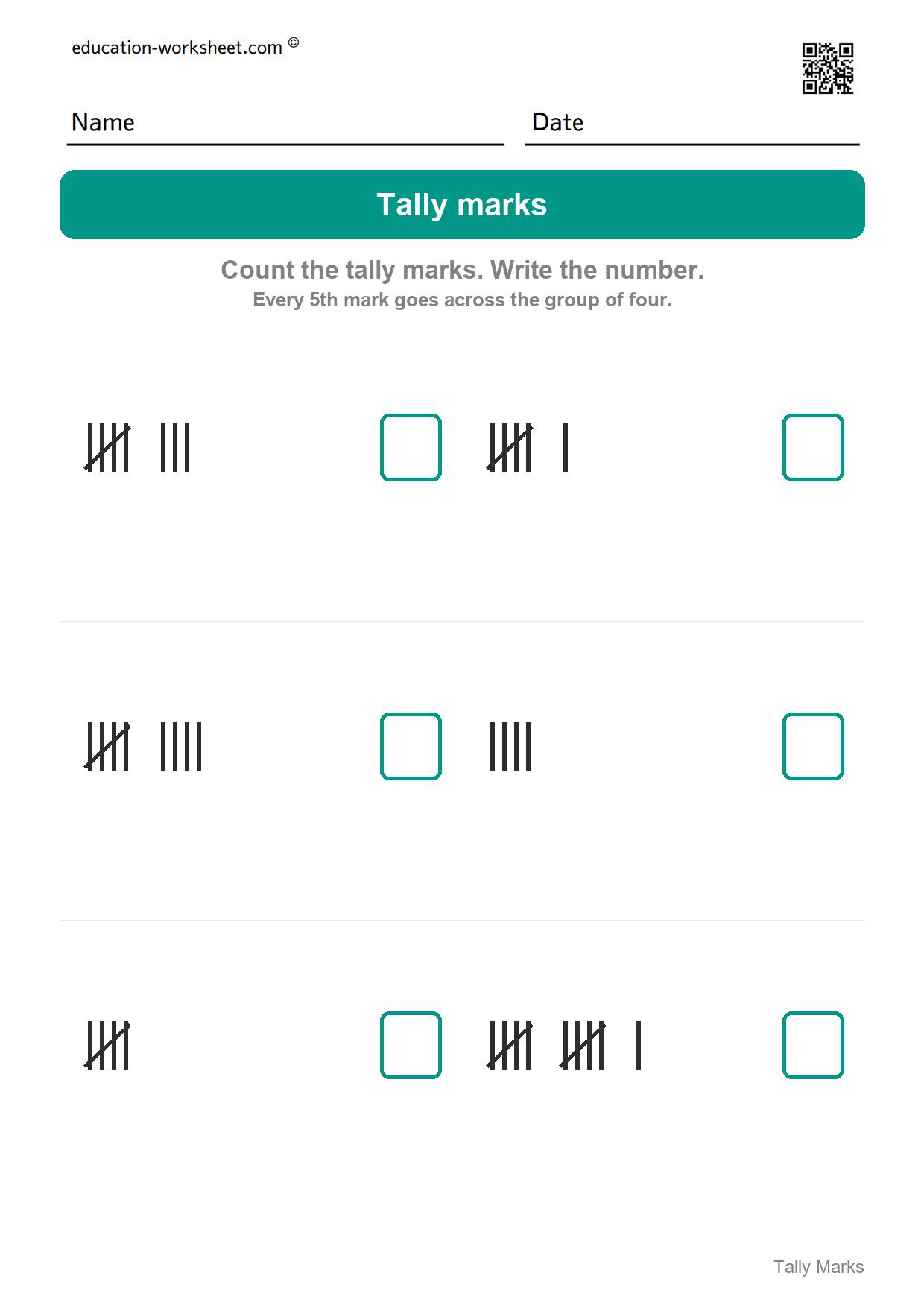
Worksheet 3 – 3, 5, 11, 7, 9, 6 (count)
The six numbers on this page are 3, 5, 11, 7, 9, 6.
Six numbers between three and eleven, with nothing new to learn. This is the page to use as a second attempt if page 1 went badly.
Three tally marks and no diagonal at all is the smallest answer in the pack, and it appears four times across the ten pages.
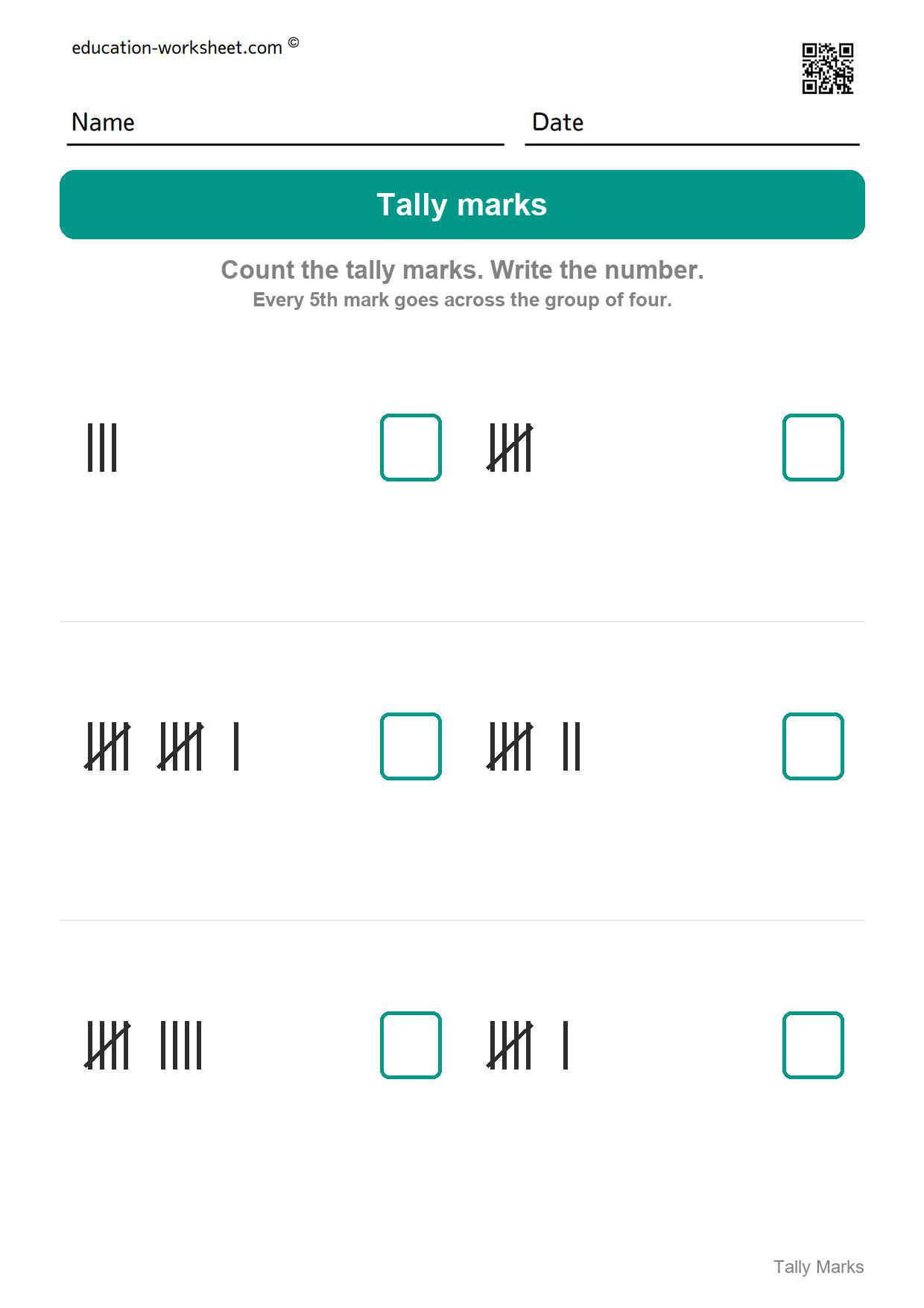
Worksheet 4 – 7, 11, 15, 12, 20, 16 (count)
The six numbers on this page are 7, 11, 15, 12, 20, 16.
The jump. Five of the six numbers here are above ten, and the pack has not warned anybody. 15, 12, 20 and 16 in a row is four times the counting of the previous page.
The 20 is four full groups of five. A child who counts it one mark at a time will get it wrong; a child who counts the groups will not.
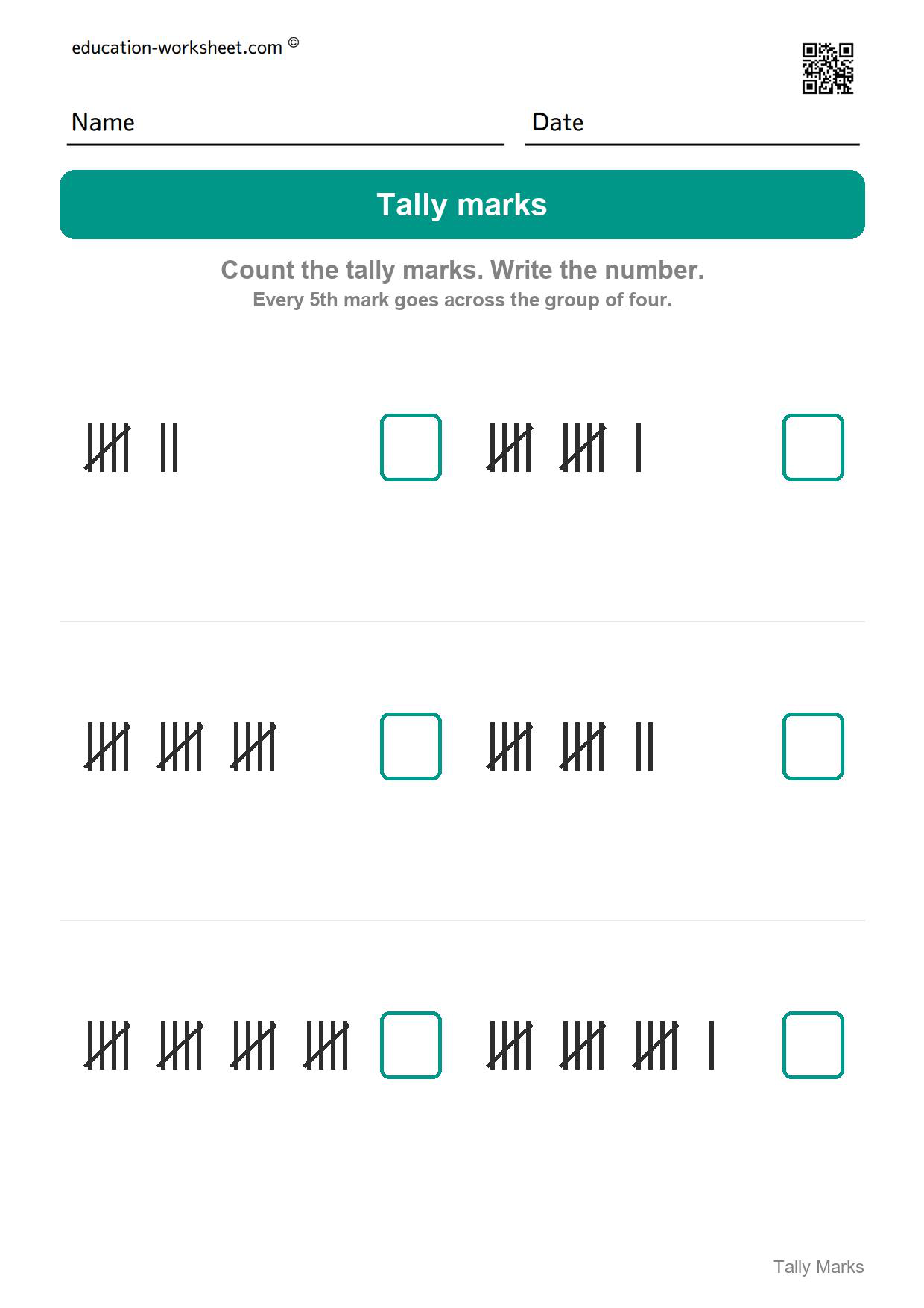
Worksheet 5 – 16, 12, 11, 7, 6, 5 (count)
The six numbers on this page are 16, 12, 11, 7, 6, 5.
The same big numbers as page 4, in reverse order: it opens at 16 and comes down to 5.
Starting with the hardest number on the page is a deliberate choice and an uncomfortable one. If a child stalls, start them at the bottom row and work up.
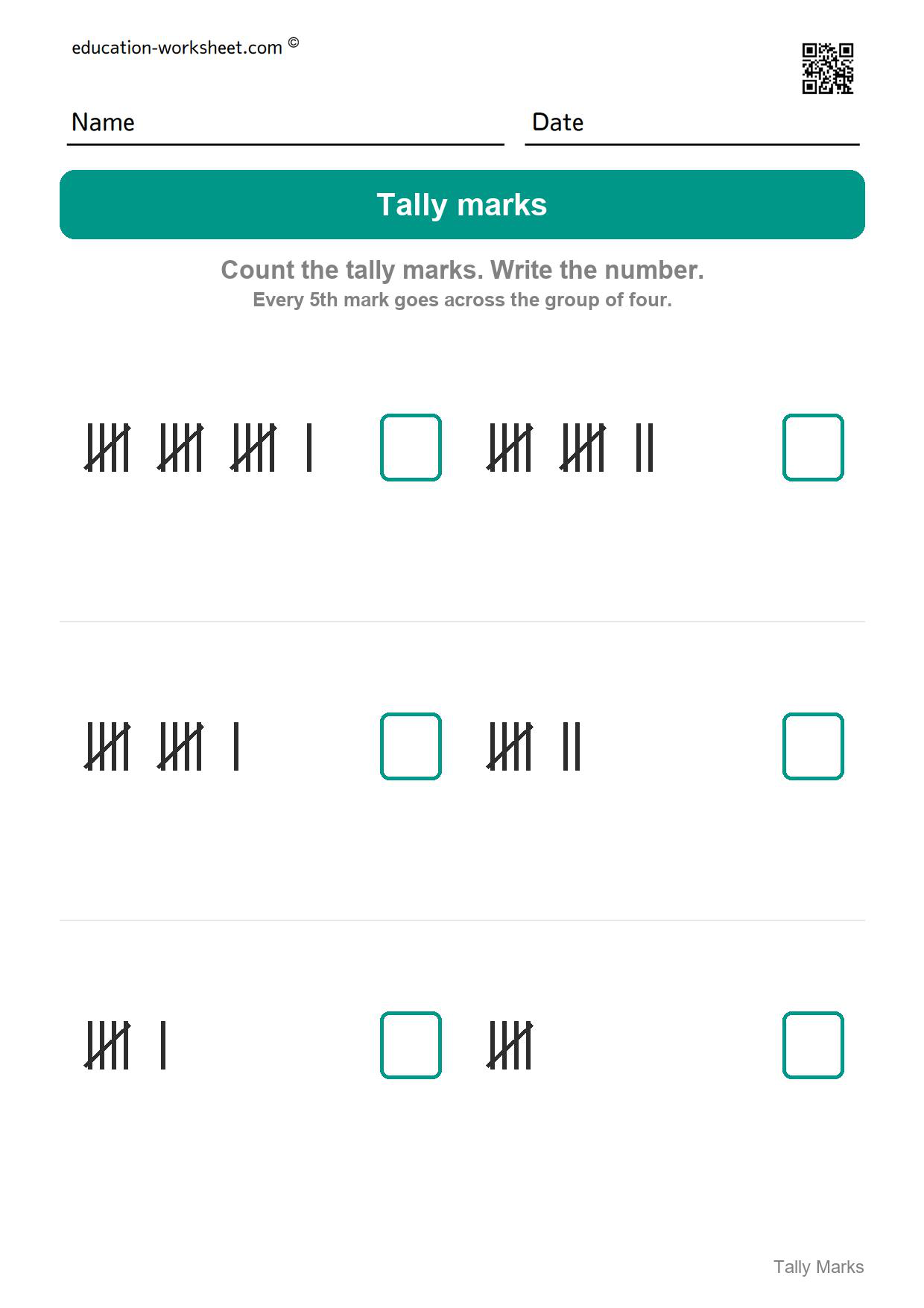
Worksheet 6 – 6, 4, 10, 5, 11, 12 (draw)
The six numbers on this page are 6, 4, 10, 5, 11, 12.
The task turns over here. From this page on, the number is given and the child draws the tally marks.
Drawing is much harder than reading, and the numbers drop back to a gentle range for exactly that reason – four of the six are ten or under.
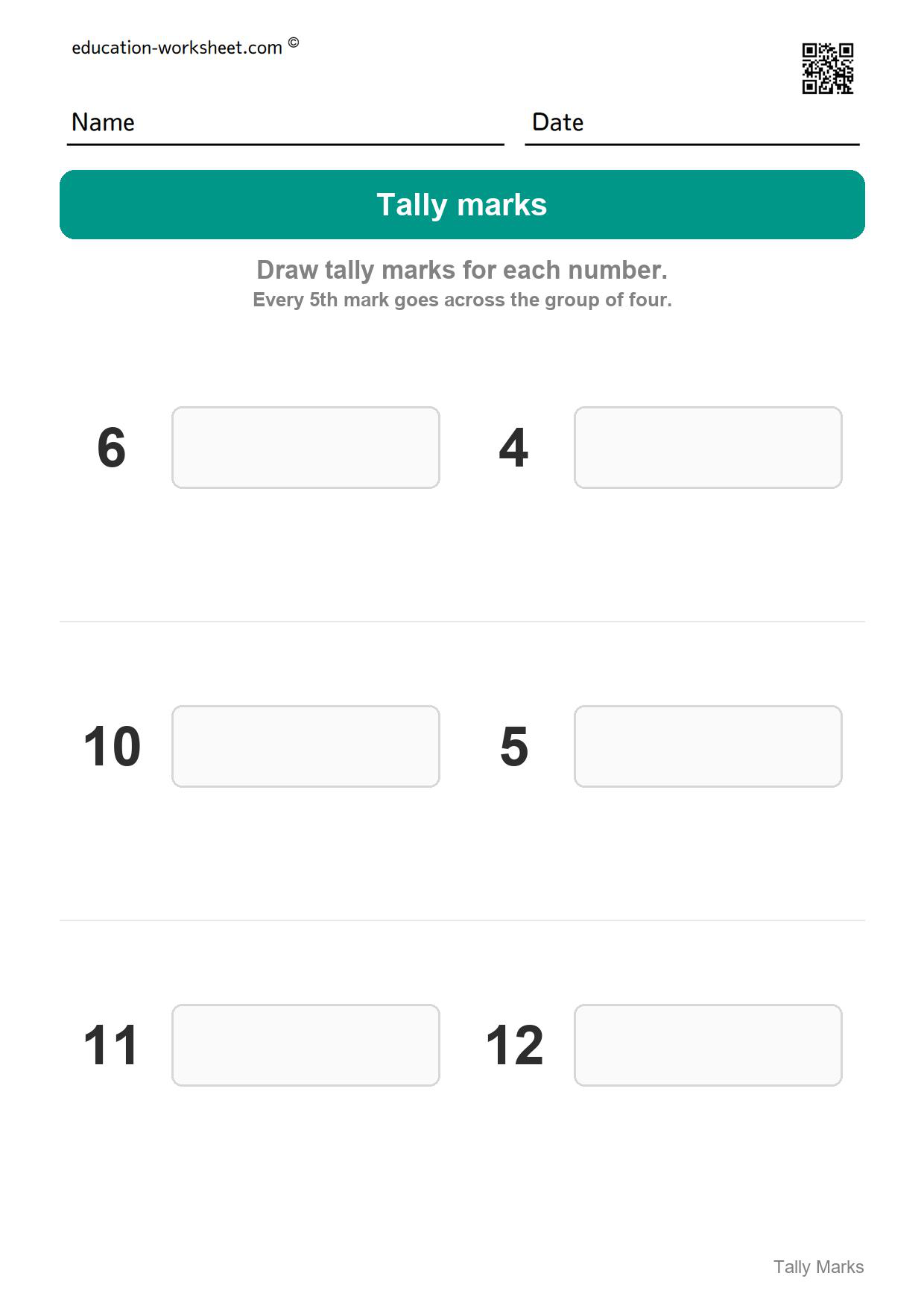
Worksheet 7 – 7, 4, 10, 6, 5, 3 (draw)
The six numbers on this page are 7, 4, 10, 6, 5, 3.
Not one number on this page is above ten. It is the only page in the pack where that is true, and it is the easiest page for drawing.
Every answer needs at most two groups of five, so the diagonal is drawn twice at most.
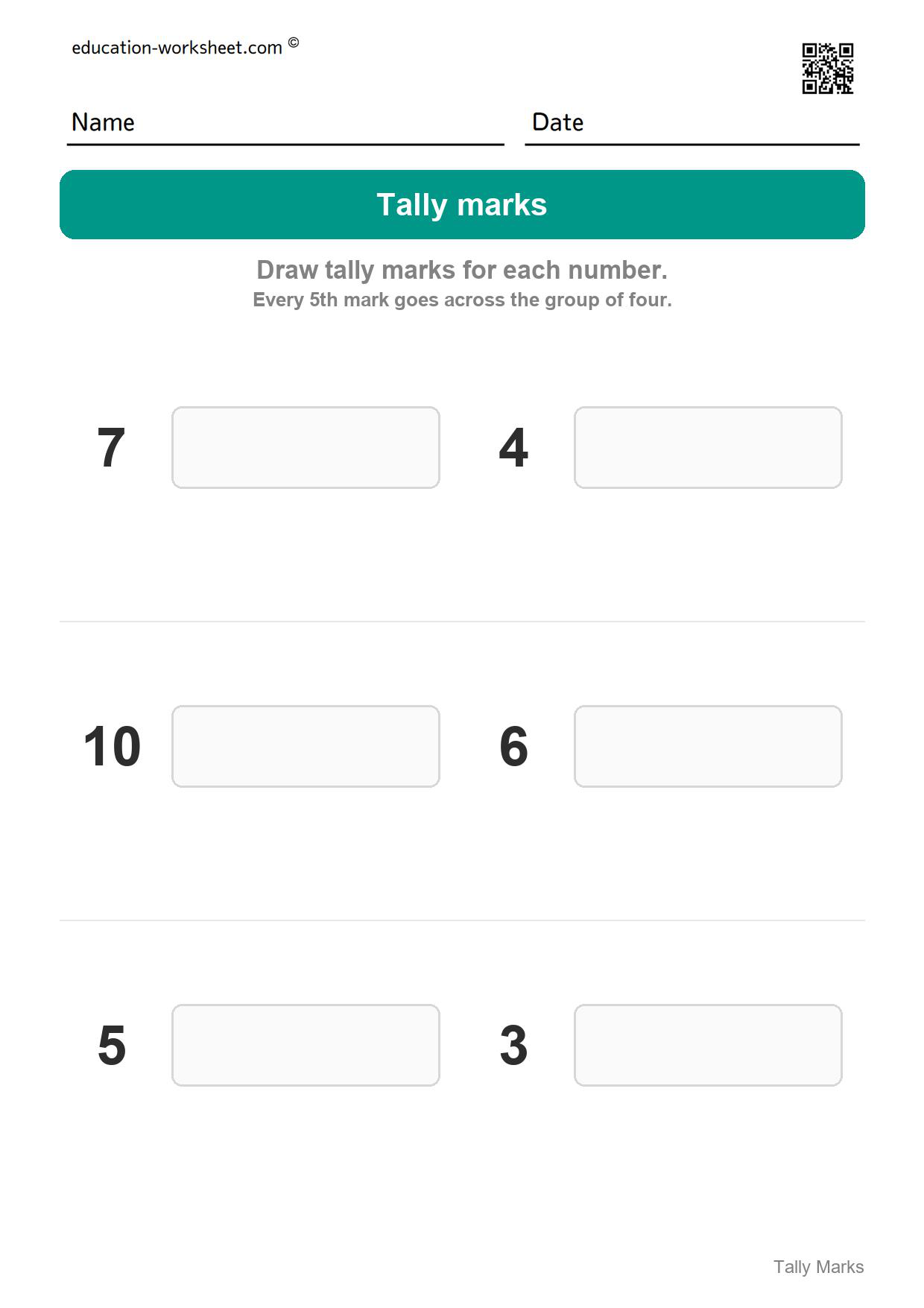
Worksheet 8 – 6, 4, 10, 3, 9, 11 (draw)
The six numbers on this page are 6, 4, 10, 3, 9, 11.
Six numbers, five of them under ten, and a 3 that needs three plain strokes and no diagonal at all.
By this page a child should be drawing the four uprights and then the diagonal without being reminded.
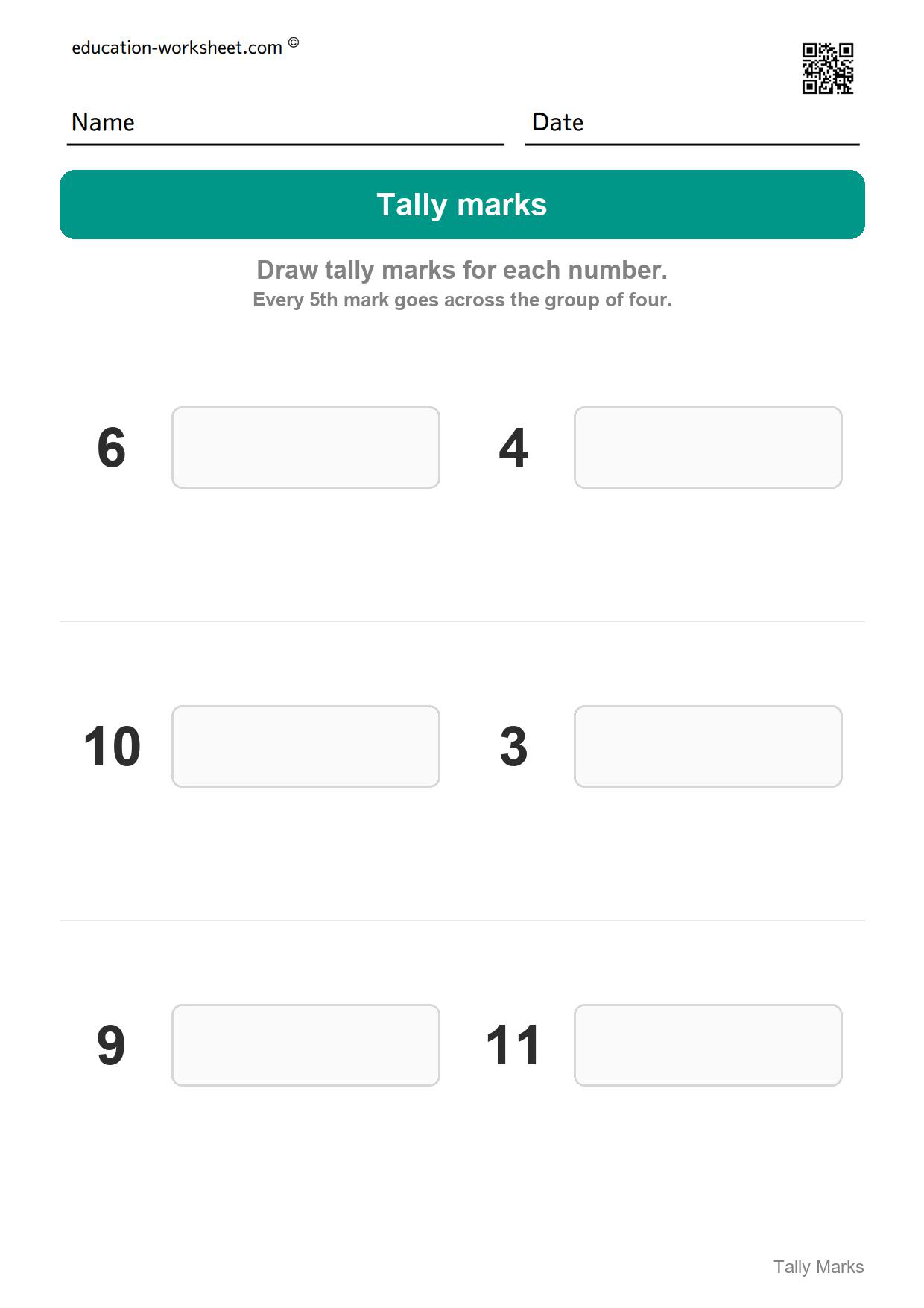
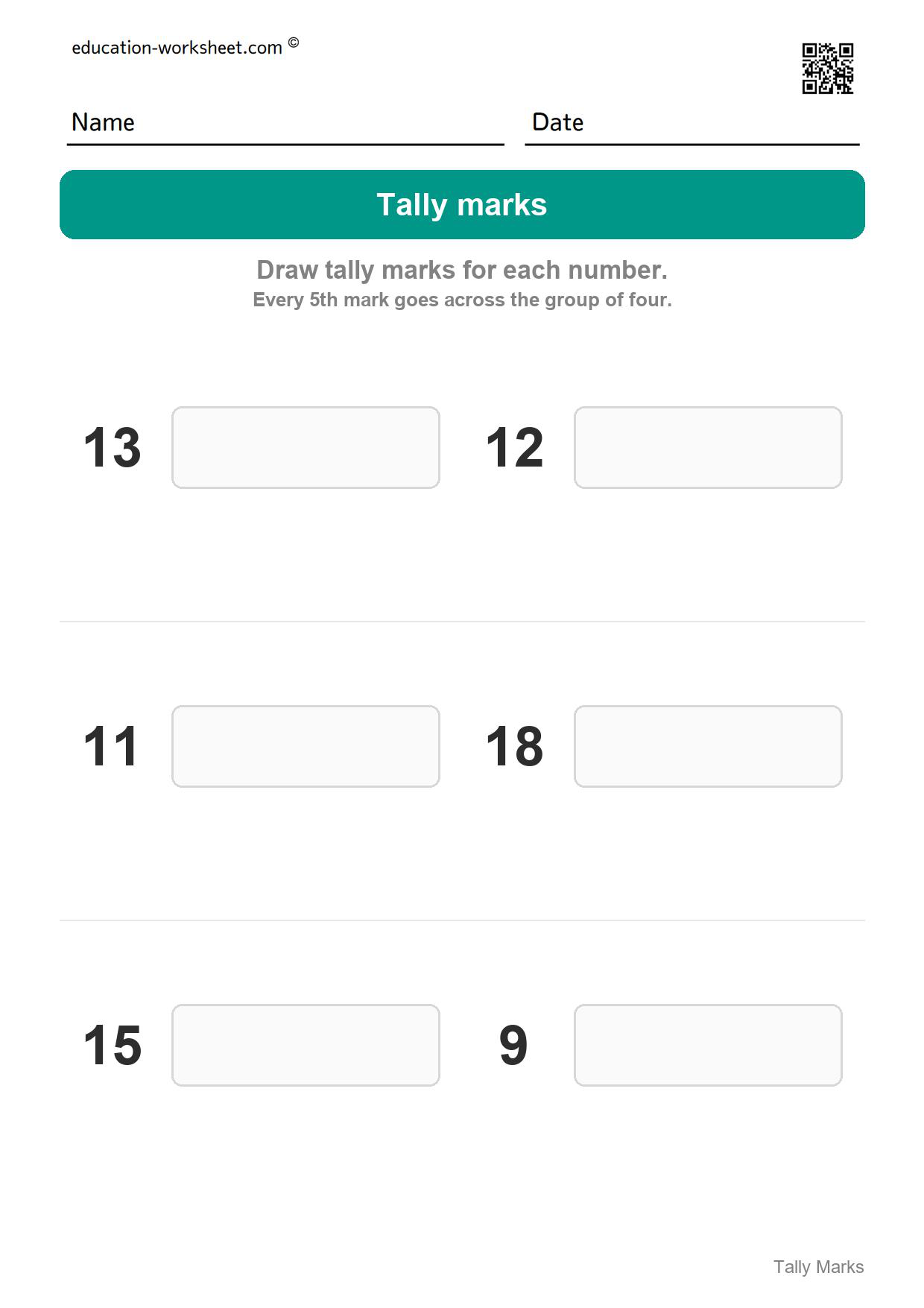
Worksheet 9 – 13, 12, 11, 18, 15, 9 (draw)
The six numbers on this page are 13, 12, 11, 18, 15, 9.
Five of the six numbers are above ten, including an 18 and a 15. Drawing eighteen marks in groups of five takes real care.
13 appears once in the whole pack and it is here. It is the number children most often draw as two groups and three strokes, which is right, but they often forget the second diagonal.
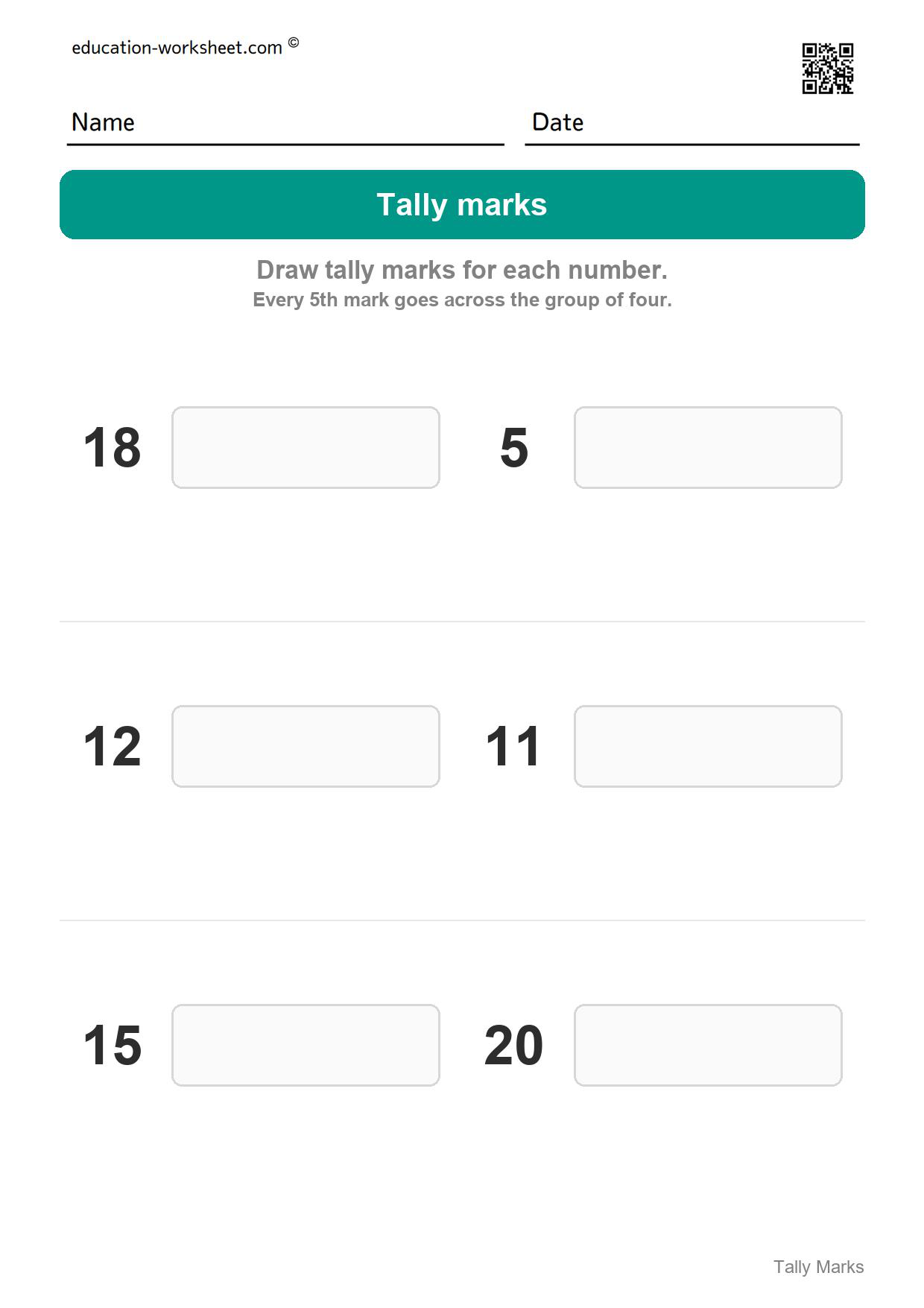
Worksheet 10 – 18, 5, 12, 11, 15, 20 (draw)
The six numbers on this page are 18, 5, 12, 11, 15, 20.
The pack finishes at its hardest: 18, 12, 11, 15 and a 20, with a single 5 in among them for relief.
20 means four complete groups and no leftovers. A finished page of this kind is worth keeping.
Answer Key – All 60 Answers
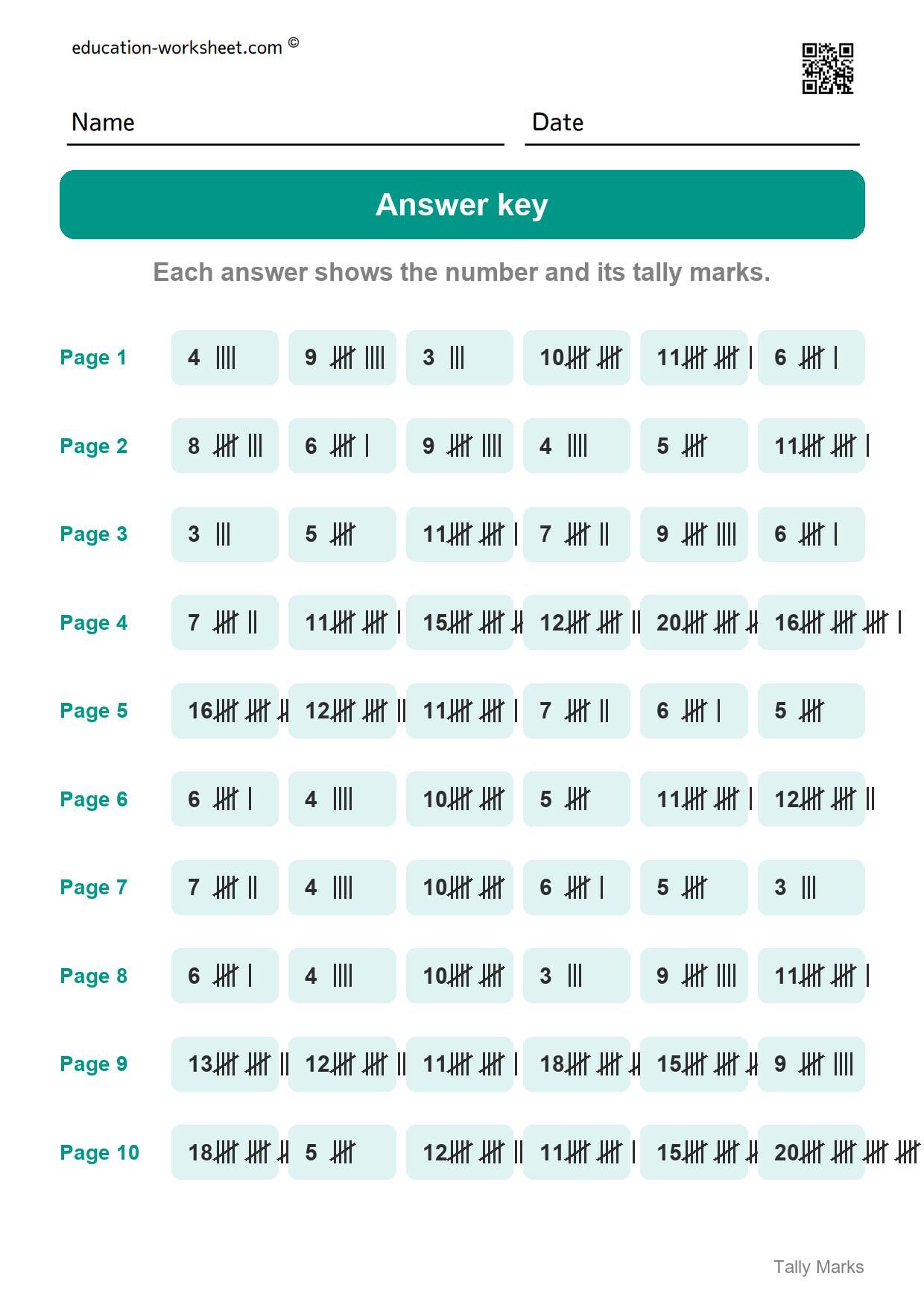
The eleventh sheet gives every answer as the number followed by its tally marks, six to a page.
Printed out, it is also a reference chart: a child who forgets what 13 looks like in tallies can find it here rather than being told.
Why Tally Marks Are Worth Teaching
A tally is the first time most children meet a number written as groups rather than as a symbol. Eleven is not a shape to memorize here – it is two fives and a one, and the page says so in the drawing.
That makes tallies a quiet introduction to counting in fives. A child who counts a group of 16 as five, ten, fifteen, sixteen has done skip counting without anyone using the phrase, and they have done it because the grouping made it the easy route.
It is also the most useful notation a five-year-old can actually use. Counting cars from a window, votes for a snack, how many times the dog barked – tallies are the one piece of data recording that works before writing does.
When Children Are Ready for Tally Marks
- Age: about five to six – kindergarten, once counting to twenty is secure.
- Before starting: the child should be able to count to twenty and write two-digit numerals. For the drawing pages they need enough pencil control for straight lines.
- K.CC.B.5 – count to answer “how many?” about as many as twenty things.
- K.CC.A.1 and skip counting by fives – reading a tally is counting in fives whether anybody says so or not.
- 1.MD.C.4 – organize and represent data. Tallies are how a first grader collects it.
How to Use These Worksheets
- Count the groups first, not the marks. Five, ten, fifteen, then the leftovers.
- On the drawing pages, say the number as groups before the pencil moves: sixteen is three fives and a one.
- Draw the four uprights with a gap, then the diagonal. Children who draw five uprights and then try to cross one of them make a mess of it.
- Do pages 1 to 5 in one sitting and 6 to 10 in another. Reading and drawing are different jobs.
- Watch for page 4. It is the first page with big numbers and it arrives without warning.
- Use a real tally for something at home afterwards – it is the whole point of the notation.
Three Things to Watch For
1. Counting every mark one at a time. It works, it is slow, and it gets 16 and 18 wrong. The fix is to point at each completed group and say five, ten, fifteen before counting the leftovers.
2. Drawing the diagonal in the wrong place. The fifth mark goes across the four that came before it. Children often draw five uprights and then add a sixth diagonal, which makes six. Count the finished group back with them.
3. Losing the last group. On 11, 13 and 18 the leftovers sit at the end and are easy to miss when a child is pleased with the groups. Ask how many are left over after the last five.
Printing Tips
- Print at 100 percent, actual size, on A4 or US Letter. The drawing pages need the space.
- Black and white throughout – nothing on these pages uses color.
- Print page 7 twice. It is the only drawing page with no number above ten, which makes it the right page to practice the diagonal on.
Frequently Asked Questions
What age are these tally marks worksheets for?
About five to six years old. The child needs to count to twenty and write numerals; the drawing pages also need steady pencil control.
What is the range of numbers?
Three to twenty. Eleven comes up most often, nine times across the sixty questions.
Why does the fifth mark go sideways?
So the marks can be counted in fives instead of one at a time. It is the whole reason tallies exist, and it is printed at the top of every page.
Which pages are hardest?
Pages 4, 9 and 10. Each has five numbers above ten. Page 7 is the easiest: nothing on it is above ten.
Is there an answer key?
Yes, page 11 gives all sixty answers as the number with its marks.
Do I need to sign up to download these?
No. Every PDF downloads immediately, with no account, no email address and no cost.
Can I use these in my classroom?
Yes, they are free to print for home and classroom use. Please do not sell them or re-host the files elsewhere.
More Free Counting Worksheets
- Free Count and Graph Worksheets for Kindergarten – Picture Graphs
- Free Skip Counting Worksheets for Kindergarten – Count by 2s, 5s and 10s
- Free Ten Frame Worksheets for Kindergarten – Count to 10
- Free Count the Shapes Worksheets for Kindergarten
- Free Missing Numbers Worksheets 1-20 for Kindergarten
- Free Tens and Ones Worksheets for Kindergarten – Teen Numbers