
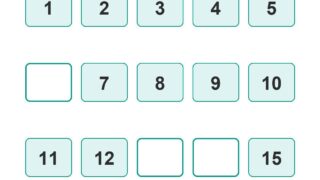
These free printable skip counting worksheets give kindergarten and first grade children ten pages of counting by 2s, 5s and 10s. Each page shows a row of ten boxes. Six of them hold numbers and four are empty, and the child writes in the numbers that are missing.
Every sheet counts all ten steps. The tens sheets run 10 to 100, the fives run 5 to 50, and the twos run 2 to 20. The last box is always the tenth step, which means a child who has filled the row in correctly always finishes on 100, 50 or 20 – a built-in way to check the work without an answer key.
The pack starts with tens, moves to fives and finishes with twos. That order is not an accident: it goes from the count children hear most often to the one they have to work hardest for.
- What Is in This Free Skip Counting Worksheet Pack
- The 10 Skip Counting Worksheets
- Worksheet 1 – Count by 10s, 10 to 100
- Worksheet 2 – Count by 10s, a Different Set of Gaps
- Worksheet 3 – Count by 10s, Ending on Two Blanks
- Worksheet 4 – Count by 5s, 5 to 50
- Worksheet 5 – Count by 5s, with the Gap Right at the Start
- Worksheet 6 – Count by 5s, Hollowed Out in the Middle
- Worksheet 7 – Count by 2s, 2 to 20
- Worksheet 8 – Count by 2s, the Second Half Missing
- Worksheet 9 – Count by 2s, with an Early Gap
- Worksheet 10 – Count by 2s, Gaps All the Way Along
- What Skip Counting Is Actually For
- When Children Are Ready for Skip Counting
- How to Use These Worksheets
- Three Things to Watch For
- Printing Tips
- Frequently Asked Questions
- More Free Counting Worksheets
What Is in This Free Skip Counting Worksheet Pack
- Ten printable worksheets: three counting by 10s, three counting by 5s and four counting by 2s.
- Ten boxes on every page, laid out in two rows of five.
- Six numbers printed and four blanks on every page, every time.
- The first box is never blank, so there is always somewhere to start.
- Never three blanks in a row.
- A separate PDF for every page, free to download and print.
The 10 Skip Counting Worksheets
The numbers on the page are always the same; only the holes move. Each sheet takes the same ten-step count and empties four different boxes, and where those four blanks fall is the whole of the difficulty. Blanks near the start are harder than blanks near the end, because the child has less of the pattern in front of them. Two blanks side by side are harder than four scattered ones.
Look at the two rows of five as well. Because there are five boxes in a row, the box directly underneath any number is five steps further on – fifty more on the tens sheets, twenty-five more on the fives, ten more on the twos. Children who spot that have found a shortcut and a piece of real number sense at the same time.
Worksheet 1 – Count by 10s, 10 to 100
Printed: 10, 30, 40, 60, 70, 90. Missing: 20, 50, 80 and 100. No two blanks sit side by side, so the child always has a printed number to count from.
Tens come first in this pack because they are the easiest to hear. The words ten, twenty, thirty carry the pattern themselves, in a way that two, four, six does not.

Worksheet 2 – Count by 10s, a Different Set of Gaps
The same row of tens, with the gaps moved: 30, 50, 70 and 100 are missing this time, and 10, 20, 40, 60, 80 and 90 are printed.
Doing the same count twice with different holes in it is the point. The second attempt is where a child stops reading the numbers off the page and starts producing them.
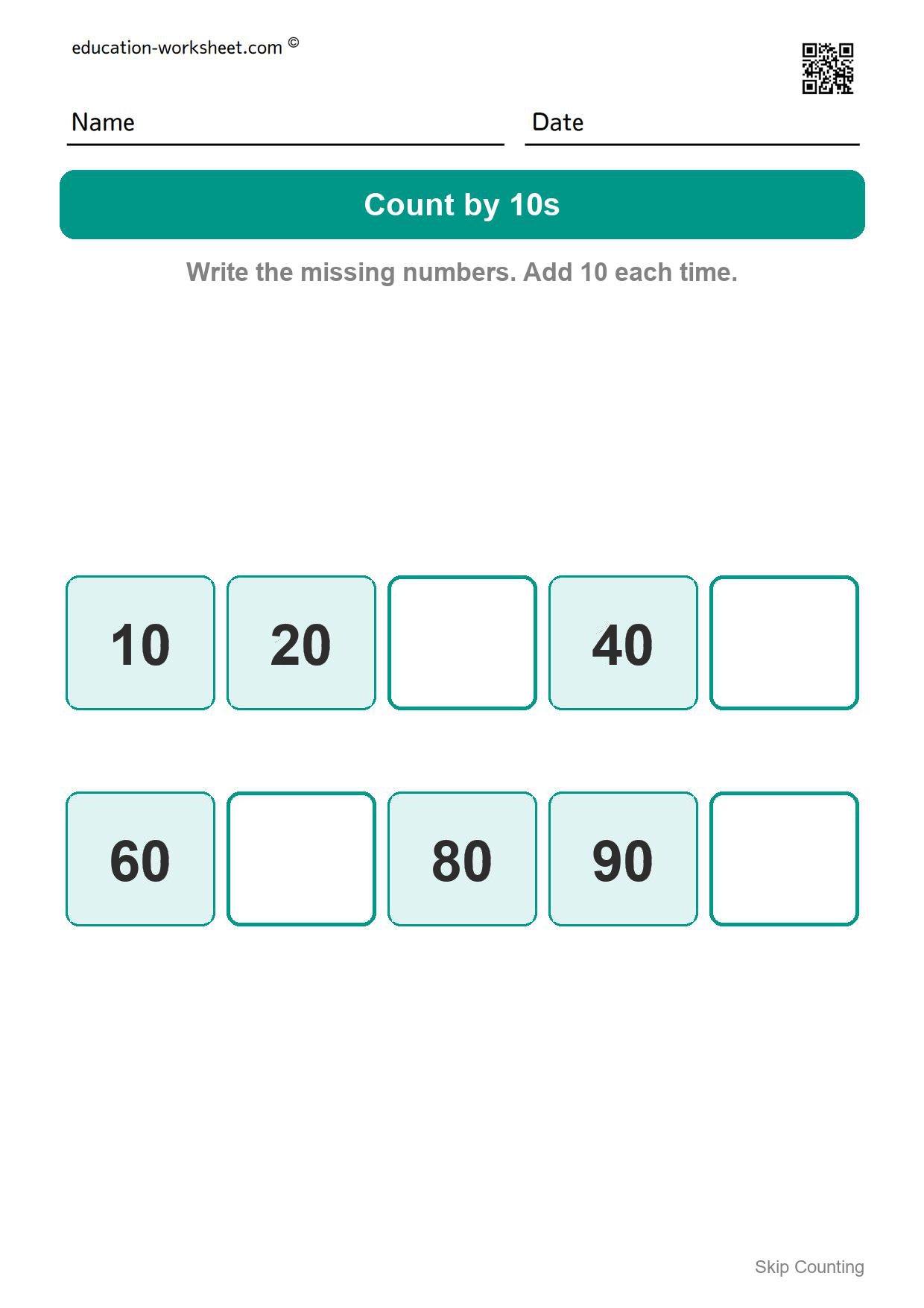
Worksheet 3 – Count by 10s, Ending on Two Blanks
Printed: 10, 20, 30, 50, 70, 80. Missing: 40, 60, 90 and 100.
This is the first sheet with two blanks in a row. The last two boxes, 90 and 100, are both empty, so the child has to carry the pattern two steps past the last printed number. That is a real step up from sheets 1 and 2, and it is the reason to do the tens sheets in order.

Worksheet 4 – Count by 5s, 5 to 50
Printed: 5, 10, 20, 25, 30, 40. Missing: 15, 35, 45 and 50. The sheet ends on two blanks, the same way sheet 3 did.
Fives are where rote learning starts to run out. Most children can say five, ten, fifteen, twenty without thinking; far fewer can carry on past thirty without counting.

Worksheet 5 – Count by 5s, with the Gap Right at the Start
Printed: 5, 20, 25, 35, 45, 50. Missing: 10, 15, 30 and 40.
This is the only sheet in the pack where the two boxes straight after the start are both empty. There is a 5 and then nothing until 20. A child who has been leaning on the printed numbers will notice the difference immediately.

Worksheet 6 – Count by 5s, Hollowed Out in the Middle
Printed: 5, 10, 15, 20, 35, 50. Missing: 25, 30, 40 and 45.
The easy half is given and the hard half is taken away. Everything up to 20 is printed; almost everything after it is blank. If a child can finish this sheet, they are counting in fives rather than reciting the first four of them.

Worksheet 7 – Count by 2s, 2 to 20
Printed: 2, 4, 10, 12, 16, 18. Missing: 6, 8, 14 and 20.
Twos come last, and they are harder than they look. Two, four, six, eight has no rhythm in the words themselves – the child has to know the numbers, not the tune.

Worksheet 8 – Count by 2s, the Second Half Missing
Printed: 2, 4, 6, 8, 12, 18. Missing: 10, 14, 16 and 20.
The start of the row is handed over and the end is not, which is the same shape as sheet 6 in fives. Twelve is printed, so a child who gets lost after 8 has somewhere to pick the count back up.

Worksheet 9 – Count by 2s, with an Early Gap
Printed: 2, 6, 8, 10, 16, 18. Missing: 4, 12, 14 and 20.
The second box is blank – the child has to produce 4 before they have seen the pattern repeat even once. Then 12 and 14 go together, the only pair of adjacent blanks on the twos sheets.

Worksheet 10 – Count by 2s, Gaps All the Way Along
Printed: 2, 4, 6, 10, 14, 18. Missing: 8, 12, 16 and 20.
The blanks are spread evenly down the row, so there is no run-up and no long stretch of help. It is the last sheet in the pack and the one to keep for when the counting is nearly there.

What Skip Counting Is Actually For
Counting by twos, fives and tens is the first time a child counts something other than one at a time. It is the bridge between counting and multiplying: ten fives is fifty, and a child who has written that row out eight times will meet five times ten later with the answer already half known.
The counting by 2s sheets are also the even numbers, all of them, in order. Nothing on the page says so. If you want a child to make that link, the moment to say it is when they have just filled in the last box: these are the numbers you land on when you count things in pairs.
There is one thing to keep an eye on. On all four of the twos sheets, the last box – 20 – is blank. A child who does four of these in a row can learn that the answer at the end is always 20 without ever counting to it. Asking them to read the whole finished row aloud is the quickest way to find out which of the two is happening.
When Children Are Ready for Skip Counting
- Age: about five to seven – the end of kindergarten through first grade.
- Before starting: the child should be able to count to twenty one number at a time and write numerals without help.
- K.CC.A.1 – count to 100 by ones and by tens. The three tens sheets sit squarely on this standard.
- Counting by 2s and 5s is not a kindergarten standard in the Common Core. It is preparation for 2.NBT.A.2 – count within 1000 and skip-count by 5s, 10s and 100s.
- The twos sheets also lead toward 2.OA.C.3, telling odd numbers from even ones.
How to Use These Worksheets
- Start with sheet 1 and work down. The pack is ordered tens, then fives, then twos, from easiest to hardest.
- Read the printed numbers aloud before writing anything. Saying ten, twenty, thirty gets the pattern going in a way that looking at it does not.
- Point at the box below, not just the box to the right. Five more steps down the row is a jump of 50, 25 or 10, and it turns a long count into a short one.
- When a blank is reached, ask what gets added each time – the instruction at the top of the page says it, and children skip reading it.
- Check the finished row by reading it out. If it does not end on 100, 50 or 20, something upstream went wrong.
- Come back to sheet 5 and sheet 6 a week later. They are the two that separate counting in fives from remembering the first four fives.
Three Things to Watch For
1. Slipping back into counting by ones. A child writes 11 after 10, or 21 after 20. It usually means the step size has dropped out of their head partway along the row. Go back to the last printed number and say the count from there.
2. Running out of fives after twenty. Five, ten, fifteen, twenty is memorized; twenty-five onwards has to be worked out. Sheets 5 and 6 are built on exactly that gap, which is why they feel much harder than sheet 4 even though the numbers are identical.
3. Learning the last box instead of the count. The final box on all four twos sheets is 20, and on all three tens sheets it is 100. That repetition is useful for checking, but it also lets a child fill the last box without counting. Ask for the whole row out loud.
Printing Tips
- Print at 100 percent, actual size, on A4 or US Letter.
- The boxes are large and the printed numbers are bold, so black and white printing costs nothing in readability.
- Print two copies of the sheets you expect to repeat. Children remember where the blanks were, and a second copy of the same sheet is worth less than it looks.
Frequently Asked Questions
What age are these skip counting worksheets for?
About five to seven years old. The counting by 10s pages suit the end of kindergarten; the 5s and 2s pages are usually first grade work.
Is there an answer key?
There is no separate key, and none is needed. Every row counts ten steps, so a correctly finished sheet always ends on 100, 50 or 20.
Which order should we do them in?
Straight through, 1 to 10. Tens are easiest because the number words carry the pattern; twos are hardest because they do not.
How many numbers are missing on each page?
Four, out of ten boxes. The first box is never one of them, and there are never three blanks in a row.
Why is counting by 2s last if the numbers are smaller?
Because the size of the numbers is not what makes it hard. Ten, twenty, thirty sounds like a pattern; two, four, six, eight does not, so the child has to know the sequence rather than hear it.
Do I need to sign up to download these?
No. Every PDF downloads immediately, with no account, no email address and no cost.
Can I use these in my classroom?
Yes, they are free to print for home and classroom use. Please do not sell them or re-host the files elsewhere.
More Free Counting Worksheets
- Free Skip Counting by 3s and 4s Worksheets for Grade 1
- Free Number Maze Worksheets for Kindergarten – Count and Skip Count
- Free Even and Odd Numbers Worksheets for Kindergarten
- Free Tally Marks Worksheets for Kindergarten – Count and Draw Tallies
- Free Missing Numbers Worksheets 1-20 for Kindergarten – Fill In the Chart
- Free Numbers to 100 Worksheets for Grade 1 – Hundred Chart