
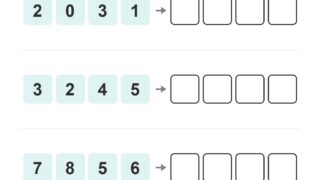
These free printable ten frame worksheets give kindergarten children ten pages of counting to 10. Each page shows one ten frame with some counters in it, the question “How many?”, and a box to write the number in.
A ten frame is a two-by-five grid – five boxes on top, five underneath. On these pages the counters always fill the top row completely, left to right, before a single one goes into the bottom row. That rule is the entire value of the pack, and it is what separates a ten frame from a picture of some dots.
Page 1 holds one counter, page 2 holds two, and so on to page 10, which is full. Along the bottom of every page is a number line from 1 to 10 under the words “Use the number line to help you write” – a model to copy for a child who can count but cannot yet form the numeral.
- What Is in This Free Ten Frame Worksheet Pack
- The 10 Ten Frame Worksheets
- Worksheet 1 – One Counter in the Top Left Corner
- Worksheet 2 – Two Counters, and the Row Fills Left to Right
- Worksheet 3 – Three: Still Room in the Top Row
- Worksheet 4 – Four: One Box Short of a Full Row
- Worksheet 5 – Five: The Top Row Is Full
- Worksheet 6 – Six: Five and One
- Worksheet 7 – Seven: Five and Two
- Worksheet 8 – Eight: Five and Three, or Two Short of Ten
- Worksheet 9 – Nine: One Empty Box Left
- Worksheet 10 – Ten: The Frame Is Full
- Why the Top Row Always Fills First
- When Children Are Ready for These Worksheets
- How to Use These Worksheets
- Three Things to Watch For
- Printing Tips
- Frequently Asked Questions
- More Free Counting and Number Worksheets
What Is in This Free Ten Frame Worksheet Pack
- Ten printable worksheets, one ten frame on each page.
- The numbers 1 to 10, one per page, in order.
- The top row always filled first, so every amount above five reads as five and some more.
- A number line 1–10 at the foot of every page as a writing guide.
- A name and date line at the top of each page.
- A separate PDF for every page, free to download and print.
The 10 Ten Frame Worksheets
The pages run 1 to 10 in order: the answer to page 4 is four, and the answer to page 9 is nine. Handy for checking, and a temptation if a child works through the pile in sequence. Shuffle them before handing them over, or use the order as a self-check at the end.
Worksheet 1 – One Counter in the Top Left Corner
A single counter in the first box. This page is less trivial than it looks: it establishes where counting starts on a ten frame, which is the top left corner, the same place reading starts. One counter in the top row, four empty boxes beside it, and the bottom row empty.
Worksheet 2 – Two Counters, and the Row Fills Left to Right
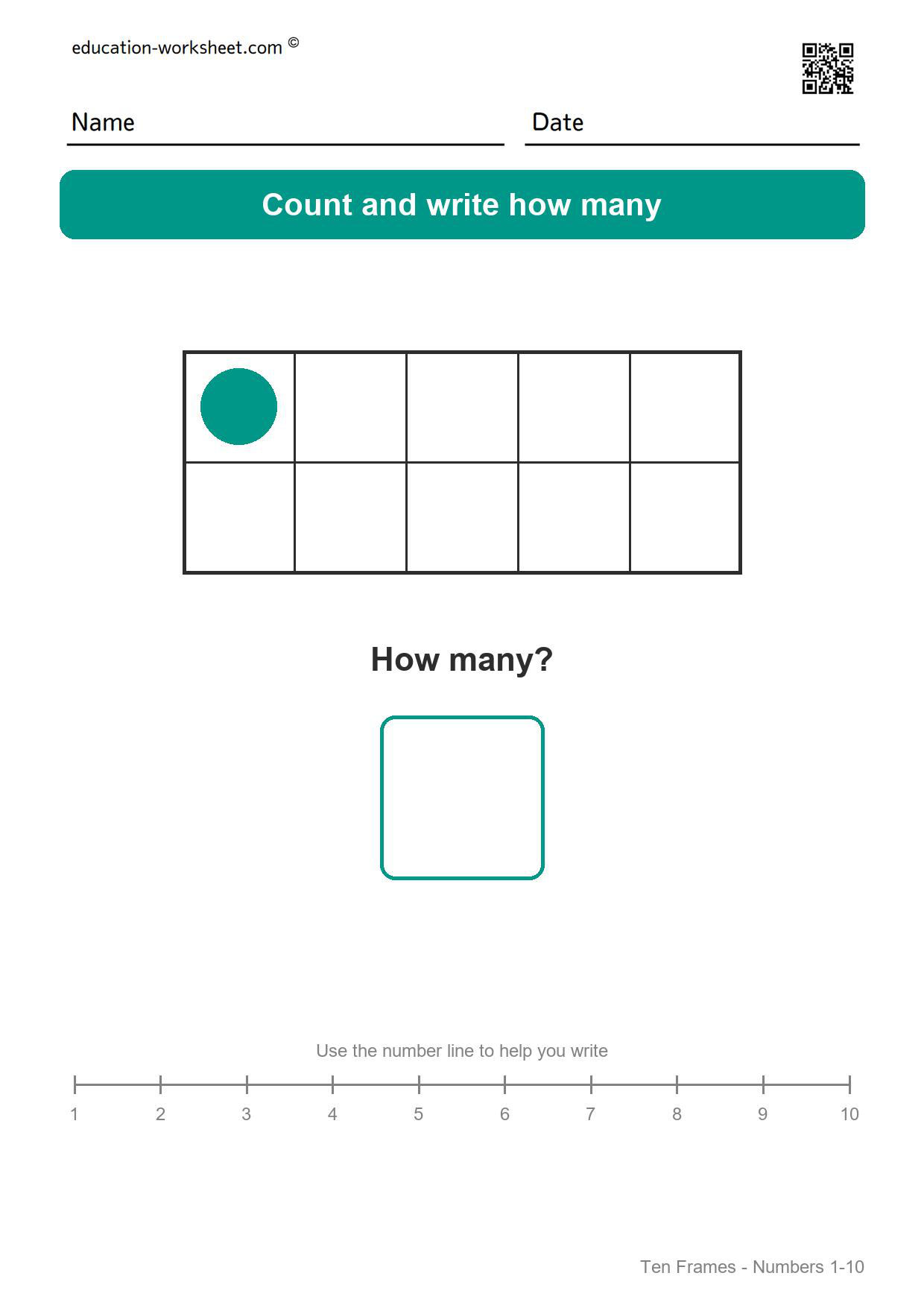
The second counter goes next to the first, not underneath it. Two pages in, a child has already seen the rule the rest of the pack depends on. Two counters in the top row, three empty boxes beside them, and the bottom row empty.
Worksheet 3 – Three: Still Room in the Top Row
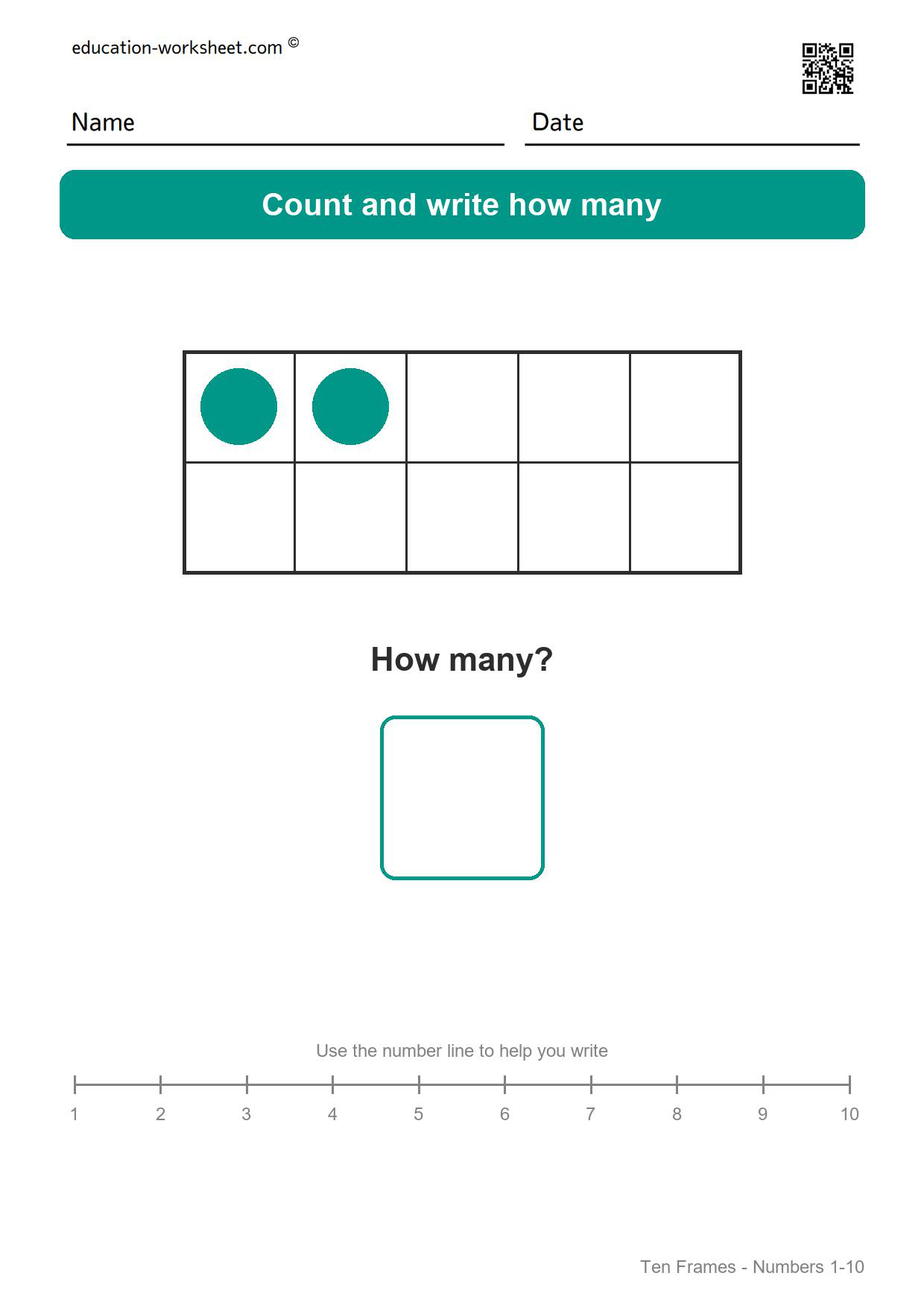
Three counters and two empty boxes beside them. Some children will start noticing the gap rather than the counters, which is a useful thing to notice and worth a comment. Three counters in the top row, two empty boxes beside them, and the bottom row empty.
Worksheet 4 – Four: One Box Short of a Full Row
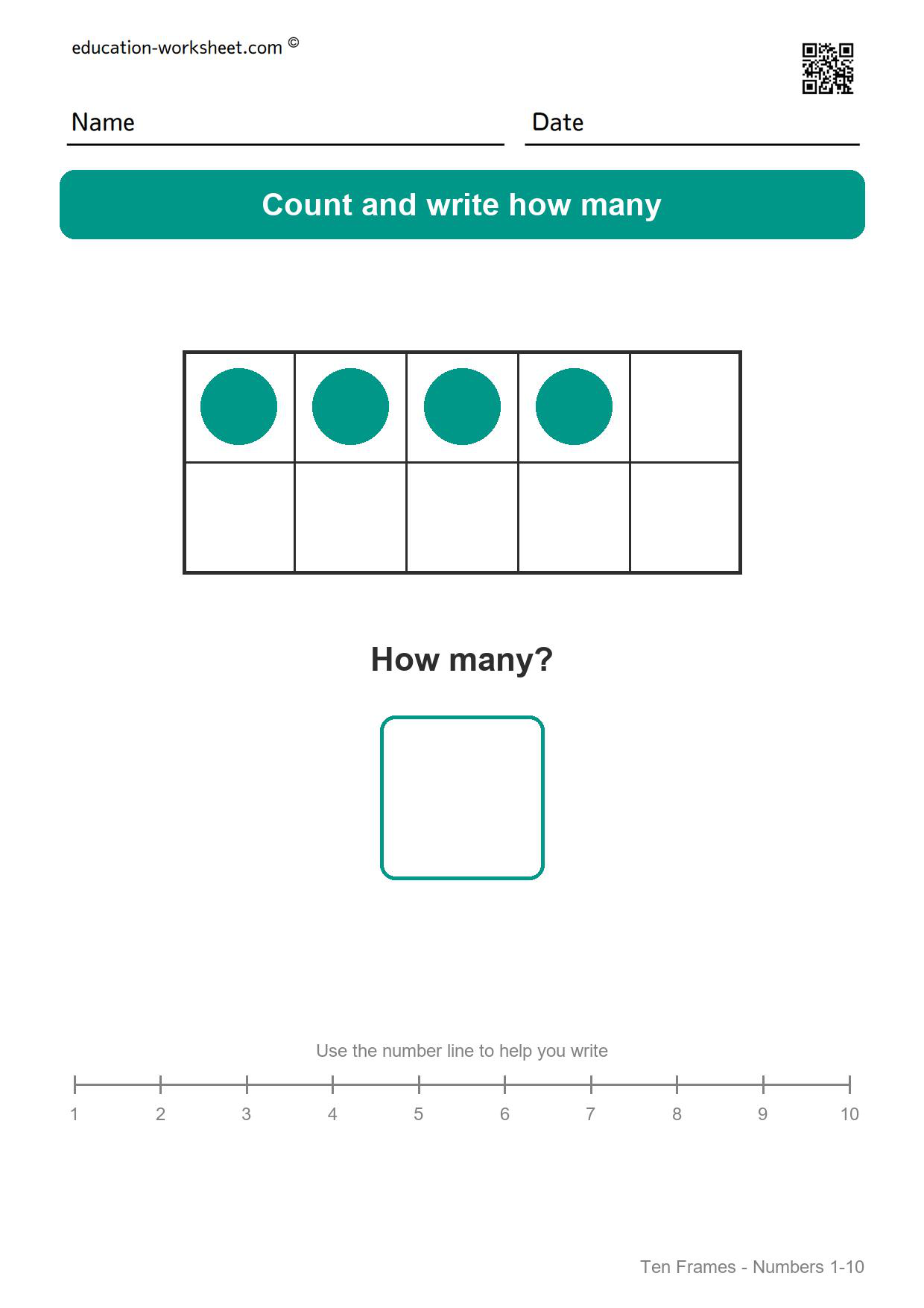
Four counters, one empty box. A child who says “four” without counting has taken the first step away from counting one by one. A child who counts each one is doing exactly what is expected at this age. Four counters in the top row, one empty box beside them, and the bottom row empty.
Worksheet 5 – Five: The Top Row Is Full
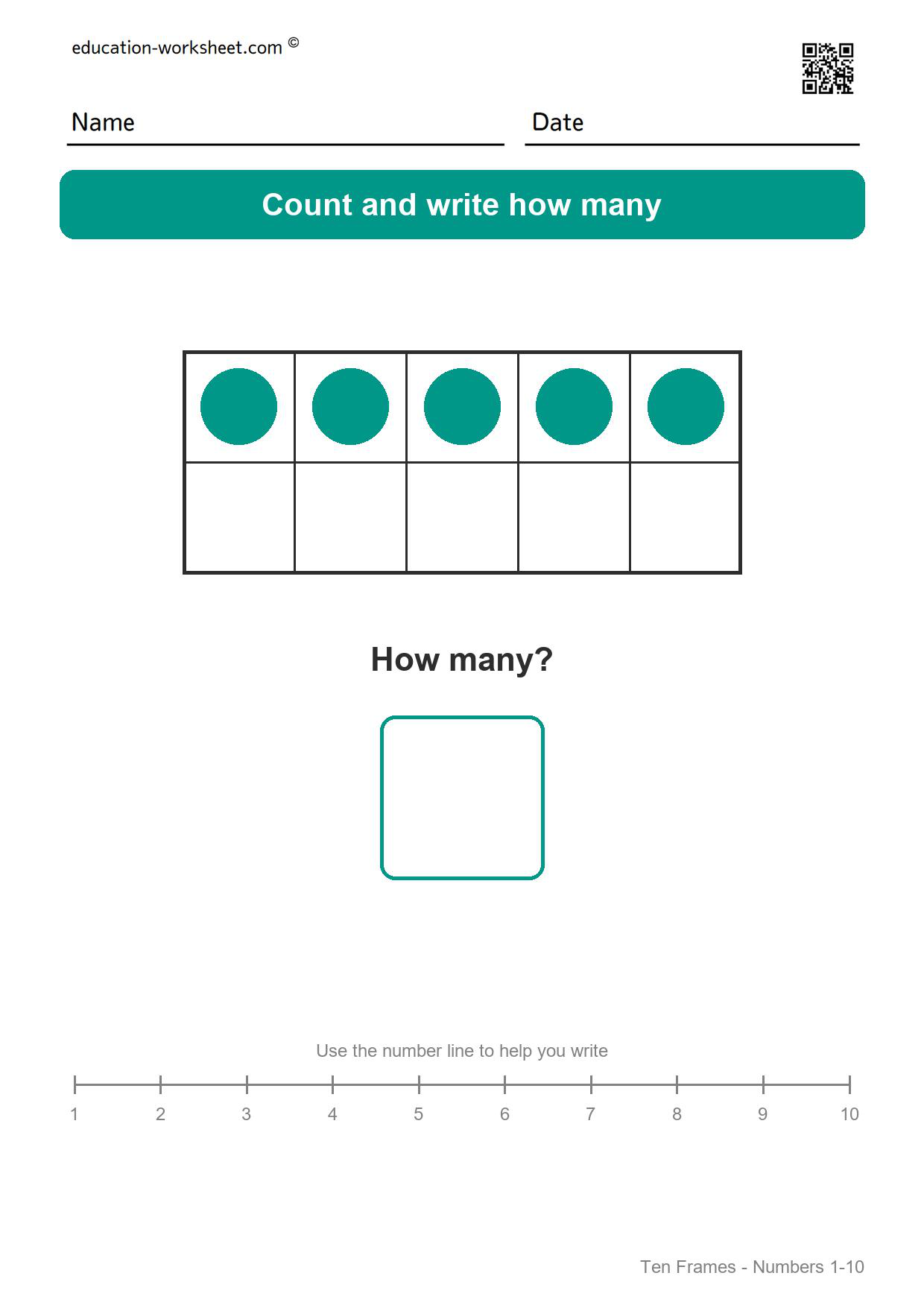
The important page. A full top row is the anchor for everything that follows: from here on, every arrangement in this pack is five and something. Say it out loud together – “the top row is full, that is five”. The top row is full with five counters, and the bottom row is empty.
Worksheet 6 – Six: Five and One
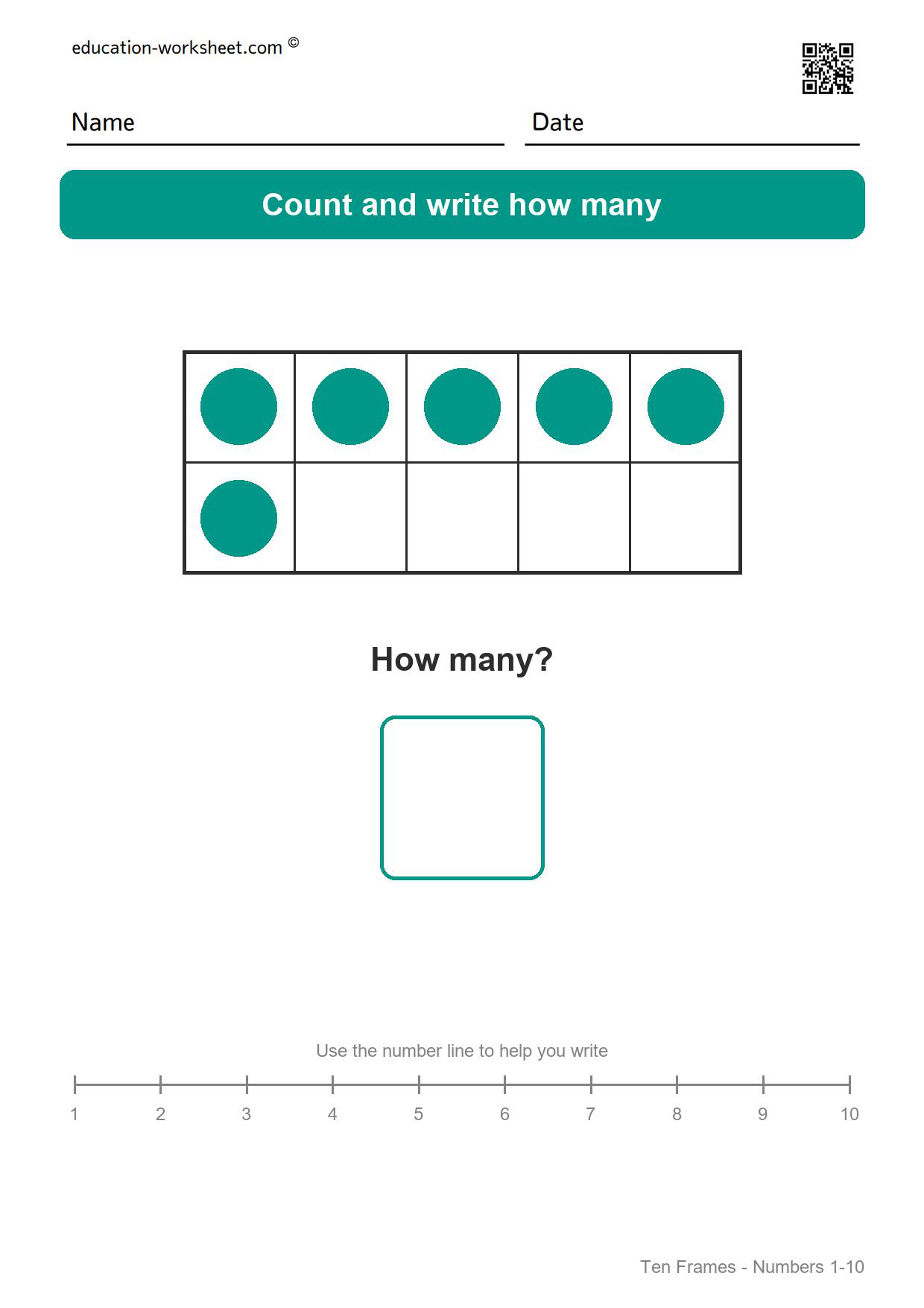
The first counter in the bottom row. If your child counts all six from the beginning, that is fine. Then cover the bottom row and ask how many are hidden above, and uncover it. Six as five and one is what the frame is showing. 6 counters: five in the top row and 1 in the bottom row.
Worksheet 7 – Seven: Five and Two
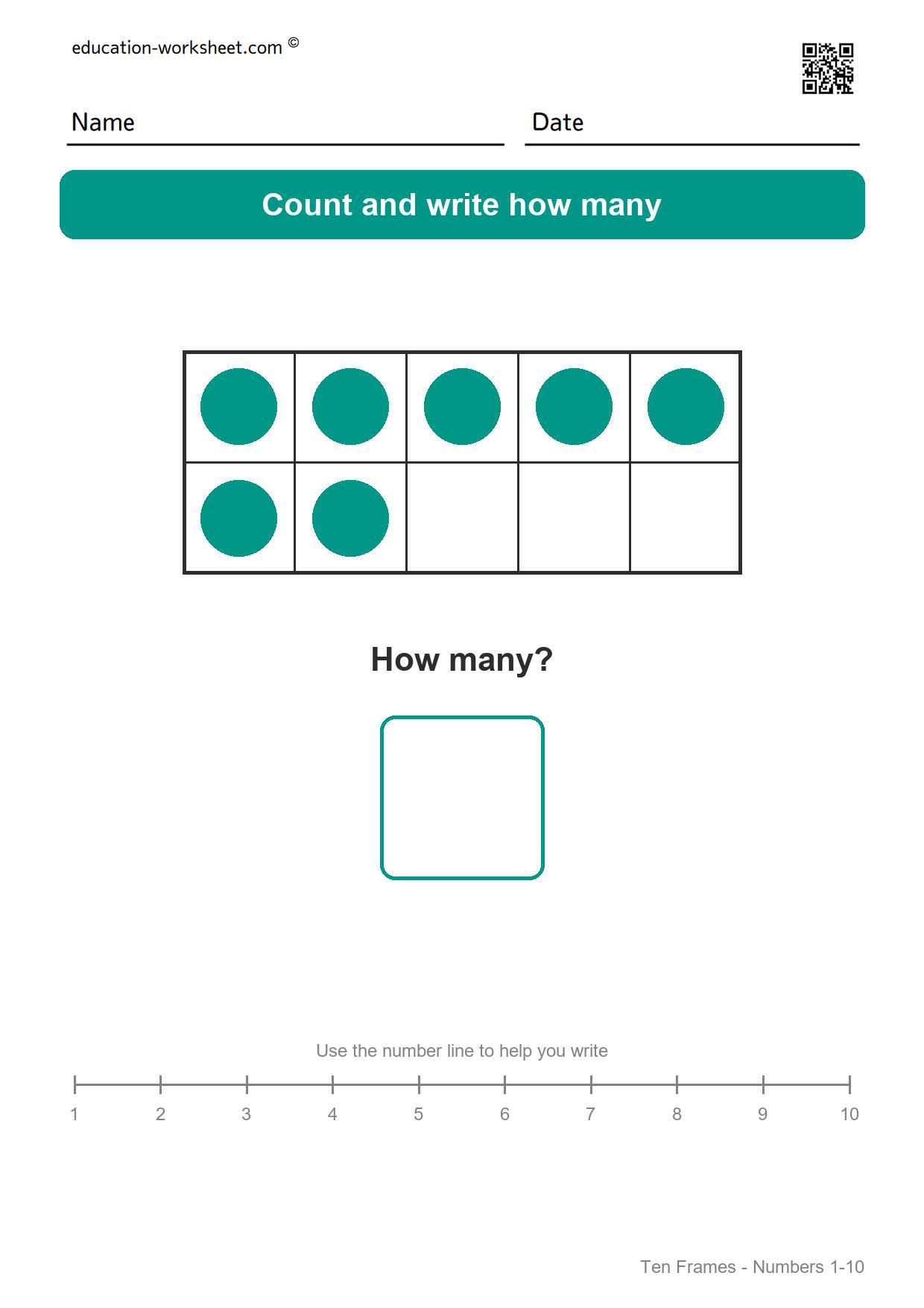
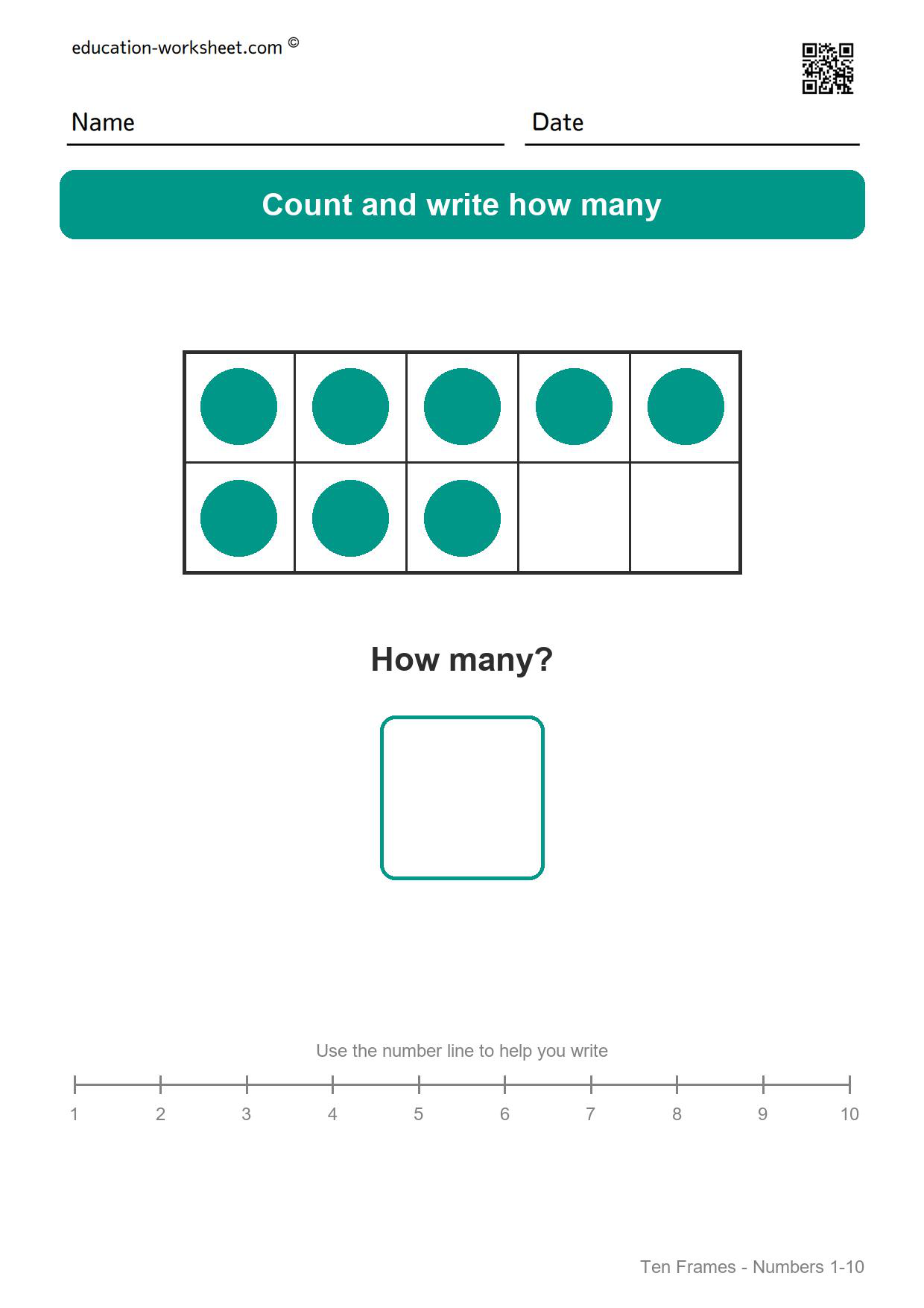
Two counters in the bottom row. The top row does not need counting any more; it is five whether you count it or not, and that recognition is the point of the shape. 7 counters: five in the top row and 2 in the bottom row.
Worksheet 8 – Eight: Five and Three, or Two Short of Ten
Eight is the first page where the empty boxes are easier to count than the counters. Two empty, so eight. Reading the gap instead of the objects is a real strategy, and this is the page where it first pays. 8 counters: five in the top row and 3 in the bottom row.
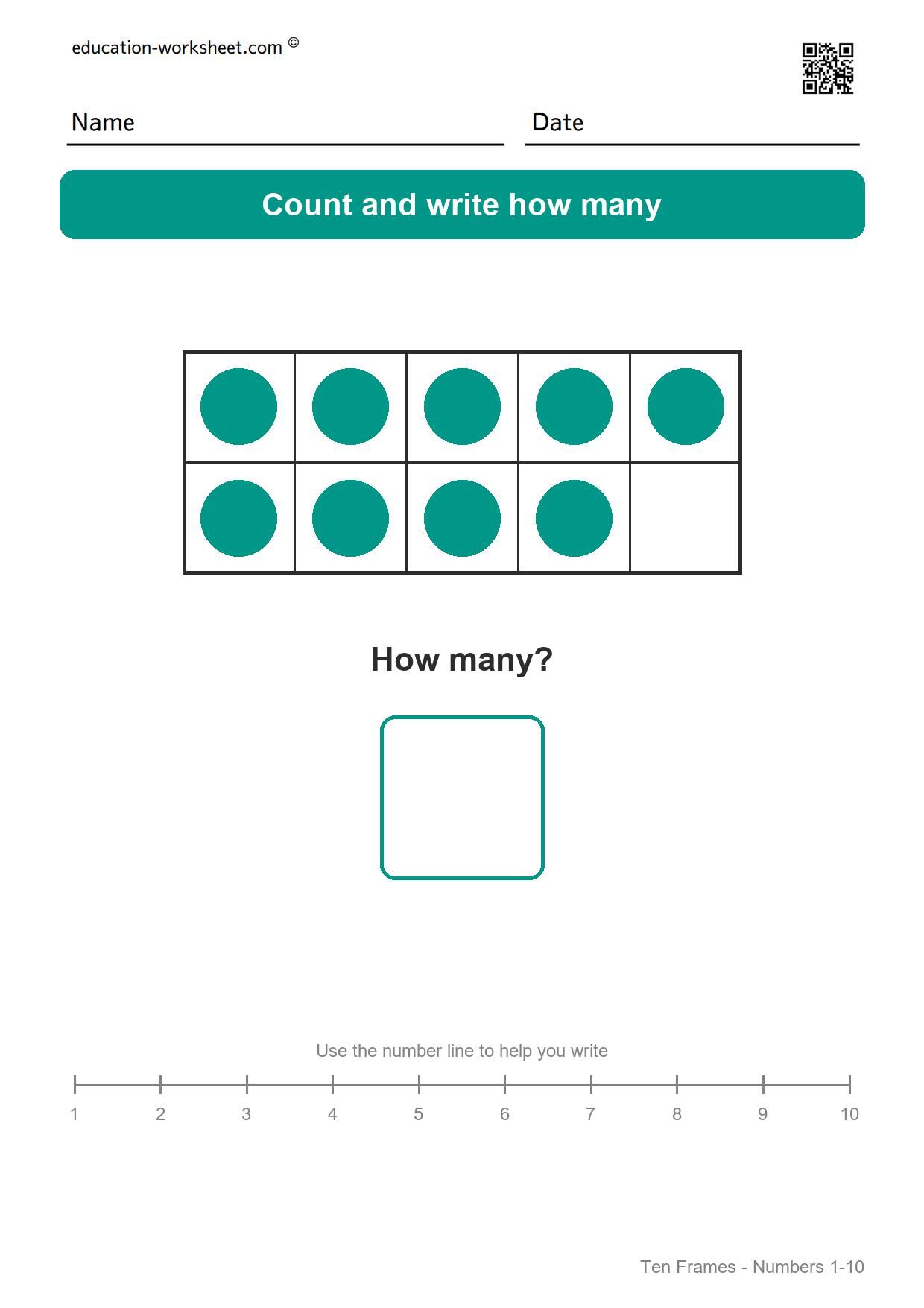
Worksheet 9 – Nine: One Empty Box Left
Nine counters and a single hole. Almost every child sees this as “one missing” before they see it as nine, which is exactly the thinking that later makes 9 + 3 easy. 9 counters: five in the top row and 4 in the bottom row.
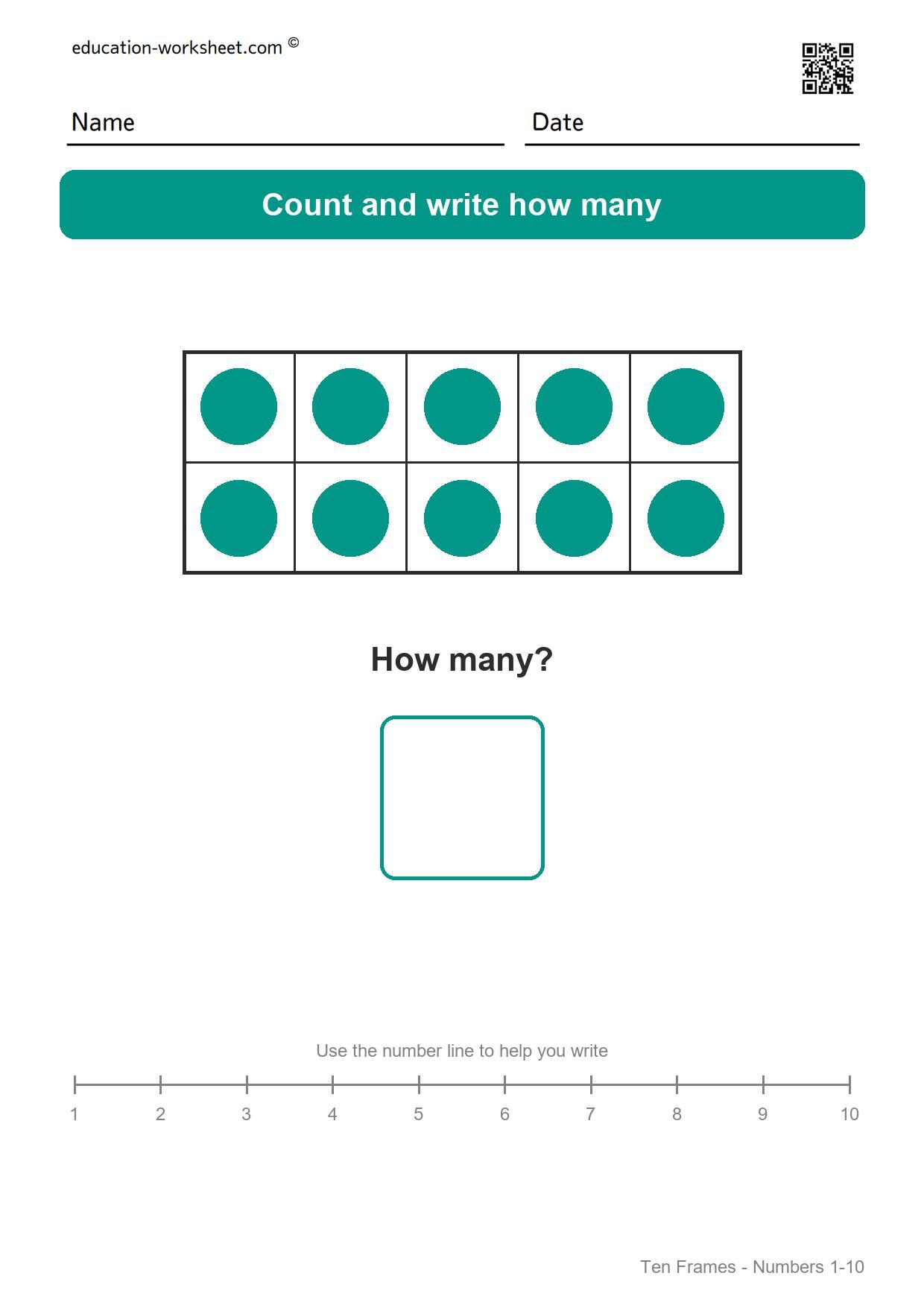
Worksheet 10 – Ten: The Frame Is Full
The full frame, and the picture of ten that children carry with them for years. Two rows of five, no gaps. Everything the pack has done so far has been building towards this image. 10 counters: five in the top row and 5 in the bottom row.
Why the Top Row Always Fills First
Plenty of free ten frame sheets scatter the counters, or fill downwards, or drop them in wherever they land. Those pages ask a child to count. These pages ask a child to see.
Because the top row is always completed before the bottom row begins, every amount from six upwards is drawn as a full five and a few more. Eight is a full row and three; nine is a full row and four, or a full frame with one box empty. After a few pages children stop counting the top row at all – it is five, and it is always five. That is subitizing: knowing how many without counting, and it is the skill that makes mental arithmetic possible later on.
The last page pays this off. A full frame is ten, and it looks like ten – two rows of five with nothing missing. Children who have this picture in their heads find the make-ten strategy much easier when it arrives in first grade, because “how many more to make ten” becomes “how many empty boxes”.
The number line at the foot of the page is doing something different, and its caption says so: it is there to help with the writing, not the counting. A child who knows the answer is nine but cannot remember which way round a 9 goes has a model to copy without anyone having to write one for them.
When Children Are Ready for These Worksheets
These pages suit children from about four to six: pre-K through kindergarten. A child is ready when they can count a small group of objects by touching each one, and they do not need to be writing numerals confidently yet, because the number line at the bottom fills that gap.
They sit squarely on K.CC.B.4 and K.CC.B.5: counting to answer “how many” about objects arranged in a rectangular array. Writing the answer in the box covers K.CC.A.3, writing numerals 0 to 20. The five-and-some-more reading that the frame builds is what later supports K.OA.A.4, finding the number that makes ten.
How to Use These Worksheets
- Print one page on ordinary paper.
- Ask the question on the page: “how many?” Let your child count by touching each counter if that is what they need.
- From page 6 on, add one question: how many are in the top row? Establishing that the top row is five, without counting it, is the whole exercise.
- On pages 8, 9 and 10, ask how many boxes are empty. Counting the gaps is the strategy that makes ten easy later.
- Write the number in the box, using the number line at the bottom as a guide if the shape of the numeral is uncertain.
Three Things to Watch For
Counting all ten boxes instead of the counters
A frame with nine counters and one hole invites a child to count boxes rather than dots. Ask them to put a finger on each counter as they count, and to skip the empty one out loud. Making the empty box explicit is better than pretending it is not there.
Losing the five
A child may count all seven counters on page 7, then all eight on page 8, without ever noticing that the top row has not changed. Cover the bottom row with a piece of paper and ask how many are underneath. Uncover it. Do that two or three times and the five stops needing to be counted.
Numerals written backwards
Especially 6, 7 and 9 at this age. It is normal, it is not a sign of anything, and it sorts itself out. The number line at the bottom of the page is the fix: point at the number there and let your child copy it rather than correcting what they have written.
Printing Tips
- Choose Actual size or Fit to page in the print dialog – both keep the page in proportion.
- Each page fills one sheet and works on US Letter and A4 paper.
- Ordinary copier paper is fine. Card is only worth it if you want the page to survive an eraser.
- Greyscale printing works perfectly here. The counters are solid, so they stay clearly visible without color.
- If you print the whole pack, shuffle the pages before use so the answers cannot be read off the order.
- A page in a plastic wallet with a dry-wipe pen can be reused, which is useful for the pages your child wants to repeat.
Frequently Asked Questions
What age are these ten frame worksheets for?
About four to six years old: pre-K and kindergarten.
What is a ten frame for?
It is a two-by-five grid that shows an amount as a picture. Because the top row of five fills first, everything above five is seen as five and some more, which is how children stop counting one by one.
Do the pages get harder?
They go up by one, from one counter to ten. That is a gentle climb rather than a jump, and the later pages are only harder in that there is more to see.
Does my child need to be able to write numbers already?
No. Every page has a number line from 1 to 10 at the bottom to copy from, so a child who can count but not yet write can still finish the page.
Is there an answer key?
The answers are 1 to 10, matching the page order. That is why shuffling the pages is worth doing before you hand them over.
Do I need to sign up to download these?
No. Every PDF downloads immediately, with no account, no email address and no cost.
Can I use these in my classroom?
Yes, they are free to print for home and classroom use. Please do not sell them or re-host the files elsewhere.
More Free Counting and Number Worksheets
- Free Make 10 Worksheets for Kindergarten – Ways to Make Ten with Ten Frames
- Free Tens and Ones Worksheets for Kindergarten – Teen Numbers with Ten Frames
- Free Counting 1 to 10 Worksheets for Preschool and Kindergarten – Count and Write
- Free Number Bonds Worksheets for Kindergarten – Numbers to 10
- Free Subtraction Worksheets for Kindergarten – Subtracting within 10 with Ten Frames
- Free Learn the Numbers 1 to 10 Worksheets for Preschool – Ten Frames and Tracing