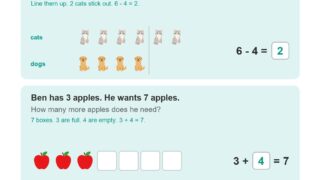
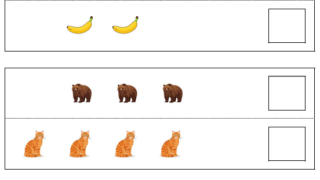
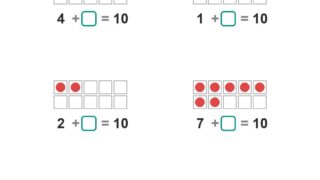
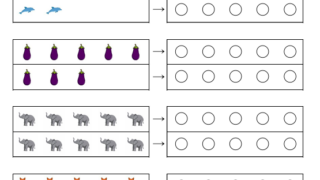
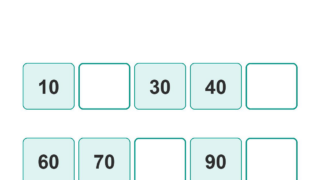
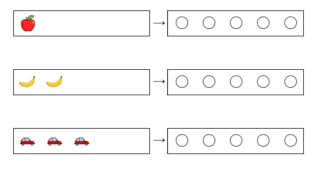
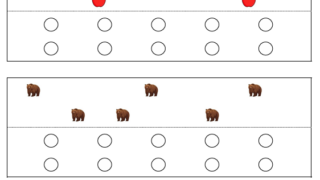
These free printable subtraction worksheets give kindergarten children ten pages of practice taking away within 10. Each page shows a group of pictures with some of them already crossed out in red, and underneath it the matching number sentence with an empty box for the answer.
The crossings-out are printed on the page rather than left for the child to do, and that is the design decision that makes this pack work for beginners. Subtraction is genuinely harder than addition for young children, because counting backwards is harder than counting forwards. Showing the take-away as a picture means a child never has to count backwards at all – they simply count the pictures that are left.
What Is in This Free Subtraction Worksheet Pack
- Ten printable worksheets, one subtraction on each page.
- Every problem shown twice: once as crossed-out pictures, once as a number sentence.
- All answers within 10, and all of them positive.
- A large empty box for the answer, sized for a young hand.
- Mostly taking away one or two, so the counting stays manageable.
- A separate PDF for every page – no sign-up, no email address, no cost.
The 10 Subtraction Worksheets
The pages are ordered so the starting number grows while the number taken away stays small. One page is a complete session for most five year olds.
Worksheet 1 – 2 − 1
The smallest subtraction there is. One picture crossed out of two, and the answer is visible without counting.

Worksheet 2 – 3 − 1
Three take away one. Still small enough to see at a glance, which is how a first subtraction page should feel.

Worksheet 3 – 5 − 2
Taking away two for the first time. Two crossings-out is the point where a child stops seeing the answer and starts counting what is left.

Worksheet 4 – 6 − 2
Six take away two. The number crossed out stays the same while the starting number grows – that is the pattern running through the middle of this pack.

Worksheet 5 – 7 − 2
Seven take away two.

Worksheet 6 – 8 − 2
Eight take away two.

Worksheet 7 – 9 − 2
Nine take away two. By now most children have noticed that the answer is always two less, which is a genuine discovery and worth saying out loud.

Worksheet 8 – 10 − 2
Ten take away two. The largest starting number in the pack.

Worksheet 9 – 10 − 1
Ten take away one, straight after ten take away two. Putting them next to each other makes the effect of the second number obvious.

Worksheet 10 – 6 − 3
Six take away three – the only page where half the group disappears, and the hardest one here.

Why Subtraction Is Harder Than Addition
A child adding three and two can count the whole lot from one and get the right answer. The same strategy does not work for subtraction: counting all the pictures gives the starting number, not the answer. Something has to be ignored, and ignoring things on purpose is difficult at five.
That is why these pages cross the pictures out for the child. The crossed-out ones are still visible – so the starting number can be checked – but they are visibly out of play. A child can count what remains and write it down, and the number sentence underneath quietly teaches what the minus sign was describing all along.
When Children Are Ready for These Worksheets
These pages suit children from about five to six years old. A child should be able to count ten objects reliably and recognise the numerals 0 to 10 before starting; writing them neatly is not required.
In American classrooms this is kindergarten operations work: representing subtraction with objects and drawings, and solving subtraction problems within 10 (Common Core K.OA.A.1 and K.OA.A.2). The picture and the number sentence on the same page are exactly the connection those standards ask for.
How to Use These Worksheets
- Print one page and count all the pictures first, including the crossed-out ones.
- Ask how many have been taken away.
- Count only the ones left and write that number in the box.
- Read the whole number sentence out loud together: “seven take away two is five”.
- Use the word minus as well as take away. Children meet both, and the sooner the better.
Three Things to Watch For
Counting every picture, crossed out or not
The commonest mistake, and an understandable one – the crossed-out pictures are still there to be counted. Cover them with a hand for the first few pages.
Writing the starting number in the box
Closely related, and usually a sign that the child is answering “how many pictures?” rather than the question that was asked. Point at the minus sign and read the sentence again.
Getting the picture right but not the numbers
Some children can say “five are left” and still not see which number goes in the box. Trace the sentence with a finger while saying it – seven, take away, two, is – and the box stops being a mystery.
Printing Tips
- Choose Actual size or Fit to page so the letters and pictures stay large.
- Each page fills one sheet and works on both US Letter and A4 paper.
- Slip a page into a plastic wallet and use a dry-wipe pen to reuse it with more than one child.
- The crossings-out are printed in red. Greyscale printing still works, though the crossed pictures are easier to see in colour.
Frequently Asked Questions
What age are these subtraction worksheets for?
About five to six years old – kindergarten, and confident preschoolers.
Does my child cross the pictures out?
No, they are already crossed out. That is what makes the pack suitable for a first introduction to subtraction.
Are all the answers positive?
Yes. Every problem stays within 10 and never goes below zero.
What comes after this pack?
Subtraction without the pictures, and fact families. Both are linked below.
Do I need to sign up to download these?
No. Every PDF downloads immediately, with no account, no email address and no cost.
Can I use these in my classroom?
Yes, they are free to print for home and classroom use. Please do not sell them or re-host the files elsewhere.
More Free Addition and Subtraction Worksheets
- Free Addition Worksheets to 10 for Kindergarten – Add and Write
- Free Subtraction Worksheets – Subtracting within 10 with Ten Frames
- Free Fact Family Worksheets – Add and Subtract
- Free Missing Addend Worksheets – Sums to 20
- Free Number Bonds Worksheets – Numbers to 10
- Free Word Problems Worksheets – Add, Subtract