These free printable 3D shapes worksheets ask kindergarten children to do one thing fifty times: look at a drawing of a solid shape and circle its name. Five rows on each page, three names to choose from in every row.
Every page asks about all five solids exactly once – cone, sphere, cube, cylinder and pyramid – and the ten pages put them in ten different orders. Counted across the pack, each shape is the right answer exactly ten times.
That design has a consequence worth knowing: on any page, a child who is sure of four rows can get the fifth by elimination. It is not cheating. It is the same reasoning that makes a multiple-choice test answerable, and noticing it is a good sign.
- What Is in This Free 3D Shapes Worksheet Pack
- The 11 Solid Shape Worksheets
- Worksheet 1 – Cone, sphere, cube, cylinder, pyramid
- Worksheet 2 – Cylinder, sphere, cone, pyramid, cube
- Worksheet 3 – Cone, pyramid, cylinder, cube, sphere
- Worksheet 4 – Sphere, cone, cylinder, pyramid, cube
- Worksheet 5 – Cylinder, pyramid, sphere, cube, cone
- Worksheet 6 – Cube, pyramid, cone, sphere, cylinder
- Worksheet 7 – Cube, sphere, pyramid, cylinder, cone
- Worksheet 8 – Cylinder, cone, pyramid, sphere, cube
- Worksheet 9 – Pyramid, cylinder, sphere, cube, cone
- Worksheet 10 – Cone, cylinder, cube, pyramid, sphere
- Answer Key – All 50 Rows
- The Pyramid in This Pack Is a Triangle-Based One
- Which Shapes Get Confused
- When Children Are Ready to Name Solid Shapes
- How to Use These Worksheets
- Three Things to Watch For
- Printing Tips
- Frequently Asked Questions
- More Free Shape Worksheets
What Is in This Free 3D Shapes Worksheet Pack
- Ten printable worksheets with five shapes on each – fifty questions in all.
- Five solids: cone, sphere, cube, cylinder and pyramid.
- Three names to choose from in every row, one of them correct.
- Each shape is the answer ten times, and no two pages use the same order.
- An eleventh page with the full answer key.
- A separate PDF for every page, free to download and print.
The 11 Solid Shape Worksheets
The drawings never change. We compared all fifty of them: every cone in the pack is the same cone, at the same size, from the same angle, down to the pixel. Same for the sphere, the cube, the cylinder and the pyramid.
That makes the pack consistent and easy to learn from, and it also fixes its limit. A child who finishes all ten pages can name five pictures. Whether they can name a ball, a tin and a party hat on the kitchen table is a separate question, and one worth asking.
Worksheet 1 – Cone, sphere, cube, cylinder, pyramid
The order is the one every book uses: cone, sphere, cube, cylinder, pyramid. If a child has met these shapes before, this page will feel like a checklist.
It is also the page to use for the elimination trick. Five rows, five shapes, each one used once – so the last row can be worked out even by a child who is not sure what they are looking at.
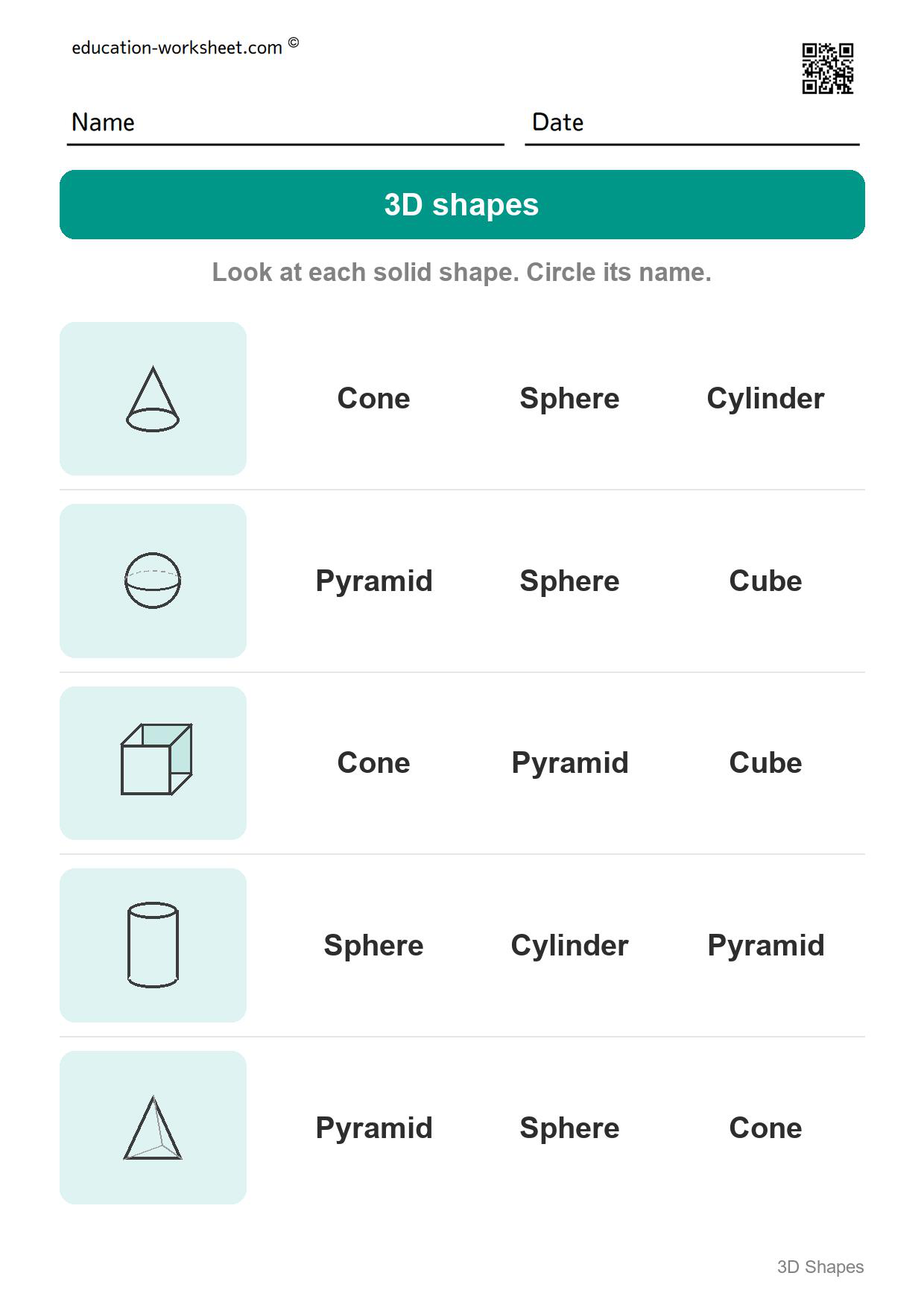
Worksheet 2 – Cylinder, sphere, cone, pyramid, cube
Cylinder first this time, then sphere, cone, pyramid and cube.
The cylinder and the cone are the two that get confused most often at this age, and putting the cylinder in the opening row is a fair test of whether page 1 stuck.
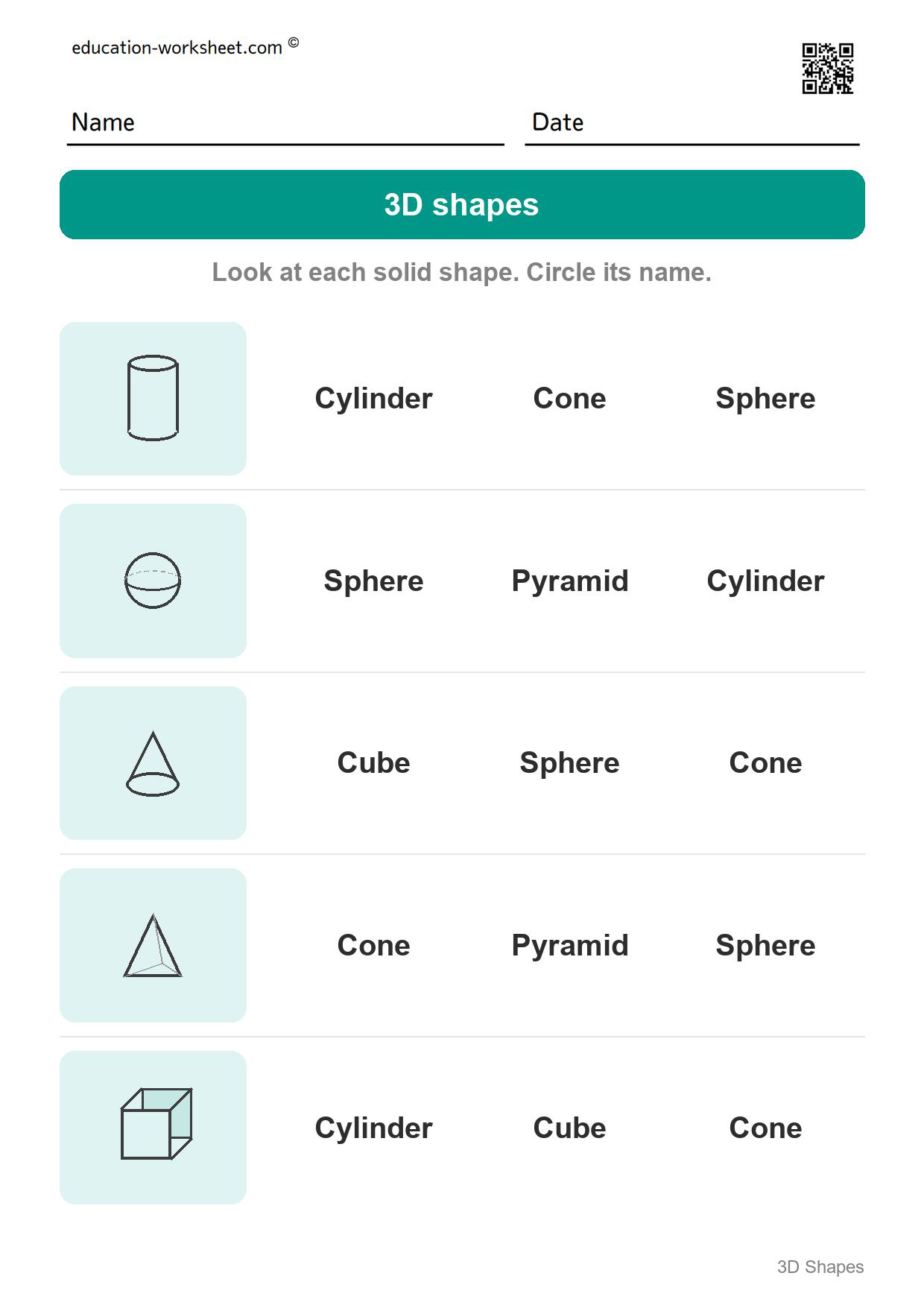
Worksheet 3 – Cone, pyramid, cylinder, cube, sphere
Cone, pyramid, cylinder, cube, sphere. The cone and the pyramid are in rows one and two, back to back.
Both are pointed, both sit on a base, and the only difference is whether that base is round or flat-sided. Two rows apart is close enough to compare them properly.
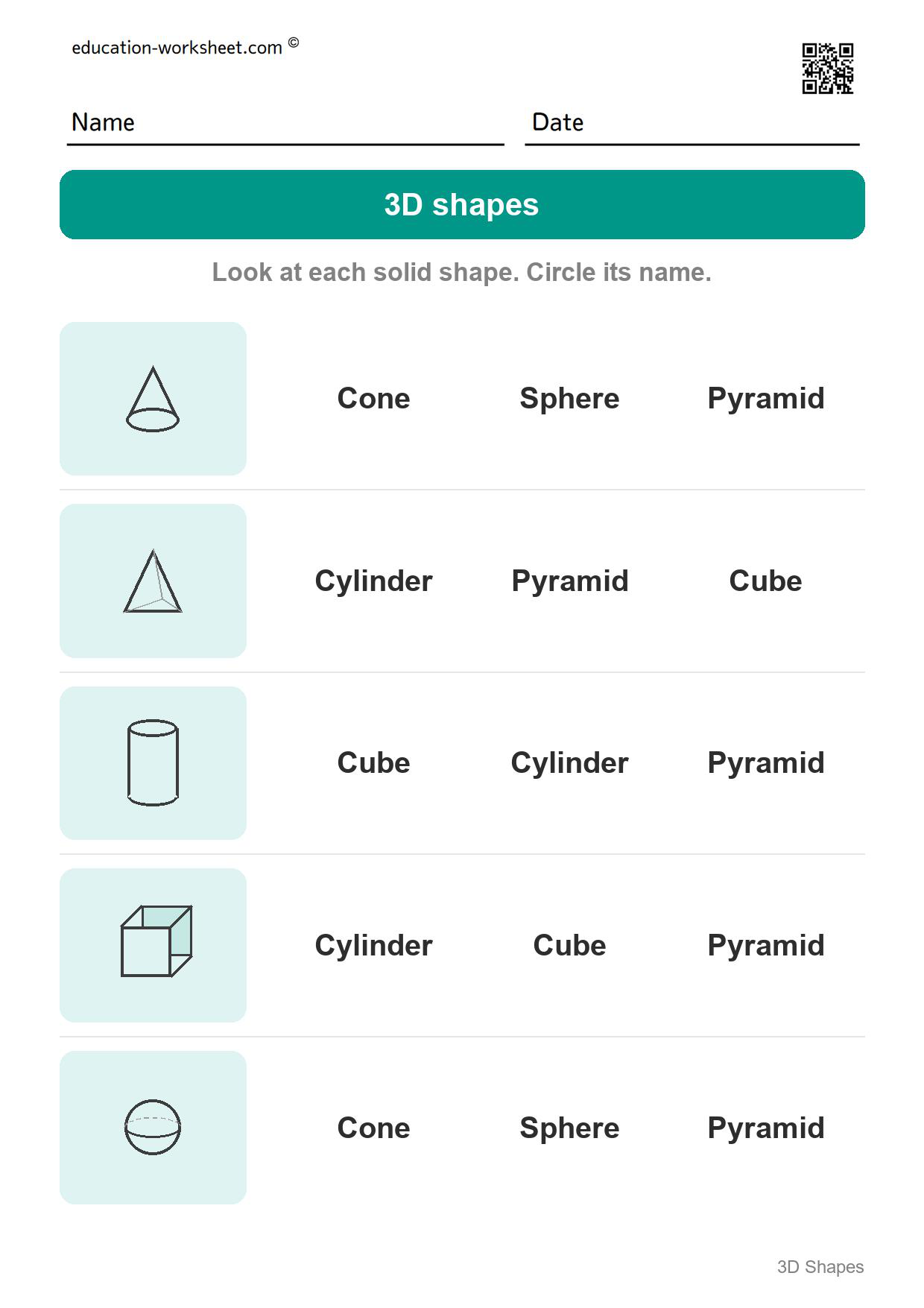
Worksheet 4 – Sphere, cone, cylinder, pyramid, cube
Sphere, cone, cylinder, pyramid, cube – the round shapes first and the flat-faced ones last.
Children who sort solids by “does it roll” will find the first three easy and then have to switch to counting faces.
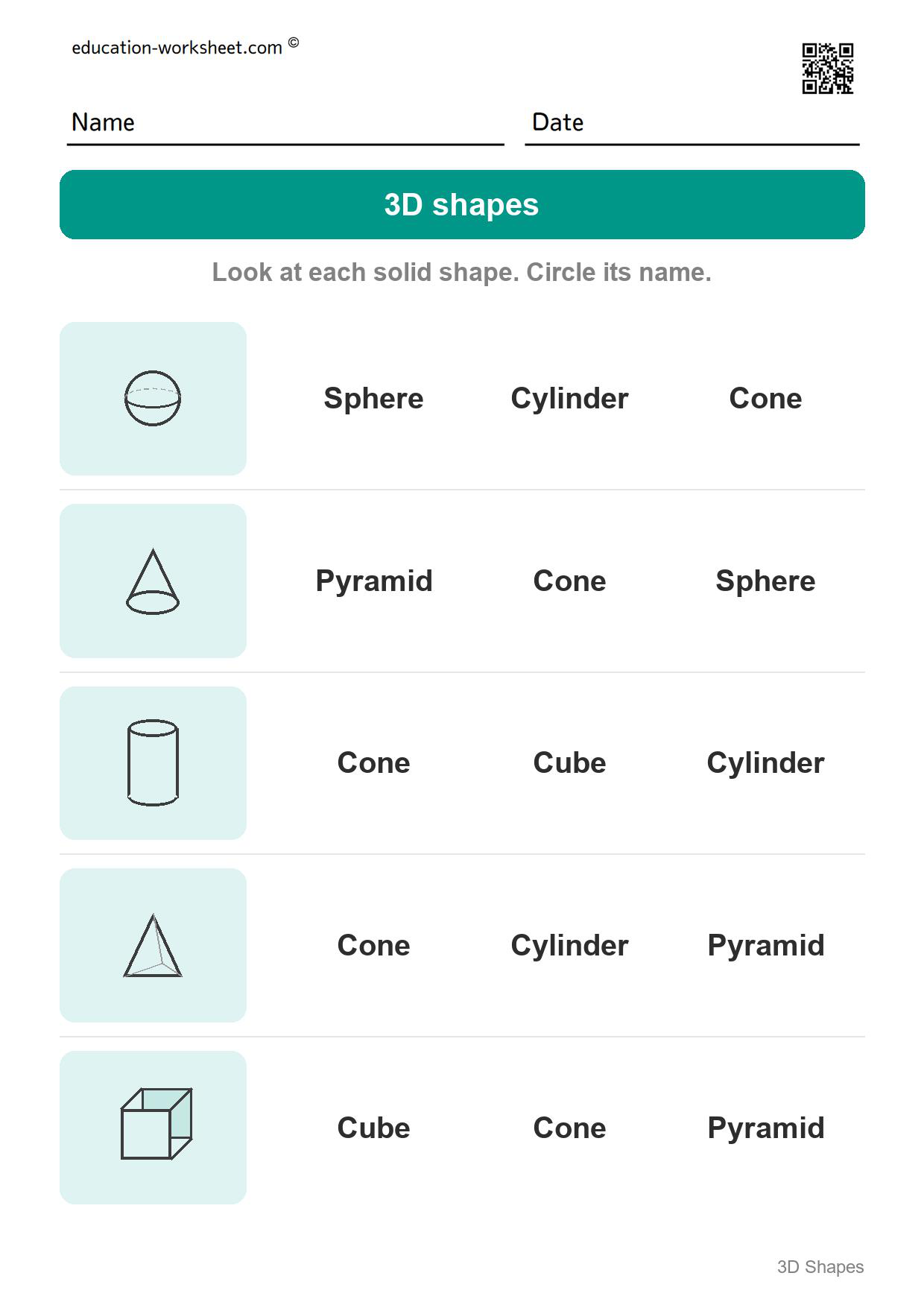
Worksheet 5 – Cylinder, pyramid, sphere, cube, cone
Cylinder, pyramid, sphere, cube, cone. The two pointed shapes are split up, one near the top and one at the bottom.
By this page most children have stopped reading all three names and are reaching for the one they recognize. That works until two names look alike.
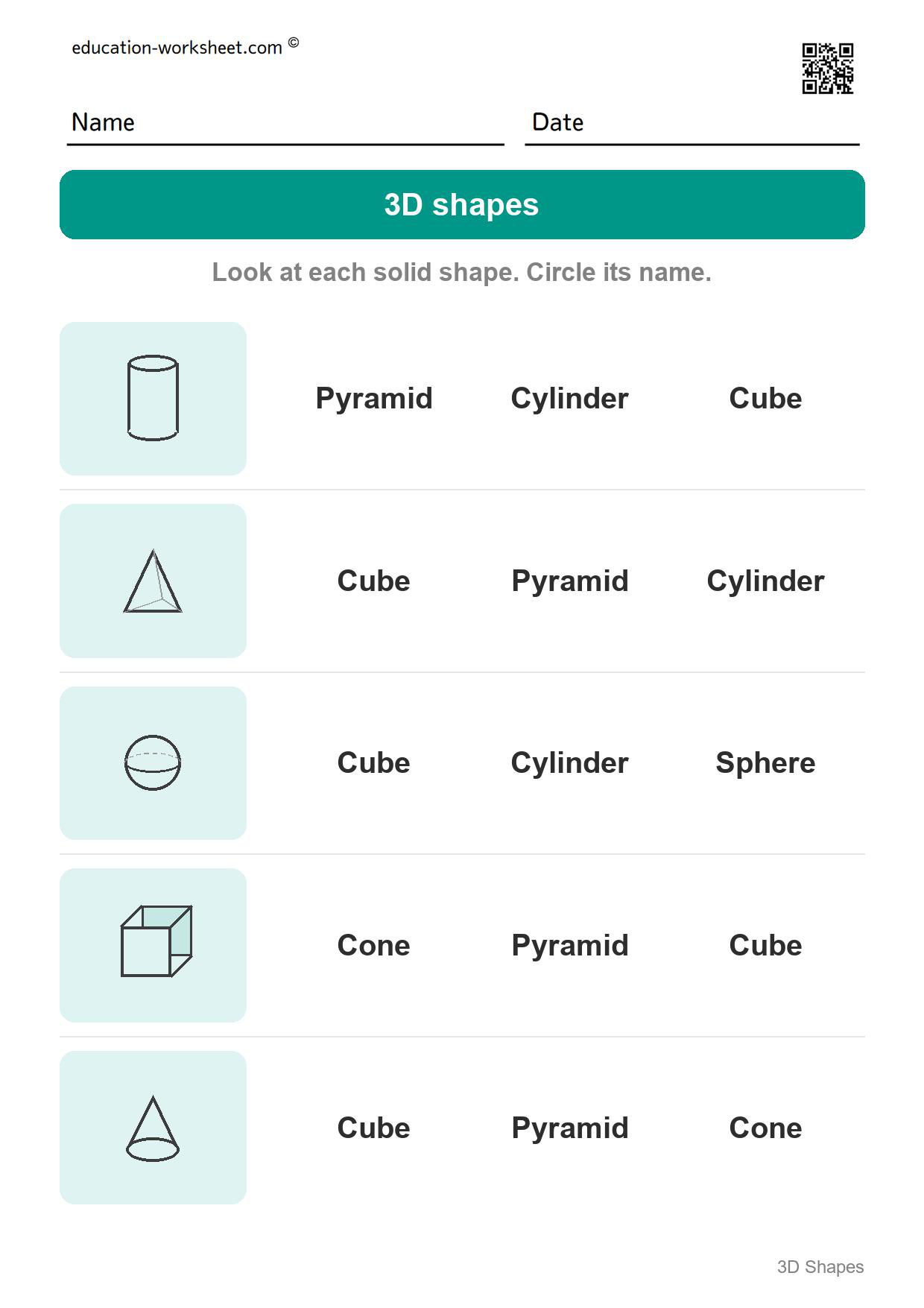
Worksheet 6 – Cube, pyramid, cone, sphere, cylinder
Cube, pyramid, cone, sphere, cylinder. Cube opens the page for the first time.
The cube is the shape almost nobody gets wrong, so this is a page that starts easy and ends on the cylinder.
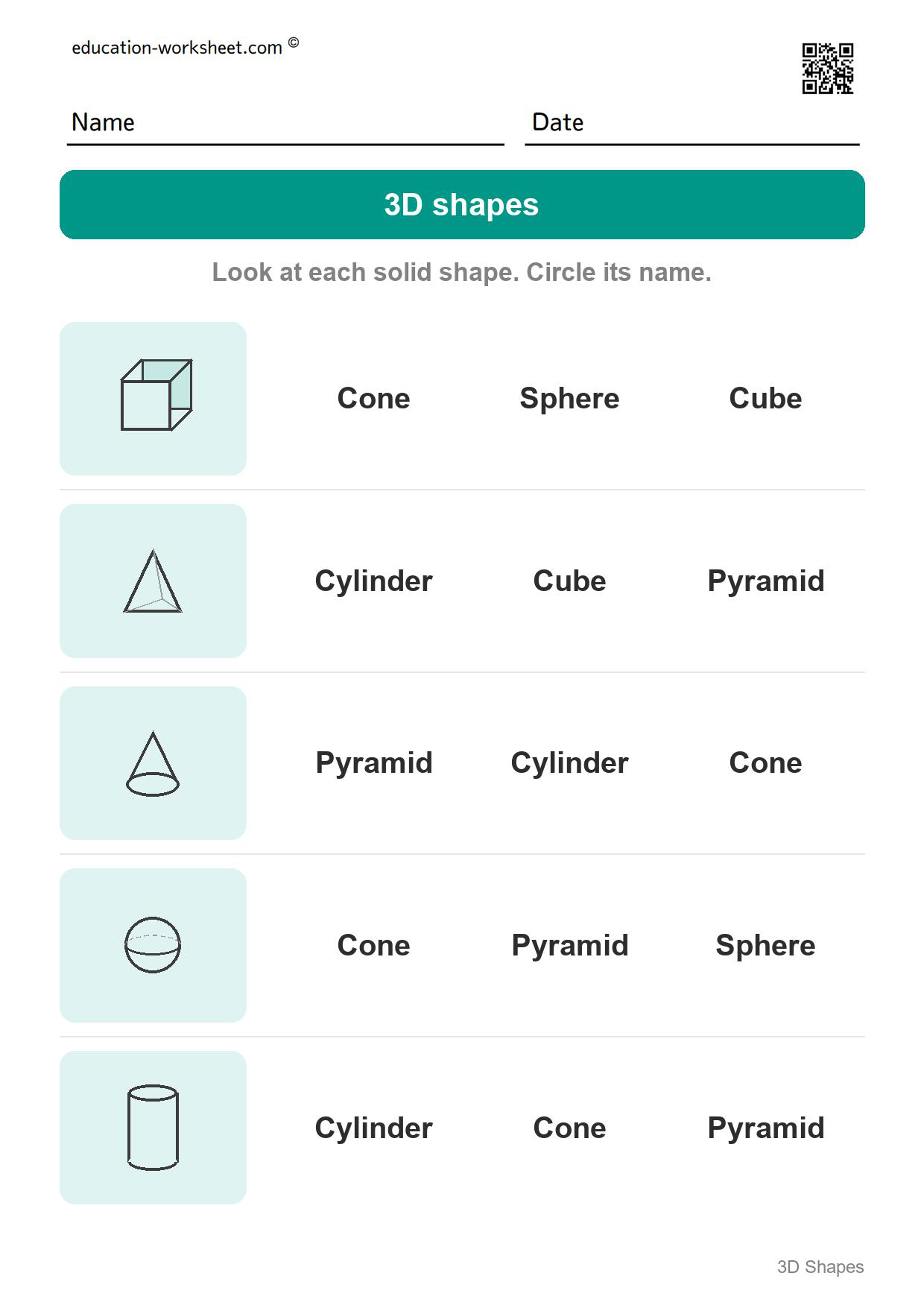
Worksheet 7 – Cube, sphere, pyramid, cylinder, cone
Cube, sphere, pyramid, cylinder, cone.
Halfway through the pack the drawings have not changed at all. That is worth saying out loud to a child: the picture of the cube on this page is exactly the picture on page 1.
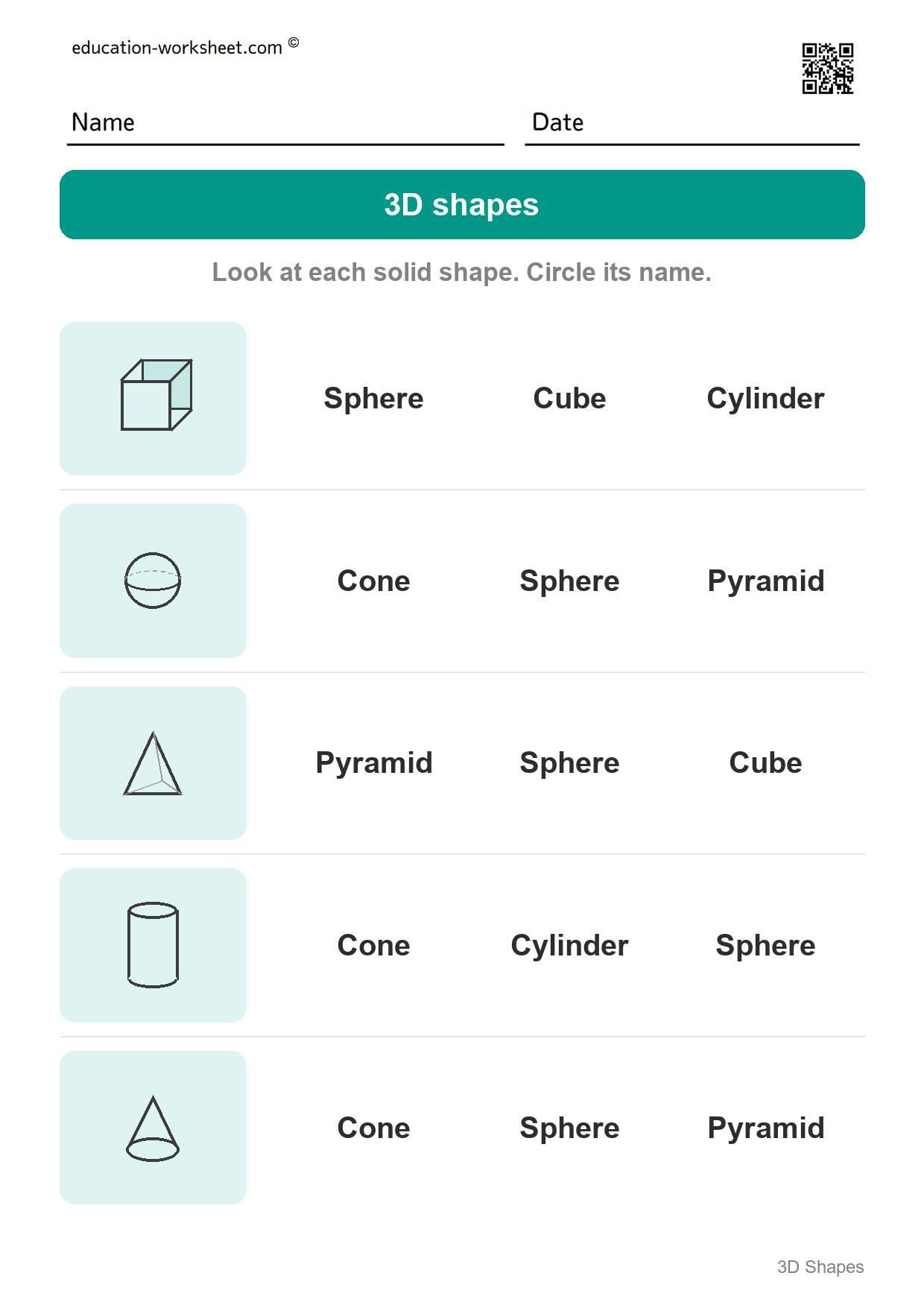
Worksheet 8 – Cylinder, cone, pyramid, sphere, cube
Cylinder, cone, pyramid, sphere, cube. Cylinder and cone in rows one and two, the tightest pairing in the pack.
Cover the names and ask how the two drawings differ before letting the child choose. One has a point; the other has a flat lid.
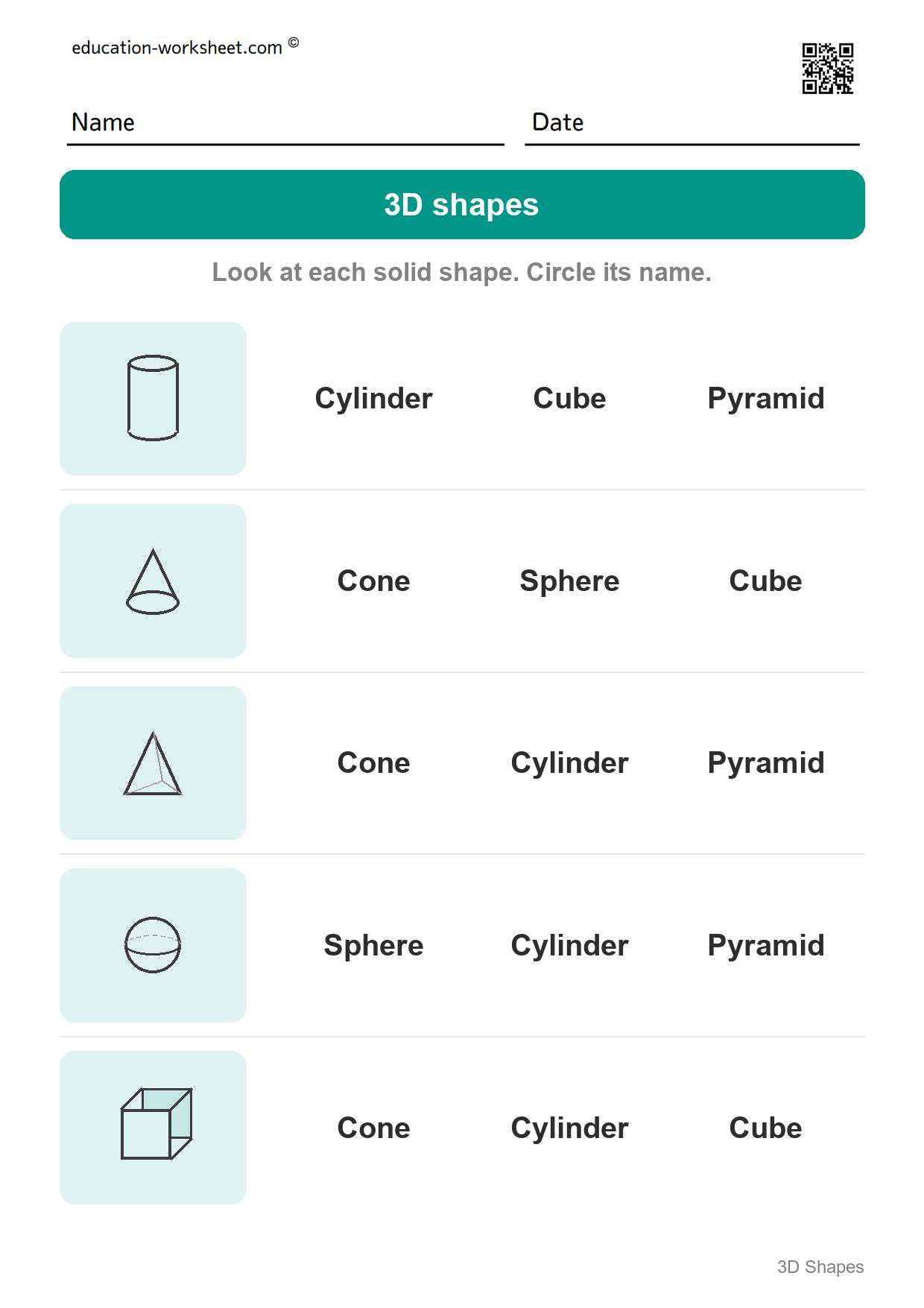
Worksheet 9 – Pyramid, cylinder, sphere, cube, cone
Pyramid, cylinder, sphere, cube, cone. Pyramid opens the page for the only time in the pack.
Pyramid is also the name that appears most often as a wrong answer – 24 times across the fifty rows – so children see the word far more often than they need it.
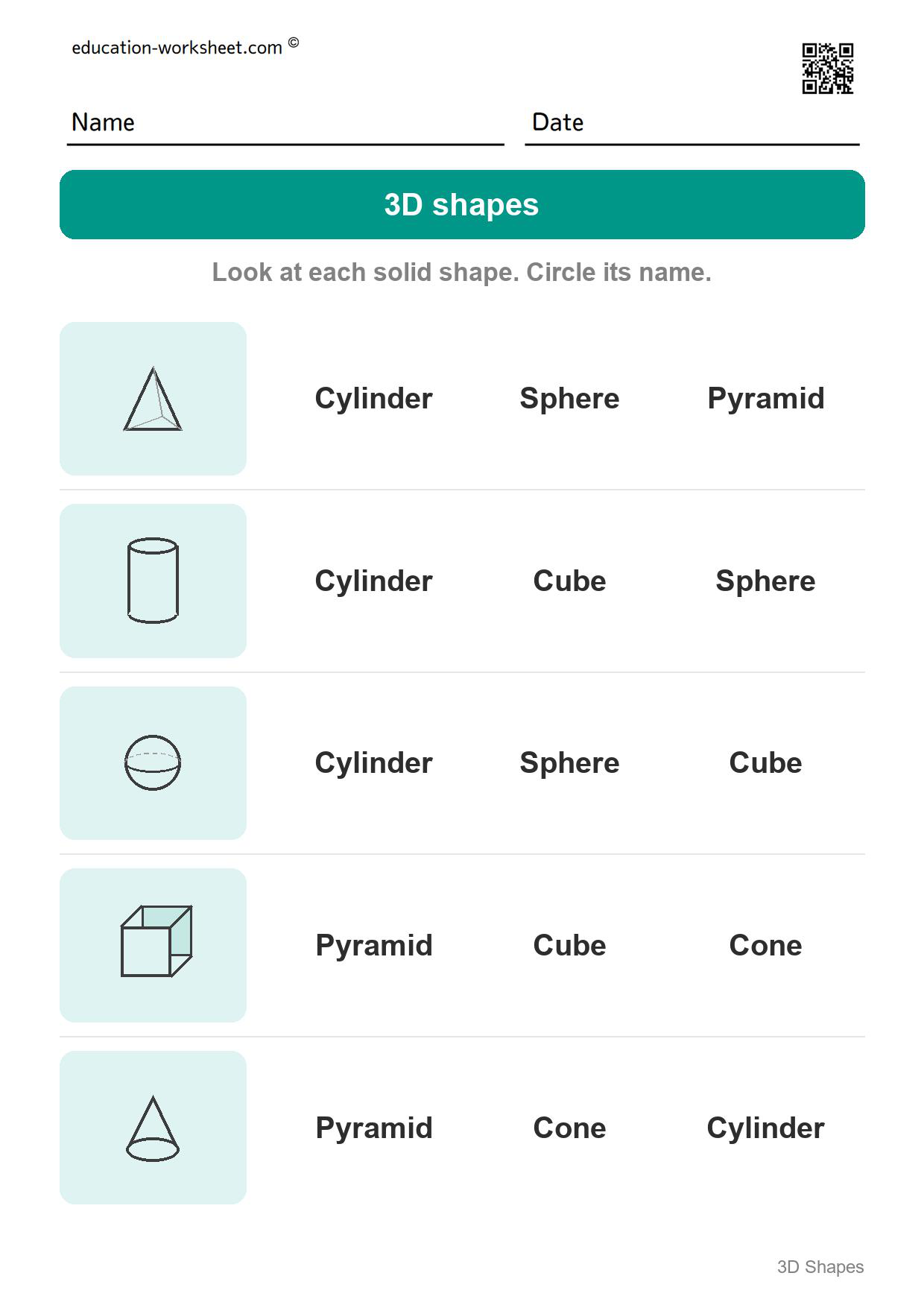
Worksheet 10 – Cone, cylinder, cube, pyramid, sphere
Cone, cylinder, cube, pyramid, sphere. The pack closes with the cone, which is where it started.
If a child can finish this page without hesitating, they can name all five solids from a drawing. Naming them from a real object on the table is the next step, and a different one.
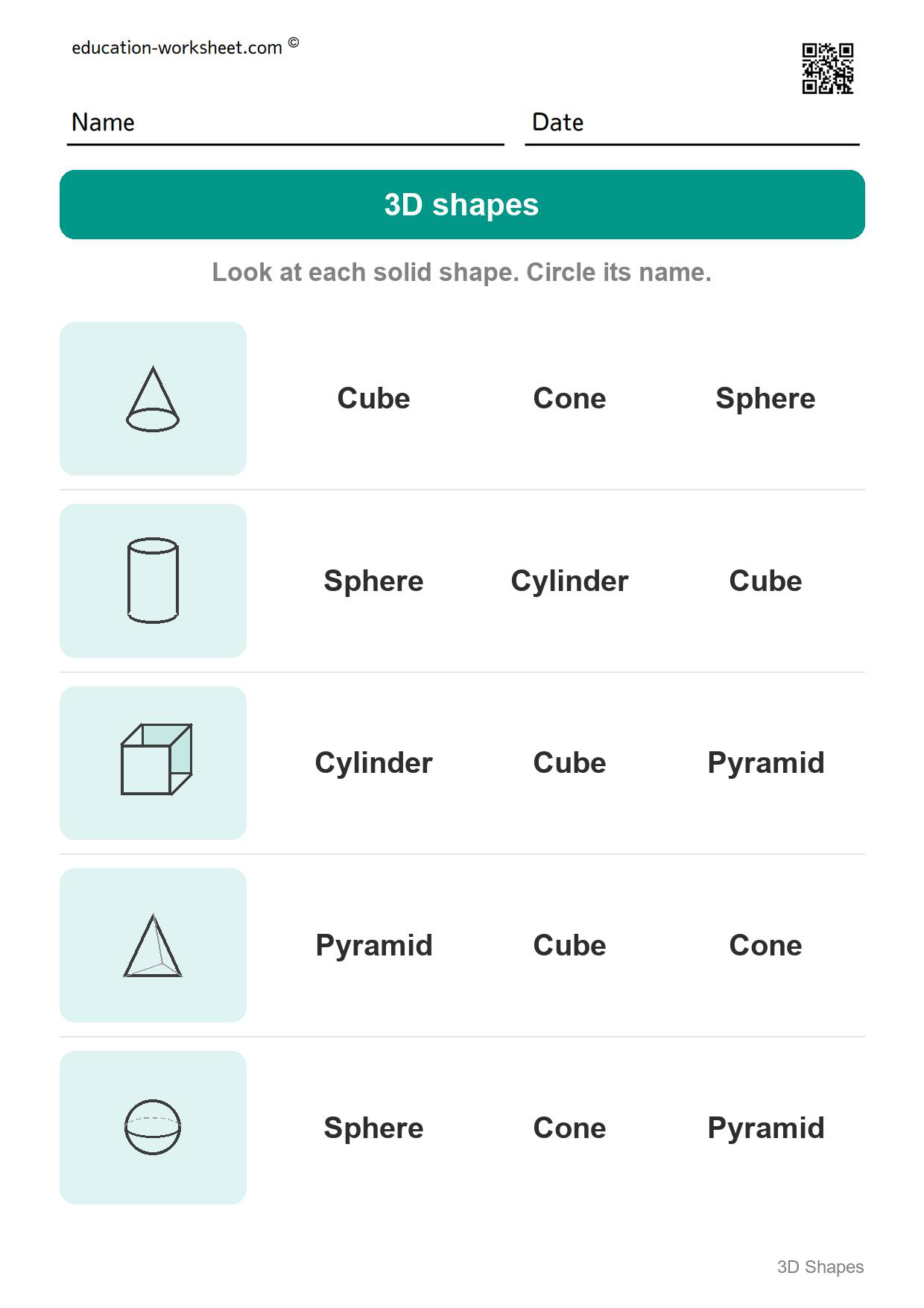
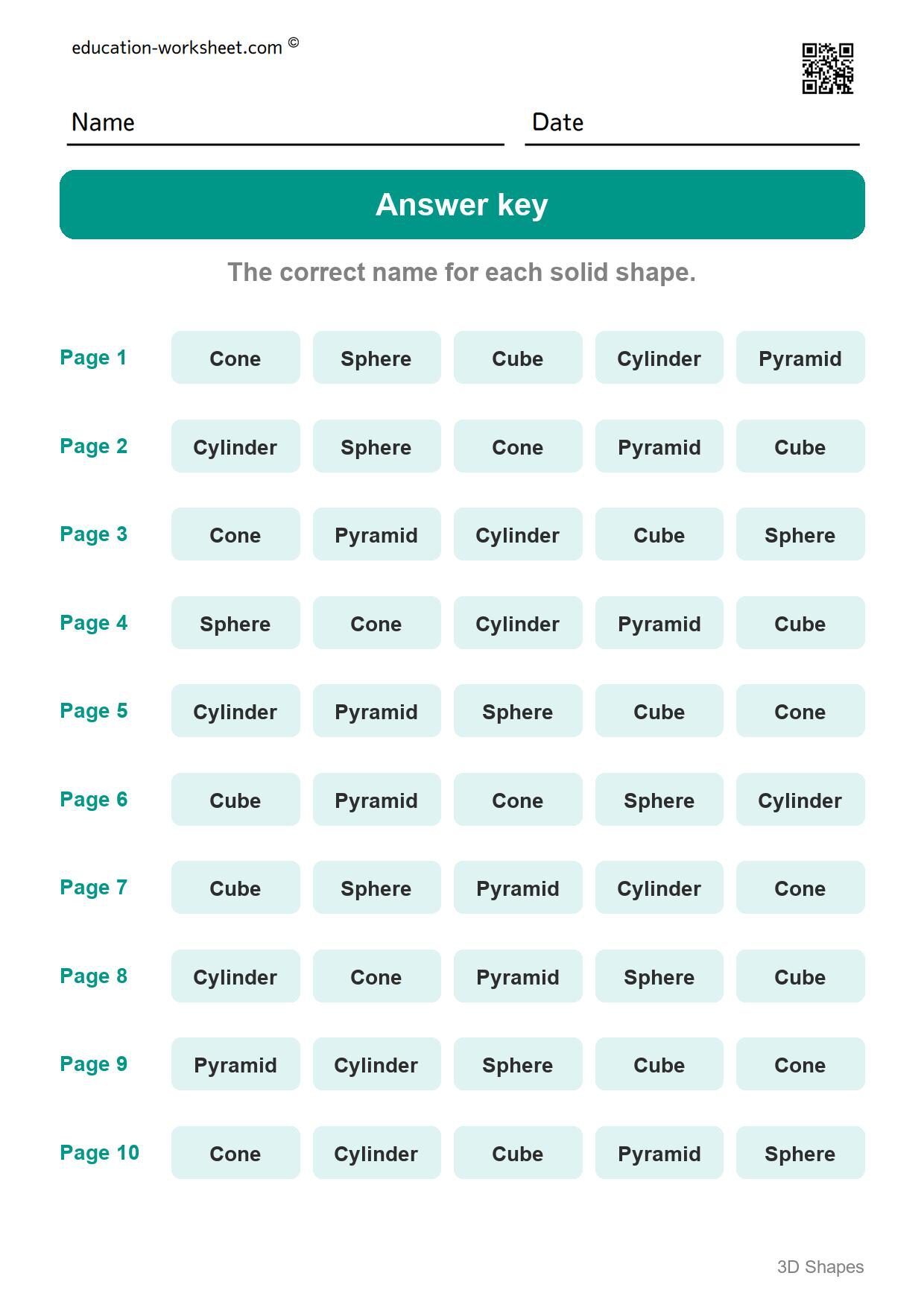
Answer Key – All 50 Rows
The eleventh sheet lists the correct name for all fifty rows, five to a page.
Read down the columns and the design shows itself: every page is the same five names in a different order.
The Pyramid in This Pack Is a Triangle-Based One
Worth knowing before you print: the pyramid drawn here has a triangular base – four triangular faces in all, the shape a mathematician calls a tetrahedron. Most picture books and most classroom shape sets use a square-based pyramid instead, the Egyptian kind.
Both are pyramids and neither is wrong. But a child who has been taught the square one may look at this drawing and not recognize it, and a child who learns it here may not recognize the square one later. If you have a shape set at home or in the classroom, put the two side by side once.
The other four drawings are the standard ones: the sphere has a dashed line around its equator, the cube is drawn as a see-through box with its hidden edges showing, and the cone and cylinder both stand upright on their circular bases.
Which Shapes Get Confused
Across the fifty rows, every possible pair of shapes is put together at least once – every shape is offered as a wrong answer beside every other shape somewhere in the pack. But the wrong answers are not evenly spread.
- Pyramid appears as a wrong answer 24 times, more than any other name.
- Cone appears 21 times, cylinder 19, and sphere and cube 18 each.
- The correct answer is the first name 16 times, the middle name 20 times and the last name 14 times, so there is no position to guess from.
The pair that matters most is cone and cylinder. Both are round, both stand up, and the difference is a point against a flat lid. Pages 2 and 8 put them in the first two rows, which is the best place in the pack to stop and compare.
When Children Are Ready to Name Solid Shapes
- Age: about five to six – kindergarten, after flat shapes are secure.
- Before starting: the child should know circle, square and triangle by name. Reading is not needed if you read the three choices aloud.
- K.G.A.3 – identify shapes as two-dimensional or three-dimensional. This pack is entirely three-dimensional.
- K.G.B.4 – analyze and compare two- and three-dimensional shapes, describing their similarities and differences.
- K.G.A.2 asks children to name shapes regardless of their orientation or size. This pack draws every solid in one fixed orientation, so it does not practice that half of the standard. Real objects do.
How to Use These Worksheets
- Read the three names out loud in every row until the child is reading them alone. The shapes are the lesson, not the spelling.
- Ask how do you know after each answer. “It has a point” and “it can roll” are the descriptions that will still be there next year.
- Put a real object next to the page: a ball, a tin, a dice, a party hat. The drawing is one view of a solid, and the object is the solid.
- On pages 2 and 8, cover the names in the first two rows and ask how the cone differs from the cylinder before choosing.
- Use elimination on the last row of a page when a child is stuck. Four names are already used; the fifth is the one left.
- Check with page 11 when the page is done, not row by row.
Three Things to Watch For
1. Cone and cylinder. This is the confusion the pack is really about. Both are round and both stand upright. A child who says “the one with the point” has understood; a child who guesses between them has not.
2. Naming the flat shape instead of the solid. Children who know their 2D shapes will look at the cube and say square, or at the sphere and say circle. They are not wrong about the face they are looking at – but the question is about the whole object.
3. Learning the picture, not the shape. Every drawing in the pack is identical every time it appears. That makes the pages easy to finish and easy to over-learn. Turn a real cone upside down and ask what it is: that is the test the worksheet cannot give.
Printing Tips
- Print at 100 percent, actual size, on A4 or US Letter.
- Black and white is fine. The drawings are line art with a pale tint behind them and nothing depends on the color.
- Print two copies of pages 2 and 8 if cone-and-cylinder is the sticking point. Those are the two pages that put them side by side.
Frequently Asked Questions
What age are these 3D shapes worksheets for?
About five to six years old. They suit kindergarten children who already know circle, square and triangle and are meeting solid shapes for the first time.
Which shapes are covered?
Five: cone, sphere, cube, cylinder and pyramid. Every page asks about all five, once each.
Is there an answer key?
Yes, page 11 lists the correct name for all fifty rows.
Why is the pyramid drawn with a triangle base?
Because a triangle-based pyramid is a pyramid too. It is worth showing a child a square-based one as well, since that is the kind they will see in most picture books.
Does my child need to read?
Not necessarily. The three choices can be read aloud by an adult, and the child circles the one they hear.
Do the pages get harder?
Not by design – every page is the same five shapes in a new order. What changes is how much the child can do without help.
Do I need to sign up to download these?
No. Every PDF downloads immediately, with no account, no email address and no cost.
Can I use these in my classroom?
Yes, they are free to print for home and classroom use. Please do not sell them or re-host the files elsewhere.
More Free Shape Worksheets
- Free Real World 3D Shapes Worksheets for Kindergarten
- Free 3D Shapes Worksheets for Kindergarten – Faces and Edges
- Free Flat or Solid Shapes Worksheets for Kindergarten – 2D vs 3D Shapes
- Free 2D Shapes Worksheets for Kindergarten – Count Sides and Corners
- Free Shape Recognition Worksheets for Kindergarten – Circle the Shapes
- Free Shape Words Worksheets for Kindergarten – Read and Write Shape Names