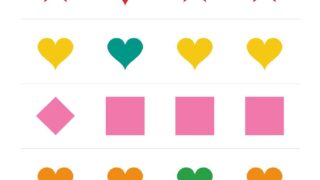
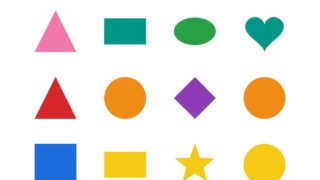
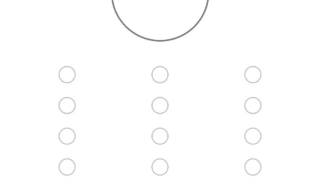
These free printable sorting worksheets ask kindergarten children to count the sides of sixty shapes and put each one in the right box. Six shapes run down the middle of each page, with two labelled boxes – 3 sides and 4 sides, say – and the child draws a line from each shape to its box.
Every page splits exactly three and three. That is not stated anywhere on the sheet, and it is the most useful thing to know about the pack: a child who has drawn four lines to one box has made a mistake, and they can find it themselves.
The shapes are rotated, stretched and tipped on purpose. There is no way through this pack except counting.
- What Is in This Free Sort by Sides Worksheet Pack
- The 11 Sort by Sides Worksheets
- Worksheet 1 – Sort by sides: 3 and 4
- Worksheet 2 – Sort by sides: 3 and 5
- Worksheet 3 – Sort by sides: 3 and 4
- Worksheet 4 – Sort by sides: 4 and 5
- Worksheet 5 – Sort by sides: 4 and 6
- Worksheet 6 – Sort by sides: 4 and 5
- Worksheet 7 – Sort by sides: 3 and 5
- Worksheet 8 – Sort by sides: 5 and 6
- Worksheet 9 – Sort by sides: 5 and 6
- Worksheet 10 – Sort by sides: 3 and 6
- Answer Key – All 10 Pages
- Three and Three, Every Time
- When Children Are Ready to Sort by Sides
- How to Use These Worksheets
- Three Things to Watch For
- Printing Tips
- Frequently Asked Questions
- More Free Shape Worksheets
What Is in This Free Sort by Sides Worksheet Pack
- Ten printable worksheets with six shapes on each – sixty shapes in all.
- Two labelled boxes per page and a line to draw from every shape.
- Six different pairings: 3 and 4, 3 and 5, 4 and 5, 4 and 6, 5 and 6, and 3 and 6.
- Fourteen different shapes, including a trapezoid, a parallelogram, a house shape and hexagons stretched two ways.
- An eleventh page listing which shapes belong in which box on every page.
- A separate PDF for every page, free to download and print.
The 11 Sort by Sides Worksheets
The difficulty is the gap between the two numbers. Three against six (page 10) is easy, because nothing looks alike. Five against six (pages 8 and 9) is hard, because one edge is all that separates the groups and every shape has been distorted.
Four against five, on pages 4 and 6, is the pairing most children find hardest of all – partly because the four-sided group contains a trapezoid and a parallelogram, which look like nothing a child has been taught to name.
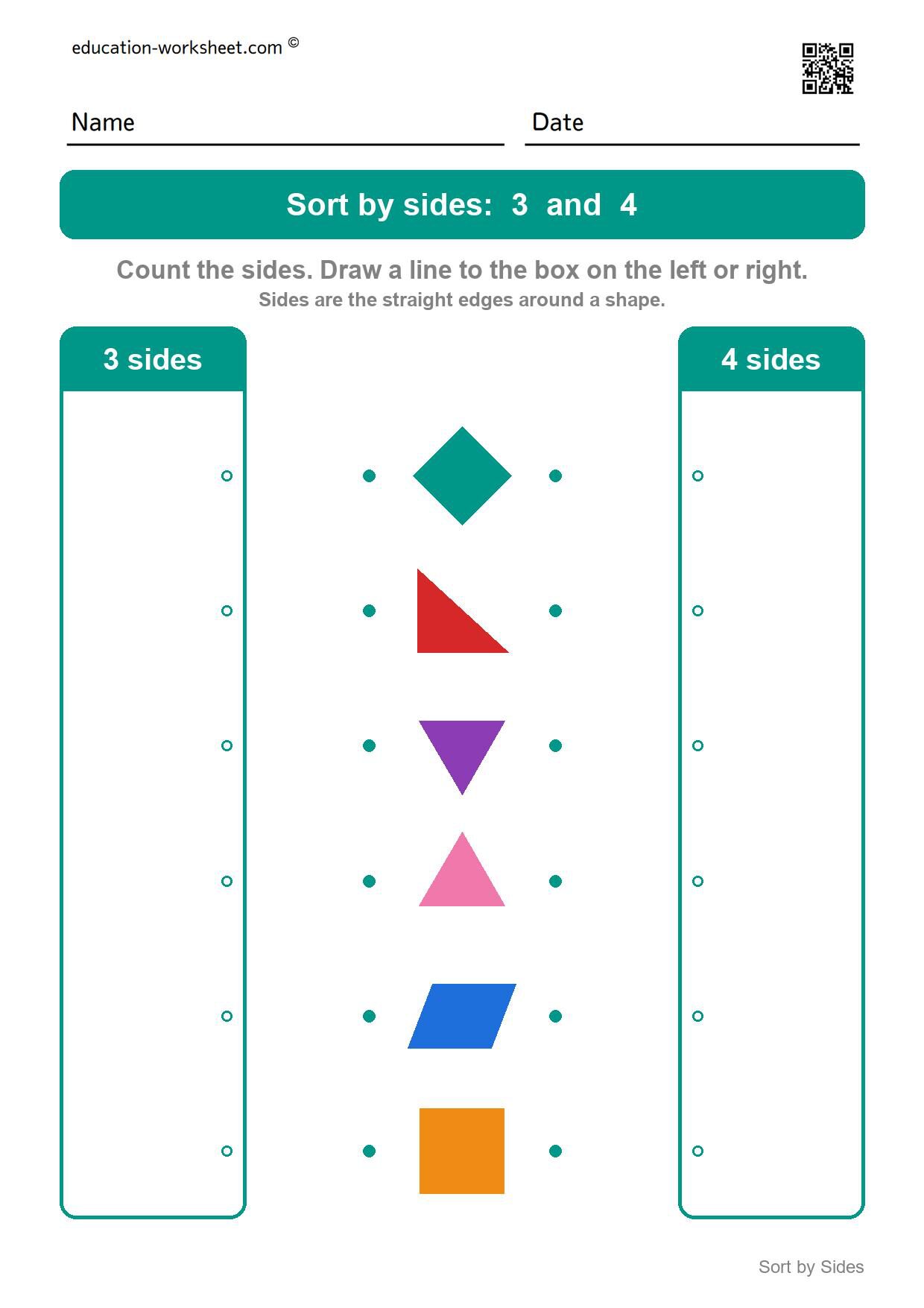
Worksheet 1 – Sort by sides: 3 and 4
The six shapes are right triangle, upside-down triangle and triangle / diamond, parallelogram and square.
Three triangles and three four-sided shapes, and not one of them is drawn the way a picture book would draw it. The square is tipped on its corner into a diamond, and one triangle is upside down.
That is the point of the pack. A child who recognizes shapes by their outline has nothing to go on here and has to count the edges instead.
Worksheet 2 – Sort by sides: 3 and 5
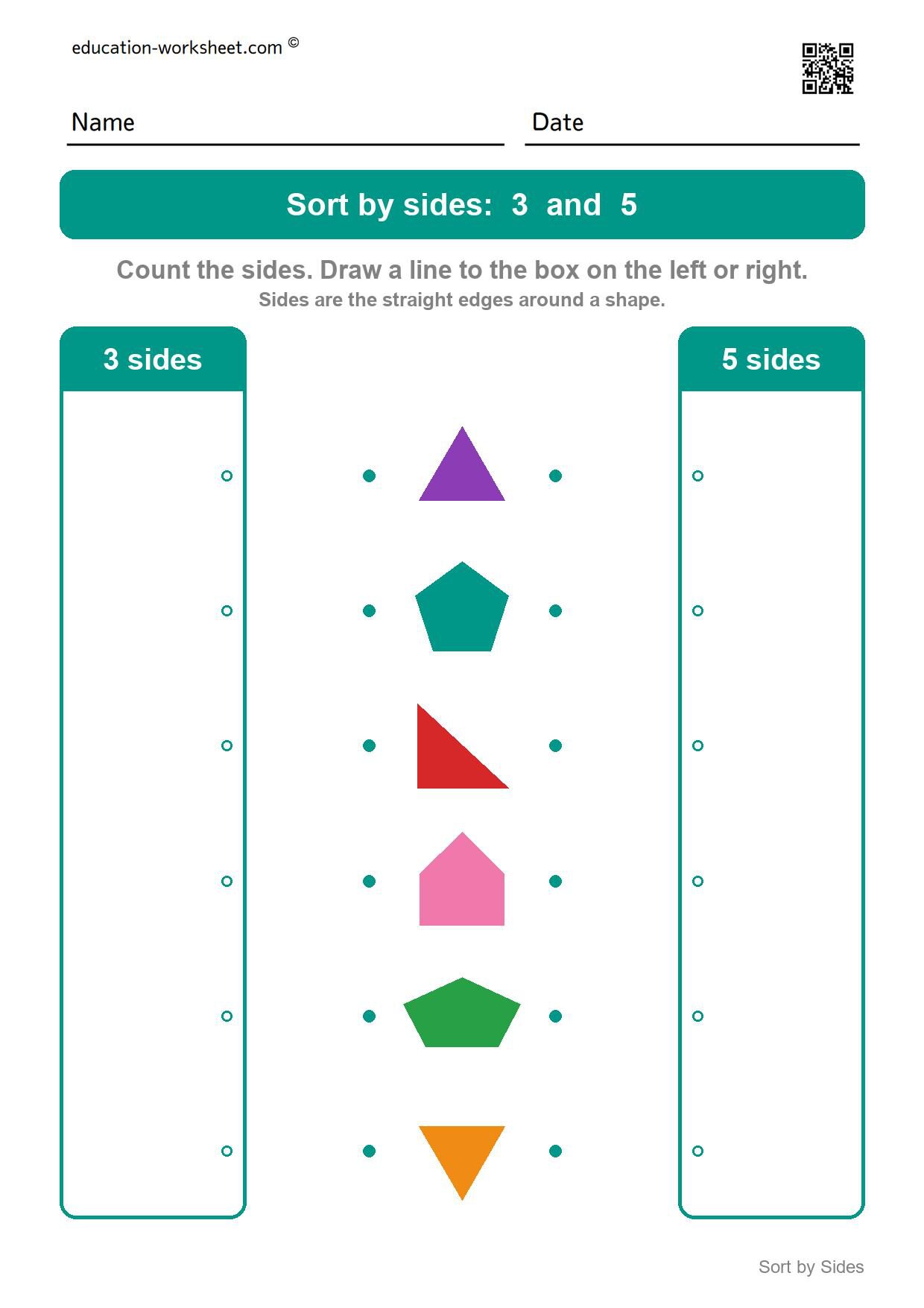
The six shapes are triangle, right triangle and upside-down triangle / pentagon, house shape and wide pentagon.
Triangles against five-sided shapes. The house shape – a square with a roof – is the one children hesitate over, because it does not look like a pentagon at all.
It has five sides all the same, and counting settles it in about four seconds.
Worksheet 3 – Sort by sides: 3 and 4
The six shapes are upside-down triangle, triangle and right triangle / diamond, parallelogram and square.
The same six shapes as page 1, in a different order. Use it a few days later rather than straight afterwards.
Two pages with the same shapes is useful for checking, and useless as new practice.
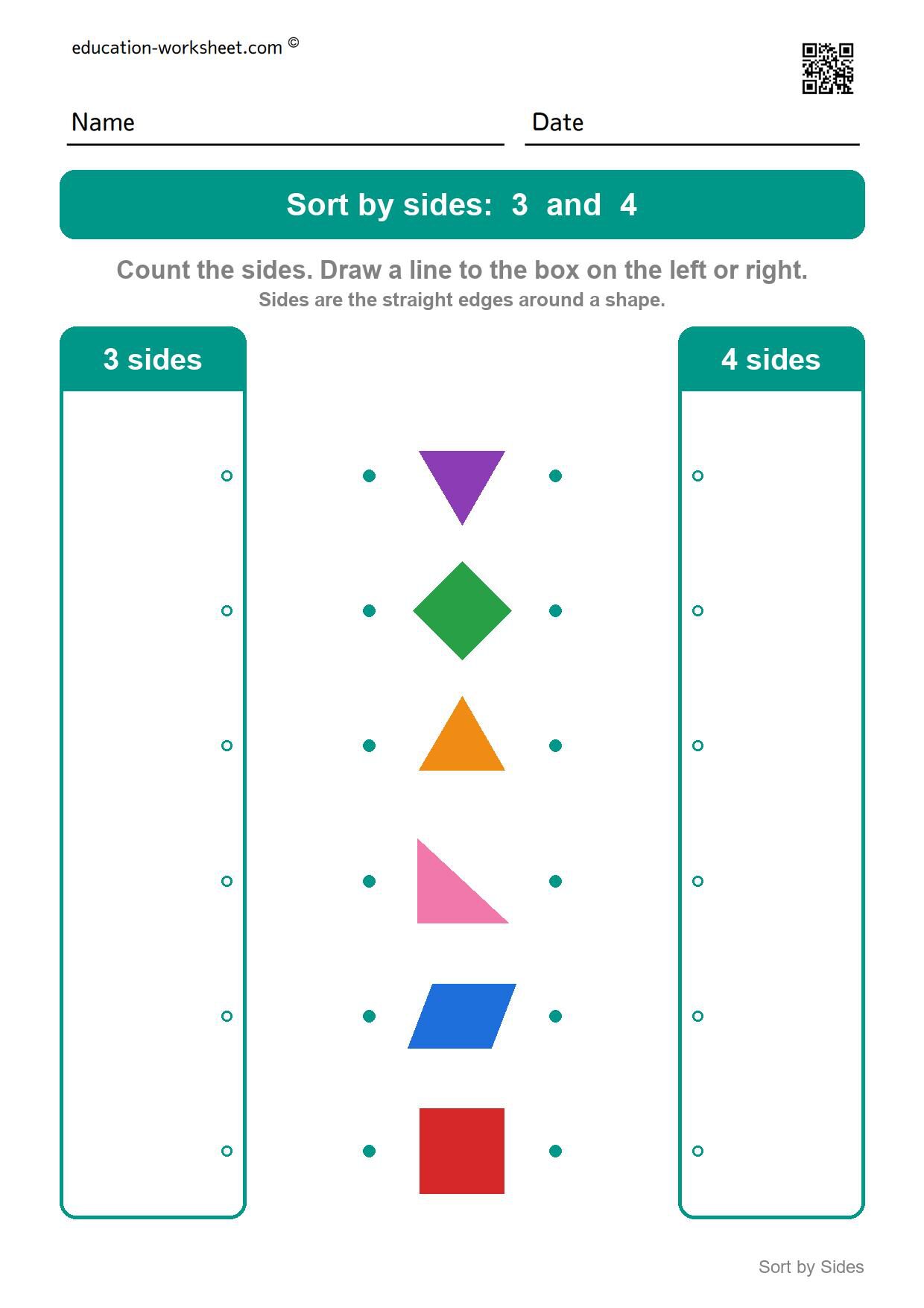
Worksheet 4 – Sort by sides: 4 and 5
The six shapes are square, trapezoid and diamond / house shape, pentagon and wide pentagon.
Four sides against five for the first time, which is the hardest pairing in the pack: one side apart, and both groups full of shapes that have been stretched or tipped.
The trapezoid is the shape to watch. It has four sides and looks nothing like a square.
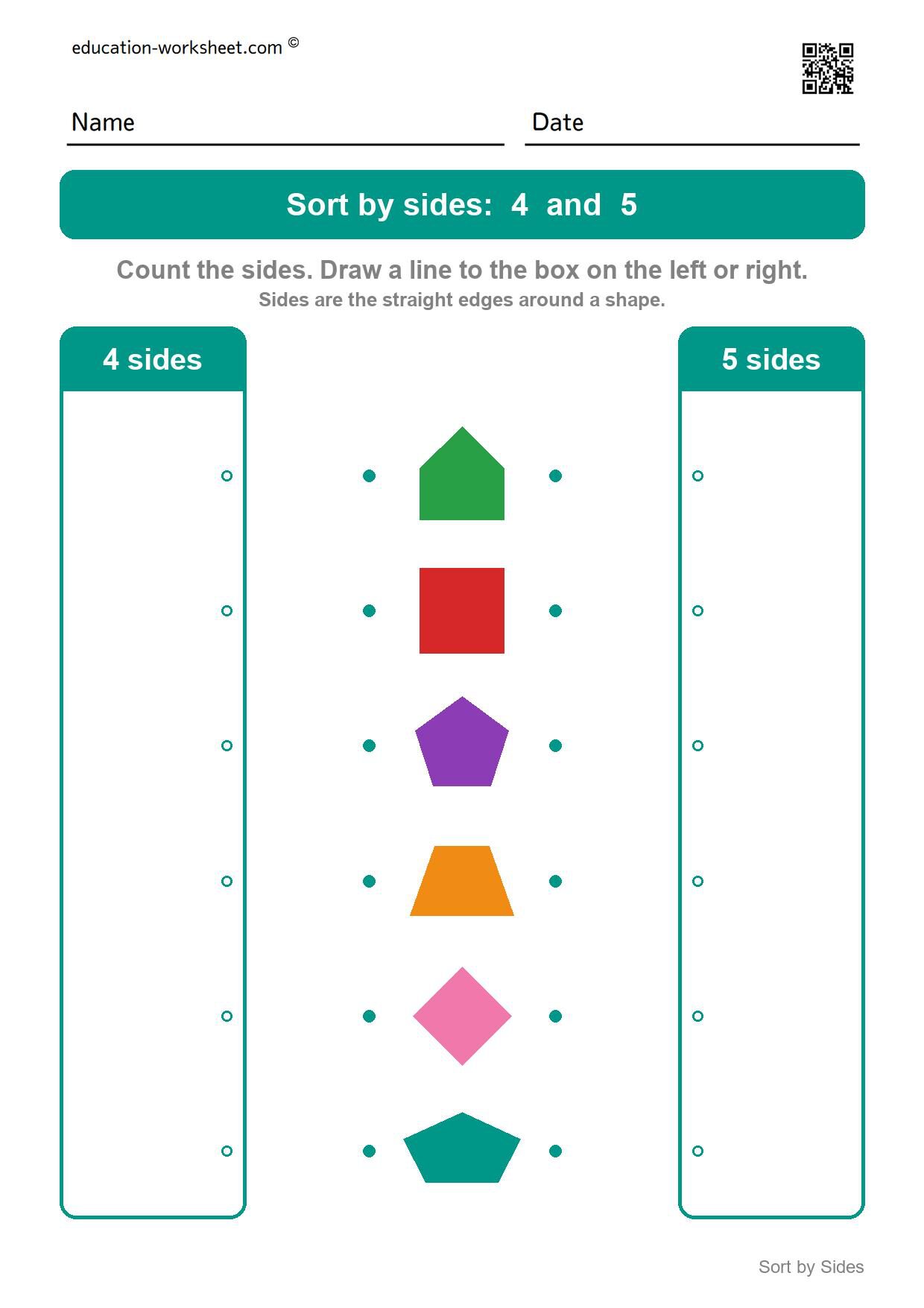
Worksheet 5 – Sort by sides: 4 and 6
The six shapes are diamond, rectangle and trapezoid / hexagon, wide hexagon and tall hexagon.
Four against six, which is easier again because the gap is wider.
The wide hexagon and the tall hexagon are the same shape stretched two different ways. Their sides do not change, and that is worth saying out loud.
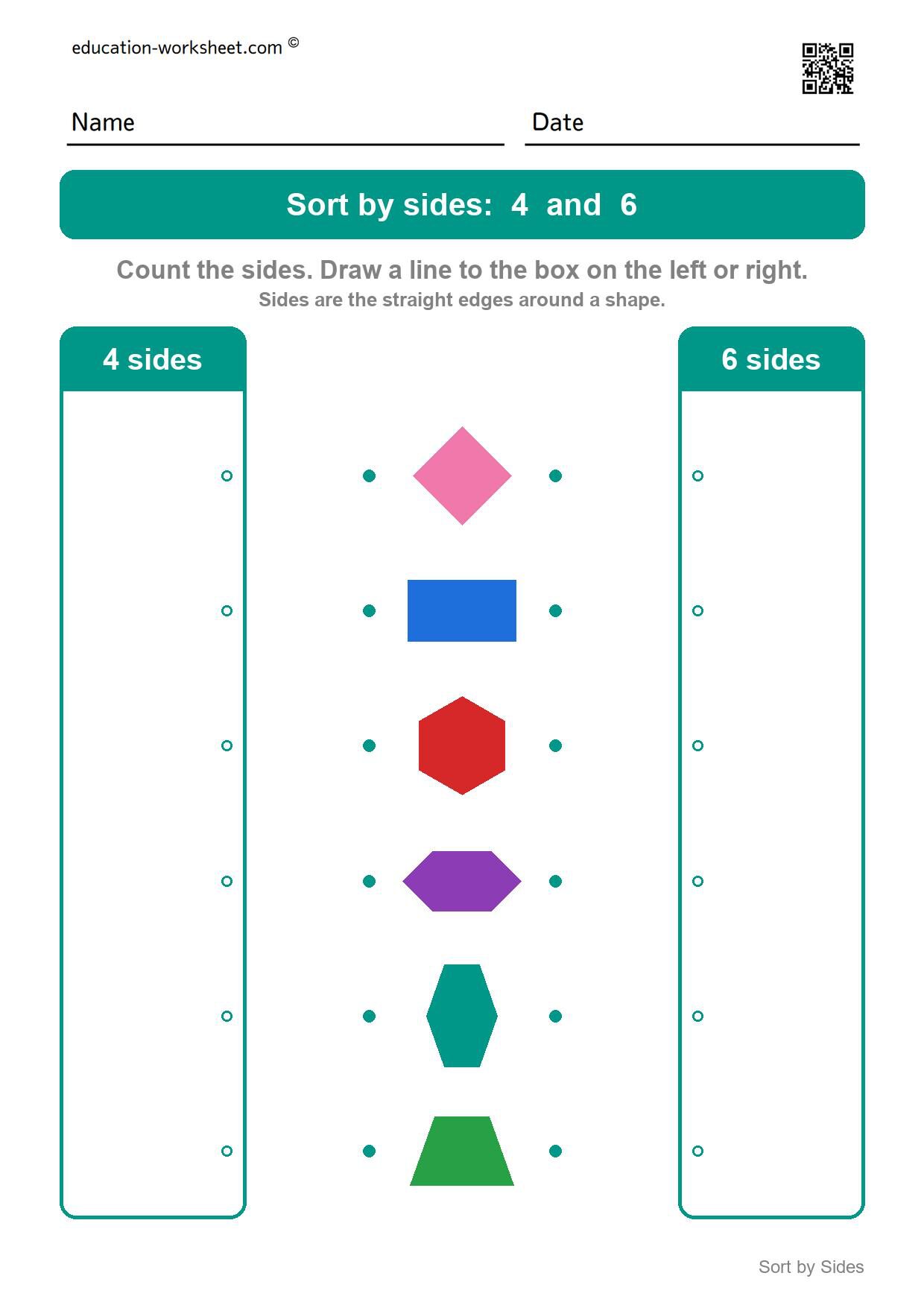
Worksheet 6 – Sort by sides: 4 and 5
The six shapes are rectangle, square and trapezoid / house shape, pentagon and wide pentagon.
Four and five once more, with a rectangle, a square and a trapezoid on one side.
Page 4 and page 6 differ by a single shape. If a child was fine on page 4 they will be fine here.
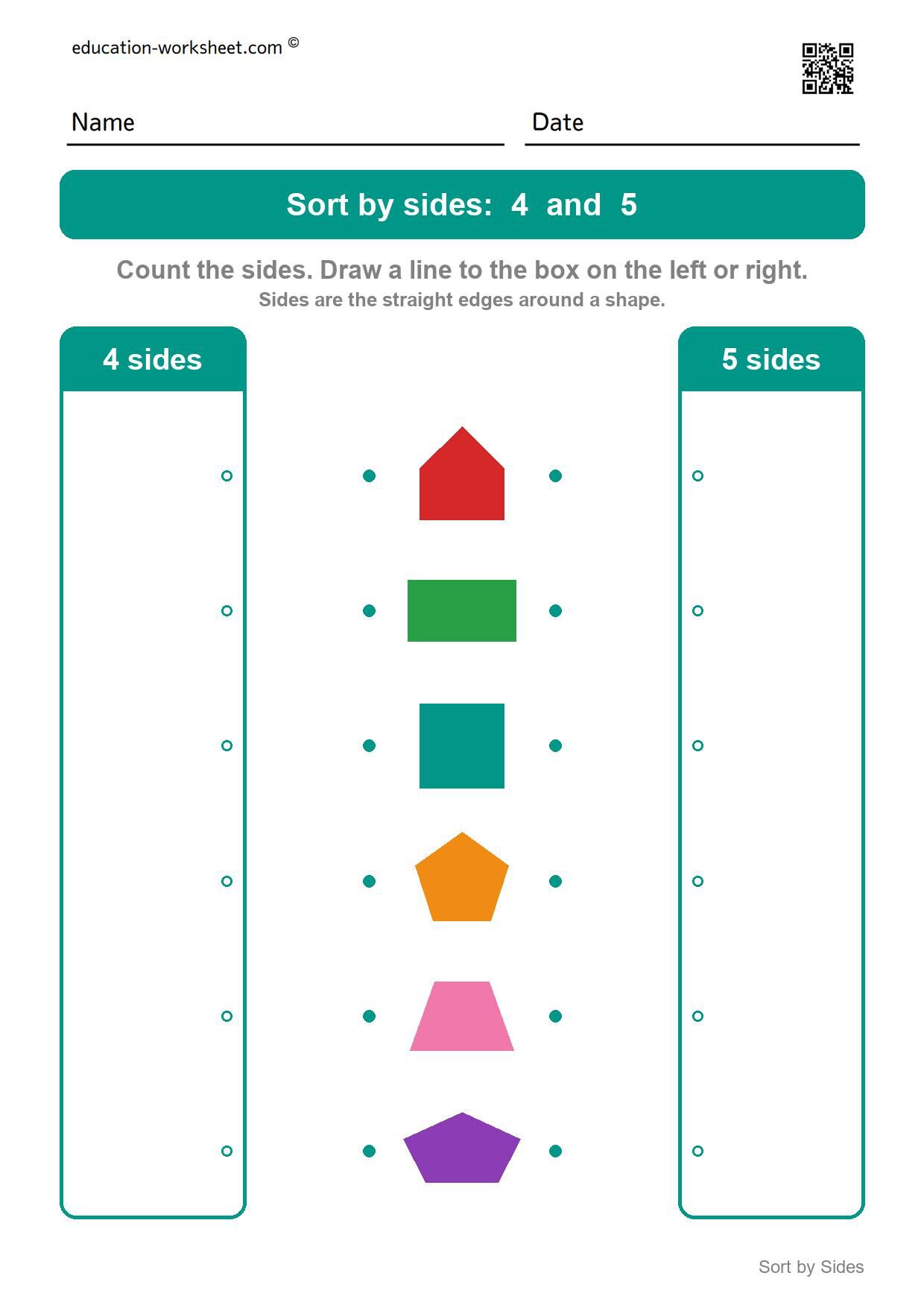
Worksheet 7 – Sort by sides: 3 and 5
The six shapes are triangle, upside-down triangle and right triangle / pentagon, wide pentagon and house shape.
Three against five, the widest gap in the pack after 3 and 6.
A good page for a child who has found the four-and-five pages hard: the two groups look nothing like each other.
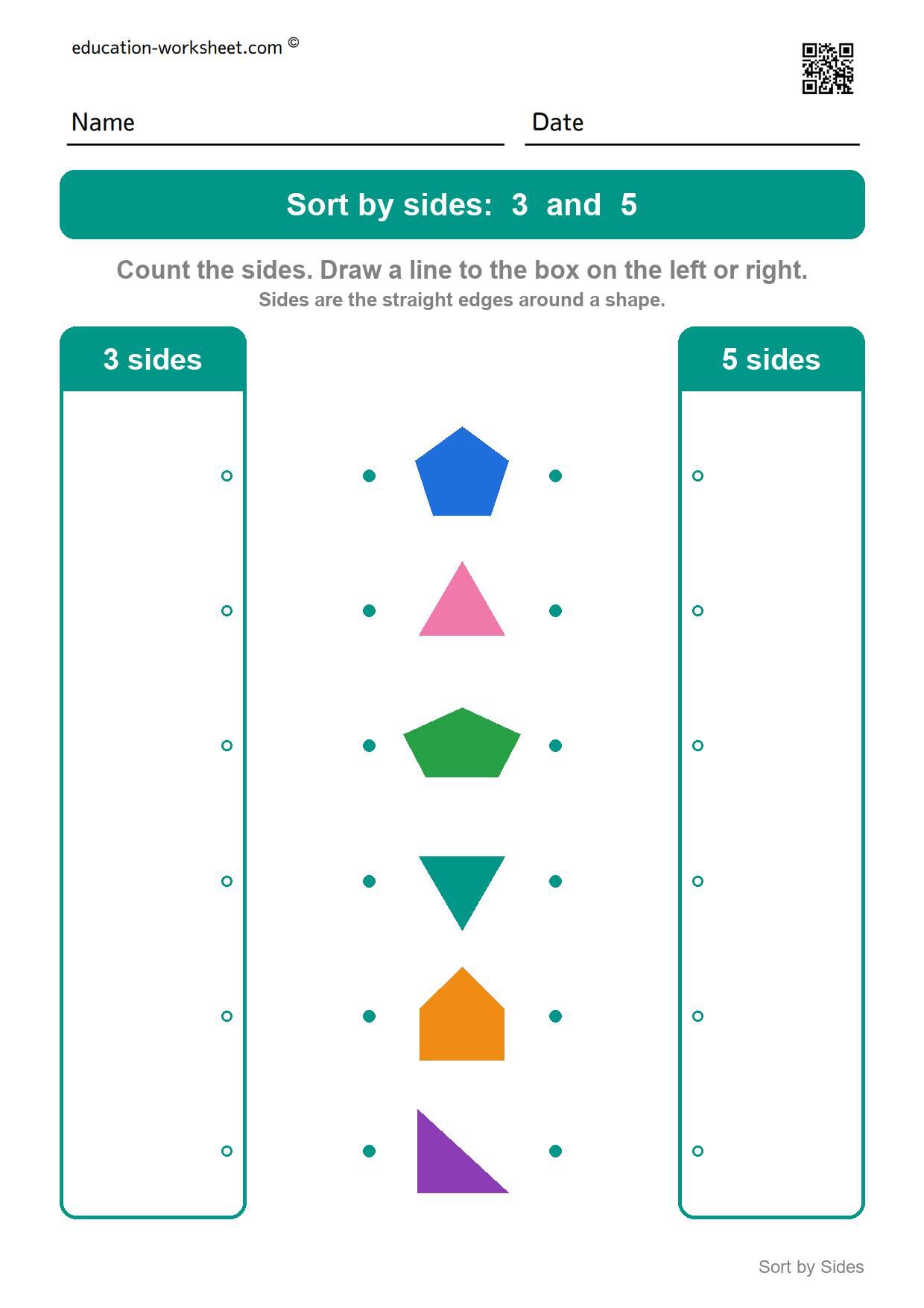
Worksheet 8 – Sort by sides: 5 and 6
The six shapes are pentagon, wide pentagon and house shape / wide hexagon, hexagon and tall hexagon.
Five against six is the tightest pairing there is, and every shape on the page has been stretched or rotated.
Counting six edges around a tall hexagon without losing your place is genuinely hard. Start at a corner and mark it.
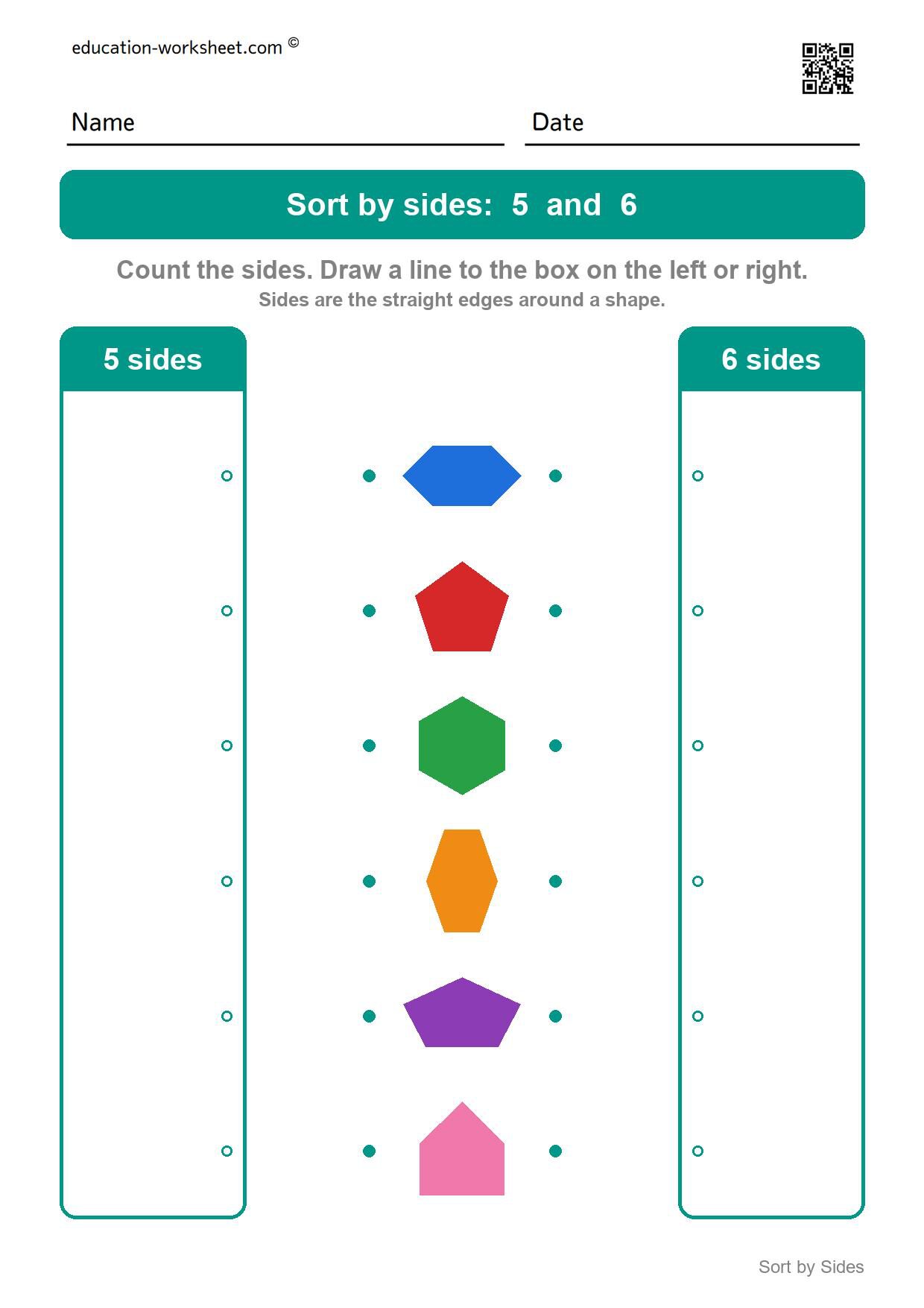
Worksheet 9 – Sort by sides: 5 and 6
The six shapes are wide pentagon, pentagon and house shape / tall hexagon, wide hexagon and hexagon.
The same six shapes as page 8, again in a different order. Treat it as a second attempt.
By this page a child should have a method: pick a corner, count round, say the number out loud.
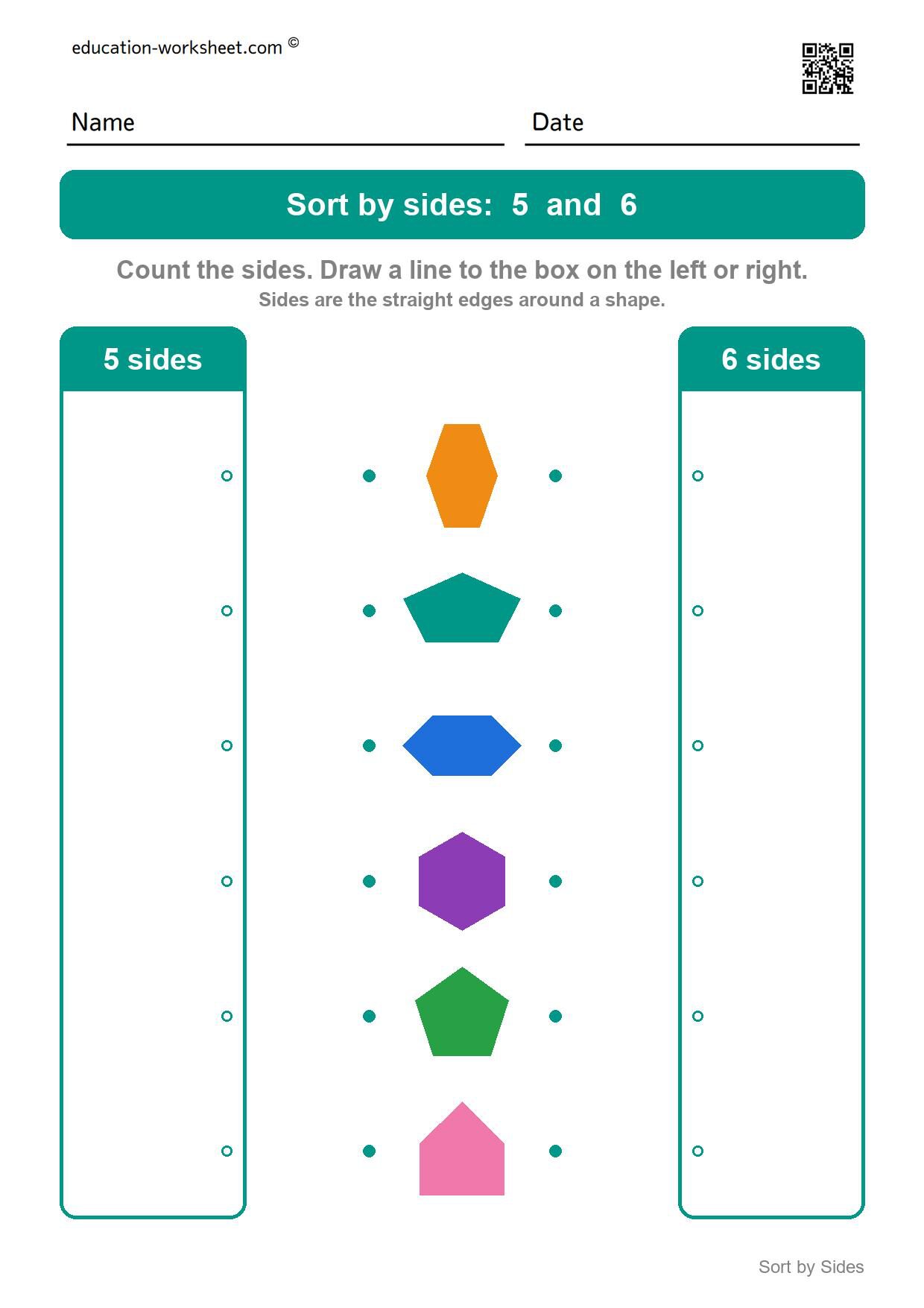
Worksheet 10 – Sort by sides: 3 and 6
The six shapes are upside-down triangle, triangle and right triangle / wide hexagon, tall hexagon and hexagon.
The pack ends on three against six, which is the easiest sorting of all – nothing here can be confused with anything else.
A deliberate easy finish after two pages of five against six.
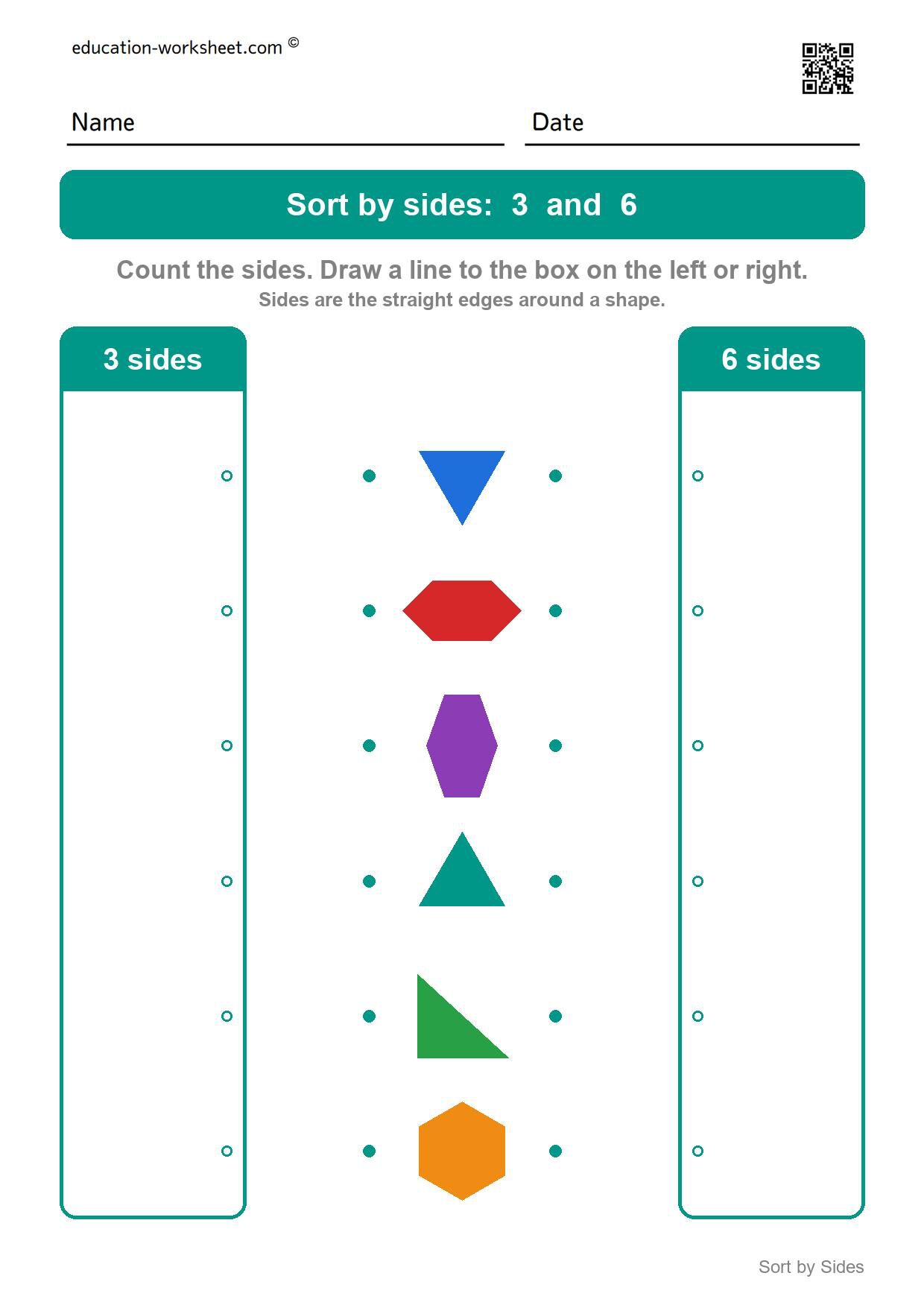
Answer Key – All 10 Pages
The eleventh sheet names the three shapes that belong in each box on every page.
It is also where the shape vocabulary lives: trapezoid, parallelogram, house shape, wide pentagon, tall hexagon. Those names are not needed to do the pages, but they are useful for talking about them.
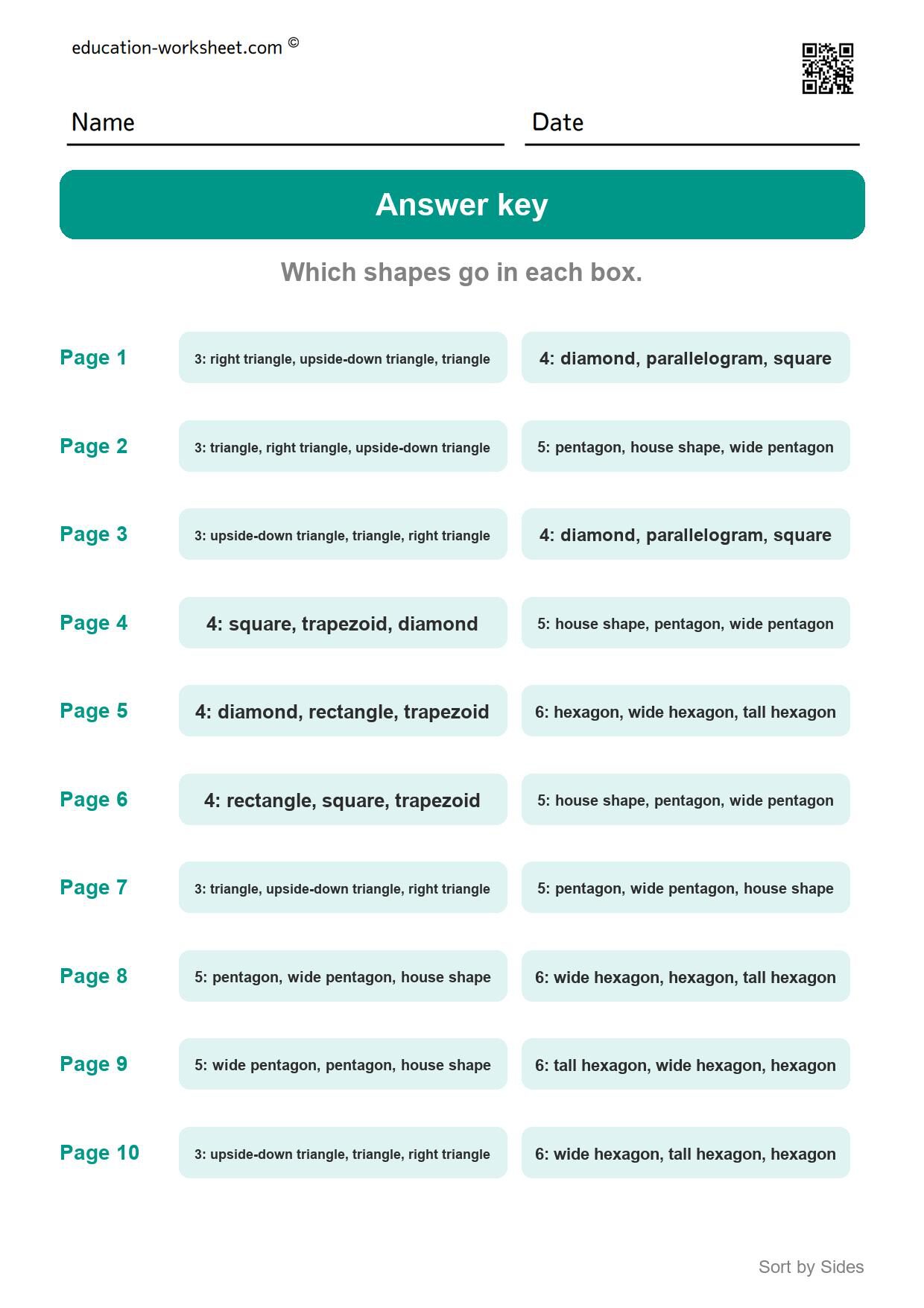
Three and Three, Every Time
Every one of the ten pages divides its six shapes evenly: three in the left box and three in the right. Nothing on the page says so, which makes it the best self-check in the pack.
Tell a child once, at the start, and the rest looks after itself. Four lines going to one box means a shape has been miscounted, and they can go back and find which one without being told the answer. That is a far better end to a worksheet than being marked.
Two pairs of pages use exactly the same six shapes – pages 1 and 3, and pages 8 and 9. Doing them a few days apart turns the repeat into a check; doing them back to back wastes one of them.
When Children Are Ready to Sort by Sides
- Age: about five to six – kindergarten, after counting sides on ordinary shapes is secure.
- Before starting: the child should be able to count to six and draw a straight-ish line across a page.
- K.G.B.4 – analyze and compare shapes and describe their parts, such as the number of sides.
- 1.G.A.1 – distinguish between defining attributes and non-defining ones. Here the number of sides defines the group and nothing else does.
- K.MD.B.3 – classify objects into given categories. Two boxes, six objects, one rule.
How to Use These Worksheets
- Read both box labels out loud before anything is counted, so the child knows what the two groups are.
- Put a pencil dot on one corner of a shape, count round from there, and stop when the dot comes back.
- Say the number before drawing the line. Drawing first and counting after is how lines end up in the wrong box.
- Count the lines at the end. Three to each box, every page, every time.
- Leave pages 8 and 9 until last. Five against six is the hardest sorting in the pack.
- Name the odd shapes together afterwards using page 11: trapezoid, parallelogram, house shape.
Three Things to Watch For
1. Sorting by how it looks. The diamond is a square turned on its corner and the trapezoid is not a rectangle. A child who sorts by outline will put both in the wrong place, and the three-and-three check will catch it.
2. Losing count on the six-sided shapes. Hexagons stretched tall or wide are the hardest things in the pack to count. A dot on the starting corner solves it and is worth teaching as a habit.
3. Drawing the line first. Some children draw all six lines and then check. The lines cross, the page becomes hard to read and the mistake becomes hard to find. One shape, one count, one line.
Printing Tips
- Print at 100 percent, actual size, on A4 or US Letter. The lines need the width of the page.
- Black and white is fine. The colors are decoration; the sides are the information.
- Print pages 4 and 6 together. They are the same pairing with one shape different, which makes them a natural pair to do in one sitting.
Frequently Asked Questions
What age are these sorting worksheets for?
About five to six years old. A child needs to count to six and to be able to draw a line across the page.
How many shapes go in each box?
Always three and three. It is never stated on the sheet, which makes it a useful way for a child to check their own work.
Which page is the hardest?
Pages 8 and 9, which sort five sides against six. The easiest is page 10, three against six.
Why are the shapes tipped over and stretched?
So that counting is the only way to sort them. A shape that is recognizable at a glance would not test anything.
Is there an answer key?
Yes, page 11 names the three shapes that belong in each box on every page.
Do I need to sign up to download these?
No. Every PDF downloads immediately, with no account, no email address and no cost.
Can I use these in my classroom?
Yes, they are free to print for home and classroom use. Please do not sell them or re-host the files elsewhere.
More Free Shape Worksheets
- Free 2D Shapes Worksheets for Kindergarten – Count Sides and Corners
- Free Same Shape Worksheets for Kindergarten – Match Shapes of Any Size
- Free Shape Recognition Worksheets for Kindergarten – Circle the Shapes
- Free Count the Shapes Worksheets for Kindergarten
- Free Sorting Worksheets for Kindergarten – Sort by Color and Shape
- Free Shape Words Worksheets for Kindergarten – Read and Write Shape Names