These free printable size ordering worksheets ask kindergarten children to put three pictures in order and write the answer down. Each row shows the same object drawn three times at three different sizes, with a box under each one. The child writes 1 under the smallest, 2 under the middle one and 3 under the biggest.
Fifty rows across ten pages, and not one of them is already in order. There are six ways three pictures can be arranged by size, and one of them – smallest, middle, biggest, left to right – never appears in this pack. The other five each appear exactly ten times.
That is the whole design in one sentence: the child always has to rearrange, and no arrangement is more common than any other.
- What Is in This Free Size Ordering Worksheet Pack
- The 11 Size Ordering Worksheets
- Worksheet 1 – Bananas, a lion, a watermelon, an umbrella and an apple
- Worksheet 2 – A donut, a watermelon, an elephant, a cat and a cap
- Worksheet 3 – A key, a tree, an umbrella, bananas and the sun
- Worksheet 4 – A guitar, a cat, an umbrella, bananas and a cap
- Worksheet 5 – Bananas, an elephant, a dog, an apple and a cap
- Worksheet 6 – The sun, an orange, a flower, an umbrella and an elephant
- Worksheet 7 – A watermelon, a donut, an elephant, the sun and a guitar
- Worksheet 8 – A donut, an umbrella, the moon, a guitar and a key
- Worksheet 9 – Pizza, an orange, a lion, a key and a tree
- Worksheet 10 – An umbrella, pizza, an orange, bananas and a cat
- Answer Key – All 50 Rows
- Why Nothing Is Ever Already in Order
- When Children Are Ready for Size Ordering
- How to Use These Worksheets
- Three Things to Watch For
- Printing Tips
- Frequently Asked Questions
- What age are these size ordering worksheets for?
- What do the numbers mean?
- Is there an answer key?
- Are the pictures ever already in the right order?
- My child orders them correctly but writes the numbers the wrong way round. Is that normal?
- Do I need to sign up to download these?
- Can I use these in my classroom?
- More Free Comparing Worksheets
What Is in This Free Size Ordering Worksheet Pack
- Ten printable worksheets with five rows on each – fifty questions in all.
- The same object drawn at three sizes in every row, with a box under each picture.
- Eighteen different objects across the pack, from an elephant and a lion to a key and a donut.
- Five of the six possible arrangements, ten rows each. The already-in-order arrangement is never used.
- An eleventh page with the full answer key, written as three digits per row.
- A separate PDF for every page, free to download and print.
The 11 Size Ordering Worksheets
This is the pack in the comparing series that asks for writing. Big and small, tall and short, long and short – all of those are circled. Here the child has to decide the order and then record it with three numerals, which is a second job on top of the first.
It is worth knowing that the two can fail separately. A child who points correctly at the smallest picture and then writes 3 under it has understood size and not the code. Ask them to point before they write.
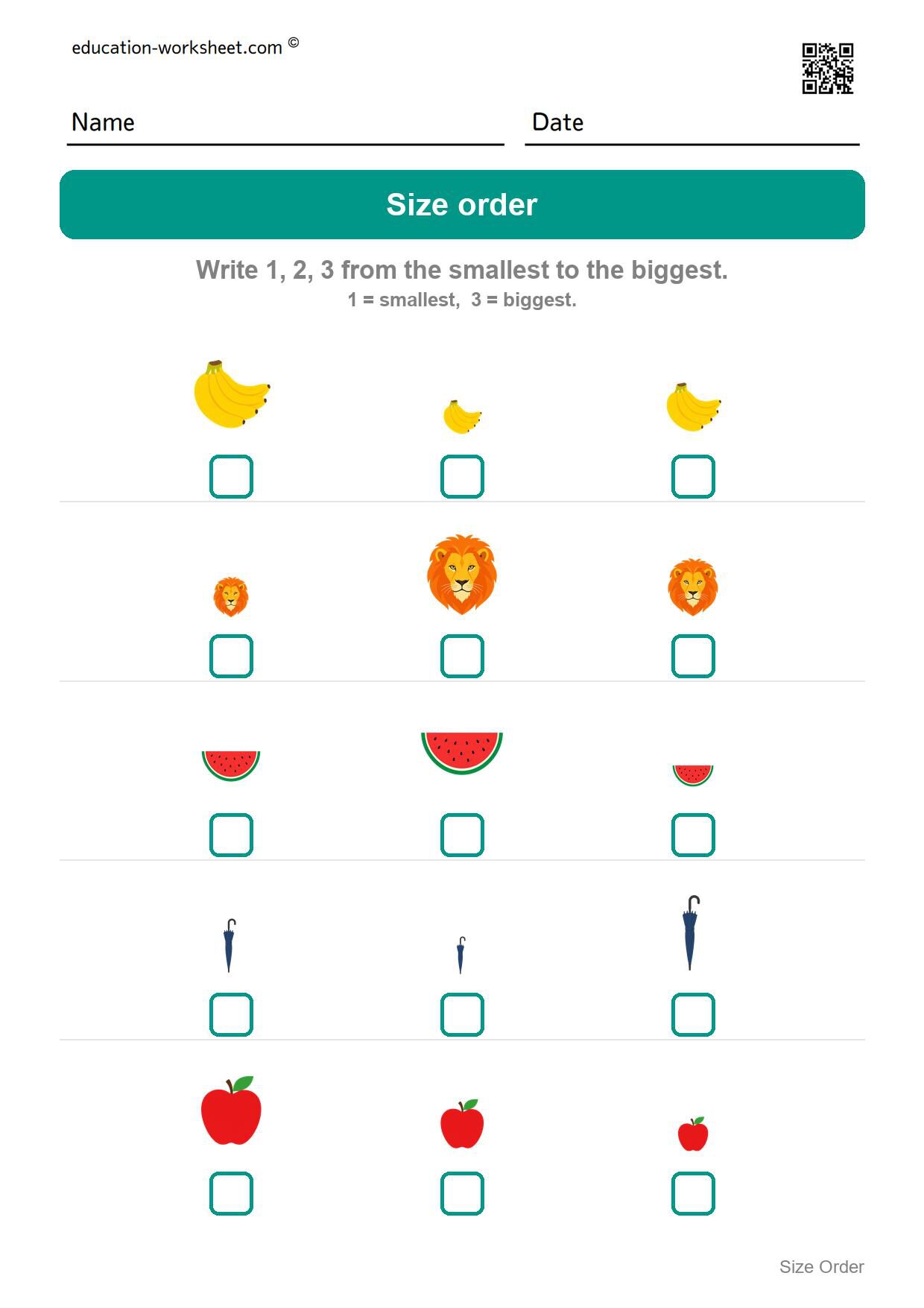
Worksheet 1 – Bananas, a lion, a watermelon, an umbrella and an apple
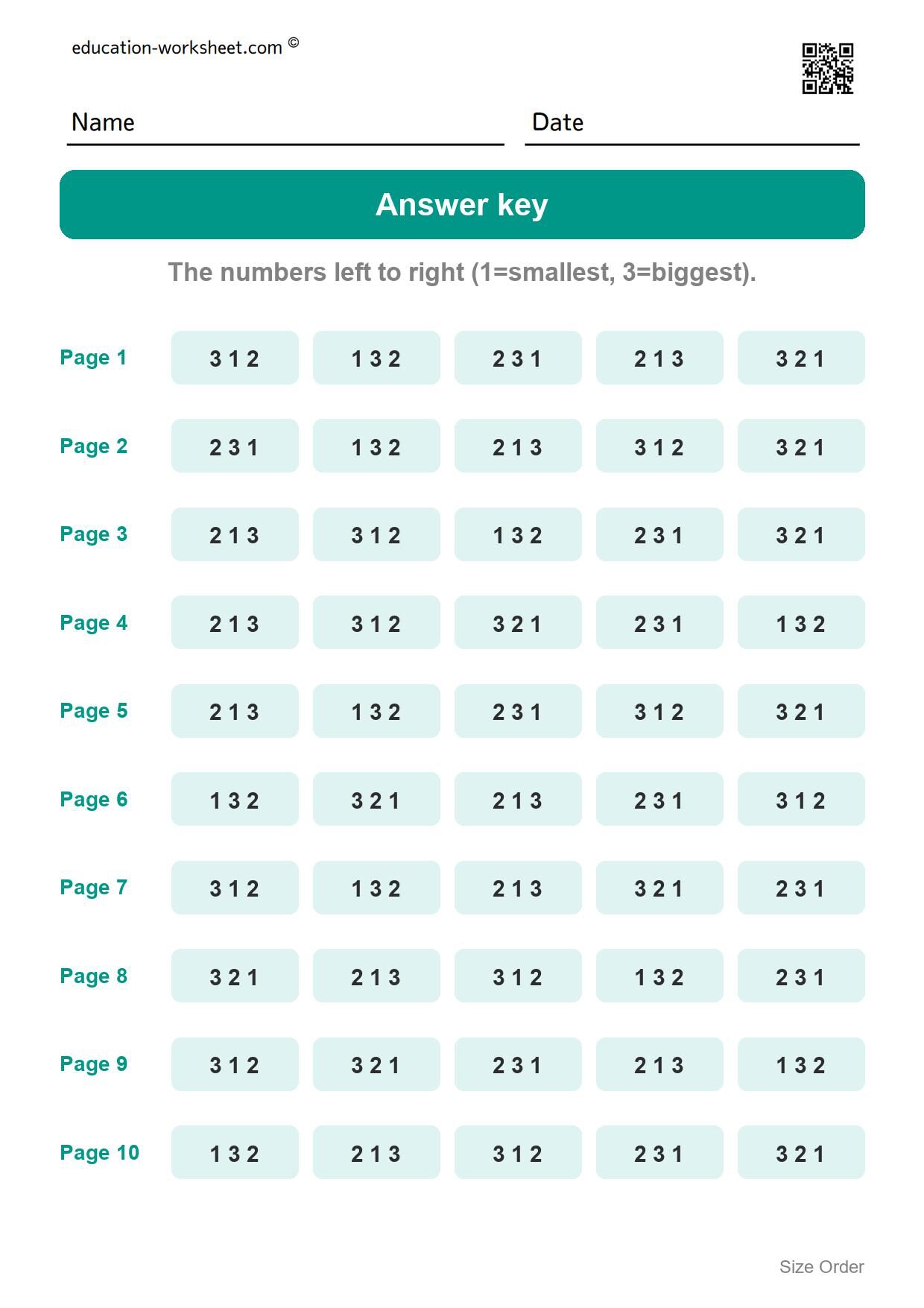
The five rows show bananas, a lion, a watermelon, an umbrella and an apple. The answers, left to right in each row, are 3 1 2 / 1 3 2 / 2 3 1 / 2 1 3 / 3 2 1.
Two of the five rows end with the biggest picture on the left, which is the arrangement children find hardest to write down: the 3 goes in the first box.
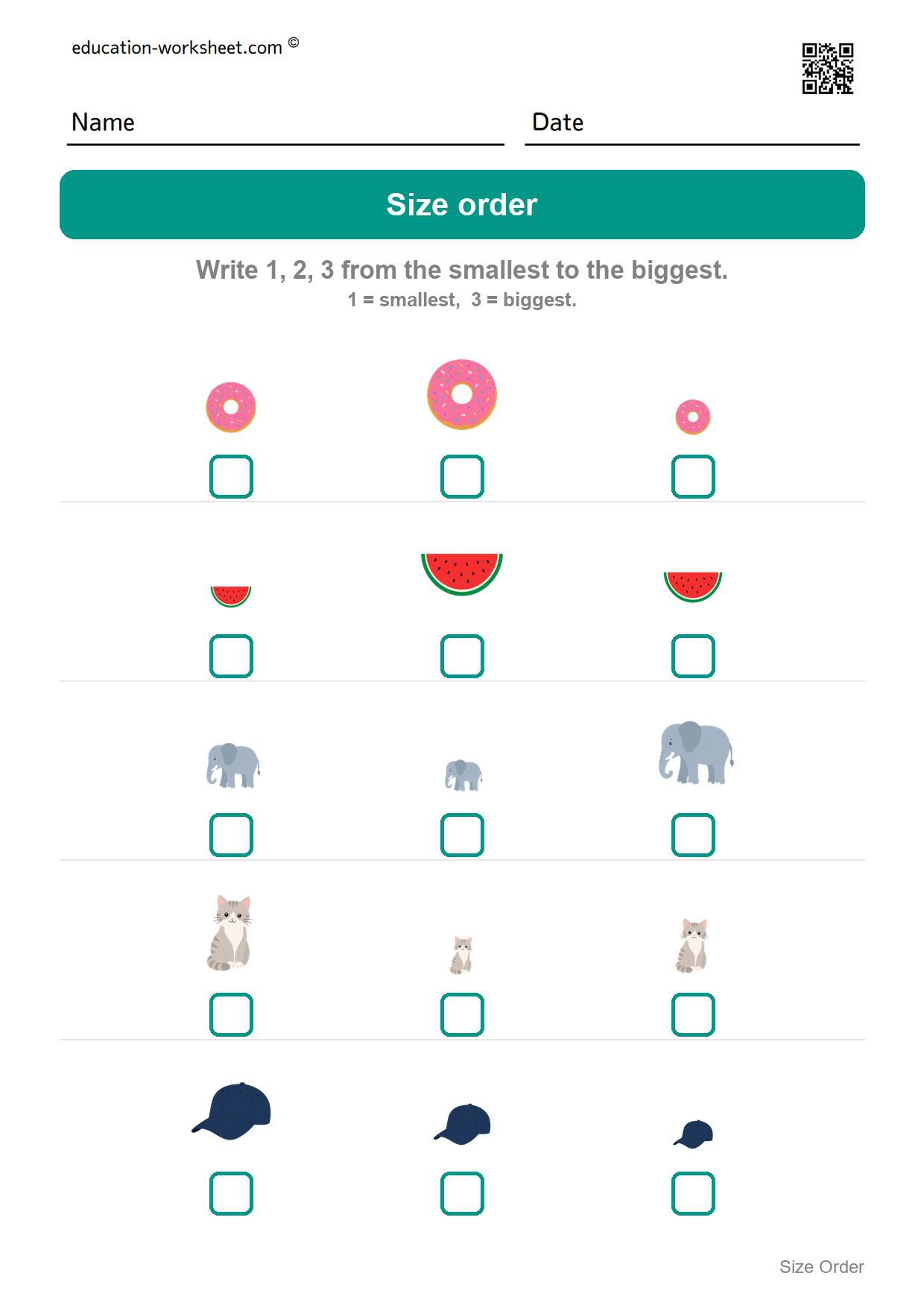
Worksheet 2 – A donut, a watermelon, an elephant, a cat and a cap
The five rows show a donut, a watermelon, an elephant, a cat and a cap. The answers, left to right in each row, are 2 3 1 / 1 3 2 / 2 1 3 / 3 1 2 / 3 2 1.
The elephant row is the one to watch. An elephant is a big animal, and a child who is thinking about real elephants rather than about the three pictures in front of them can talk themselves out of the right answer.
Worksheet 3 – A key, a tree, an umbrella, bananas and the sun
The five rows show a key, a tree, an umbrella, bananas and the sun. The answers, left to right in each row, are 2 1 3 / 3 1 2 / 1 3 2 / 2 3 1 / 3 2 1.
The sun appears here for the first time. Drawn small it looks like a star, which sometimes needs a word before the child starts.
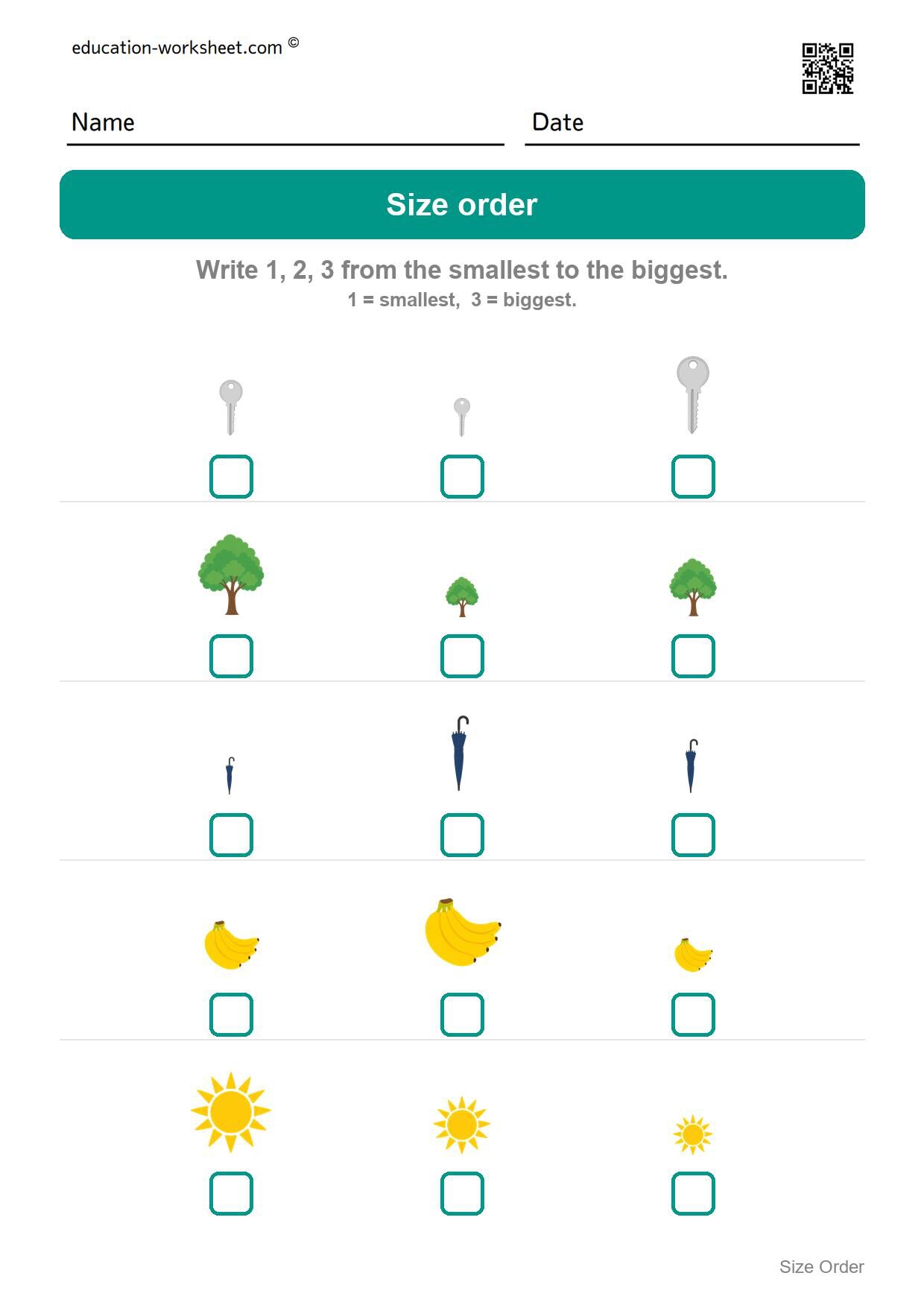
Worksheet 4 – A guitar, a cat, an umbrella, bananas and a cap
The five rows show a guitar, a cat, an umbrella, bananas and a cap. The answers, left to right in each row, are 2 1 3 / 3 1 2 / 3 2 1 / 2 3 1 / 1 3 2.
Four of this page’s five objects have already appeared earlier in the pack, at different sizes. Nothing carries over – each row is judged on its own three pictures.
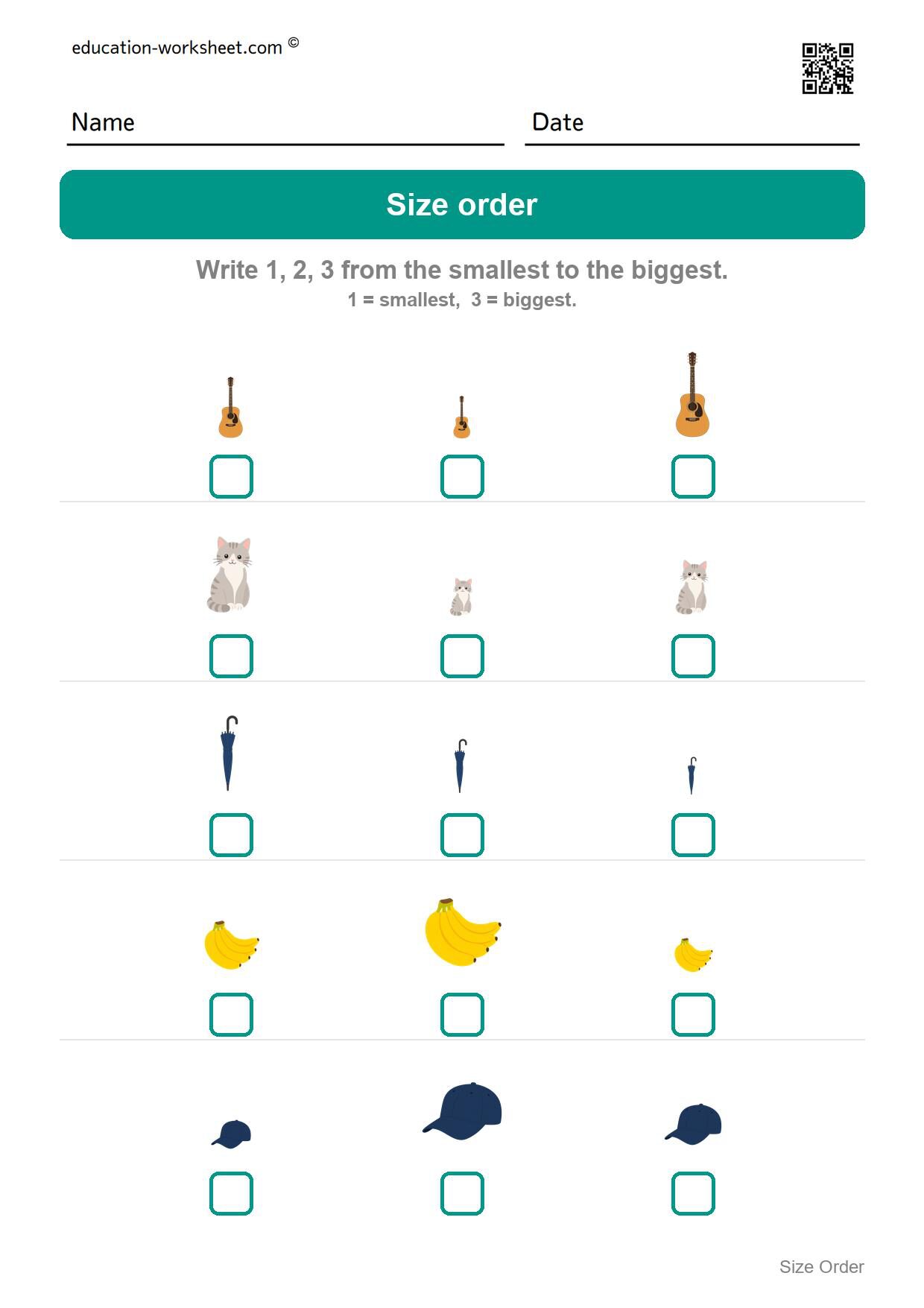
Worksheet 5 – Bananas, an elephant, a dog, an apple and a cap
The five rows show bananas, an elephant, a dog, an apple and a cap. The answers, left to right in each row, are 2 1 3 / 1 3 2 / 2 3 1 / 3 1 2 / 3 2 1.
The dog appears on this page and nowhere else in the pack. Four of the five objects here are ones a child will have met on an earlier page at different sizes.
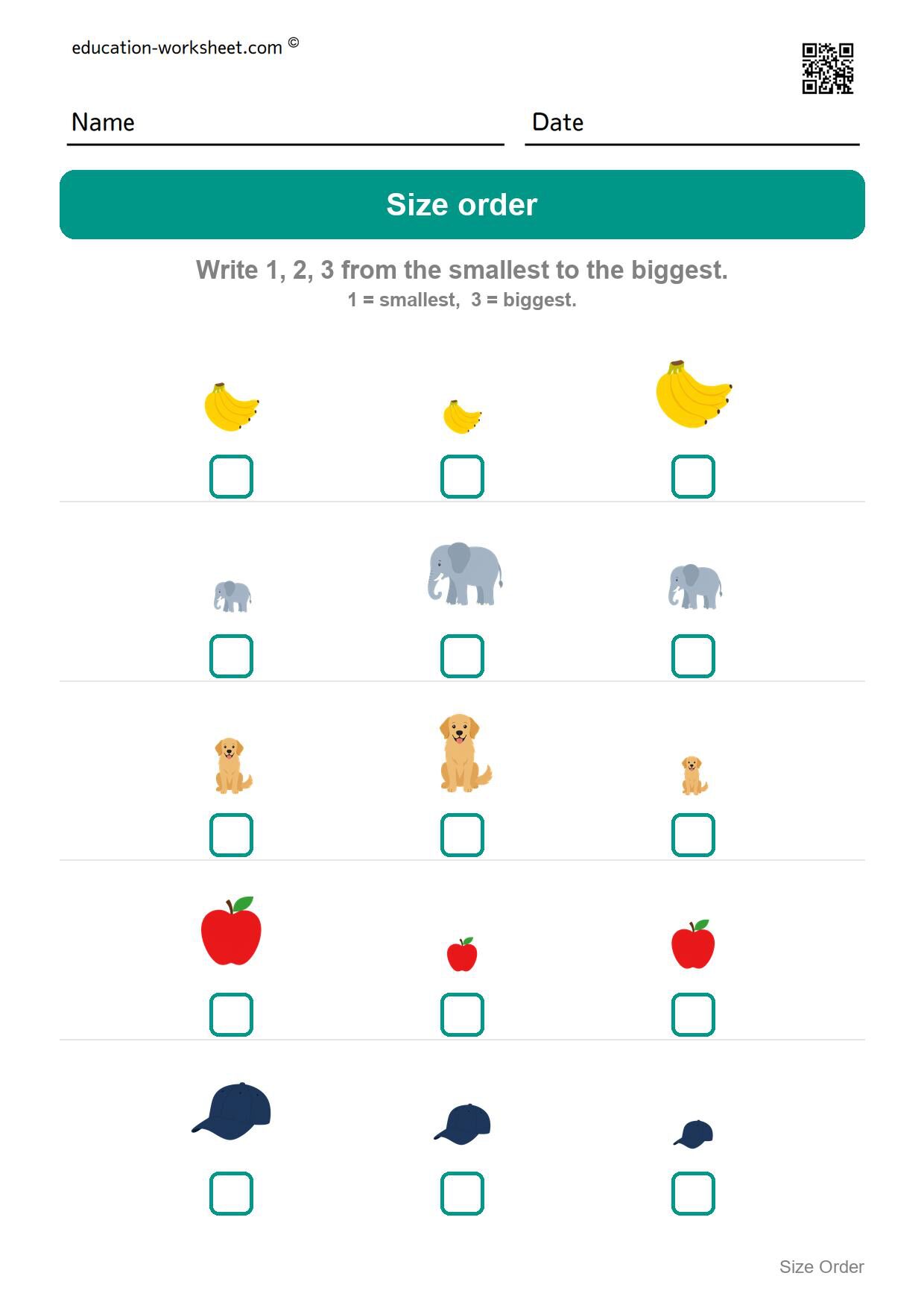
Worksheet 6 – The sun, an orange, a flower, an umbrella and an elephant
The five rows show the sun, an orange, a flower, an umbrella and an elephant. The answers, left to right in each row, are 1 3 2 / 3 2 1 / 2 1 3 / 2 3 1 / 3 1 2.
The flower row puts the smallest picture in the middle. Middle answers are the ones children skip when they are working left to right.
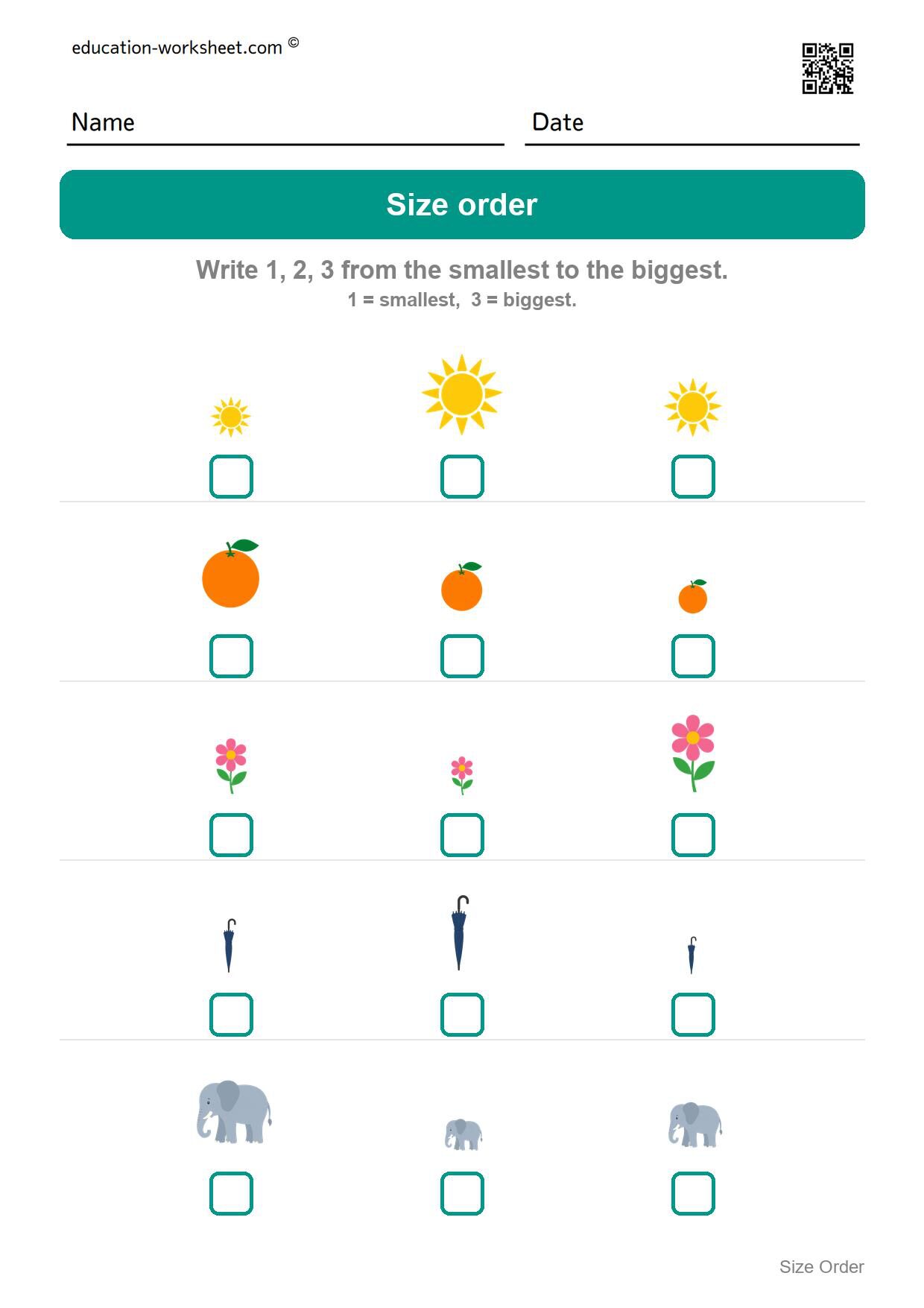
Worksheet 7 – A watermelon, a donut, an elephant, the sun and a guitar
The five rows show a watermelon, a donut, an elephant, the sun and a guitar. The answers, left to right in each row, are 3 1 2 / 1 3 2 / 2 1 3 / 3 2 1 / 2 3 1.
Two round objects in a row – a watermelon slice and a donut – which makes size the only thing to compare, since the outlines are so similar.
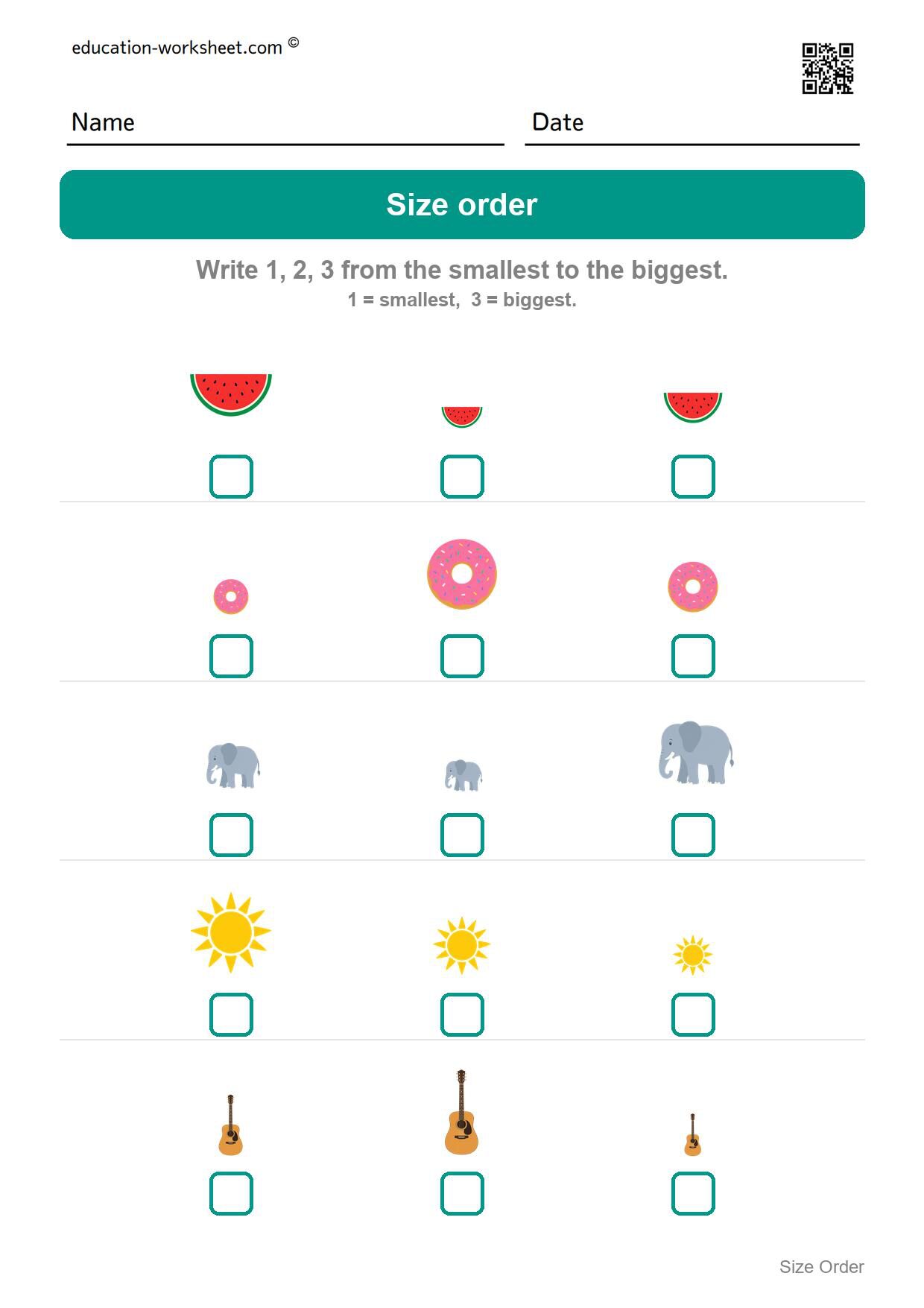
Worksheet 8 – A donut, an umbrella, the moon, a guitar and a key
The five rows show a donut, an umbrella, the moon, a guitar and a key. The answers, left to right in each row, are 3 2 1 / 2 1 3 / 3 1 2 / 1 3 2 / 2 3 1.
The moon appears once in the whole pack, on this page. A crescent is harder to size up than a circle because the shape itself changes as it grows.
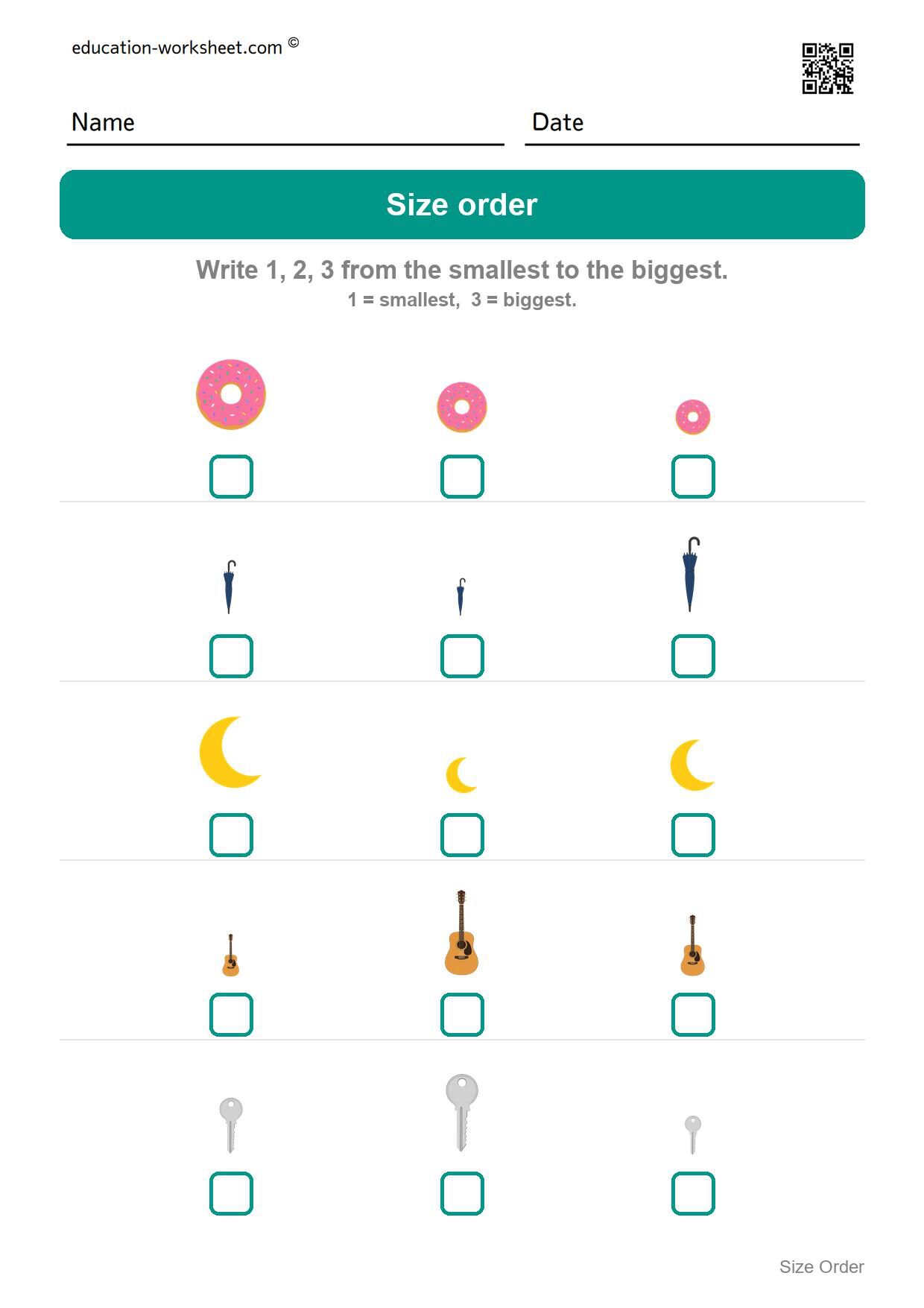
Worksheet 9 – Pizza, an orange, a lion, a key and a tree
The five rows show pizza, an orange, a lion, a key and a tree. The answers, left to right in each row, are 3 1 2 / 3 2 1 / 2 3 1 / 2 1 3 / 1 3 2.
The lion row has its biggest picture in the middle and its smallest on the right, which is the arrangement that most often gets a 2 and a 3 swapped.
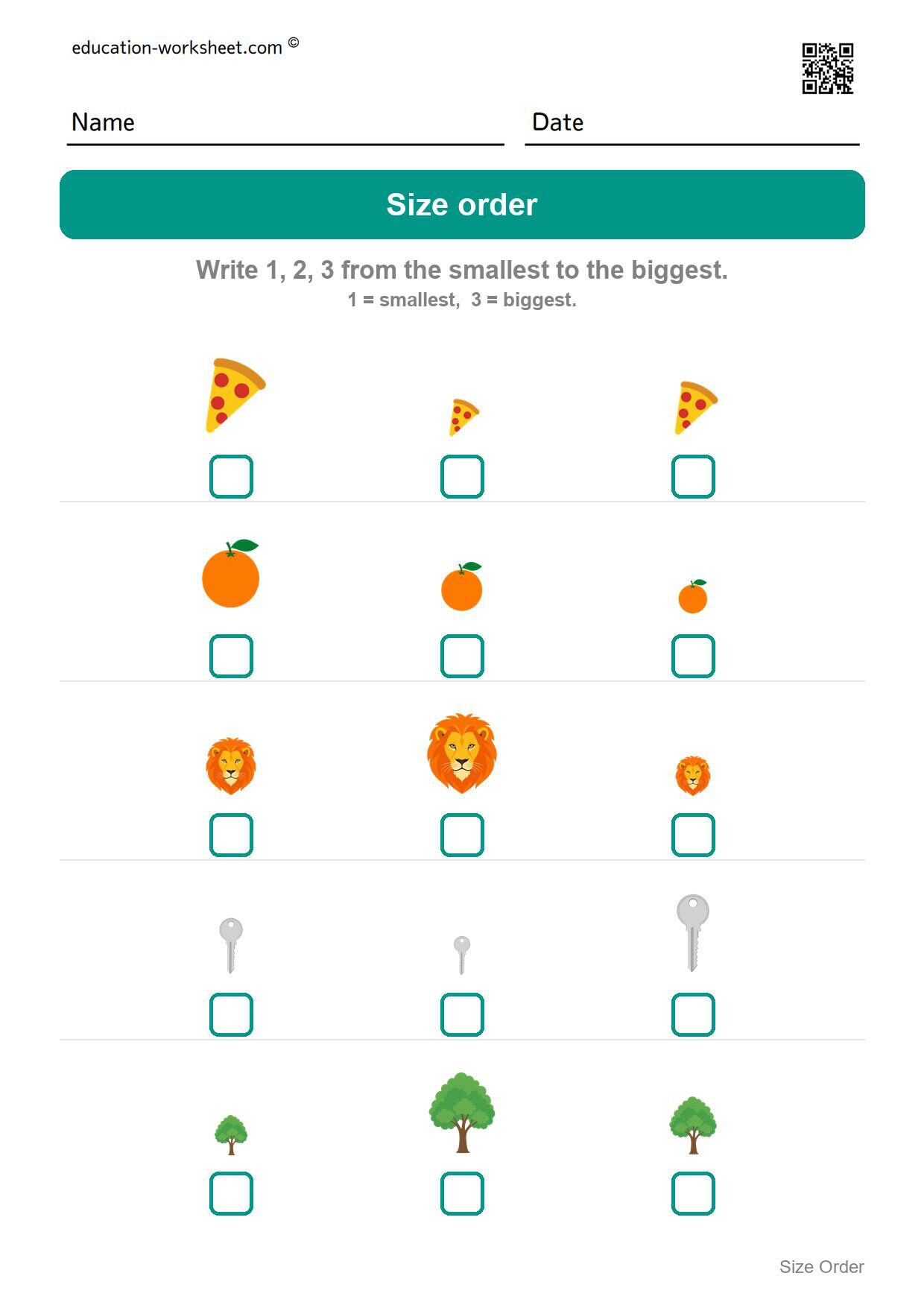
Worksheet 10 – An umbrella, pizza, an orange, bananas and a cat
The five rows show an umbrella, pizza, an orange, bananas and a cat. The answers, left to right in each row, are 1 3 2 / 2 1 3 / 3 1 2 / 2 3 1 / 3 2 1.
The pack ends with five familiar objects and the plainest arrangement of all in the last row: biggest, middle, smallest, left to right.
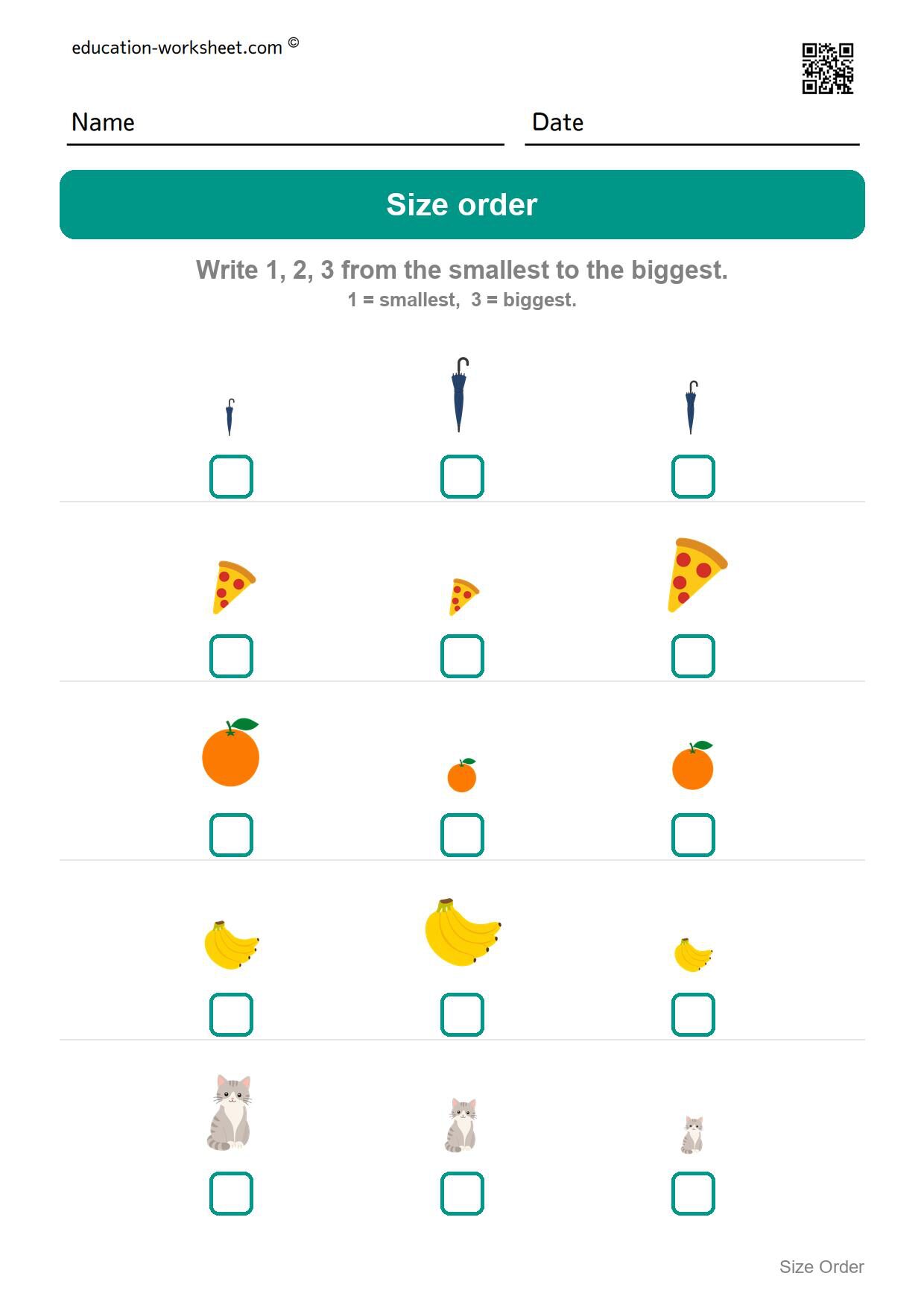
Answer Key – All 50 Rows
The eleventh sheet gives every row as three digits read left to right, five rows to a page.
Read down it and the balance shows: each of the five arrangements used in the pack appears exactly ten times, and the sixth never appears at all.
Why Nothing Is Ever Already in Order
Left to right, smallest to biggest, is the arrangement a child expects and the one an adult would draw without thinking. It is not in this pack at all.
The reason is that it can be answered without looking. A row already in order gets 1, 2, 3 written straight across, and a child who has noticed that pattern will try it on every row. By leaving that arrangement out entirely, the pack makes sure that every single row requires the three pictures to be compared.
There is one lopsidedness worth knowing. Across the fifty rows the biggest picture sits on the left twenty times and in the middle twenty times, but on the right only ten. The smallest is the mirror image: ten on the left, twenty in the middle, twenty on the right. A child who always reaches left for the biggest will be right two times in five, which is enough to look like a strategy and not enough to be one.
When Children Are Ready for Size Ordering
- Age: about four to six – pre-K through kindergarten.
- Before starting: the child should be able to write the numerals 1, 2 and 3. Comparing two objects for size should already be easy.
- K.MD.A.2 – directly compare two objects with a measurable attribute in common. This pack takes it to three.
- 1.MD.A.1 – order three objects by length. Ordering by overall size is the same idea one step earlier.
- K.CC.A.3 – write numbers from 0 to 20. Only 1, 2 and 3 are needed here, one hundred and fifty times over.
How to Use These Worksheets
- Point before writing. Ask the child to touch the smallest picture, then the middle one, then the biggest, and only then pick up the pencil.
- Say the code out loud at the start of every page: 1 is the smallest, 3 is the biggest. It is printed at the top and children stop reading it after page 2.
- Do a whole row at once rather than one box at a time. The three pictures are one question, not three.
- Watch for rows where the two larger pictures are close. Those are the ones where 2 and 3 get swapped.
- Turn the page over at the end and ask the child to draw three of something in order, smallest to biggest. Producing is harder than sorting.
- Check with page 11 when the sheet is finished. Each row is three digits, so a page takes about twenty seconds to mark.
Three Things to Watch For
1. Writing the numbers backwards. Some children order the pictures perfectly and then number them from the biggest down, because 1 feels like it should go to the winner. It is a coding mistake rather than a size mistake, and it is fixed by reading the line at the top of the page together.
2. Thinking about real life. An elephant is bigger than an apple, and a child who knows that may hesitate when the elephant on the page is drawn small. Every row here compares three pictures of the same thing, so real-world size never comes into it. Say that once, on page 2, where the elephant first appears.
3. Skipping the middle. When the smallest or the biggest sits in the middle of the row, children working left to right often leave it until last and then rush it. Encourage finding the biggest first, wherever it is, and working back from there.
Printing Tips
- Print at 100 percent, actual size, on A4 or US Letter. Scaling shrinks the gaps between the three sizes.
- Color printing helps, because several objects are recognized by color as much as by shape at the smallest size.
- The answer boxes are small. A sharp pencil beats a thick crayon on this pack.
Frequently Asked Questions
What age are these size ordering worksheets for?
About four to six years old. The child needs to be able to write 1, 2 and 3; nothing else is required.
What do the numbers mean?
1 goes under the smallest picture and 3 under the biggest. It is printed at the top of every page.
Is there an answer key?
Yes, page 11 gives all fifty rows as three digits read left to right.
Are the pictures ever already in the right order?
No, never. Of the six possible arrangements, the already-in-order one is left out of the pack entirely, and the other five each appear ten times.
My child orders them correctly but writes the numbers the wrong way round. Is that normal?
Yes, and it is worth treating as a separate thing to fix. They have understood size; they have written the code backwards.
Do I need to sign up to download these?
No. Every PDF downloads immediately, with no account, no email address and no cost.
Can I use these in my classroom?
Yes, they are free to print for home and classroom use. Please do not sell them or re-host the files elsewhere.
More Free Comparing Worksheets
- Free Big and Small Worksheets for Kindergarten – Compare Sizes
- Free Tall and Short Worksheets for Kindergarten – Compare Heights
- Free Long and Short Worksheets for Kindergarten – Compare Lengths
- Free Heavy and Light Worksheets for Kindergarten – Compare Weight
- Free Sort by Size and Color Worksheets for Kindergarten
- Free Measuring Length Worksheets for Kindergarten – How Many Cubes Long?