These free printable real-world 3D shapes worksheets give kindergarten children eight pages of solid-shape hunting. Each page names one solid at the top and shows six pictures of ordinary objects underneath. The child circles the ones that are that shape.
Four solids are covered: sphere, cube, cylinder and cone. Each one gets two pages. And there are always exactly three pictures to circle out of the six – on all eight pages, without exception.
The pack opens with a reference page rather than a worksheet, and closes with an answer key. The reference page is the useful half: it names each solid next to an everyday object, which is how these words are actually learned.
- What Is in This Free 3D Shapes Worksheet Pack
- The Reference Page: Shapes All Around Us
- The 8 Real-World 3D Shapes Worksheets
- Worksheet 1 – Three Cylinders Among Six Pictures
- Worksheet 2 – The Easiest Solid to Recognize
- Worksheet 3 – Square on Every Side
- Worksheet 4 – Round All the Way Round
- Worksheet 5 – The Same Three Cubes, Reshuffled
- Worksheet 6 – Cones Again, In a New Order
- Worksheet 7 – Cylinders Again
- Worksheet 8 – The One Page That Changes Its Answers
- Answer Key – All 8 Pages on One Sheet
- Three Pages Repeat Themselves, and One Does Not
- When Children Are Ready for These Worksheets
- How to Use These Worksheets
- Three Things to Watch For
- Printing Tips
- Frequently Asked Questions
- More Free Shape Worksheets
What Is in This Free 3D Shapes Worksheet Pack
- A reference page naming all four solids with an everyday example of each.
- Eight printable worksheets, six pictures on each.
- Four solids covered twice each: sphere, cube, cylinder and cone.
- Exactly three correct pictures on every page.
- A separate answer key sheet listing the three answers for all eight pages.
- A separate PDF for every page, free to download and print.
The Reference Page: Shapes All Around Us
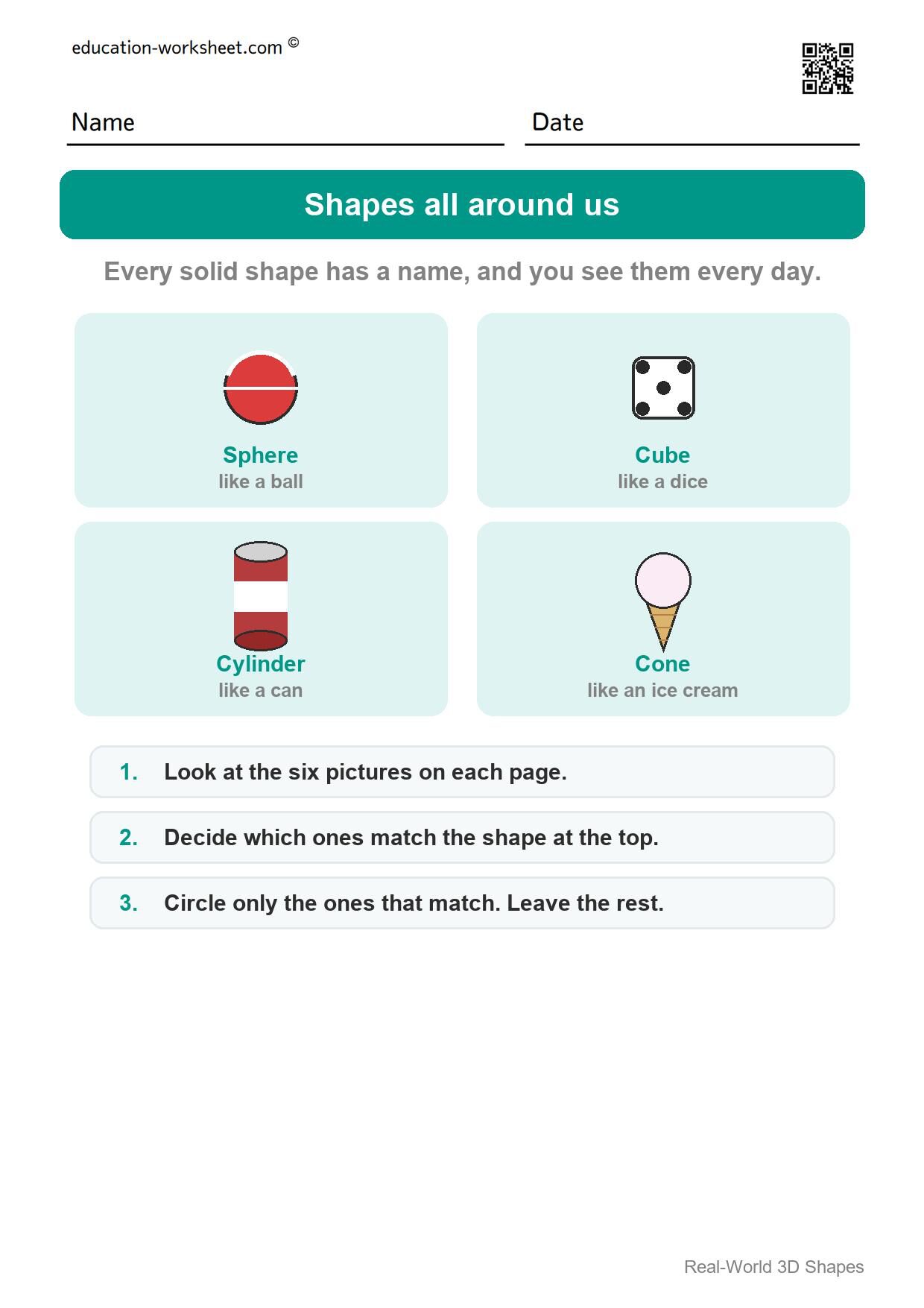
Print this one first. It names the four solids and pins each to something a child has held: sphere, like a ball; cube, like a dice; cylinder, like a can; cone, like an ice cream. Underneath are the three steps the worksheets follow – look at the six pictures, decide which match the shape at the top, circle only those.
Those four anchors do most of the work. A five year old will not remember the word cylinder from a definition, and will remember it from a can of beans.
The 8 Real-World 3D Shapes Worksheets
The shapes come in the order cylinder, cone, cube, sphere, and then the second half runs cube, cone, cylinder, sphere. Each solid is met once early and once late, with other shapes in between, which is a better arrangement than two pages of cones in a row.
Worksheet 1 – Three Cylinders Among Six Pictures
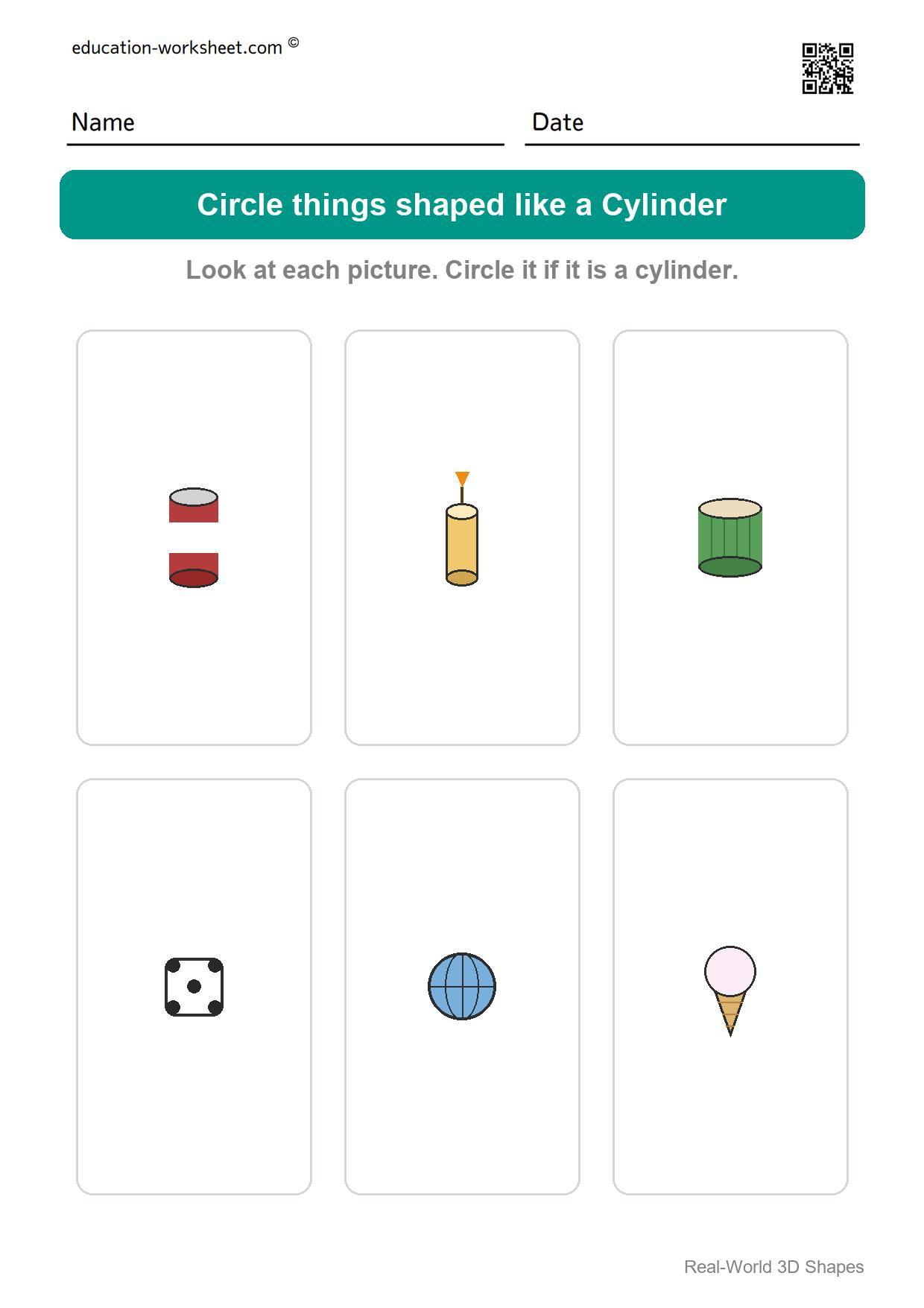
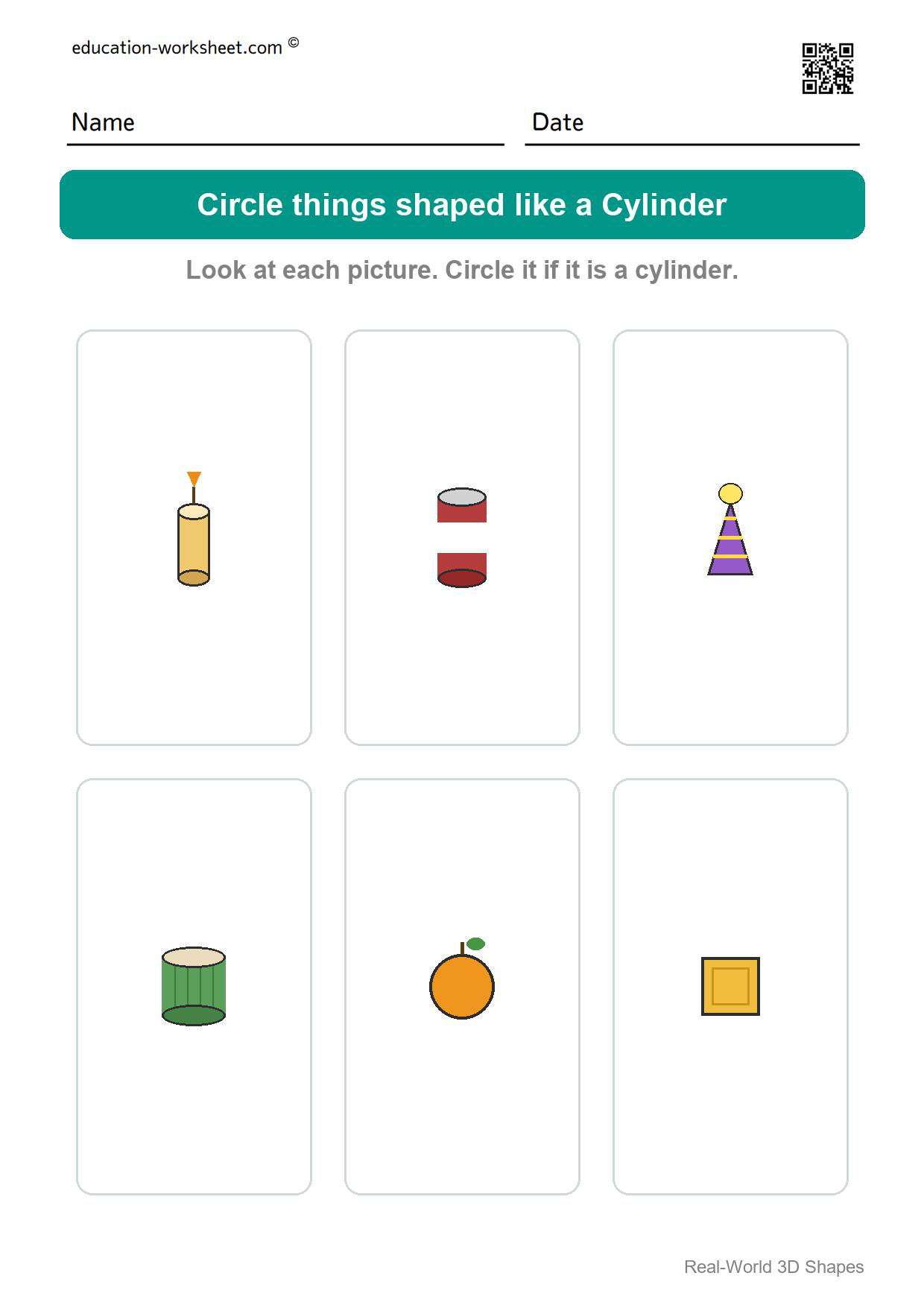
A cylinder is the shape a child meets most often and names last. A can, a candle and a drum are all the same solid at different proportions, which is exactly the point: a cylinder can be squat or tall and still be a cylinder. Circle things shaped like a cylinder. The three answers are a can, a candle and a drum.
Worksheet 2 – The Easiest Solid to Recognize
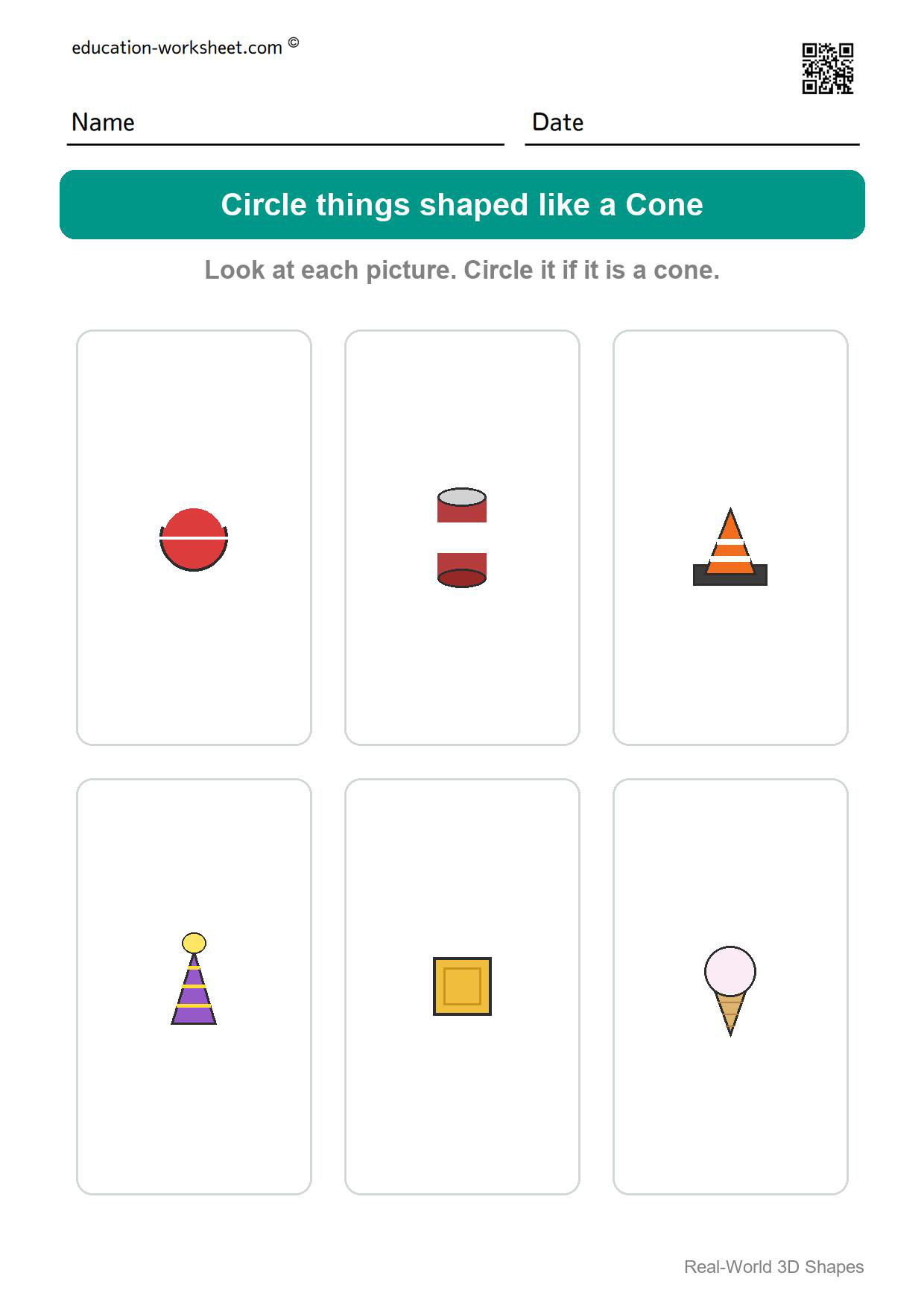
A point at the top and a circle at the bottom. Children find cones easily because all three examples here are cone-shaped on purpose rather than by accident, which is not true of most objects in a house. Circle things shaped like a cone. The three answers are an ice cream, a traffic cone and a party hat.
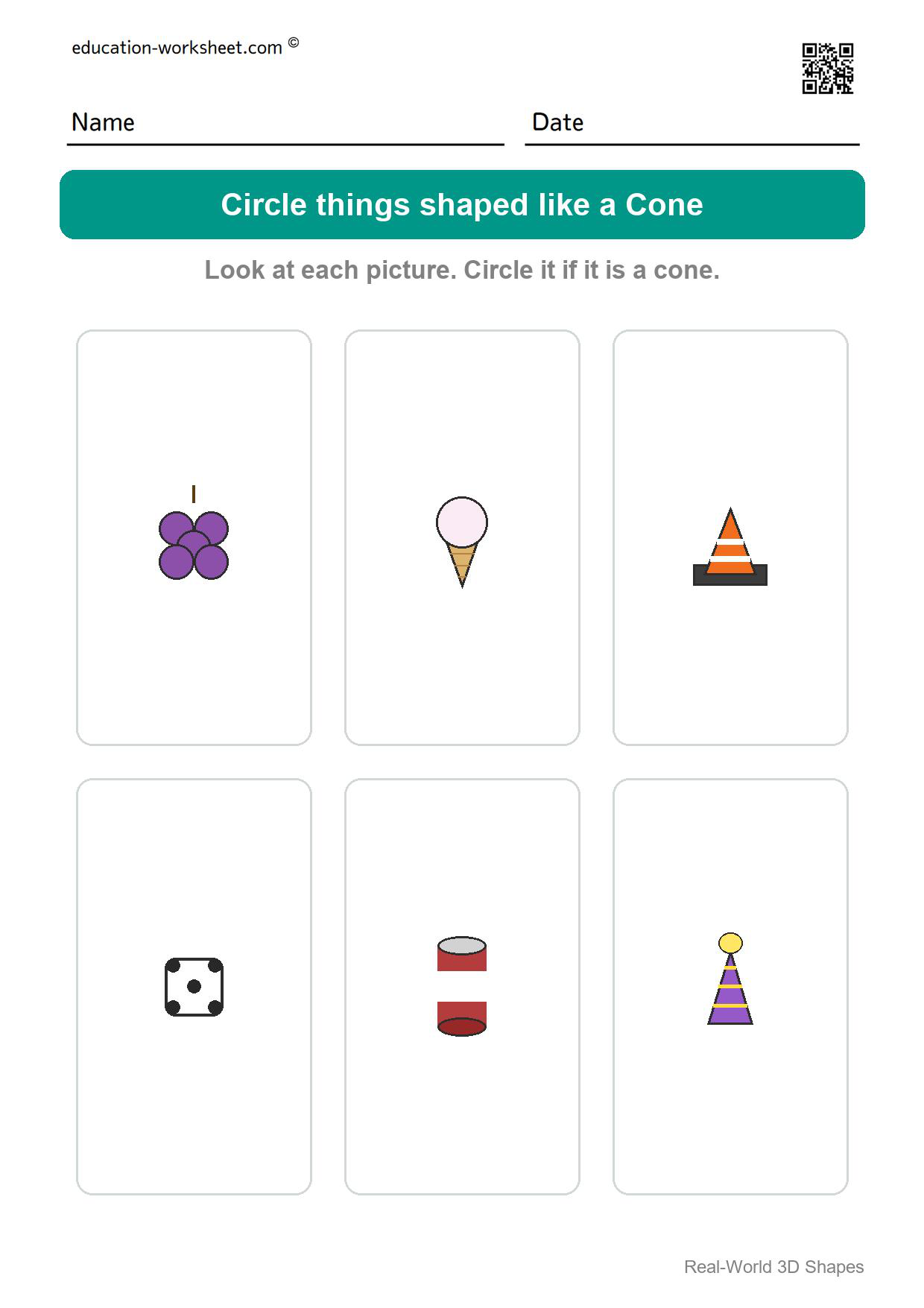
Worksheet 3 – Square on Every Side
A cube is the solid children can name and the one they most often confuse with a rectangular box. All three answers here are genuinely cubic, with every face the same square. Circle things shaped like a cube. The three answers are a gift box, dice and a block.
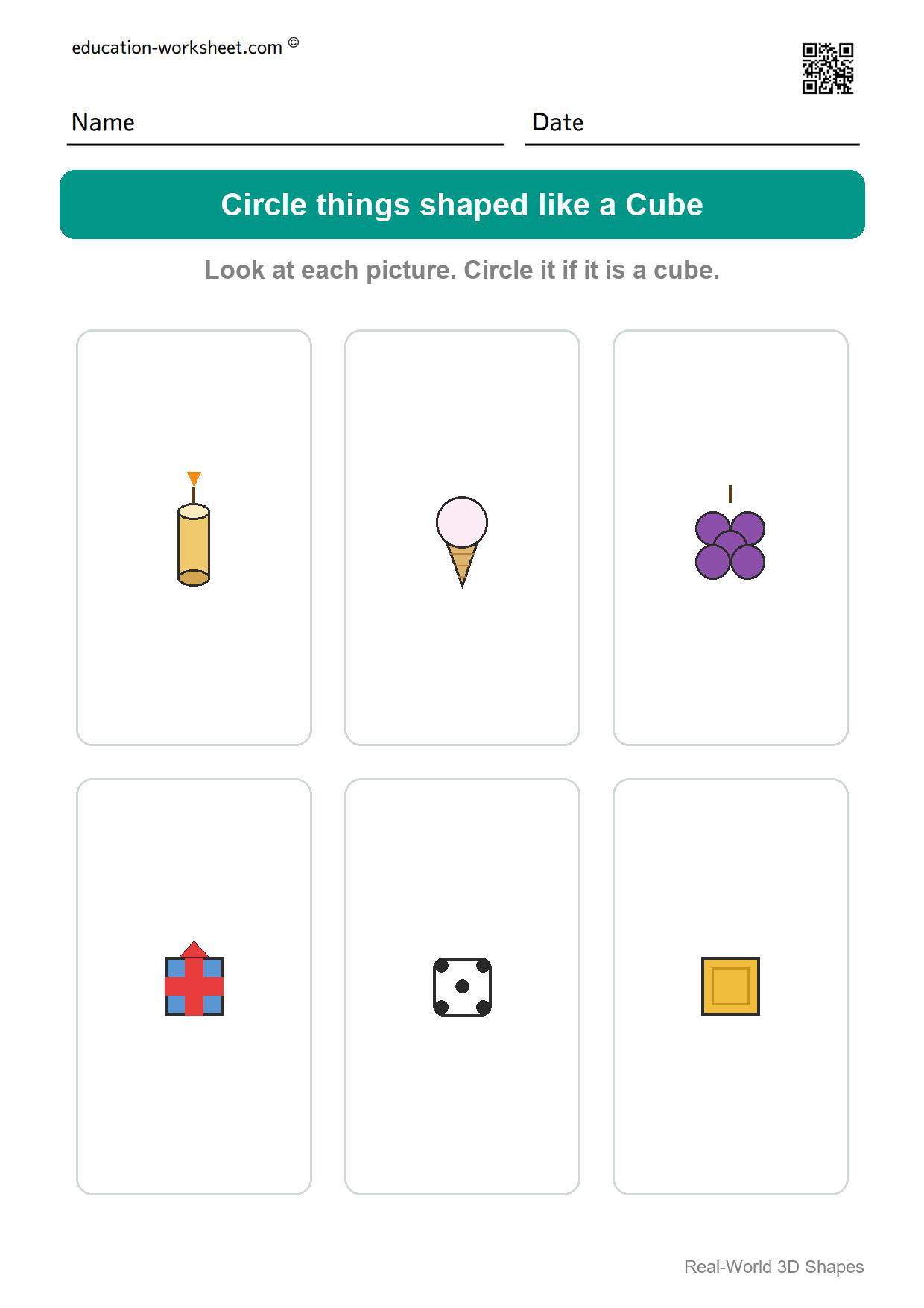
Worksheet 4 – Round All the Way Round
A sphere is the only solid with no flat face and no corner at all, and the three answers are as clear as they come. Worth asking what a sphere would do on a slope. Circle things shaped like a sphere. The three answers are a globe, a ball and an orange.
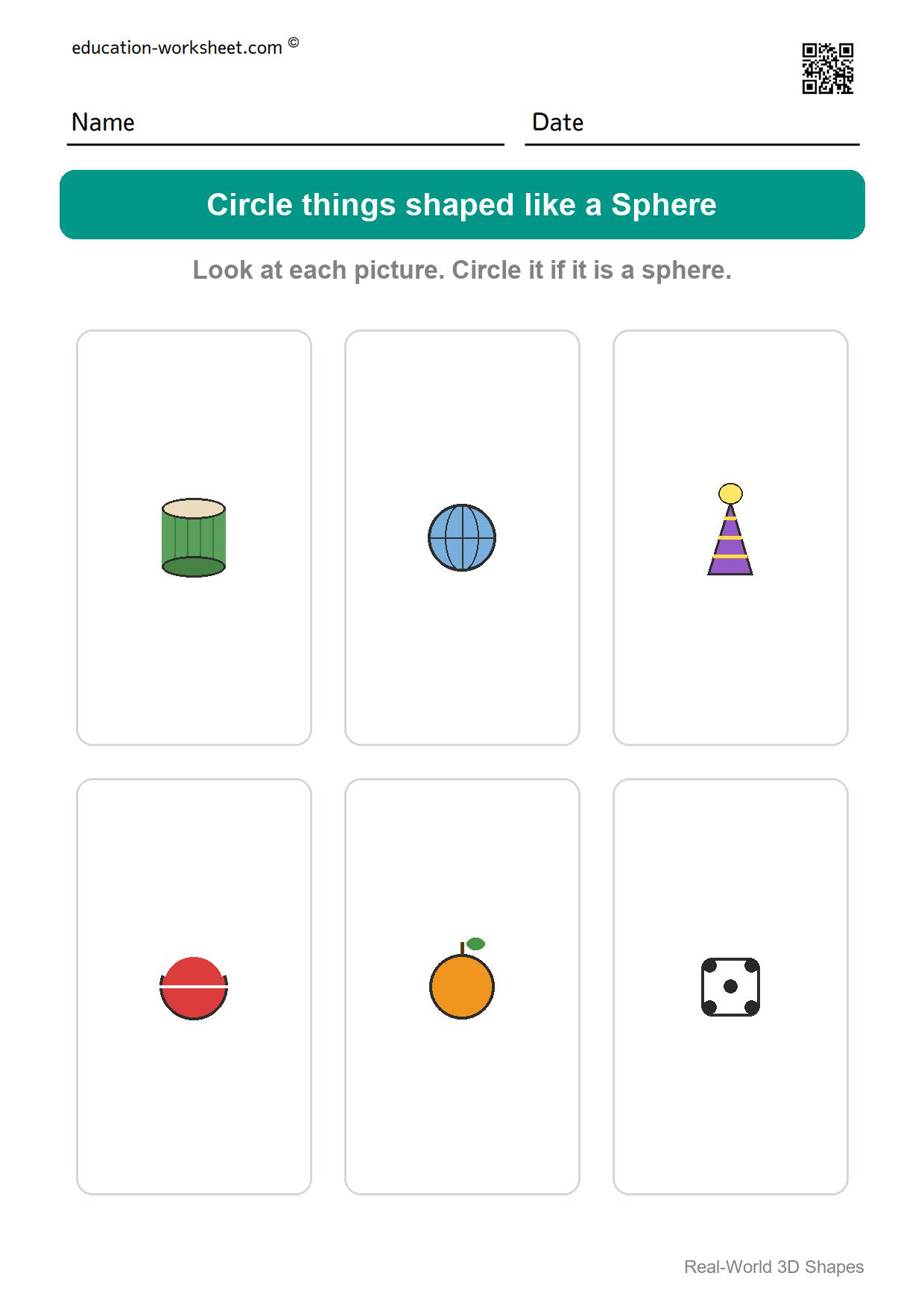
Worksheet 5 – The Same Three Cubes, Reshuffled
Exactly the same three correct pictures as page 3, in a different order on the page and among different wrong answers. A second look at the same idea, which is the point of an eight-page pack with four shapes in it. Circle things shaped like a cube. The three answers are dice, a block and a gift box.
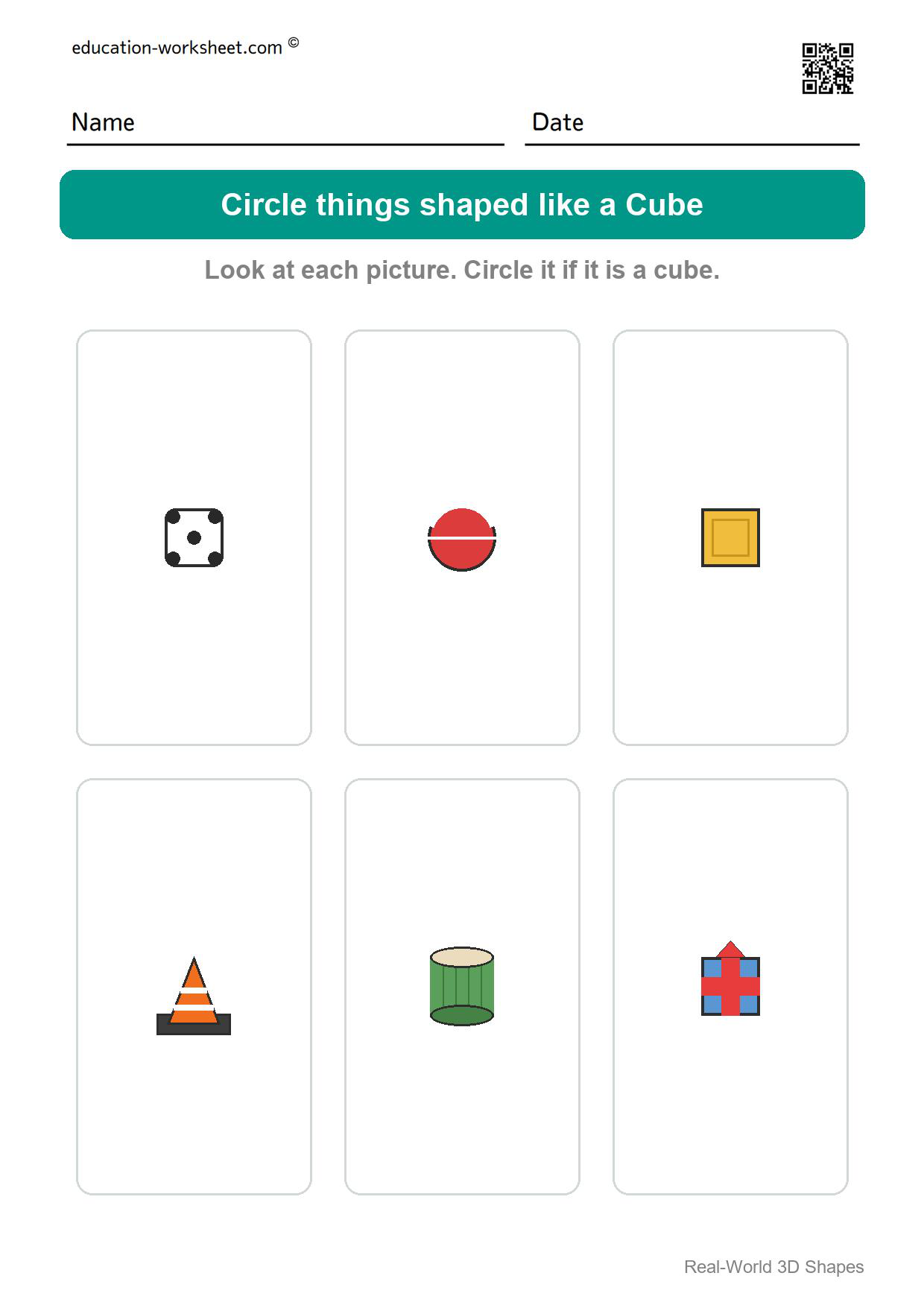
Worksheet 6 – Cones Again, In a New Order
The same three cones as page 2. If a child found them easily the first time, this page takes twenty seconds and builds confidence rather than skill, which is a fair use of a page. Circle things shaped like a cone. The three answers are a traffic cone, a party hat and an ice cream.
Worksheet 7 – Cylinders Again
The same trio as page 1. By now the useful question is not which ones but why: what do a candle and a drum have in common that an orange does not? Circle things shaped like a cylinder. The three answers are a candle, a can and a drum.
Worksheet 8 – The One Page That Changes Its Answers
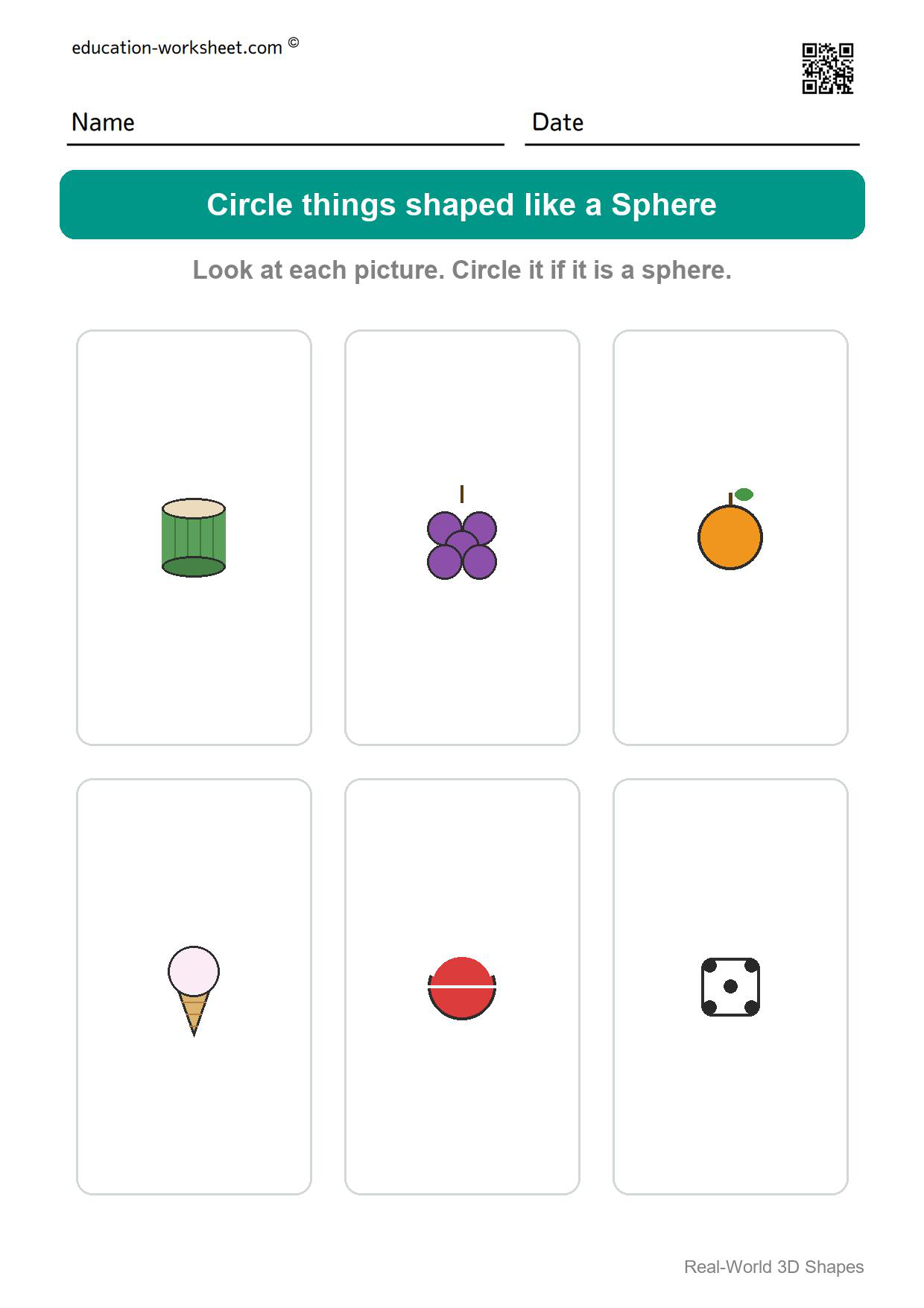
Pages 5, 6 and 7 repeat their trios exactly. This one does not. The globe from page 4 has been replaced by grapes, which is the only answer in the pack a child might reasonably argue with, and the best conversation in it. Circle things shaped like a sphere. The three answers are grapes, an orange and a ball.
Answer Key – All 8 Pages on One Sheet
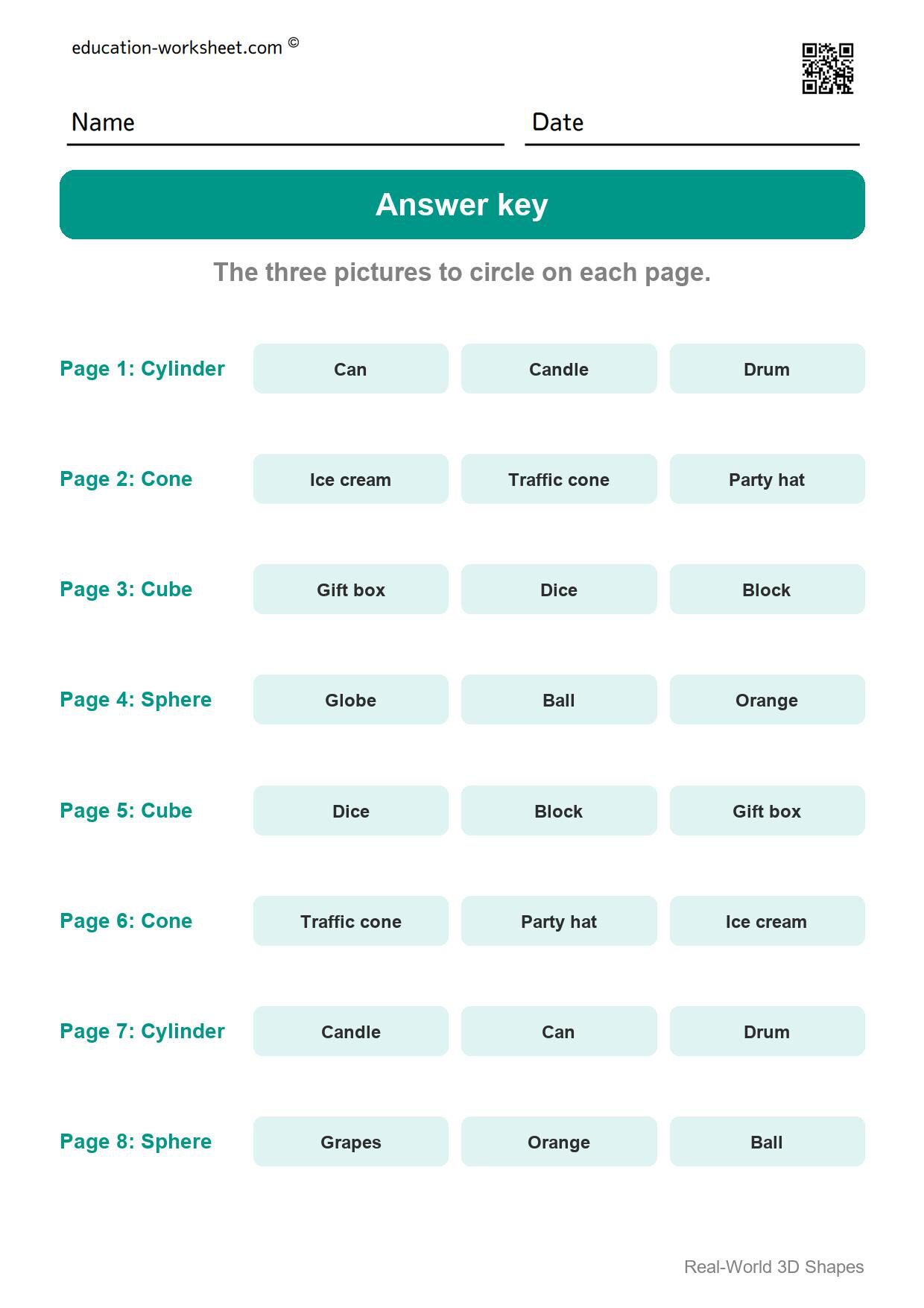
The last sheet lists the three correct pictures for every page, named in words. Handy in a classroom, and handy at home when a child is certain and you are not sure.
Three Pages Repeat Themselves, and One Does Not
Read the answer key from top to bottom and something shows up that no single page would tell you. The second half of the pack reuses the answers from the first half almost exactly:
- Page 5 (cube) has the same three answers as page 3: dice, block and gift box.
- Page 6 (cone) has the same three as page 2: traffic cone, party hat and ice cream.
- Page 7 (cylinder) has the same three as page 1: candle, can and drum.
- Page 8 (sphere) does not. The globe from page 4 has been dropped and grapes put in its place.
That one substitution is the most interesting thing in the pack, and it is worth stopping on. Grapes are the only answer here a child could reasonably argue with. A bunch of grapes is not a sphere; each grape in it is. A child who leaves the grapes uncircled has thought about it, and telling them they are simply wrong throws away the best question on the page. Ask instead: is the bunch a sphere, or is each grape one?
The repetition elsewhere is worth using rather than skipping. Give pages 1 to 4 one week and pages 5 to 8 the next. The pictures will look familiar and the shape names will not, and that gap is where you find out what a child has actually learned.
When Children Are Ready for These Worksheets
These pages suit children from about four and a half to six. A child is ready when they can name flat shapes like circles and squares. Solid shapes come after flat ones, and the jump is bigger than it looks: a ball is not a circle, and saying so out loud is most of the lesson.
The standard is K.G.A.1, describing objects in the environment using the names of shapes – which is what this pack does and very little else does. K.G.A.3, telling flat shapes from solid ones, sits right behind it, and K.G.A.2 matters here too: a cylinder on its side is still a cylinder.
How to Use These Worksheets
- Print the reference page and keep it out while you work. It is not a worksheet and does not need to be done.
- Find the real object first. A tin, a ball, a party hat, a dice. Two minutes with real objects is worth more than the page.
- Then print one worksheet. Six pictures is a session.
- Ask why for at least one picture: what makes the drum a cylinder and the orange not one? Flat circle at each end, straight up the side.
- Count the circles at the end. Three, on every page.
Three Things to Watch For
Confusing a cube with any box
Children generalise cube to mean box-shaped. Every cube on these pages really is cubic, so the pages are fair, but the word will still get stretched. A cube has six square faces, all the same. A cereal box does not.
Circling a circle for a sphere
The commonest confusion in the whole topic, and it comes from flat shapes being taught first. A sphere is a ball; a circle is what you draw round a coin. Hold both and say both words.
The grapes on page 8
The answer key counts them as a sphere. A child who disagrees is thinking clearly, not failing. Take the argument seriously and pull one grape off the bunch.
Printing Tips
- Choose Actual size or Fit to page in the print dialog – both keep the page in proportion.
- Each page fills one sheet and works on US Letter and A4 paper.
- Ordinary copier paper is fine. Card is only worth it if you want the page to survive an eraser.
- Color helps here more than on most of our packs, because the pictures are of real objects rather than line art.
- Print the reference page once and the worksheets as you need them.
- Keep the answer key away from the pile, or it will be found.
Frequently Asked Questions
What age are these 3D shapes worksheets for?
About four and a half to six years old: pre-K and kindergarten.
Which solid shapes are covered?
Four: sphere, cube, cylinder and cone. Each gets two worksheets.
How many pictures should my child circle?
Three on every page, out of the six shown. That never varies.
Is there an answer key?
Yes. The last sheet names the three correct pictures for all eight pages.
Are the grapes really a sphere?
The answer key says yes, and a single grape certainly is. A bunch is a cluster of spheres, so a child who hesitates has a point worth talking about rather than a mistake worth correcting.
Do I need to sign up to download these?
No. Every PDF downloads immediately, with no account, no email address and no cost.
Can I use these in my classroom?
Yes, they are free to print for home and classroom use. Please do not sell them or re-host the files elsewhere.
More Free Shape Worksheets
- Free 3D Shapes Worksheets for Kindergarten – Name the Solid Shapes
- Free 3D Shapes Worksheets for Kindergarten – Faces and Edges
- Free Flat or Solid Shapes Worksheets for Kindergarten – 2D vs 3D Shapes
- Free Real-World 2D Shapes Worksheets for Kindergarten
- Free 2D Shapes Worksheets for Kindergarten – Count Sides and Corners
- Free Shape Words Worksheets for Kindergarten – Read and Write Shape Names