These free printable position words worksheets give kindergarten children ten pages of practice with in, on, under and next to. Each page asks the same question four times – “Where is the ball?” – and the child circles the word that says where it is.
Every question shows a plain box drawn in outline and a red ball somewhere around it: inside, resting on top, underneath, or off to one side. Three words are offered and one of them is right. Forty questions in all.
Position words look simple and are not. They are the first words a child meets that describe a relationship rather than a thing, and a child can know the word “ball” perfectly and still have no idea what “under” is doing in the sentence.
- What Is in This Free Position Words Worksheet Pack
- The 10 Position Words Worksheets
- Worksheet 1 – Four Questions, Four Different Answers
- Worksheet 2 – Four Questions, Four Different Answers
- Worksheet 3 – Four Questions, Four Different Answers
- Worksheet 4 – Four Questions, Four Different Answers
- Worksheet 5 – Four Questions, Four Different Answers
- Worksheet 6 – Four Questions, Four Different Answers
- Worksheet 7 – Four Questions, Four Different Answers
- Worksheet 8 – Four Questions, Four Different Answers
- Worksheet 9 – Four Questions, Four Different Answers
- Worksheet 10 – Four Questions, Four Different Answers
- Four Words, Not Three, and Each One Ten Times
- When Children Are Ready for These Worksheets
- How to Use These Worksheets
- Three Things to Watch For
- Printing Tips
- Frequently Asked Questions
- More Free Position and Word Worksheets
What Is in This Free Position Words Worksheet Pack
- Ten printable worksheets, four questions on each page.
- Four words covered: in, on, under and next to.
- Forty questions in total – each word is the answer exactly ten times.
- Three word choices under every picture, with the right one always among them.
- A picture for every question, so no reading is needed to know where the ball is.
- A separate PDF for every page, free to download and print.
The 10 Position Words Worksheets
Every page uses all four words, once each. That holds on all ten pages. What changes from page to page is the order they come in, and which three of the four words are offered as choices.
Worksheet 1 – Four Questions, Four Different Answers
The four words arrive in the order most children learn them. The ball starts sitting on top of the box, then inside it, then underneath, then beside it. The answers on this page, in order: on, in, under, next to.
Worksheet 2 – Four Questions, Four Different Answers
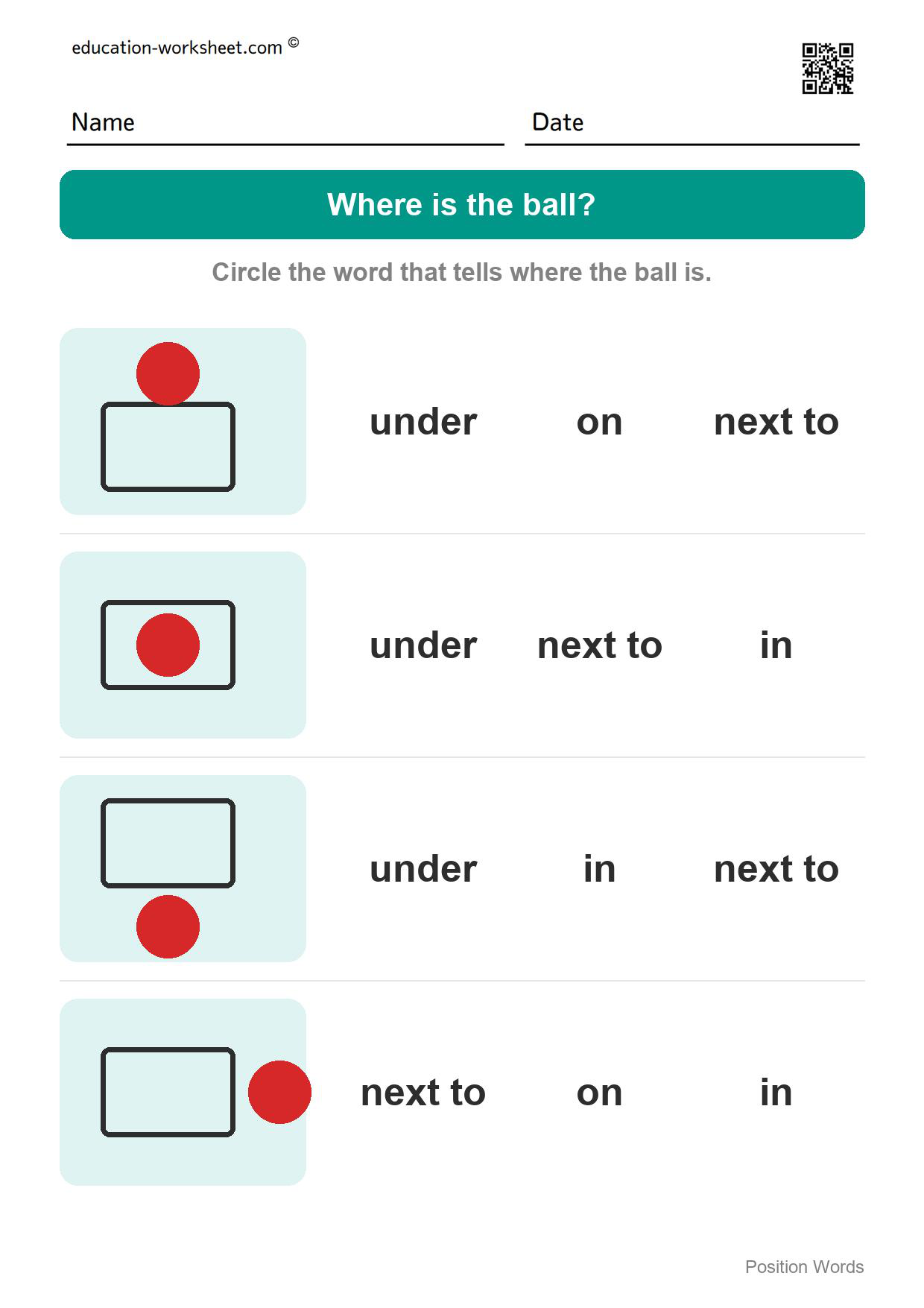
A different order to page 1, which is the point of having ten pages. A child who answered by remembering yesterday’s sequence gets nothing from it. The answers on this page, in order: under, next to, in, on.
Worksheet 3 – Four Questions, Four Different Answers
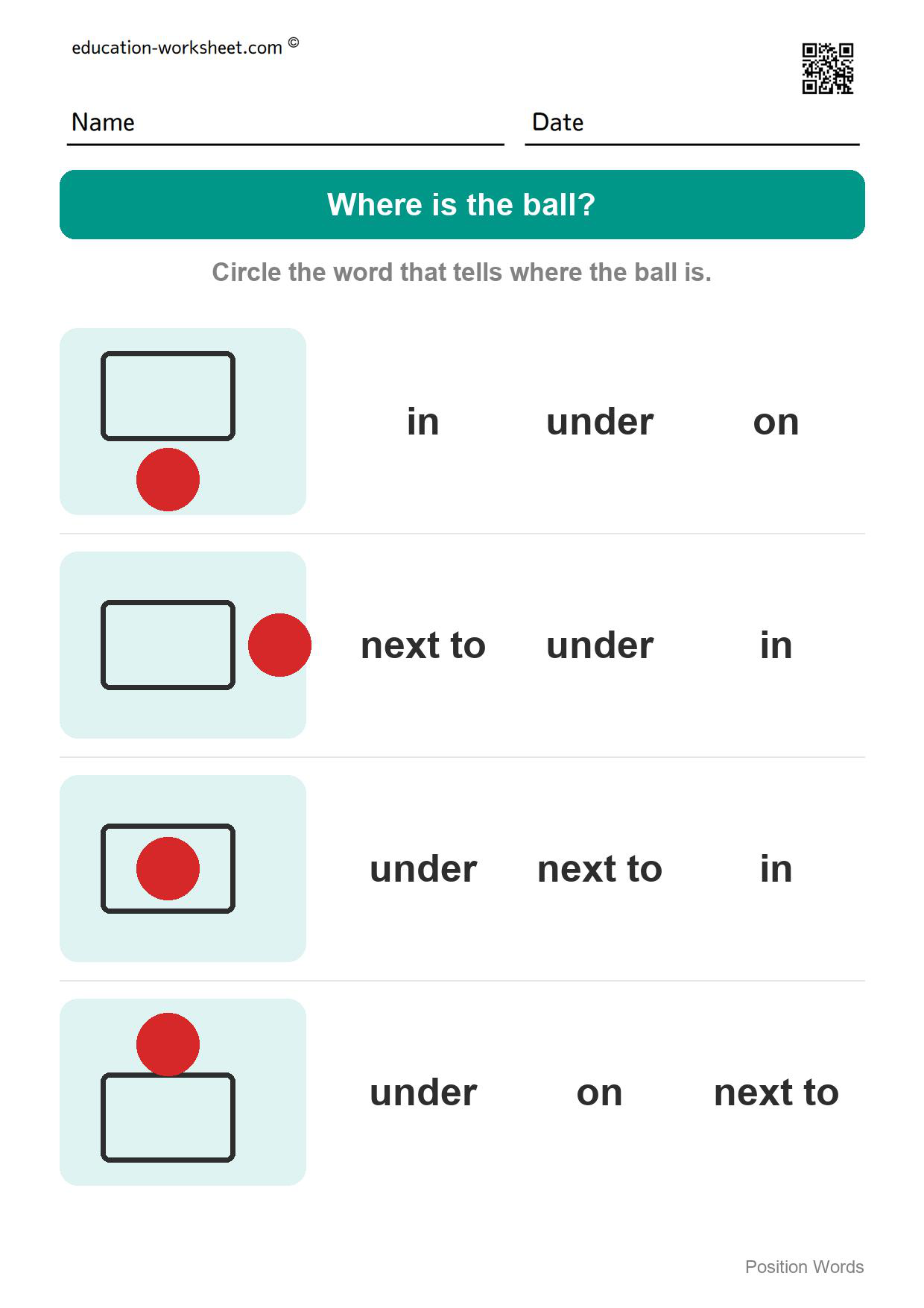
Under comes first again, and in is held back to last. In is the word children are surest of, so ending on it sends them away having got one right. The answers on this page, in order: under, next to, on, in.
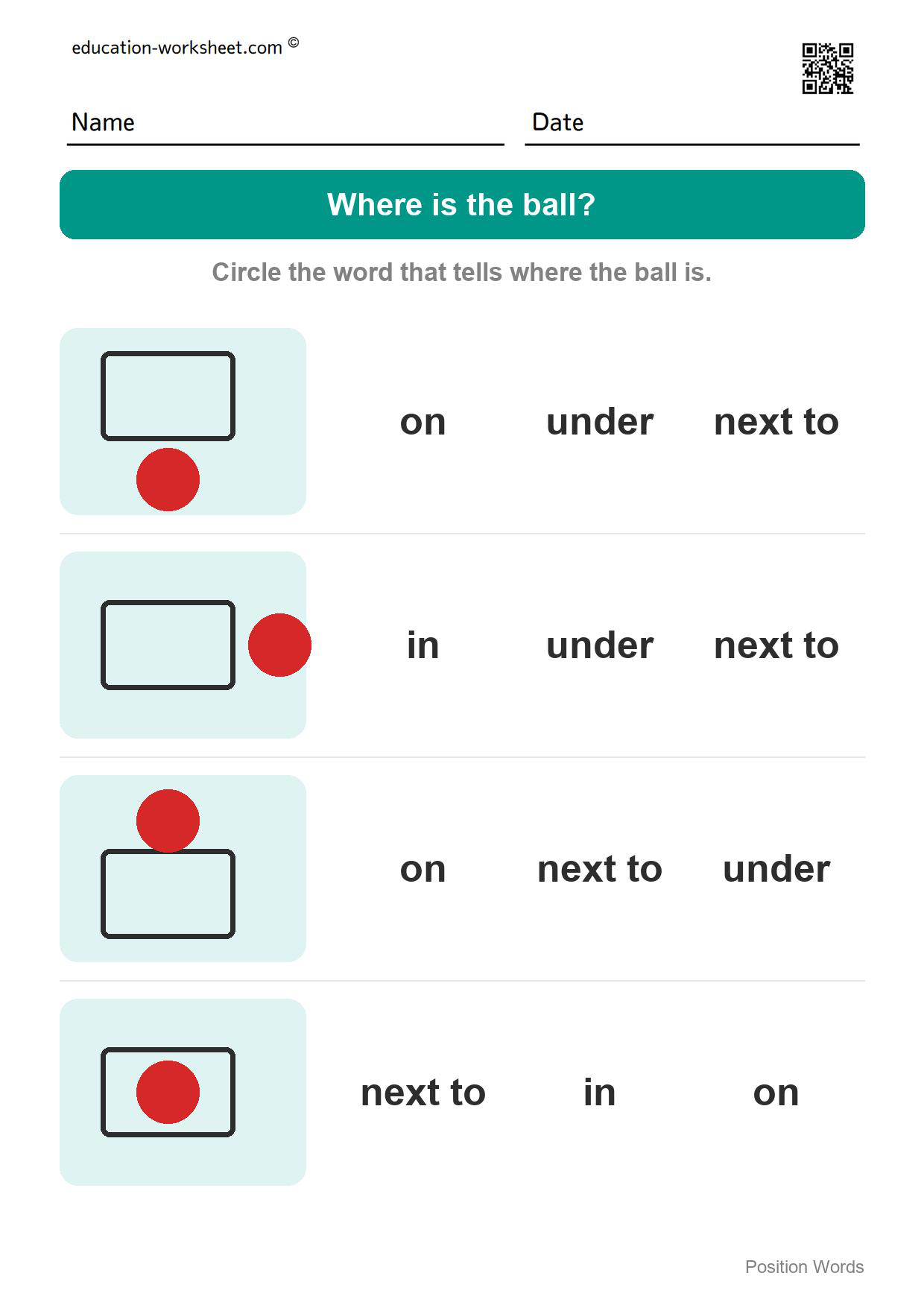
Worksheet 4 – Four Questions, Four Different Answers
The ball is beside the box in the second question and underneath it in the fourth. Those two are the pair most often swapped when a child is guessing. The answers on this page, in order: on, next to, in, under.
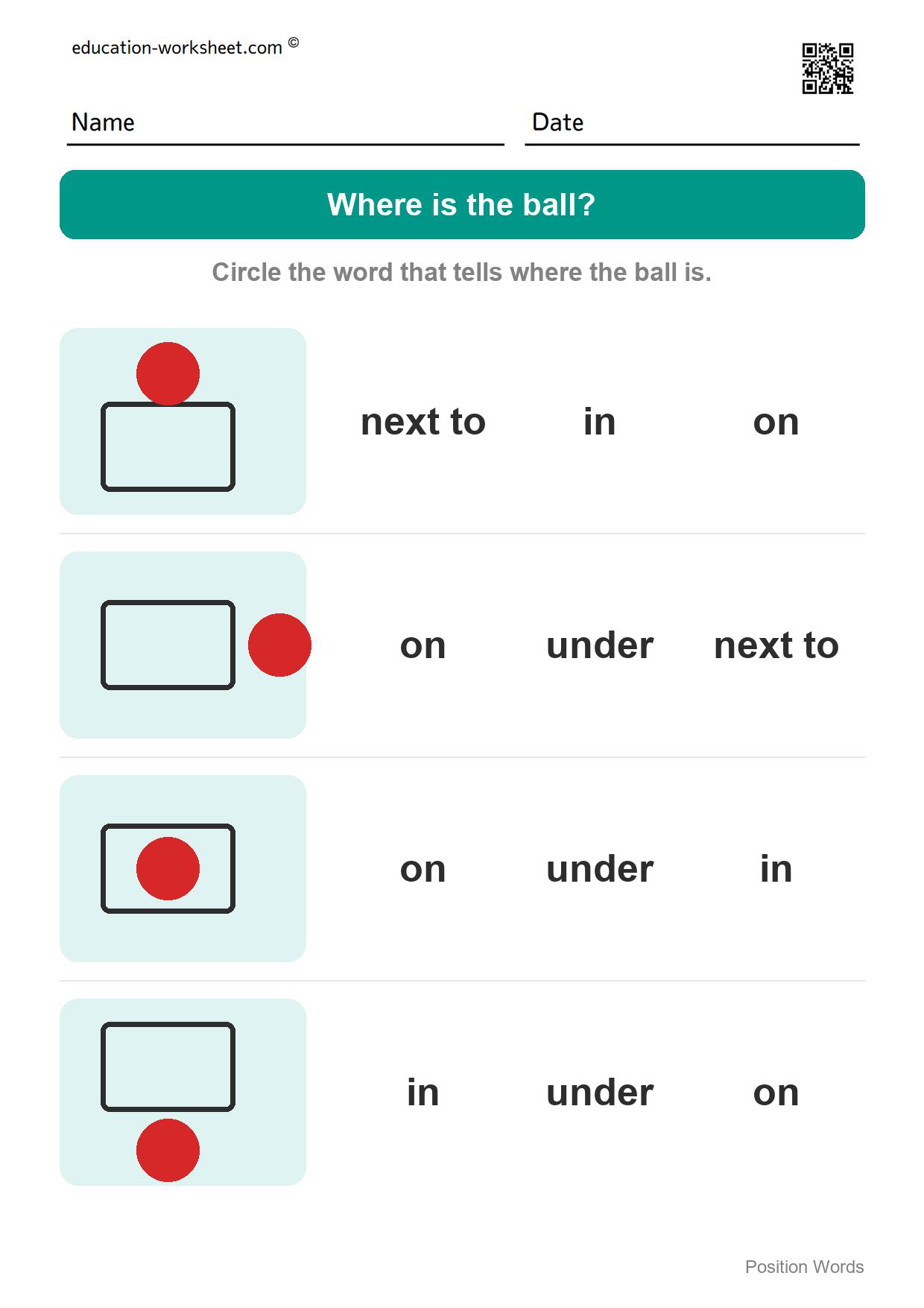
Worksheet 5 – Four Questions, Four Different Answers
Opens with the easiest word in the set. A reasonable page to start with if your child has not met this kind of question before. The answers on this page, in order: in, under, next to, on.
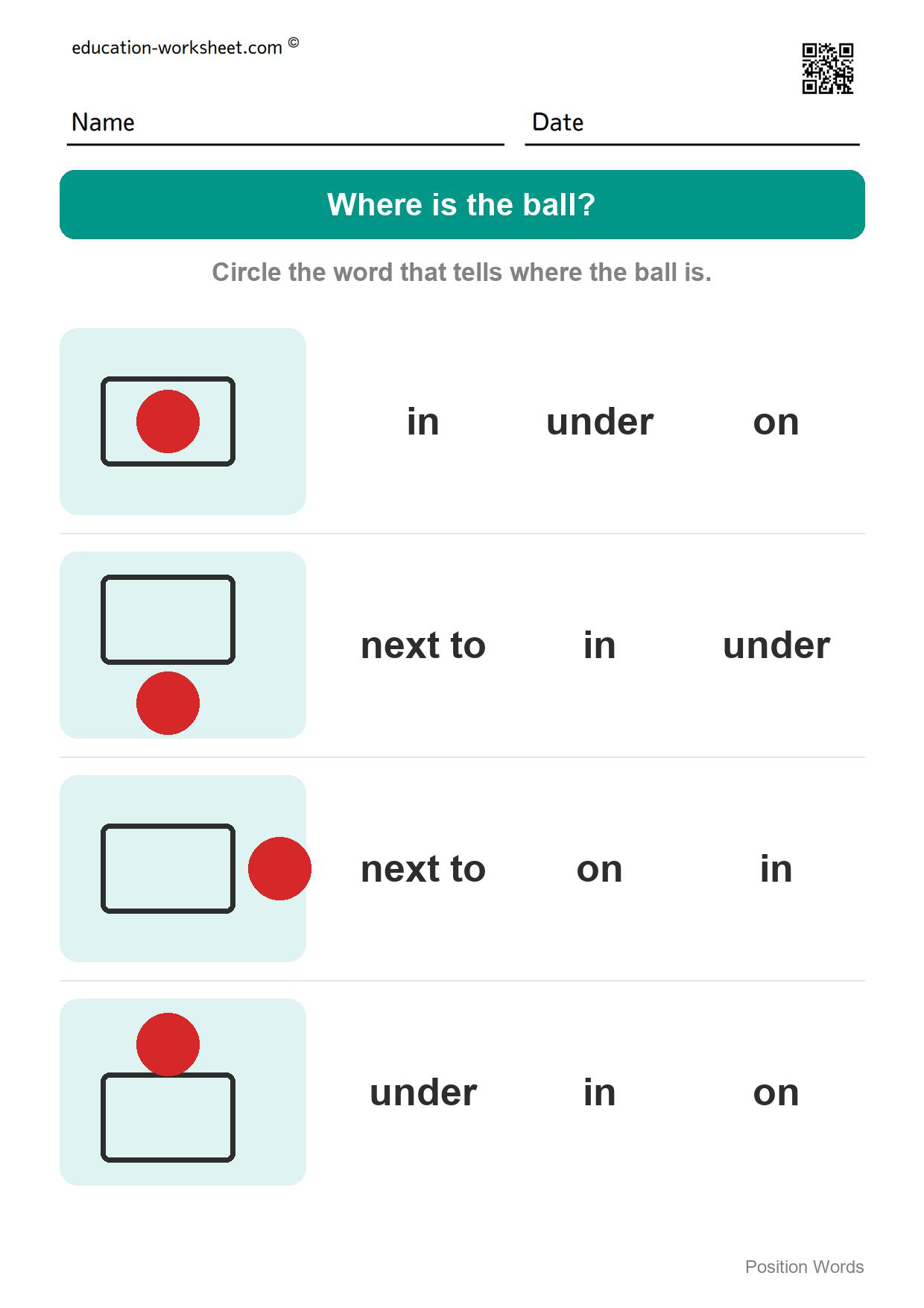
Worksheet 6 – Four Questions, Four Different Answers
Starts with the hardest of the four. Next to is two words, and it is the one a child who is beginning to read has to work at rather than recognize. The answers on this page, in order: next to, on, in, under.
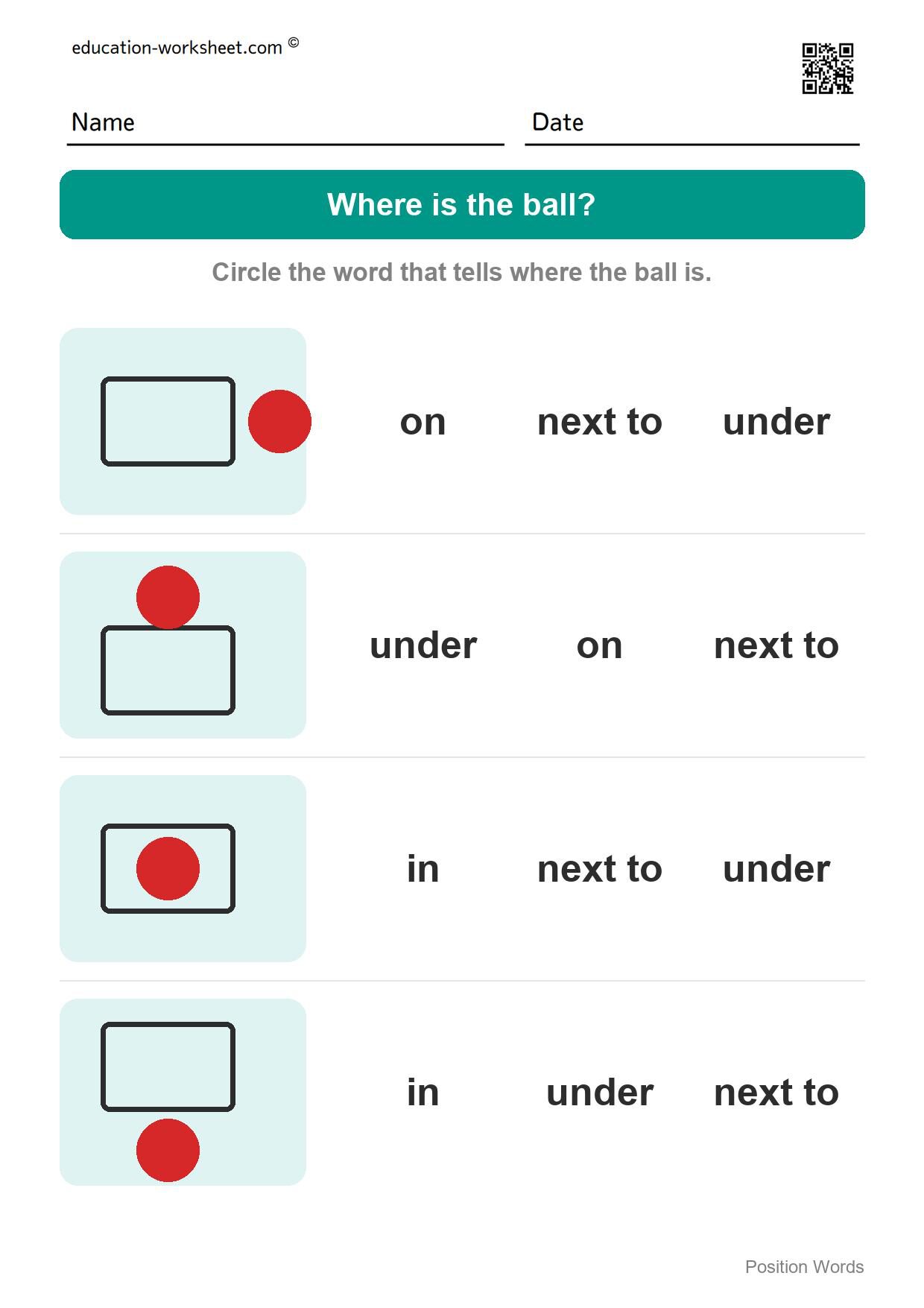
Worksheet 7 – Four Questions, Four Different Answers
The tidiest run in the pack: in, on, under, next to, straight down the page. Useful if you want to teach the four words in order rather than test them. The answers on this page, in order: in, on, under, next to.
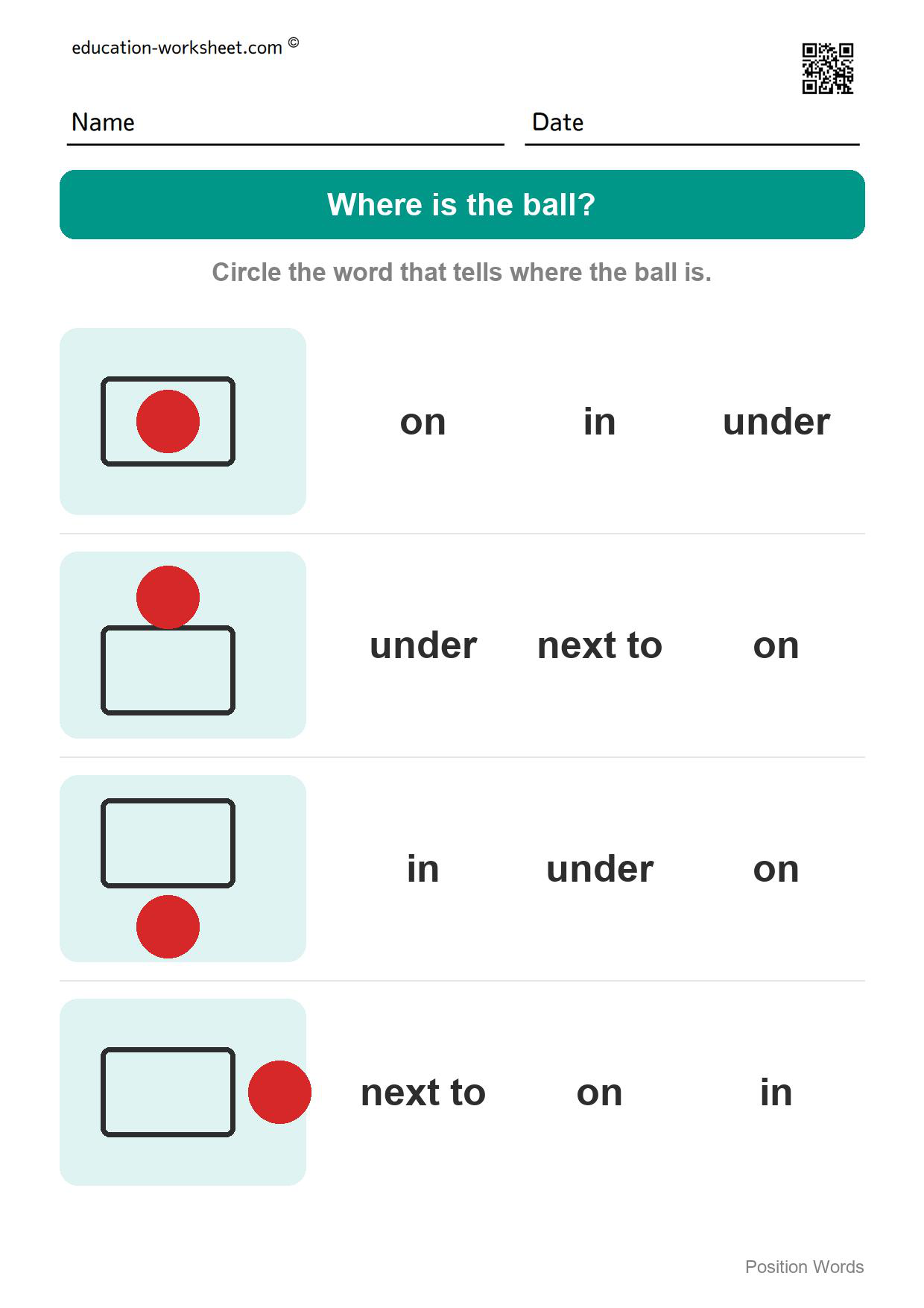
Worksheet 8 – Four Questions, Four Different Answers
The same order as page 9, so the two pages can be used a week apart to see whether anything has stuck. The answers on this page, in order: on, next to, under, in.
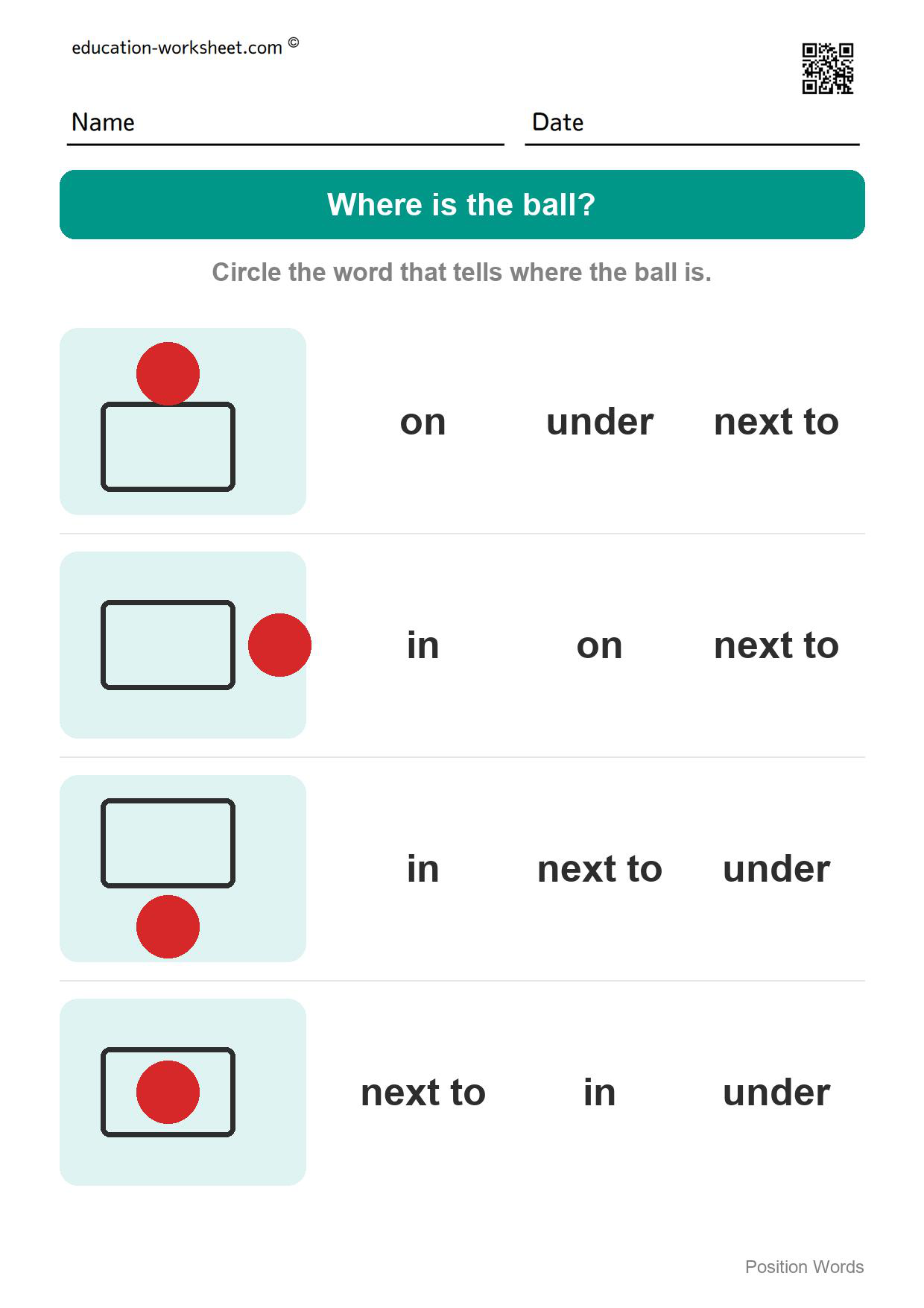
Worksheet 9 – Four Questions, Four Different Answers
Identical in answer order to page 8, with different pictures and different word choices offered. Whether a child does better here is worth noticing. The answers on this page, in order: on, next to, under, in.
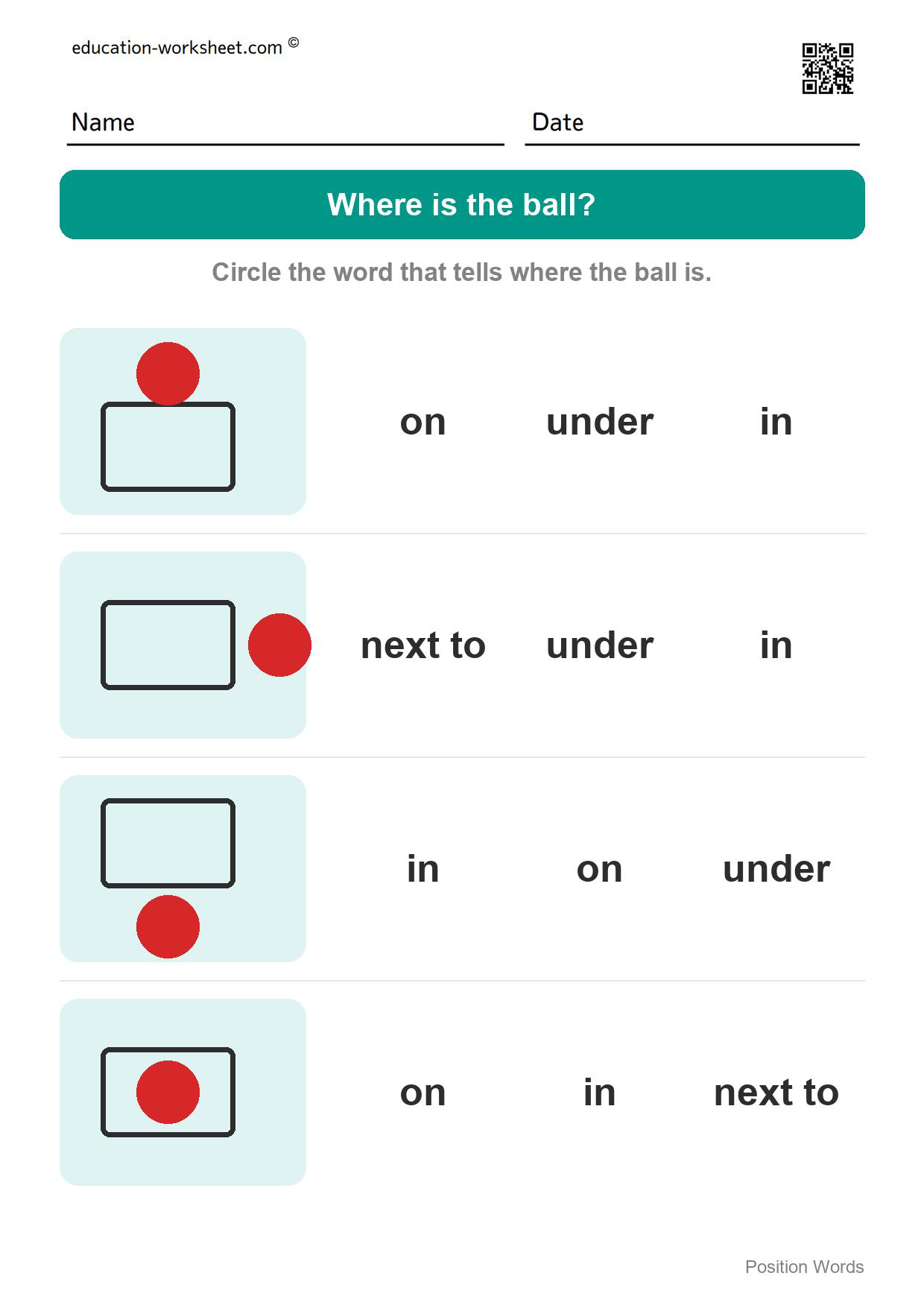
Worksheet 10 – Four Questions, Four Different Answers
The last page ends on in, the word the pack began with on page 1. Ten pages, forty questions, and every word used exactly ten times. The answers on this page, in order: under, on, next to, in.
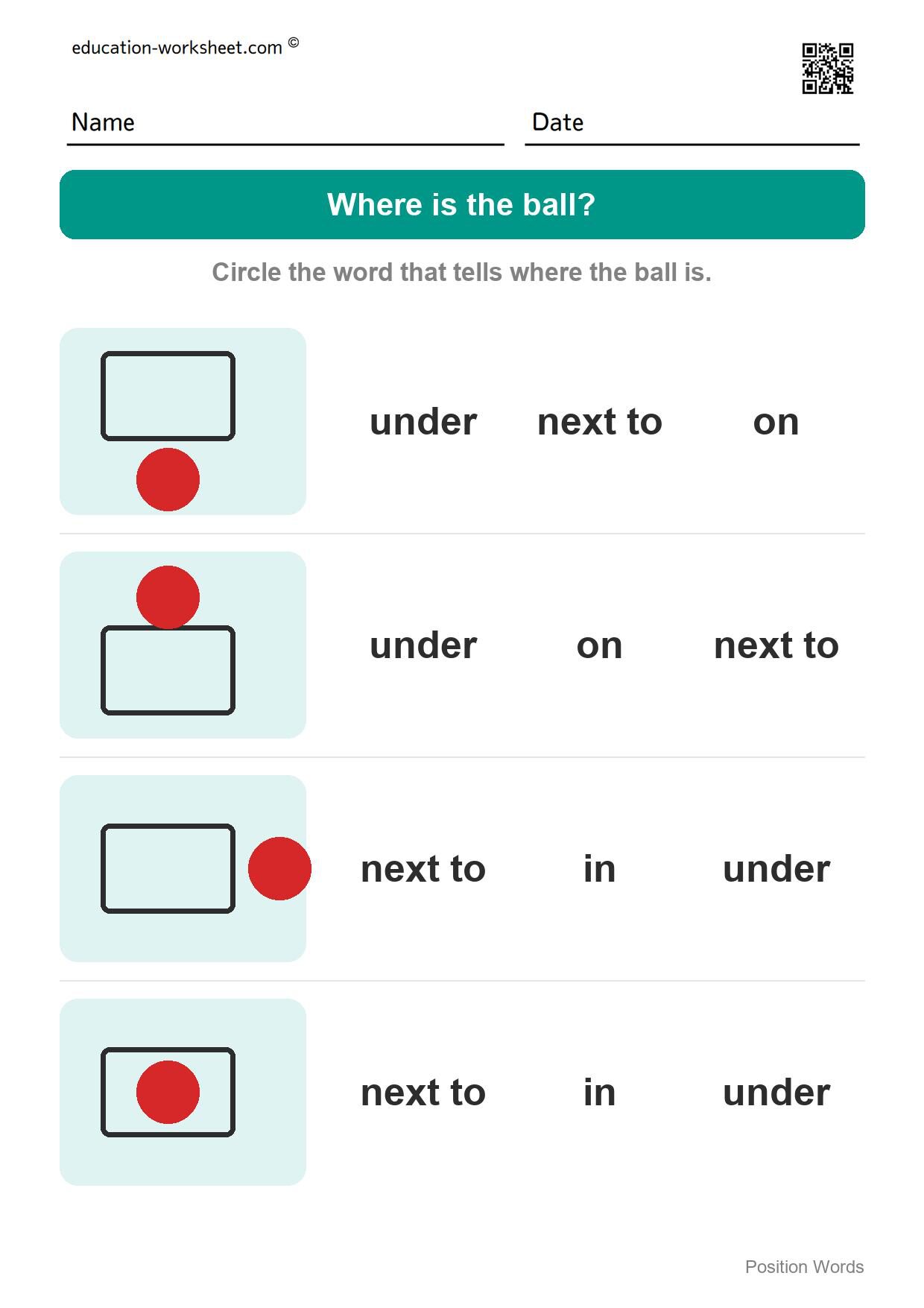
Four Words, Not Three, and Each One Ten Times
Go through all forty questions and the design shows itself. In is the answer ten times, on ten times, under ten times and next to ten times. Nothing is over-practiced and nothing is squeezed in at the end. Within each page, all four words are used once, so a page is a complete set rather than a sample.
That has a practical consequence worth knowing before you hand the page over. By the fourth question on any page, the answer is whichever word has not been used yet. Some children will find that out. It is an excellent piece of reasoning and a poor way to learn the word, so the best use of it is out loud, at the end: ask which word has not been used and then check it against the picture.
Two more things hold across all forty questions. The right word is always one of the three offered, so there is no trick. And the right word is not parked in the same place: it is first thirteen times, second fifteen times and third twelve times, which is close enough to random that guessing by position gets a child nowhere.
One note on the title of this pack, which names three words. Next to is in here too, as an answer ten times and as a choice on nearly every question. It is the hardest of the four, because it is two words rather than one and because “beside” is what most families actually say at home.
When Children Are Ready for These Worksheets
These pages suit children from about four to six. A child is ready when they can follow a spoken instruction like “put it under the chair”. Reading is helpful but not essential: the three choices can be read aloud by an adult and the child still has to decide.
This is K.G.A.1 almost word for word – describing the relative positions of objects using terms such as above, below, beside, in front of, behind and next to. It also helps with RF.K.3.C, reading common high-frequency words by sight: in and on are on every such list, and under and next to follow soon after.
How to Use These Worksheets
- Print one page. Four questions is a session for this age.
- Before the pencil comes out, do it with a real object. Put a ball, or an eraser, in a box, on the box, under the box and beside it, saying the word each time.
- Read the three choices aloud for a child who is not reading yet, then ask the question on the page: “where is the ball?”
- Circle the word. Then say the whole sentence back: “the ball is under the box”. The sentence is what fixes the word, not the circle.
- At the end, ask which of the four words was not used. There is no such word, and finding that out is the best moment on the page.
Three Things to Watch For
On and next to changing places
A ball resting on the corner of the box and a ball beside the box can look similar to a child scanning quickly. Ask them to put a finger on the box first and then say where the ball is in relation to that finger.
Saying “beside” and Then Not Finding It
Most families say beside, by, or next door rather than next to. A child who has the idea and not the phrase will look at three words and see none of them. Say both words together for a while – “next to, beside, they mean the same”.
Working out the fourth answer without looking
Since each page uses all four words once, the last question can be solved by elimination. Not a problem in itself, but check the picture with them anyway, or shuffle the questions by folding the page so only one shows at a time.
Printing Tips
- Choose Actual size or Fit to page in the print dialog – both keep the page in proportion.
- Each page fills one sheet and works on US Letter and A4 paper.
- Ordinary copier paper is fine. Card is only worth it if you want the page to survive an eraser.
- The ball prints as a solid shape, so grayscale is fine.
- Folding the page into four strips turns it into four separate questions, which removes the fourth-answer shortcut and suits a child who is put off by a full page.
- A plastic wallet and a dry-wipe pen let the same page be used again two weeks later.
Frequently Asked Questions
What age are these position words worksheets for?
About four to six years old: pre-K and kindergarten.
Which position words are covered?
Four of them: in, on, under and next to. Each is the answer ten times across the forty questions.
Does my child need to read to do these?
Not necessarily. Read the three choices aloud and let your child choose. The thinking is in deciding where the ball is, not in reading the words.
Is there an answer key?
None is needed. The picture shows the answer, and each page uses all four words once, which is a check in itself.
My child says “beside” instead of “next to”. Is that wrong?
No, it means the same thing. Use both words together for a while so that the phrase on the page connects to the one they already use.
Do I need to sign up to download these?
No. Every PDF downloads immediately, with no account, no email address and no cost.
Can I use these in my classroom?
Yes, they are free to print for home and classroom use. Please do not sell them or re-host the files elsewhere.
More Free Position and Word Worksheets
- Free Above and Below Worksheets for Kindergarten – Where Is It
- Free Behind and In Front Worksheets for Kindergarten – Find It
- Free Left and Right Worksheets for Kindergarten – Which Side
- Free Question Words Worksheets for Kindergarten – Who and What
- Free Opposites Worksheets for Kindergarten – Match the Opposite
- Free Sight Words Worksheets for Kindergarten – Trace, Write and Find
- Free Fall Following Directions Worksheets – 1, 2 and 3 Steps