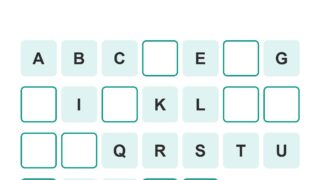
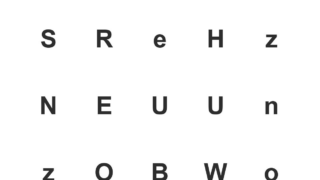
These free printable alphabet maze worksheets turn ABC order into a puzzle. Each page is a grid of thirty-six letters. The child starts in the top left corner, looks at the boxes above, below, left and right, colors the one holding the next letter of the alphabet, and keeps going until they reach the bottom right corner.
Every maze has exactly one route, and there is never a choice to make. At each step, only one of the neighboring boxes holds the next letter – we checked all one hundred and thirty steps across the ten mazes. A child cannot get lost down a wrong branch; they can only get stuck, and getting stuck always means the letter they want is next to them and they have not spotted it yet.
Five mazes use capital letters and five use small letters. No maze mixes the two, so a child is never asked to match an A with an a while also working out the order.
- What Is in This Free Alphabet Maze Worksheet Pack
- The 11 Alphabet Maze Worksheets
- Maze 1 – A to K in Capital Letters
- Maze 2 – A to M, and the First Move Upwards
- Maze 3 – A to O, Almost Nothing but the Right Letters
- Maze 4 – A to Q, the Hardest Capital Maze
- Maze 5 – a to k in Small Letters
- Maze 6 – a to m, with One Move Back
- Maze 7 – a to o, a Grid Made Almost Entirely of Near Misses
- Maze 8 – a to q, the b, d, p and q Page
- Maze 9 – K to Y, Starting in the Middle
- Maze 10 – n to z, the End of the Alphabet
- Answer Key – All 10 Mazes
- Why the Wrong Letters Are the Right Letters
- When Children Are Ready for Alphabet Mazes
- How to Use These Worksheets
- Three Things to Watch For
- Printing Tips
- Frequently Asked Questions
- More Free Alphabet Worksheets
What Is in This Free Alphabet Maze Worksheet Pack
- Ten printable mazes, each a grid of six by six letters.
- An eleventh page with the answer key for all ten.
- Five mazes in capital letters (A to K, A to M, A to O, A to Q and K to Y) and five in small letters (a to k, a to m, a to o, a to q and n to z).
- Paths of 11, 13, 15 and 17 letters, so the mazes get longer as you go.
- Start always in the top left box, finish always in the bottom right.
- A separate PDF for every page, free to download and print.
The 11 Alphabet Maze Worksheets
There is a difficulty ladder built into this pack, and it is invisible on the page. It is not the length of the path – it is how often the path turns back on itself.
Count the moves that go up or to the left, and mazes 1, 2, 3 and 4 give you none, one, two and three. Then mazes 5, 6, 7 and 8 give you none, one, two and three all over again, in small letters. Maze 1 and maze 5 are pure right-and-down: five moves right, five moves down. That is why they feel so much easier, and it is also why a child who has only done maze 1 will stall on maze 2, where the path suddenly asks them to go back up.
Work through the pages in order and the ladder does its job. Hand a child maze 4 or maze 8 first and they will meet three backward moves with no preparation at all.
Maze 1 – A to K in Capital Letters
Eleven letters, A to K. The path never goes backwards: five moves to the right and five moves down, and nothing else. A child who has understood “look right, look down” can finish this one without ever feeling stuck.
The decoys are already at work, though. C, D, G, H and J each appear three times in the grid, and only one of each is next to the letter before it.

Maze 2 – A to M, and the First Move Upwards
Thirteen letters, A to M, and one of the moves goes up. It is the first time in the pack that the path turns back on itself, and it is the single most common place for a child to give up.
The path also changes direction nine times, against four times on maze 1. Expect this sheet to take two or three times as long as the first.

Maze 3 – A to O, Almost Nothing but the Right Letters
Fifteen letters, A to O. Only seven of the thirty-six boxes hold a letter from outside that run, so nearly every box in the grid is a letter the child is looking for, just not yet.
One move up and one move left. The path turns ten times.

Maze 4 – A to Q, the Hardest Capital Maze
Seventeen letters, A to Q, and three of the moves go backwards – two up and one left. Twelve changes of direction, more than any other maze in the pack.
The grid holds three As and three Qs. The first A is the start box and the last Q is the end box, which means the child meets a decoy version of both the first and the last letter on the way.

Maze 5 – a to k in Small Letters
The same eleven-letter run as maze 1, in small letters, and the same promise: five moves right, five moves down, no backtracking at all.
It is the straightest maze in the pack – the path changes direction only three times. Small letters are harder to tell apart than capitals, so the sheet deliberately makes the route easy while the letters get harder.

Maze 6 – a to m, with One Move Back
Thirteen letters, a to m, and one move to the left. In the small-letter half of the pack, this is where backtracking starts, exactly as maze 2 did for capitals.
The grid contains four cs. Three of them are wrong.

Maze 7 – a to o, a Grid Made Almost Entirely of Near Misses
Fifteen letters, a to o. Only four of the thirty-six boxes hold a letter that is not part of the run – the fewest in the pack. Everything else on the page is a letter the child needs, in the wrong place.
The path turns eleven times, with one move up and one to the left.

Maze 8 – a to q, the b, d, p and q Page
Seventeen letters, a to q, with three moves to the left.
This is the only maze in the pack that contains all four of b, d, p and q – the letters children most often read as each other. Three ps, two bs, one d and one q are scattered through the grid. If a child is going to mix up a b and a d anywhere, it will be here, and that is the useful part of the page.

Maze 9 – K to Y, Starting in the Middle
Fifteen capital letters, and it starts at K. A child who can only find the next letter by singing the alphabet from the beginning has to sing it under their breath eleven times before they can even start, which is exactly the habit this page is designed to break.
The grid has four Ts and three Ws. Two of the moves go left.

Maze 10 – n to z, the End of the Alphabet
Thirteen small letters, n to z, the stretch children practice least. The end of the alphabet gets sung quickly and learned badly, and this maze will show it.
One move to the left; the rest is right and down.

Answer Key – All 10 Mazes
All ten grids on one page, with the correct boxes shaded. Print it for yourself rather than for the child.
A child can also check their own work: if the colored boxes do not finish in the bottom right corner, something went wrong earlier.

Why the Wrong Letters Are the Right Letters
The boxes that are not on the path are not random. They are mostly the same letters the child is hunting for, printed somewhere else in the grid. On maze 1, C, D, G, H and J each appear three times. On maze 7, only four of the thirty-six boxes hold a letter from outside the run at all.
That is what stops the maze from being a spot-the-letter exercise. Finding a D on the page is easy; there are three. Finding the D that is touching the C you just colored is a different task, and it is the one that makes a child hold two things in mind at once: which letter comes next, and where they currently are.
It also explains the most common wrong answer. A child colors a correct letter – just not the one next to their finger. The grid is designed to make that mistake available, and the answer key is designed to make it visible.
When Children Are Ready for Alphabet Mazes
- Age: about four to six – pre-K through the end of kindergarten.
- Before starting: the child should recognize most letters by sight. Reciting the alphabet is not enough on its own, because the maze asks for the next letter out of order.
- RF.K.1.D – recognize and name all upper- and lowercase letters of the alphabet. That is what these mazes practice, one letter at a time.
- Alphabetical order itself pays off later, when children start using a glossary or a beginning dictionary.
How to Use These Worksheets
- Say or sing the alphabet once before starting, then put it away. The maze is about knowing what comes next, not about singing from the start each time.
- Give the child a crayon or highlighter rather than a pencil. Coloring the box makes the path show up, and a completed maze looks like something.
- Start at maze 1 and go in order. Maze 2 is the first with a backward move, and maze 5 restarts the whole ladder in small letters.
- When a child gets stuck, do not point at the answer. Ask which letter comes next, then ask them to read out the four boxes around their finger.
- Check against the answer key on page 11. If the colored path does not end in the bottom right corner, look for where it left the alphabet.
- Save mazes 9 and 10 until the child can start from a letter in the middle. They are the test of whether the alphabet is known or only sung.
Three Things to Watch For
1. Hunting the whole page instead of the four neighbors. The letter the child wants is almost always on the page two or three times over. Only the one touching their finger counts. If a child keeps coloring letters far from the path, cover everything except the surrounding boxes with your hand for a few steps.
2. Refusing to go up or left. Mazes 1 and 5 never ask for it, so the first backward move, on mazes 2 and 6, can feel like a mistake. Tell the child before they start that the path is allowed to turn back – just never diagonally.
3. b, d, p and q. Maze 8 contains all four, and mazes 5 to 7 and 10 contain some of them. A child who colors a b when they wanted a d has not lost track of the alphabet; they have read the letter wrong. That is worth a different conversation, and it is worth having.
Printing Tips
- Print at 100 percent, actual size, on A4 or US Letter. The grid has plenty of margin, so nothing is lost either way.
- Black and white is fine – the child supplies the color.
- Print maze 1 and maze 5 twice. They are the two that children most often want to do again, and they are the two where doing it again actually helps.
Frequently Asked Questions
What age are these alphabet maze worksheets for?
About four to six years old. Children need to recognize most letters on sight; they do not need to be reading yet.
Does every maze have only one correct path?
Yes. At every step only one of the four neighboring boxes holds the next letter, so there are no branches and no dead ends to back out of.
Can the path go diagonally?
No. Up, down, left and right only. That rule is printed at the top of every maze.
Do the mazes get harder?
Yes, in two ways: the paths get longer (11, 13, 15 and 17 letters), and the number of moves that double back rises from none on maze 1 to three on maze 4. Then mazes 5 to 8 repeat the same ladder in small letters.
Which maze should a child start with?
Maze 1 for capitals, maze 5 for small letters. Both are pure right-and-down, so a child can learn the rules before the path starts turning back.
Is there an answer key?
Yes, page 11 shows the colored path through all ten mazes.
Do I need to sign up to download these?
No. Every PDF downloads immediately, with no account, no email address and no cost.
Can I use these in my classroom?
Yes, they are free to print for home and classroom use. Please do not sell them or re-host the files elsewhere.
More Free Alphabet Worksheets
- Free ABC Order Worksheets for Kindergarten – Alphabetical Order Practice
- Free Missing Letters Worksheets for Kindergarten – Alphabet Order
- Free Letter Before and After Worksheets for Kindergarten – Alphabet Order
- Free Complete the Alphabet Worksheets for Kindergarten – Missing Letters A to Z
- Free ABC Dot to Dot Worksheets for Kindergarten – Connect the Letters A to Z
- Free Uppercase and Lowercase Letters Worksheets for Kindergarten – Match the Letters