
These free printable rhyming words worksheets give kindergarten children fifty rhymes to find. Each row shows one word in a box and three more beside it, and the child circles the one that rhymes.
Every rhyme in this pack is a one-letter change. We checked all fifty pairs: nap and lap, call and ball, make and lake – in every single row the two words are spelled identically except for the first letter. There are no rhymes like eight and late here.
That makes the pack easy to get started with and it creates one thing to watch out for, which is worth knowing before you print.
- What Is in This Free Rhyming Words Worksheet Pack
- The 11 Rhyming Words Worksheets
- Worksheet 1 – nap, call, sip, tug, bit
- Worksheet 2 – tell, van, hog, pop, fall
- Worksheet 3 – sing, get, big, bug, log
- Worksheet 4 – dip, make, bit, hop, fig
- Worksheet 5 – bat, bit, fog, can, not
- Worksheet 6 – tell, rat, sing, tall, cap
- Worksheet 7 – rip, fed, hug, fig, rat
- Worksheet 8 – hip, take, mug, run, sit
- Worksheet 9 – rat, log, sip, fig, pit
- Worksheet 10 – wall, well, dog, wig, bat
- Answer Key – All 50 Rhymes
- Read It Aloud, or the Page Reads Itself
- Which Rhymes Come Up Most
- When Children Are Ready for Rhyming Words
- How to Use These Worksheets
- Three Things to Watch For
- Printing Tips
- Frequently Asked Questions
- More Free Phonics and Reading Worksheets
What Is in This Free Rhyming Words Worksheet Pack
- Ten printable worksheets with five rows on each – fifty rhymes in all.
- One word to rhyme with and three to choose from in every row.
- Seventy-eight different words across the pack, almost all of them three letters long.
- Seventeen different rhyme endings, from -at and -ig to -ing and -ake.
- An eleventh page listing every rhyming pair.
- A separate PDF for every page, free to download and print.
The 11 Rhyming Words Worksheets
None of the fifty rows has two right answers. We read every choice on every page and checked it against its target: in all fifty rows exactly one of the three words rhymes. That sounds like the least a worksheet should do, and it is the thing worksheets of this kind most often get wrong.
The two wrong words are not random either. Nineteen of the hundred wrong answers share the target’s vowel sound without rhyming with it – bit offered dip, hop offered fog. Another ten share only the last letter, like hog offered tug. Those are the rows where a child has to listen to the ending as a whole rather than to one sound inside it.
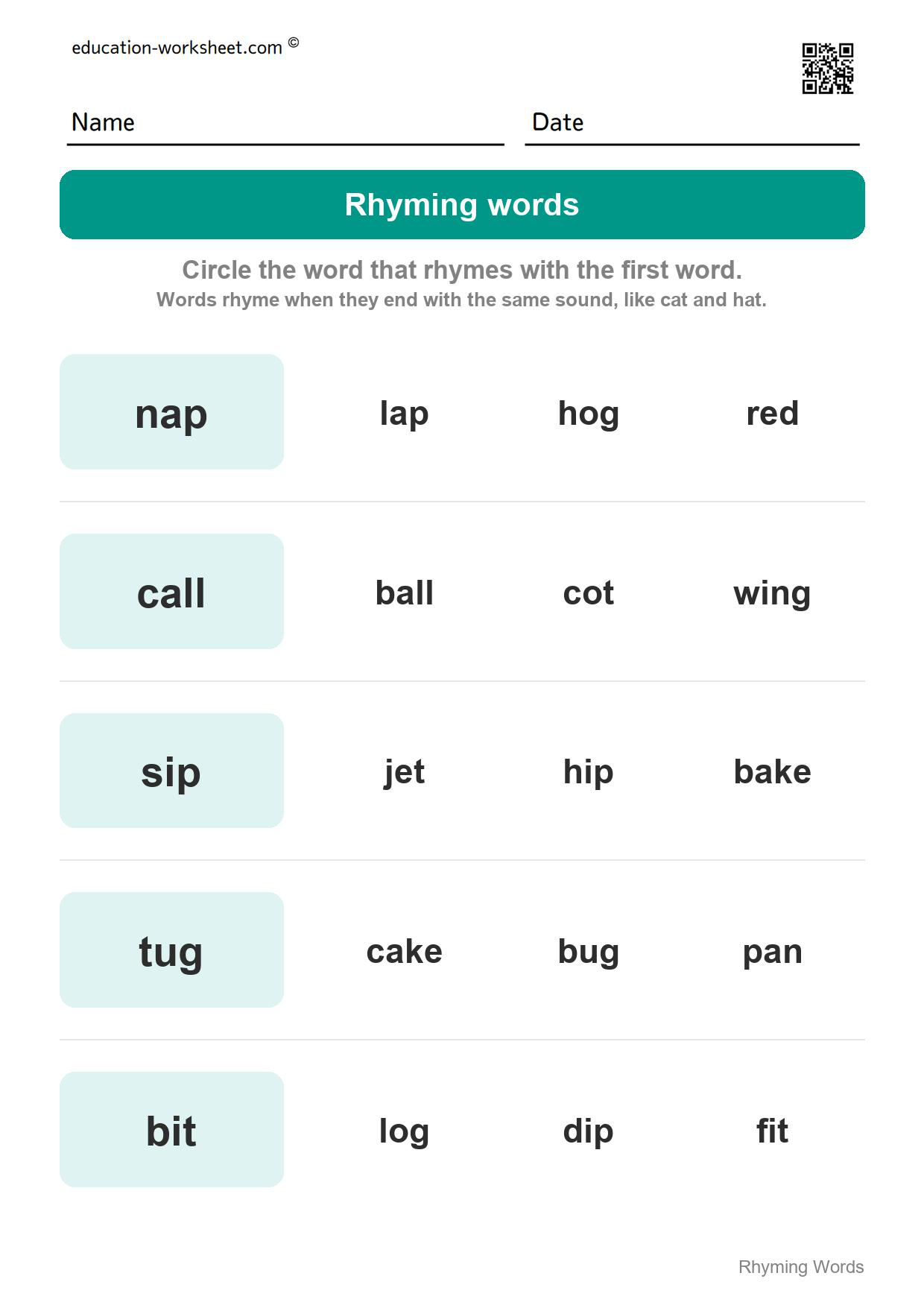
Worksheet 1 – nap, call, sip, tug, bit
The rhymes on this page are nap-lap, call-ball, sip-hip, tug-bug, bit-fit.
Five short words to start, and the wrong answers are nowhere near: nap is offered hog and red, which share nothing with it at all.
The last row is the first near miss in the pack. bit is offered dip as well as fit, and dip has the same vowel sound in the middle. A child who is listening to the whole word rather than the end can be caught by it.
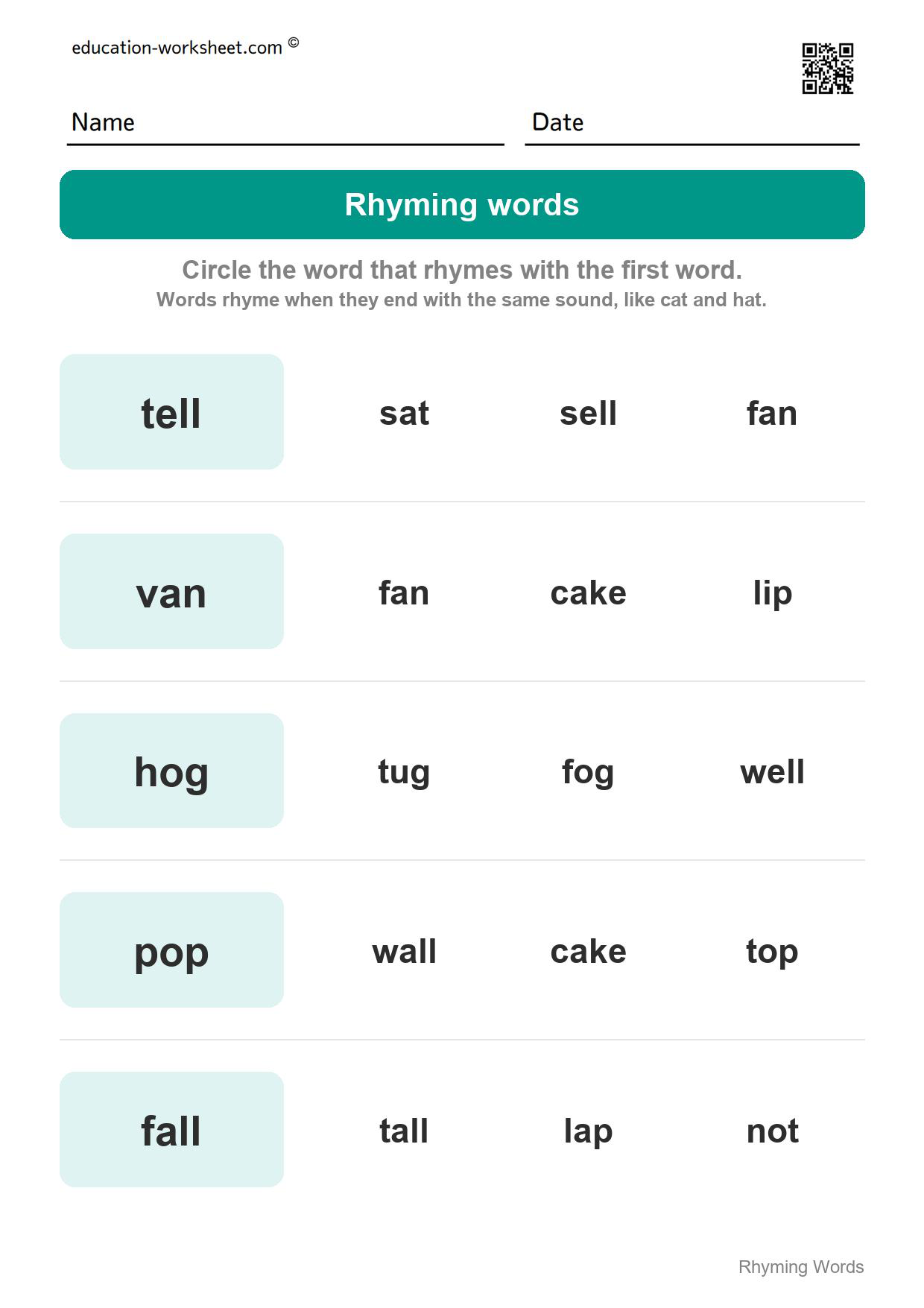
Worksheet 2 – tell, van, hog, pop, fall
The rhymes on this page are tell-sell, van-fan, hog-fog, pop-top, fall-tall.
Four-letter rhymes arrive: tell-sell and fall-tall. Longer words, same idea.
Row three offers tug against hog. Both end in a hard g, and only one of them rhymes. This is the sharpest kind of row in the pack, and there are ten like it.
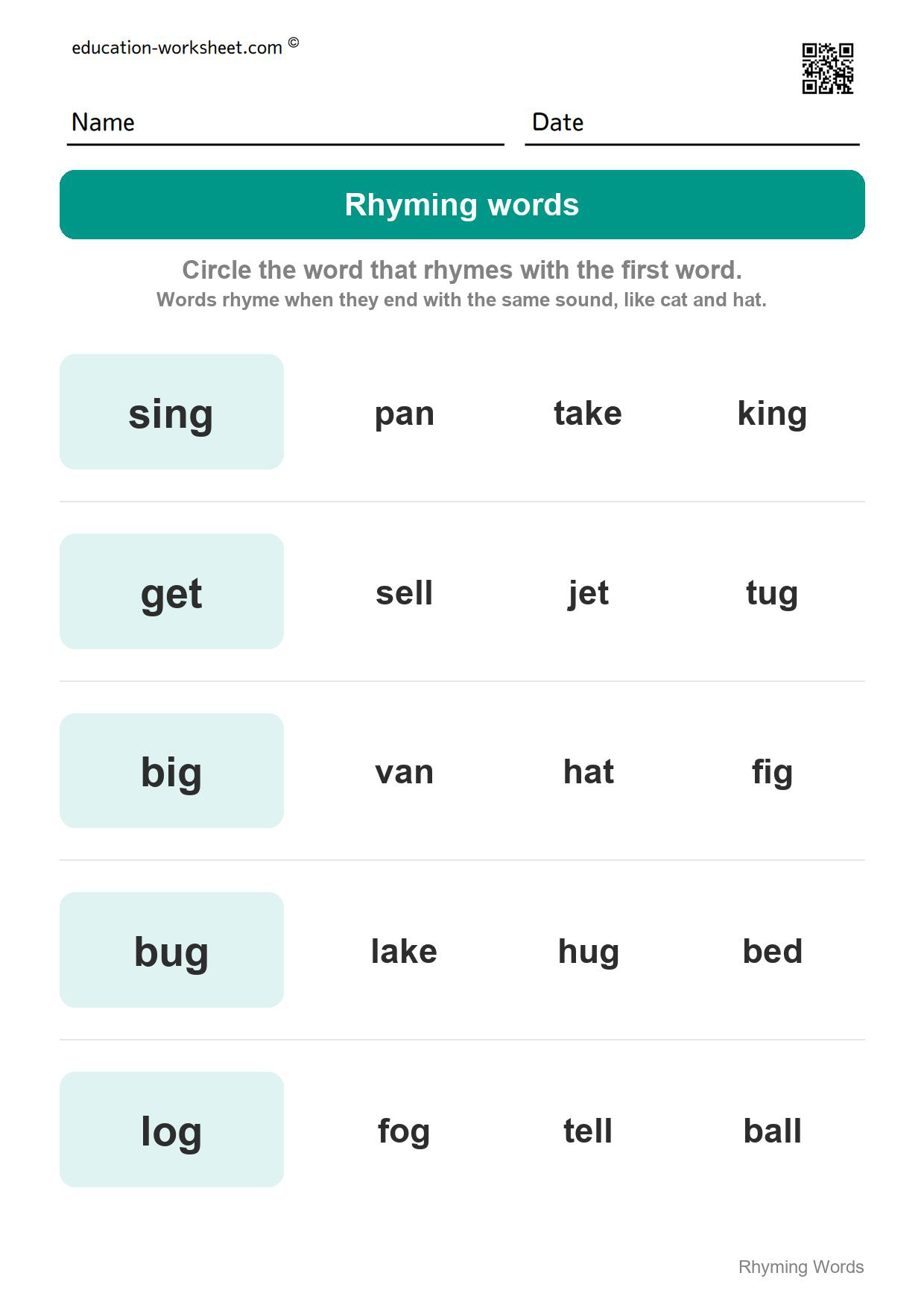
Worksheet 3 – sing, get, big, bug, log
The rhymes on this page are sing-king, get-jet, big-fig, bug-hug, log-fog.
sing-king opens the page – the first of the two -ing rhymes, and a good one to say out loud rather than read.
Row five is log with fog, tell and ball to choose from. Long and short words mixed in one row, which makes the correct answer easier to spot by shape alone.
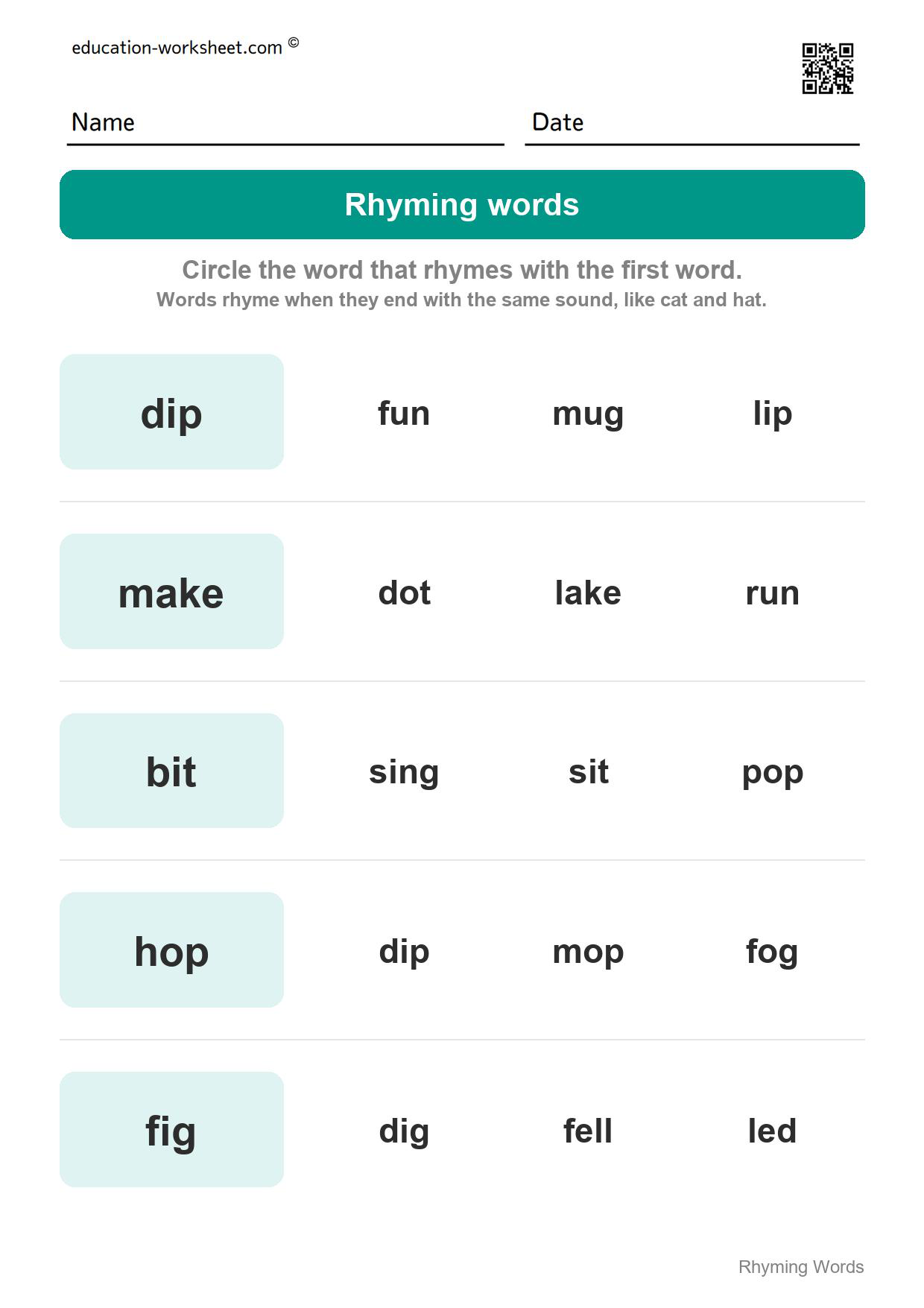
Worksheet 4 – dip, make, bit, hop, fig
The rhymes on this page are dip-lip, make-lake, bit-sit, hop-mop, fig-dig.
The first long-vowel rhyme in the pack: make and lake. Only two of the fifty rows use a silent e, and the other one is on page 8.
Row four sets hop against dip, mop and fog. Two of the three wrong-footers share a sound with hop without rhyming with it.
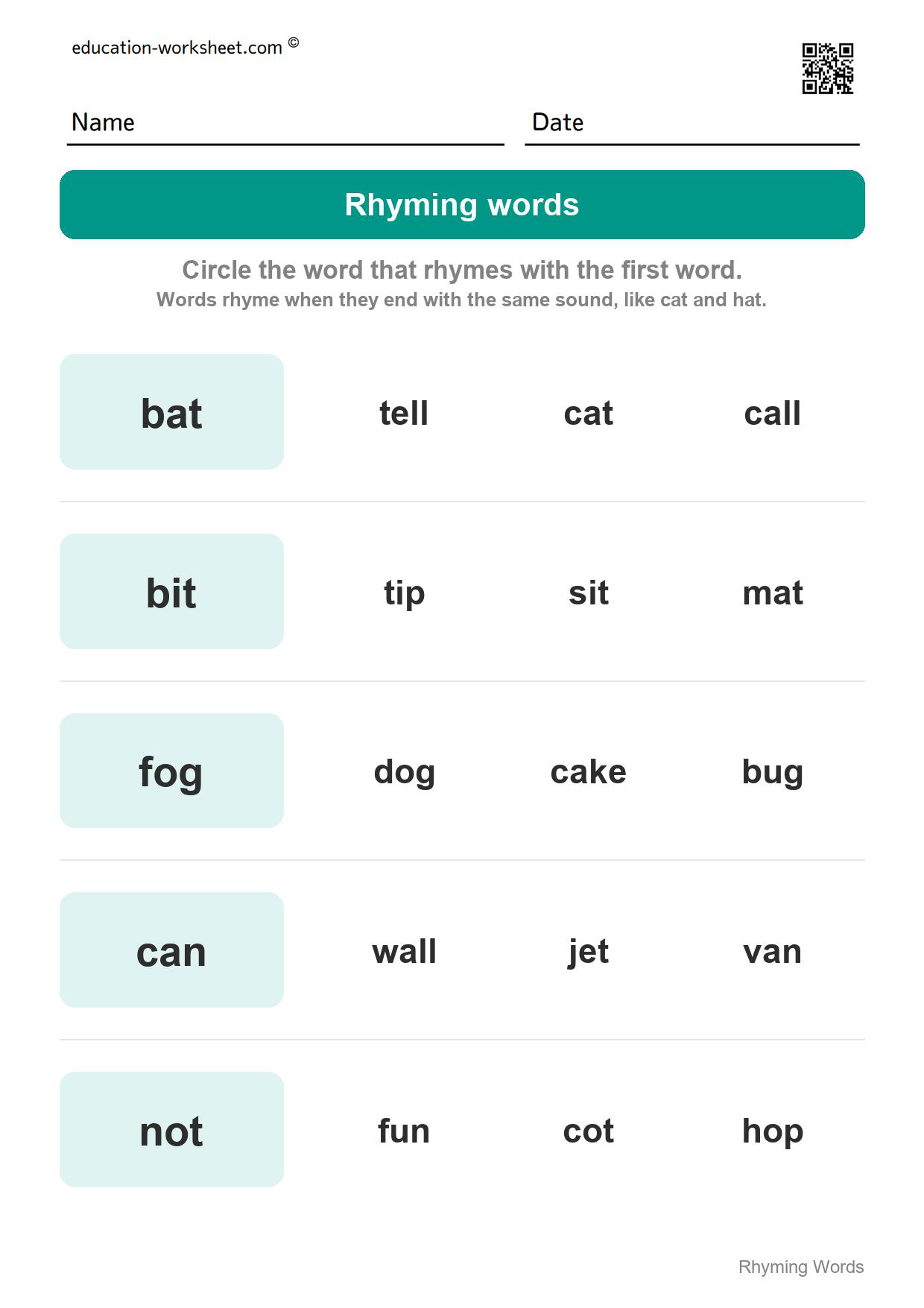
Worksheet 5 – bat, bit, fog, can, not
The rhymes on this page are bat-cat, bit-sit, fog-dog, can-van, not-cot.
Straightforward short vowels all the way down: bat-cat, bit-sit, fog-dog, can-van, not-cot.
bit-sit has already appeared on page 4 and will appear again on page 8. It is the only pair the pack asks three times.
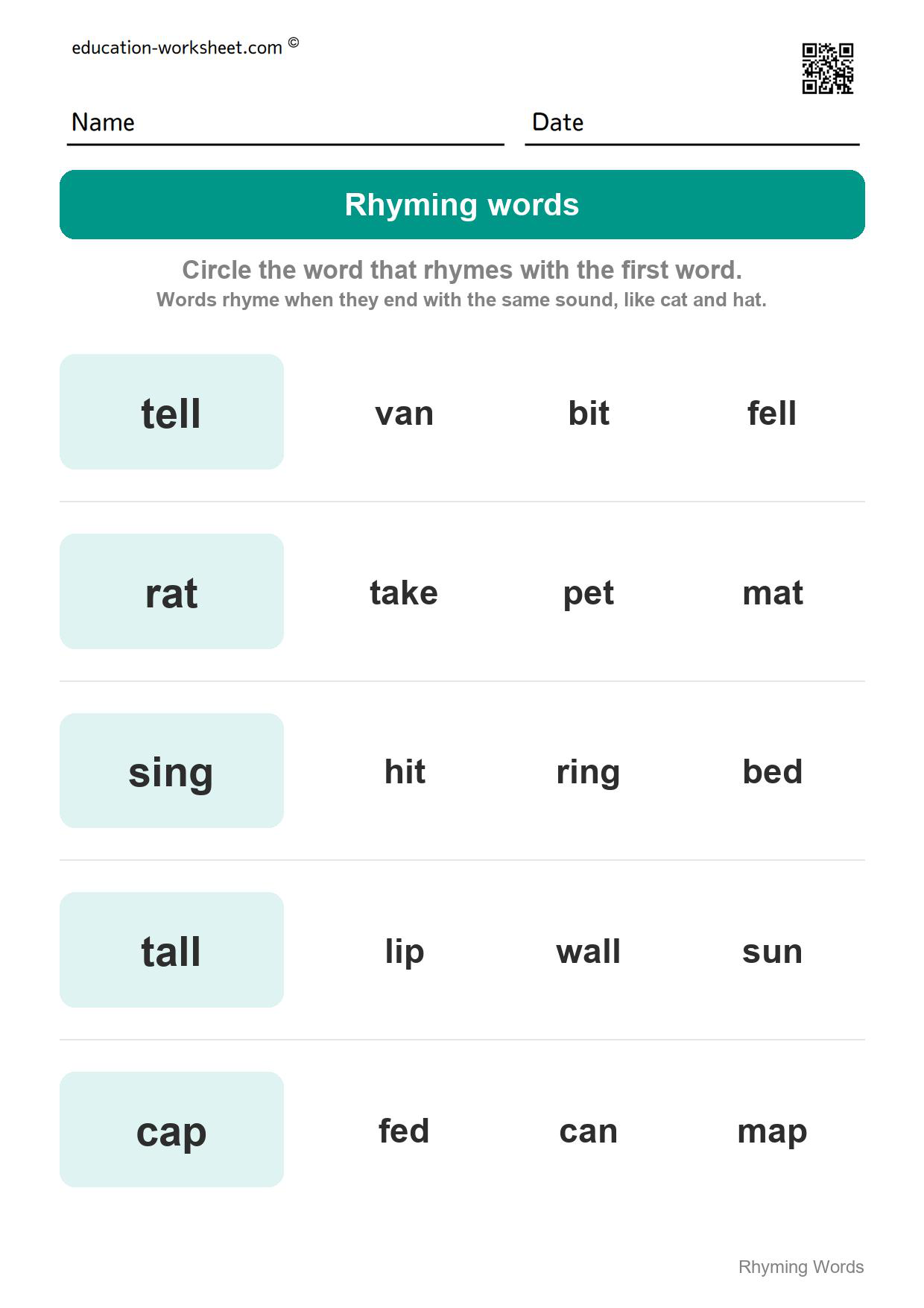
Worksheet 6 – tell, rat, sing, tall, cap
The rhymes on this page are tell-fell, rat-mat, sing-ring, tall-wall, cap-map.
tell now takes fell, having taken sell on page 2. Same target word, different correct answer – and both are right, which is worth pointing out.
Row three is the second -ing rhyme, sing-ring.
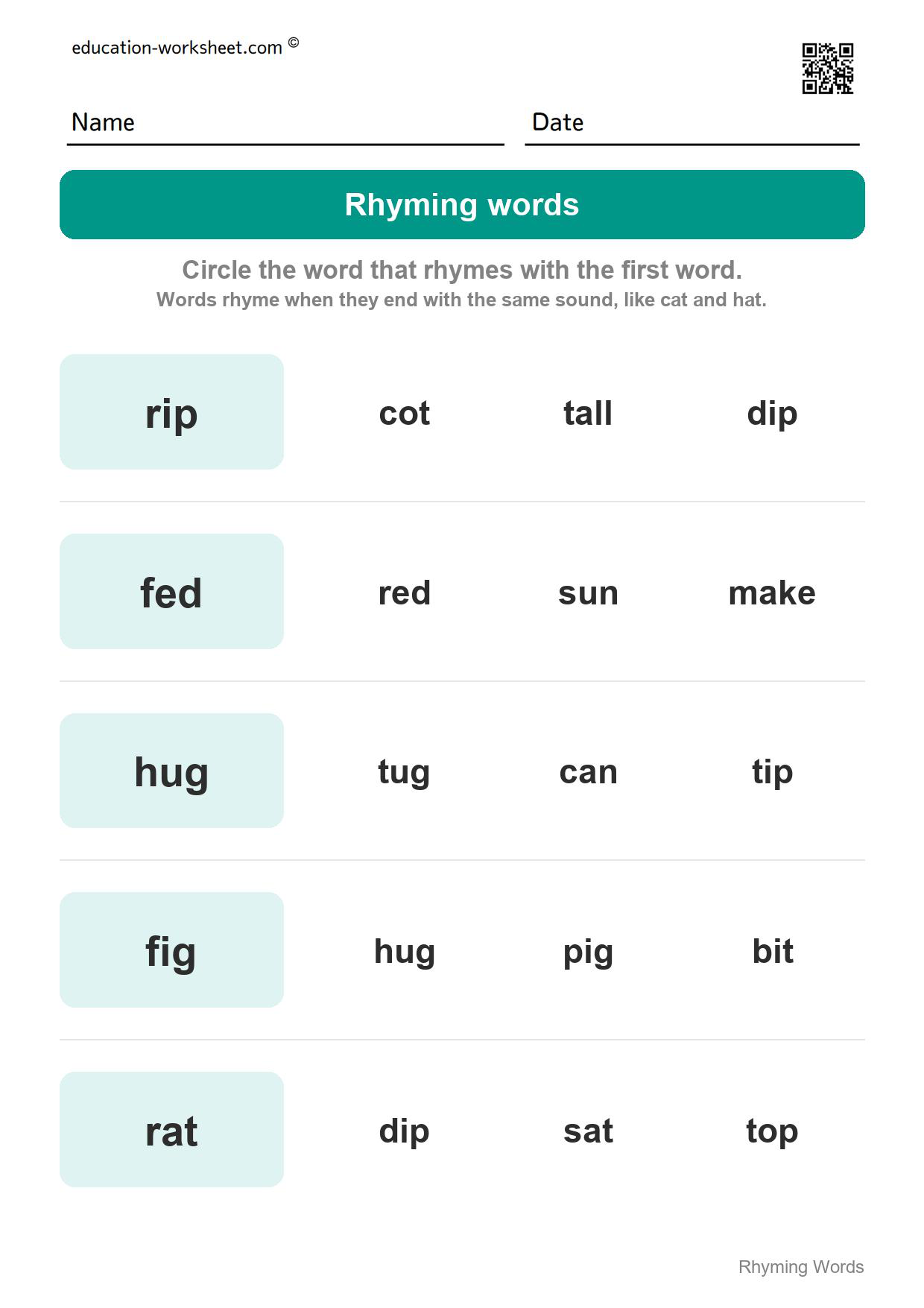
Worksheet 7 – rip, fed, hug, fig, rat
The rhymes on this page are rip-dip, fed-red, hug-tug, fig-pig, rat-sat.
fed-red is the only -ed rhyme in the pack, and run-sun on the next page is the only -un one. Some endings get five rows; others get one.
Row four offers hug to a child looking for a rhyme for fig. Same last letter, different rhyme.
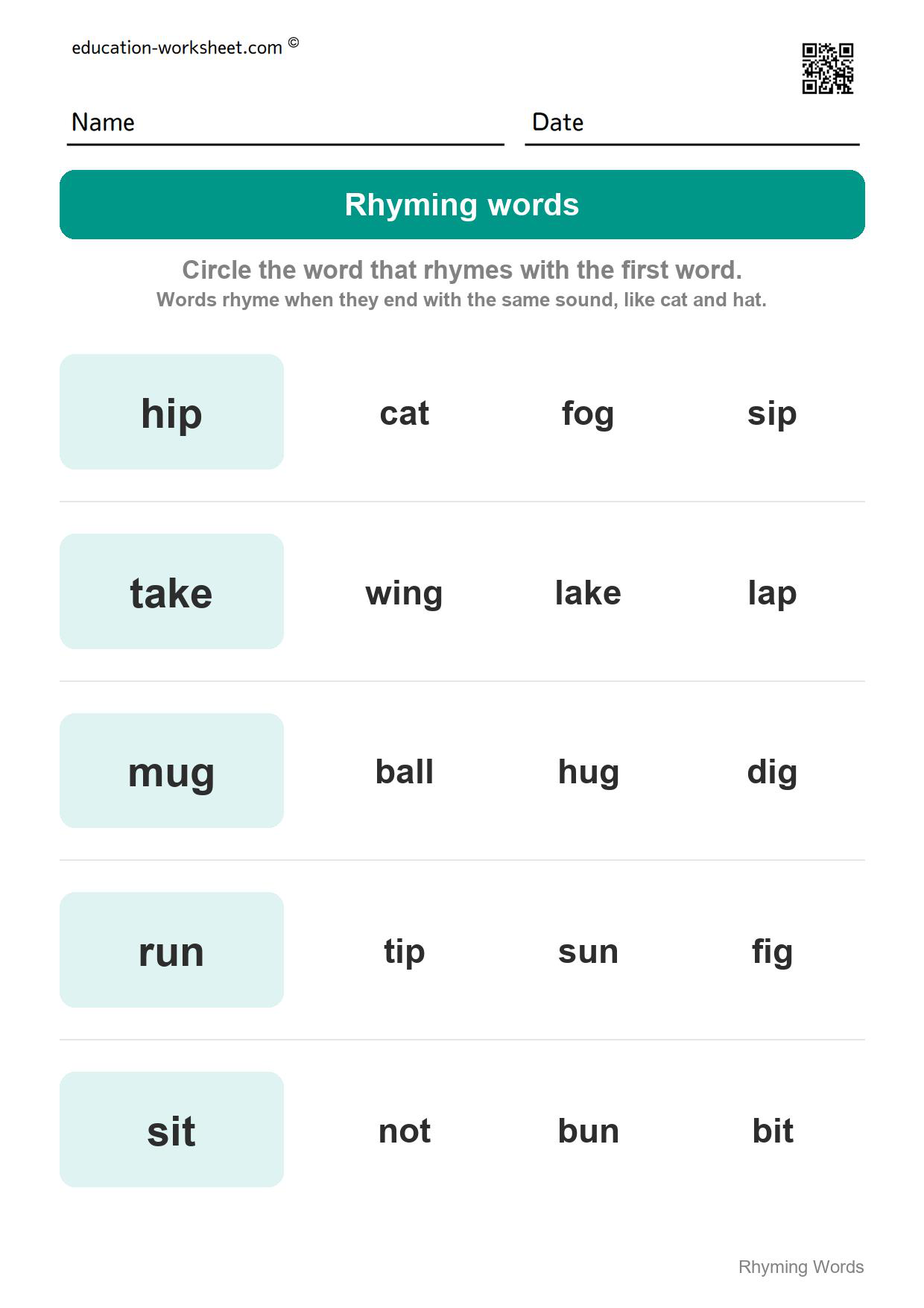
Worksheet 8 – hip, take, mug, run, sit
The rhymes on this page are hip-sip, take-lake, mug-hug, run-sun, sit-bit.
take-lake, the second and last silent-e rhyme. Note that lake was also the answer on page 4, paired with make.
The last row is sit with bit as the answer – the same pair as pages 4 and 5, with the two words swapped round.
Worksheet 9 – rat, log, sip, fig, pit
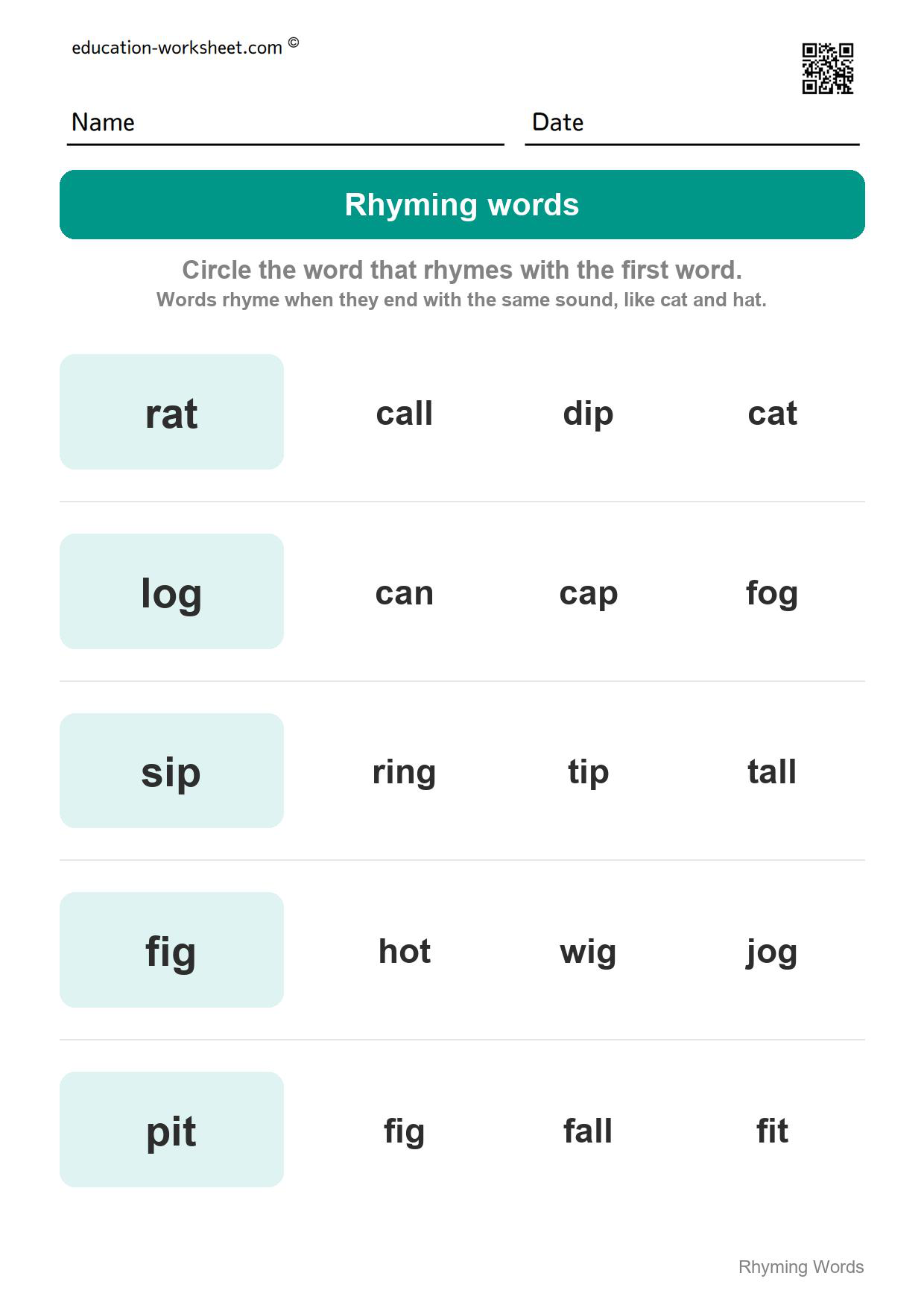
The rhymes on this page are rat-cat, log-fog, sip-tip, fig-wig, pit-fit.
Five rows of short vowels, and three of them come from families the pack has used four times already: -at, -og and -ip.
The last row is the trickiest on the page: pit, with fig, fall and fit to choose from. All three choices start with f, so the first letter is no help whatsoever and the ending is the only thing to go on.
Worksheet 10 – wall, well, dog, wig, bat
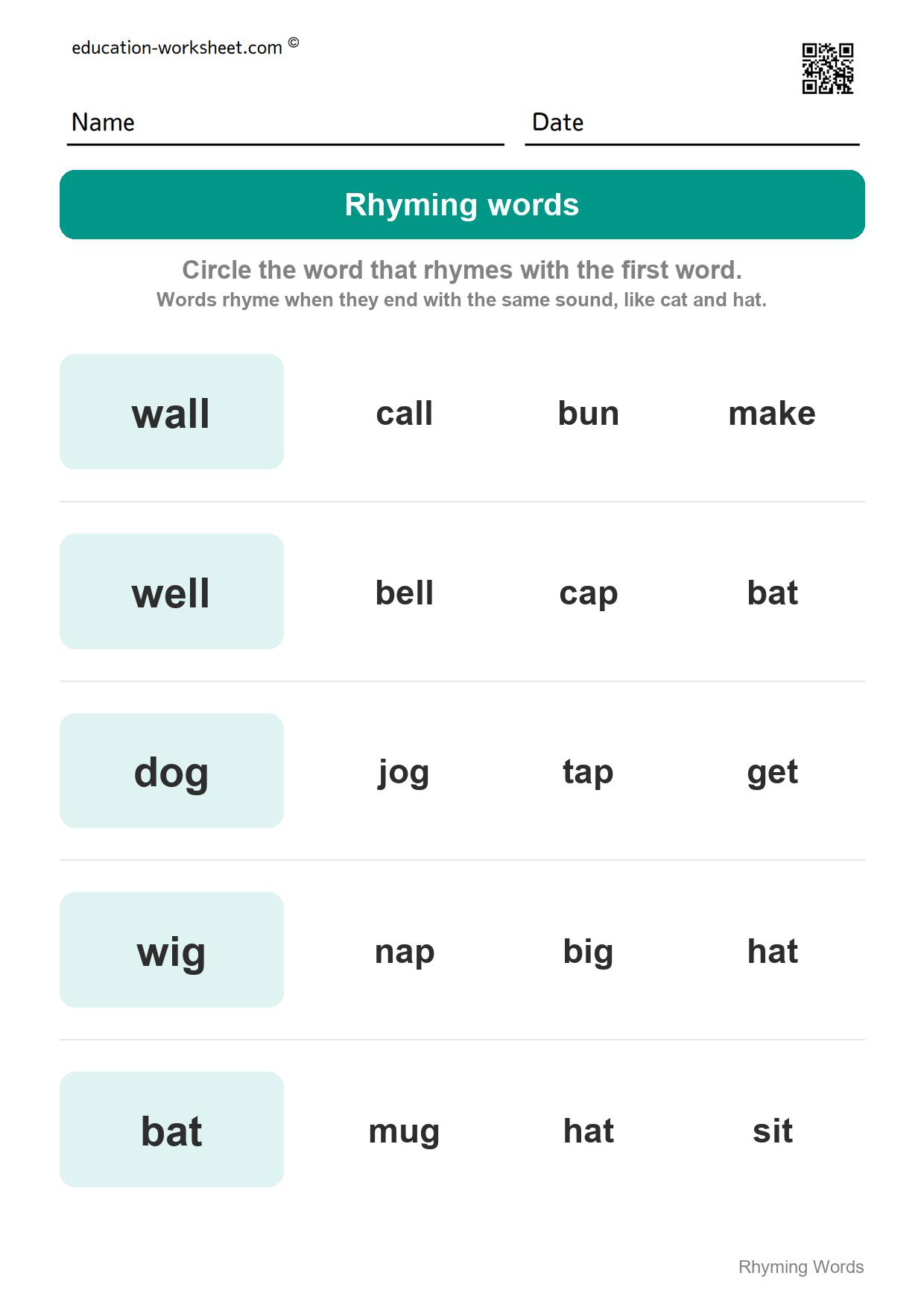
The rhymes on this page are wall-call, well-bell, dog-jog, wig-big, bat-hat.
The pack closes with its longest rhymes: wall-call and well-bell, then dog-jog, wig-big and bat-hat.
Three of the five answers are in the first column on this page, which happens nowhere else. Across the pack the answer is in the middle column nearly half the time, so the last page breaks its own habit.
Answer Key – All 50 Rhymes
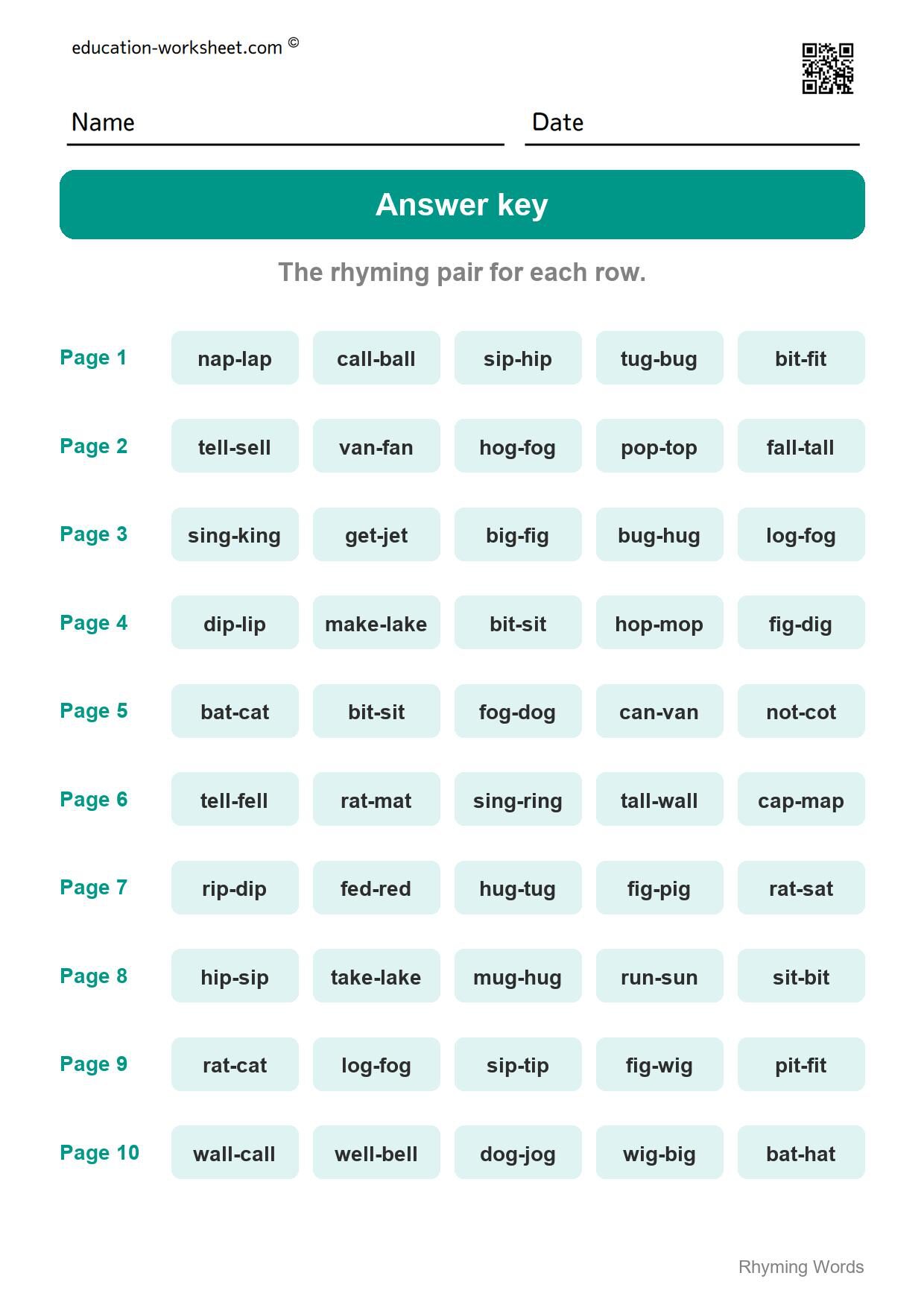
The eleventh sheet lists every rhyming pair, five to a page, so a whole worksheet can be checked in a few seconds.
It is also a reading list. Fifty rhyming pairs written out in one place is a useful thing to have on the fridge.
Read It Aloud, or the Page Reads Itself
Rhyming is an ear skill. It is the first piece of phonological awareness children get, and it comes before letters: a three-year-old who has never read a word can tell you that cat and hat go together.
Because every pair here differs by exactly one letter, this pack can be finished with the eyes alone. A child who can see that nap and lap end in the same two letters does not have to hear anything at all. They will get every row right and practice nothing.
The fix costs nothing: read the four words in each row out loud before the child circles anything, and have the child say the rhyming pair back to you. Then the spelling becomes a support rather than a shortcut, which is exactly what it should be at this age.
Which Rhymes Come Up Most
- -ip, -it, -og, -ig and -at get five rows each – half the pack between them.
- -all gets four rows, -ug four, -ell three.
- -et, -ot, -ed and -un get one row each.
- Only two rows use a long vowel: make-lake on page 4 and take-lake on page 8.
- Three pairs come round more than once: bit-sit three times, hip-sip and log-fog twice each.
If a child is working on a particular family in their reading, that list tells you which pages to print. A child on short i can do most of pages 1, 4, 5, 8 and 9 and skip the rest.
When Children Are Ready for Rhyming Words
- Age: about four to six – pre-K through kindergarten.
- Before starting: the child should be able to hear a rhyme in a nursery rhyme or a song. Reading helps here but is not required if you read the choices aloud.
- RF.K.2.A – recognize and produce rhyming words. This is the standard the pack sits on.
- RF.K.2.C – blend and segment onsets and rimes in single-syllable words. Every row in this pack is a rime with a different onset in front of it.
- The natural next step is word families, where the child writes the words instead of circling them.
How to Use These Worksheets
- Say the word in the box, then say the three choices, before the child picks anything.
- Ask for the answer out loud first and circle it second. Saying “nap, lap” is the practice; the circle is the record.
- When a child gets one wrong, say the two words they chose one after the other. Hearing bit, dip back to back usually settles it without any explaining.
- Cover the words with a finger and just say them, for a child who is reading the endings rather than hearing them.
- Do one page at a sitting. Listening work is tiring in a way that coloring is not.
- Make up a third rhyme together at the end of each row. If nap and lap rhyme, what else does?
Three Things to Watch For
1. Matching letters instead of sounds. The most likely outcome with this pack, because the spelling always gives the answer away. If a child finishes a page in silence and gets everything right, ask them to read a row back to you.
2. The same-vowel traps. Nineteen of the wrong answers share the target’s vowel – bit and dip, hop and fog. A child who has learned to listen for the vowel in the middle will pick these. Say both words slowly and ask which two end the same.
3. Thinking a word can only have one rhyme. tell rhymes with sell on page 2 and with fell on page 6. bit and sit swap places between pages. A child who objects that they already did that one has noticed something correct and is worth agreeing with.
Printing Tips
- Print at 100 percent, actual size, on A4 or US Letter.
- Black and white is fine – there is nothing colored on these pages.
- Print the answer key even if you do not need it for marking. It works as a fifty-pair rhyming list for reading aloud.
Frequently Asked Questions
What age are these rhyming words worksheets for?
About four to six years old. Children who cannot read yet can do the whole pack if an adult reads the four words in each row aloud.
Is there an answer key?
Yes, page 11 lists all fifty rhyming pairs.
Can more than one choice be correct?
No. We checked every row: exactly one of the three words rhymes with the word in the box.
Do the words rhyme by sound or by spelling?
Both, in this pack. Every pair is spelled the same except for the first letter, which makes the sheets easy to start with and means you should read them aloud rather than let a child match letters.
Which rhyme families are covered?
Seventeen of them. -ip, -it, -og, -ig and -at get five rows each; -all and -ug four; -ell three; and -et, -ot, -ed and -un one each.
What comes after rhyming?
Word families, where the child builds and writes the words rather than choosing between them.
Do I need to sign up to download these?
No. Every PDF downloads immediately, with no account, no email address and no cost.
Can I use these in my classroom?
Yes, they are free to print for home and classroom use. Please do not sell them or re-host the files elsewhere.
More Free Phonics and Reading Worksheets
- Free Word Family Worksheets for Kindergarten – CVC Words and Phonics
- Free Word Family Worksheets for Kindergarten – Silent E Families
- Free CVC Word Building Worksheets for Kindergarten – Make Three Letter Words
- Free Syllables Worksheets for Kindergarten – Count the Syllables
- Free Beginning Sounds Worksheets for Kindergarten – Phonics
- Free Ending Sounds Worksheets for Kindergarten – Phonics
- Free Auditory Memory Worksheets for Kids – Listen and Repeat