These free printable beginning sounds worksheets give preschool and kindergarten children ten pages of phonics practice. Each page shows four pictures, and beside every picture three letters. The child says the word out loud, listens to the sound it starts with, and circles the letter that makes it.
The pack is built in two halves. The first five pages run alphabetically – A B C D, then E F G H, and so on up to W – so a child working through them in order meets the sounds in a familiar sequence. The last five pages mix everything up, which is where you find out whether the sounds have been learned or the order has.
- What Is in This Free Beginning Sounds Worksheet Pack
- The 10 Beginning Sounds Worksheets
- Worksheet 1 – Circle the First Sound (A, B, C, D)
- Worksheet 2 – Circle the First Sound (E, F, G, H)
- Worksheet 3 – Circle the First Sound (K, L, M, N)
- Worksheet 4 – Circle the First Sound (O, P, R, S)
- Worksheet 5 – Circle the First Sound (T, U, V, W)
- Worksheet 6 – Circle the First Sound (O, C, B, H)
- Worksheet 7 – Circle the First Sound (G, F, T, M)
- Worksheet 8 – Circle the First Sound (P, L, O, R)
- Worksheet 9 – Circle the First Sound (S, T, P, C)
- Worksheet 10 – Circle the First Sound (D, G, B, H)
- Say the Sound, Not the Letter Name
- Which Sounds This Pack Does and Does Not Cover
- When Children Are Ready for These Worksheets
- How to Use These Worksheets
- Three Things to Watch For
- Printing Tips
- Frequently Asked Questions
- More Free Phonics Worksheets
What Is in This Free Beginning Sounds Worksheet Pack
- Ten printable worksheets, four pictures on each page – forty words in total.
- Three letter choices beside every picture, only one of which is right.
- Pages 1 to 5 in alphabetical order; pages 6 to 10 mixed.
- Twenty different initial sounds covered across the pack.
- Capital letters in the answer circles, which is what children recognise first.
- A separate PDF for every page – no sign-up, no email address, no cost.
The 10 Beginning Sounds Worksheets
Work through the first five in order, then use the last five as review. One page is a complete session for most five year olds.
Worksheet 1 – Circle the First Sound (A, B, C, D)
Pictures: apple, banana, cat, dog. The first four letters of the alphabet, in order, with four pictures almost every child can name. A gentle first page on purpose.

Worksheet 2 – Circle the First Sound (E, F, G, H)
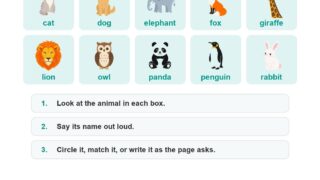
Pictures: elephant, fox, giraffe, house. E to H. Giraffe is the one to watch – it begins with a soft g sound, which is not the sound most children have been taught for the letter.

Worksheet 3 – Circle the First Sound (K, L, M, N)
Pictures: key, lion, moon, nose. K to N. Four short, clear words, and four of the easiest sounds to hear at the front of a word.

Worksheet 4 – Circle the First Sound (O, P, R, S)
Pictures: owl, penguin, rabbit, sun. O to S. Owl starts with a vowel sound, which is always harder to isolate than a consonant.

Worksheet 5 – Circle the First Sound (T, U, V, W)
Pictures: tree, umbrella, violin, watermelon. T to W, the end of the alphabetical run. Tree begins with a consonant blend, tr, so a child has to hear past the r.

Worksheet 6 – Circle the First Sound (O, C, B, H)
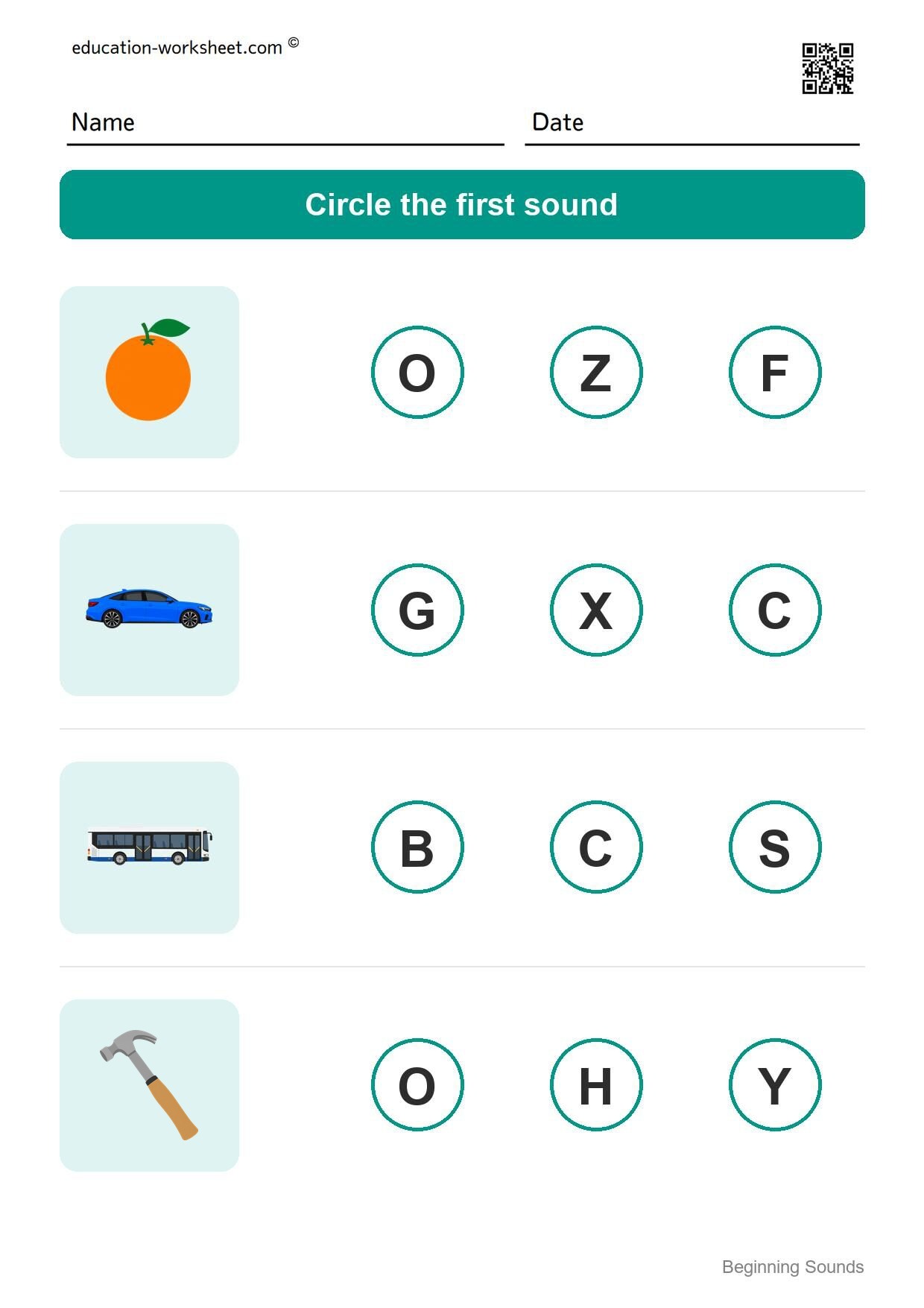
Pictures: an orange, a car, a bus and a hammer. From here the pages stop following the alphabet and mix the sounds up. The fourth picture is a hammer, so the answer is H.
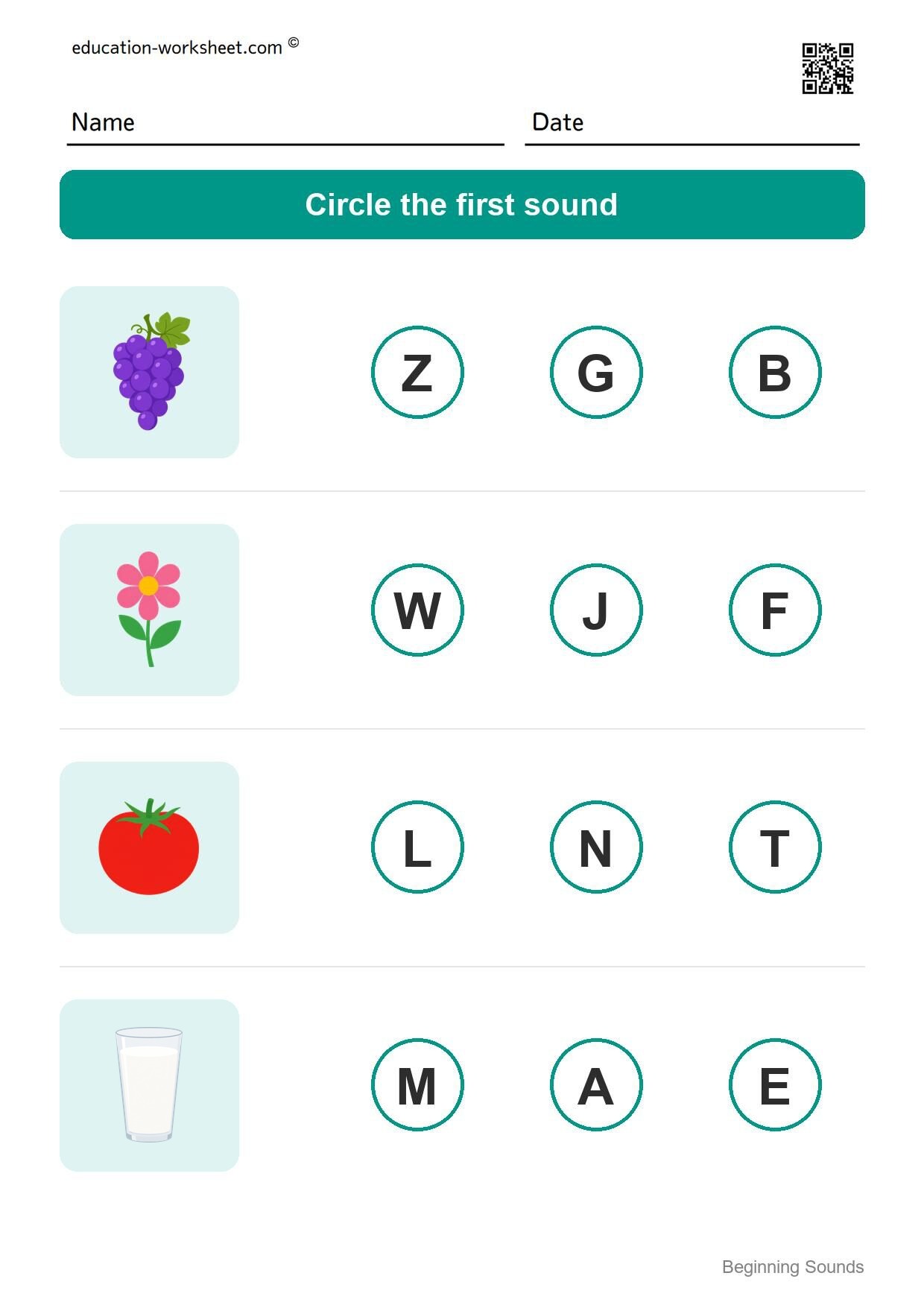
Worksheet 7 – Circle the First Sound (G, F, T, M)
Pictures: grapes, a flower, a tomato and milk. Mixed sounds again. The fourth picture is a glass of milk, so the answer is M.
Worksheet 8 – Circle the First Sound (P, L, O, R)
Pictures: panda, lamp, onion, rainbow. Onion is the interesting one here: it starts with a short o sound that many children hear as u.

Worksheet 9 – Circle the First Sound (S, T, P, C)
Pictures: strawberry, train, pizza, carrot. Train begins with the tr blend and pizza with a p that is followed by a long e sound – both are worth saying slowly.

Worksheet 10 – Circle the First Sound (D, G, B, H)
Pictures: donut, guitar, bicycle, hand. The last page. Guitar is spelled with gu but sounds like a plain g, which is a useful thing to meet once.

Say the Sound, Not the Letter Name
This is the single thing that makes the difference on these pages. The letter B is named bee but makes the sound buh. A child who is thinking of the name will listen to banana for a bee and not find one.
So when you work through a page, say the sounds: b-b-banana, not “banana starts with bee”. It feels odd for the first few minutes and then stops feeling odd. Every phonics programme in use starts here, because letter names actively get in the way of sounding words out later.
Which Sounds This Pack Does and Does Not Cover
The forty words between them cover twenty initial sounds: A, B, C, D, E, F, G, H, K, L, M, N, O, P, R, S, T, U, V and W.
Six letters are missing – I, J, Q, X, Y and Z – and that is deliberate rather than an oversight. The usual pictures for them (igloo, jam, queen, xylophone, yo-yo, zebra) are words many young children do not know, which turns a listening exercise into a vocabulary quiz. They are better met in the alphabet packs linked at the bottom of this page, where the letter is shown rather than guessed.
When Children Are Ready for These Worksheets
These pages suit children from about four to six years old. A child needs to be able to name most of the pictures and to recognise capital letters on sight. They do not need to be reading yet – hearing the first sound in a word comes well before reading words.
In American classrooms this is a kindergarten reading foundation standard: isolating and pronouncing the initial sounds in spoken words, and knowing the sound each consonant makes (Common Core RF.K.2.D and RF.K.3.A).
How to Use These Worksheets
- Print one page and name all four pictures together before starting. If a word is unfamiliar, say it a few times.
- Say the first word slowly, stretching the first sound: ffff-ox.
- Ask which of the three letters makes that sound, and circle it.
- If your child is stuck, say the three letter sounds out loud and let them pick by ear.
- Come back to a finished page the next day and do it again out loud without a pencil.
Three Things to Watch For
Naming the picture differently
A child who calls the couch a sofa is not wrong, but the answer will not be there. Naming all four pictures before you start takes ten seconds and prevents it.
Vowels at the front of a word
Apple, elephant, owl, onion and umbrella all begin with vowel sounds, which are harder to isolate than consonants because they run straight into the next sound. Expect these to take longer.
Blends
Tree, train and strawberry begin with two or three consonants run together. Children often hear the second one. Saying the word very slowly, almost separating the sounds, usually sorts it out.
Printing Tips
- Choose Actual size or Fit to page so the pictures and letters stay large.
- Each page fills one sheet and works on both US Letter and A4 paper.
- Slip a page into a plastic wallet and use a dry-wipe pen to reuse it with more than one child.
Frequently Asked Questions
What age are these beginning sounds worksheets for?
About four to six years old – pre-K and kindergarten.
Should I say the letter name or the letter sound?
The sound. Say buh rather than bee – the name is what confuses children when they start sounding words out.
How many sounds are covered?
Twenty of the twenty-six initial sounds, across forty words.
Are the letters uppercase or lowercase?
Uppercase in the answer circles, because capitals are what children recognise first.
Do I need to sign up to download these?
No. Every PDF downloads immediately, with no account, no email address and no cost.
Can I use these in my classroom?
Yes, they are free to print for home and classroom use. Please do not sell them or re-host the files elsewhere.