

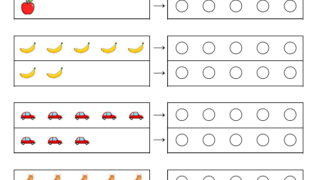
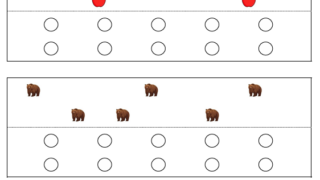
These free printable ordinal numbers worksheets give kindergarten children ten pages of practice with first, second, third, fourth and fifth. Each page asks four questions, and each question works the same way: a label says which one to find, an arrow shows where to start, and a row of five pictures waits to be counted.
The important detail is easy to miss. All five pictures in a row are identical. Five apples, five cats, five buses. There is nothing to recognize and nothing to guess at – the only way to find the third one is to count to it. A row of different pictures would let a child answer by looking; these rows do not.
The label gives the position twice, as a numeral and as a word: 3rd above third. That pairing is the whole vocabulary lesson, because “3rd” and “third” look nothing like each other and a child has to learn that they are the same thing.
- What Is in This Free Ordinal Numbers Worksheet Pack
- The 10 Ordinal Numbers Worksheets
- Worksheet 1 – Starting at the Far End
- Worksheet 2 – First and Fifth, One After the Other
- Worksheet 3 – Fifth Then Fourth
- Worksheet 4 – Everything Except Fifth
- Worksheet 5 – The End of the First Half
- Worksheet 6 – Page 1 Again, With New Questions
- Worksheet 7 – Page 2 Again, All Four Questions Changed
- Worksheet 8 – Page 3 Again
- Worksheet 9 – Page 4 Again
- Worksheet 10 – The Last Page, Every Question New
- Why the Second Half Repeats the First
- When Children Are Ready for These Worksheets
- How to Use These Worksheets
- Three Things to Watch For
- Printing Tips
- Frequently Asked Questions
- More Free Number Worksheets
What Is in This Free Ordinal Numbers Worksheet Pack
- Ten printable worksheets, four questions on each page.
- Forty questions in all, covering first through fifth.
- Five identical pictures in every row, so the answer has to be counted.
- An arrow marked start on every row – counting always runs left to right.
- Both forms of each position shown together: 1st and first, 2nd and second, and so on.
- A separate PDF for every page, free to download and print.
The 10 Ordinal Numbers Worksheets
No page ever asks for the same position twice. All four questions on a page are different, on all ten pages. And the second half of the pack is built on the first: pages 6 to 10 use exactly the same rows of pictures as pages 1 to 5, with different positions asked. That makes the pack a test and a re-test rather than twenty unrelated pages.
Worksheet 1 – Starting at the Far End
The first question asks for the fifth apple, which means counting all the way along the row before circling anything. It is the hardest of the five positions and it is on page one, so stay beside your child for this page. Pictures: apples, cats, suns and cars. The positions asked, in order: 5th, 2nd, 3rd, 1st.

Worksheet 2 – First and Fifth, One After the Other
The two ends of the row, asked one after the other. Putting them together like this is the clearest way to show that first and fifth are about position and nothing else, since both rows look identical. Pictures: bananas, dogs, trees and buses. The positions asked, in order: 1st, 5th, 3rd, 2nd.

Worksheet 3 – Fifth Then Fourth
Two neighboring positions in a row, and neighbors are where mistakes happen. A child who counts fifth correctly and then counts fourth from the wrong end lands on the second picture. Pictures: rabbits, grapes, moons and caps. The positions asked, in order: 5th, 4th, 1st, 3rd.

Worksheet 4 – Everything Except Fifth
Fourth, first, second and third. The positions nearest the start dominate this page, which makes it a gentler one than pages 1 to 3. Pictures: foxes, donuts, pins and lions. The positions asked, in order: 4th, 1st, 2nd, 3rd.

Worksheet 5 – The End of the First Half
The last page before the pictures start again. Fifth and fourth come first, then the two easiest positions, so the page gets easier as it goes down rather than harder. Pictures: penguins, oranges, trains and owls. The positions asked, in order: 5th, 4th, 1st, 2nd.

Worksheet 6 – Page 1 Again, With New Questions
The same four rows of pictures as page 1, in the same order, but three of the four questions have changed. Only the apples are asked for in the same position. This is the page to use if you want to know whether anything has stuck. Pictures: apples, cats, suns and cars (the same rows as page 1). The positions asked, in order: 5th, 1st, 4th, 2nd.

Worksheet 7 – Page 2 Again, All Four Questions Changed
Every one of the four positions is different from page 2. If your child did page 2 a week ago and does this one now, nothing can be answered from memory. Pictures: bananas, dogs, trees and buses (the same rows as page 2). The positions asked, in order: 4th, 3rd, 2nd, 5th.

Worksheet 8 – Page 3 Again
The moons are asked for in the same position as on page 3, first. The other three have moved. The page ends on fifth, which is the longest count. Pictures: rabbits, grapes, moons and caps (the same rows as page 3). The positions asked, in order: 2nd, 3rd, 1st, 5th.

Worksheet 9 – Page 4 Again
The donuts are first again, as on page 4. This page ends with fifth and fourth side by side, which is the reverse of page 3 and the same trap. Pictures: foxes, donuts, pins and lions (the same rows as page 4). The positions asked, in order: 2nd, 1st, 5th, 4th.

Worksheet 10 – The Last Page, Every Question New
The same pictures as page 5 with four different positions asked. A fair last test: nothing here can be answered by recognizing the row. Pictures: penguins, oranges, trains and owls (the same rows as page 5). The positions asked, in order: 4th, 2nd, 5th, 3rd.

Why the Second Half Repeats the First
Go through the pictures rather than the questions and the structure appears. Page 6 has the apples, cats, suns and cars of page 1, in that order. Page 7 has the bananas, dogs, trees and buses of page 2. So do pages 8, 9 and 10 for pages 3, 4 and 5.
What changes is the question. Across those twenty repeated rows, only three ask for the same position again: the apples on pages 1 and 6, the moons on pages 3 and 8, and the donuts on pages 4 and 9. Everything else has moved. A child cannot remember “the apples one is the one at the end”, because next time it is not.
That gives you a way to use the pack that is better than working straight through it. Do pages 1 to 5 in one week and pages 6 to 10 the next. The pictures will feel familiar and the questions will not, which is exactly the condition under which you find out whether a child has learned the idea or memorized the page.
One more thing worth knowing before you print. Across the forty questions the five positions are not used equally: fifth and second come up nine times each, first eight times, and third and fourth seven times each. If your child is shaky on third, there is slightly less of it here than you might expect.
When Children Are Ready for These Worksheets
These pages suit children from about four and a half to six. A child is ready when they can count five objects reliably, one at a time. Reading is not needed: the numeral on the label carries the meaning and an adult can read the word.
Ordinal numbers are not named in the Common Core kindergarten mathematics standards, although nearly every kindergarten curriculum teaches them and a number of state standards require them. They earn their place all the same. Counting how many is K.CC.B.4; saying which one is the other half of the same idea, and children who have only the first half struggle the first time a teacher says “look at the third picture”.
How to Use These Worksheets
- Print one page. Four questions is a session.
- Put a finger on the arrow before counting anything. The arrow is the answer to “where do I start?”, and a child who ignores it will count from whichever end feels natural.
- Count out loud and touch each picture: first, second, third. Not one, two, three. The words are what is being learned.
- Circle, then say the whole answer back: “the third cat”.
- On the second week, use pages 6 to 10 and say nothing about the pictures being the same. Let your child notice.
Three Things to Watch For
Counting from the wrong end
The most common error by a distance, and the reason the arrow is printed on every row. Children who read right to left at home, or who simply start where their hand is, will count backwards and be confident about it. Point at the arrow, not at the answer.
Saying “one, two, three” instead of “first, second, third”
A child can find the right picture while never once using an ordinal word. The counting is not the point here; the vocabulary is. Count along with them in the ordinal words until it sounds normal.
Fourth and fifth swapping places
These two are next to each other and sound nothing alike, but they are the last two in a row of five and both require counting past the middle. Pages 3 and 9 put them side by side, which is the place to check.
Printing Tips
- Choose Actual size or Fit to page in the print dialog – both keep the page in proportion.
- Each page fills one sheet and works on US Letter and A4 paper.
- Ordinary copier paper is fine. Card is only worth it if you want the page to survive an eraser.
- Color is worth having here. The pictures are the only thing on the page that is not text, and a page of grey shapes is less inviting.
- Print pages 1 to 5 now and keep pages 6 to 10 for a couple of weeks later, to use the built-in re-test.
Frequently Asked Questions
What age are these ordinal numbers worksheets for?
About four and a half to six years old: pre-K and kindergarten.
Which positions are covered?
First through fifth. Each row holds five pictures, so fifth is as far as the pack goes.
Why are all the pictures in a row the same?
So that the answer cannot be found by looking. With five identical apples, the only way to find the third one is to count from the arrow.
Are pages 6 to 10 the same as pages 1 to 5?
The pictures are the same; the questions are not. Only three of the twenty repeated rows ask for the same position again, so the second half works as a re-test.
Is there an answer key?
None is included. Counting from the arrow with your child settles every question, and doing that out loud is the exercise.
Do I need to sign up to download these?
No. Every PDF downloads immediately, with no account, no email address and no cost.
Can I use these in my classroom?
Yes, they are free to print for home and classroom use. Please do not sell them or re-host the files elsewhere.
More Free Number Worksheets
- Free Counting 1 to 10 Worksheets for Preschool and Kindergarten – Count and Write
- Free Number Order Worksheets for Kindergarten – Ordering Numbers 1 to 20
- Free Before and After Number Worksheets for Kindergarten – Numbers 1 to 12
- Free Position Words Worksheets for Kindergarten – In, On, Under, Next To
- Free Ten Frame Worksheets for Kindergarten – Count to 10
- Free Count and Graph Worksheets for Kindergarten – Picture Graphs