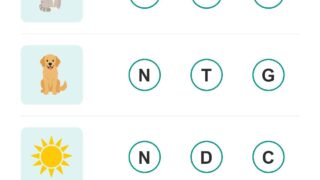
These free printable syllable worksheets give preschool and kindergarten children nine pages of practice hearing the beats inside words. Each page shows four pictures with the word printed underneath, and the numbers 1, 2 and 3 beside each one. The child says the word, claps the parts, and circles how many claps there were.
Printing the word under the picture matters more than it looks. On a picture-only worksheet a child who calls the bunny a rabbit gets a different answer from one who calls it a bunny, and both are right about the picture. Naming the word on the page removes that entirely, so the only thing being tested is the listening.
- What Is in This Free Syllables Worksheet Pack
- The 9 Syllable Worksheets
- Worksheet 1 – Count the Syllables (Set 1)
- Worksheet 2 – Count the Syllables (Set 2)
- Worksheet 3 – Count the Syllables (Set 3)
- Worksheet 4 – Count the Syllables (Set 4)
- Worksheet 5 – Count the Syllables (Set 5)
- Worksheet 6 – Count the Syllables (Set 6)
- Worksheet 7 – Count the Syllables (Set 7)
- Worksheet 8 – Count the Syllables (Set 8)
- Worksheet 9 – Count the Syllables (Set 9)
- Why Clapping Beats Counting in Your Head
- Why Syllables Come Before Reading
- When Children Are Ready for These Worksheets
- How to Use These Worksheets
- Three Things to Watch For
- Printing Tips
- Frequently Asked Questions
- More Free Phonics Worksheets
What Is in This Free Syllables Worksheet Pack
- Nine printable worksheets, four words on each page – thirty-six words in total.
- The word printed under every picture, so there is no guessing what it is called.
- Answers of 1, 2 or 3 syllables, with all three choices on every row.
- Everyday words a young child already knows: apple, bus, fox, lion, umbrella, bicycle.
- Nothing to write – the child only circles a number.
- A separate PDF for every page – no sign-up, no email address, no cost.
The 9 Syllable Worksheets
One page is a complete session for most five year olds, and it is worth doing out loud in a room where clapping is welcome.
Worksheet 1 – Count the Syllables (Set 1)
apple, bus, fox and sun. Three one-beat words and one two-beat word, so the difference is easy to hear on a first page.

Worksheet 2 – Count the Syllables (Set 2)
rabbit, lion, train and giraffe. Lion catches people out – it is two beats, li-on, even though it is spelled with four letters.

Worksheet 3 – Count the Syllables (Set 3)
umbrella, bicycle, lamp and nose. The first page with three-beat words, and um-brel-la is the clearest example in the pack.

Worksheet 4 – Count the Syllables (Set 4)
A mix of one and two-beat words. Clap rather than count in your head – the hand is more honest than the ear at this age.

Worksheet 5 – Count the Syllables (Set 5)
More two-beat words than one-beat ones, so a child who is answering “one” out of habit will notice.

Worksheet 6 – Count the Syllables (Set 6)
Halfway. By now most children are clapping without being reminded.

Worksheet 7 – Count the Syllables (Set 7)
A page with a three-beat word among the shorter ones, which is where careful listening pays off.

Worksheet 8 – Count the Syllables (Set 8)
Longer words again. Saying the word slowly and loudly helps more than saying it repeatedly.

Worksheet 9 – Count the Syllables (Set 9)
The last page, and a mix of all three lengths to finish on.

Why Clapping Beats Counting in Your Head
Syllables are a physical thing before they are an idea. Every syllable is one push of air, and clapping in time with the word turns that push into something a child can feel and see. Asking a five year old to count the parts silently asks them to do the hard version first.
If clapping is awkward, the other reliable trick is the chin: put a hand flat under the jaw and say the word. The jaw drops once per syllable, so um-brel-la gives three definite bumps. Children who cannot hear the beats can almost always feel them.
Why Syllables Come Before Reading
Breaking a spoken word into parts is the first step of phonological awareness – the ladder that runs syllables, then rhyme, then individual sounds, and finally blending those sounds back into a word, which is reading. Children who can hear syllables reliably find the later rungs much easier.
It also pays off directly. A child who can hear rab-bit as two chunks has a way of tackling a long word on a page instead of stopping at it, which is exactly the strategy they will be taught in first grade.
When Children Are Ready for These Worksheets
These pages suit children from about four to six years old. A child does not need to read the printed words – an adult can read them aloud – and does not need to write anything. Being able to clap in time is genuinely the only requirement.
In American classrooms this is a kindergarten reading foundation standard: counting, pronouncing, blending and segmenting syllables in spoken words (Common Core RF.K.2.B).
How to Use These Worksheets
- Print one page and read the four words out loud together.
- Say each word again slowly, clapping once for each part.
- Count the claps out loud and circle that number.
- Try the chin trick on any word that is hard to hear.
- Clap your child’s name, your own, and the name of the street afterwards. That is where it stops being a worksheet.
Three Things to Watch For
Clapping on every letter
Some children clap once per letter or per sound rather than per beat. Say the word yourself, exaggerated, and let them join in on the second attempt rather than explaining.
Words that look longer than they sound
Train, sun and lamp are all one beat despite being ordinary-looking words, and children who are counting letters will get them wrong. Lion is the reverse – short to look at, two beats to say.
Answering “one” to everything
Common on the first page or two, and usually a sign the child has not yet worked out what is being asked rather than that they cannot hear it. Clap a three-beat word with them and the penny generally drops.
Printing Tips
- Choose Actual size or Fit to page so the pictures and letters stay large.
- Each page fills one sheet and works on both US Letter and A4 paper.
- Slip a page into a plastic wallet and use a dry-wipe pen to reuse it with more than one child.
Frequently Asked Questions
What age are these syllable worksheets for?
About four to six years old – pre-K and kindergarten.
Does my child need to read the words?
No. The words are printed so that everyone agrees what the picture is called, but an adult can read them out loud.
How many syllables can the answers be?
One, two or three. Every row offers all three choices.
What if my child cannot hear the beats?
Put a hand under the chin and say the word. The jaw drops once per syllable, which is easier to feel than to hear.
Do I need to sign up to download these?
No. Every PDF downloads immediately, with no account, no email address and no cost.
Can I use these in my classroom?
Yes, they are free to print for home and classroom use. Please do not sell them or re-host the files elsewhere.
More Free Phonics Worksheets
- Free Beginning Sounds Worksheets – Phonics
- Free Rhyming Words Worksheets – Words That Rhyme
- Free Middle Sounds Worksheets – Short Vowels
- Free Compound Words Worksheets – Join Two Words Into One
- Free CVC Word Building Worksheets – Make Three Letter Words
- Free Word Family Worksheets – CVC Words and Phonics
- Free Auditory Memory Worksheets for Kids – Listen and Repeat