These free printable vowels worksheets give kindergarten children ten pages of practice finding A, E, I, O and U. Each page shows twenty letters in four rows of five, and the child circles every vowel.
Capitals and small letters are mixed on the same page, which is the point – the instruction at the top reads “Circle all the vowels (big and small)”. A child who knows only the capital A has not finished learning the letter A. Under the instruction, every page prints the same reminder strip: Vowels: Aa Ee Ii Oo Uu, so nobody has to hold the five letters in memory while they hunt.
Every page holds exactly seven vowels and thirteen consonants. That is true of all ten pages, so the task is the same length every time: seventy vowels to find across the pack.
- What Is in This Free Vowels Worksheet Pack
- The 10 Vowels Worksheets
- Worksheet 1 – Only Three of the Five Vowels Appear
- Worksheet 2 – A Row With Nothing to Circle
- Worksheet 3 – Four Vowel Letters, Evenly Spread
- Worksheet 4 – All Five Vowels on One Page
- Worksheet 5 – U Three Times, Twice Small and Once Capital
- Worksheet 6 – All Five Vowels Again
- Worksheet 7 – The Densest Row in the Pack
- Worksheet 8 – Seven Vowels in the First Three Rows
- Worksheet 9 – Two Small e Letters Side by Side
- Worksheet 10 – Ending on the Small Letters
- Seven Vowels a Page, and Never the Letter L
- When Children Are Ready for These Worksheets
- How to Use These Worksheets
- Three Things to Watch For
- Printing Tips
- Frequently Asked Questions
- More Free Alphabet and Phonics Worksheets
What Is in This Free Vowels Worksheet Pack
- Ten printable worksheets, twenty letters on each page.
- Exactly seven vowels to circle per page, seventy in all.
- Capitals and small letters mixed throughout – both count.
- A reminder strip showing Aa Ee Ii Oo Uu at the top of every page.
- No reading required. A child who knows their letters can do these.
- A separate PDF for every page, free to download and print.
The 10 Vowels Worksheets
The pages are not graded from easy to hard, and they do not need to be: the count is always seven. What changes is where the vowels sit and which of the five turn up, and that is what makes one page feel different from the next.
Worksheet 1 – Only Three of the Five Vowels Appear
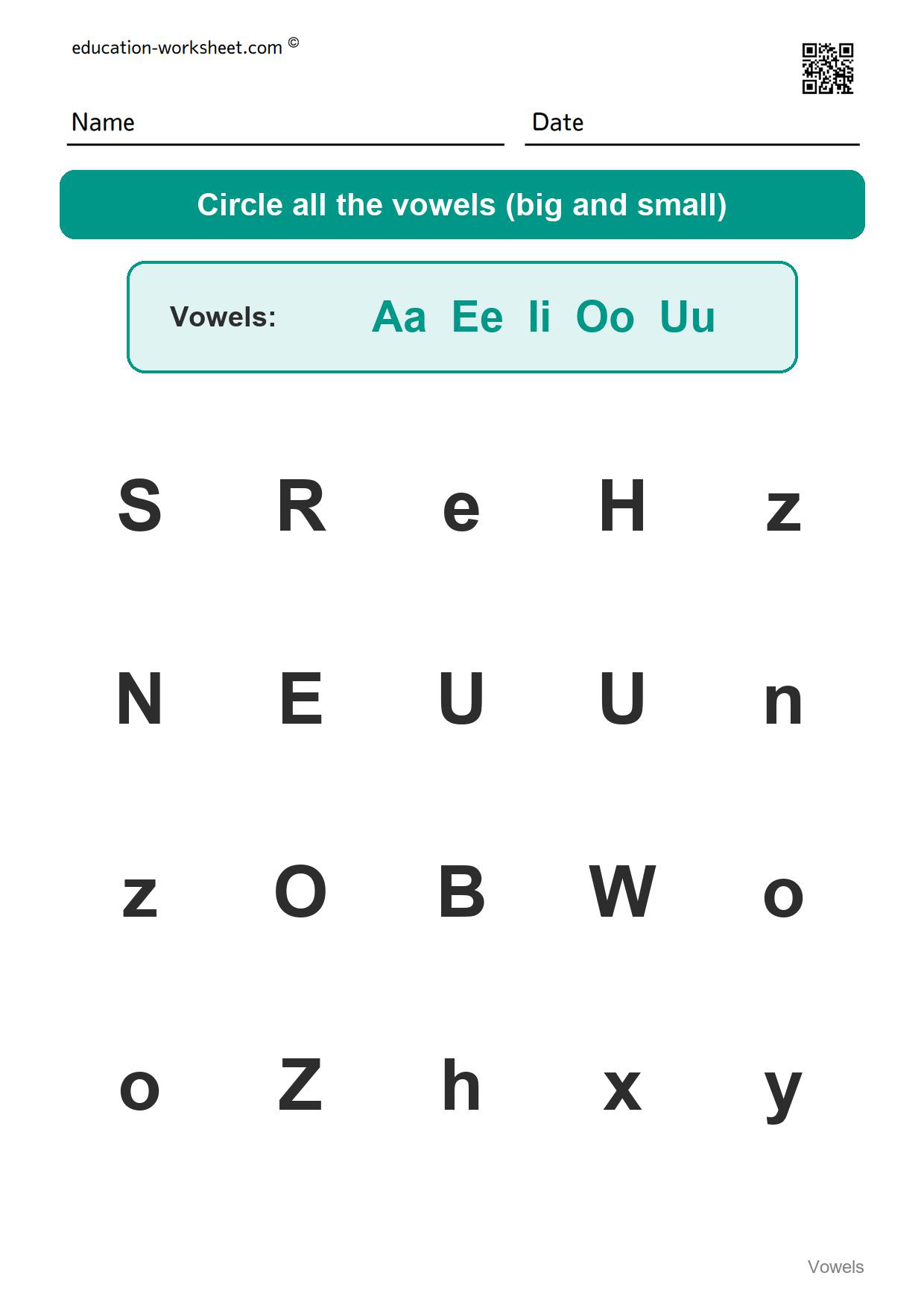
There is no A and no I anywhere on this page. A child who has learned to hunt for “a” first has to let that habit go and look at every letter instead. The second row carries three of the seven. The letters are SReHz, then NEUUn, then zOBWo, then oZhxy. Vowel letters used: E, O and U. Vowels per row: 1, 3, 2, 1.
Worksheet 2 – A Row With Nothing to Circle
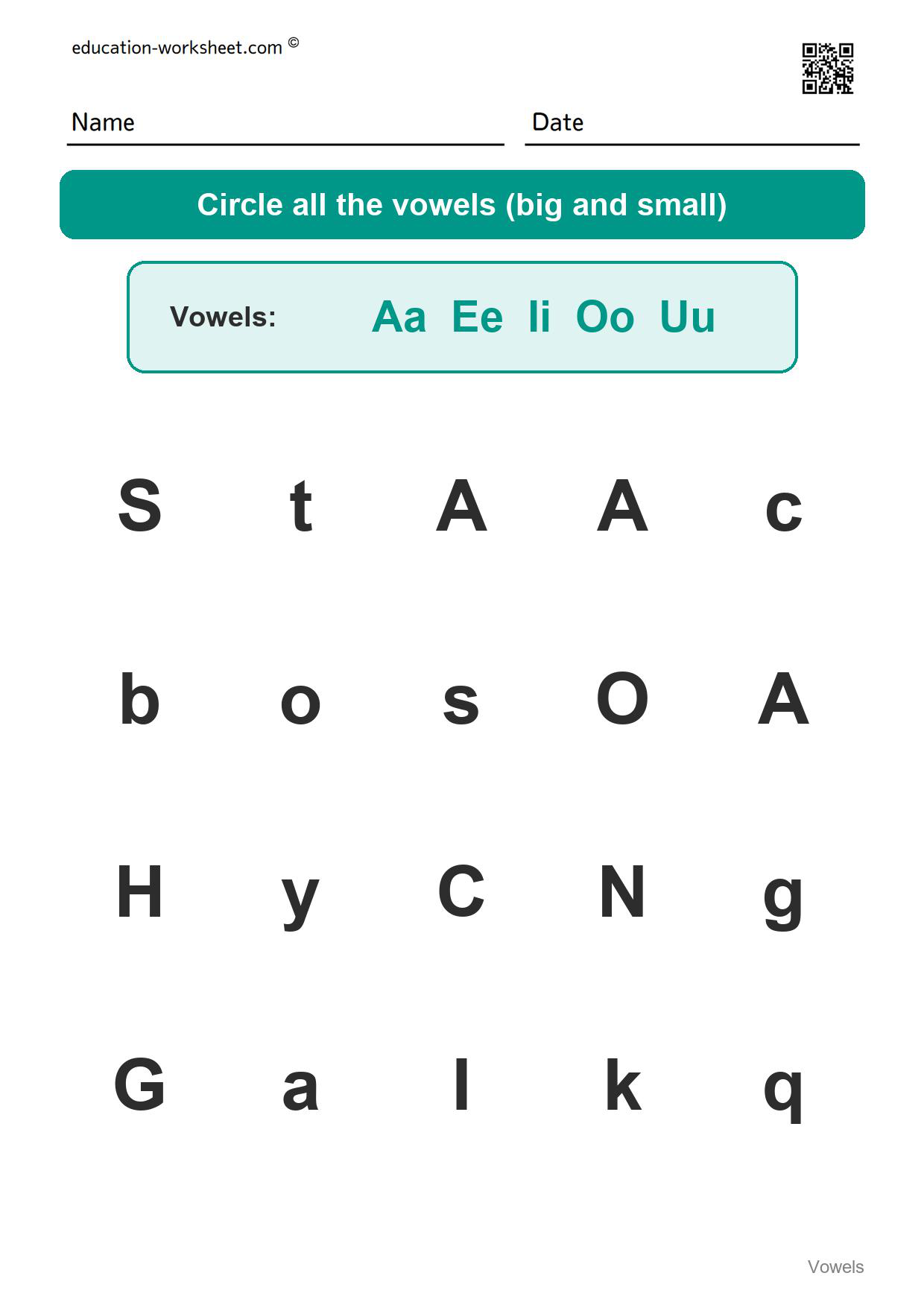
The third row has no vowels at all. That is worth watching: some children assume every row must contain one and start circling consonants to fill the quota. A is the busiest letter here, appearing three times. The letters are StAAc, then bosOA, then HyCNg, then GaIkq. Vowel letters used: A, I and O. Vowels per row: 2, 3, 0, 2.
Worksheet 3 – Four Vowel Letters, Evenly Spread
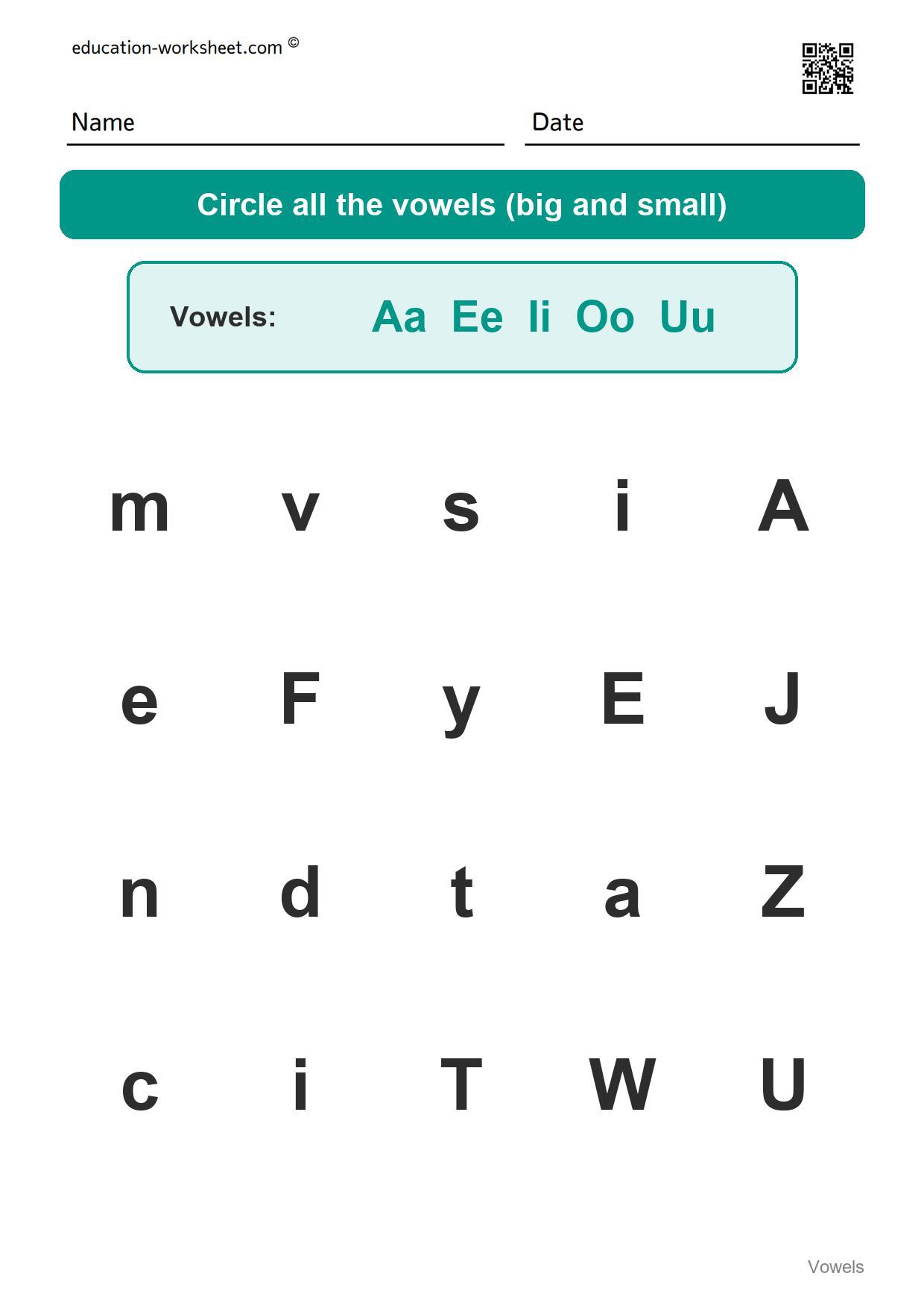
The seven vowels sit two, two, one, two down the page, so every row gives something back. More lowercase than capitals on this page, which suits a child who reads small letters more comfortably. The letters are mvsiA, then eFyEJ, then ndtaZ, then ciTWU. Vowel letters used: A, E, I and U. Vowels per row: 2, 2, 1, 2.
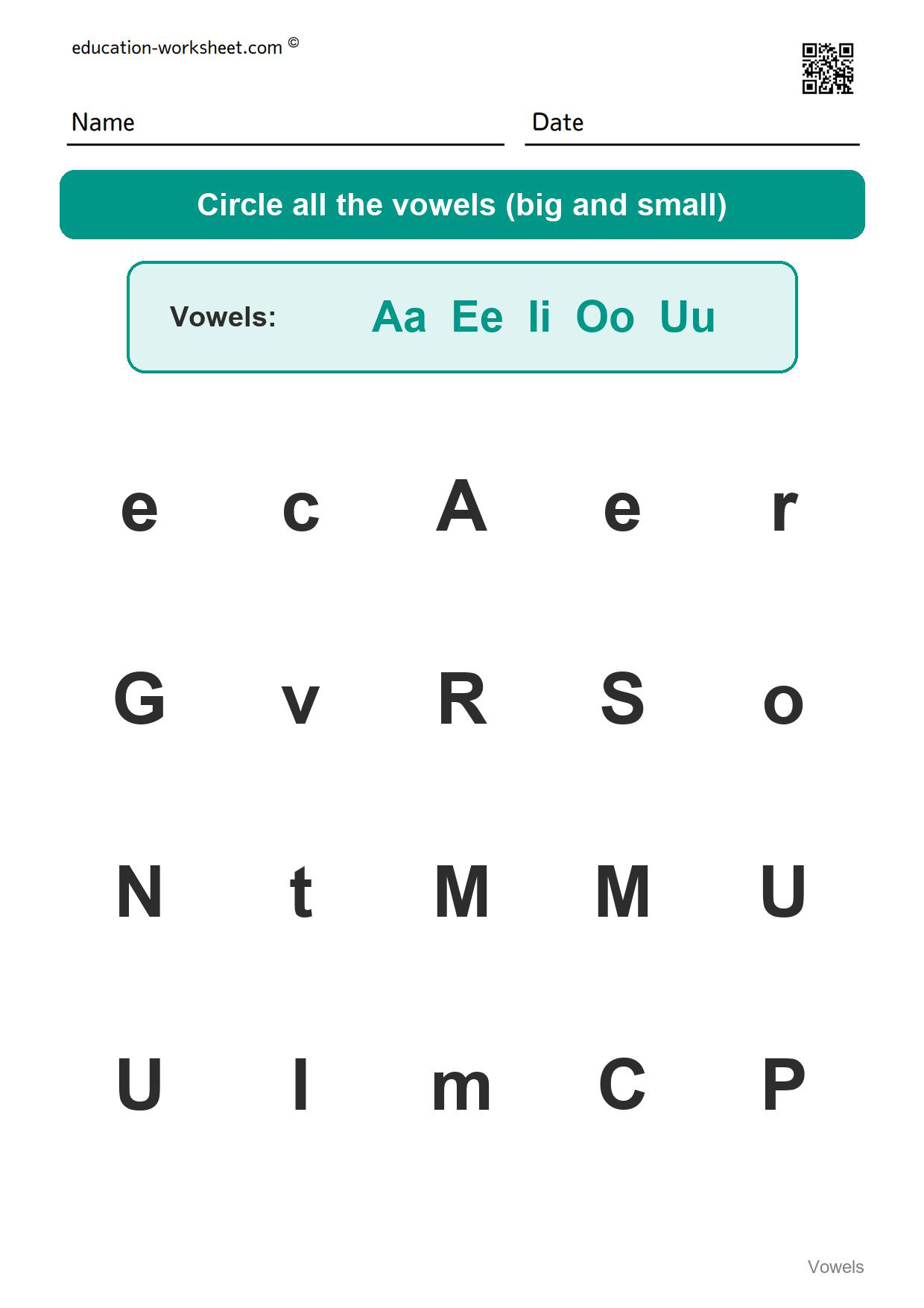
Worksheet 4 – All Five Vowels on One Page
One of only two pages that uses A, E, I, O and U. It is also the most capital-heavy page in the pack, with twelve of the twenty letters in upper case, and three letters repeat. The letters are ecAer, then GvRSo, then NtMMU, then UImCP. Vowel letters used: all five. Vowels per row: 3, 1, 1, 2.
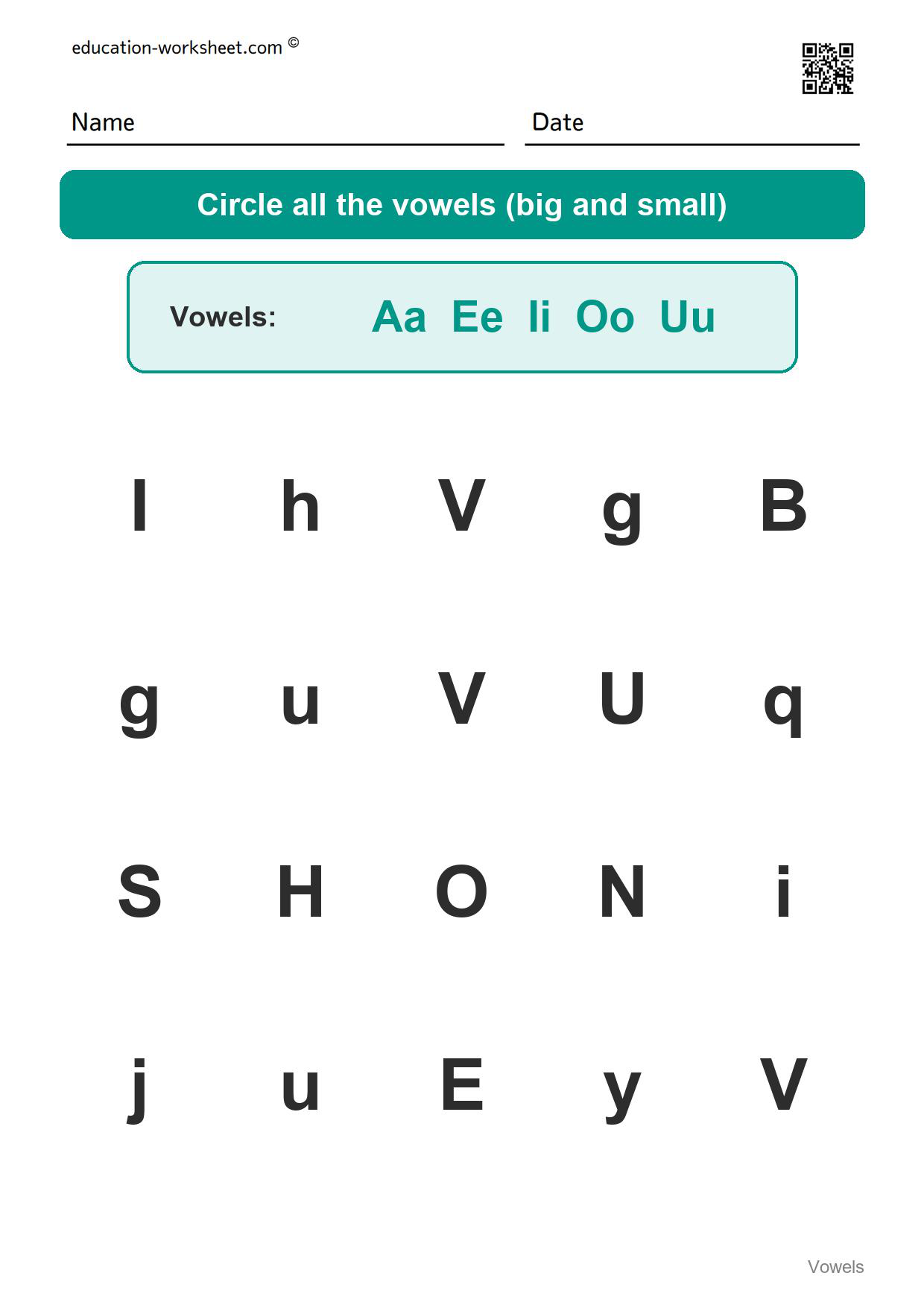
Worksheet 5 – U Three Times, Twice Small and Once Capital
A useful page for the case question. The letter u turns up as a small u twice and a capital U once, so a child cannot circle by shape memory alone; they have to know that both are the same letter. The letters are IhVgB, then guVUq, then SHONi, then juEyV. Vowel letters used: E, I, O and U. Vowels per row: 1, 2, 2, 2.
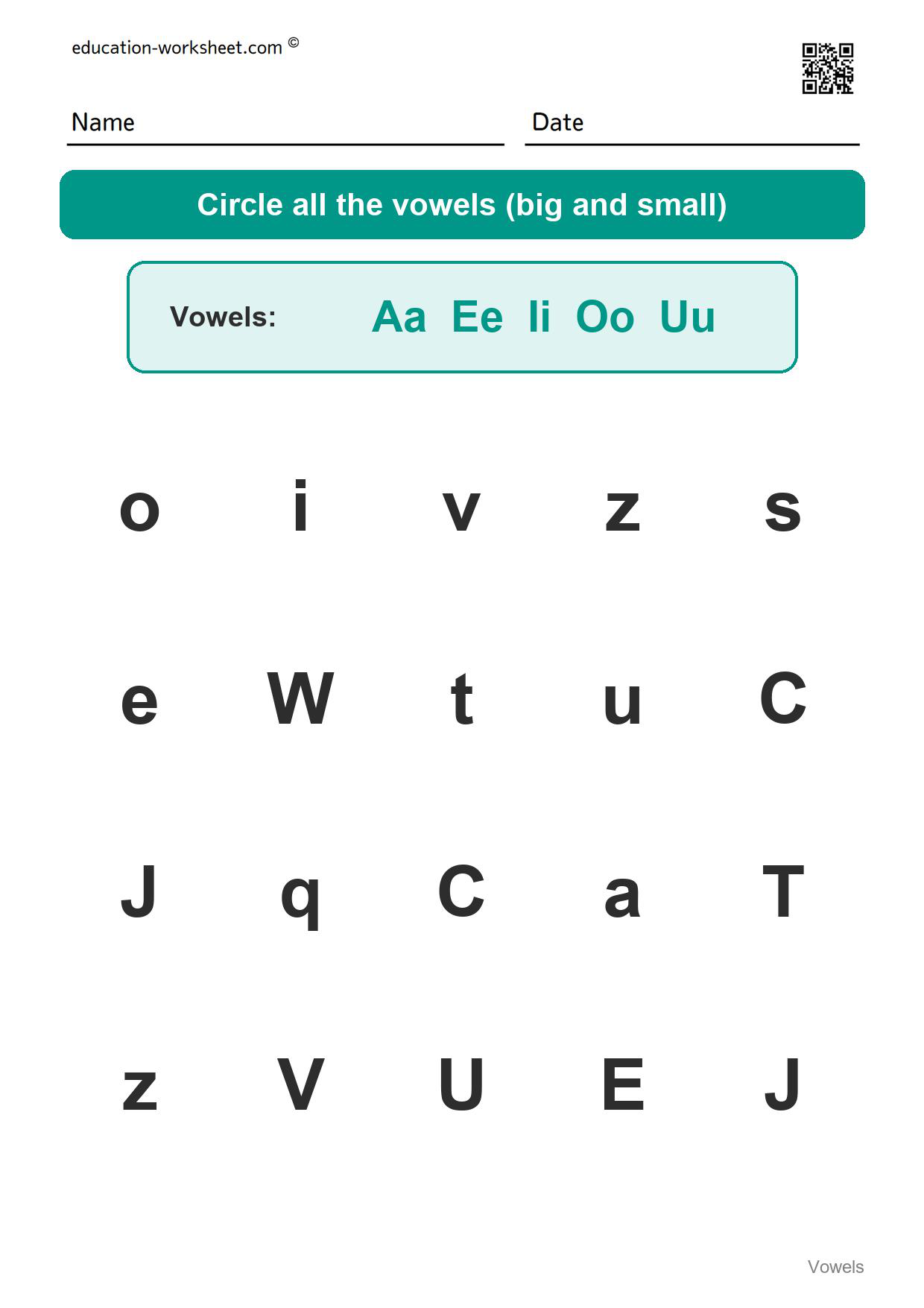
Worksheet 6 – All Five Vowels Again
The second page that uses every vowel letter. It opens with two vowels in the first two boxes, which makes it an encouraging page to start on. The letters are oivzs, then eWtuC, then JqCaT, then zVUEJ. Vowel letters used: all five. Vowels per row: 2, 2, 1, 2.
Worksheet 7 – The Densest Row in the Pack
Four of the five letters in the second row are vowels: only the Q is not. Nothing else in the pack comes close, and children who have settled into a rhythm of one-per-row often miss the last one. The letters are zkboy, then QaeOU, then DpAmB, then tsjgA. Vowel letters used: A, E, O and U. Vowels per row: 1, 4, 1, 1.
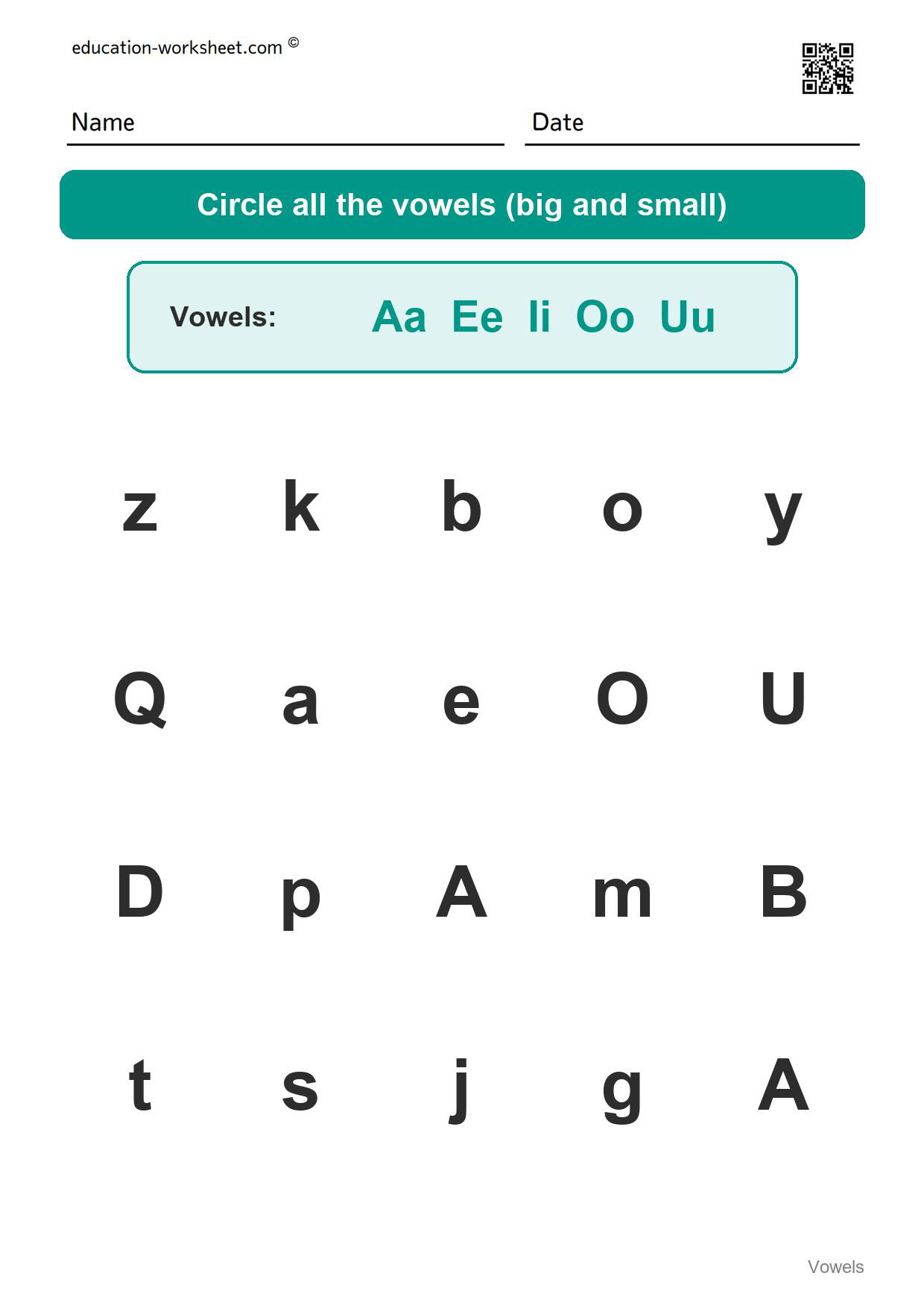
Worksheet 8 – Seven Vowels in the First Three Rows
The bottom row has none at all, so the work is finished before the page is. No U on this page, and the capital I appears twice. The letters are gJFIo, then COgIE, then eRqTA, then HzphJ. Vowel letters used: A, E, I and O. Vowels per row: 2, 3, 2, 0.
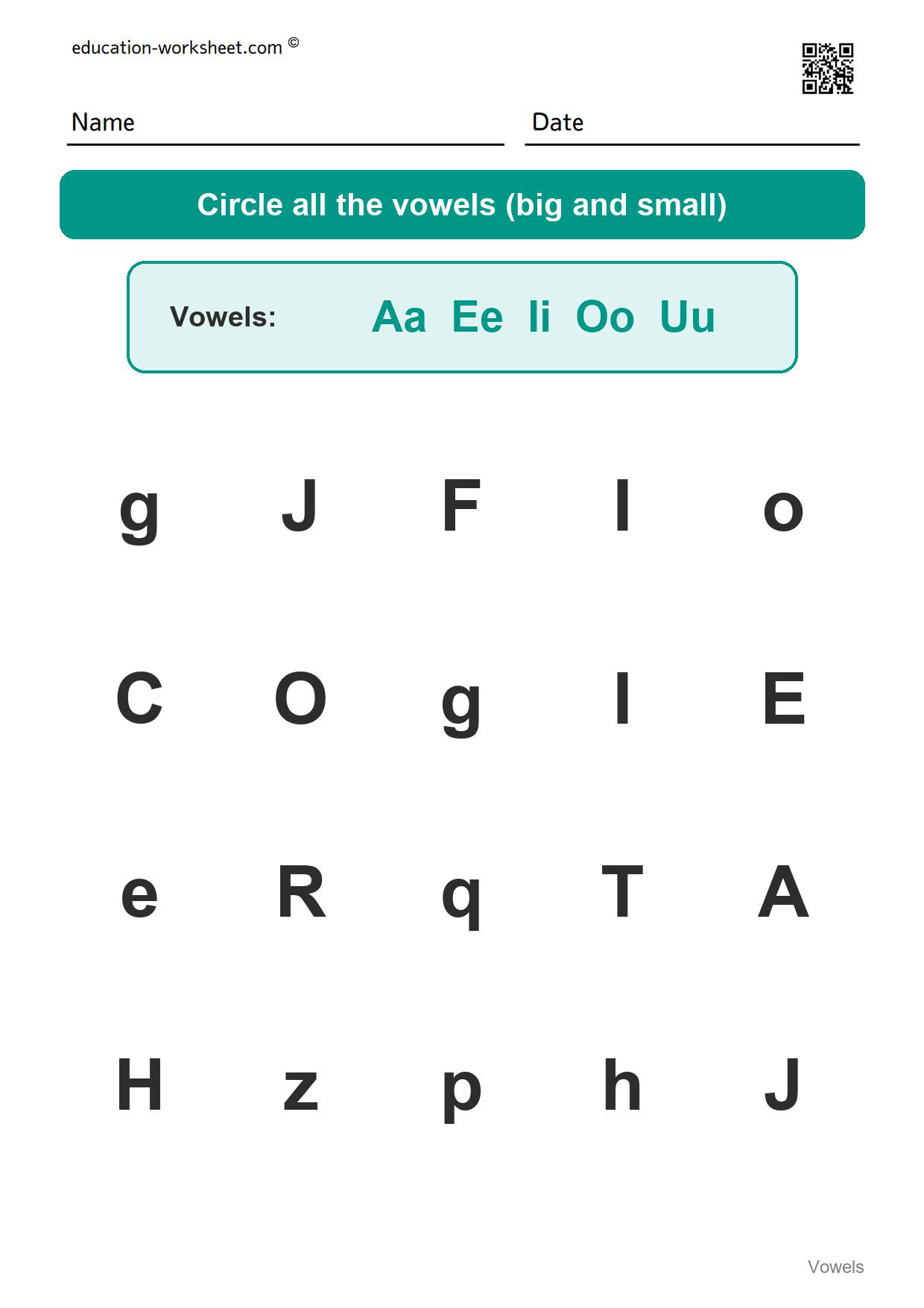
Worksheet 9 – Two Small e Letters Side by Side
The last row holds two small e letters separated by one letter. Pairs like this are where children stop and check whether they have already circled that one. The letters are ExOtp, then ADxUt, then goTPK, then eZeTX. Vowel letters used: A, E, O and U. Vowels per row: 2, 2, 1, 2.
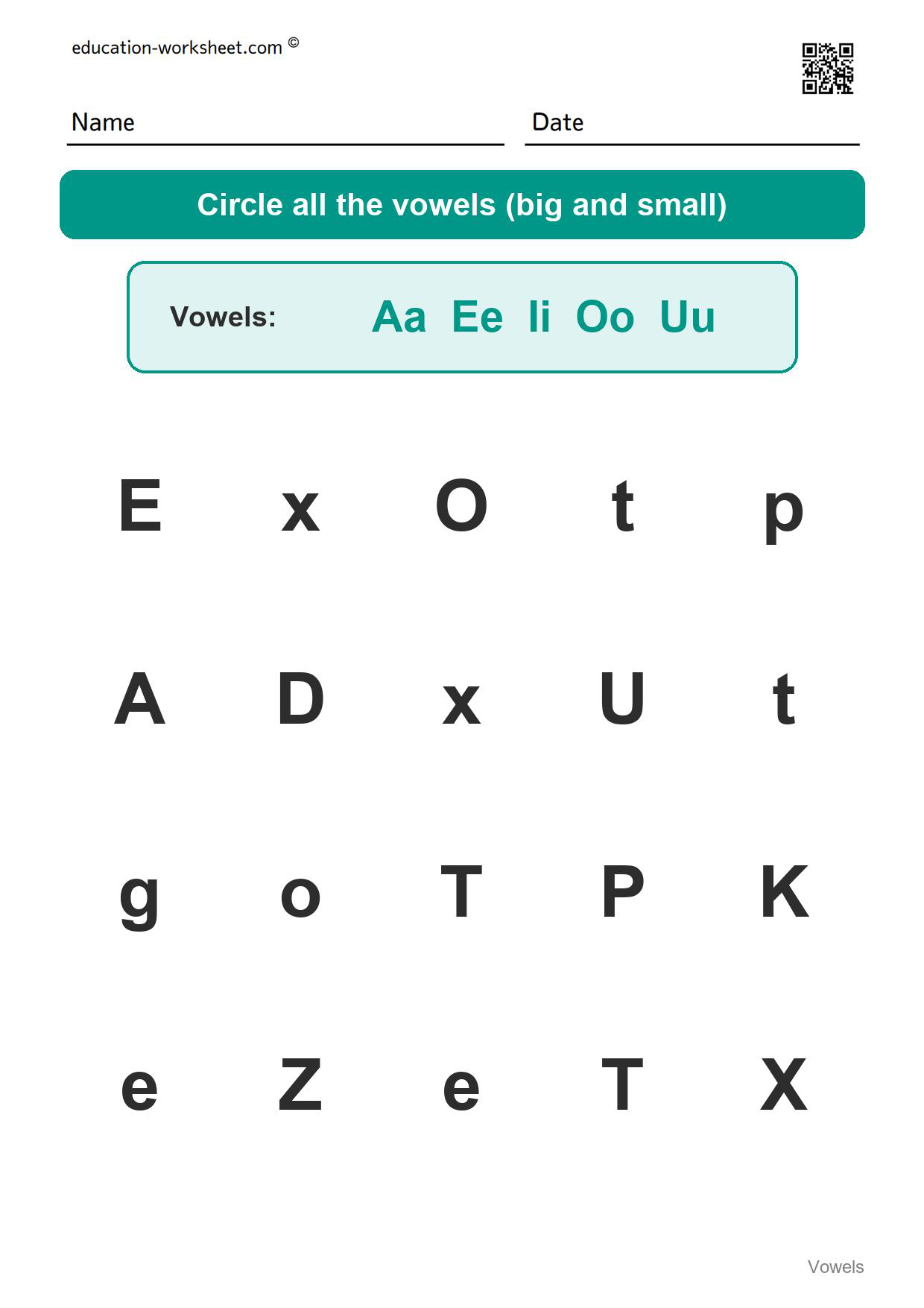
Worksheet 10 – Ending on the Small Letters
The final page leans on lowercase vowels: five of its seven are small letters. A sensible last page, because small letters are what a child will meet in a book. The letters are AtVTW, then OzjDi, then GeayW, then MvePi. Vowel letters used: A, E, I and O. Vowels per row: 1, 2, 2, 2.
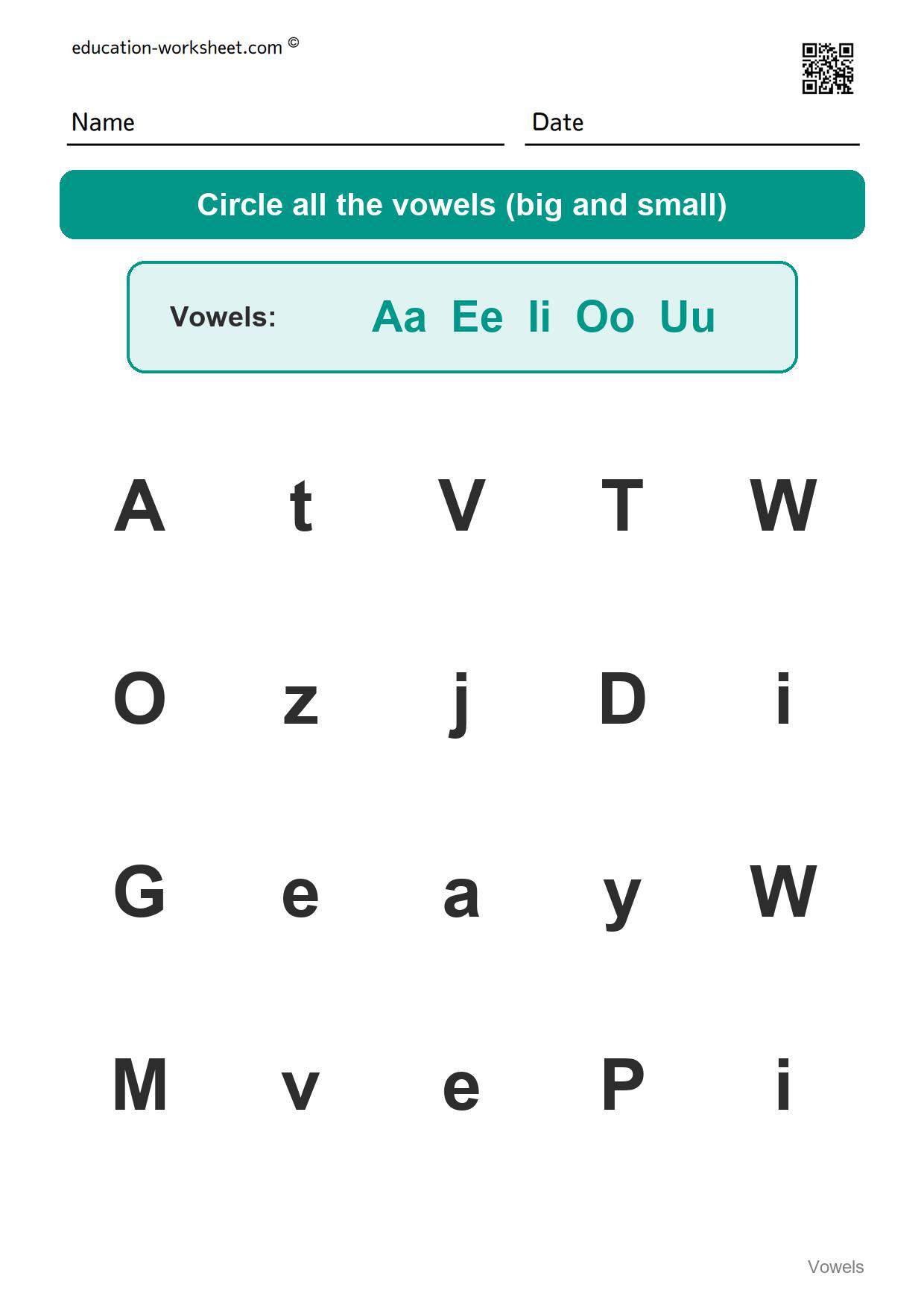
Seven Vowels a Page, and Never the Letter L
Two details only turn up if you go through all two hundred letters. The first is the count. Seven vowels on page one, seven on page ten, seven on every page in between. A child who finds six knows to keep looking, and a parent marking the page does not need an answer key: count the circles.
The second is an absence. The letter L never appears in this pack at all – not as a capital, not as a small letter, on any of the ten pages. It is the only letter of the alphabet missing. Look at the pages and the reason is visible: in this typeface a capital I and a small l are drawn as the same plain vertical stroke. Leaving L out removes the one pair a child could stare at and still not know whether it belongs in the circle.
Across the whole pack the five vowels are not used equally: E appears seventeen times, O and A fifteen each, U twelve and I eleven. Nor does every page use all five. Only pages 4 and 6 contain A, E, I, O and U together; page 1 has no A and no I at all. If you are working on one particular vowel, it is worth checking the page before you print it.
When Children Are Ready for These Worksheets
These pages suit children from about four and a half to six. A child is ready when they can name most letters on sight and knows the word “vowel” means something. They do not need to read, write or know the sounds the vowels make.
The relevant standard is RF.K.1.D, recognizing and naming all upper- and lowercase letters of the alphabet. Circling vowels is a step beyond naming letters: it asks a child to sort them. That sorting is what makes RF.K.3.B, matching the long and short sounds to the five vowels, possible later – you cannot learn what the vowels sound like until you know which letters they are.
How to Use These Worksheets
- Print one page on ordinary paper.
- Read the reminder strip together first: “A a, E e, I i, O o, U u”. Point at each pair. Saying both cases out loud is what stops a child hunting for capitals only.
- Work along the rows rather than scanning the page. Missing one is almost always a skipped letter, not a wrong decision.
- Circle as you go. Seven circles means the page is done.
- Count the circles at the end together. If there are six, go back along the rows – do not point at the one that was missed.
Three Things to Watch For
Circling only the capitals
The commonest mistake, and the reason the pages mix the cases. A child who has learned letters from blocks or fridge magnets has usually met capitals first. The reminder strip at the top is the fix: point at the small letter in each pair before starting.
Assuming every row has a vowel
Page 2 has a row with none, and page 8 ends with a row with none. A child who expects one per row will find something to circle anyway. If a consonant is circled, ask them to read the reminder strip and check that letter against it, rather than saying it is wrong.
Mixing up i and j, or O and 0
Small i and small j both have a dot, and at this age they are easy to confuse when scanning quickly. The same goes for the letter O and the digit zero, though no digits appear here. Slowing down and touching each letter solves both.
Printing Tips
- Choose Actual size or Fit to page in the print dialog – both keep the page in proportion.
- Each page fills one sheet and works on US Letter and A4 paper.
- Ordinary copier paper is fine. Card is only worth it if you want the page to survive an eraser.
- Grayscale printing is fine. The letters are black, and only the header band and the reminder strip use color.
- A page in a plastic wallet with a dry-wipe pen lets a child repeat the same page, which is useful here because the answer does not change.
Frequently Asked Questions
What age are these vowels worksheets for?
About four and a half to six years old: pre-K through kindergarten.
How many vowels are on each page?
Seven, on every page. Twenty letters, seven vowels, thirteen consonants.
Do capital and small letters both count?
Yes. The instruction says “big and small”, and the reminder strip at the top of the page shows both forms of all five vowels.
Is there an answer key?
None is needed. Count the circles: seven is right. If a consonant has been circled, the reminder strip at the top settles it.
Does my child need to know vowel sounds first?
No. These pages are about recognizing the letters. The sounds come next, and they come more easily once a child can pick the five letters out of a crowd.
Do I need to sign up to download these?
No. Every PDF downloads immediately, with no account, no email address and no cost.
Can I use these in my classroom?
Yes, they are free to print for home and classroom use. Please do not sell them or re-host the files elsewhere.
More Free Alphabet and Phonics Worksheets
- Free Vowels and Consonants Worksheets for Kindergarten – Sort the Letters
- Free Middle Sounds Worksheets for Kindergarten – Short Vowels
- Free Uppercase and Lowercase Letter Matching Worksheets – One Page for Every Letter A-Z
- Free Find the Letter Worksheets for Kindergarten – Letter Recognition
- Free Beginning Sounds Worksheets for Kindergarten – Phonics, 40 Words
- Free CVC Word Building Worksheets for Kindergarten – Make Three Letter Words