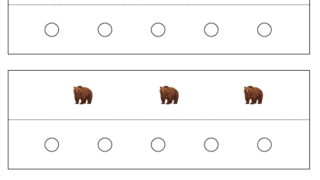


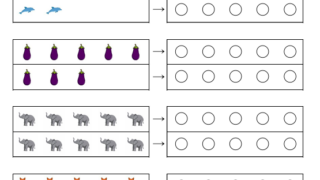
These free printable more or fewer worksheets give preschool and kindergarten children ten pages of practice comparing two groups. Each page shows two boxes of pictures side by side and asks the child to circle the group that has more – or, on four of the pages, the group that has fewer.
Two things in the design do most of the teaching. The questions alternate between more and fewer rather than running in blocks, so a child cannot settle into a habit of circling the bigger pile. And the gap between the two groups narrows as the pack goes on – from four down to one – so a page that could be answered at a glance early on has to be counted by the end.
- What Is in This Free More or Fewer Worksheet Pack
- The 10 More or Fewer Worksheets
- Worksheet 1 – Circle the Group With More (2 or 6)
- Worksheet 2 – Circle the Group With More (7 or 3)
- Worksheet 3 – Circle the Group With Fewer (3 or 6)
- Worksheet 4 – Circle the Group With Fewer (8 or 4)
- Worksheet 5 – Circle the Group With More (5 or 8)
- Worksheet 6 – Circle the Group With More (6 or 4)
- Worksheet 7 – Circle the Group With Fewer (7 or 5)
- Worksheet 8 – Circle the Group With More (5 or 6)
- Worksheet 9 – Circle the Group With Fewer (9 or 7)
- Worksheet 10 – Circle the Group With More (8 or 6)
- Why “Fewer” Is Harder Than “More”
- When Children Are Ready for These Worksheets
- How to Use These Worksheets
- Three Things to Watch For
- Printing Tips
- Frequently Asked Questions
- More Free Comparing Worksheets
What Is in This Free More or Fewer Worksheet Pack
- Ten printable worksheets, one comparison on each page.
- Six more pages and four fewer pages, alternating.
- Groups of two to nine, with gaps that shrink from four down to one.
- The larger group sometimes on the left and sometimes on the right.
- Pictures drawn the same size in both boxes, so size never gives the answer away.
- A separate PDF for every page – no sign-up, no email address, no cost.
The 10 More or Fewer Worksheets
Work through them in order the first time – the difficulty is built into the sequence.
Worksheet 1 – Circle the Group With More (2 or 6)
Two against six – the widest gap in the pack, and a page most children can answer without counting at all.

Worksheet 2 – Circle the Group With More (7 or 3)
Seven against three. Still an easy gap, but the bigger group is now on the left, so position gives nothing away.

Worksheet 3 – Circle the Group With Fewer (3 or 6)
The first fewer page. A child who has settled into circling the bigger pile will get this one wrong, which is the point of putting it third.

Worksheet 4 – Circle the Group With Fewer (8 or 4)
Fewer again, with the larger group first. Read the question at the top out loud before starting.

Worksheet 5 – Circle the Group With More (5 or 8)
Five against eight. The gap narrows to three, and guessing by eye starts to fail.

Worksheet 6 – Circle the Group With More (6 or 4)
Six against four. A gap of two – most children now need to count at least one of the groups.

Worksheet 7 – Circle the Group With Fewer (7 or 5)
Fewer, seven against five. Two questions in a row that reward careful reading rather than quick looking.

Worksheet 8 – Circle the Group With More (5 or 6)
Five against six – a gap of one, and the hardest page in the pack. Counting is the only way.

Worksheet 9 – Circle the Group With Fewer (9 or 7)
Fewer, nine against seven. The largest numbers here, with a gap of two.

Worksheet 10 – Circle the Group With More (8 or 6)
Eight against six to finish. By this page most children are counting without being asked to.

Why “Fewer” Is Harder Than “More”
A child hears the word more hundreds of times before starting school, almost always in their own favour. They may never have heard fewer at all. So when a page asks for fewer, two things have to happen at once: the comparison itself, and the translation of an unfamiliar word.
If your child gets every more page right and every fewer page wrong, the comparing is fine and the vocabulary is the problem. Ask “which one has less?” instead and watch what happens – most children answer correctly straight away. (Strictly, fewer is for things you can count and less for things you cannot, but that distinction can wait a decade.)
When Children Are Ready for These Worksheets
These pages suit children from about four to six years old. A child does not need to count to do the early pages, which makes this a good pack to start before counting is reliable – but the later pages, where the gap is one, do need counting.
In American classrooms this is the kindergarten comparison standard: identifying whether the number of objects in one group is greater than, less than, or equal to the number in another (Common Core K.CC.C.6). It comes before the greater-than and less-than symbols, which are much easier to teach once the idea is already in place.
How to Use These Worksheets
- Print one page and read the instruction at the top out loud. Every time, even when your child says they know it.
- Ask which box they think it is before any counting. The guess is useful information.
- Count both groups together, touching each picture once.
- Circle the answer, then say the whole sentence: “six is more than four”.
- On a wrong answer, re-read the question rather than the pictures. It is usually the word, not the counting.
Three Things to Watch For
Answering “more” on every page
The most common pattern by far, and the reason the fewer pages are scattered through the pack rather than grouped at the end.
Judging by how much space the group fills
Four pictures spread out can look like more than six packed together. The boxes on these pages are the same size, so this shows up quickly.
Counting one group and guessing the other
Watch the finger. A child who counts the left box carefully and then glances at the right one is halfway to the answer and will be wrong whenever the gap is small.
Printing Tips
- Choose Actual size or Fit to page so the letters and pictures stay large.
- Each page fills one sheet and works on both US Letter and A4 paper.
- Slip a page into a plastic wallet and use a dry-wipe pen to reuse it with more than one child.
Frequently Asked Questions
What age are these more or fewer worksheets for?
About four to six years old – preschool, pre-K and kindergarten.
Does my child need to count first?
Not for the early pages, where the gap is wide enough to see. The later pages do need counting.
Can I say “less” instead of “fewer”?
Yes, and many children understand it better. The worksheets use fewer because that is the word used in most classrooms.
Is there an answer key?
No separate key – counting the two groups together settles it, and doing that is the exercise.
Do I need to sign up to download these?
No. Every PDF downloads immediately, with no account, no email address and no cost.
Can I use these in my classroom?
Yes, they are free to print for home and classroom use. Please do not sell them or re-host the files elsewhere.
More Free Comparing Worksheets
- Free Circle the Larger Number Worksheets – Count and Compare
- Free How Many More Worksheets for Kindergarten
- Free Comparing Numbers Worksheets – Greater Than, Less Than
- Free Counting 1 to 10 Worksheets – Count and Write
- Free Big and Small Worksheets – Compare Sizes
- Free Count and Graph Worksheets for Kindergarten