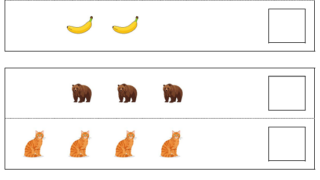

These free counting worksheets give preschool and kindergarten children ten pages of count-and-write practice with the numbers 1 to 10. On every page a child counts a small group of pictures – one sun, two cats, three apples – and then writes the matching numeral three times in the boxes underneath. Each page is its own PDF, so you can print one number at a time instead of a whole booklet.
Counting to ten sounds simple, but it is three skills stacked on top of each other: saying the number words in the right order, touching each object exactly once, and understanding that the last number you say is how many there are. The groups on these sheets are small and well spaced so a child can practise all three without losing their place.
- What Is in This Free Counting 1 to 10 Worksheet Pack
- The 10 Count and Write Worksheets
- Worksheet 1 – Count One Sun and Write the Number 1
- Worksheet 2 – Count Two Cats and Write the Number 2
- Worksheet 3 – Count Three Apples and Write the Number 3
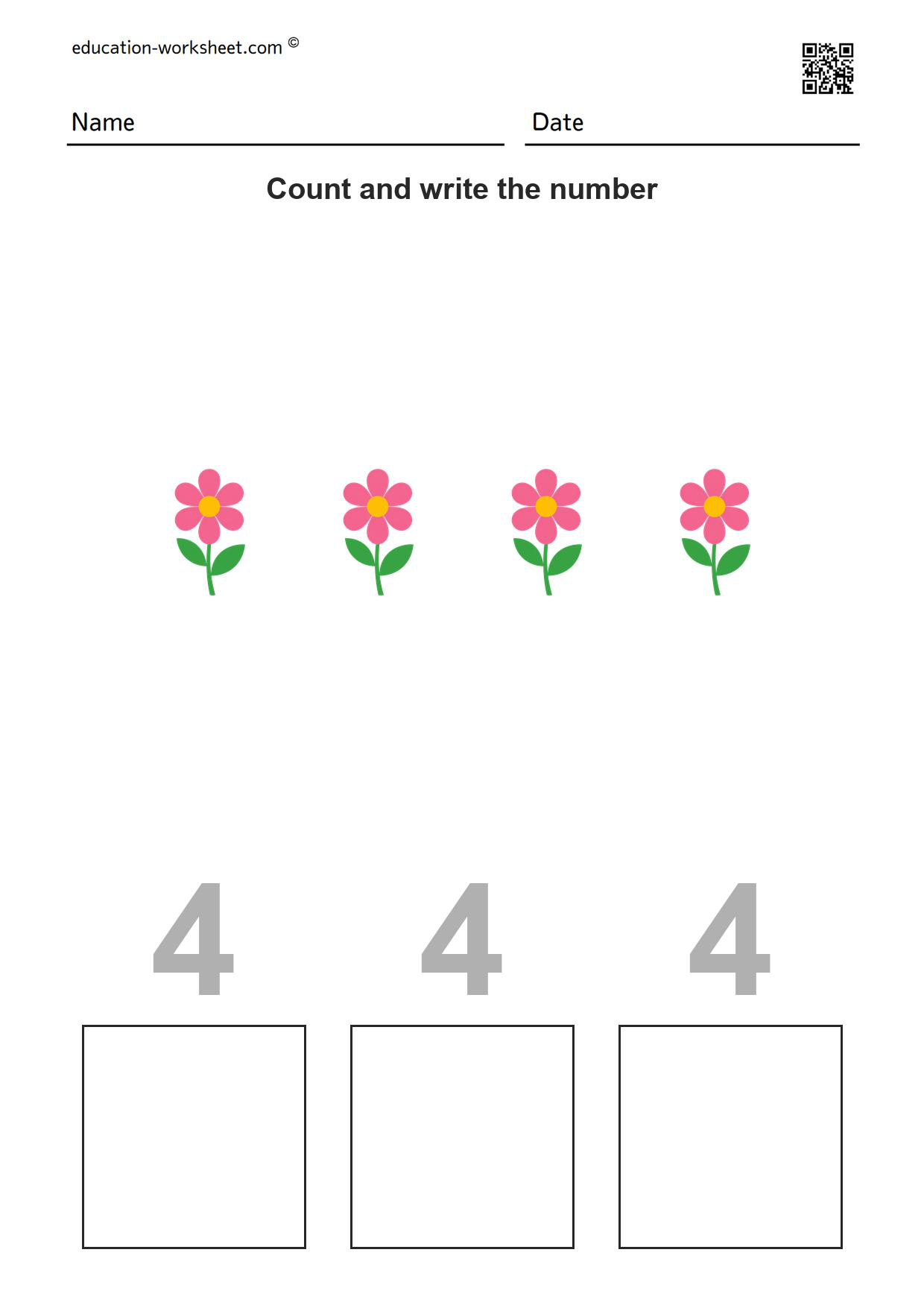
- Worksheet 4 – Count Four Flowers and Write the Number 4
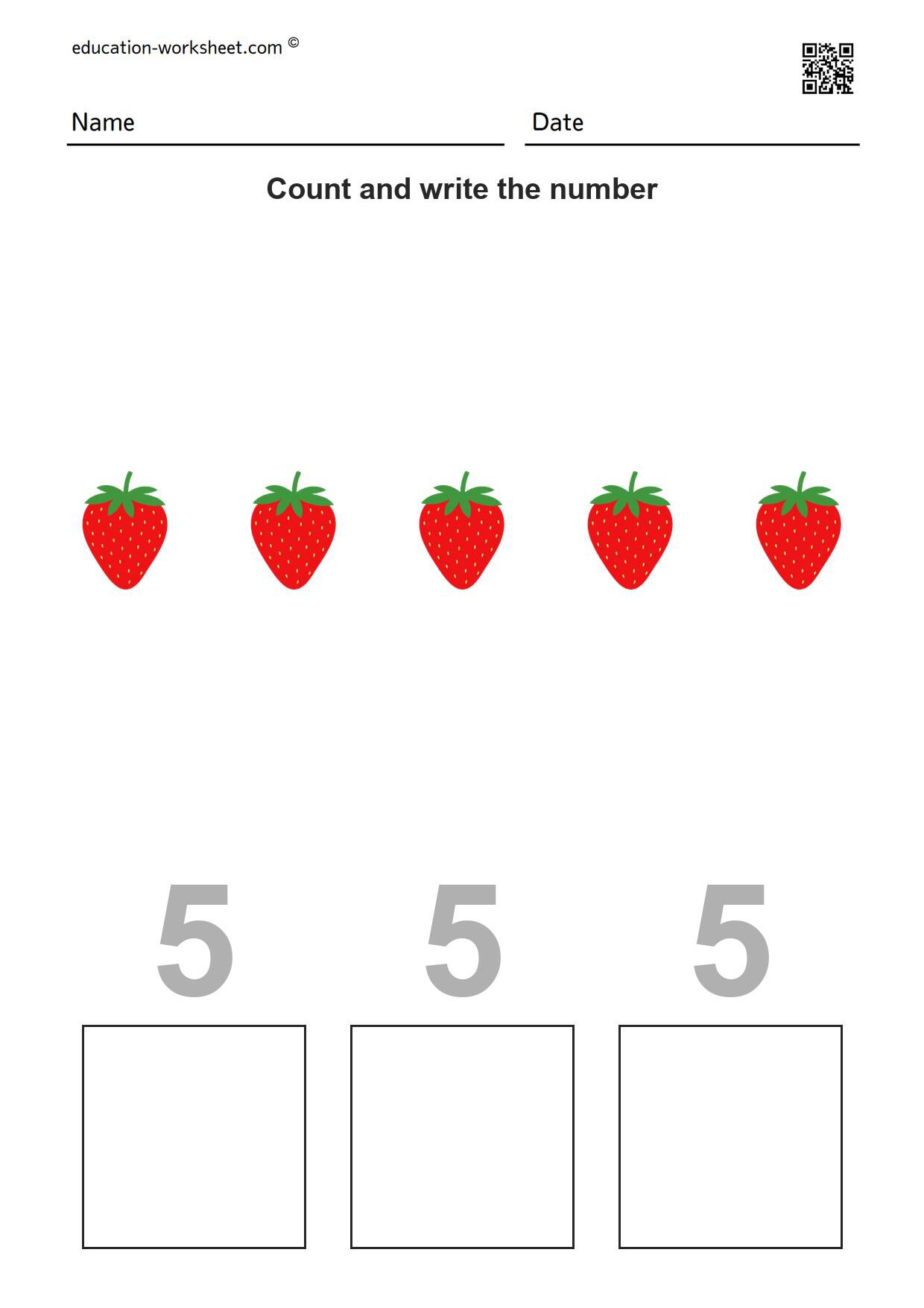
- Worksheet 5 – Count Five Strawberries and Write the Number 5
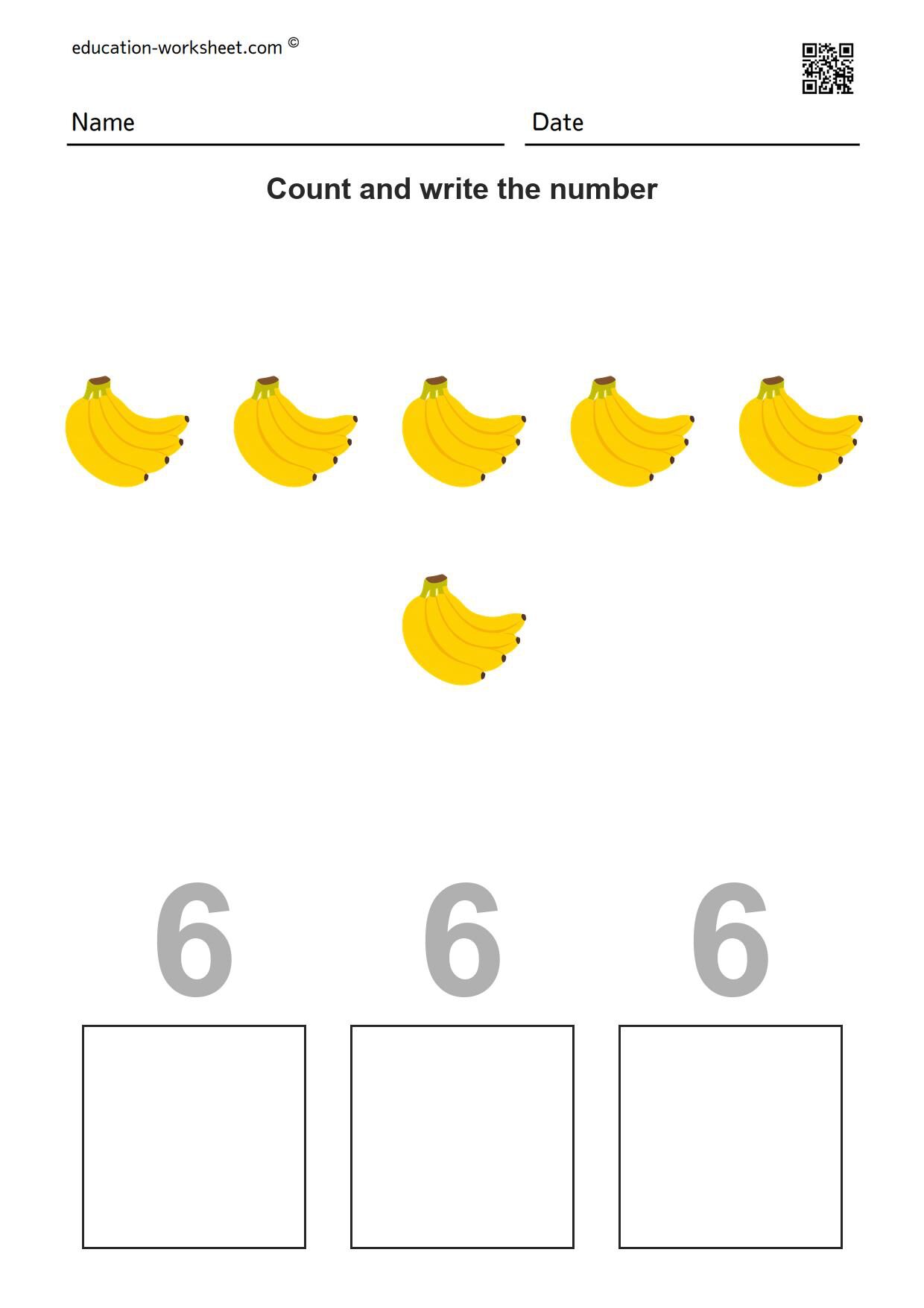
- Worksheet 6 – Count Six Bananas and Write the Number 6
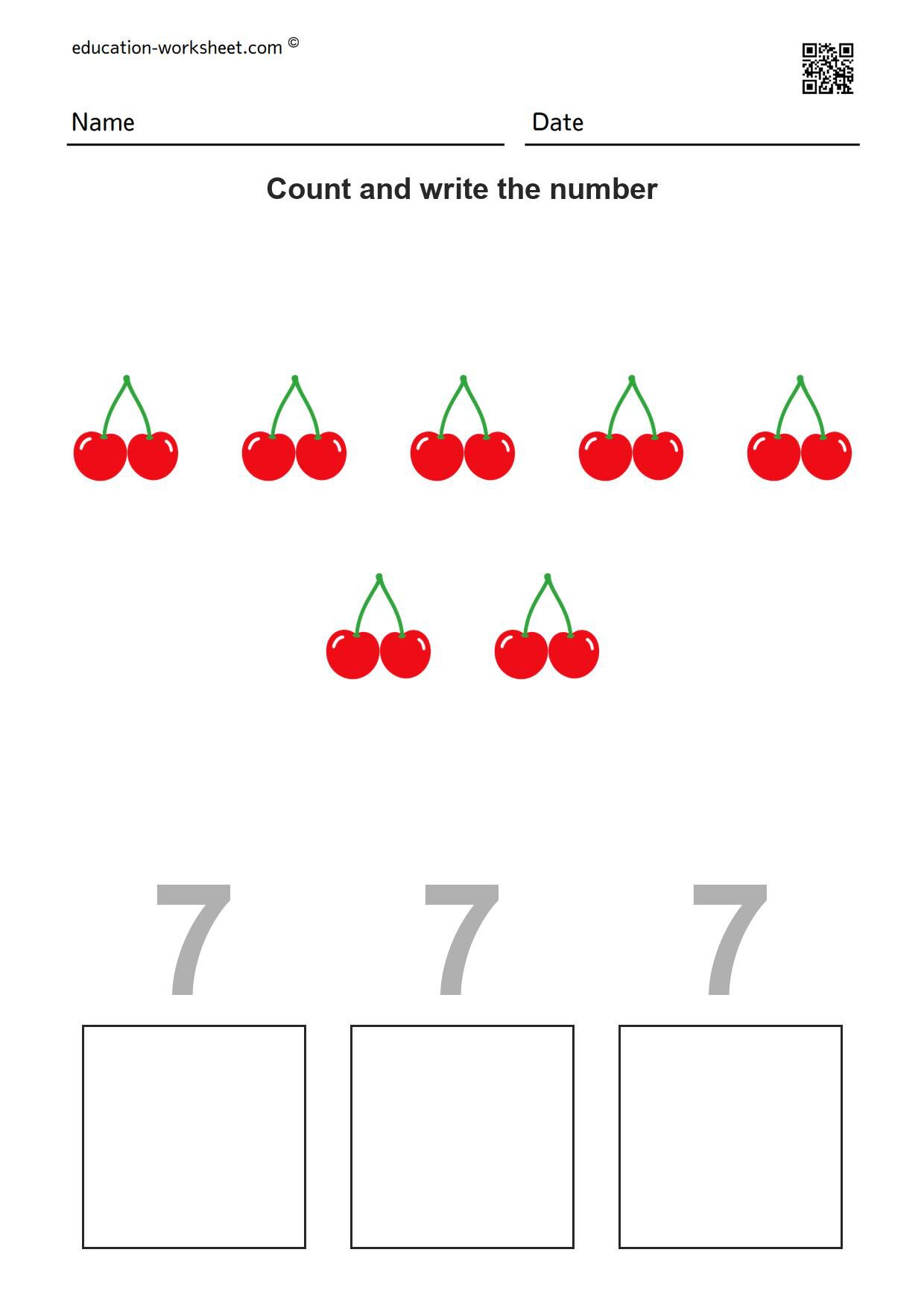
- Worksheet 7 – Count Seven Cherries and Write the Number 7
- Worksheet 8 – Count Eight Dogs and Write the Number 8
- Worksheet 9 – Count Nine Trees and Write the Number 9
- Worksheet 10 – Count Ten Rabbits and Write the Number 10
- When Children Are Ready for These Worksheets
- How to Use These Worksheets
- Three Counting Mistakes to Watch For
- Printing Tips
- Frequently Asked Questions
- More Free Counting and Number Worksheets
What Is in This Free Counting 1 to 10 Worksheet Pack
- Ten printable worksheets, one for each number from 1 to 10.
- The same layout on every page, so a child knows what to do without being told twice.
- A row of pictures to count, then three light grey numerals to trace and copy into boxes.
- A name and date line at the top, ready for classroom use.
- Black and white apart from the pictures, so the pages cost very little to print.
- A separate PDF for every page – no sign-up, no email address, no account.
The 10 Count and Write Worksheets
Each worksheet below can be viewed as an image and downloaded as a PDF. They run in order from 1 to 10, but there is no need to work through them in one sitting – one page a day is plenty for most four year olds.
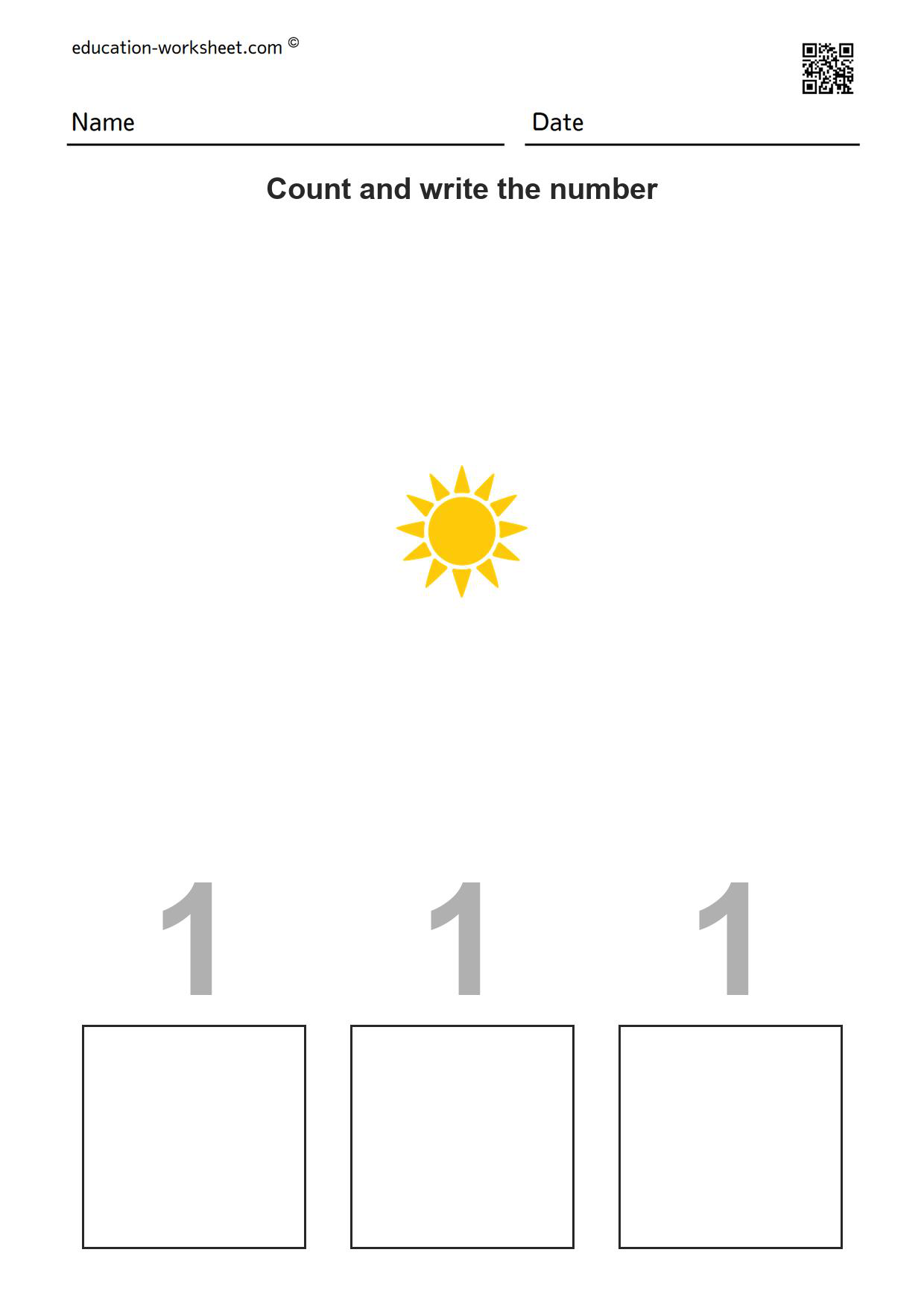
Worksheet 1 – Count One Sun and Write the Number 1
The first page shows a single sun. A group of one is the easiest possible starting point, because there is nothing to keep track of, and it lets a child practise the physical act of writing the numeral 1 before counting gets harder.
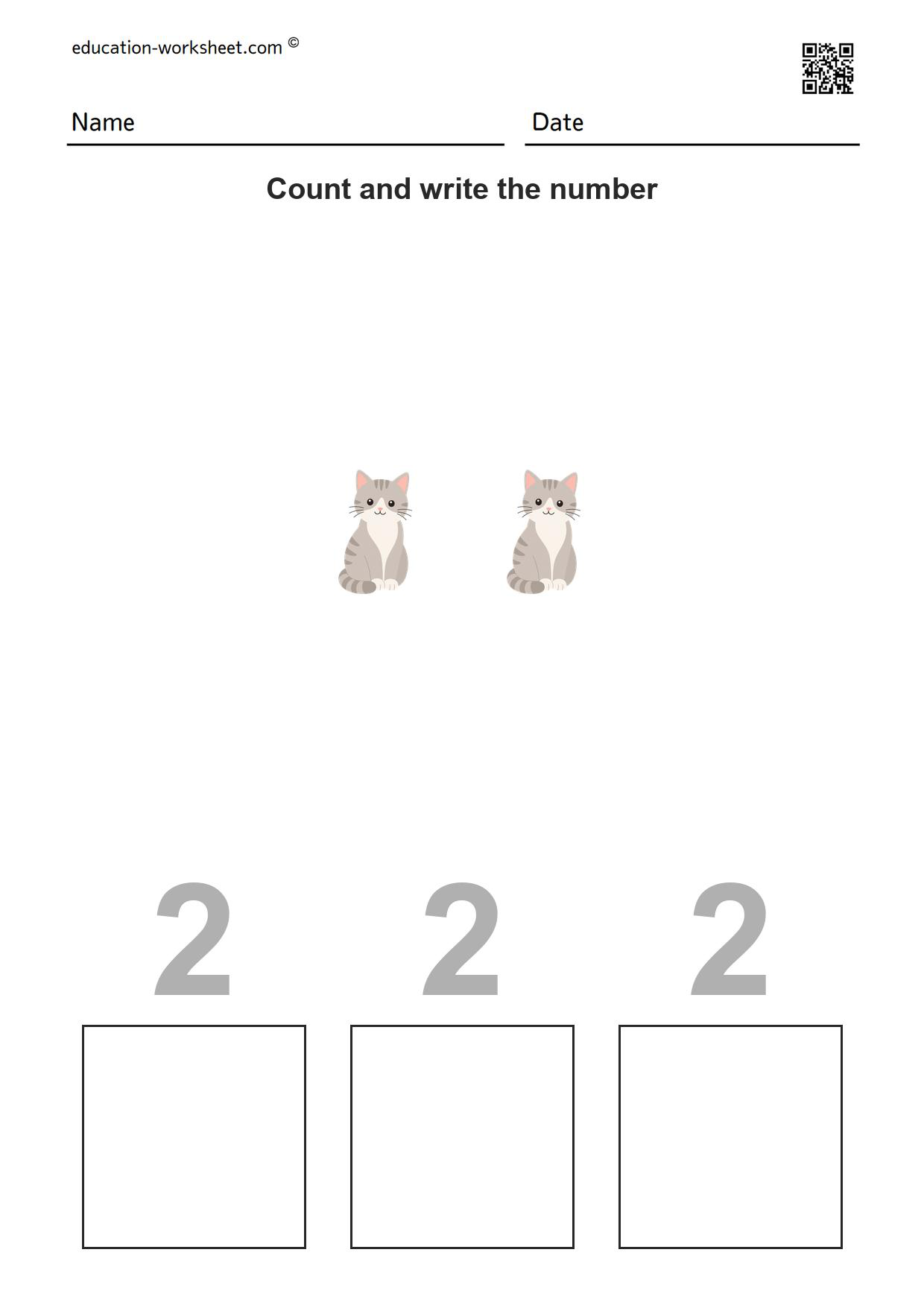
Worksheet 2 – Count Two Cats and Write the Number 2
Two cats sit side by side. At this size a child can still see the whole group at a glance, without counting, which is exactly the point: recognising two as a quantity comes before counting it.
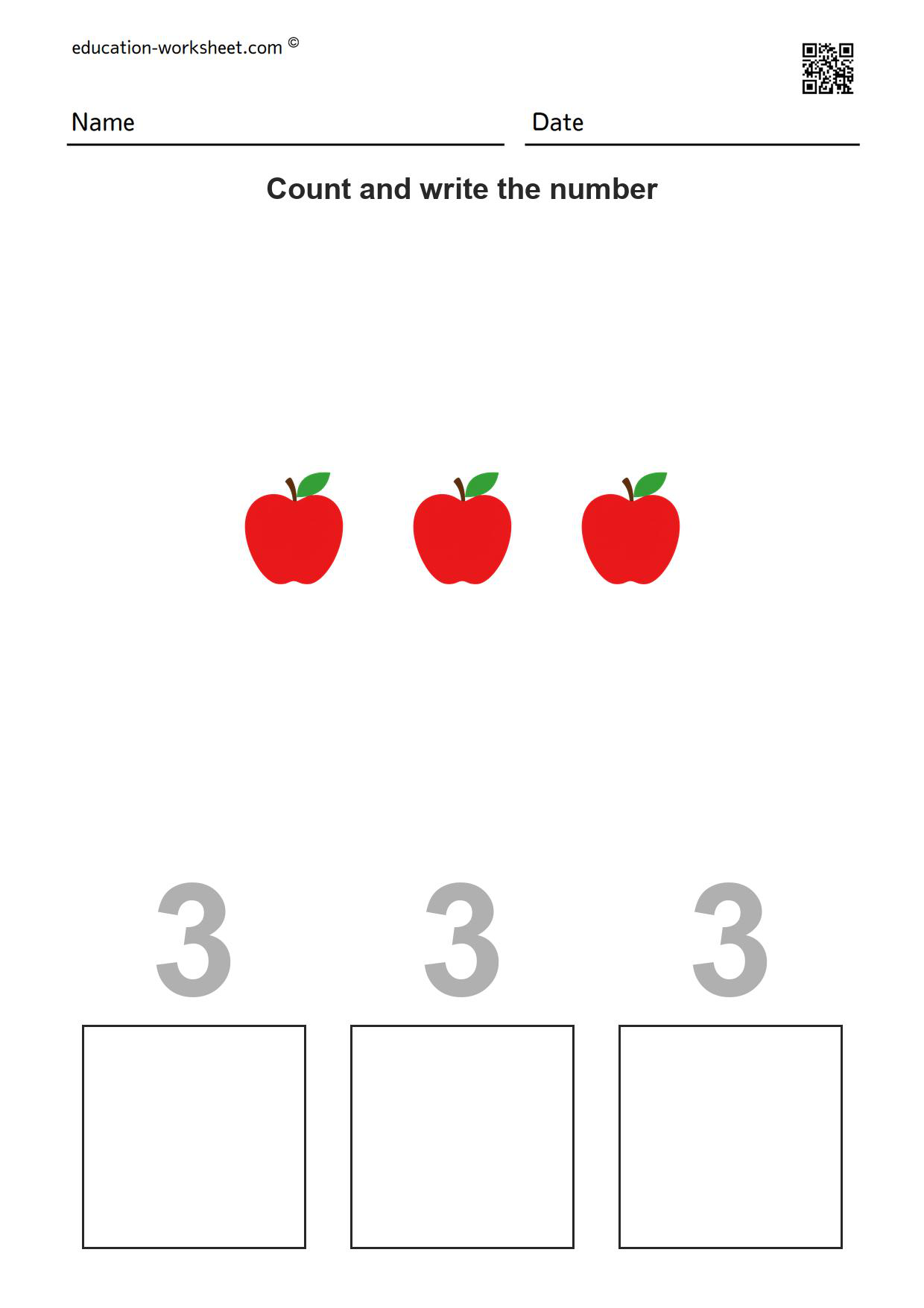
Worksheet 3 – Count Three Apples and Write the Number 3
Three apples in a row. Three is usually the last number most children can see instantly, so this page is a good place to check whether your child is really counting or simply recognising the shape of the group.
Worksheet 4 – Count Four Flowers and Write the Number 4
Four flowers. From four onward most children have to point and count one at a time, so watch their finger here. Touching each flower once, and only once, is the skill this page is really practising.
Worksheet 5 – Count Five Strawberries and Write the Number 5
Five strawberries. Five is a milestone number because it matches one hand, and a child who can hold up five fingers is able to check their own answer without any help from an adult.
Worksheet 6 – Count Six Bananas and Write the Number 6
Six bunches of bananas, arranged as a row of five with one underneath. That second line is deliberate: it stops a child guessing from the length of the row and makes them count the whole group.
Worksheet 7 – Count Seven Cherries and Write the Number 7
Seven pairs of cherries, laid out as five and two. Splitting the group this way quietly introduces the idea that seven is five and two more, which is where mental addition begins.
Worksheet 8 – Count Eight Dogs and Write the Number 8
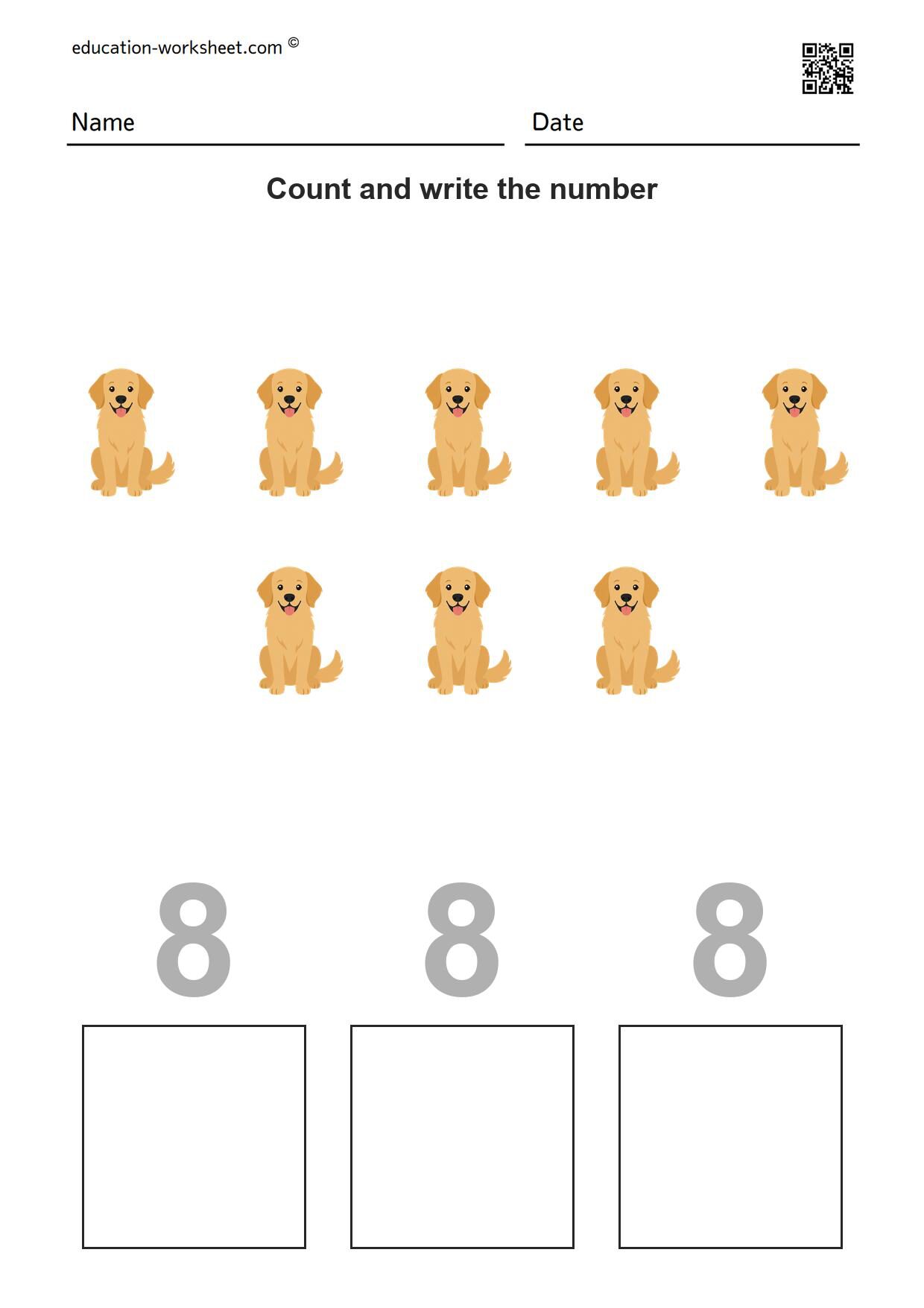
Eight dogs, in a row of five and a row of three. If your child loses their place, ask them to count the top row first, say that number out loud, and then carry on along the bottom row.
Worksheet 9 – Count Nine Trees and Write the Number 9
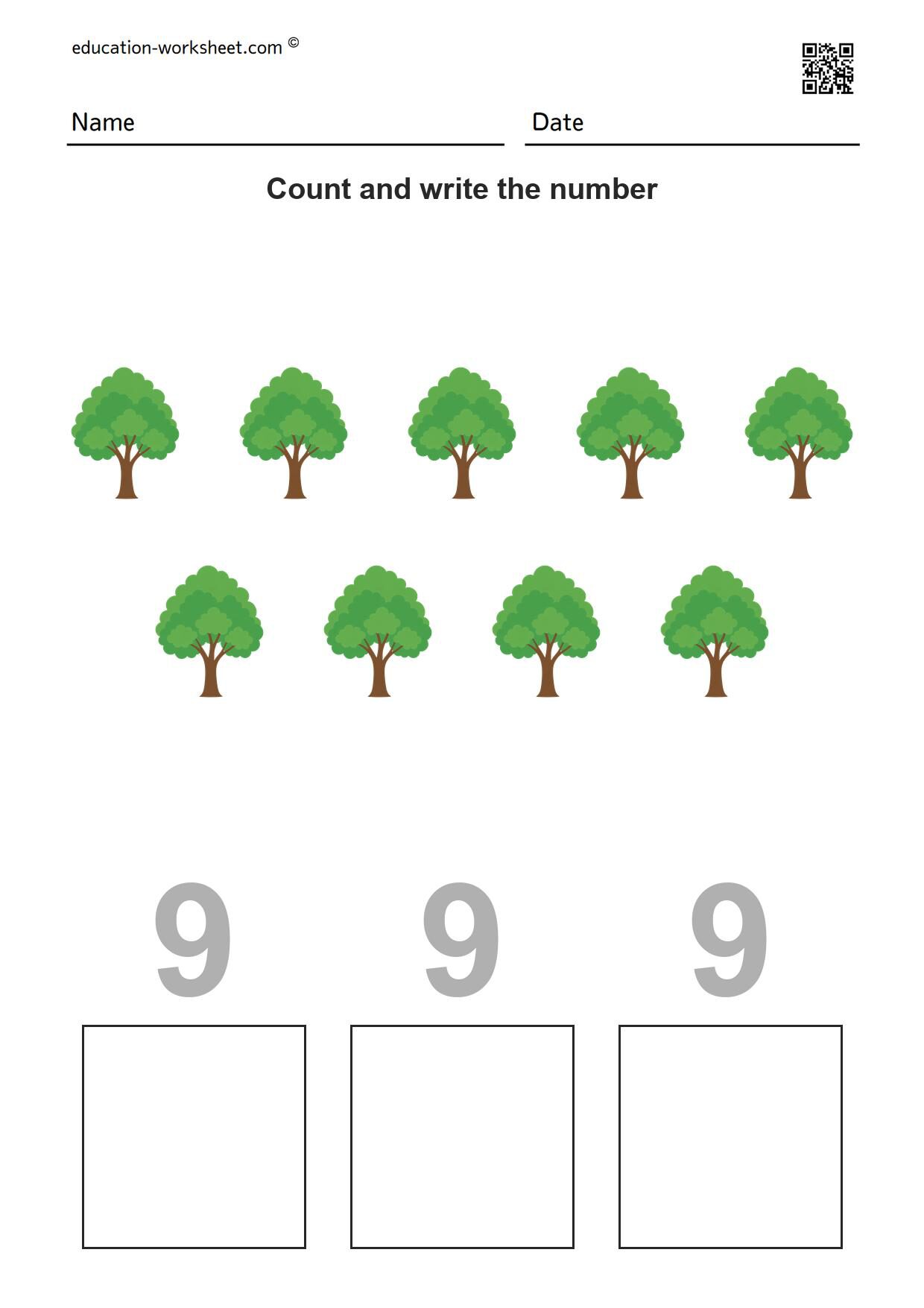
Nine trees, arranged as five and four. Nine is the number children most often miscount, usually because they say the words faster than they point, so slow this page down if it is being rushed.
Worksheet 10 – Count Ten Rabbits and Write the Number 10
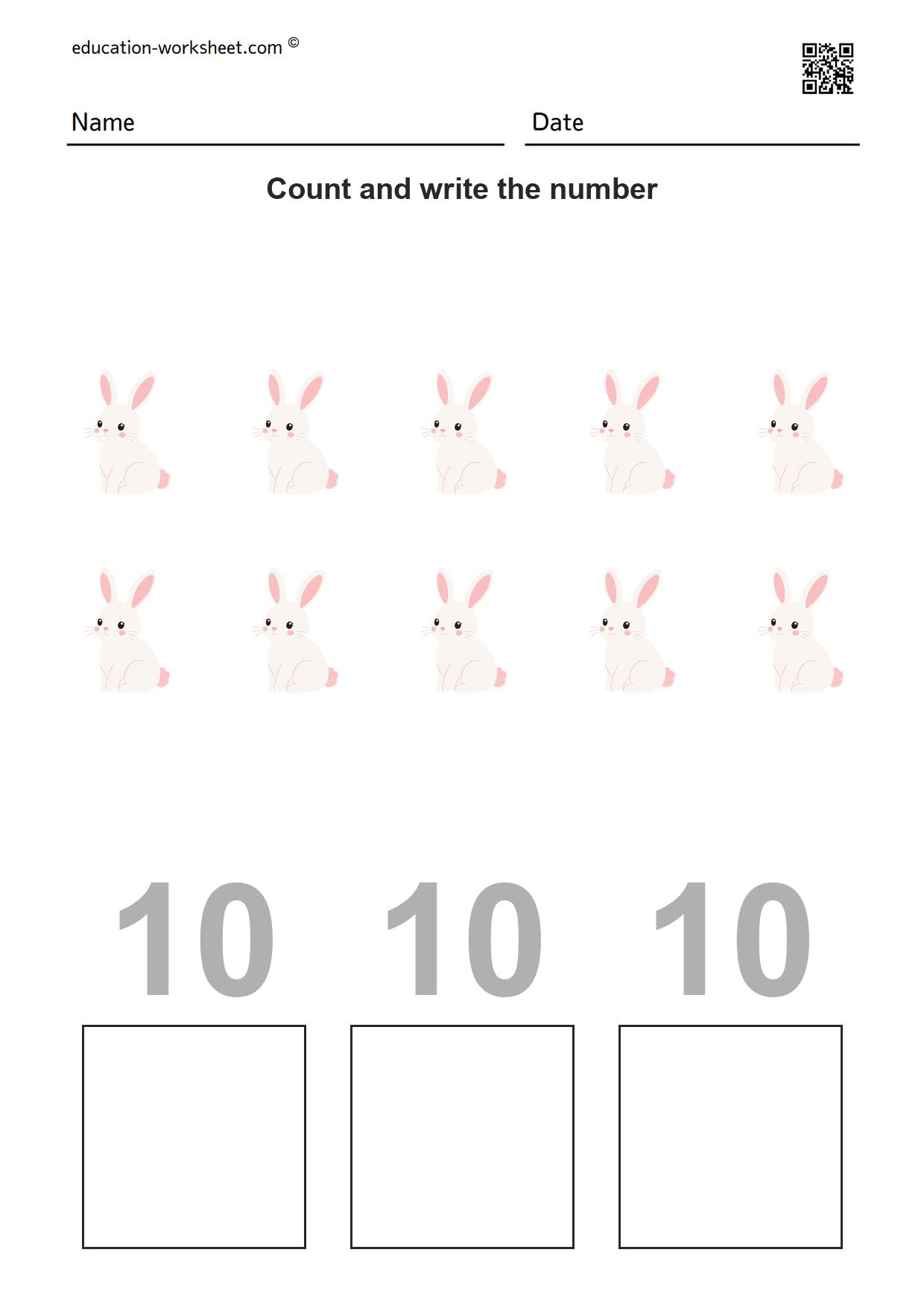
Ten rabbits, in two rows of five. Finishing at ten with a group that is clearly five and five gives a child a picture to remember, and it is the natural place to stop before moving on to teen numbers.
When Children Are Ready for These Worksheets
Most children are ready for count-and-write pages somewhere between the ages of four and six. Before starting, a child should be able to say the number words from one to ten out loud, even if the counting itself is still shaky. Writing the numerals can come later – tracing the grey numbers is enough at first.
In American classrooms this work sits inside two kindergarten counting standards: counting objects to tell how many there are, and understanding that the last number said gives the total (Common Core K.CC.B.4 and K.CC.B.5). If your child already writes numerals confidently, the pages still work as quick handwriting practice.
How to Use These Worksheets
- Print the page you want on ordinary paper. Plain copy paper is fine.
- Ask your child to count the pictures out loud, touching each one with a finger as they say the number.
- When they finish, ask “so how many are there?” and wait. The answer should be the last number they said.
- Have them trace the two grey numerals, then write the third one on their own in the empty box.
- Stop while it is still going well. Two or three pages is a full session for a four year old.
Three Counting Mistakes to Watch For
Skipping a picture, or counting one twice
This is the most common problem, and it is a pointing problem rather than a maths problem. If it happens, ask your child to slide a finger across each picture as they count, or to cross each one out with a pencil as it is counted.
Counting all over again when you ask how many
If a child counts “one, two, three, four” and then starts again from one when you ask how many there are, they have not yet realised that the last number is the answer. This is called cardinality, and it arrives with practice – keep asking the question rather than correcting them.
Numbers written back to front
Reversed 3s, 5s and 7s are completely normal up to about the age of seven. The grey guide numerals on these pages give a starting point and a direction, which is usually enough to fix it without anyone having to say anything.
Printing Tips
- Choose Actual size or Fit to page in the print dialog so the writing boxes stay big enough for a young child.
- Each page is designed to fill one sheet and works on both US Letter and A4 paper.
- There is no need for card unless you want to slip a page into a plastic wallet and reuse it with a dry-wipe pen.
- Printing in greyscale saves ink and does not change the activity.
Frequently Asked Questions
What age are these counting worksheets for?
Roughly ages four to six – preschool, pre-K and kindergarten. Younger children can do the first few pages with an adult counting alongside them.
Do I need to sign up or give an email address?
No. Every PDF on this page downloads straight away, with no account and no cost.
Can I use these worksheets in my classroom?
Yes. They are free to print for home and classroom use. Please do not sell them or host the files on another site.
Do the worksheets come with an answer key?
There is no separate answer key, because the answer is already on the page: the grey numeral shows the number the child should have counted to. That means a child can check their own work.
What should my child do after finishing 1 to 10?
Comparing two groups is the natural next step – deciding which pile has more, and later which number is larger. The links below cover both.
More Free Counting and Number Worksheets
- Free Learn the Numbers 1 to 10 Worksheets for Preschool – Ten Frames and Tracing
- Free More or Fewer Worksheets for Kindergarten – Compare Two Groups
- Free Circle the Larger Number Worksheets for Kindergarten – Compare Two Numbers
- Free Connect the Numbers in a Circle Worksheets – Number Order 1 to 12
- Free Even and Odd Numbers Worksheets for Kindergarten