
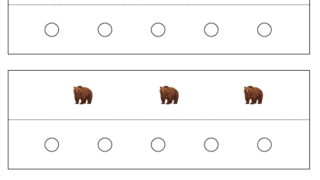
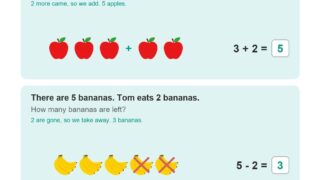
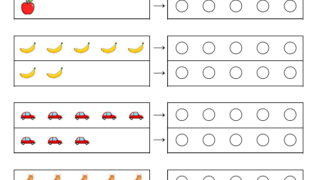
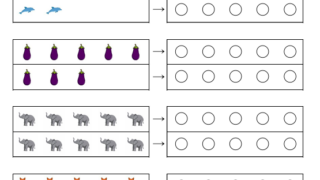

These free printable worksheets give preschool and kindergarten children practice comparing two amounts. Each box holds two rows of pictures. The child counts the first row and writes how many there are in the box beside it, counts the second row and writes that number too, and then circles the larger of the two numbers they have just written.
This is the harder of the two sets. It uses the same pictures as Set 1, but the groups are roughly five to ten instead of one to five, and they are scattered across the row rather than lined up. Both changes remove the shortcuts: a child can no longer take in the group at a glance, and the wider-looking row is not reliably the bigger one.
What Is in This Free Compare Numbers Worksheet Pack
- Five printable worksheets, three comparisons on each page.
- Two rows of pictures in every box, with a box to write each count in.
- Groups of about five to ten, so the counting stays achievable.
- Everyday pictures – fruit, animals, vehicles, furniture – that a child can name.
- A name and date line at the top, ready for classroom use.
- A separate PDF for every page – no sign-up, no email address, no cost.
The 5 Worksheets
One page is a complete session for most five year olds. There is no need to work through them in order, though they do get slightly harder as they go.
Worksheet 1 – Count Both Rows and Circle the Larger Number
The same apples, bananas, bears, cats, bicycles and cars as Set 1 – but the groups are now around five to ten, and the pictures are scattered instead of lined up neatly.

Worksheet 2 – Count Both Rows and Circle the Larger Number
Books, pencils, fridges, washing machines, carrots and corn. With this many pictures, a child who does not touch each one as they count will land one out almost every time.

Worksheet 3 – Count Both Rows and Circle the Larger Number
Chairs, tables, elephants, foxes, grapes and oranges. Two rows on this page differ by only one, which is the hardest comparison to make without counting carefully.

Worksheet 4 – Count Both Rows and Circle the Larger Number
Pigs, pandas, juice, milk, whales and frogs. The scattered layout means the wider row is not always the bigger one.

Worksheet 5 – Count Both Rows and Circle the Larger Number
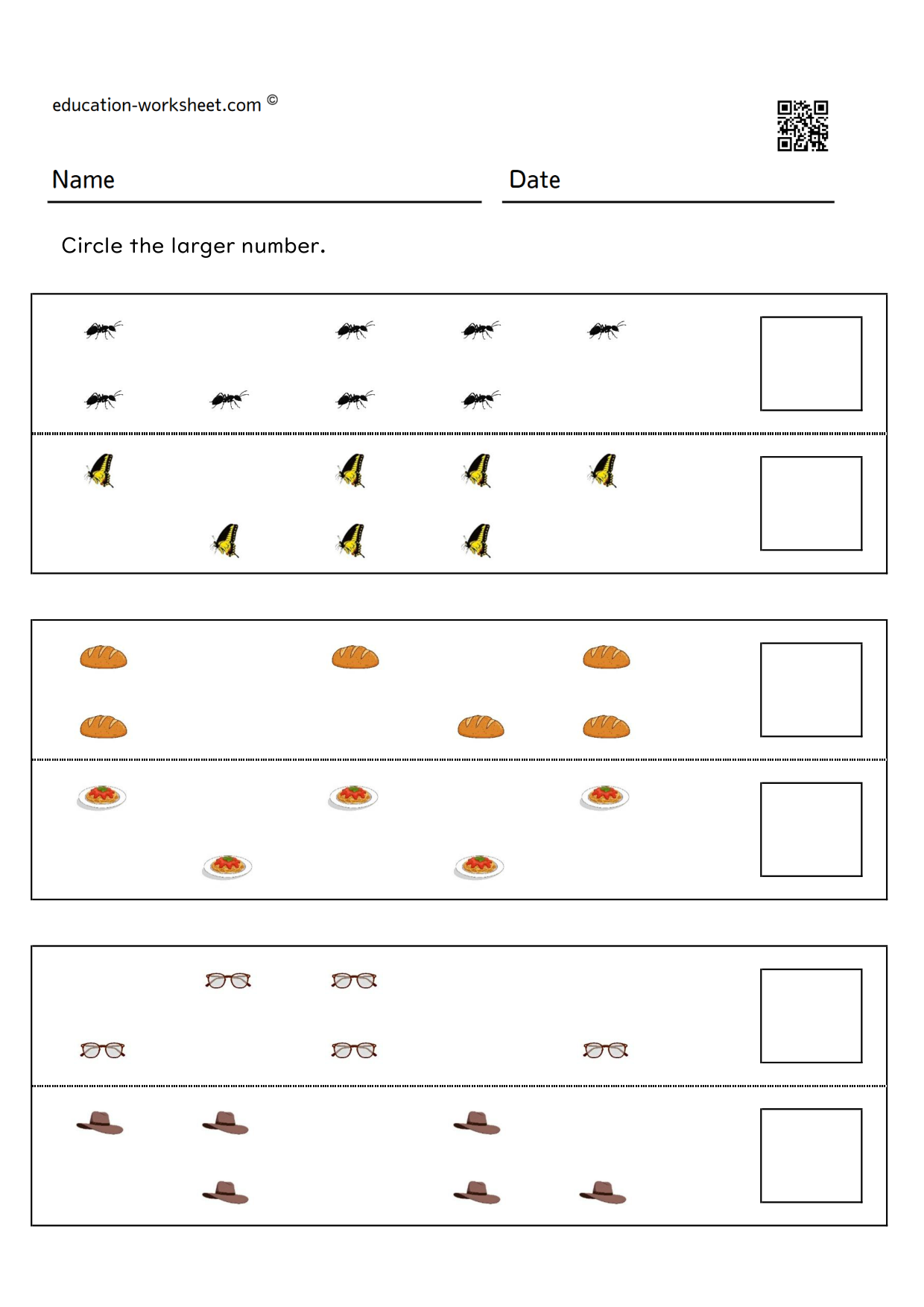
Ants, butterflies, bread, spaghetti, glasses and hats. The last and hardest page in the pack.
Why Children Write the Numbers Themselves
Comparing is the point of the page, but counting is the work. By the time a child has written 6 and 4 in the two boxes, the comparison is usually obvious to them – and if it is not, you have learned something useful, because it means the numerals are not yet connected to the amounts they stand for.
If your child writes the right numbers but then circles the wrong one, do not treat it as a careless mistake. Ask them to point to the row with more pictures. Almost every child gets that right, and the gap between the two answers is exactly what needs practice.
When Children Are Ready for These Worksheets
These pages suit children from about five to six years old, and follow on from Set 1. Start here only once counting to five is reliable, because the effort in this set goes into keeping track of larger scattered groups rather than into the comparison itself.
In American classrooms this sits inside the kindergarten counting and comparison standards: counting objects to say how many there are, and comparing two groups to tell which has more (Common Core K.CC.B.5 and K.CC.C.6). It is the step that comes before the greater-than and less-than symbols, which are easier to teach once a child already knows what the comparison means.
How to Use These Worksheets
- Print one page on ordinary paper.
- Count the first row out loud together, touching each picture once.
- Write the number in the box before moving on. Doing both rows first and then writing is where children lose track.
- Once both numbers are down, ask “which one is more?” and let them circle it.
- Ask “how do you know?” on one box per page. The explanation is worth more than the circle.
Three Things to Watch For
Circling the row with the bigger pictures
Size and quantity are easy to confuse at this age. Some boxes in this pack deliberately draw the smaller group larger. If your child falls for it, count both rows together and let the numbers settle the argument.
Circling the longer row
A row of four spread out can look longer than a row of six packed together. This is one of the most reliable early-counting mistakes there is, and it disappears with practice rather than with explanation.
Writing the number but not using it
Watch for a child who counts, writes the numbers correctly, and then goes back to looking at the pictures to decide which is bigger. That is a sign the numerals are still just shapes, and it is worth a few sessions of counting games away from paper.
Printing Tips
- Choose Actual size or Fit to page so the boxes stay big enough for a young child to write in.
- Each page fills one sheet and works on both US Letter and A4 paper.
- Printing in greyscale saves ink, though the pictures are easier to tell apart in color.
- Slip a page into a plastic wallet and use a dry-wipe pen to reuse it with more than one child.
Frequently Asked Questions
What age are these comparing numbers worksheets for?
About five to six years old – they follow on from Set 1.
Are the numbers printed on the page?
No. The child counts each row and writes the number themselves, then circles the larger one.
Does my child need to write numbers already?
It helps, but reversed or wobbly numerals are normal and fine. What matters is that the number they write matches what they counted.
Is there an answer key?
No separate key – the pictures are the answer. Counting the row again together settles any disagreement.
Do I need to sign up to download these?
No. Every PDF downloads immediately, with no account and no cost.
Can I use these in my classroom?
Yes, they are free to print for home and classroom use. Please do not sell them or re-host the files elsewhere.
More Free Comparing and Counting Worksheets
- Free Circle the Larger Number Worksheets – Set 1, the easier set
- Free More or Fewer Worksheets for Kindergarten – Compare Two Groups
- Free How Many More Worksheets for Kindergarten – Compare
- Free Counting 1 to 10 Worksheets – Count and Write
- Count and Color the Circles 1-5
- Free Learn the Numbers 1 to 10 Worksheets – Ten Frames and Tracing