
These free printable missing numbers worksheets give kindergarten children ten pages of practice writing the numbers from 1 to 20 in order. Each page shows the same chart with some of the numbers taken out, and the child writes in the ones that are gone.
The chart is a grid, not a line: four rows of five boxes, holding 1–5, 6–10, 11–15 and 16–20. Numbers that are already there sit in a pale green box. Boxes to fill in are plain white, so a child can see at a glance how much work is on the page. There are exactly seven blanks on every page – seventy numbers written across the whole pack.
One detail is worth knowing before you print: 1 and 20 are filled in on all ten pages. Neither end is ever missing. A child is never asked to carry on past the last number they can see, which is what makes these pages usable by a child who is still unsure above fifteen.
- What Is in This Free Missing Numbers Worksheet Pack
- The 10 Missing Numbers Worksheets
- Worksheet 1 – A Run of Four: 16, 17, 18, 19
- Worksheet 2 – Blanks Spread Across All Four Rows
- Worksheet 3 – The Middle of the First Ten Disappears
- Worksheet 4 – The Second Row Almost Empty
- Worksheet 5 – The Teens Stay, the First Ten Goes
- Worksheet 6 – Single Blanks, One After Another
- Worksheet 7 – A Run of Four in the Teens: 15, 16, 17, 18
- Worksheet 8 – Two Missing in Nearly Every Row
- Worksheet 9 – The Only Page Where 11 Is Missing
- Worksheet 10 – Two Pairs in the Teens: 13, 14 and 16, 17
- Why the Numbers Sit in a Grid Instead of a Line
- When Children Are Ready for These Worksheets
- How to Use These Worksheets
- Three Things to Watch For
- Printing Tips
- Frequently Asked Questions
- More Free Number Worksheets
What Is in This Free Missing Numbers Worksheet Pack
- Ten printable worksheets, one 1–20 chart on each page.
- Seven numbers to write on every page, seventy in all.
- 1 and 20 always given, so the sequence is anchored at both ends.
- A different set of blanks on every page – no page repeats another.
- A name and date line at the top of each page.
- A separate PDF for every page, free to download and print.
The 10 Missing Numbers Worksheets
The pages are not arranged from easy to hard. Page 1 is one of the three hardest in the pack, because four of its blanks sit next to each other. If this is your child’s first chart, start with page 2, 5 or 6, where no gap is longer than two boxes, and keep pages 1, 3 and 7 for later.
Worksheet 1 – A Run of Four: 16, 17, 18, 19
The whole top row is already filled in, which makes the start easy. The last row is another matter: only the 20 is left standing, so four boxes in a row have to be written from memory or counted on from the 15 above them. Along with pages 3 and 7, this is the hardest page here. Missing on this page: 6, 13, 14, 16, 17, 18, 19.
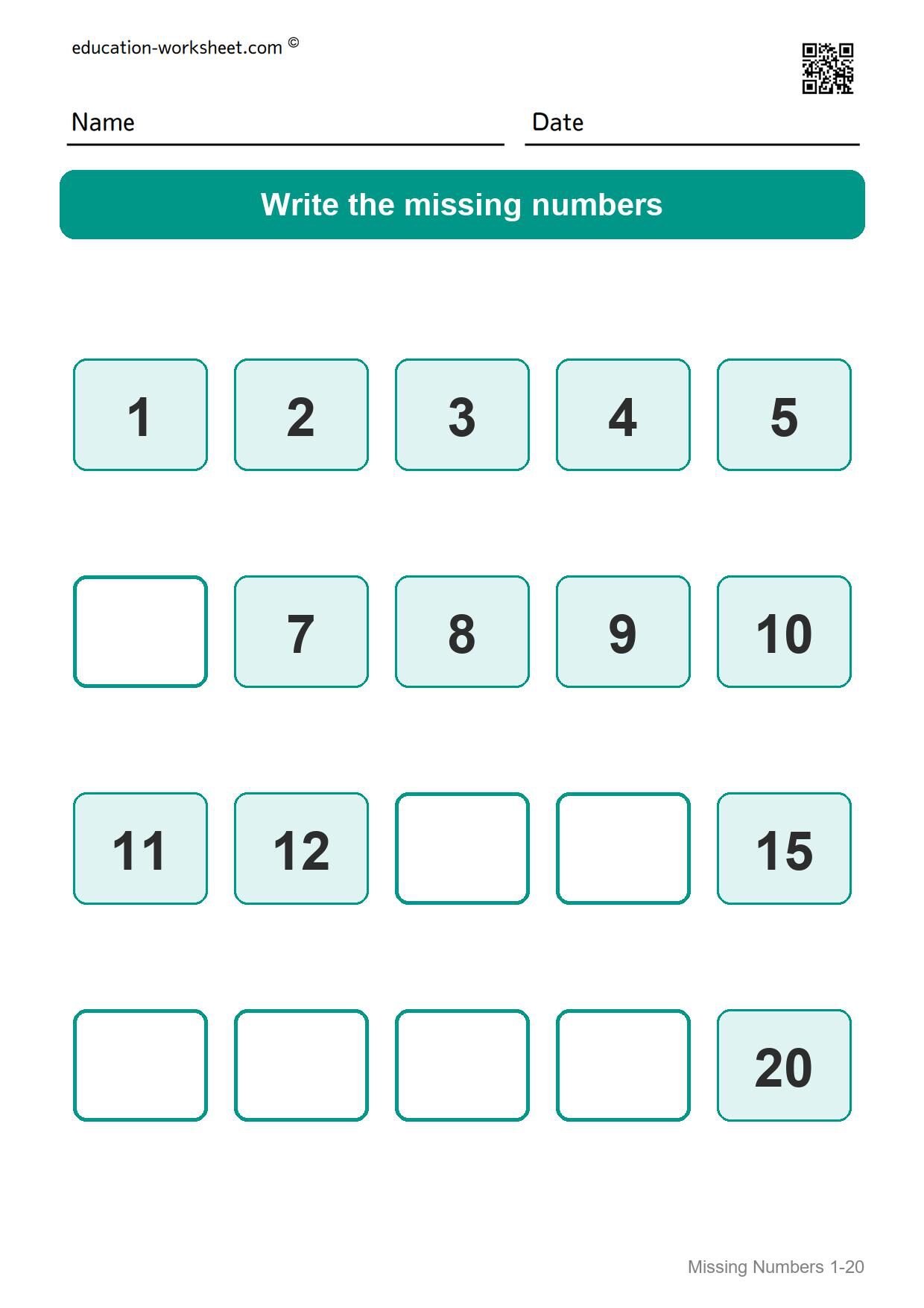
Worksheet 2 – Blanks Spread Across All Four Rows
Seven blanks, no two of them more than two apart, and at least one in every row. Each answer has a neighbor still showing, so a child can always count on from something. A good first page. Missing on this page: 4, 5, 9, 12, 14, 16, 19.
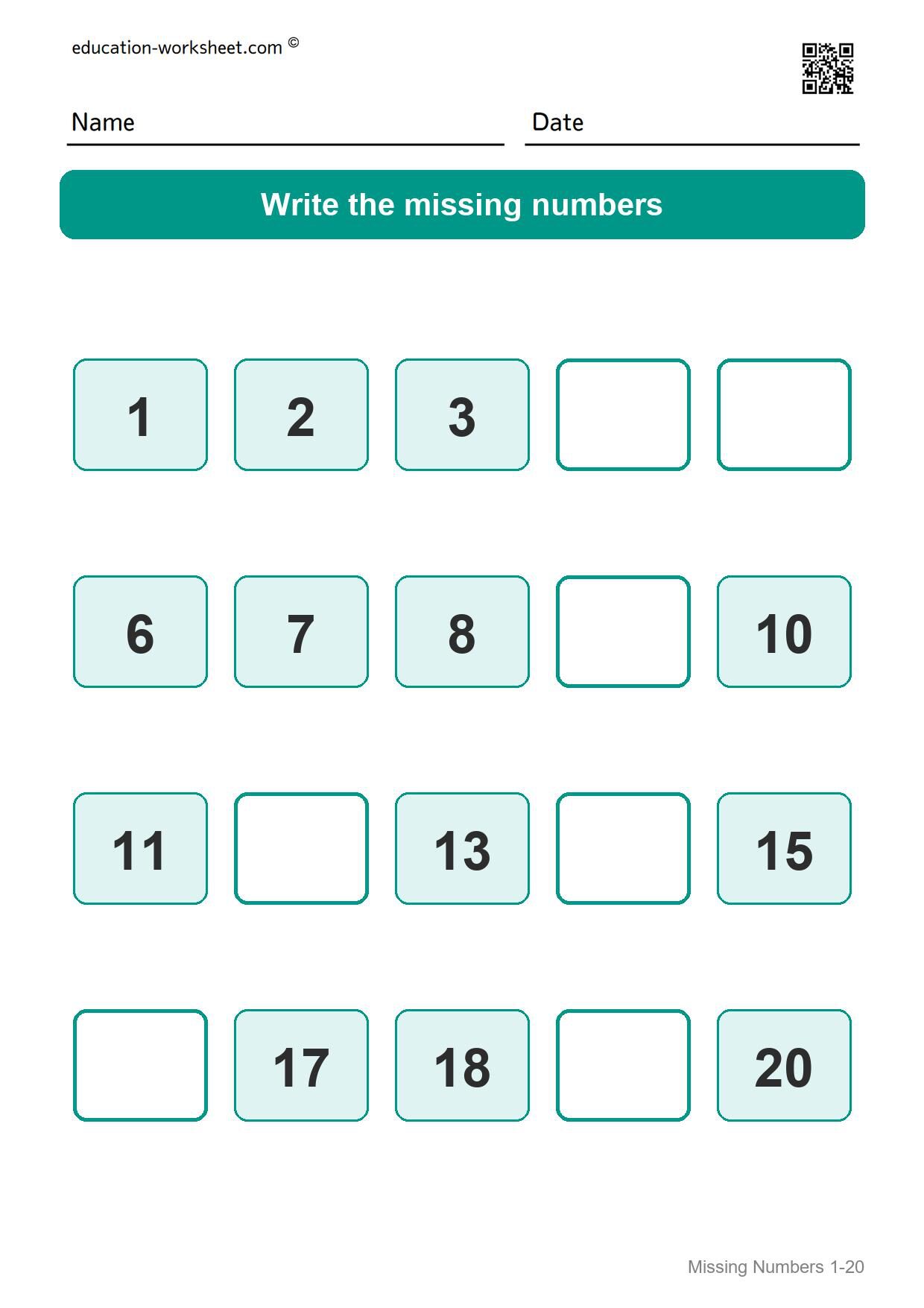
Worksheet 3 – The Middle of the First Ten Disappears
Four numbers in a row are gone – 4, 5, 6 and 7 – and that run crosses the end of the first row into the second. Crossing from 5 to 6 while counting on is exactly the point where young children slip, so stay nearby for this one. The third row is complete. Missing on this page: 2, 4, 5, 6, 7, 16, 18.
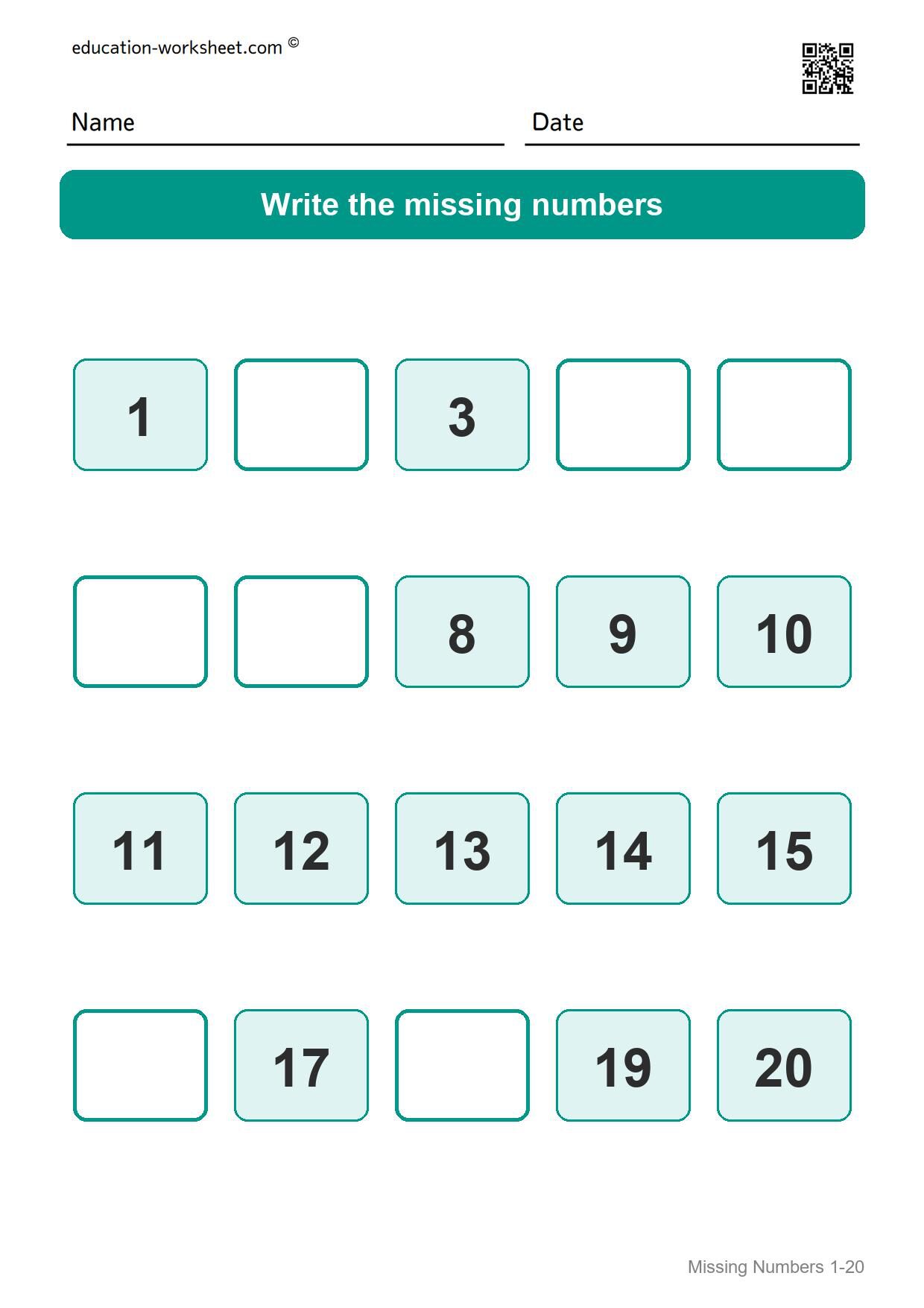
Worksheet 4 – The Second Row Almost Empty
The top row is untouched and the row below it has lost nearly everything: 6, 7, 8 and 10 are all blank, leaving one lonely 9. This is the page that shows whether a child really knows the order of the numbers, or has been reading them off the boxes on either side. Missing on this page: 6, 7, 8, 10, 15, 17, 19.
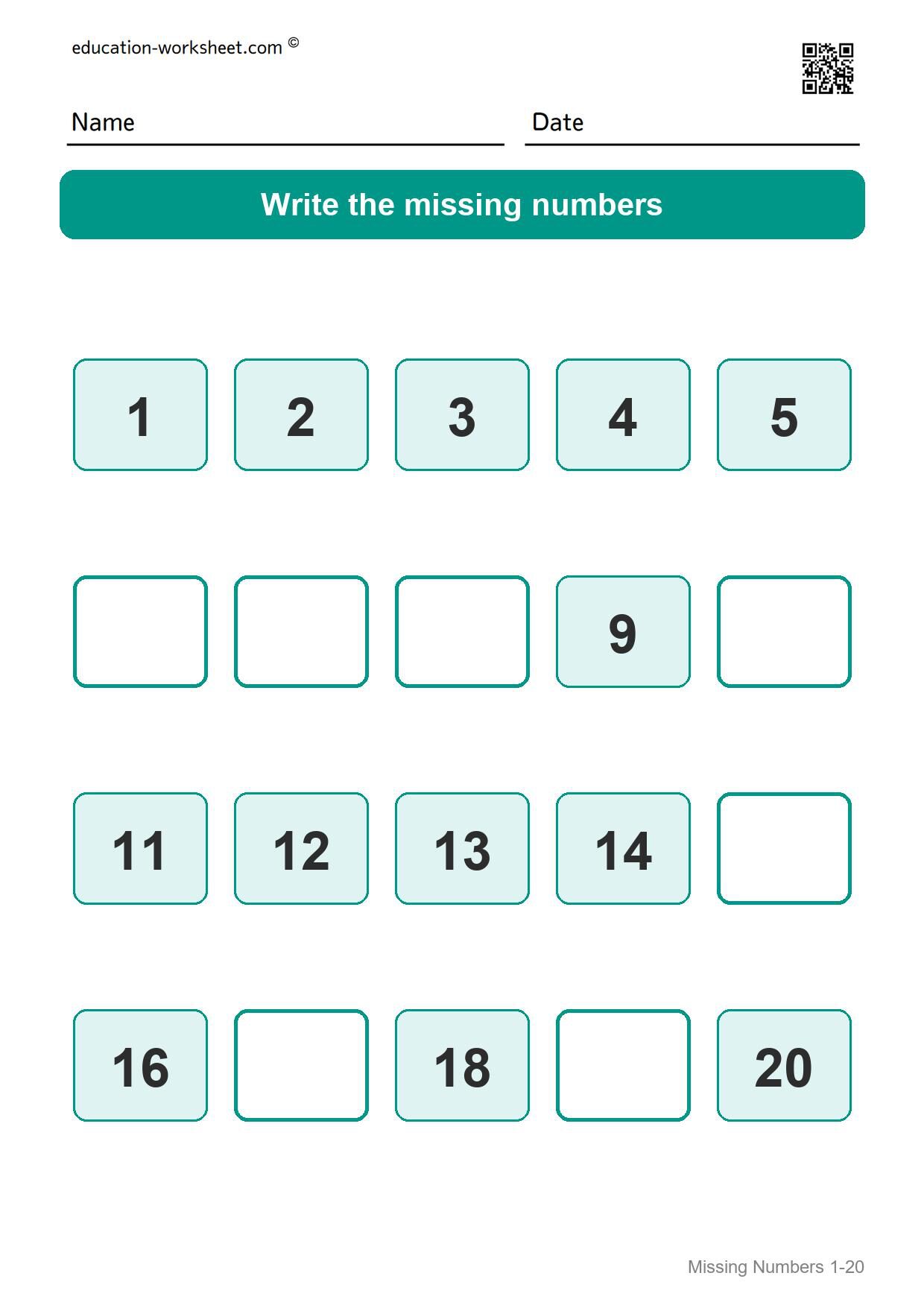
Worksheet 5 – The Teens Stay, the First Ten Goes
Five of the seven blanks are below ten, and the whole bottom row, 16 to 20, is already written in. Useful for a child who is confident with the teens but still hesitates over the small numbers. Missing on this page: 2, 3, 5, 8, 9, 13, 14.
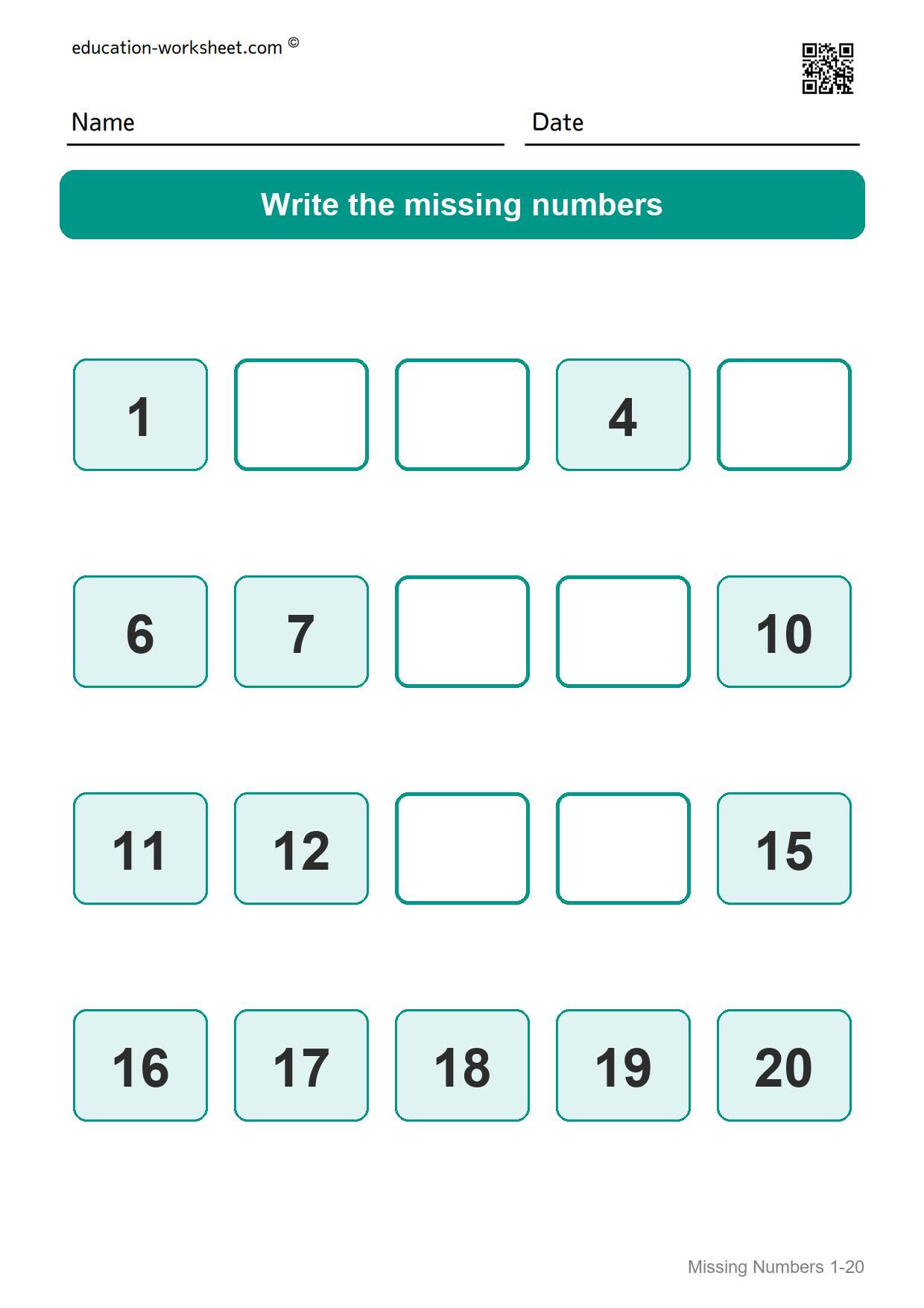
Worksheet 6 – Single Blanks, One After Another
Seven separate blanks, none of them touching. Every answer sits between two numbers a child can see, which makes this the gentlest page in the pack and a sensible place to start. Missing on this page: 2, 6, 7, 9, 12, 14, 17.
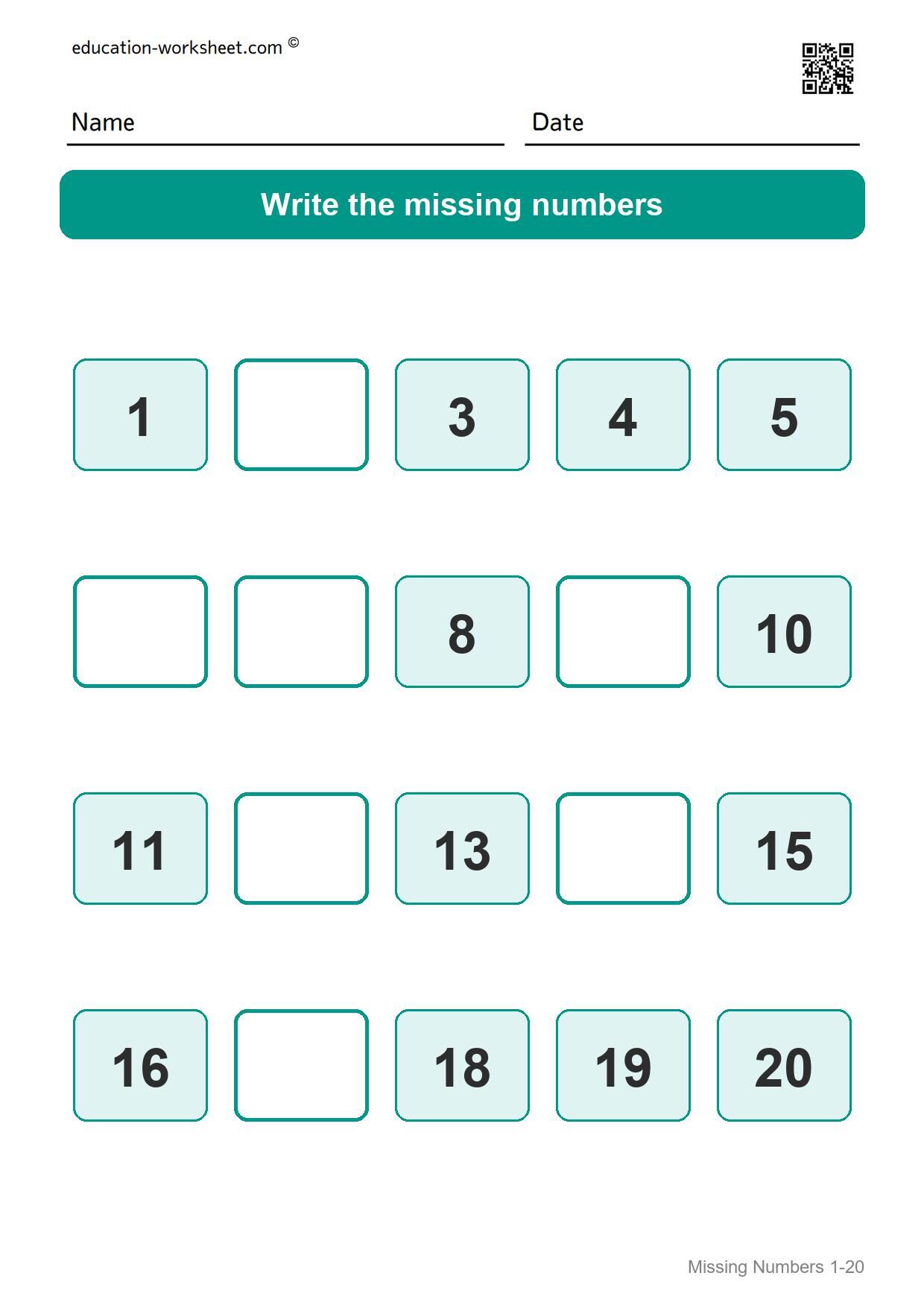
Worksheet 7 – A Run of Four in the Teens: 15, 16, 17, 18
The second row, 6 to 10, is complete, and then the page asks for four teen numbers in a row. Teens are the numbers children write backwards most often, so this page is worth checking carefully – see the third point under “Three Things to Watch For”. Missing on this page: 3, 4, 13, 15, 16, 17, 18.
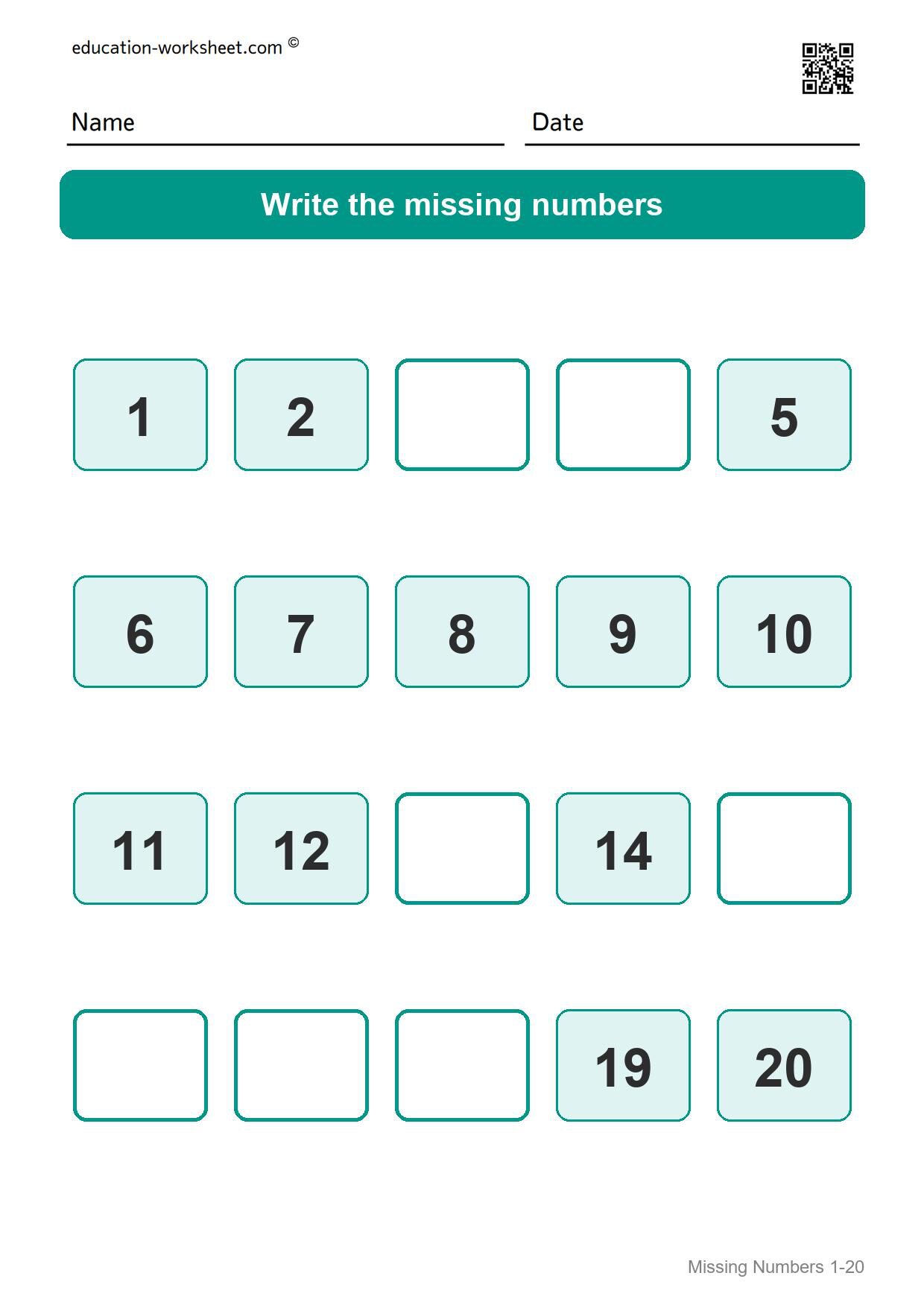
Worksheet 8 – Two Missing in Nearly Every Row
Two blanks in each of the first three rows and one in the last, and none of them touching except the 15 and 16 that straddle the end of the third row. Crossing a row boundary is the one thing this page asks that the gentler pages do not. Missing on this page: 2, 5, 7, 10, 13, 15, 16.
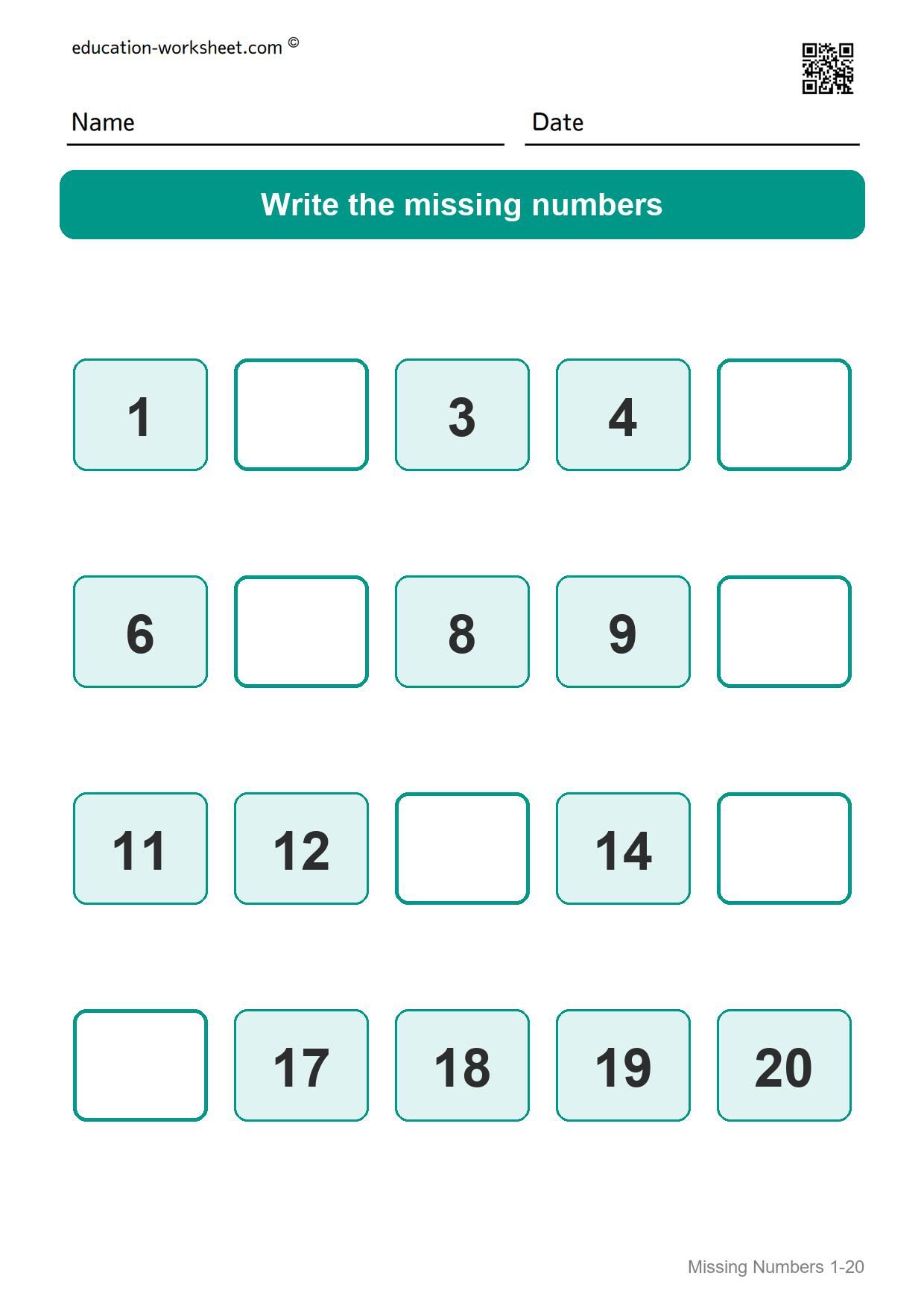
Worksheet 9 – The Only Page Where 11 Is Missing
Across all ten pages, 11 is left blank exactly once, and this is it. The first row also loses 3, 4 and 5 together. If your child has just learned to write the teens, this page is the one to give them. Missing on this page: 3, 4, 5, 7, 11, 13, 19.
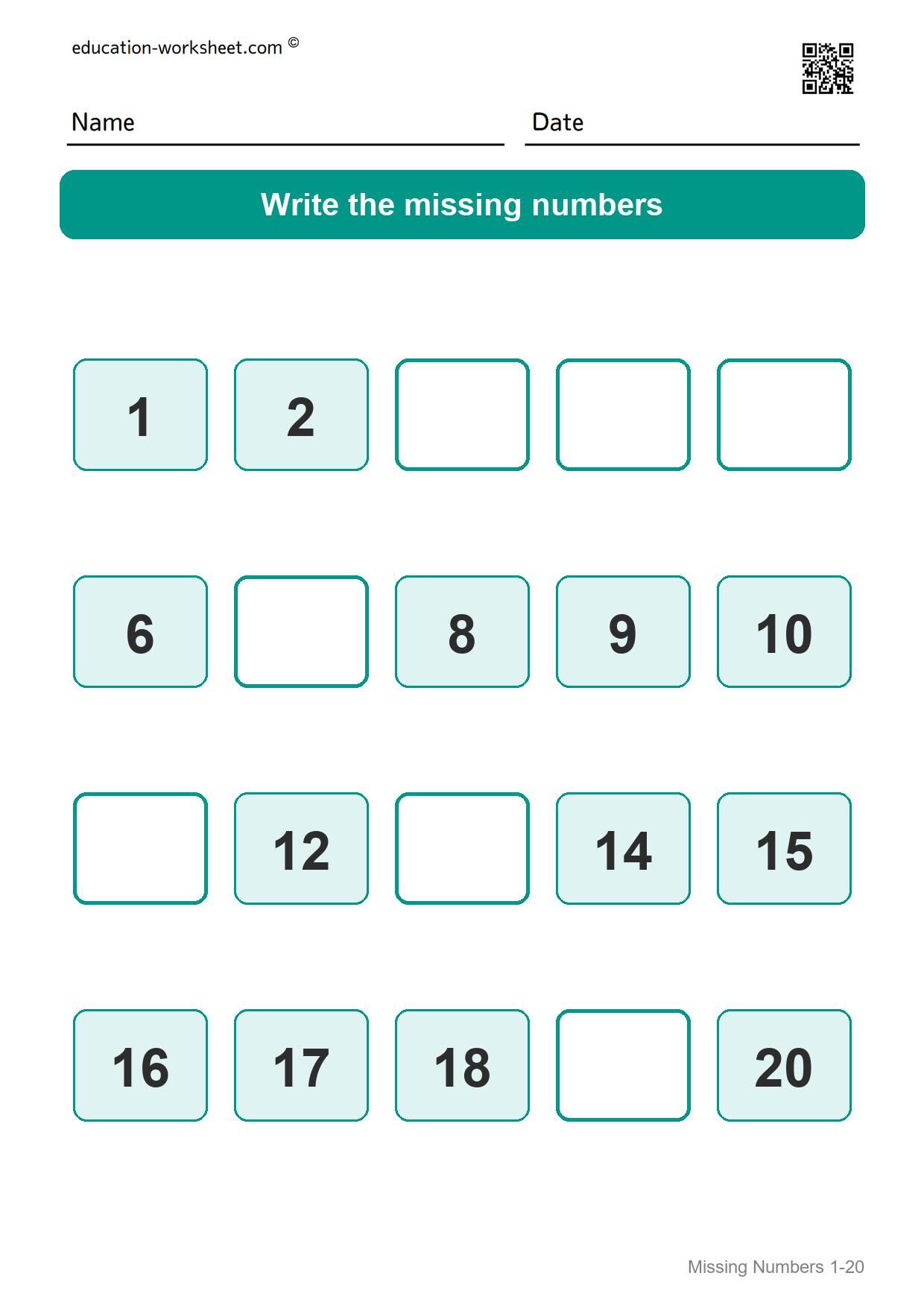
Worksheet 10 – Two Pairs in the Teens: 13, 14 and 16, 17
Three single blanks below ten, then two pairs in the teens. Pairs are a small step up from single blanks: the second number of a pair has no visible neighbor before it, so it has to come from counting on rather than from looking. Missing on this page: 3, 6, 8, 13, 14, 16, 17.
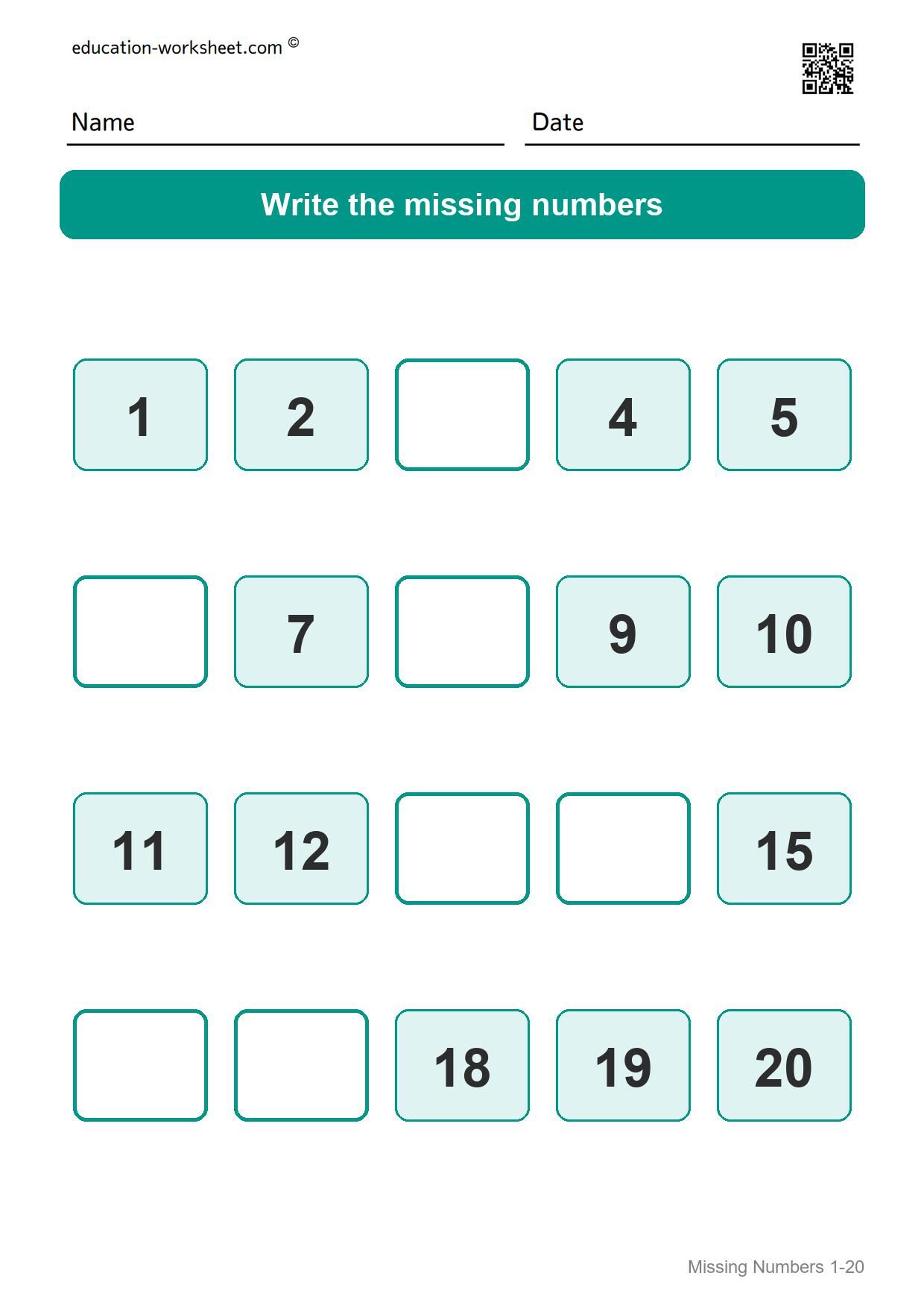
Why the Numbers Sit in a Grid Instead of a Line
A number line would have worked. The grid does something a line cannot: because every row holds five numbers, the box directly underneath any number is exactly five more. The 3 has the 8 below it, the 8 has the 13, the 13 has the 18. A child who is stuck on a blank has a second route to the answer – look up the column instead of along the row.
That route matters on the pages with a run of four blanks. On page 1 the numbers 16, 17, 18 and 19 are all gone at once, so counting on from the box before only works for the first of them. Looking up the column gives a fresh starting point for each one.
The pale green fill on the given numbers does a quieter job. It turns the page into something a child can survey before starting: seven white boxes, seven numbers to write. Children who find a full page of work discouraging often settle once they can see that the end is in sight.
When Children Are Ready for These Worksheets
These pages suit children from about four and a half to six, which in most classrooms means kindergarten and the first weeks of first grade. A child is ready when they can count out loud to twenty fairly reliably and can form most of the numerals, even untidily. Perfect handwriting is not the point here.
Two Common Core standards sit behind this work. K.CC.A.2 asks children to count forward from a given number rather than always starting at one – which is precisely what a blank in the middle of a chart requires. K.CC.A.3 asks them to write the numerals 0 to 20. Filling in seven blanks is a short, complete piece of work against both.
How to Use These Worksheets
- Print one page on ordinary paper. One page is a session.
- Before your child writes anything, ask them to point at the white boxes and count them – “how many do you have to fill in?” Seven, every time.
- Read the row out loud together, saying “hmm” or “something” for each blank. The missing number often arrives in the child’s own voice.
- Write the answers. There is no need to work left to right; let them do the easy ones first.
- At the end, read the whole chart from 1 to 20 as a check. A number written backwards is usually heard before it is seen.
Three Things to Watch For
Starting again at 1 for every blank
Very common, and not a mistake so much as an earlier stage. Counting on from the nearest number showing is the skill these pages are really after. Cover everything to the left of the blank with your hand and ask what comes after the number just before it.
Stopping dead at a run of four
On pages 1, 3 and 7 four blanks sit together. A child who has been reading the answer off the neighboring box has nothing to lean on and may simply stop. Point at the box directly above and count on five, or go back to a page with single blanks and come back to this one another day.
Teen numbers written back to front
“Seventeen” sounds like seven, so a good many children write 71. It is a hearing problem, not a counting problem, and it clears up with time. Saying the number while writing it – “one, then seven” – helps more than correcting the page afterwards.
Printing Tips
- Choose Actual size or Fit to page in the print dialog – both keep the page in proportion.
- Each page fills one sheet and works on US Letter and A4 paper.
- Ordinary copier paper is fine. Card is only worth it if you want the page to survive an eraser.
- Greyscale printing is fine. The pale green fill still prints as a light grey, so the difference between a given number and a blank survives.
- A page in a plastic wallet with a dry-wipe pen can be used by several children, or by the same child a week later.
Frequently Asked Questions
What age are these missing numbers worksheets for?
About four and a half to six years old, which is kindergarten and the start of first grade.
How many numbers does my child write on each page?
Seven. The blanks are different on every page, but the count is always seven, which makes the length of the task predictable.
Are 1 and 20 ever missing?
No. Both ends are given on all ten pages, so the sequence a child is asked to complete is always bounded at both ends.
Which page should we start with?
Page 6, or page 2. Both have no gap longer than two boxes, so there is always a number showing next to each blank. Leave pages 1, 3 and 7 until later.
Is there an answer key?
None is needed. Reading the finished chart aloud from 1 to 20 catches any mistake, and reading it aloud is part of the exercise.
Do I need to sign up to download these?
No. Every PDF downloads immediately, with no account, no email address and no cost.
Can I use these in my classroom?
Yes, they are free to print for home and classroom use. Please do not sell them or re-host the files elsewhere.
More Free Number Worksheets
- Free Number Order Worksheets for Kindergarten – Ordering Numbers 1 to 20
- Free Before and After Number Worksheets for Kindergarten – Numbers 1 to 12
- Free Number Tracing Worksheets 1-10 for Kindergarten – Trace, Count and Write
- Free Counting 1 to 10 Worksheets for Preschool and Kindergarten – Count and Write
- Free Connect the Dots Worksheets for Kids – Numbers 1 to 20
- Free Ordering Numbers Worksheets for Kindergarten – 1 to 100