These free printable comparing numbers worksheets give kindergarten children ten pages of practice with the greater-than, less-than and equals signs. Each page holds six problems: two numbers with an empty box between them, and the child writes >, < or = in the box.
Every page carries the same two pieces of help. A key strip shows all three symbols with their names, and one line of instruction does the real work: the open side always faces the bigger number. That sentence is the whole trick, and it is better than the crocodile story most children are told, because it describes the symbol rather than decorating it.
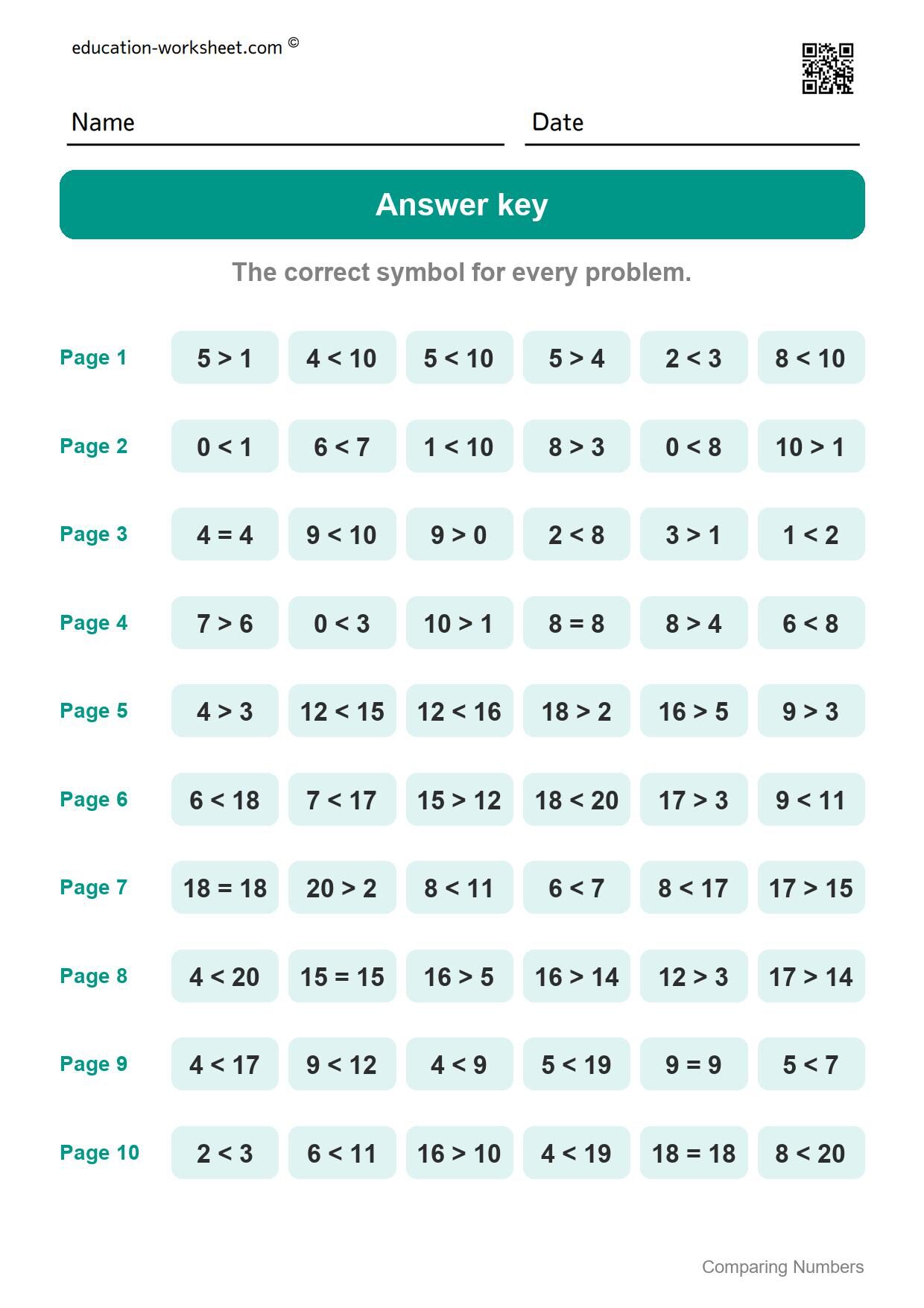
Pages 1 to 4 stay inside 10. Pages 5 to 10 go up to 20. And there is an eleventh sheet: a full answer key listing the correct symbol for all sixty problems, page by page.
- What Is in This Free Comparing Numbers Worksheet Pack
- The 10 Comparing Numbers Worksheets
- Worksheet 1 – No Equals Sign Yet
- Worksheet 2 – Zero Turns Up Twice
- Worksheet 3 – The First Equals Sign
- Worksheet 4 – Eight Against Eight
- Worksheet 5 – The Numbers Go Past Ten
- Worksheet 6 – Teens Against Single Digits
- Worksheet 7 – Eighteen Against Eighteen
- Worksheet 8 – Only One Less-Than
- Worksheet 9 – Not a Single Greater-Than
- Worksheet 10 – A Last Mixed Page
- Answer Key – All 10 Pages on One Sheet
- Where the Equals Sign Hides
- When Children Are Ready for These Worksheets
- How to Use These Worksheets
- Three Things to Watch For
- Printing Tips
- Frequently Asked Questions
- More Free Number Worksheets
What Is in This Free Comparing Numbers Worksheet Pack
- Ten printable worksheets, six problems on each page.
- Sixty problems in total – 32 less-than, 22 greater-than and 6 equals.
- Numbers to 10 on pages 1 to 4, numbers to 20 on pages 5 to 10.
- A key strip on every page showing >, < and = with their names.
- A separate answer key sheet covering all ten pages.
- A separate PDF for every page, free to download and print.
The 10 Comparing Numbers Worksheets
The pages are ordered by number size rather than by difficulty of the comparison. What moves around is the mix of symbols, and one page in particular is worth holding back – see the note under page 3.
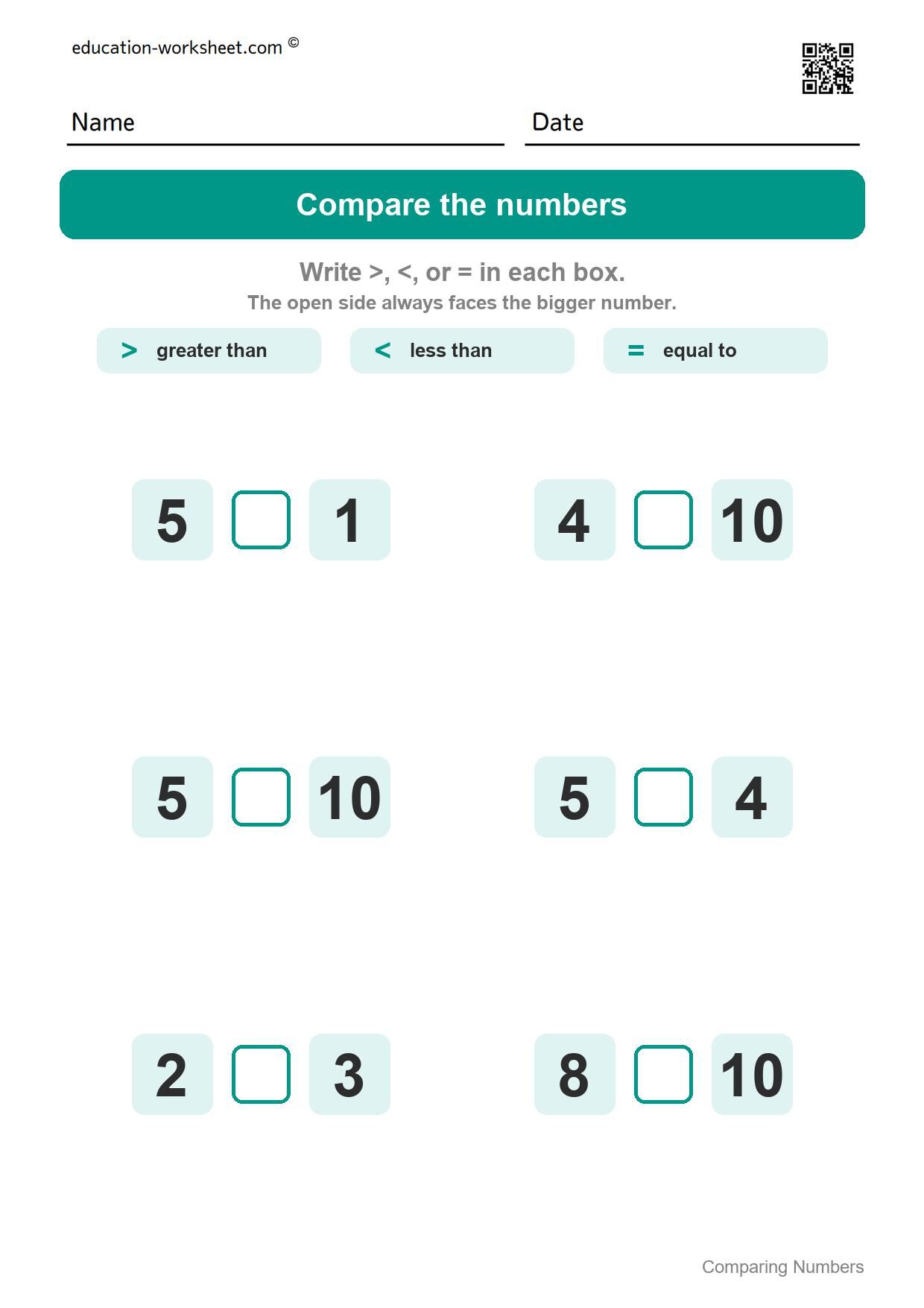
Worksheet 1 – No Equals Sign Yet
Six problems, all of them with a clear winner. A child meeting this page first will conclude that the box is always a greater-than or a less-than, which is worth knowing before page 3 arrives. Numbers to 10. The six answers are 2 greater-than and 4 less-than.
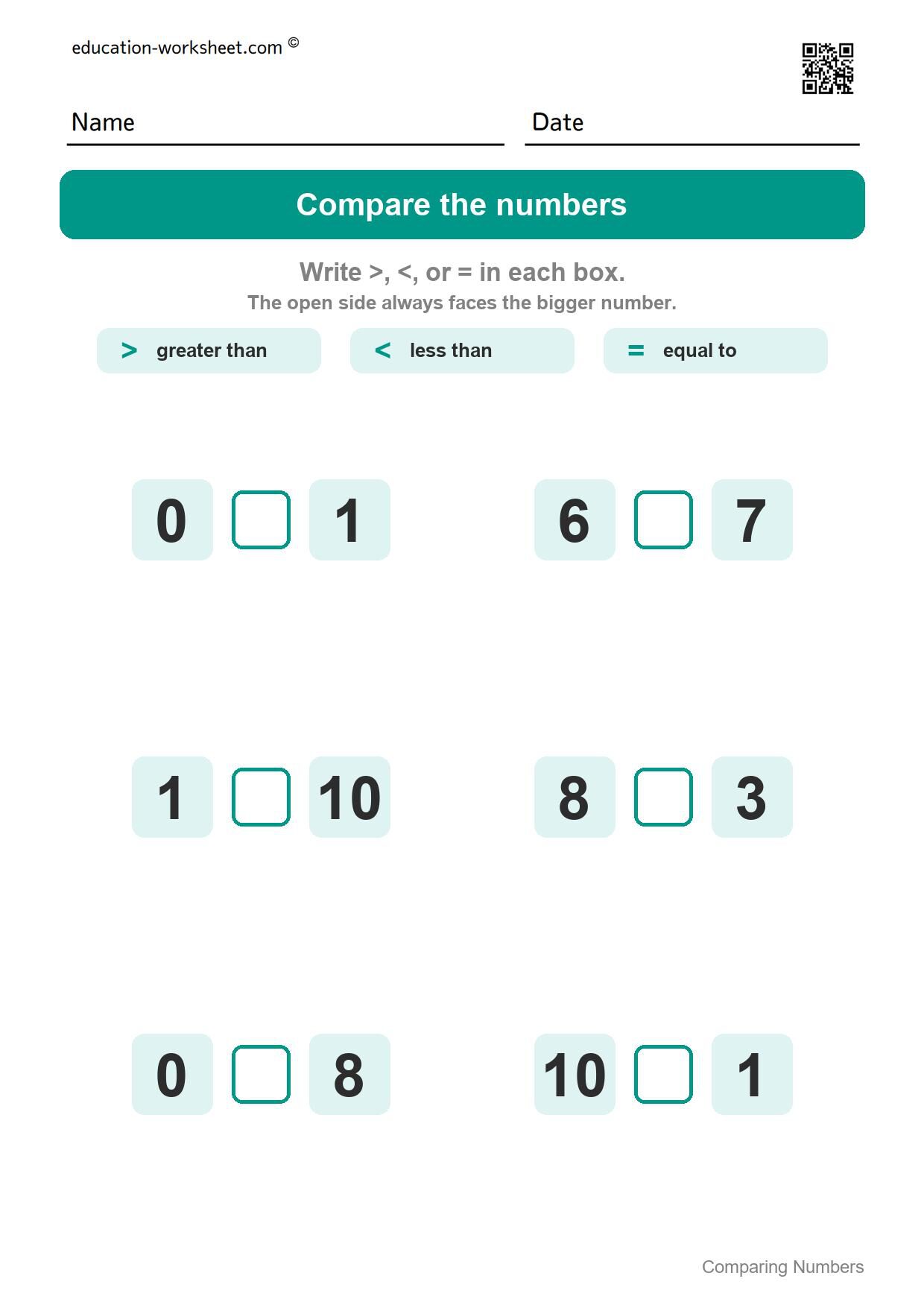
Worksheet 2 – Zero Turns Up Twice
Two problems start with 0, which is a useful and slightly odd number to compare. Nothing is smaller, and children who think of numbers as amounts of something sometimes hesitate over whether nothing counts at all. Numbers to 10. The six answers are 2 greater-than and 4 less-than.
Worksheet 3 – The First Equals Sign
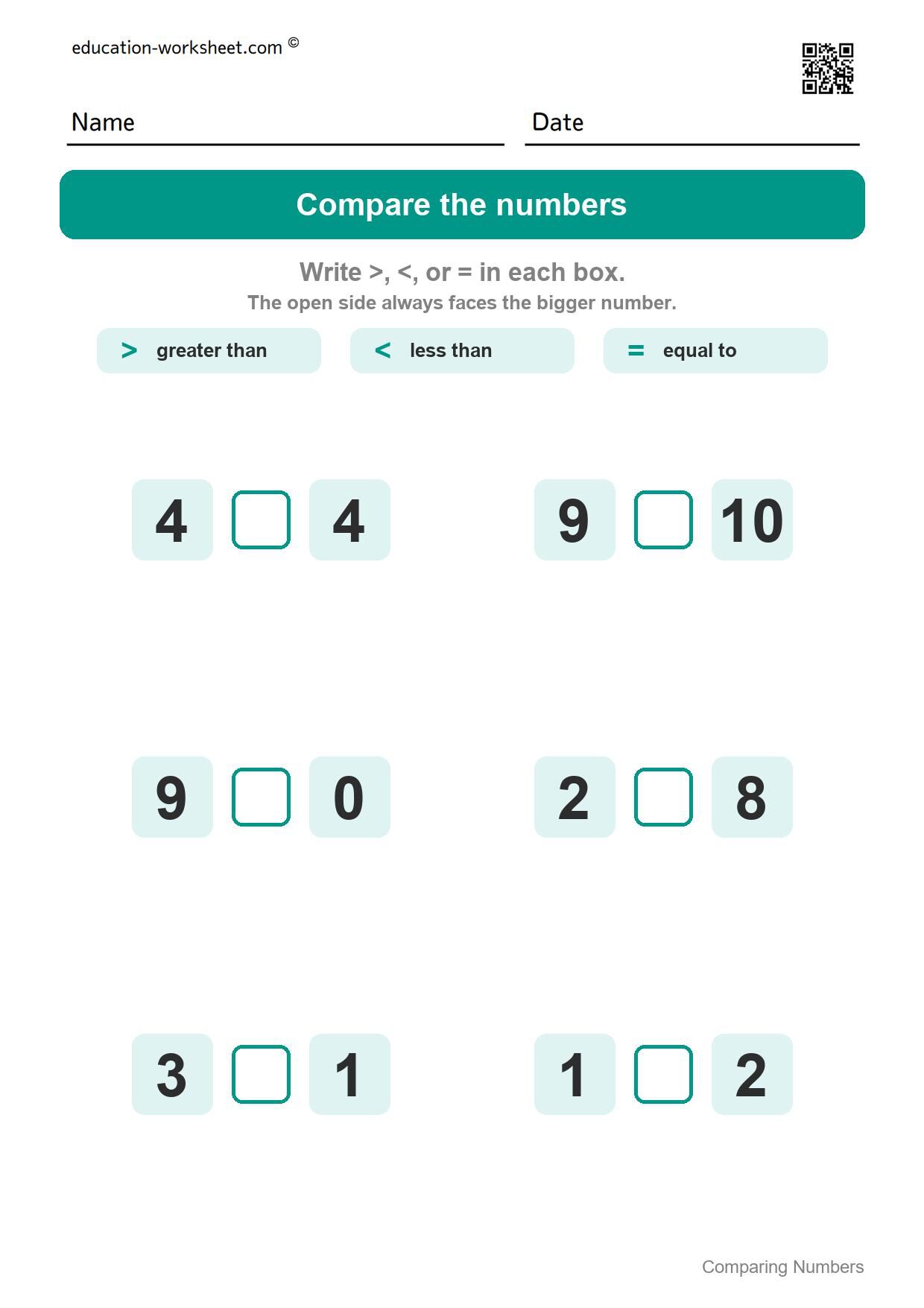
Four against four opens the page. This is the moment the pack stops being about which is bigger and starts being about what the box actually says, so do not let it go by without comment. Numbers to 10. The six answers are 2 greater-than, 3 less-than and 1 equals.
Worksheet 4 – Eight Against Eight
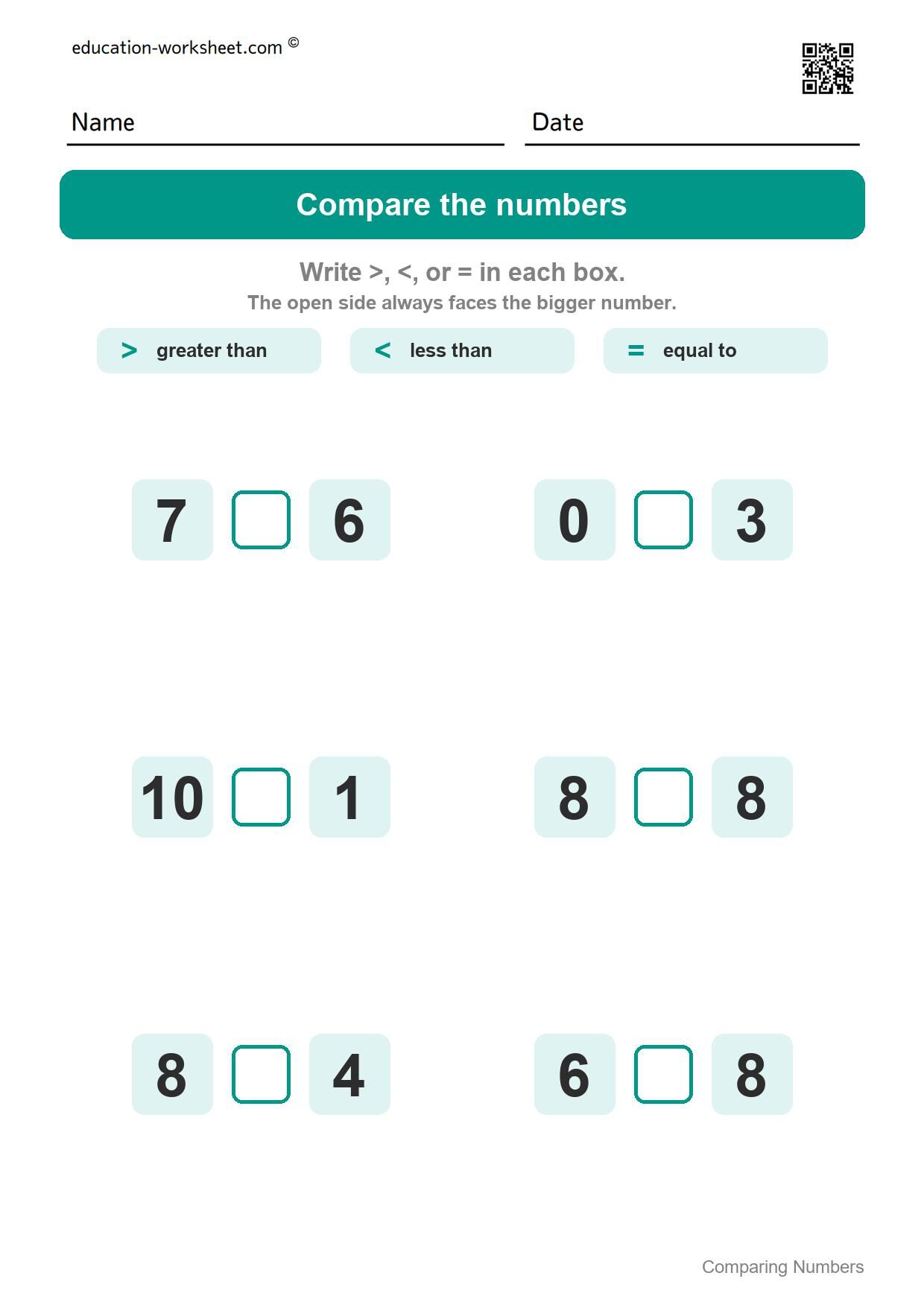
A second equals problem, this time in the middle of the page rather than at the top. The page also has the widest gap so far, ten against one. Numbers to 10. The six answers are 3 greater-than, 2 less-than and 1 equals.
Worksheet 5 – The Numbers Go Past Ten
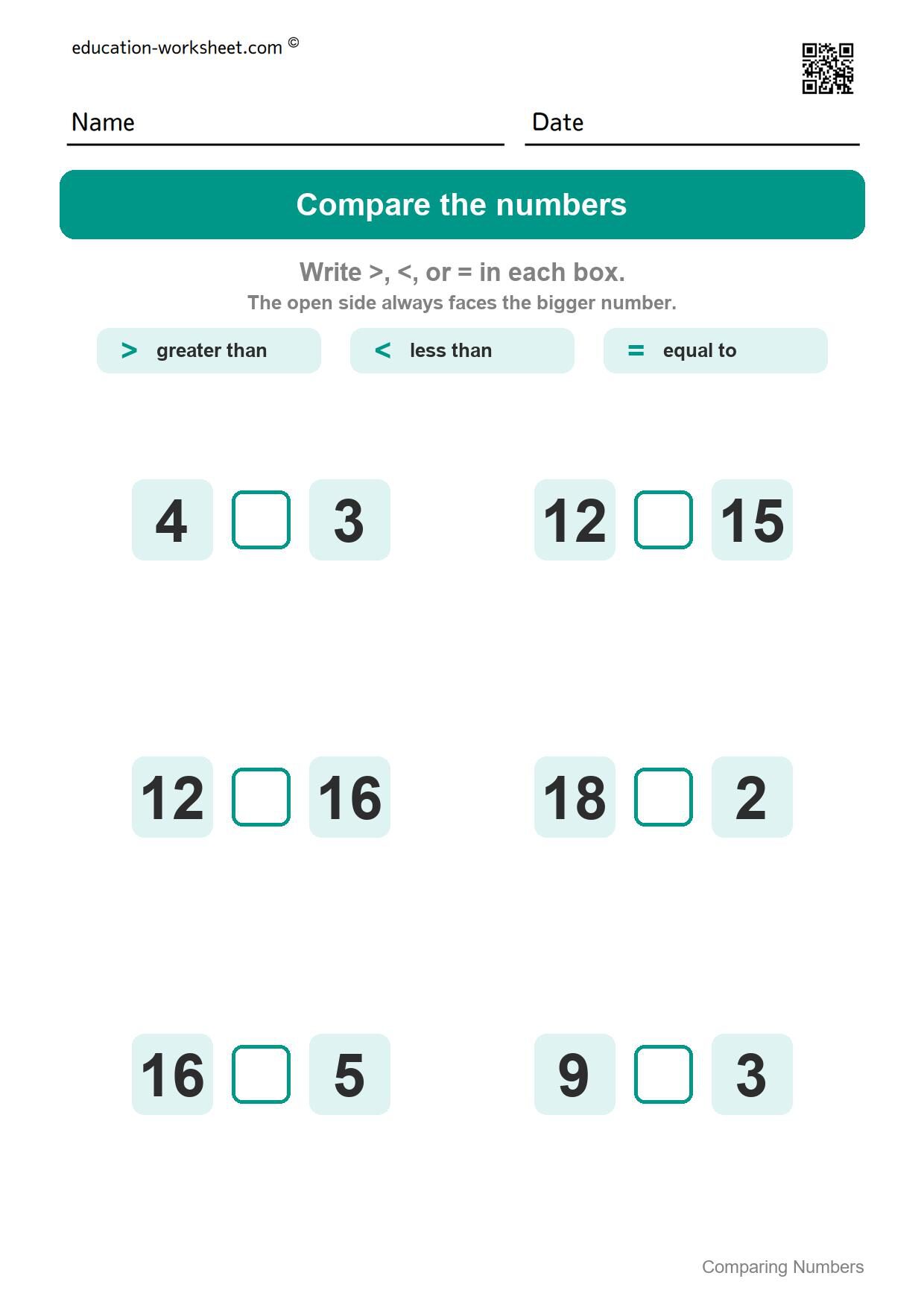
The first page of the second half, where the numbers run to 20. Four of the six problems are greater-than, which makes this the most one-sided page in the pack. Numbers to 20. The six answers are 4 greater-than and 2 less-than.
Worksheet 6 – Teens Against Single Digits
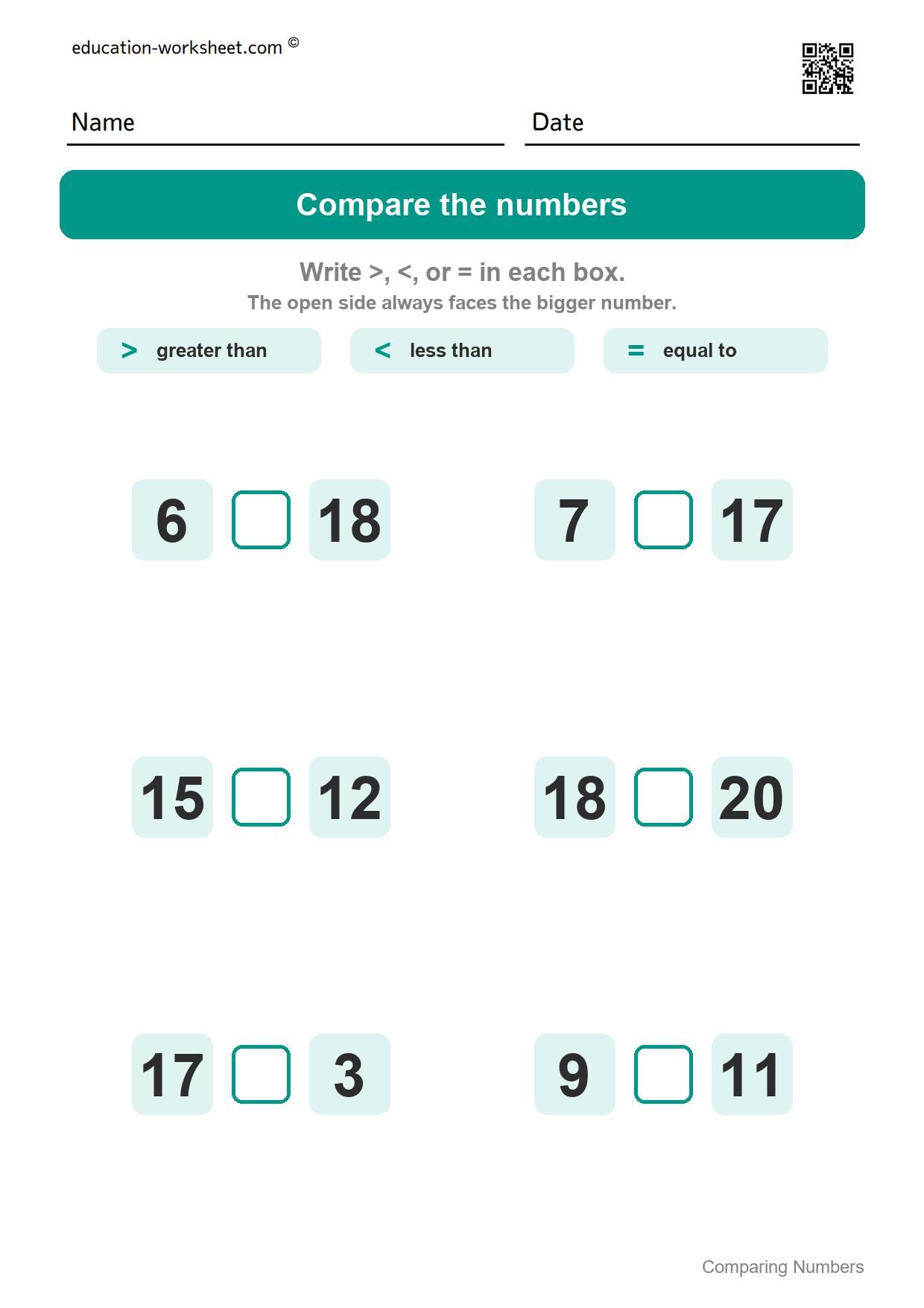
Problems like 6 against 18 look harder than they are and problems like 15 against 12 look easier. A child who compares by the size of the first digit gets 15 and 12 right by luck. Numbers to 20. The six answers are 2 greater-than and 4 less-than.
Worksheet 7 – Eighteen Against Eighteen
The equals sign returns, now with two-digit numbers. It is easier to see that 18 and 18 match than that 8 and 8 do, because there is twice as much to compare. Numbers to 20. The six answers are 2 greater-than, 3 less-than and 1 equals.
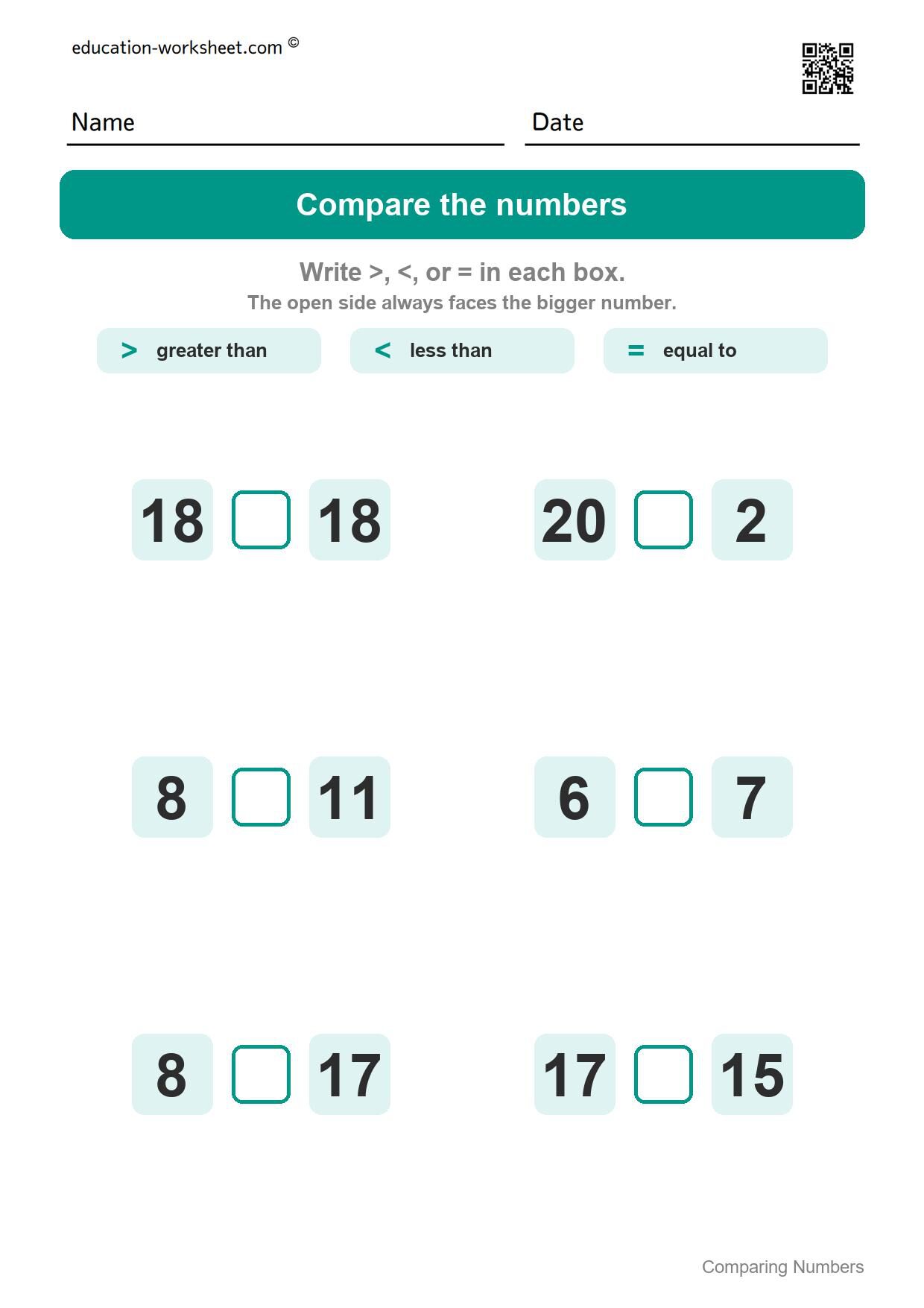
Worksheet 8 – Only One Less-Than
Five of the six problems are greater-than or equals. A page like this catches the child who has settled into writing the same symbol without reading the numbers. Numbers to 20. The six answers are 4 greater-than, 1 less-than and 1 equals.
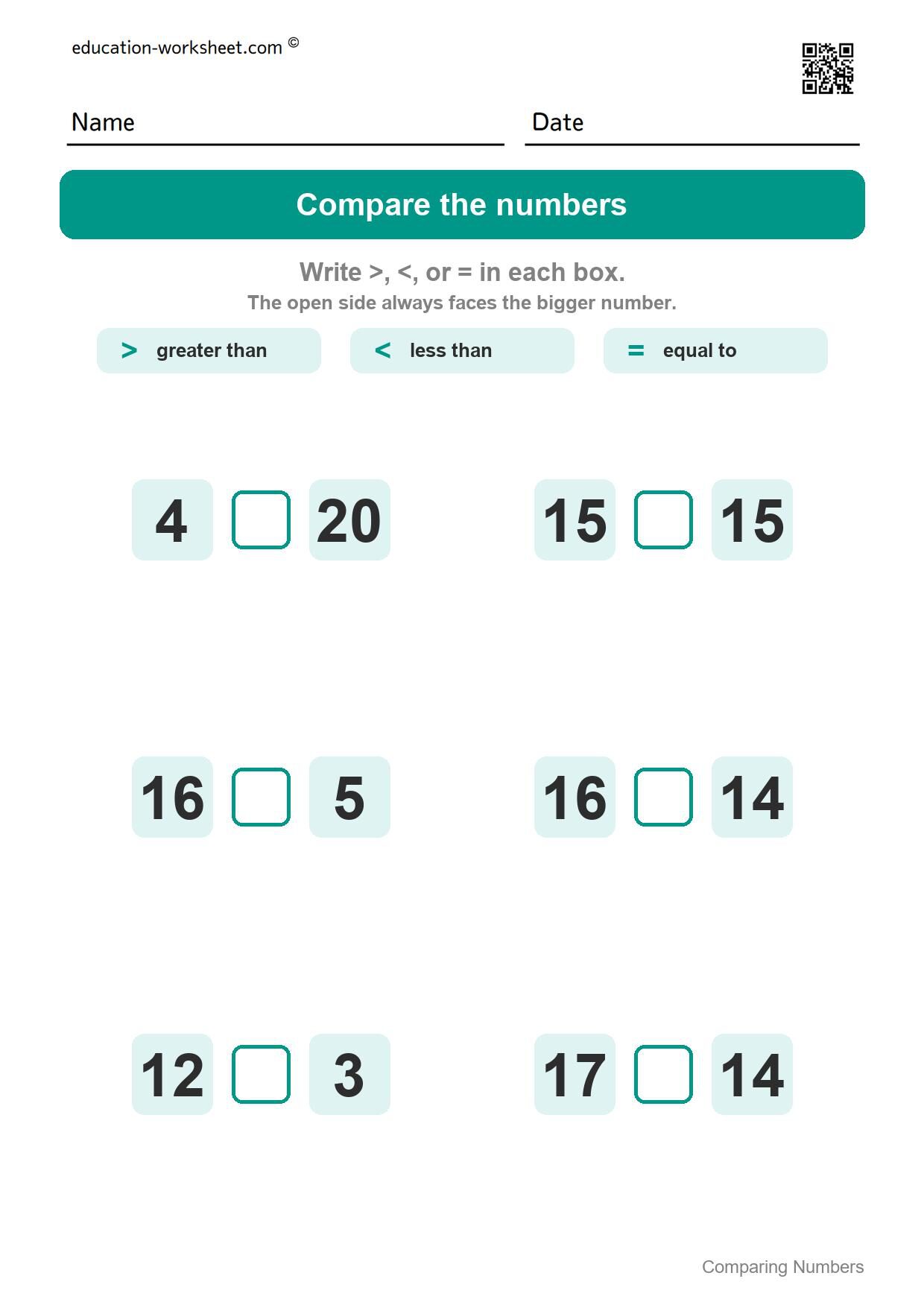
Worksheet 9 – Not a Single Greater-Than
Five less-than problems and one equals, and no greater-than anywhere on the page. If your child writes a single > here, something has been guessed rather than worked out. Numbers to 20. The six answers are 5 less-than and 1 equals.
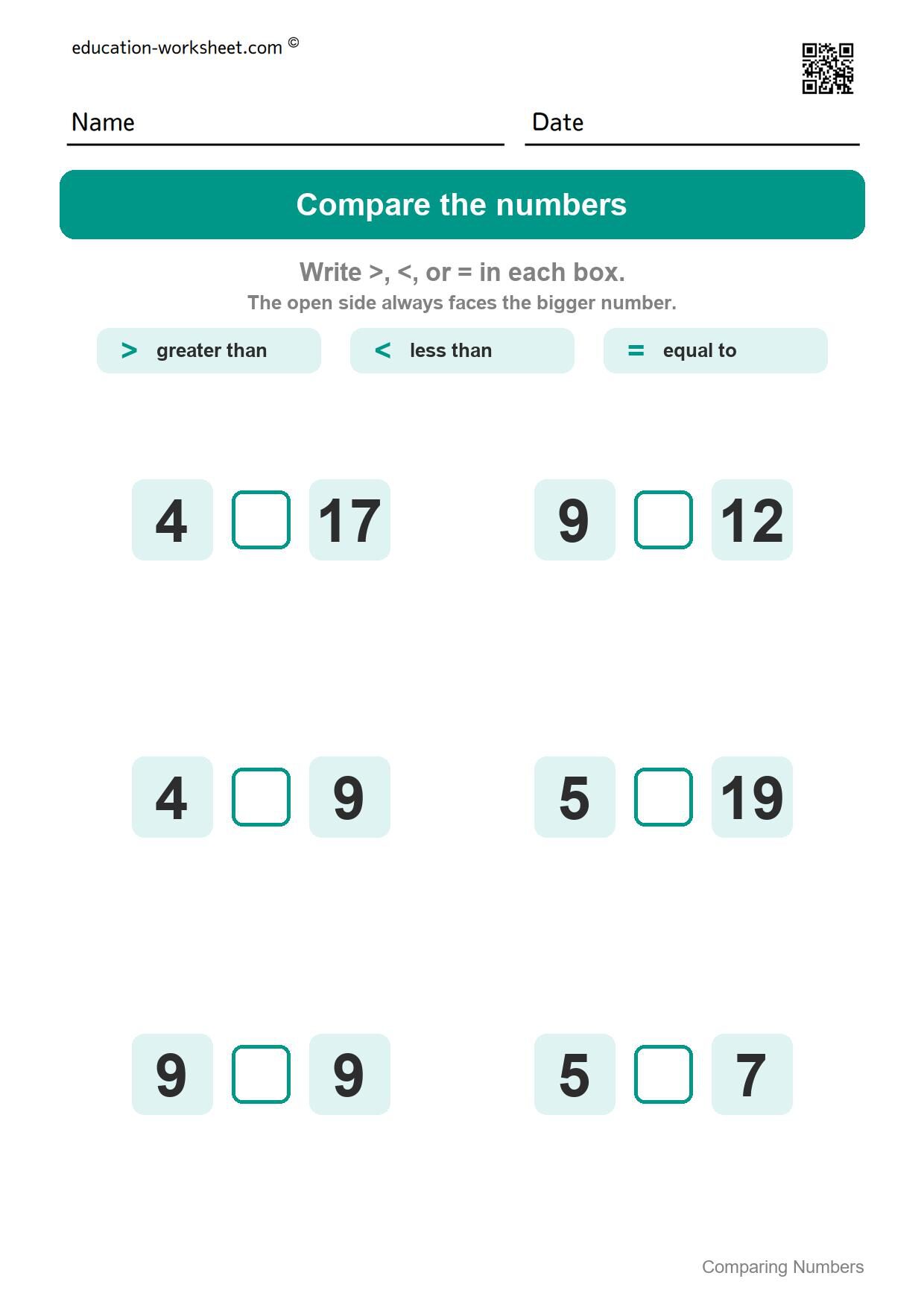
Worksheet 10 – A Last Mixed Page
Four less-than, one greater-than and one equals: close to the balance of the pack as a whole. A fair final page. Numbers to 20. The six answers are 1 greater-than, 4 less-than and 1 equals.
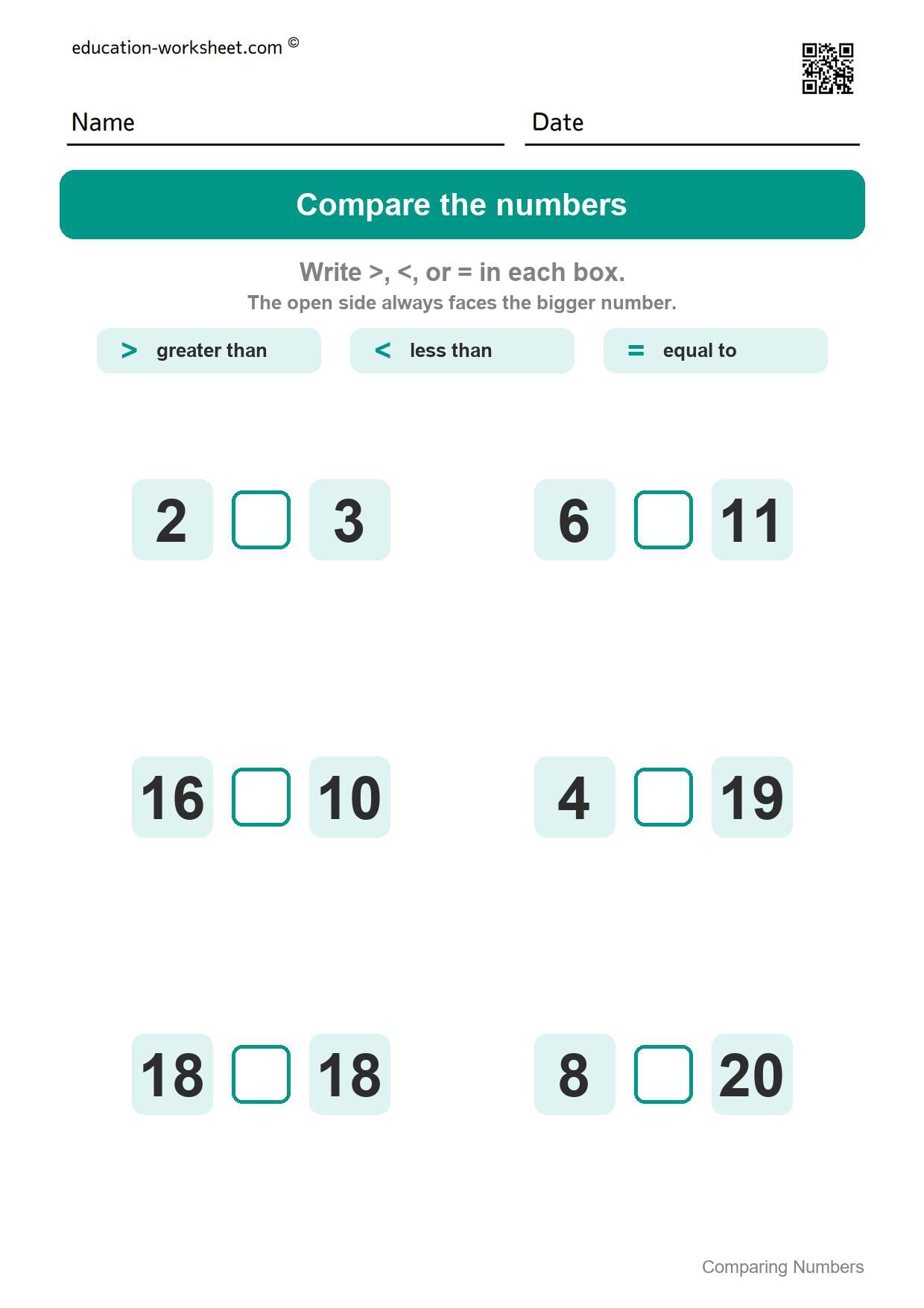
Answer Key – All 10 Pages on One Sheet
The eleventh sheet lists every problem with its correct symbol, grouped by page. Useful for a classroom, and useful at home for the argument that starts when a child is sure and you are not.
Where the Equals Sign Hides
Count the symbols across all sixty problems and the equals sign is rare: six times out of sixty, against 32 less-than and 22 greater-than. That is reasonable, since two numbers picked at random are rarely the same. What matters is where those six sit.
Pages 1, 2, 5 and 6 contain no equals problem at all. The first one appears on page 3, and the first one in the second half appears on page 7. A child who works through pages 1 and 2 meets twelve problems in a row where the box is never an equals sign, and quite reasonably stops considering it. Then page 3 opens with 4 against 4.
So page 3 is the page to slow down on, and it is worth saying out loud beforehand that the two numbers might be the same. The alternative is watching a child write a greater-than between two fours because that is what the box has always been.
Page 9 is the mirror image and just as useful. It has five less-than problems and one equals, and no greater-than anywhere on the page. If a greater-than turns up in your child’s work there, it was guessed. Page 8 does the same job from the other side, with four greater-than problems and only one less-than.
When Children Are Ready for These Worksheets
These pages suit children from about five to seven. A child is ready when they can read the numerals and knows which of two small numbers is bigger. Writing the symbols is a separate skill and the key strip at the top is there for that.
Pages 1 to 4 sit on K.CC.C.7, comparing two numbers between 1 and 10 written as numerals, and behind it K.CC.C.6, deciding whether one group is greater than, less than or equal to another. Pages 5 to 10 go past the kindergarten standard: comparing two-digit numbers with the symbols is 1.NBT.B.3, a first grade standard. That is a feature if you want something to stretch into, and worth knowing if you are using this pack for kindergarten assessment.
How to Use These Worksheets
- Print one page. Six problems is a session.
- Read the key strip together first and trace each symbol in the air.
- For each problem, say which number is bigger before writing anything. Deciding and recording are two different jobs and children fail at the second while succeeding at the first.
- Then apply the rule on the page: the open side faces the bigger number. Point the open side at it.
- Read the finished line back as a sentence: “eight is greater than three”. A symbol that cannot be read aloud has not been learned.
Three Things to Watch For
The symbol reversed
Getting the comparison right and the symbol backwards is the standard error at this age and it is not a math problem. Go back to the sentence on the page: the open side faces the bigger number. Have your child point at the bigger number first, then open the symbol towards that finger.
Never using the equals sign
Twelve problems on pages 1 and 2 without a single equals, then 4 against 4 at the top of page 3. Say beforehand that sometimes the two numbers match. The point of the equals sign is not that it is rare; it is that it has to be considered every time.
Comparing the first digit only
From page 5 the numbers pass ten, and comparing 15 with 12 by looking at the 1 gives the right answer for the wrong reason. Ask which is bigger and why. The reason is where the learning is, and it is what first grade will ask for directly.
Printing Tips
- Choose Actual size or Fit to page in the print dialog – both keep the page in proportion.
- Each page fills one sheet and works on US Letter and A4 paper.
- Ordinary copier paper is fine. Card is only worth it if you want the page to survive an eraser.
- Grayscale printing is fine. The numbers and boxes are dark and the color is decoration.
- Print the answer key on its own and keep it away from the worksheets, or it will be found.
- The box is small. A sharp pencil makes a > that can actually be told apart from a <.
Frequently Asked Questions
What age are these comparing numbers worksheets for?
About five to seven years old: kindergarten and first grade. Pages 1 to 4 are kindergarten level, pages 5 to 10 reach into first grade.
How many problems are there?
Sixty, six on each of ten pages, plus a separate answer key sheet.
Is there an answer key?
Yes. The eleventh sheet lists the correct symbol for all sixty problems, grouped by page.
How do I stop my child writing the symbol backwards?
Use the sentence printed on the page rather than a story about crocodiles: the open side always faces the bigger number. Point at the bigger number, then open the symbol towards it.
Do the numbers go above 10?
Yes, from page 5 onwards. Pages 1 to 4 stay inside 10 and pages 5 to 10 go up to 20.
Do I need to sign up to download these?
No. Every PDF downloads immediately, with no account, no email address and no cost.
Can I use these in my classroom?
Yes, they are free to print for home and classroom use. Please do not sell them or re-host the files elsewhere.
More Free Number Worksheets
- Free Circle the Larger Number Worksheets for Kindergarten – Count and Compare Two Groups
- Free More or Fewer Worksheets for Kindergarten – Compare Two Groups
- Free Comparing Numbers Worksheets for Grade 1 – Greater Less
- Free How Many More Worksheets for Kindergarten – Compare
- Free Number Order Worksheets for Kindergarten – Ordering Numbers 1 to 20
- Free Tens and Ones Worksheets for Kindergarten – Teen Numbers with Ten Frames