These free printable heavy and light worksheets give preschool and kindergarten children forty balance scales to read, four to a page. Two things hang from the two pans, one pan has gone down, and the child circles the thing the question asks for.
The balance always answers the question for you. The heavier thing goes down and the lighter thing goes up, so a child never has to know what anything actually weighs. We checked all forty balances against the answer key: the tilt and the key agree every single time.
Pages 1 to 5 ask for the heavier thing. Pages 6 to 10 ask for the lighter one. The pictures stay the same kind; only the question turns over, and that turn is what the pack is really teaching.
- What Is in This Free Heavy and Light Worksheet Pack
- The 11 Heavy and Light Worksheets
- Worksheet 1 – Circle the Heavier Thing
- Worksheet 2 – Circle the Heavier Thing
- Worksheet 3 – Circle the Heavier Thing
- Worksheet 4 – Circle the Heavier Thing
- Worksheet 5 – Circle the Heavier Thing
- Worksheet 6 – Circle the Lighter Thing
- Worksheet 7 – Circle the Lighter Thing
- Worksheet 8 – Circle the Lighter Thing
- Worksheet 9 – Circle the Lighter Thing
- Worksheet 10 – Circle the Lighter Thing
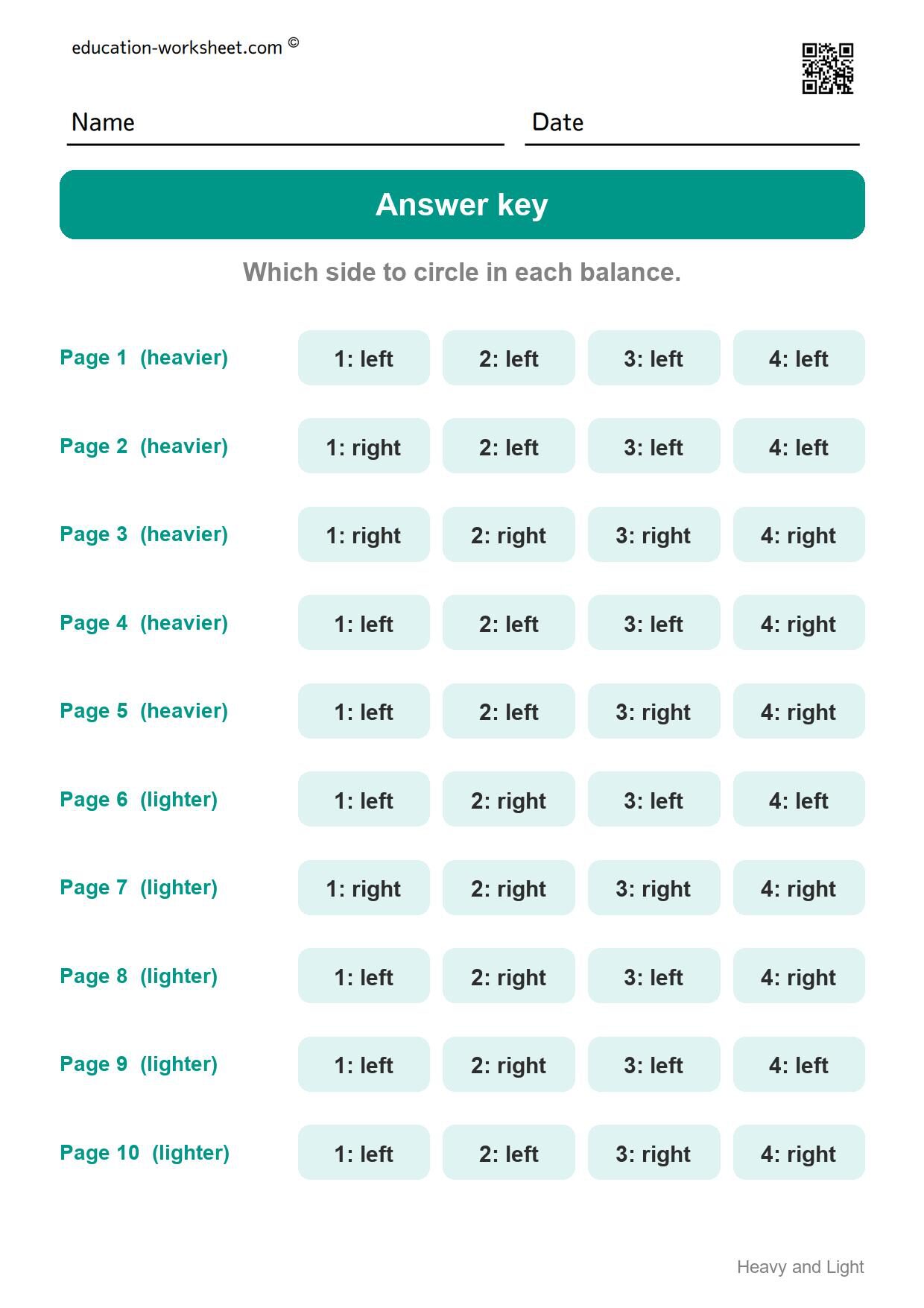
- Answer Key – All 40 Balances
- Four Pairs That Come Round Twice
- The Moon, and Why It Belongs
- When Children Are Ready for Heavy and Light
- How to Use These Worksheets
- Three Things to Watch For
- Printing Tips
- Frequently Asked Questions
- More Free Comparing Worksheets
What Is in This Free Heavy and Light Worksheet Pack
- Ten printable worksheets with four balance scales on each page – forty questions in all.
- An eleventh page with the full answer key, given as left or right.
- Twenty-two different pictures, from an elephant and a bus down to a key and a strawberry.
- Pages 1 to 5: circle the heavier thing. Pages 6 to 10: circle the lighter one.
- No reading, counting or writing – the child only circles.
- A separate PDF for every page, free to download and print.
The 11 Heavy and Light Worksheets
The difficulty in this pack is not the pictures. It is page 6. For five pages straight, the answer is the pan that has gone down, and children stop reading the instruction within about two pages. Then the question flips to the lighter thing and the same balance means the opposite answer.
That is the whole design, and it is a good one. A child who can do pages 6 to 10 has understood that a balance shows a relationship rather than a winner.
Worksheet 1 – Circle the Heavier Thing
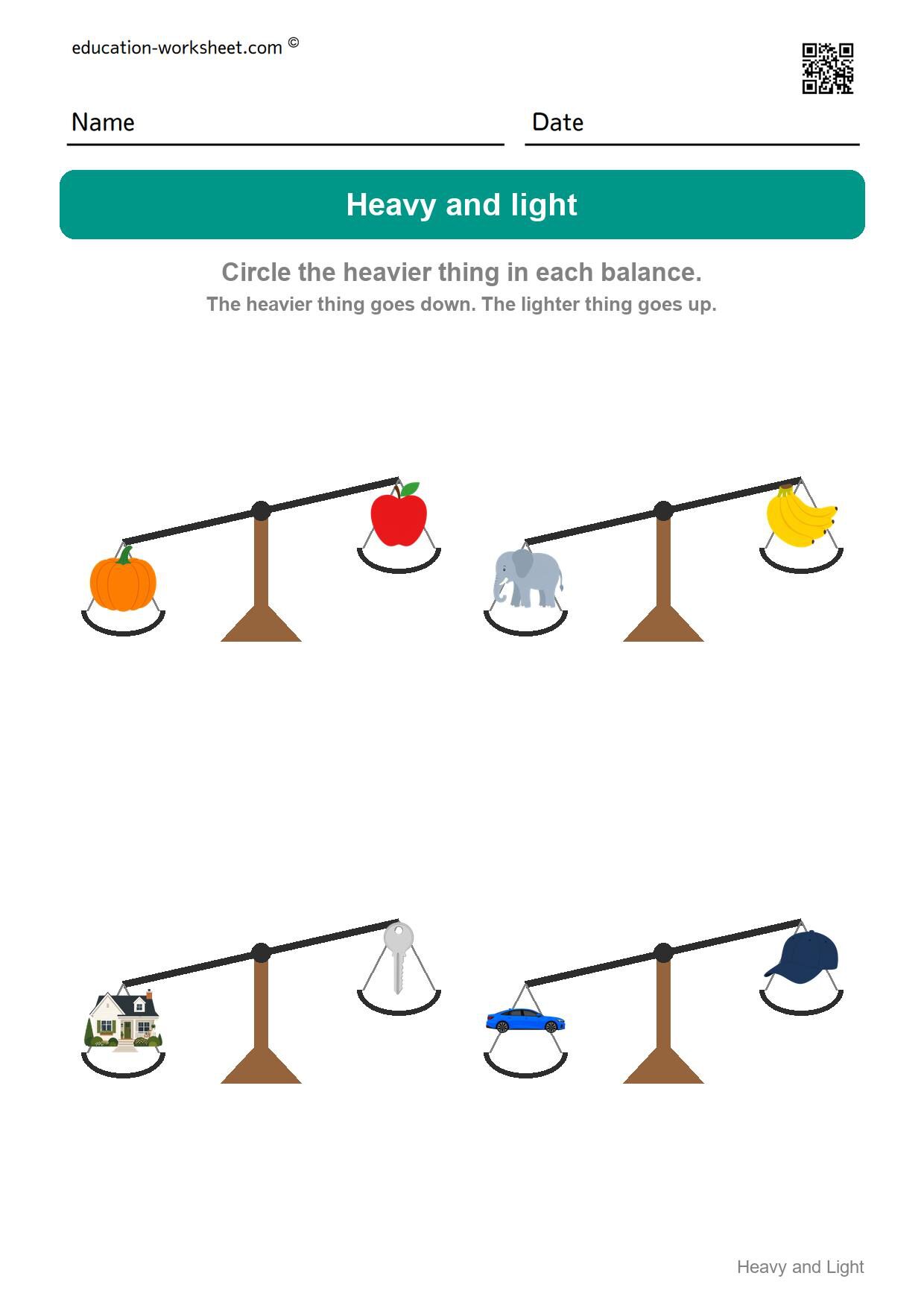
A pumpkin against an apple, an elephant against a bunch of bananas, a house against a key, and a car against a cap. Four pairs where nobody has to think twice.
All four answers are on the left-hand pan. That makes the first page easy to mark and easy to talk through, but it also means a child can finish it without ever looking at the right-hand side. Page 2 breaks the habit immediately.
Worksheet 2 – Circle the Heavier Thing
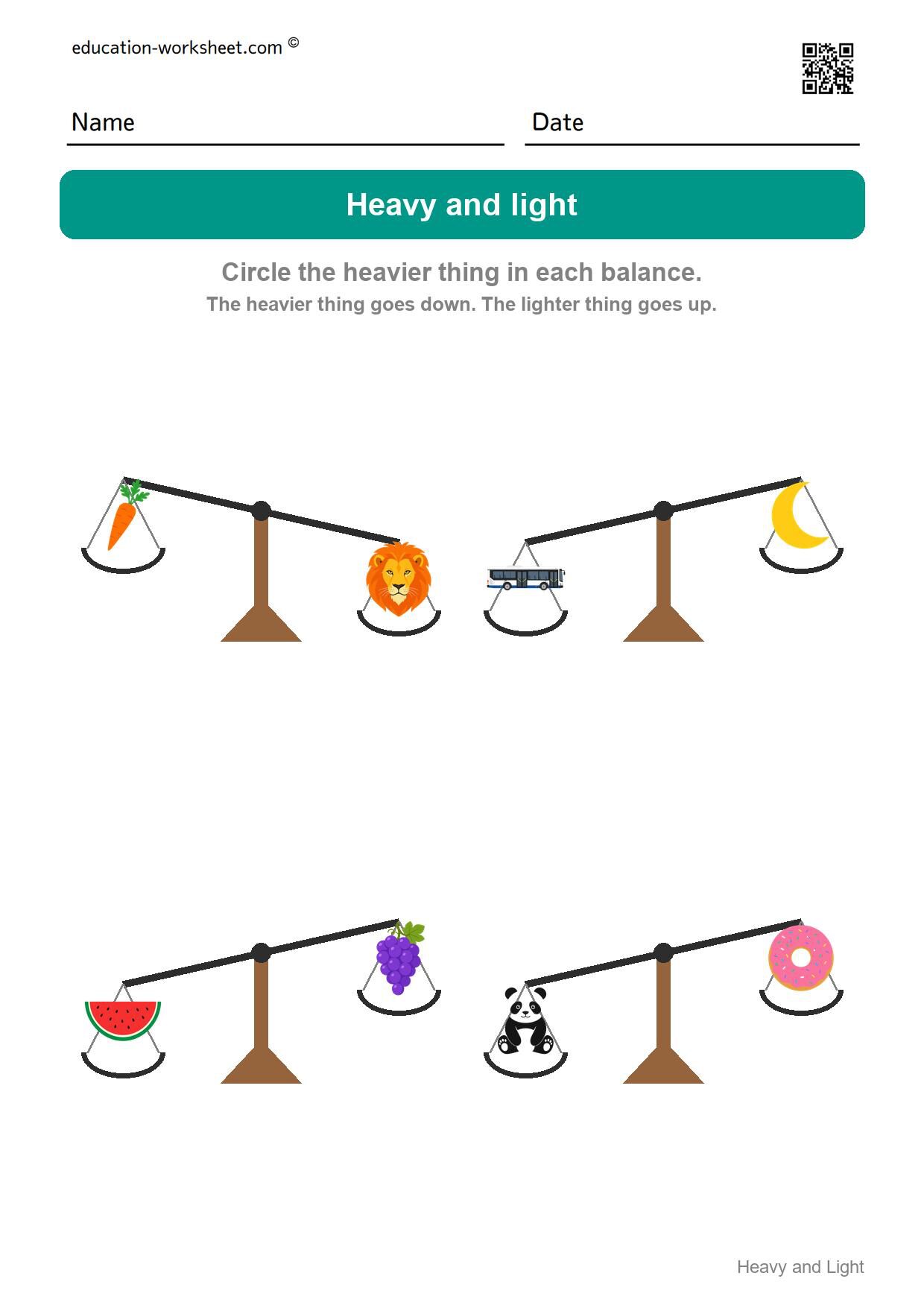
A carrot against a lion, a bus against the moon, a watermelon against grapes, a panda against a donut. The first answer is on the right, which is the first time the page does not open with the left pan.
The second row is the odd one in this pack: a bus on one side and a crescent moon on the other. Nobody knows what a picture of the moon weighs, and that is the point – the balance has already tipped, so the answer is on the page.
Worksheet 3 – Circle the Heavier Thing
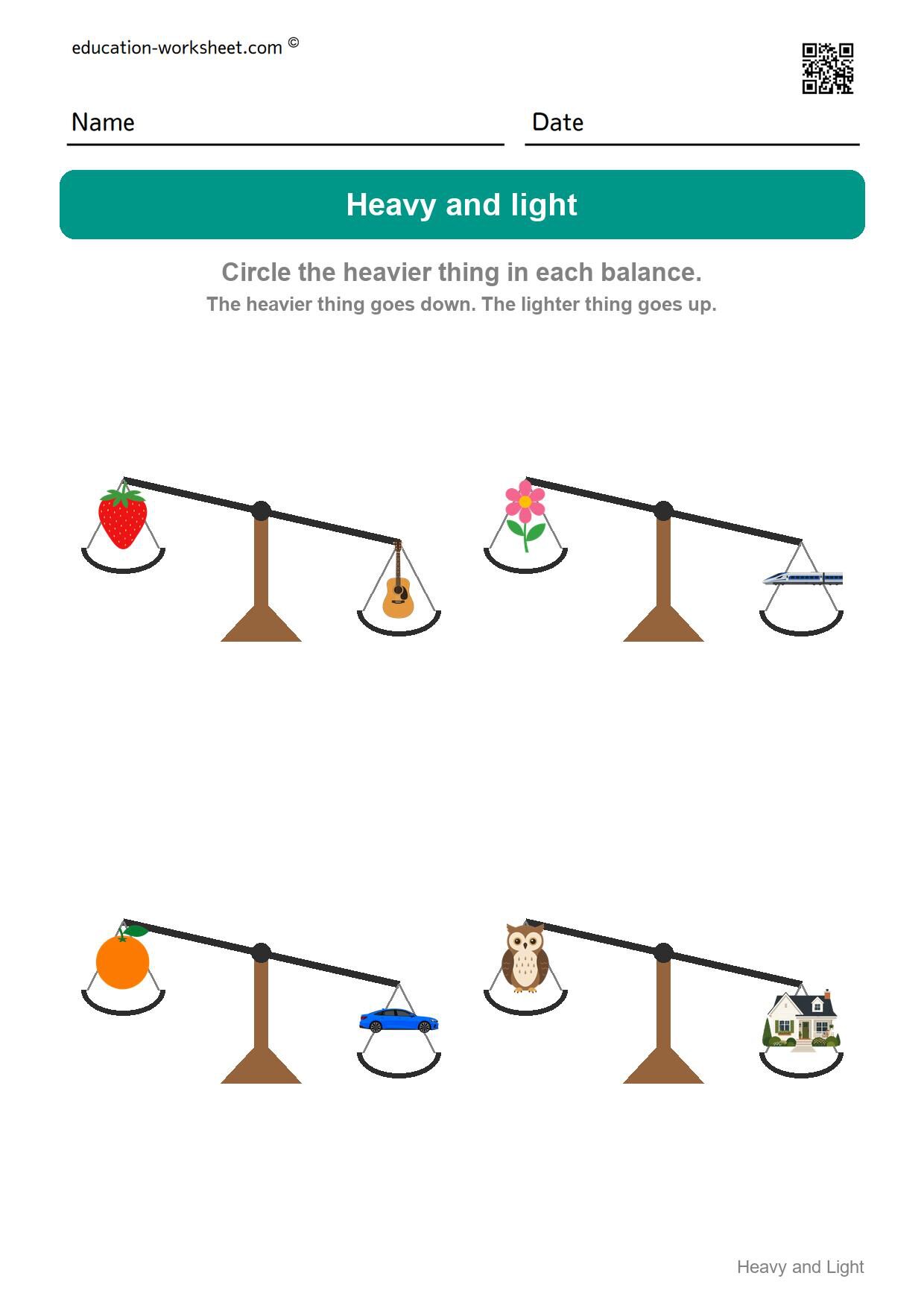
A strawberry against a guitar, a flower against a train, an orange against a car, an owl against a house.
Every answer on this page is the right-hand pan – the mirror image of page 1. Two pages in the pack are built this way and a third comes later, which is worth knowing before you decide a child has spotted a pattern.
Worksheet 4 – Circle the Heavier Thing
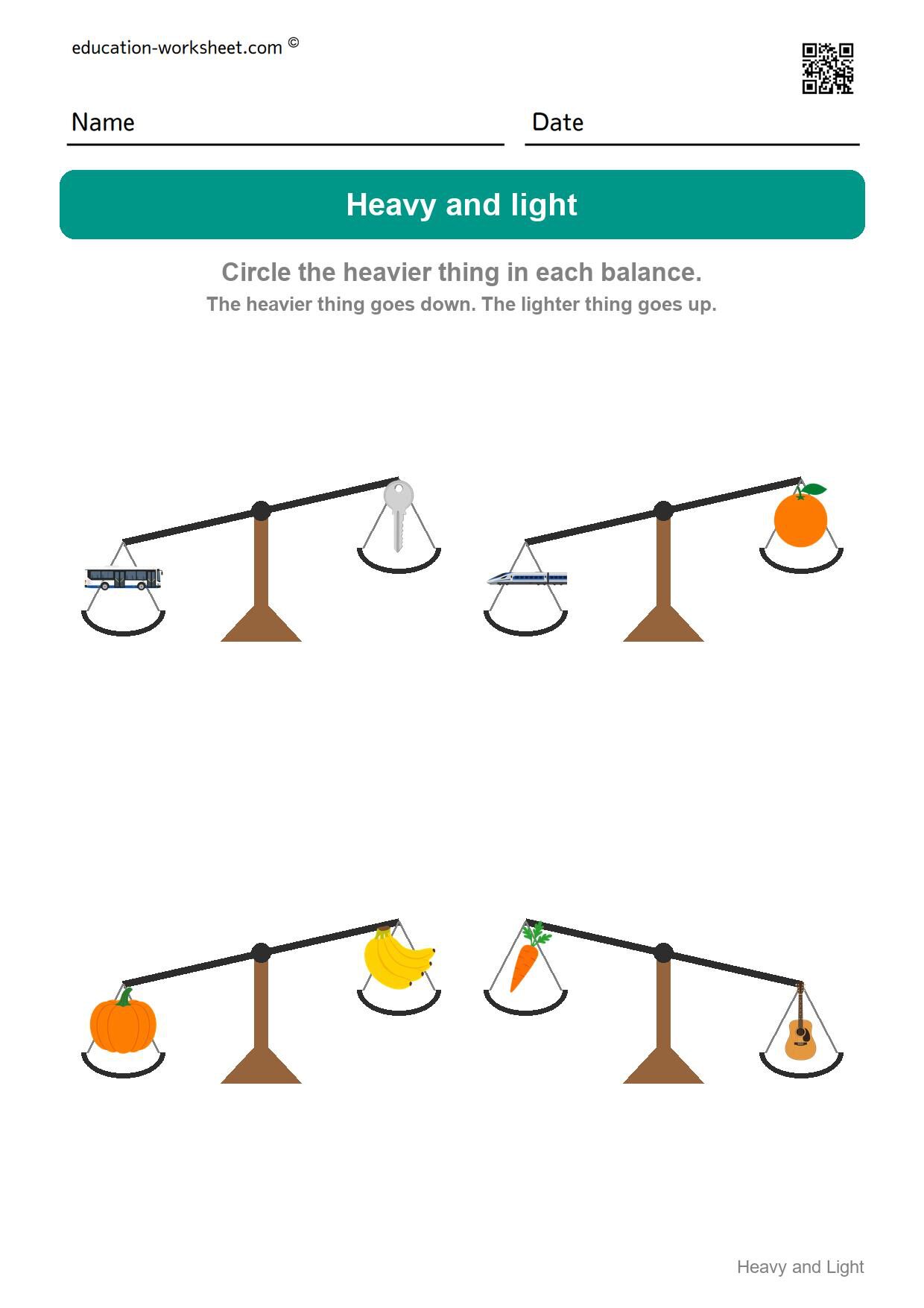
A bus against a key, a train against an orange, a pumpkin against bananas, a carrot against a guitar. Three answers on the left and one on the right.
Every pair here is a big thing against a small thing, so the pictures and the balance agree. A child who is guessing from the size of the drawing will still get four out of four, and page 5 is where that stops mattering.
Worksheet 5 – Circle the Heavier Thing
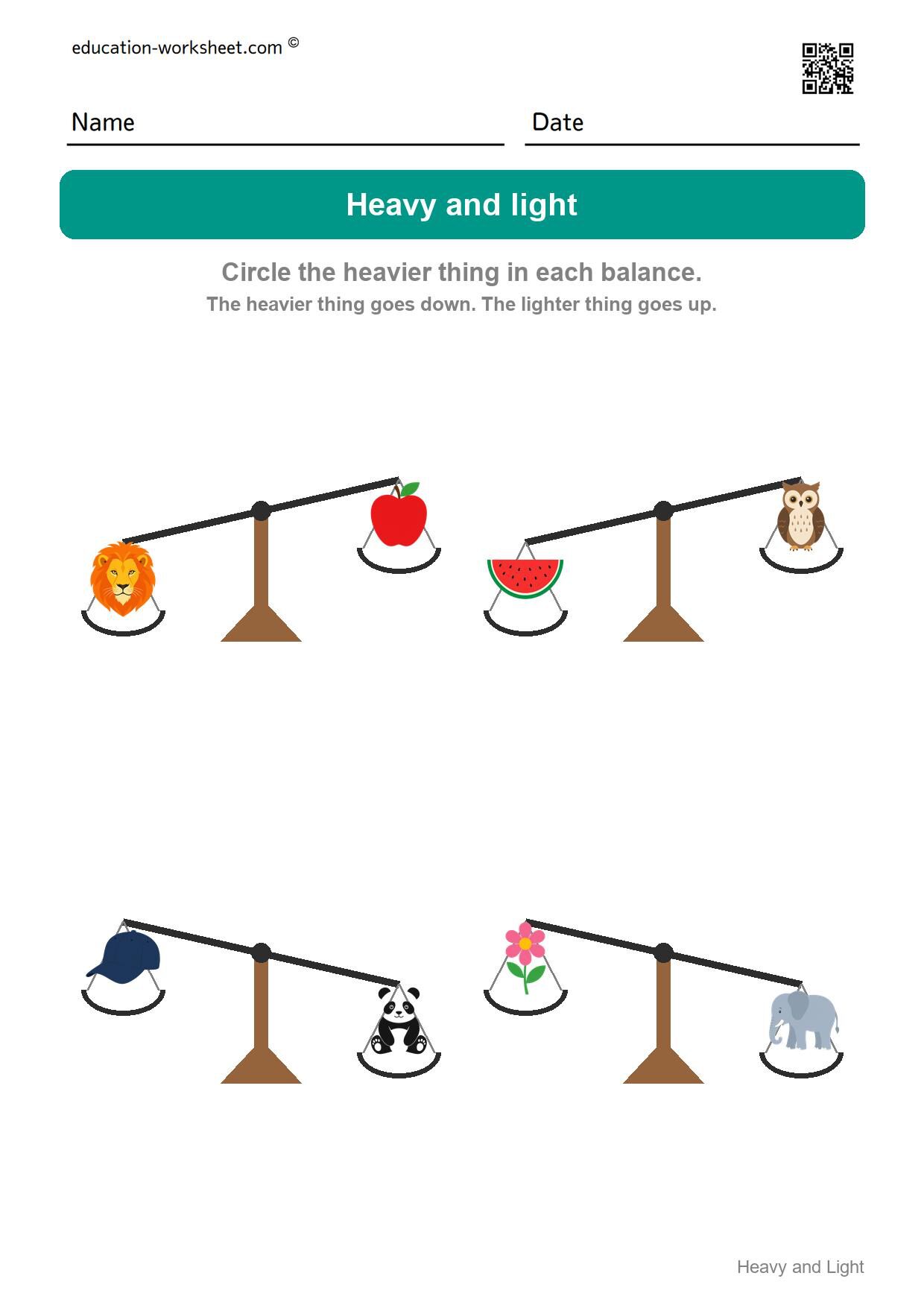
A lion against an apple, a watermelon against an owl, a cap against a panda, a flower against an elephant. Two answers left, two right.
The watermelon and the owl is the interesting row. An owl is an animal and a watermelon is a fruit, and children often assume the animal must be heavier. The balance says otherwise, and it is right: a big watermelon outweighs an owl several times over.
Worksheet 6 – Circle the Lighter Thing
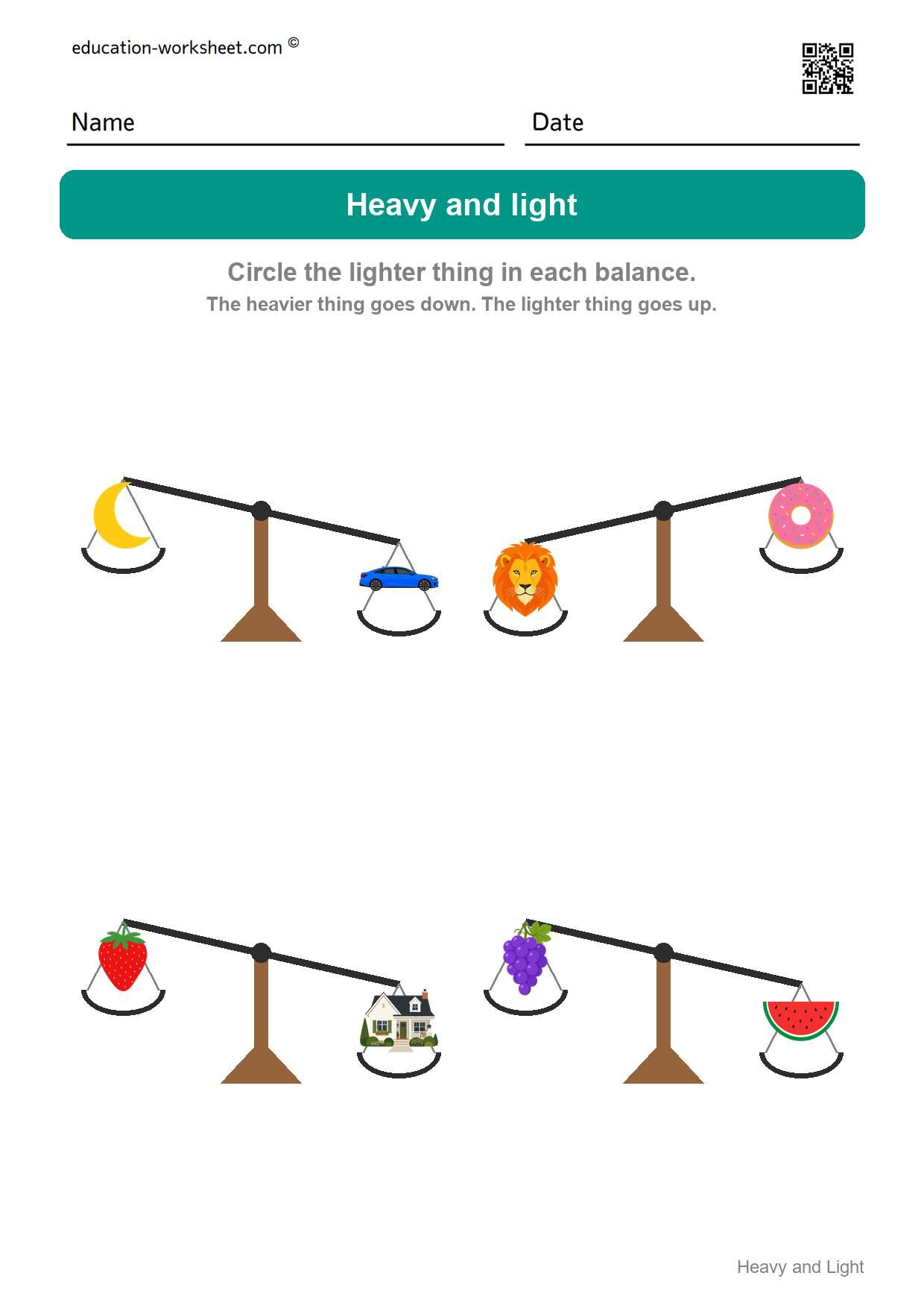
The question flips here, and this is the most important page in the pack. For five pages the child has been circling the pan that went down. From now on the answer is the pan that goes up.
The pairs are the moon against a car, a lion against a donut, a strawberry against a house, grapes against a watermelon. Note the last row: grapes and a watermelon were already weighed against each other on page 2, when the question was the other way round.
Worksheet 7 – Circle the Lighter Thing
An elephant against the moon, a pumpkin against a cap, a panda against a strawberry, a train against an owl.
All four answers are the right-hand pan, and every heavy thing happens to be drawn on the left. A child who has learned “the answer is the one that is up” sails through. A child who is still circling the low side gets nothing right, which makes this page a clean test of whether the switch on page 6 landed.
Worksheet 8 – Circle the Lighter Thing
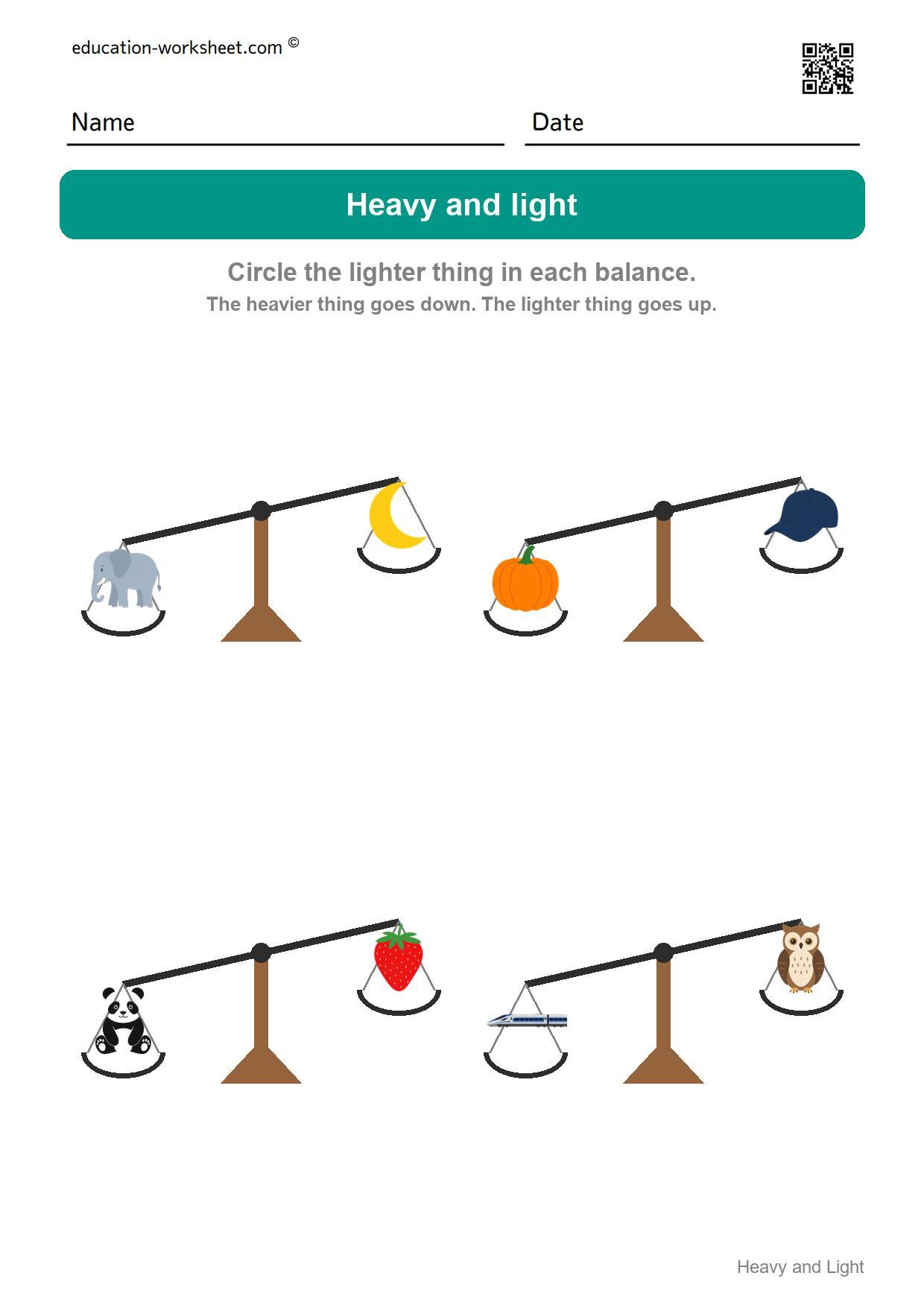
A carrot against a bus, a guitar against a flower, bananas against an elephant, a pumpkin against a key. The answers alternate: left, right, left, right.
The elephant and the bananas met on page 1 as well. Back then the question was which is heavier and the elephant was on the left; here the two have swapped sides and the question has swapped too.
Worksheet 9 – Circle the Lighter Thing
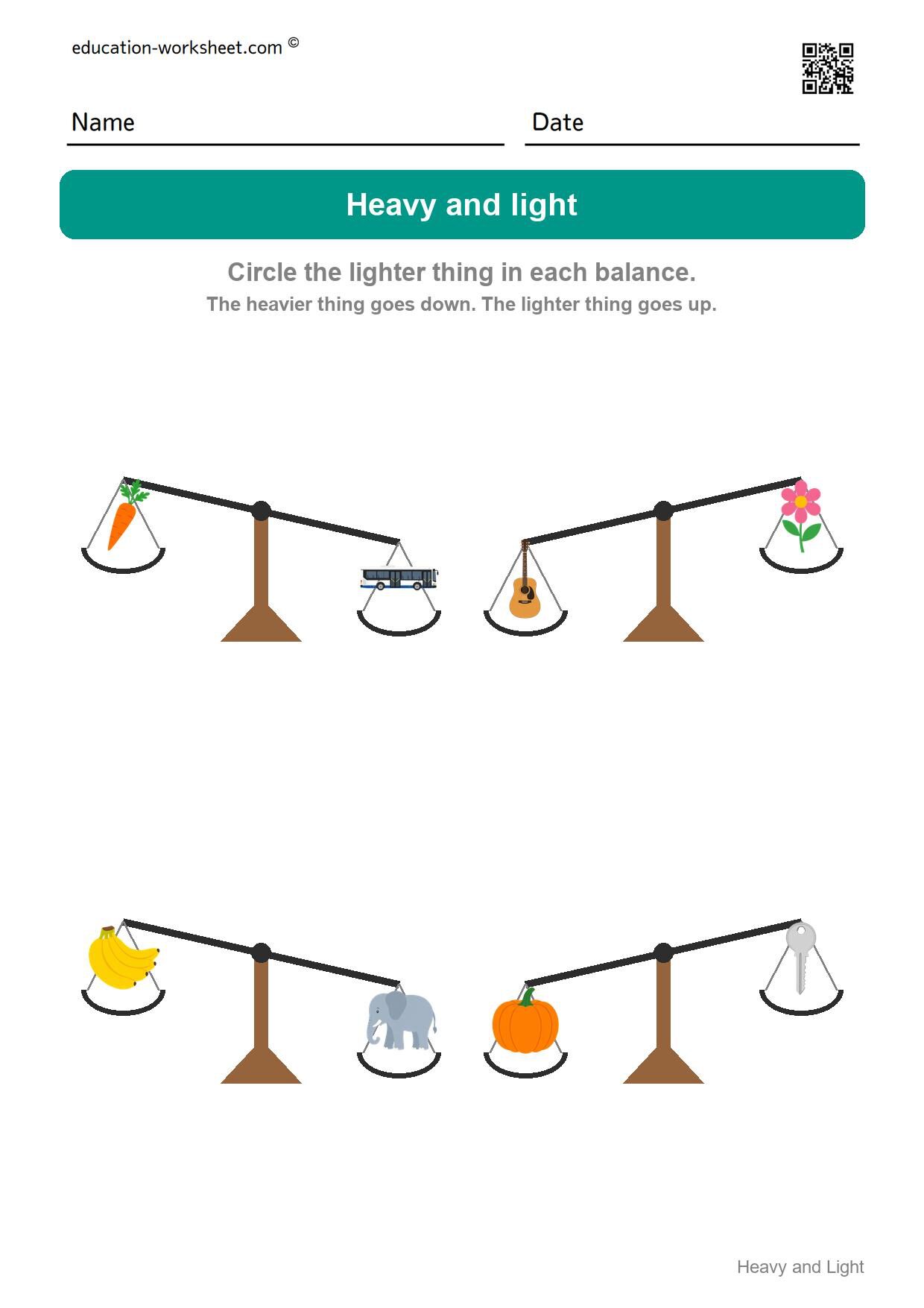
Grapes against a panda, a train against an apple, an orange against a car, a donut against a guitar.
The orange and the car appeared on page 3 in exactly the same arrangement, orange on the left and car on the right, with the car sitting low. Nothing in the picture has changed. Only the question has, so the answer moves to the other pan.
Worksheet 10 – Circle the Lighter Thing
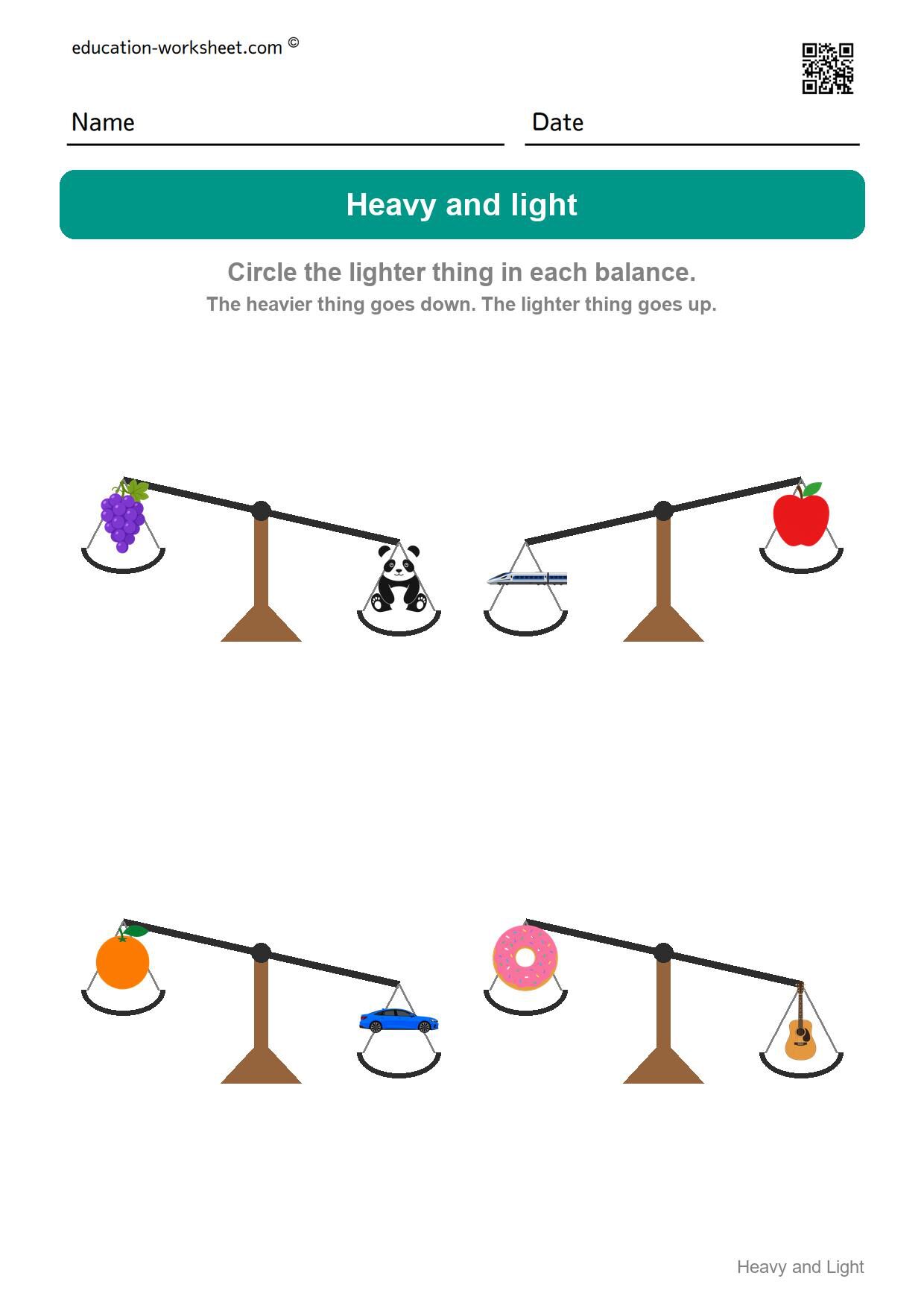
A donut against a bus, a strawberry against a lion, a watermelon against an orange, a house against a key.
The last row is the house and the key, the same pair and the same picture as row three of page 1. It is the neatest way to finish: the child has seen this exact balance before and answered house. This time the answer is the key.
Answer Key – All 40 Balances
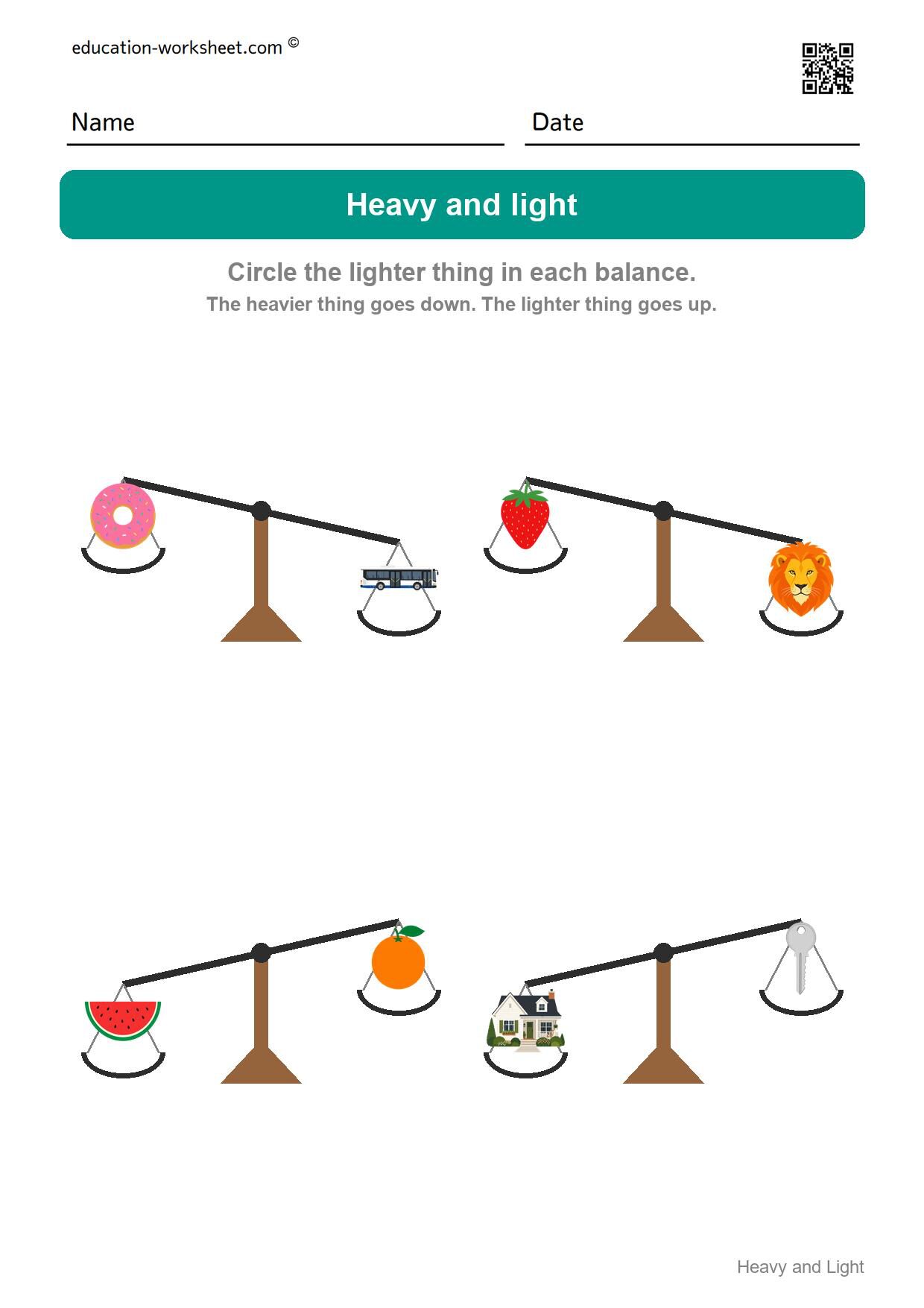
The eleventh sheet gives every answer as left or right, four to a page, with a reminder of which question each page asked.
Twenty-two of the forty answers are the left-hand pan and eighteen are the right. If a child has circled the left pan far more often than that, they are probably not reading the question at the top of the page.
Four Pairs That Come Round Twice
Four of the forty balances are repeats, and every one of them is repeated in the other half of the pack, where the question is the opposite:
- The elephant and the bananas – page 1 (heavier) and page 8 (lighter).
- The house and the key – page 1 (heavier) and page 10 (lighter).
- The watermelon and the grapes – page 2 (heavier) and page 6 (lighter).
- The orange and the car – page 3 (heavier) and page 9 (lighter).
For two of them – the house and key, and the orange and car – the picture is arranged exactly as it was the first time. Same objects, same pans, same tilt. The only thing that has changed is the word at the top of the page, and the answer has moved to the other side.
These four are the best rows in the pack to talk through, because a child who answers them from memory gets them wrong, and getting them wrong is more useful here than getting them right.
The Moon, and Why It Belongs
Three of the forty balances weigh a crescent moon: against a bus on page 2, against a car on page 6, against an elephant on page 7. A grown-up reading the sheet will stop at that, and children sometimes do too.
It is worth keeping rather than skipping. Every other pair in the pack lines up with real life – the elephant really is heavier than the bananas, the watermelon really is heavier than the owl – so a child can quietly answer from what they already know and never read the balance at all. The moon rows are the ones where that is impossible. The only way to answer is to look at which pan has gone down, which is exactly the skill the page is for.
When Children Are Ready for Heavy and Light
- Age: about three to five – preschool, pre-K and the start of kindergarten.
- Before starting: nothing beyond naming everyday objects. There is no reading or counting on these pages.
- K.MD.A.1 – describe measurable attributes of objects, such as length or weight.
- K.MD.A.2 – directly compare two objects with a measurable attribute in common, and say which has more of it.
- A real balance, a coat hanger with two bags, or a child holding one thing in each hand does the same job. These sheets are the picture version of that.
How to Use These Worksheets
- Read the instruction at the top out loud with the child every single time, including on page 6 where it changes.
- Point at the pan that has gone down and say what it means: this side is heavier, so it sank. Then ask what the question wanted.
- Do pages 1 to 5 in one sitting and stop. Start the next sitting with page 6, so the switch gets its own beginning.
- If a page comes back all correct in ten seconds, check it. Pages 1, 3 and 7 have all four answers on the same side, which a guesser can hit by accident.
- Hold two real objects, one in each hand, and let the child feel what the picture is showing. Nothing on paper teaches weight by itself.
- Use page 11 to check, or just look at the tilt. Both give the same answer.
Three Things to Watch For
1. Still circling the low pan after page 6. This is the mistake the pack is built around. It is not carelessness – the child has learned a rule that worked five pages in a row. Say the new question aloud before every row for the first page or two.
2. Answering from the size of the drawing. On most pages the bigger picture really is the heavier thing, so guessing works. Ask how do you know, and listen for whether the answer mentions the balance.
3. Arguing with the pictures. Some children will say a lion is heavier than a watermelon, or that the moon cannot go on a scale at all. They are reasoning, not failing. The answer is still whichever pan has gone down.
Printing Tips
- Print at 100 percent, actual size, on A4 or US Letter.
- Color helps with the pictures but the answer is in the tilt of the beam, which prints perfectly well in black and white.
- Print pages 1 to 5 and pages 6 to 10 as two separate batches. Keeping the two questions apart on your desk makes it easier to keep them apart for the child.
Frequently Asked Questions
What age are these heavy and light worksheets for?
About three to five years old. There is no reading or writing, so a child who can name everyday objects and hold a crayon can do the whole pack.
Does my child need to know how much things weigh?
No, and that is the point. Every answer can be read off the balance itself: the heavier thing has gone down, the lighter thing has gone up.
Is there an answer key?
Yes, page 11 gives all forty answers as left or right.
Why do the last five pages feel so much harder?
Because the question changes. Pages 1 to 5 ask for the heavier thing and pages 6 to 10 ask for the lighter one, so the same balance now points to the opposite pan.
Why is there a moon on a balance scale?
Because it is a picture, not a weight. Those three rows are the only ones a child cannot answer from what they already know, so they are the rows that force a proper look at the scale.
Do I need to sign up to download these?
No. Every PDF downloads immediately, with no account, no email address and no cost.
Can I use these in my classroom?
Yes, they are free to print for home and classroom use. Please do not sell them or re-host the files elsewhere.
More Free Comparing Worksheets
- Free Long and Short Worksheets for Kindergarten – Compare Lengths
- Free Tall and Short Worksheets for Kindergarten – Compare Heights
- Free Big and Small Worksheets for Kindergarten – Compare Sizes
- Free Wide and Narrow Worksheets for Kindergarten – Compare Width
- Free Measuring Length Worksheets for Kindergarten – How Many Cubes Long?
- Free Size Ordering Worksheets for Kindergarten – Smallest to Biggest