
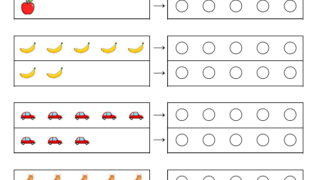
These free printable count and graph worksheets give kindergarten children ten picture graphs to build. Each page shows a panel full of three kinds of picture scattered about, a blank graph underneath with a column for each one, and a last question: circle the picture you found the most.
The graph does the answering. A child who has counted and colored correctly can read the final answer straight off their own bars – the tallest column is the one to circle. That is the whole idea of a graph, delivered in one page, and it is the reason this pack is worth more than a counting sheet.
Every graph column goes up to 10, and no picture is ever there more than ten times, so nothing ever overflows.
- What Is in This Free Count and Graph Worksheet Pack
- The 11 Count and Graph Worksheets
- Worksheet 1 – Cars, donuts and pizza slices
- Worksheet 2 – Caps, umbrellas and buses
- Worksheet 3 – Guitars, houses and dogs
- Worksheet 4 – Rabbits, suns and lions
- Worksheet 5 – Rainbows, owls and bananas
- Worksheet 6 – Trees, grapes and apples
- Worksheet 7 – Flowers, cats and penguins
- Worksheet 8 – Pandas, foxes and moons
- Worksheet 9 – Keys, carrots and strawberries
- Worksheet 10 – Trains, watermelons and oranges
- Answer Key – All 30 Counts
- What Makes Counting Scattered Pictures Hard
- Where the Answer Sits
- When Children Are Ready for Count and Graph
- How to Use These Worksheets
- Three Things to Watch For
- Printing Tips
- Frequently Asked Questions
- More Free Counting Worksheets
What Is in This Free Count and Graph Worksheet Pack
- Ten printable worksheets, each with a scatter panel, a three-column graph and a question.
- Three kinds of picture per page, thirty different pictures across the pack.
- Counts from 2 to 10 – never more, so the ten-high graph always fits.
- The most-found picture is different on every page and is never a tie.
- An eleventh page with all the counts.
- A separate PDF for every page, free to download and print.
The 11 Count and Graph Worksheets
The pack splits cleanly in half, and nothing on the pages says so. Pages 1 to 5 hold eleven, twelve or thirteen pictures each. Pages 6 to 10 hold between eighteen and twenty-two.
That is close to double the counting, and it is where children stop being able to hold the tally in their heads. Expect the first five pages to take a few minutes each and the last five to take much longer – and expect the first lost count to happen on page 6 or 7.
Worksheet 1 – Cars, donuts and pizza slices
The panel holds 3 cars, 4 donuts and 5 slices of pizza – 12 pictures in all.
The three counts are 3, 4 and 5 – next-door numbers, so the graph columns end up almost level and the last question has to be read off the bars rather than guessed. It is one of the three smallest pages in the pack.

Worksheet 2 – Caps, umbrellas and buses
The panel holds 2 caps, 4 umbrellas and 5 buses – 11 pictures in all.
The smallest page in the pack. Two caps is the lowest count anywhere here, and a column two boxes high is a useful thing for a child to see standing next to one that is five high.

Worksheet 3 – Guitars, houses and dogs
The panel holds 6 guitars, 3 houses and 4 dogs – 13 pictures in all.
The first page where the most-found picture is the one on the left. On pages 1 and 2 it was the right-hand one, which is long enough for a child to have formed an expectation.

Worksheet 4 – Rabbits, suns and lions
The panel holds 5 rabbits, 2 suns and 6 lions – 13 pictures in all.
Six lions against two suns is the widest spread so far. The sun is also the easiest picture to miss, because it is the smallest thing on the page.

Worksheet 5 – Rainbows, owls and bananas
The panel holds 2 rainbows, 5 owls and 4 bunches of bananas – 11 pictures in all.
The only page in the whole pack where the middle picture is the one found most often. Across the ten pages the winner is on the left five times and on the right four times; the middle gets this single page.

Worksheet 6 – Trees, grapes and apples
The panel holds 10 trees, 4 bunches of grapes and 8 apples – 22 pictures in all.
The pack doubles in size here. Twenty-two pictures against the eleven or thirteen of the first five pages, and ten trees fills a graph column right to the top.

Worksheet 7 – Flowers, cats and penguins
The panel holds 9 flowers, 4 cats and 5 penguins – 18 pictures in all.
Nine flowers scattered across the panel is the point at which children start losing count and going back to the beginning. This is the page to introduce crossing off.

Worksheet 8 – Pandas, foxes and moons
The panel holds 5 pandas, 7 foxes and 9 moons – 21 pictures in all.
Twenty-one pictures and no small count at all – five is the lowest. Three tall columns side by side make the graph much harder to read than one tall and two short.

Worksheet 9 – Keys, carrots and strawberries
The panel holds 10 keys, 4 carrots and 6 strawberries – 20 pictures in all.
The second page with a count of exactly ten. The key is a small, pale picture, which makes ten of them the hardest count in the pack.

Worksheet 10 – Trains, watermelons and oranges
The panel holds 9 trains, 4 watermelons and 7 oranges – 20 pictures in all.
The last page, and the winner is on the left again. Twenty pictures, three counts that are all different, and nothing new to learn – a good place to finish.

Answer Key – All 30 Counts
The eleventh sheet gives all three counts for every page, with the largest of the three printed in green.
It is worth checking a finished page against it even when the child is confident. A count that is one out still produces a graph that looks perfectly reasonable.

What Makes Counting Scattered Pictures Hard
Counting five things in a row is easy. Counting five things scattered across a panel is a different job, because the child has to keep track of which ones they have already counted. That is the skill this pack is really practicing, and it is the one that breaks down as the numbers grow.
There is a fix, and it is worth teaching directly: cross each picture off as it is counted. A small pencil mark on each donut turns an impossible tracking problem into a simple one. Page 7, with nine flowers among eighteen pictures, is the natural place to introduce it.
The other strategy is to color the graph box at the same moment as counting the picture – one picture, one box, straight away. Then the graph itself becomes the record of what has been counted, and the child never has to hold a number in their head at all. That is one-to-one correspondence in its purest form.
Where the Answer Sits
- The most-found picture is the left-hand one on five pages, the right-hand one on four, and the middle one on exactly one (page 5).
- It is never a tie. On every page one count is strictly larger than the other two.
- The smallest count in the pack is 2 and the largest is 10.
- Two pages have a count of exactly 10 – the trees on page 6 and the keys on page 9 – so their columns fill to the very top.
That distribution matters for one reason: a child who guesses the middle column will be wrong nine times out of ten. If a child is circling without counting, this is where it shows.
When Children Are Ready for Count and Graph
- Age: about five to six – kindergarten, once counting to ten is secure.
- Before starting: the child should be able to count a group of ten objects reliably. Reading is not needed.
- K.CC.B.5 – count to answer “how many?” about up to twenty things in a scattered arrangement. That is exactly what the panel is.
- K.MD.B.3 – classify objects into given categories and count the number in each category.
- 1.MD.C.4 – organize, represent and interpret data with up to three categories, and ask how many more. These pages are a first-grade data lesson a year early.
How to Use These Worksheets
- Do page 1 together and color each graph box the moment the picture is counted, rather than counting first and coloring after.
- Teach crossing off before page 6. A tiny pencil mark on each picture as it is counted is the difference between twenty-two pictures being possible and being guesswork.
- Count one kind of picture at a time, all the way across the panel, rather than working left to right through everything.
- Ask the last question out loud before the child circles: which column is tallest? Then look from the bar to the picture underneath it.
- Ask one extra question the sheet does not: how many more? Comparing two columns is the step beyond finding the tallest.
- Check against page 11. A count that is one out is invisible on the finished page.
Three Things to Watch For
1. Losing track in the panel. The pictures are scattered on purpose, and from page 6 there are twice as many of them. A child who counts nine flowers, then eight, then nine again has not failed at counting – they have failed at remembering which ones they already touched. Cross them off.
2. Coloring from the top down. The graph is numbered 1 at the bottom and 10 at the top, and some children start coloring at the top box. The bars then look right but mean nothing. Point at the 1 and start there.
3. Circling the biggest picture instead of the tallest bar. On page 4 the lions are the largest pictures and they also happen to be the most numerous; on page 9 the keys are the smallest pictures and they are the answer. Children who have been reading size rather than counting get caught by page 9.
Printing Tips
- Print at 100 percent, actual size, on A4 or US Letter. The graph boxes are small and scaling makes them smaller.
- Color printing helps a lot here, because the three kinds of picture are told apart at a glance by color as much as by shape.
- Print two copies of pages 6 and 9 – the two with a count of ten. They are the pages worth doing twice.
Frequently Asked Questions
What age are these count and graph worksheets for?
About five to six years old. A child needs to be able to count a scattered group of up to ten objects; there is nothing to read.
How high does the graph go?
Ten. No picture appears more than ten times in the pack, so a column never runs out of room.
Is there an answer key?
Yes, page 11 lists all three counts for every page and marks the largest in green.
Do the pages get harder?
Yes, and sharply. Pages 1 to 5 have eleven to thirteen pictures each; pages 6 to 10 have eighteen to twenty-two.
My child keeps getting a different number each time. What helps?
Crossing each picture off with a pencil as it is counted, and coloring the graph box at the same moment. Both turn remembering into marking.
Is the answer ever a tie?
No. On every page one of the three counts is strictly bigger than the other two.
Do I need to sign up to download these?
No. Every PDF downloads immediately, with no account, no email address and no cost.
Can I use these in my classroom?
Yes, they are free to print for home and classroom use. Please do not sell them or re-host the files elsewhere.
More Free Counting Worksheets
- Free Tally Marks Worksheets for Kindergarten – Count and Draw Tallies
- Free Count the Shapes Worksheets for Kindergarten
- Free Ten Frame Worksheets for Kindergarten – Count to 10
- Free How Many More Worksheets for Kindergarten – Compare
- Free Comparing Numbers Worksheets for Kindergarten – Greater Than, Less Than
- Free Skip Counting Worksheets for Kindergarten – Count by 2s, 5s and 10s