
These free printable long and short worksheets give preschool and kindergarten children forty rows of objects to compare, four to a page. Pencils, colored bars and strips of blocks, two or three to a row, and one question at the top of each page.
Everything in a row starts from the same line. We measured it: every object in the pack begins within about a millimeter of the same left-hand edge. That is not decoration – it is the rule that makes a length comparison fair, and it is the first thing children are taught about measuring.
The pack moves in four steps: the longer of two, the shorter of two, the longest of three, the shortest of three. The last two pages then make the lengths close together on purpose.
- What Is in This Free Long and Short Worksheet Pack
- The 11 Long and Short Worksheets
- Worksheet 1 – Circle the Longer One
- Worksheet 2 – Circle the Longer One
- Worksheet 3 – Circle the Shorter One
- Worksheet 4 – Circle the Shorter One
- Worksheet 5 – Circle the Longest One
- Worksheet 6 – Circle the Longest One
- Worksheet 7 – Circle the Shortest One
- Worksheet 8 – Circle the Shortest One
- Worksheet 9 – Circle the Longest One
- Worksheet 10 – Circle the Shortest One
- Answer Key – All 40 Rows
- Why the Blocks Are There
- When Children Are Ready for Long and Short
- How to Use These Worksheets
- Three Things to Watch For
- Printing Tips
- Frequently Asked Questions
- More Free Comparing Worksheets
What Is in This Free Long and Short Worksheet Pack
- Ten printable worksheets with four rows on each – forty questions in all.
- Two objects per row on pages 1 to 4, and three per row from page 5 onwards.
- An eleventh page with the full answer key.
- Three kinds of object: pencils, rounded bars and strips of equal-sized blocks.
- Every object is a whole number of centimeters long, from 5 to 16, give or take a couple of millimeters for pencil tips and rounded ends.
- A separate PDF for every page, free to download and print.
The 11 Long and Short Worksheets
The lengths in this pack are not arbitrary. Measured off the printed page, every single object lands on a whole centimeter, somewhere between 5 and 16, to within about two millimeters at the tip. Nothing is 7 and a half. That means a ruler settles any argument, and it means every comparison in the pack is a whole-centimeter difference rather than a hairline.
It also means the difficulty can be counted. The deciding gap is never less than 2 centimeters, and on eight of the ten pages it is at least 4. The two exceptions are pages 9 and 10, where three rows come down to 2 centimeters – which is exactly what the pack was building toward.
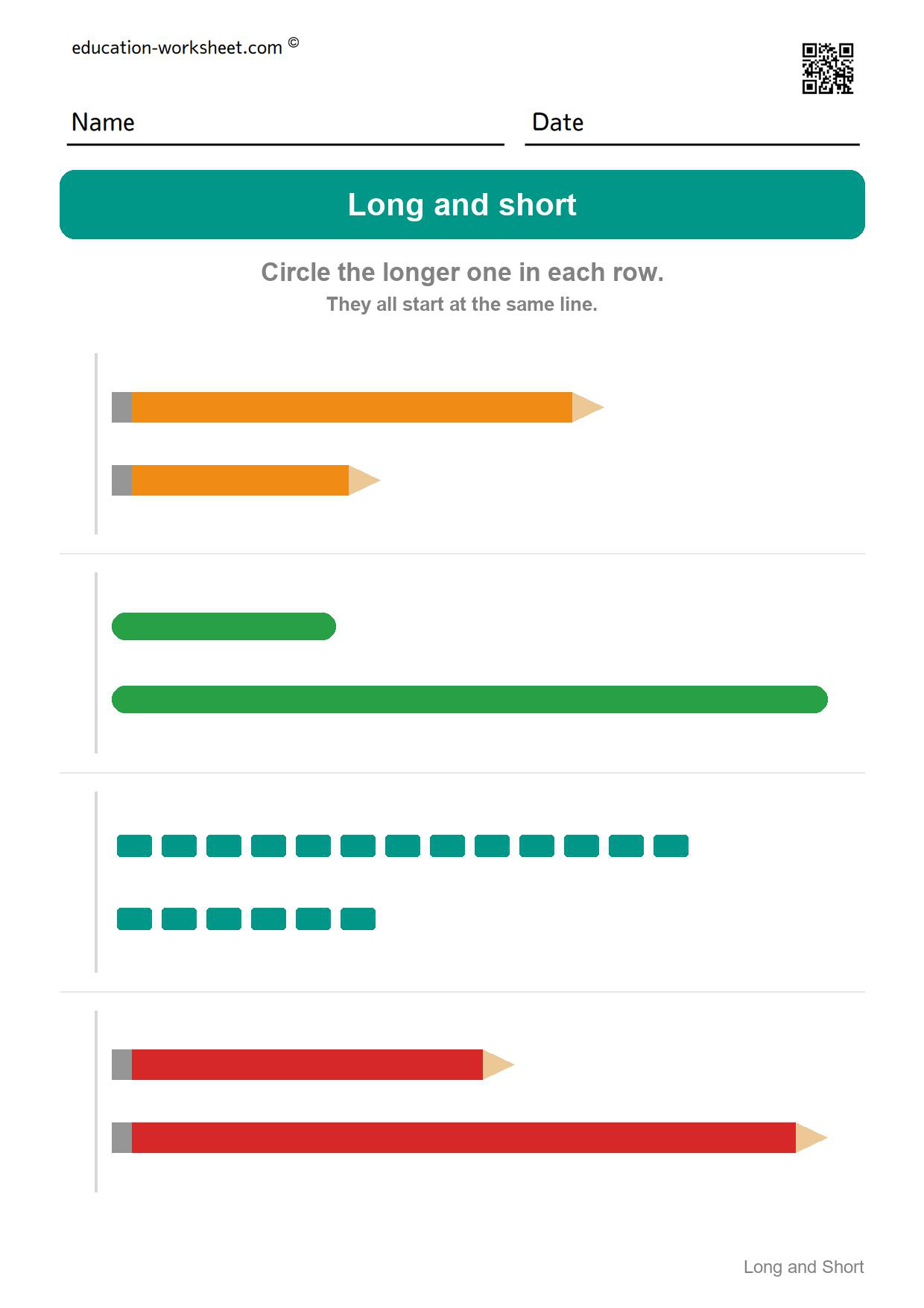
Worksheet 1 – Circle the Longer One
Two things in every row: orange pencils, green bars, a strip of blocks, then red pencils. Measured on the page, the pairs are 11 against 6 centimeters, 5 against 16, 13 against 6, and 9 against 16.
Row two is the widest gap in the whole pack – one bar is three times the other. Nobody gets it wrong, which is what a first row is for.
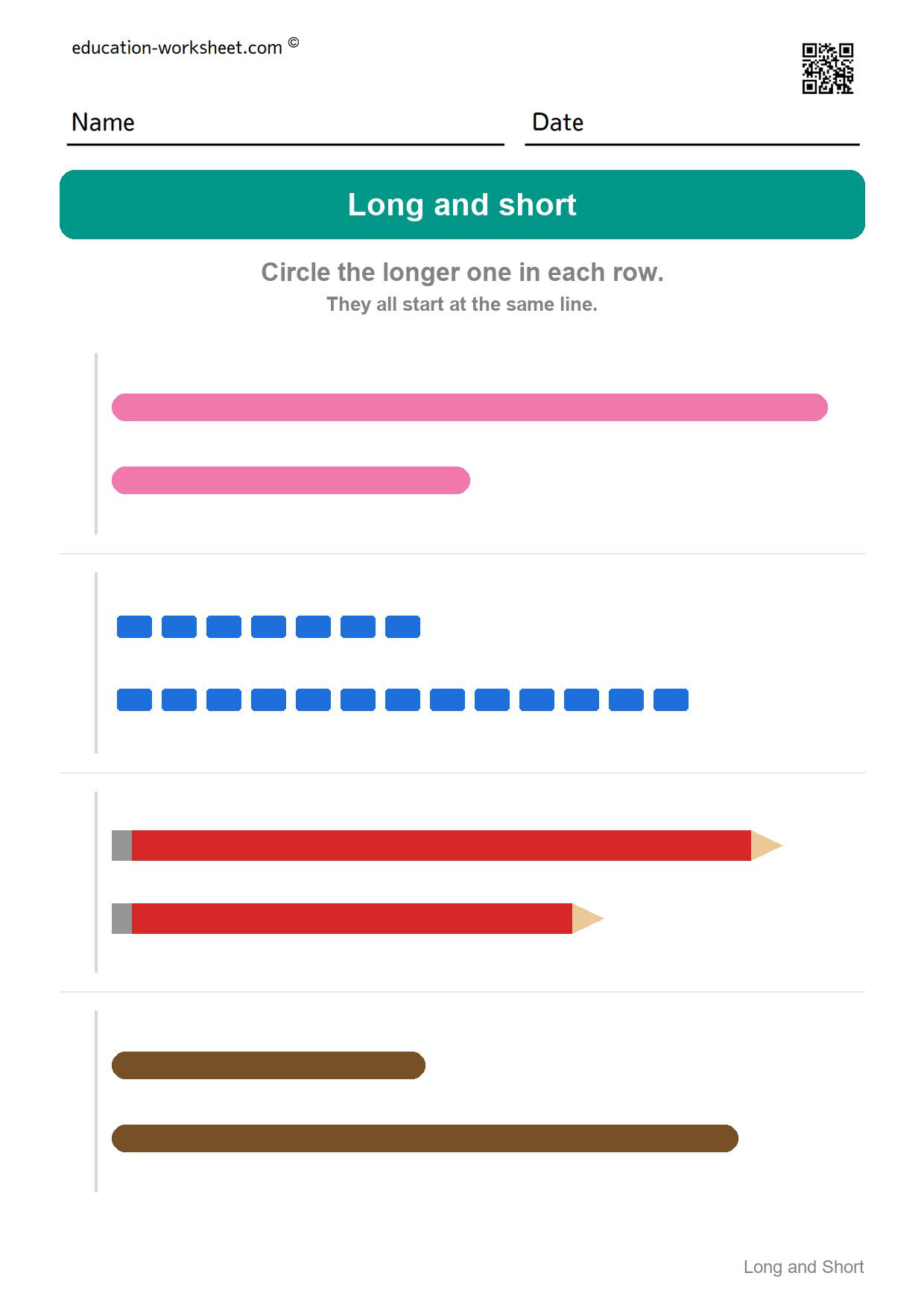
Worksheet 2 – Circle the Longer One
Pink bars, blue blocks, red pencils, brown bars: 16 against 8, 7 against 13, 15 against 11, and 7 against 14 centimeters.
This page has exactly the same answer pattern as page 1 – first, second, first, second. It is the only pair of pages in the pack that match, so a child who has spotted the rhythm can get four out of four here without measuring anything. Ask them to point at which one is longer rather than just circling it.
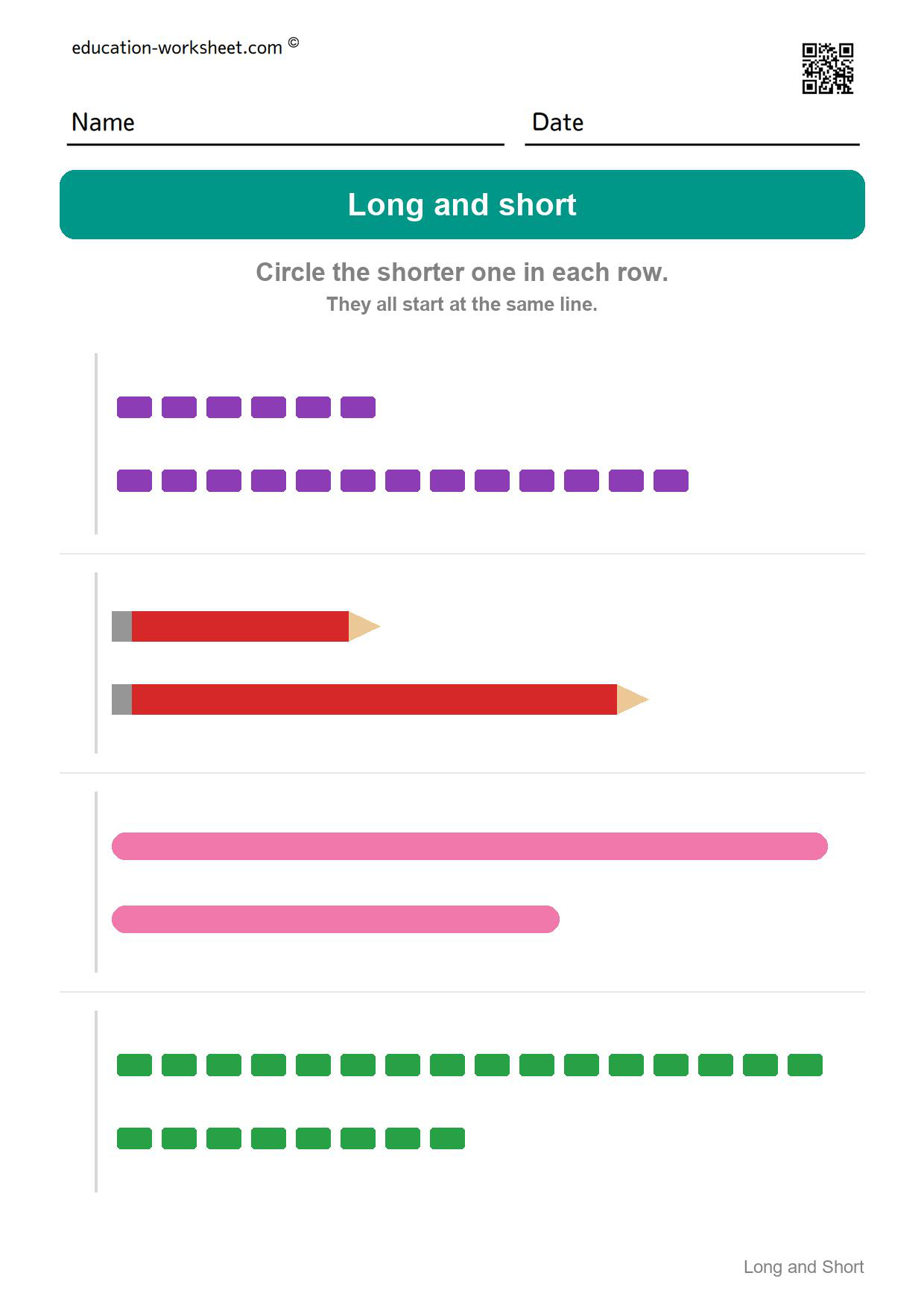
Worksheet 3 – Circle the Shorter One
The question turns over here. Purple blocks, red pencils, pink bars, green blocks: 6 against 13, 6 against 12, 16 against 10, and 16 against 8.
Children who have done two pages of longer will circle at least one long one out of habit. That is the page doing its job, not the child failing.
Worksheet 4 – Circle the Shorter One
Red pencils, blue bars, purple blocks, green pencils: 11 against 7, 10 against 6, 5 against 15, and 12 against 6 centimeters.
This is the last page with only two things in a row. From page 5 onwards there are three, and picking the extreme of three is a different job from picking between two.
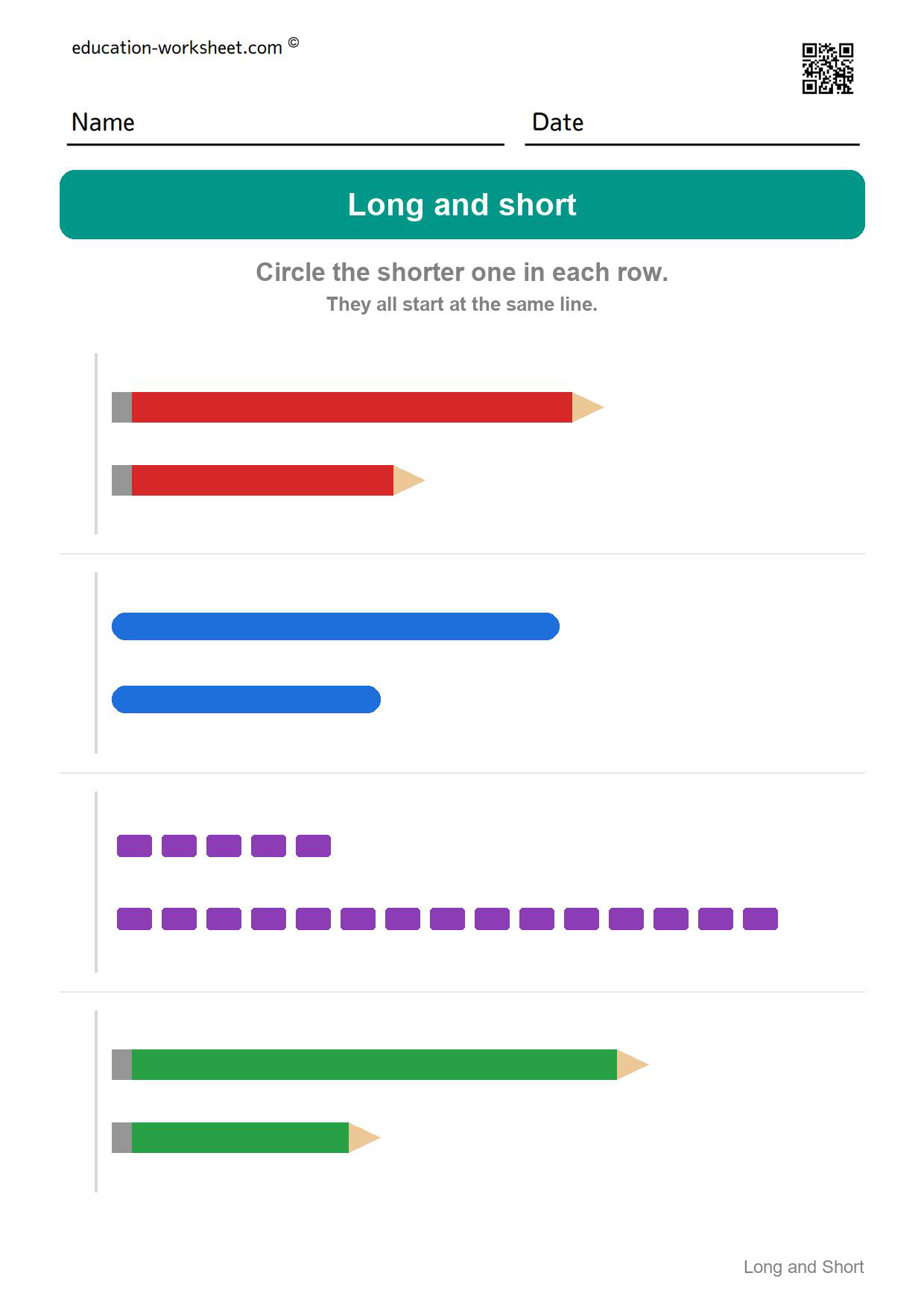
Worksheet 5 – Circle the Longest One
Three things in every row now, and the word changes from longer to longest. Teal bars, red blocks, pink pencils, blue bars.
The first row is 5, 10 and 15 centimeters – a clean staircase, and the gentlest possible introduction to comparing three things. The answer is the bottom one, so a child has to look past the two above it.
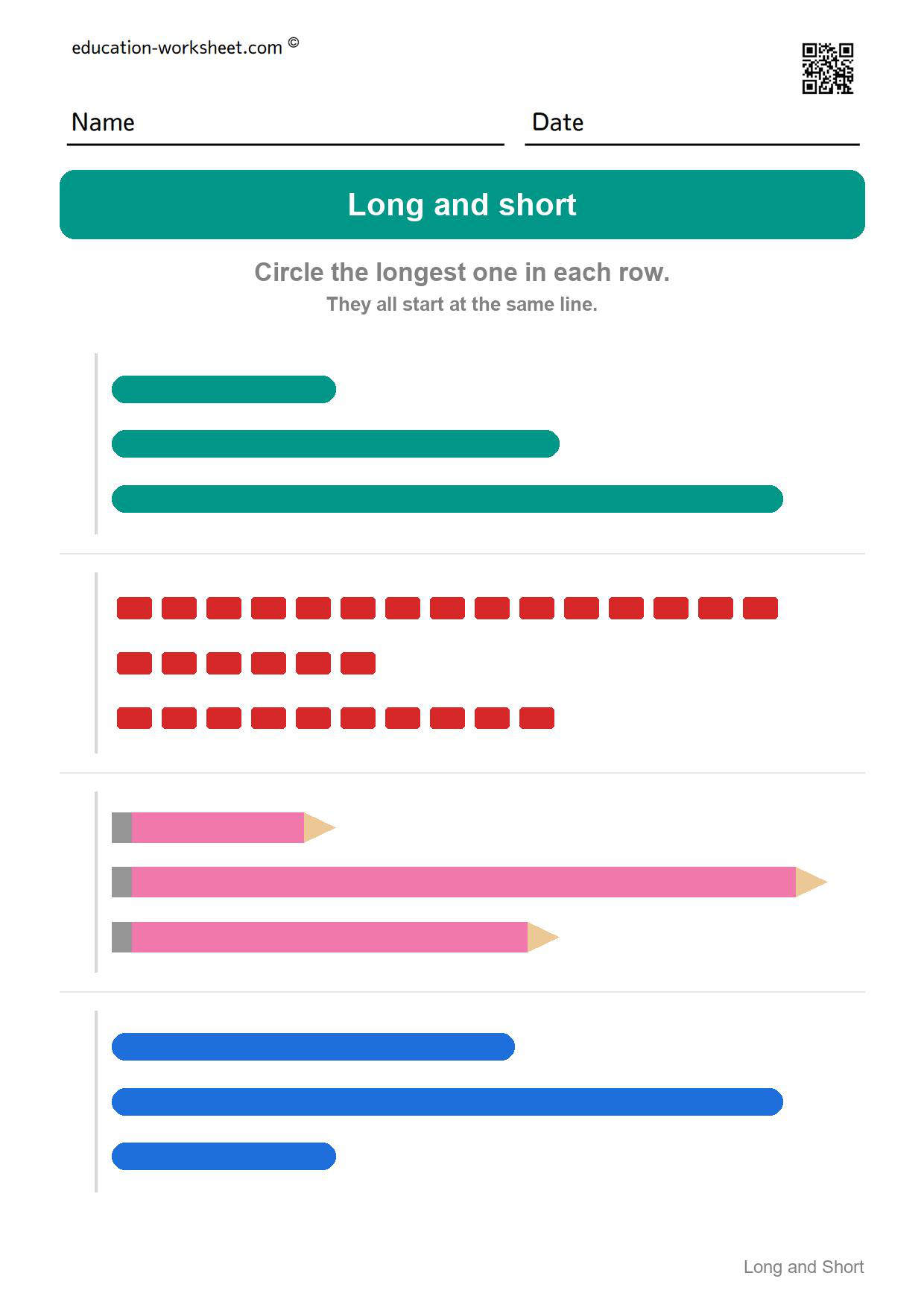
Worksheet 6 – Circle the Longest One
Red blocks, pink pencils, green bars, purple blocks. The first row runs 16, 12 and 8 centimeters, evenly spaced again but this time with the longest at the top.
Two of the four answers on this page are in the middle of the three. Middle answers are the ones children skip, because the eye goes to the top row and then to the bottom one.
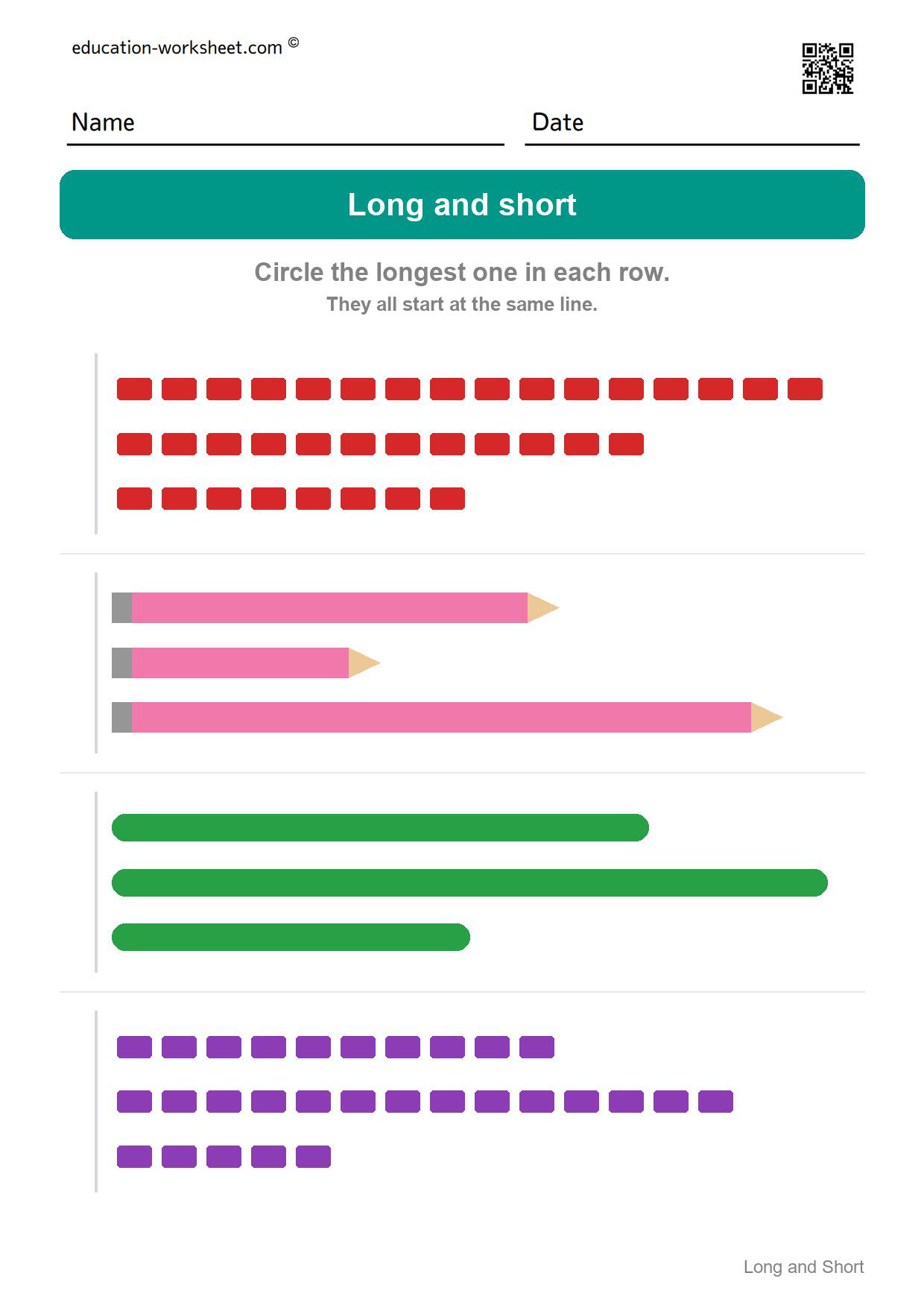
Worksheet 7 – Circle the Shortest One
Teal pencils, orange bars, pink blocks, green pencils. The question changes to shortest, which is the second turn of the page and the harder of the two.
Two answers are the bottom of the three and two are not. A child who has decided that the shortest one is always drawn last will get half of this page.
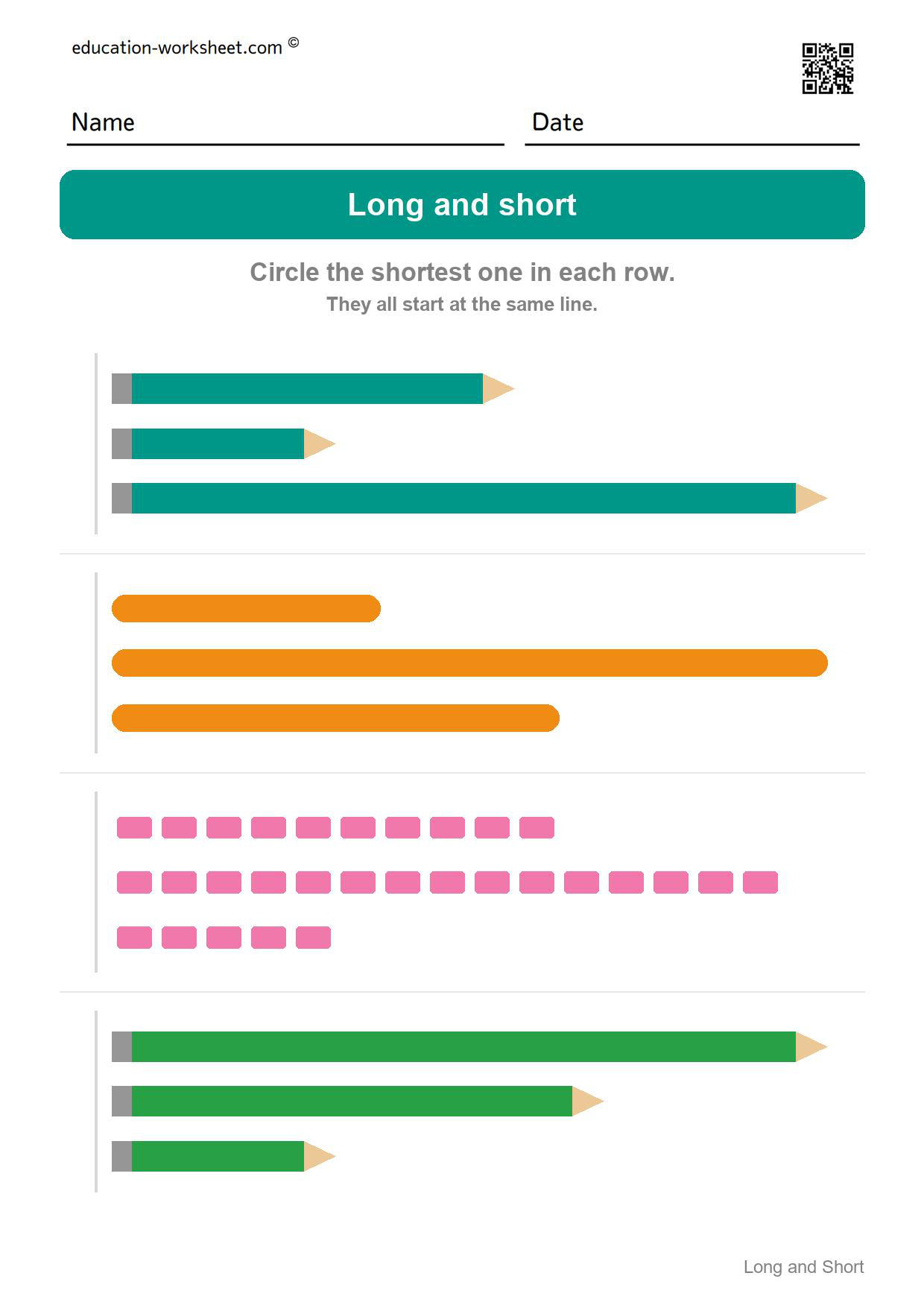
Worksheet 8 – Circle the Shortest One
Blue bars, green blocks, pink pencils, purple bars: rows of 5, 13, 9 / 16, 12, 8 / 10, 5, 16 / 13, 9, 5 centimeters.
Every row here is decided by at least 4 centimeters, which makes it the last comfortable page. Pages 9 and 10 are built differently.
Worksheet 9 – Circle the Longest One
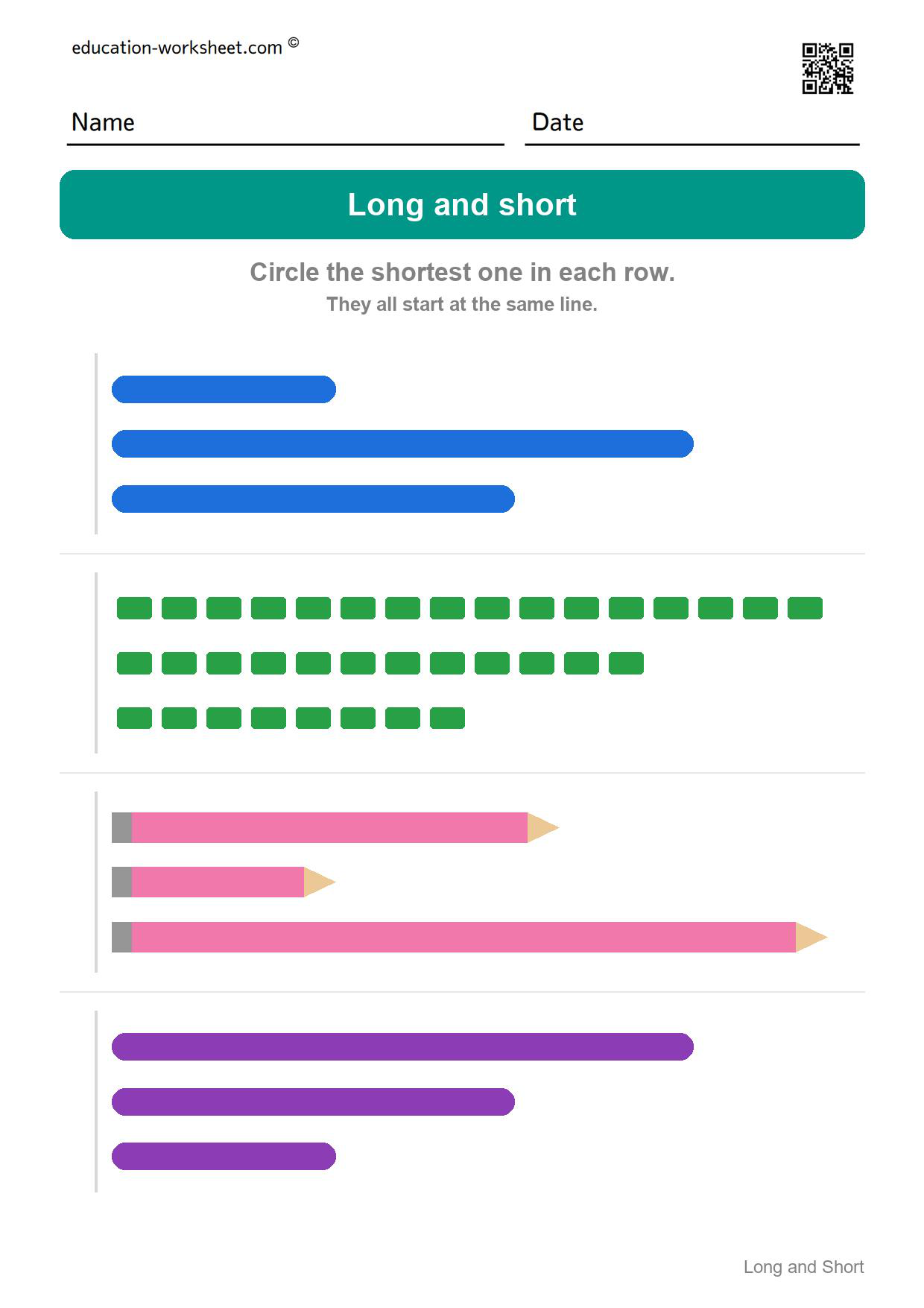
This is the hardest page in the pack, and the reason is measurable. The first row is 8, 10 and 12 centimeters, and the second is 9, 11 and 7. The winner is ahead by only 2 centimeters in both.
Everywhere else in the pack the gap is 4 centimeters or more. Here it is 2, three times over. A child who has been eyeballing the rows now has to line the ends up properly, and that is the whole point of saving these until last.
Worksheet 10 – Circle the Shortest One
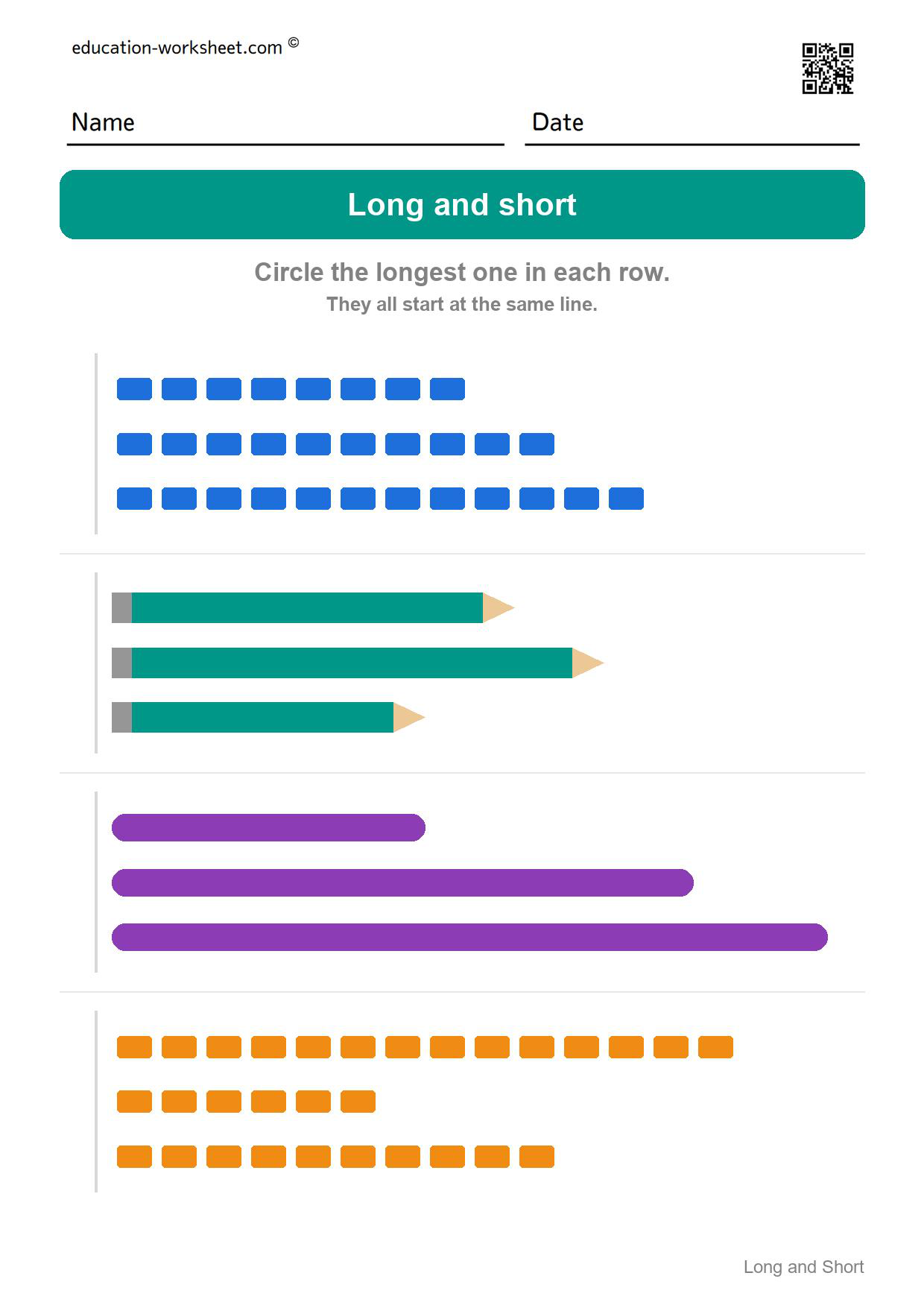
Pink pencils, green bars, purple blocks, brown pencils. The first row is 15, 10 and 12 centimeters – the shortest one is in the middle, and it is only 2 centimeters shorter than the next.
The pack finishes on shortest with lengths this close, which is the right place to stop. If a child can do page 9 and page 10, they are comparing rather than guessing.
Answer Key – All 40 Rows
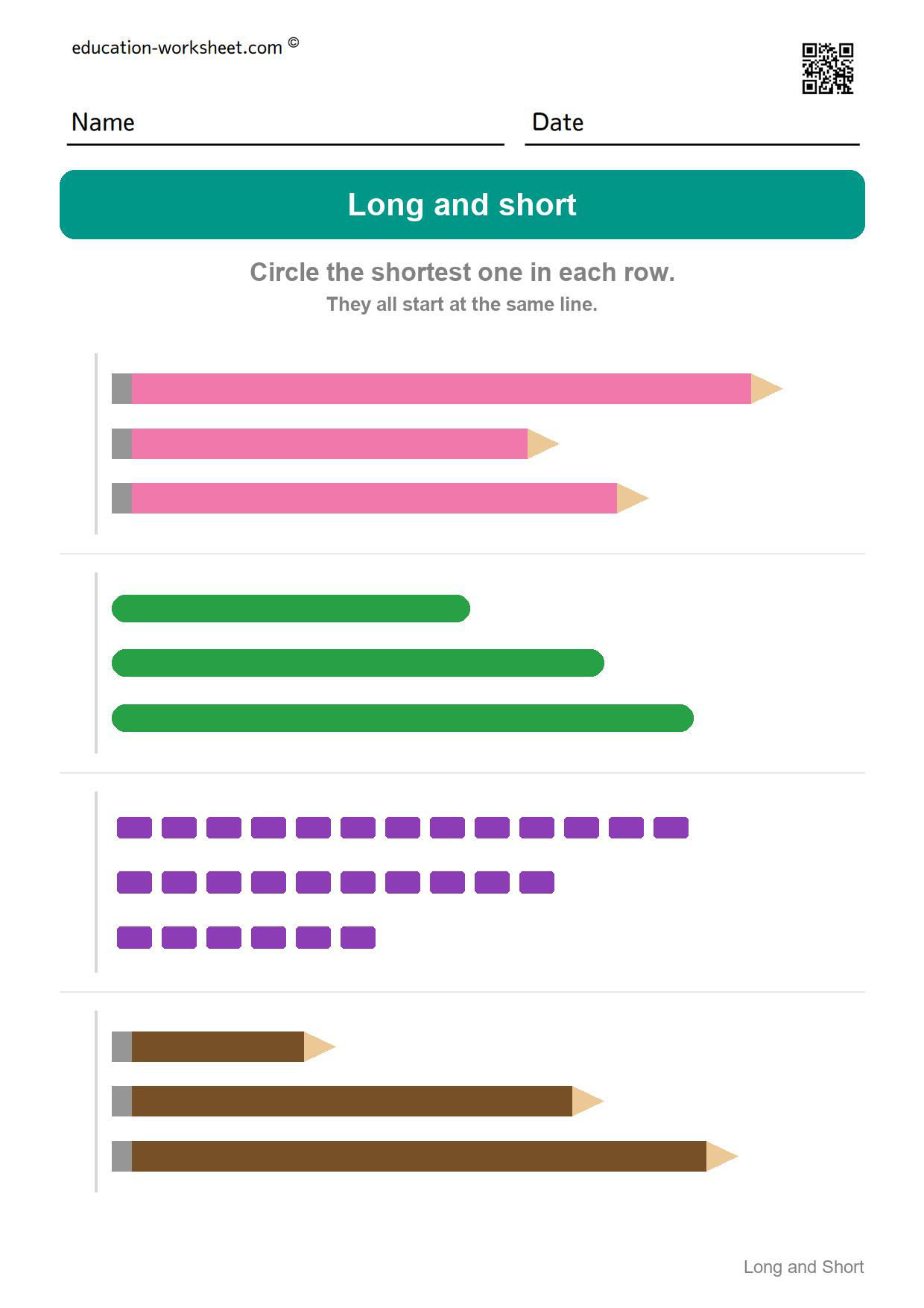
The eleventh sheet gives the answer for every row as first, second or third, counting from the top, with a reminder of what each page asked for.
Across the forty rows the answer is the first item 14 times, the second 17 times and the third 9 times. The middle is the most common answer and the bottom is the least, which is the opposite of what most children expect.
Why the Blocks Are There
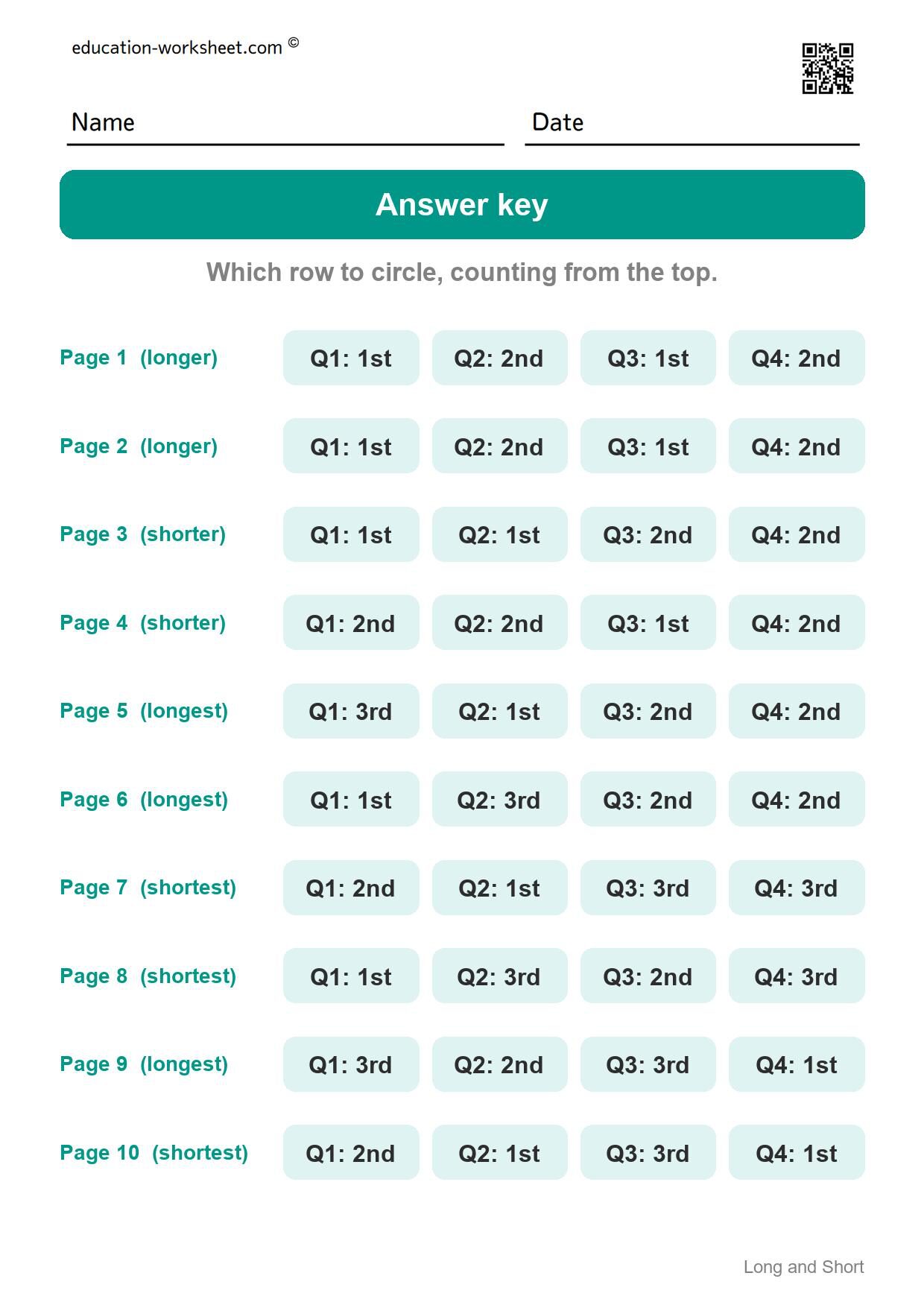
Three kinds of object turn up in this pack, and the strips of blocks are the interesting ones. Within a row every block is the same size, so the longer strip always has more blocks in it. A child can answer those rows by counting instead of comparing, and they will get the same answer.
That is worth knowing rather than worrying about. Counting is a legitimate way to measure – it is what the ruler is doing, one unit at a time – and a child who counts blocks on one row and then eyeballs a pencil on the next has used two strategies on the same page. Ask which one felt easier.
Some rows are built as even staircases: 5, 10 and 15 centimeters on page 5, or 16, 12 and 8 on page 6 and again on page 8. Those rows are worth a second look, because the pattern is visible once someone points at it.
When Children Are Ready for Long and Short
- Age: about four to six – pre-K through the end of kindergarten, with the last pages useful into first grade.
- Before starting: nothing. No reading, no counting, no writing.
- K.MD.A.1 – describe measurable attributes of objects, such as length.
- K.MD.A.2 – directly compare two objects with a measurable attribute in common. That is pages 1 to 4.
- 1.MD.A.1 – order three objects by length. That is pages 5 to 10, and it is first grade work sitting at the back of a kindergarten pack.
How to Use These Worksheets
- Read the question at the top out loud every time, especially on pages 3, 7 and 10 where it has just changed.
- Run a finger along the row from the starting line to the end of each object. Comparing with a finger is slower than looking and much more reliable.
- On a row that is close, put a strip of paper against the longest one, mark it, and hold it against the others. That is measuring, and page 9 is the page that makes it worth doing.
- Do pages 1 to 4 in one sitting and 5 to 10 in another. The change from two objects to three is bigger than it looks.
- Keep a ruler nearby for pages 9 and 10. The lengths step in whole centimeters, so a ruler settles any row a child is unsure about.
- When a page is finished, ask the child to put the three in order from shortest to longest, not just to find one. That is the next skill along.
Three Things to Watch For
1. Answering the previous page’s question. The word at the top changes four times in this pack: longer, shorter, longest, shortest. Each change catches children out for a row or two, and the only fix is to read it aloud together.
2. Assuming the answer is at the bottom. Across the forty rows, the middle item is the answer 17 times and the bottom item only 9. Children who decide the longest thing is always drawn last will be wrong more often than they are right.
3. Eyeballing instead of comparing. It works perfectly well for eight pages, because the gaps are 4 centimeters or more. Then page 9 arrives with a 2-centimeter gap and the same child suddenly gets rows wrong. That is not a step backwards – it is the moment measuring starts to be worth the effort.
Printing Tips
- Print at 100 percent, actual size, on A4 or US Letter. Do not use fit-to-page: it changes every length on the sheet, and the centimeter measurements stop working.
- Black and white printing is fine. The colors separate the rows but carry no information.
- Print pages 9 and 10 twice. They are the two worth repeating with a ruler in hand.
Frequently Asked Questions
What age are these long and short worksheets for?
About four to six years old. There is nothing to read or write, so a child who can hold a crayon can do the first pages; the last two suit a child who is already comfortable comparing.
Is there an answer key?
Yes, page 11 gives every answer as first, second or third, counting from the top of each row.
Do the objects really start at the same line?
Yes. Measured on the printed page, every object begins within about a millimeter of the same left-hand edge, which is what makes the comparison a fair one.
How long are the objects?
Between 5 and 16 centimeters, stepping in whole centimeters, give or take a couple of millimeters for pencil tips and rounded ends. A ruler will confirm any answer on any page.
Which pages are the hardest?
Pages 9 and 10. Everywhere else the deciding gap is at least 4 centimeters; on those two pages three rows come down to 2 centimeters.
Why do some rows have three objects?
Because picking the longest of three is a different skill from picking the longer of two, and it is a first grade standard rather than a kindergarten one. Pages 5 to 10 are all threes.
Do I need to sign up to download these?
No. Every PDF downloads immediately, with no account, no email address and no cost.
Can I use these in my classroom?
Yes, they are free to print for home and classroom use. Please do not sell them or re-host the files elsewhere.
More Free Comparing Worksheets
- Free Heavy and Light Worksheets for Kindergarten – Compare Weight
- Free Tall and Short Worksheets for Kindergarten – Compare Heights
- Free Measuring Length Worksheets for Kindergarten – How Many Cubes Long?
- Free Size Ordering Worksheets for Kindergarten – Smallest to Biggest
- Free Big and Small Worksheets for Kindergarten – Compare Sizes
- Free Wide and Narrow Worksheets for Kindergarten – Compare Width