These free P sound articulation worksheets help children practice the P sound at the beginning of words, one small step at a time. The 14-page PDF starts with four large pictures (pie, pear, peach and pea), builds up to phrases and full sentences, and ends in play: riddles, a party story, a board game and bingo. Every one of the 14 picture words starts with a single P sound followed by a vowel.
A speech-language-hearing therapist with over 16 years of experience made these pages for parents, preschool and kindergarten teachers, and speech therapists who want ready-to-print practice. Please treat it as practice material. It is not a test and gives no score, and no worksheet can decide whether a child has a speech sound disorder.
P is a sound you can see and feel. The lips close in plain view, and the puff of air can be felt on the back of a hand or watched as it moves a tissue. That makes it a friendly sound for children who learn best by seeing and touching, and the pages lean on that: the guide page gives you a tissue cue, and the first pages use short words where the puff is strongest.
- What You Get in This Free P Sound Pack
- The 12 P Sound Articulation Worksheets, Page by Page
- Start Here – How the P Sound Is Made
- Page 1 – Short Words: pie, pear, peach, pea
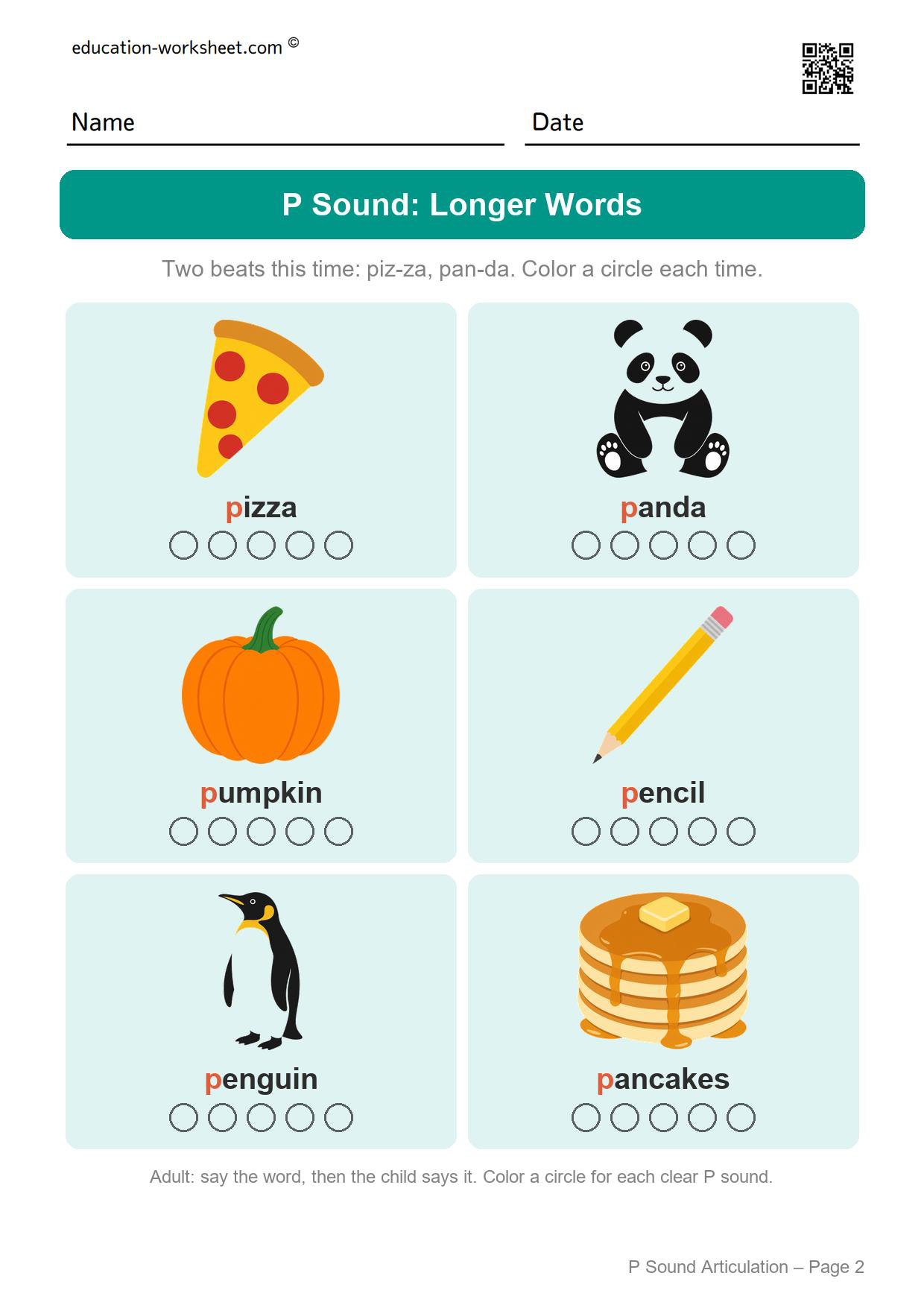
- Page 2 – Longer Words: pizza, panda, pumpkin, pencil, penguin, pancakes
- Page 3 – All the Words
- Page 4 – Two-Word Phrases with My
- Page 5 – Three-Word Phrases with Colors
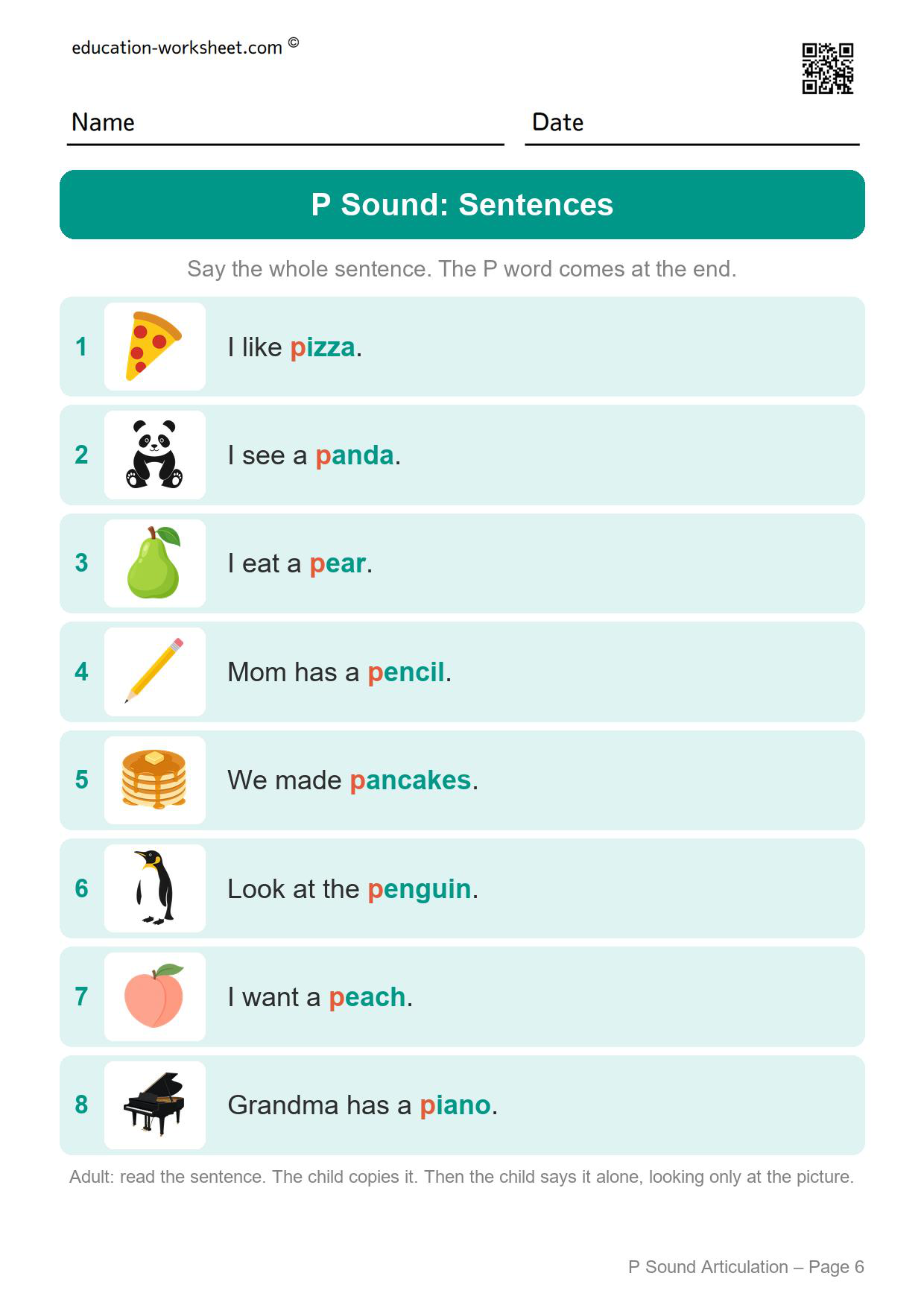
- Page 6 – Sentences That End with a P Word
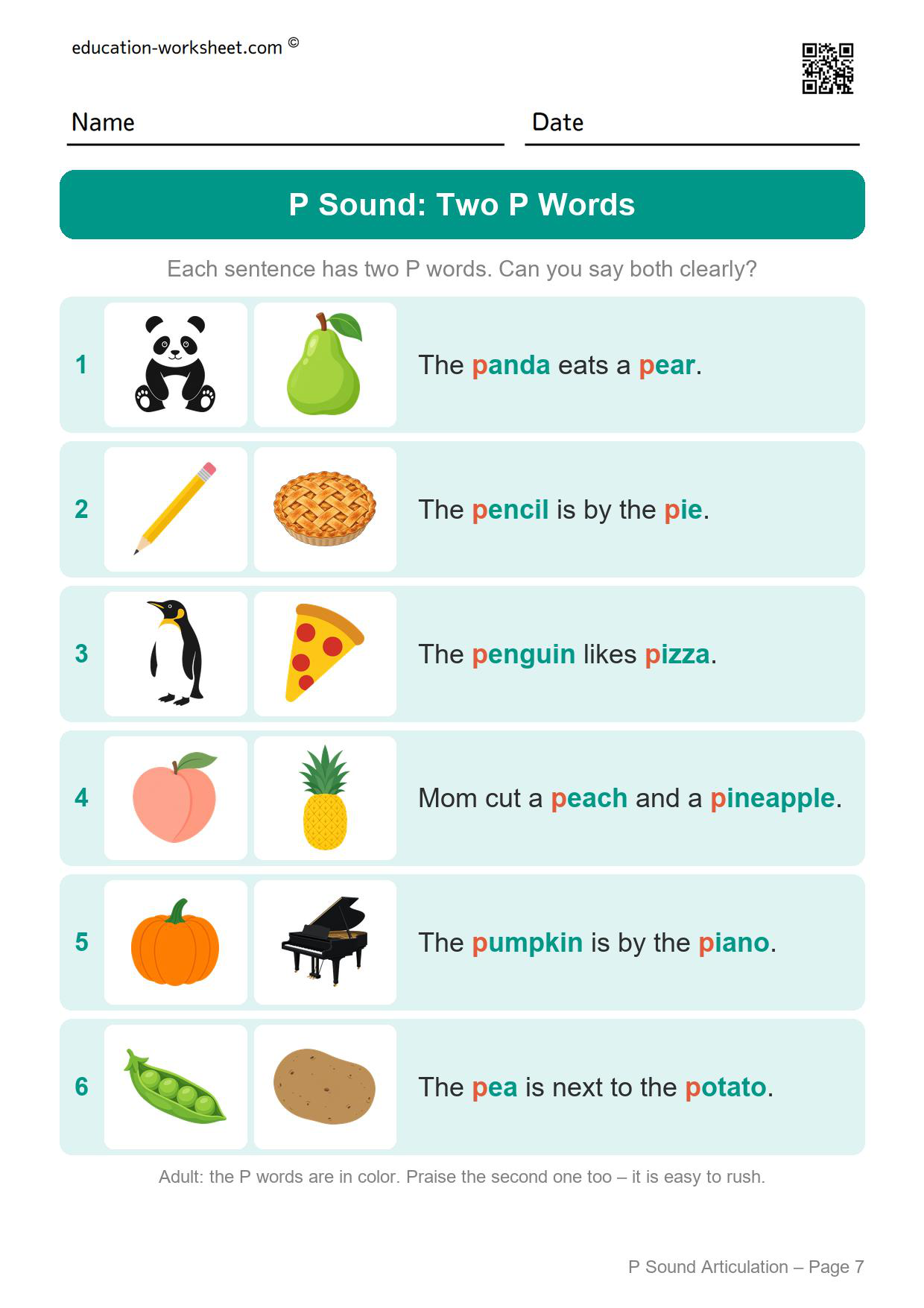
- Page 7 – Two P Words in One Sentence
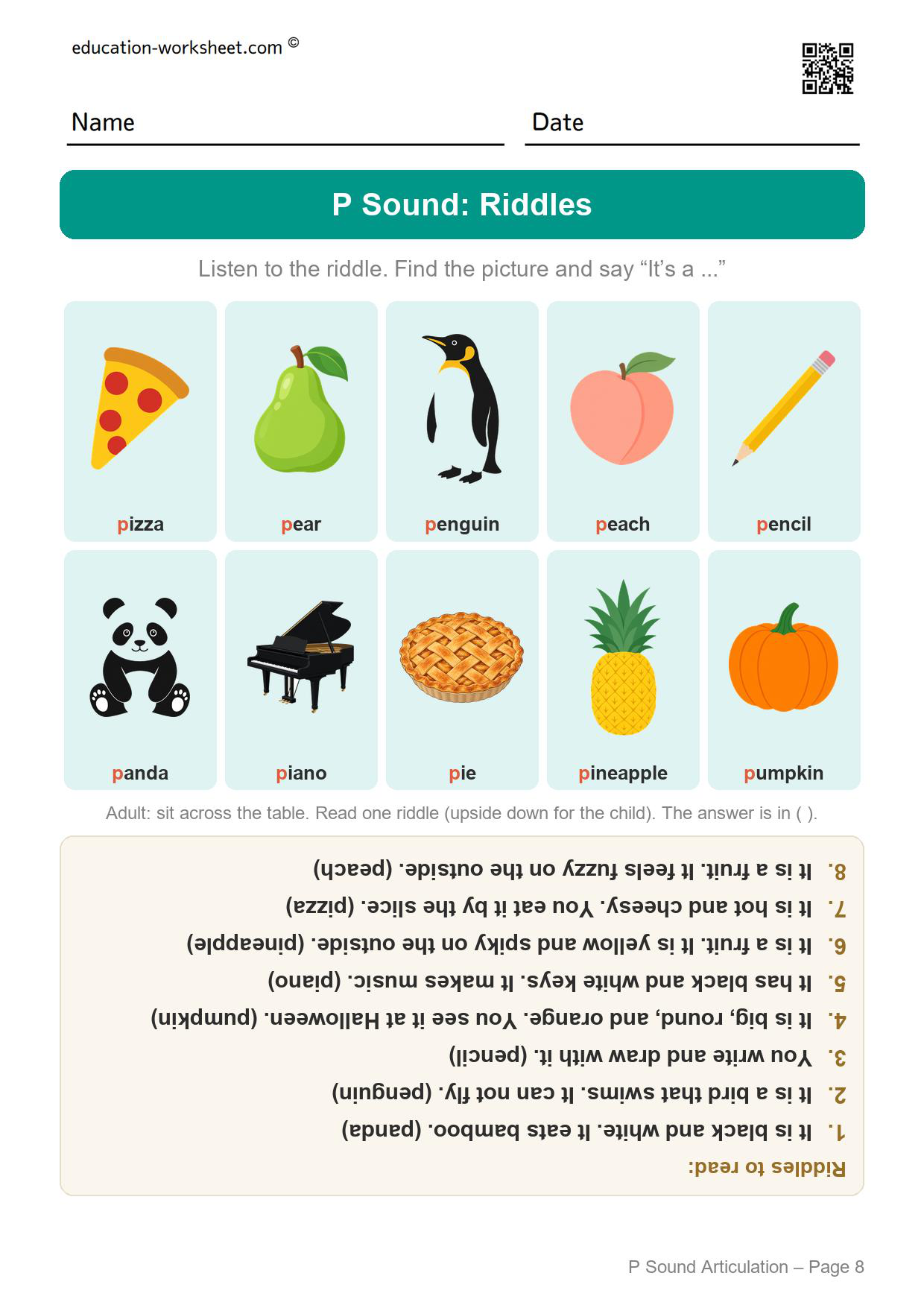
- Page 8 – P Sound Riddles
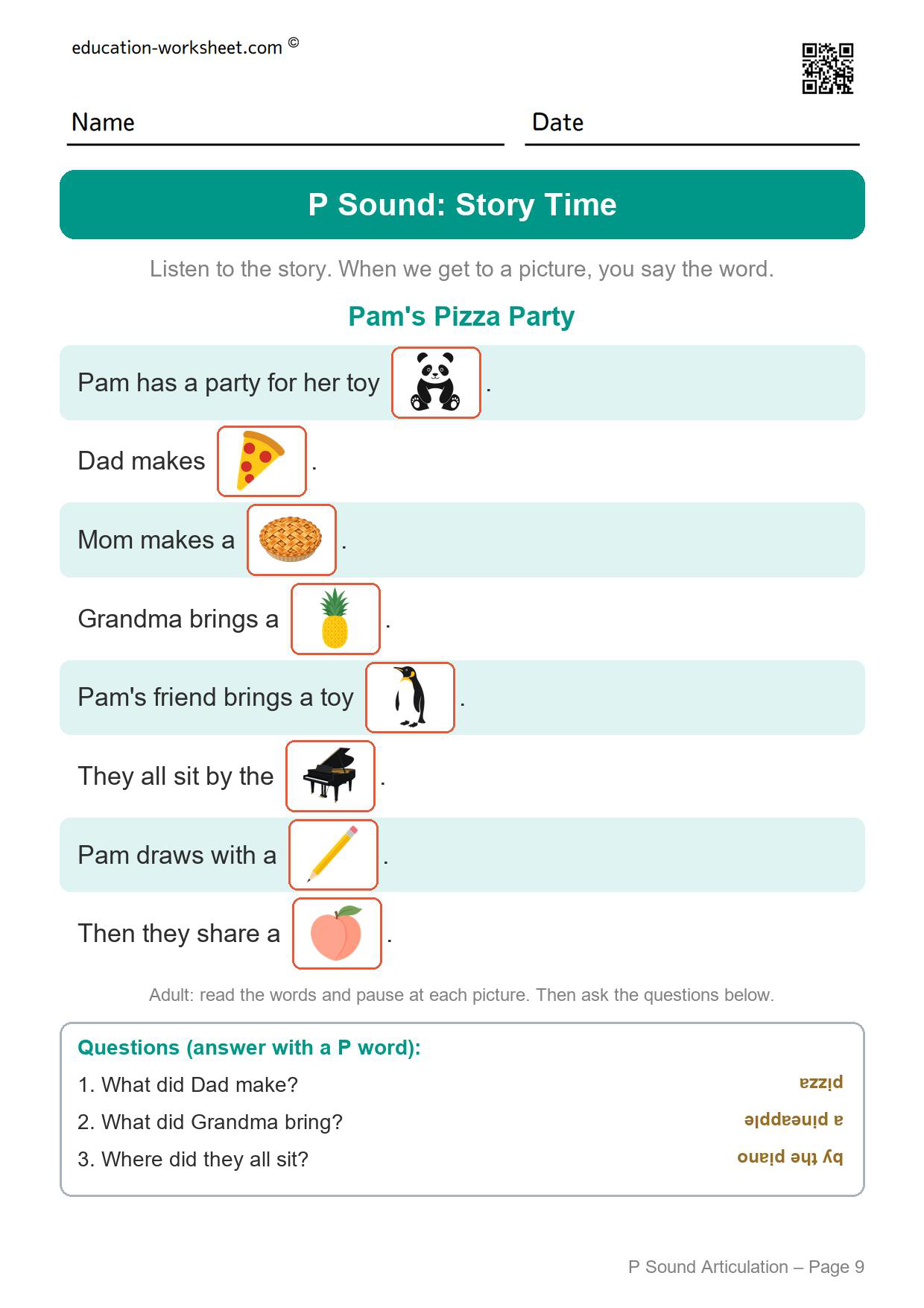
- Page 9 – Story Time: Pam’s Pizza Party
- Page 10 – P Sound Board Game
- Page 11 – P Sound Bingo with Calling Cards
- Page 12 – A Week of Home Practice
- Progress Record
- The Rules Behind the Pages
- Helping a Child Find the P Sound
- When to Ask for Help
- Who This Pack Is For
- Using the Worksheets Step by Step
- Three Things to Listen For
- Ways to Keep It Fun
- Printing Tips
- Frequently Asked Questions
- What age are these P sound worksheets for?
- Why are there no words like plate or present?
- My child says B instead of P. Should I use these pages?
- Why is the P softer in potato than in pizza?
- Will this pack show whether my child is behind in speech?
- Is there anything to pay or register for?
- Can I print these for my students or my speech therapy caseload?
- More Free Speech and Language Worksheets
What You Get in This Free P Sound Pack
- One guide page for the adult, twelve practice pages and one progress record – 14 pages in all.
- 14 picture words: pie, pea, pear, peach, pot, pizza, panda, pancakes, pumpkin, penguin, pencil, pineapple, potato and piano.
- No words that start with PL or PR (such as plate or present). Those are consonant blends and are practiced separately.
- Words sorted by length: one beat on page 1, two beats on page 2, and three-beat words from page 3 on.
- Upside-down adult scripts on the riddle and story pages, so you can sit across from the child.
- Each page is also a separate PDF, so you can print one level without printing the whole pack.
The 12 P Sound Articulation Worksheets, Page by Page
The pages climb from single words to conversation-like talk. Use them in order the first time through. After that, mix freely: a child who is steady at the sentence level can still enjoy the board game, and a child who stumbles in sentences can drop back to page 4 or 5 for a while without losing anything.
Start Here – How the P Sound Is Made
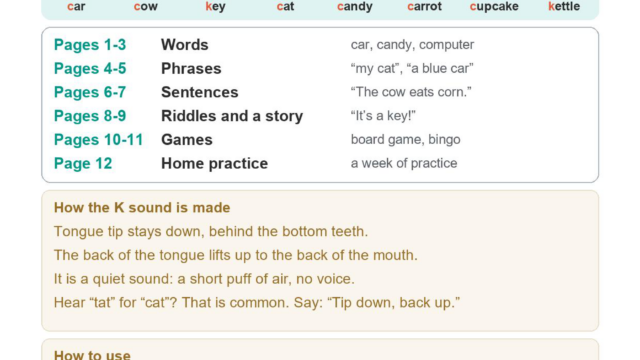
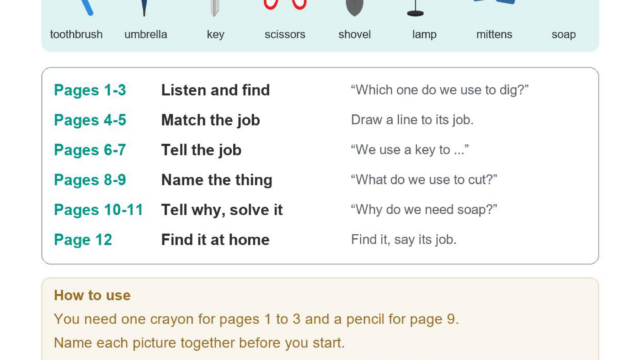
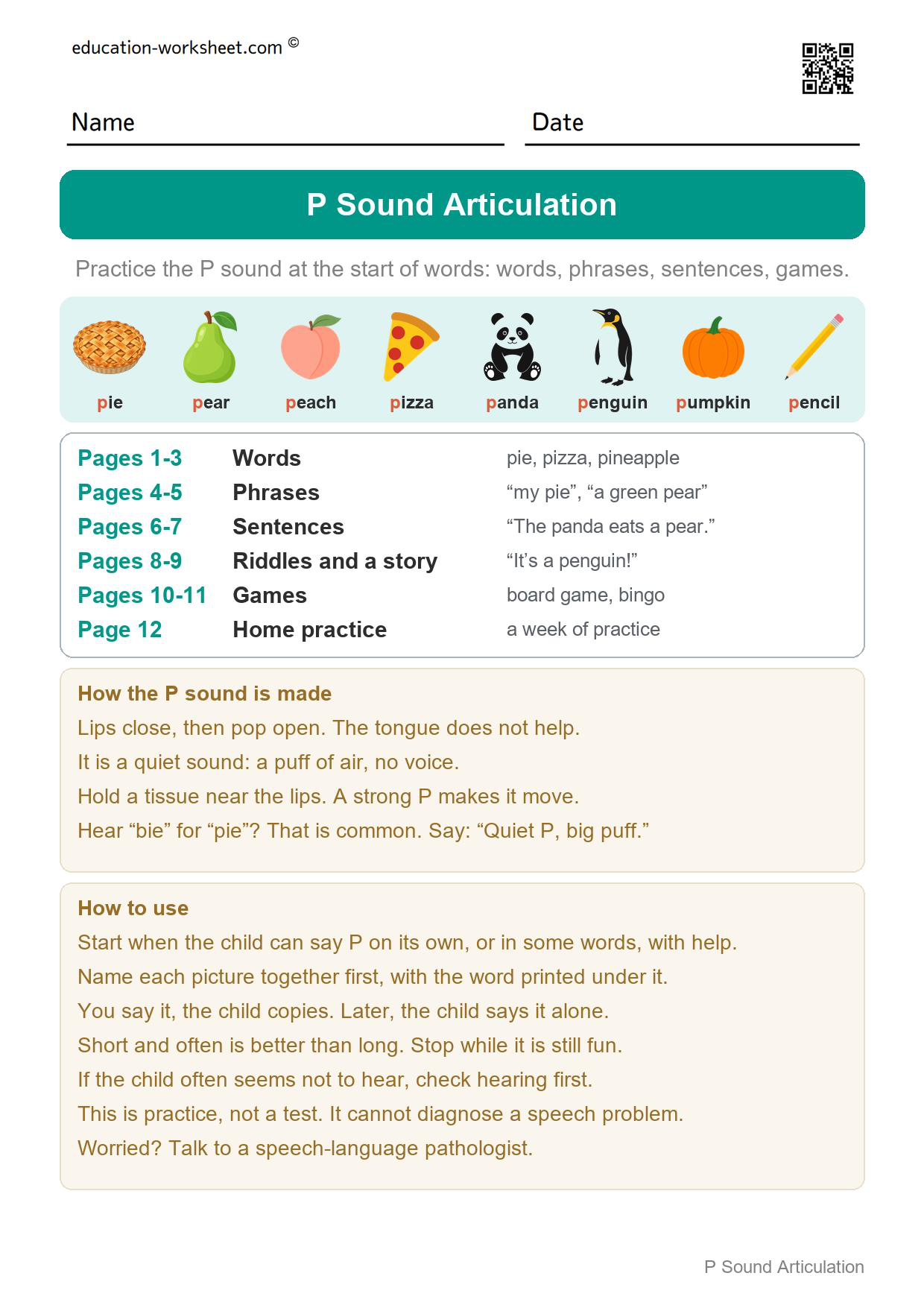
The first page is for you, not the child. Along the top are eight of the picture words; below them is a map of the six levels, each with a sample, and then four cues for the P sound: the lips close and then pop open, the tongue is not needed, the voice stays off, and a strong P will make a tissue move. The last cue is the one children usually like best.
Page 1 – Short Words: pie, pear, peach, pea
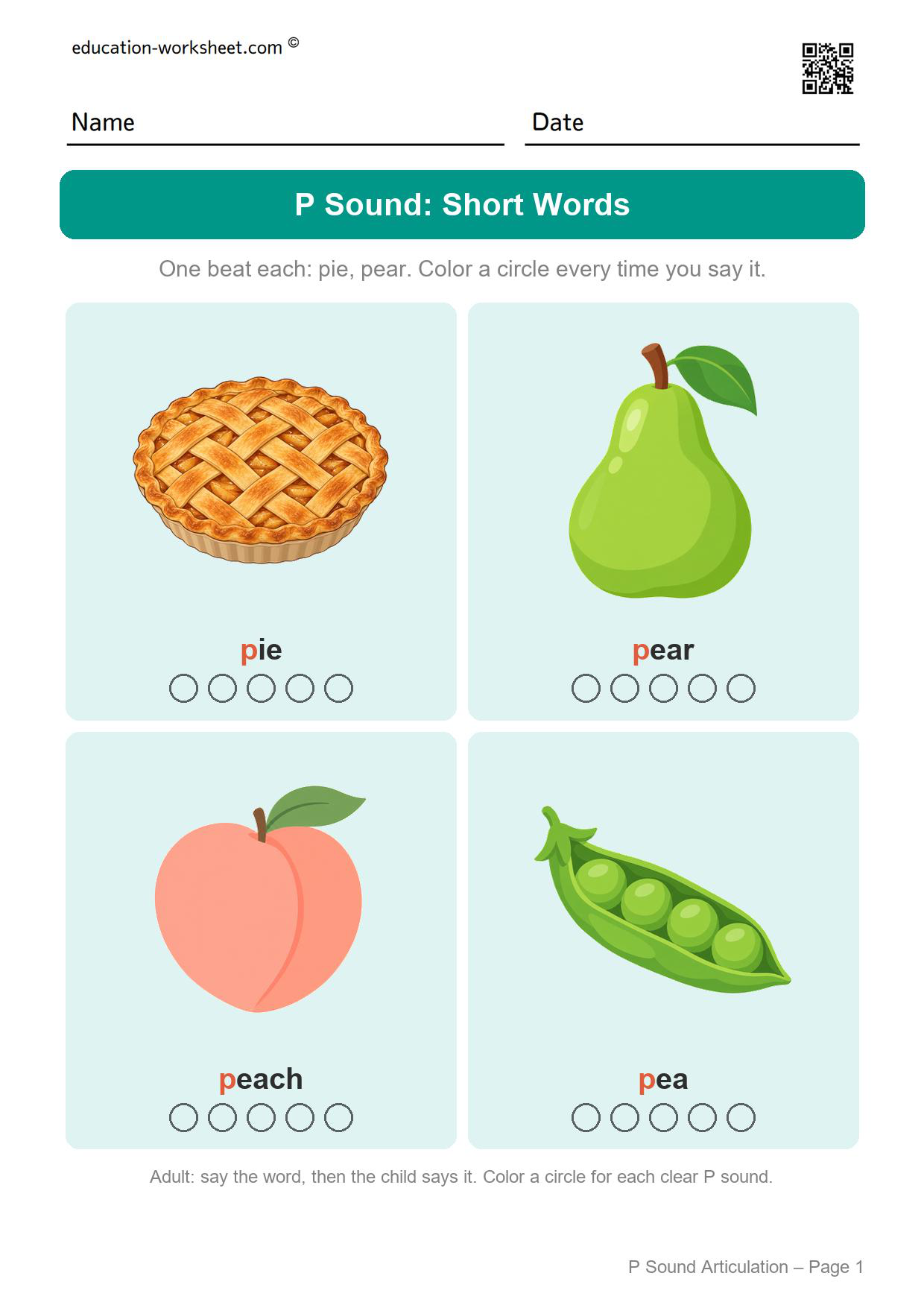
Only four pictures on this page, and each one is large: pie, pear, peach and pea. All four are one beat long and start with P followed straight away by a vowel, which is the easiest place to hear the puff of air. Each picture has five circles to color.
The pea is drawn as a green pod with peas inside. Call it “pea” together before you start, so the child is not trying to say “peas” or “pea pod” on one turn and “pea” on the next.
Page 2 – Longer Words: pizza, panda, pumpkin, pencil, penguin, pancakes
Six two-beat words: pizza, panda, pumpkin, pencil, penguin and pancakes. In every one of them the P begins the strong first beat (PIZ-za, PAN-da), so the puff of air should still be easy to feel. Pumpkin also has a P in the middle, but it is very light, even when adults say it. Listen only for the first one.
Page 3 – All the Words
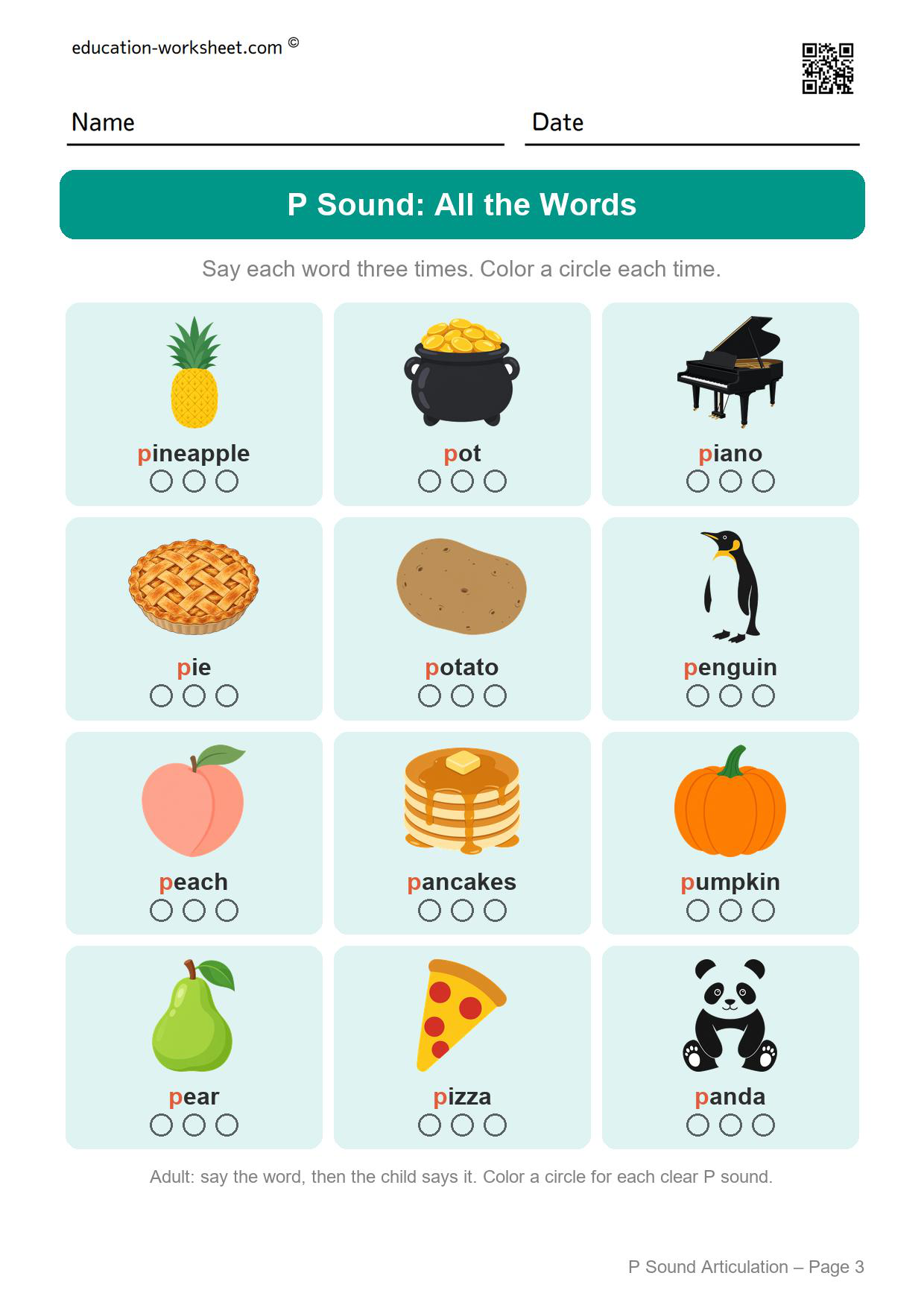
A mixed review of twelve pictures, three circles under each. Eight return from pages 1 and 2, and four are new: pineapple, piano, potato and pot. Pineapple, piano and potato are three beats long. In piano and potato the first beat is weak (pi-A-no, po-TA-to), so the P is shorter and the puff is softer. Listen for a P that is short but still clearly there.
The pot is a black pot full of gold coins. Children may call it “gold” or “treasure,” so it is used only on this page, after you have named it together.
Page 4 – Two-Word Phrases with My
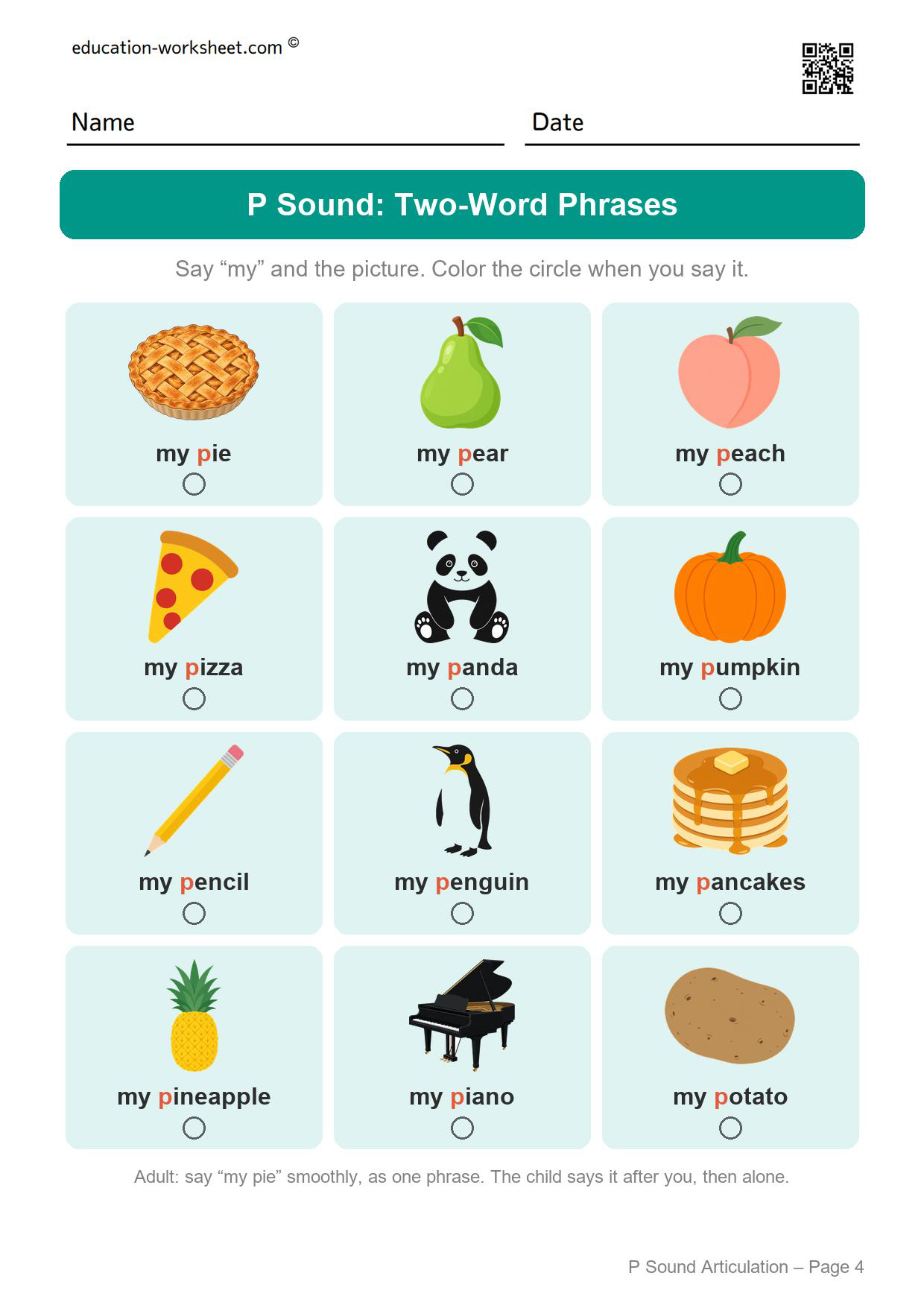
Twelve pictures, each labeled with “my” and the word: my pie, my pear, my panda, my pumpkin, my potato and more. Here is a nice detail: M is also made with closed lips. The lips are already together at the end of “my,” so they only need to stay shut for a moment and then pop open for the P. For many children this makes the phrase easier than the word alone. One circle per phrase keeps the page moving.
Page 5 – Three-Word Phrases with Colors
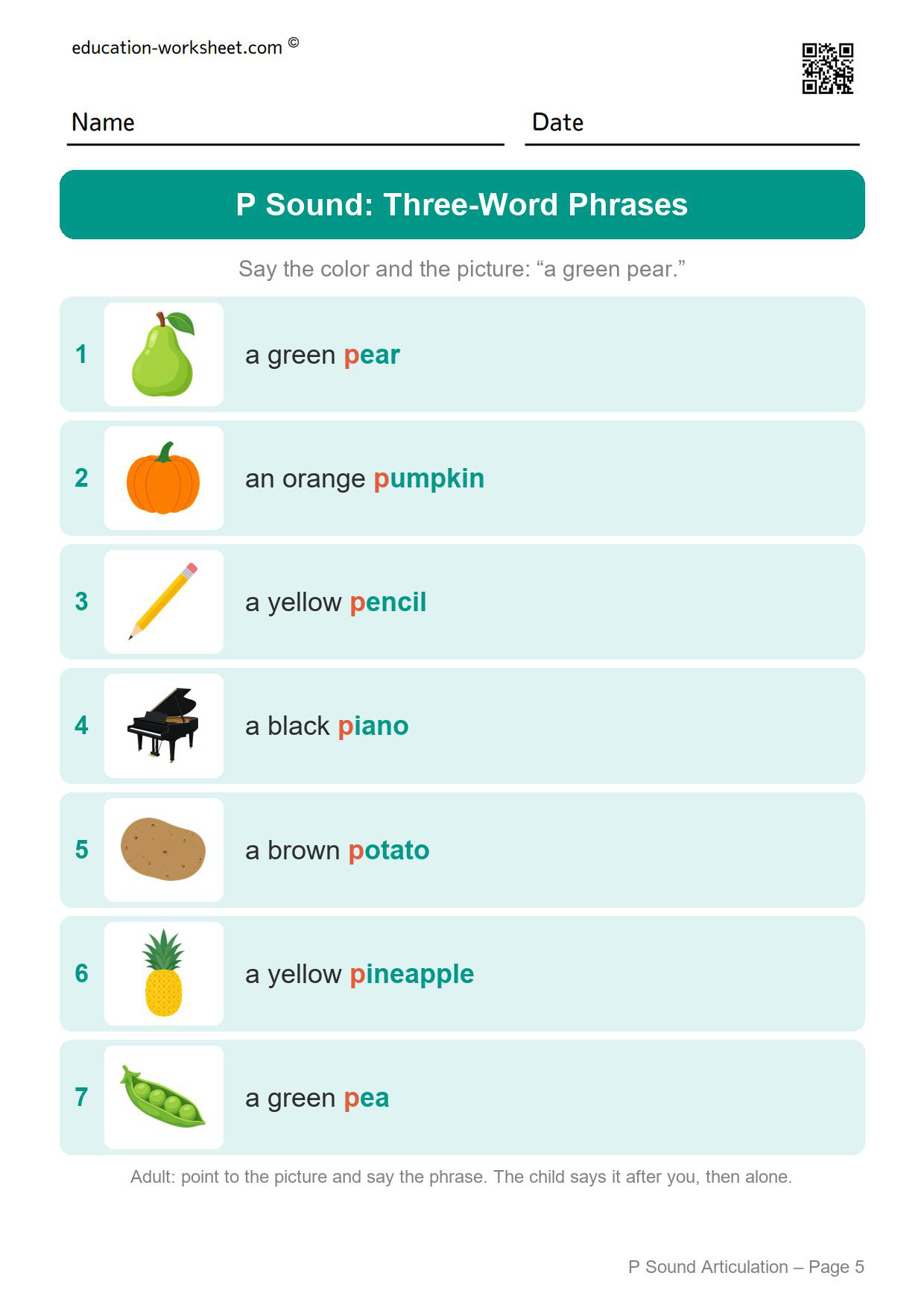
Seven rows: a green pear, an orange pumpkin, a yellow pencil, a black piano, a brown potato, a yellow pineapple and a green pea. Each color was checked against the drawing on the page, so the child can work out the phrase just by looking. Notice that “an” goes with orange. Children will hear the difference even if you never explain it.
Page 6 – Sentences That End with a P Word
Eight short sentences, each ending with its P word: “I like pizza,” “I see a panda,” “We made pancakes,” “Look at the penguin,” “Grandma has a piano.” No other word in a sentence starts with P, so there is only one sound to listen for, and it comes at the end where it is easy to catch.
First the child repeats each sentence after you. Then cover the words with a sheet of paper and let the child say it again from the picture alone.
Page 7 – Two P Words in One Sentence
Here every sentence carries two P words, and both are pictured: “The panda eats a pear,” “The pencil is by the pie,” “The penguin likes pizza,” “Mom cut a peach and a pineapple,” “The pumpkin is by the piano” and “The pea is next to the potato.”
Some of these are a little silly on purpose. A penguin eating pizza tends to get a laugh, and a laughing child is usually a willing one. Both P words count toward the progress record, so this row is out of 12.
Page 8 – P Sound Riddles
The child sees ten pictures; you hold the eight riddles, which are printed upside down at the foot of the page so they face you when you sit opposite each other. Examples: “It is black and white. It eats bamboo.” (panda) and “It is a fruit. It feels fuzzy on the outside.” (peach). The child answers with “It’s a …”
The pear and the pie are not the answer to any riddle. They stay on the page so that the last riddle still needs listening, not just pointing at the only picture left. The pear is a useful extra: like the peach it is a fruit, so the child has to listen for the word “fuzzy” to choose between them.
Page 9 – Story Time: Pam’s Pizza Party
An eight-line story about Pam, who has a party for her toy panda. You read the words and pause at each picture; the child says the picture word to finish the line. Dad makes pizza, Mom makes a pie, Grandma brings a pineapple, a friend brings a toy penguin, everyone sits by the piano, Pam draws with a pencil and they share a peach.
Three questions follow, and the answers (pizza, a pineapple, by the piano) are printed upside down for you. Because the child has to remember the story, the P sound gets less of their attention here, which makes it a good check on how steady the sound has become.
Page 10 – P Sound Board Game
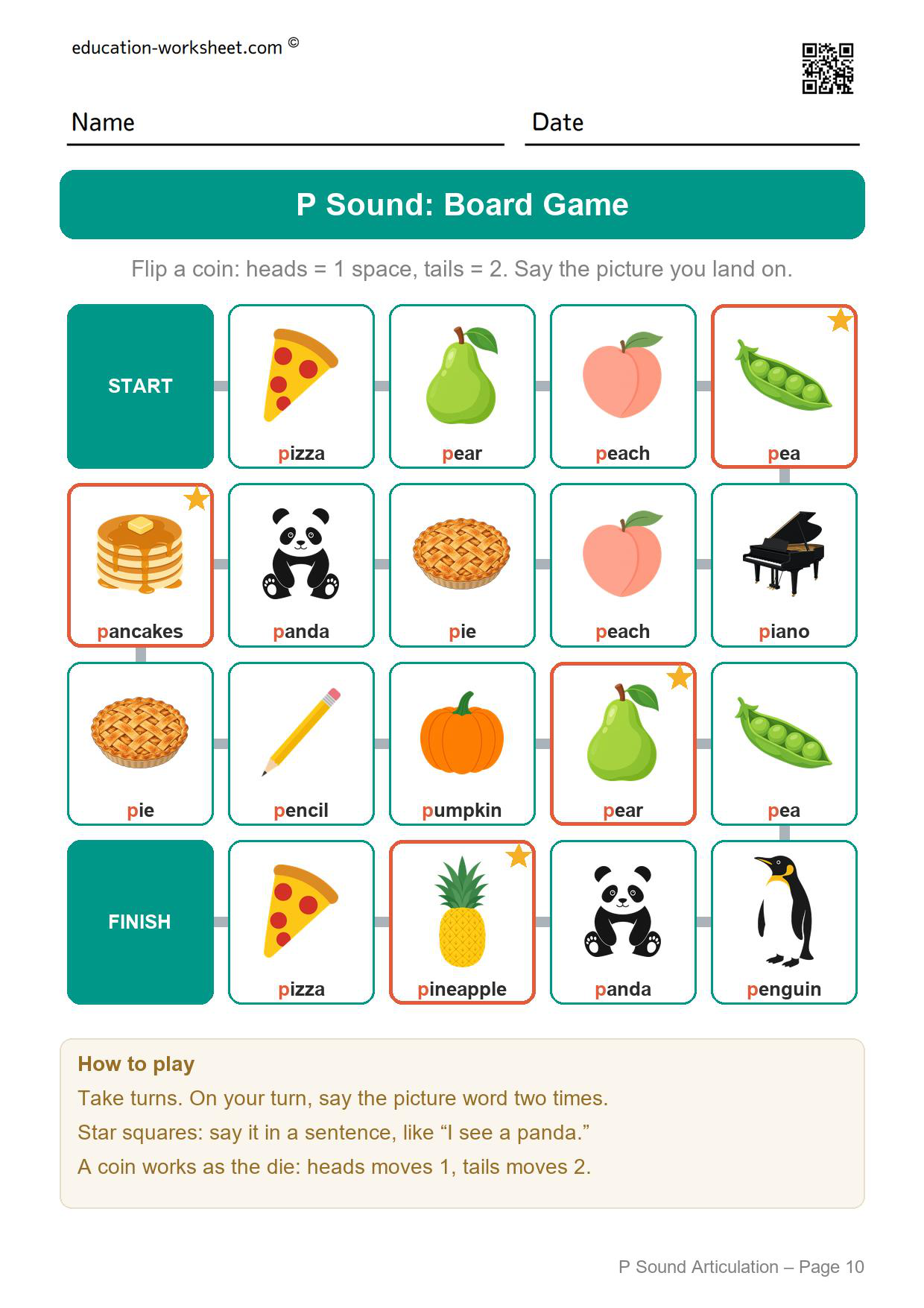
Eighteen picture squares snake down the page between START and FINISH. A coin replaces the die (one space for heads, two for tails). Say the word on your square twice. On the four star squares, make a whole sentence instead, such as “I see a panda.” The board uses the ten words from pages 1 and 2 plus pineapple and piano, and the same picture never appears twice in a row.
Page 11 – P Sound Bingo with Calling Cards
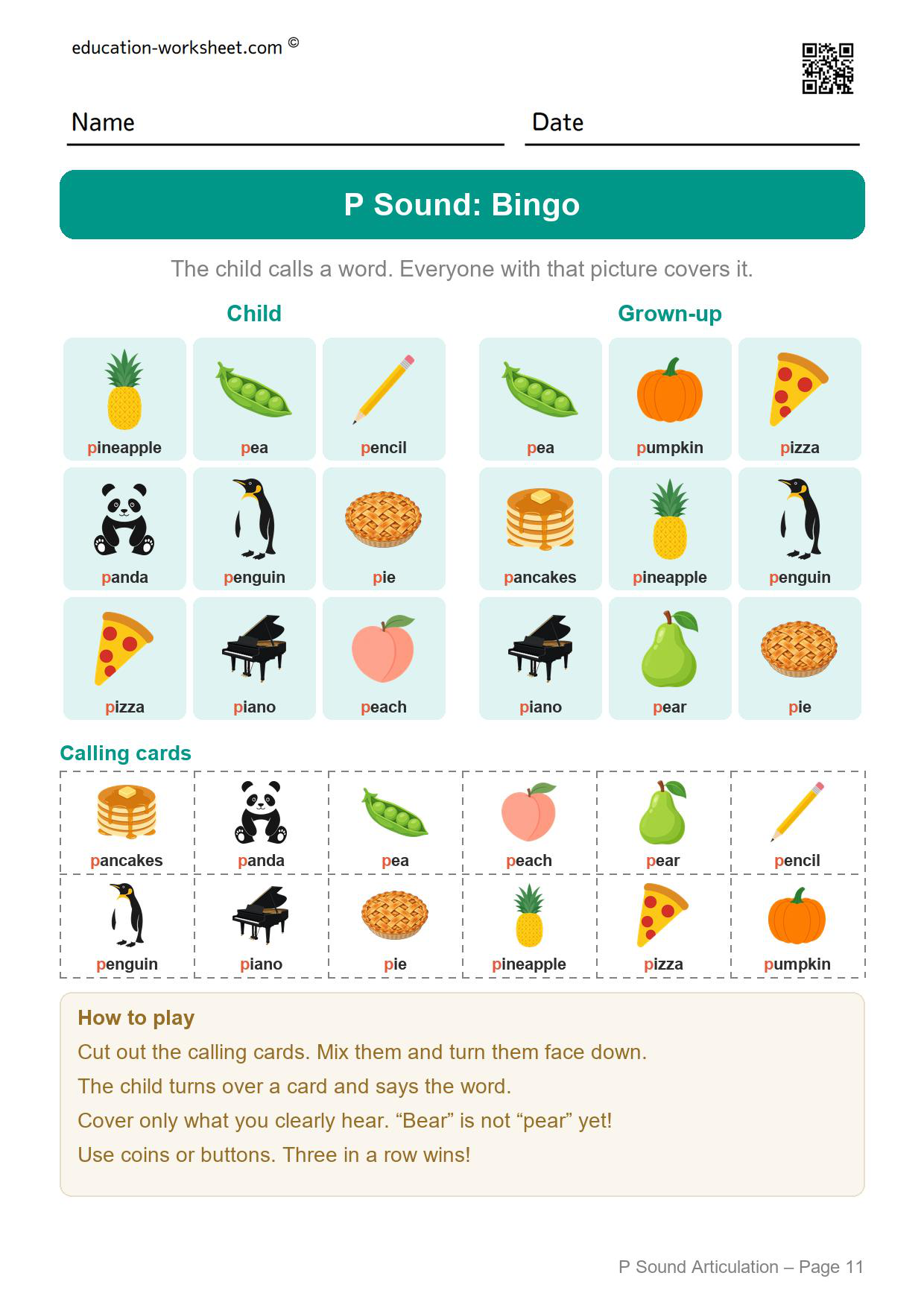
There are two boards of nine pictures, one labeled Child and one labeled Grown-up, plus twelve cards below the boards to cut out and shuffle. Only the child calls the words; anyone with that picture covers it. The rule printed on the page is the heart of the game: cover only what you clearly hear. If the child calls “bear” when the card shows a pear, there is no pear to cover yet, and the child gets an honest reason to try again.
Page 12 – A Week of Home Practice
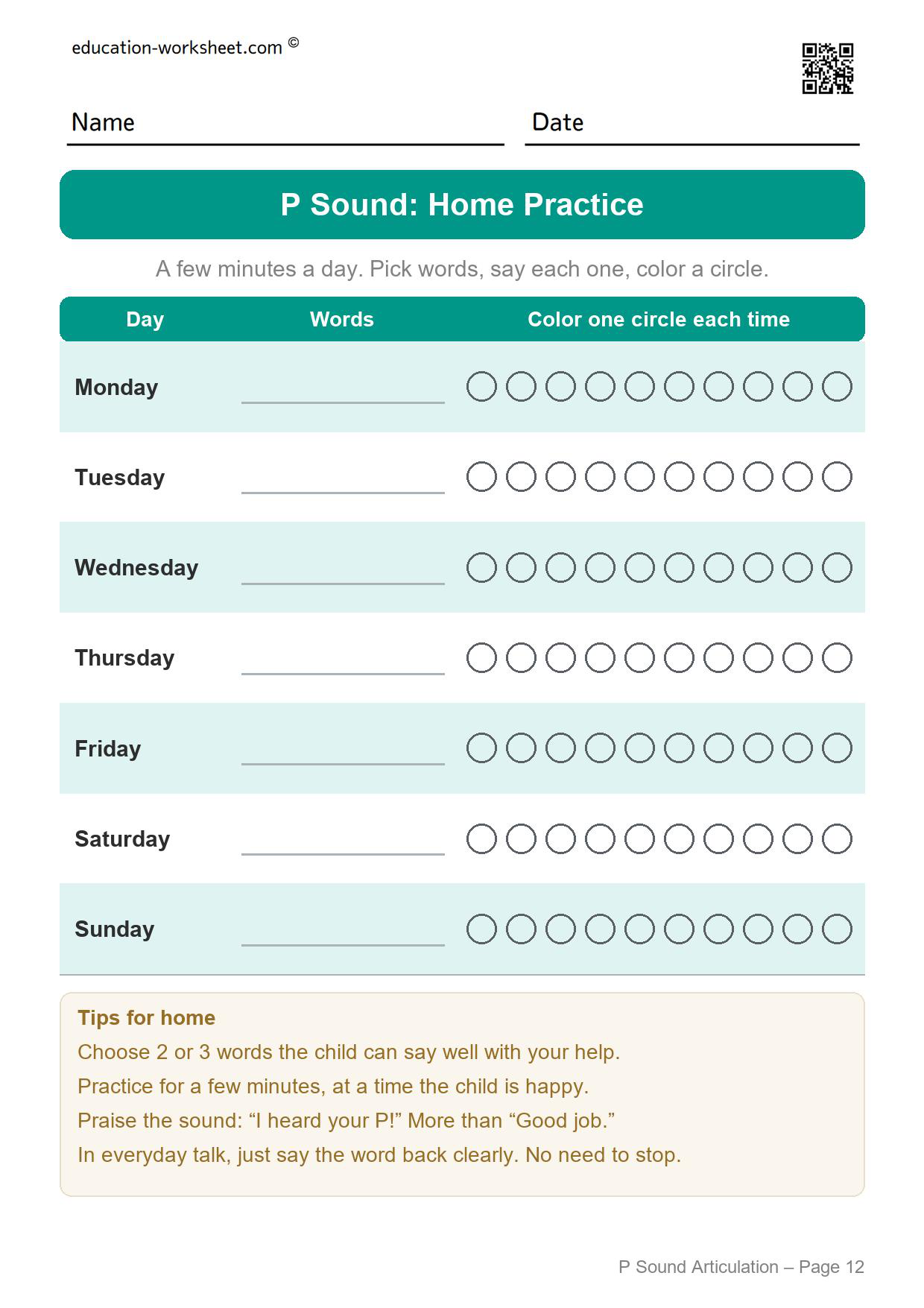
Monday to Sunday down the side, a blank for which words you chose that day, and ten circles per row. Four tips for families sit underneath. A few minutes a day, at a moment when the child is in a good mood, tends to work better than one long session at the weekend.
Progress Record
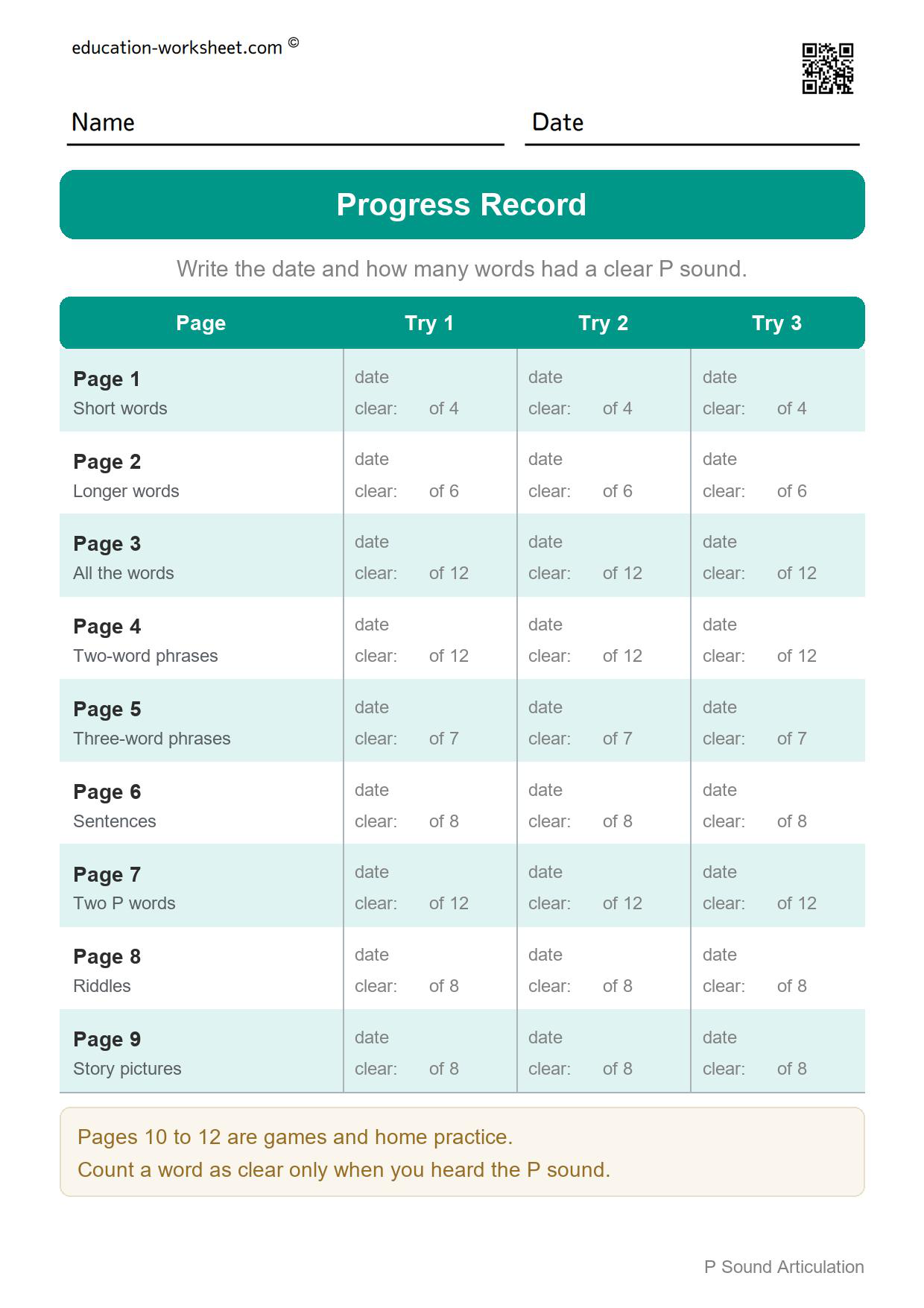
Three tries can be logged for each of pages 1 to 9. Write the date and the number of words with a clear P sound. Each row shows the total for that page: 4 for page 1, 6 for page 2, 7 for the color phrases on page 5, and 12 for page 7, because each of its six sentences has two P words.
The Rules Behind the Pages
Every page was generated by a short computer program that checks its own work. When a rule failed, the program stopped, and the page was fixed before anything was saved. These are the main rules:
- A single P at the start of every target word. No PL, PR or PH words, and no other word in any sentence that starts that way. That is why there is no “play” or “present” anywhere in the pack.
- Length grows slowly. Page 1 has only one-beat words and page 2 only two-beat words. The three-beat words, where the P can sit on a weak first beat, wait until page 3.
- One P word per sentence on page 6, two on page 7. Words such as “put” were left out of the sentences so that the count is exact and you always know what to listen for.
- Each riddle fits one picture. No riddle contains its own answer, and the pear and the pie are never the answer.
- Pictures with one name. The present was left out because it starts with PR, and pictures that children often call something else, such as a push pin or a puzzle piece, were not used. The pot of gold appears only on page 3, where you name it together.
- No neighbors repeat. Along the board-game path, any picture is at least three squares away from its next copy.
Helping a Child Find the P Sound
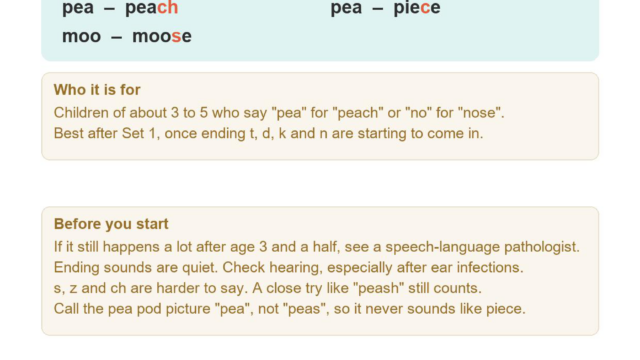
To make P, the lips press together, air builds up behind them, and then the lips open and let it out in a small burst. The voice is off. At the start of a word like pie or pear, English adds an extra breath of air after the P, and this is what moves a tissue held in front of the mouth. B is made in exactly the same place with the voice switched on, and with much less air.
So the most common slip is easy to understand: “bie” for pie, or “bear” for pear. The lips are right; the voice came on too early and the puff of air was lost. Two cues help. First, the tissue: hold a tissue or a strip of paper in front of the child’s lips and see if a P makes it flutter. Second, a whisper: say the word in a whisper together, which turns the voice off, and then say it again out loud, keeping the puff.
Start with the sound on its own, then a P with a vowel (“pa,” “po,” “pee”), and only then turn to page 1. Should the child be unable to make a P with closed lips even with your help, or seems to have trouble closing the lips at all, pause the worksheets and ask a speech-language pathologist to take a look.
When to Ask for Help
Young children’s speech changes quickly, and children do not all reach the same sound at the same time. A worksheet can give practice to a child who is almost there, but judging whether one child’s speech is developing as expected takes a trained ear and a proper assessment.
Rule out hearing first if the child often misses what you say. It is very hard to change a sound you cannot hear well. Also mention it to a professional if air seems to escape through the nose when the child says P, or if the child’s voice sounds very nasal; that is something a speech-language pathologist should look at, not something to practice away at home. And whenever you are worried about how a child talks, or other people find the child hard to understand, a pediatrician or a speech-language pathologist is the right person to ask.
Who This Pack Is For
- Children: preschool, kindergarten and early elementary children who are practicing the P sound at home, at school or with a speech therapist.
- Start when: the child can make a P on its own or in a few words with help, and knows most of the pictures.
- Adults: parents, teachers, speech-language pathologists and speech therapy assistants. You will need crayons, scissors, a coin and a few small tokens. A tissue is useful too.
- SL.K.6 – speak audibly and express thoughts, feelings and ideas clearly.
- RF.K.3a – every target word is spelled with the letter P for the P sound, which ties speech practice to early letter-sound knowledge.
Using the Worksheets Step by Step
- Read the guide page and try the tissue cue yourself.
- Name all the pictures together first. Agree on “pea” for the pod and “pot” for the pot of gold.
- Model each word, phrase or sentence and let the child copy you. Once that is easy, point and wait instead of modeling.
- Save the circles for clear P sounds. If you hear a B, give one quick cue (“big puff!”) and try again.
- Finish within a few minutes, with a word you know will go well.
- Use the progress record once every week or two rather than daily.
Three Things to Listen For
1. B instead of P. “Bie,” “bear,” “bizza.” This is the voice switching on too soon. Repeat what you heard and the target side by side, “You said bear. Let’s say pear, with a puff,” and bring out the tissue.
2. A missing P. Some children drop the first sound and say “ie” for pie or “anda” for panda. Make the closed lips easy to see: point to your own lips, hold them shut for a moment, then pop them open into the word.
3. A P that disappears in longer words. A child may say a clear P in pie but lose it in potato or piano, where the first beat is weak. Slow the word down, give the first beat a bit of extra length (“po…tato”), and then bring it back up to normal speed.
Ways to Keep It Fun
- Tissue race. Hang a tissue from a pencil and take turns saying P words. Who can make it swing the most?
- P picnic. Pack a pretend basket with play food that starts with P (pizza, pear, peach, pie) and name each one as it goes in.
- Penguin voice. Read the sentences on page 7 in a funny penguin voice. Changing the voice often keeps a child practicing longer without noticing.
Printing Tips
- Print at actual size (100 percent). The pages fit US Letter and A4 paper.
- Color ink matters most for page 5, since its phrases say what color each picture is.
- Make a fresh copy of page 12 every week. Heavier paper makes the bingo cards on page 11 easier to shuffle.
Frequently Asked Questions
What age are these P sound worksheets for?
Most children who use them are in preschool, kindergarten or the first grades of school. Children develop speech sounds at different rates, so decide where to start by listening to the child rather than looking at their age. A speech-language pathologist can help if you are not sure.
Why are there no words like plate or present?
Both start with two consonants together (PL and PR). A blend asks the child to move from the lips to the tongue very quickly, which is a separate skill. It is usually easier once a single P is steady.
My child says B instead of P. Should I use these pages?
Yes, this is one of the patterns the pages are built around. Use the tissue and whisper cues on the guide page, and stay on pages 1 and 2 until the puff of air comes back reliably. If nothing changes after a few weeks of short practice, ask a speech-language pathologist.
Why is the P softer in potato than in pizza?
In pizza the P starts the strong beat of the word; in potato it starts a weak beat. English gives a bigger puff of air to P sounds on strong beats. Both are correct, so in potato listen for closed lips and a quick, quiet P rather than a big puff.
Will this pack show whether my child is behind in speech?
No. The pack has no scores, cut-offs or age charts. If something worries you, start with a hearing test and then an assessment by a speech-language pathologist.
Is there anything to pay or register for?
Nothing at all. Each Download button opens a PDF straight away, with no account and no email address needed.
Can I print these for my students or my speech therapy caseload?
Of course. Make all the copies your own family, class or caseload needs. The only request: do not sell the files or post them on another site.
More Free Speech and Language Worksheets
- Free K Sound Articulation Worksheets – Initial /k/ Words
- Free S Blends Worksheets for Speech Therapy – SP, ST, SK, SN
- Free Final Consonant Deletion Worksheets – Minimal Pairs PDF
- Free Auditory Memory Worksheets for Kids – Listen and Repeat
- Free Syllables Worksheets for Kindergarten – Say It, Clap It, Count It
- Free Beginning Sounds Worksheets for Kindergarten – Phonics, 40 Words