These free K sound articulation worksheets give children a full set of steps for practicing the K sound at the start of words. The pack begins with single words such as car, cow and key, moves on to short phrases and sentences, and ends with riddles, a story, a board game and bingo. All 14 picture words start with a single K sound: car, cow, comb, corn, key, cat, candy, carrot, coffee, cupcake, kettle, kiwi, cabbage and computer.
A speech-language-hearing therapist designed this pack for parents, teachers and speech therapists to use with children who are learning to say the K sound. These are practice pages, not a test. They cannot tell you whether a child has a speech sound difficulty, and they are not a replacement for speech therapy when a child needs it.
Why so many levels for one sound? Saying a sound in a single word, with an adult’s model just before it, is much easier than saying it in the middle of a sentence while thinking about something else. Children who are learning a new sound usually need practice at each level along the way. The pages follow that order, so a child can stay on a level as long as needed and move up when it feels easy.
- What Is in This Free K Sound Pack
- The 12 K Sound Articulation Worksheets
- Start Here – How the K Sound Is Made and How to Use the Pack
- Page 1 – Short Words: car, cow, comb, corn, key, cat
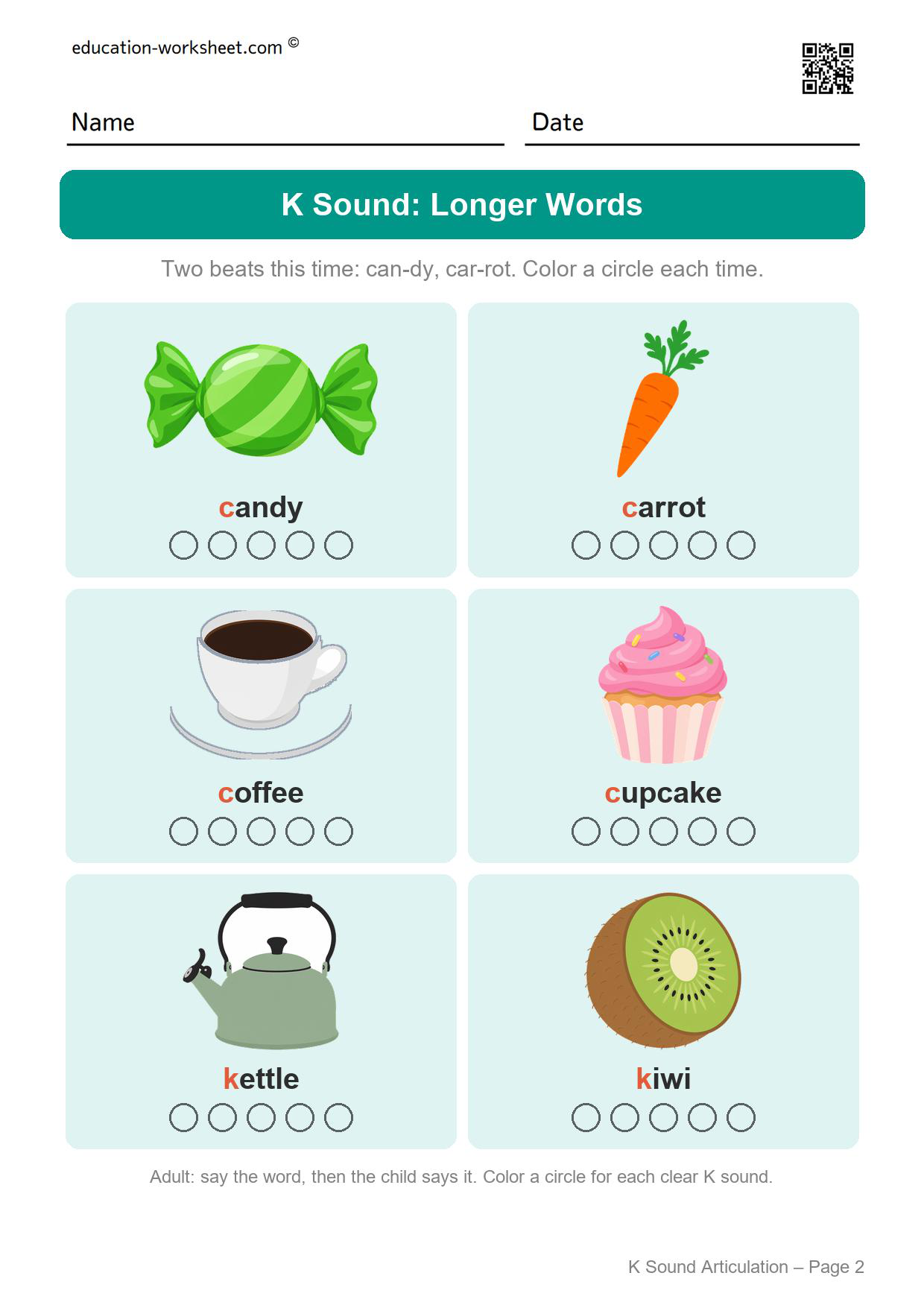
- Page 2 – Longer Words: candy, carrot, coffee, cupcake, kettle, kiwi
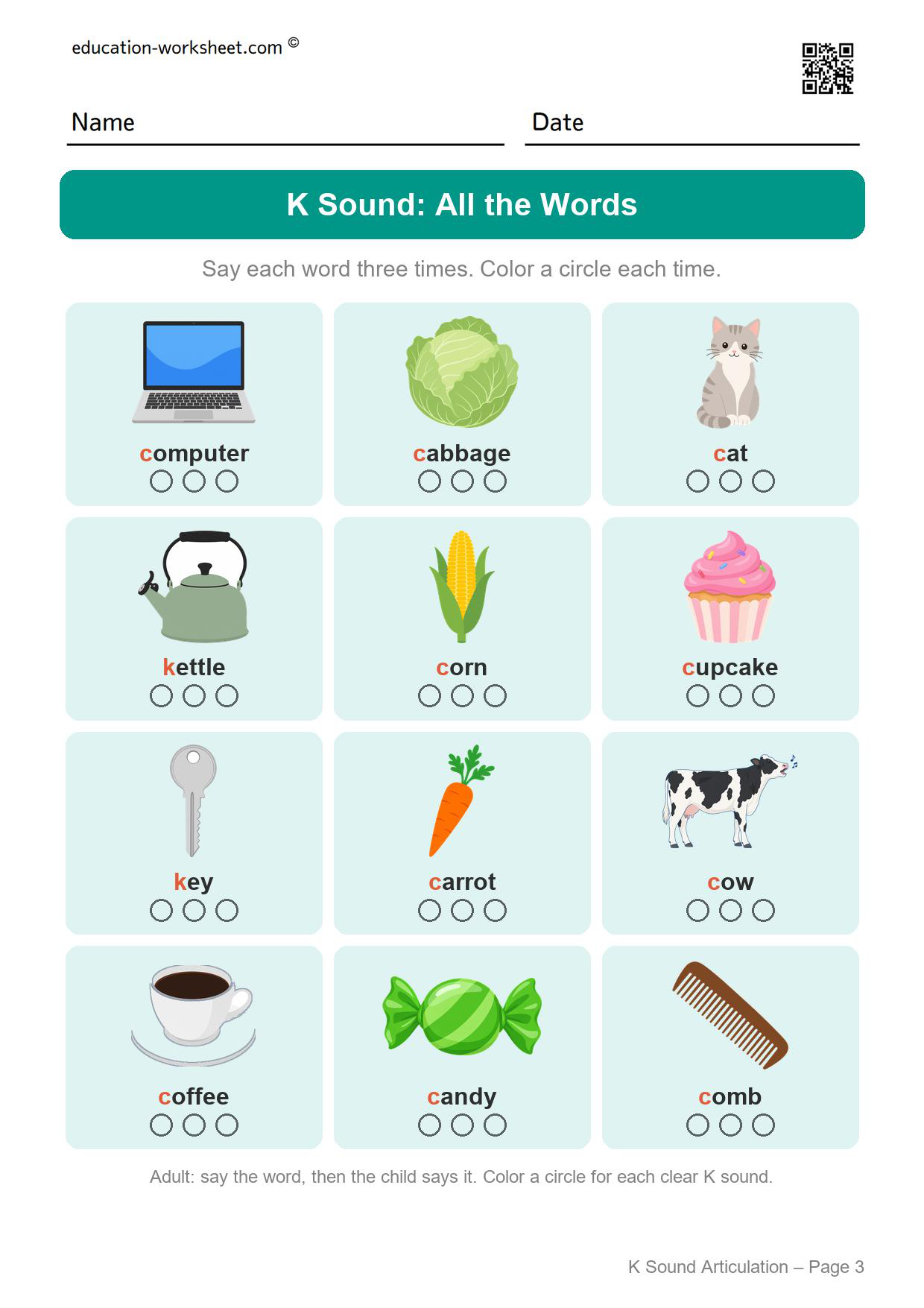
- Page 3 – All the Words
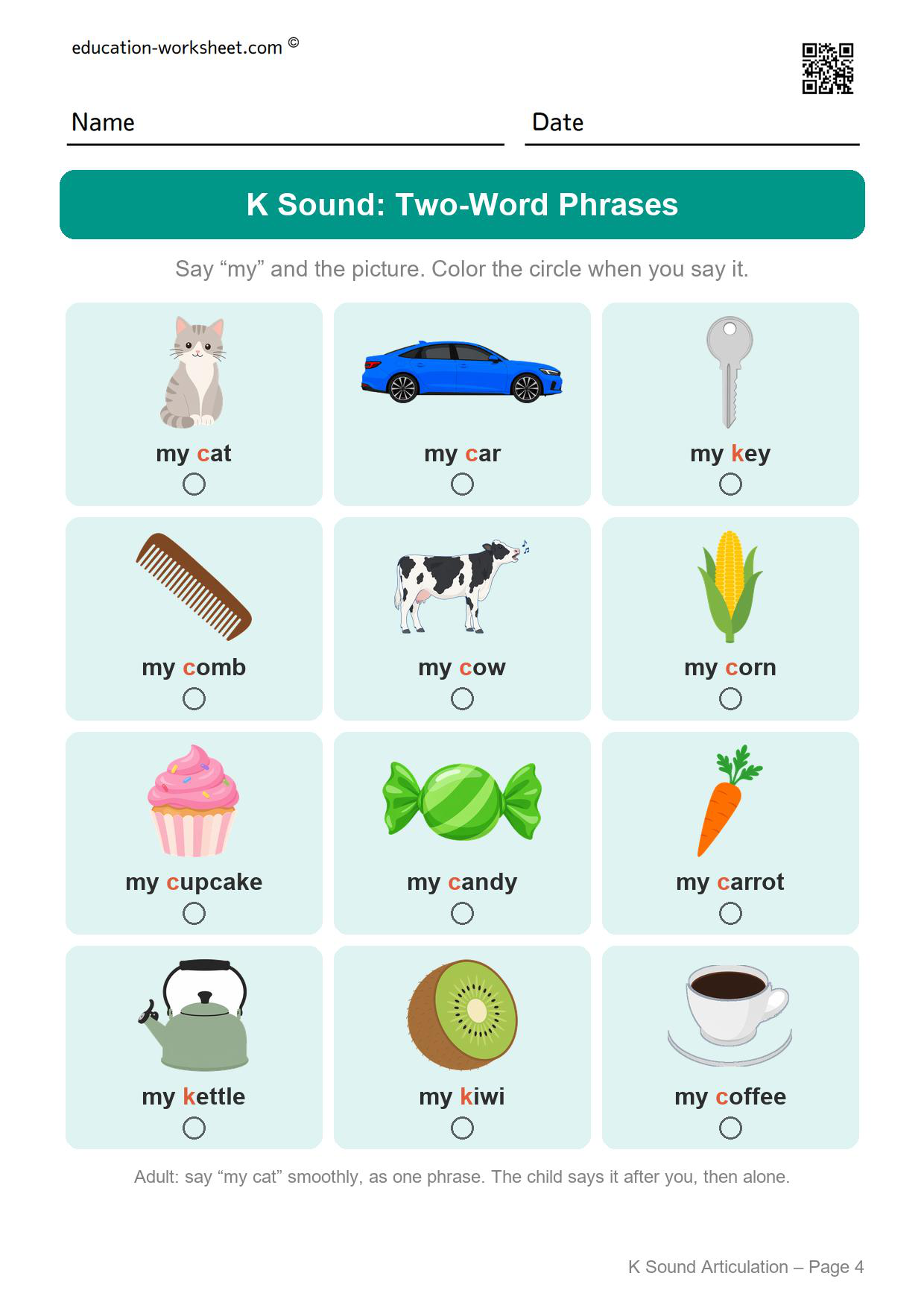
- Page 4 – Two-Word Phrases with My
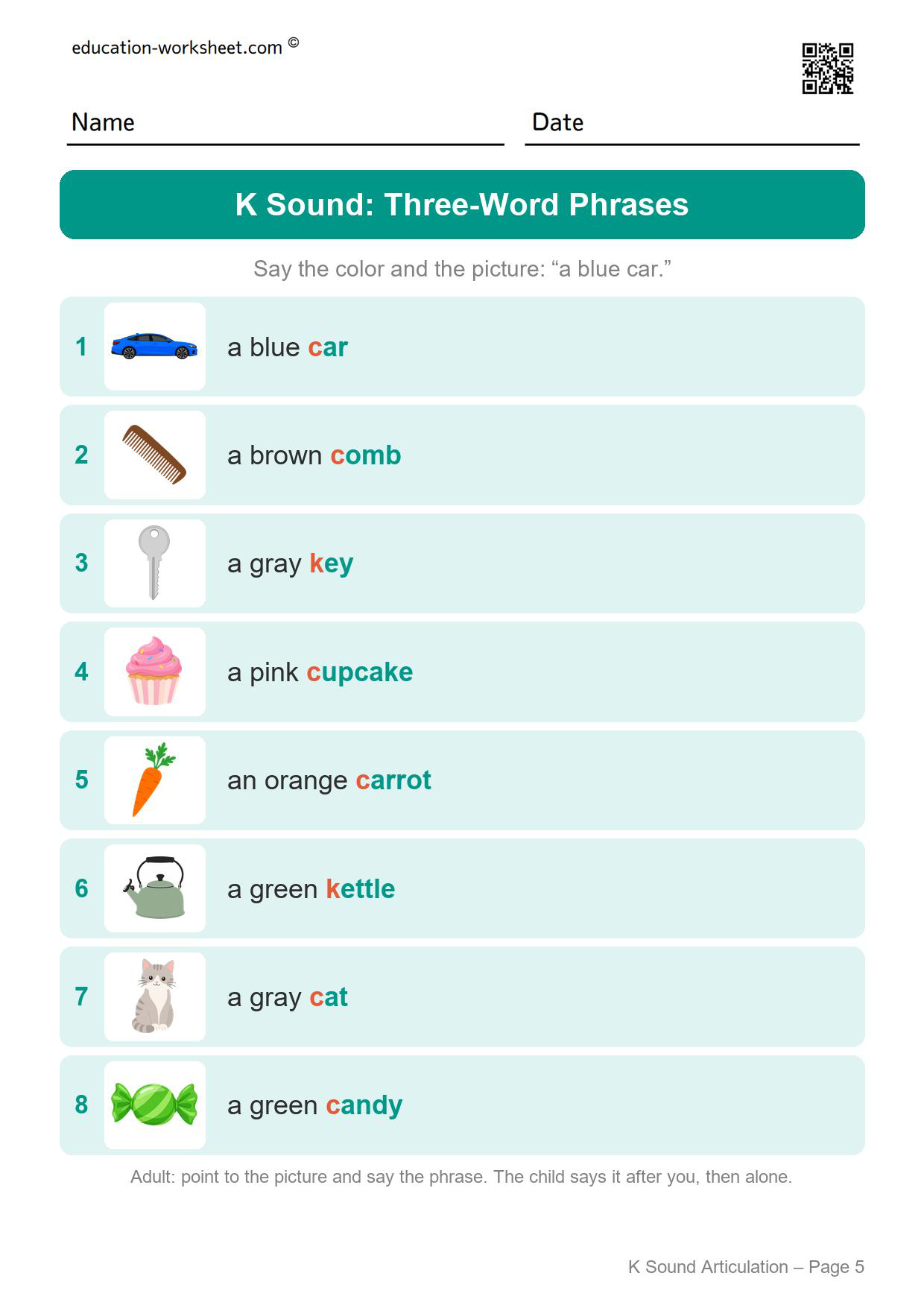
- Page 5 – Three-Word Phrases with Colors
- Page 6 – Sentences with the K Word at the End
- Page 7 – Two K Words in One Sentence
- Page 8 – K Sound Riddles
- Page 9 – Story Time: Kate’s Day at the Farm
- Page 10 – K Sound Board Game
- Page 11 – K Sound Bingo with Calling Cards
- Page 12 – Home Practice for One Week
- Progress Record
- How These Pages Were Put Together
- How to Help a Child Make the K Sound
- When the K Sound Stays Hard
- Who These Worksheets Are For
- How to Use These Worksheets
- Three Things to Watch For
- Ideas to Keep It Playful
- Printing Tips
- Frequently Asked Questions
- What age are these K sound worksheets for?
- Why are there no words like clock or crab?
- Why do some words start with C and others with K?
- The child says the words well on the worksheet but not in conversation. Is that normal?
- Can these pages show whether my child has a speech problem?
- Is there a sign-up or a fee?
- May speech therapists and teachers print these for their students?
- More Free Speech and Language Worksheets
What Is in This Free K Sound Pack
- A guide page for the adult, twelve practice pages and a progress record.
- 14 picture words that start with one K sound, spelled with C or K. No words that start with blends such as cl or cr.
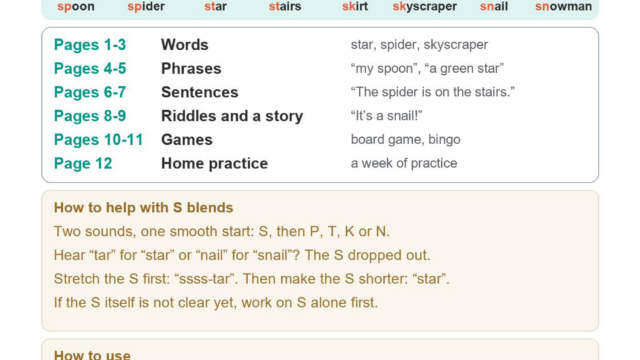
- Six levels: words (pages 1 to 3), phrases (pages 4 and 5), sentences (pages 6 and 7), riddles and a story (pages 8 and 9), games (pages 10 and 11) and home practice (page 12).
- Circles to color on the word and phrase pages, so the child can see the practice adding up.
- Short cues for making the K sound, and scripts for the adult on the riddle and story pages.
- A separate PDF for every page, so you can print just the level you need.
The 12 K Sound Articulation Worksheets
Each level asks a little more of the child than the one before it. The word pages come first and the games come last, but you do not need to finish one page before trying the next. If a child is saying the K sound clearly on page 4, play the board game for fun. If the K sound slips on page 6, go back to the phrases for a few days.
Start Here – How the K Sound Is Made and How to Use the Pack
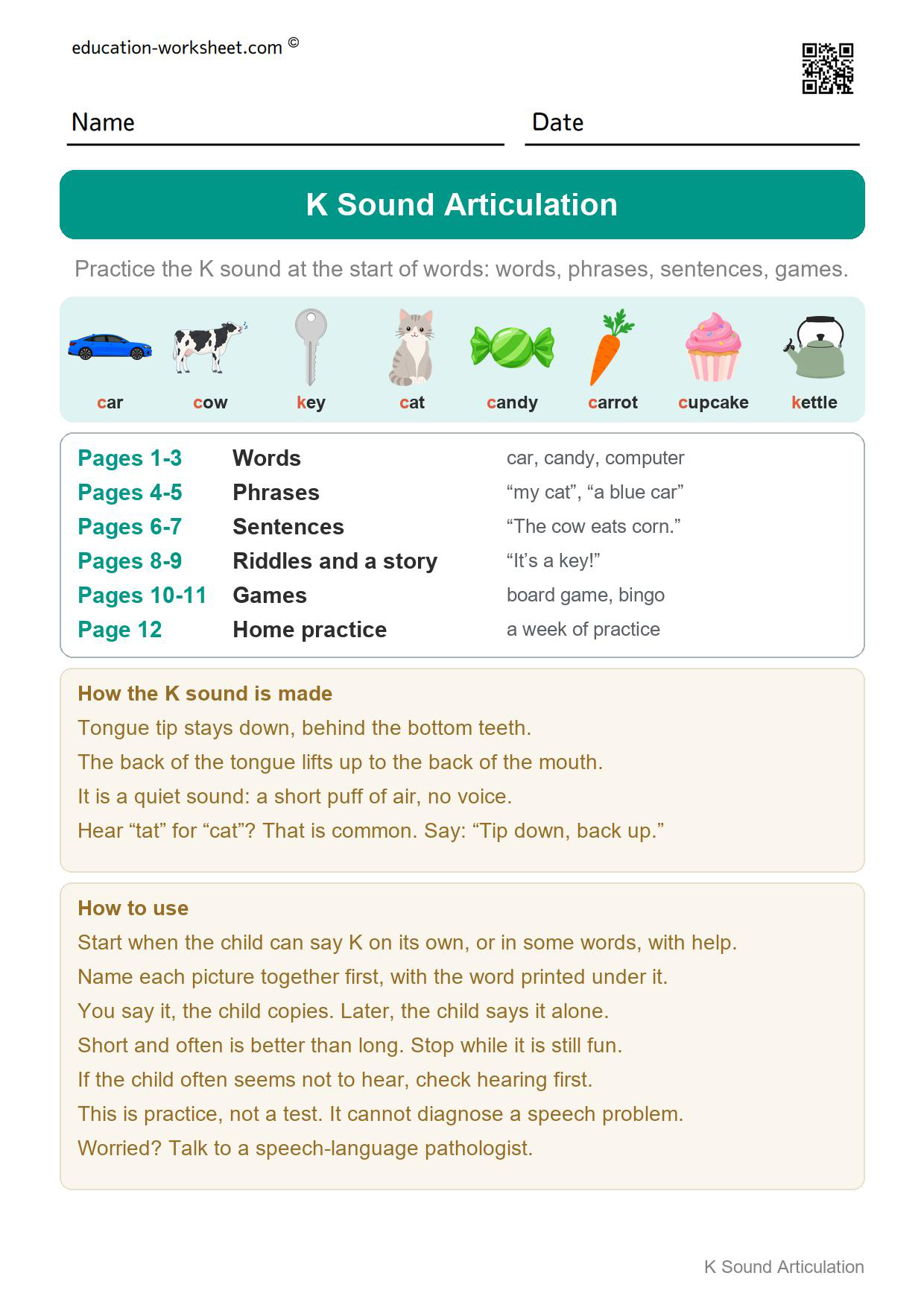
The guide page lists the six levels, shows eight of the picture words, and gives four short cues for making the K sound: the tongue tip stays down behind the bottom teeth, the back of the tongue lifts, and the sound is a quiet puff of air with no voice. Read it once before the first session.
Page 1 – Short Words: car, cow, comb, corn, key, cat
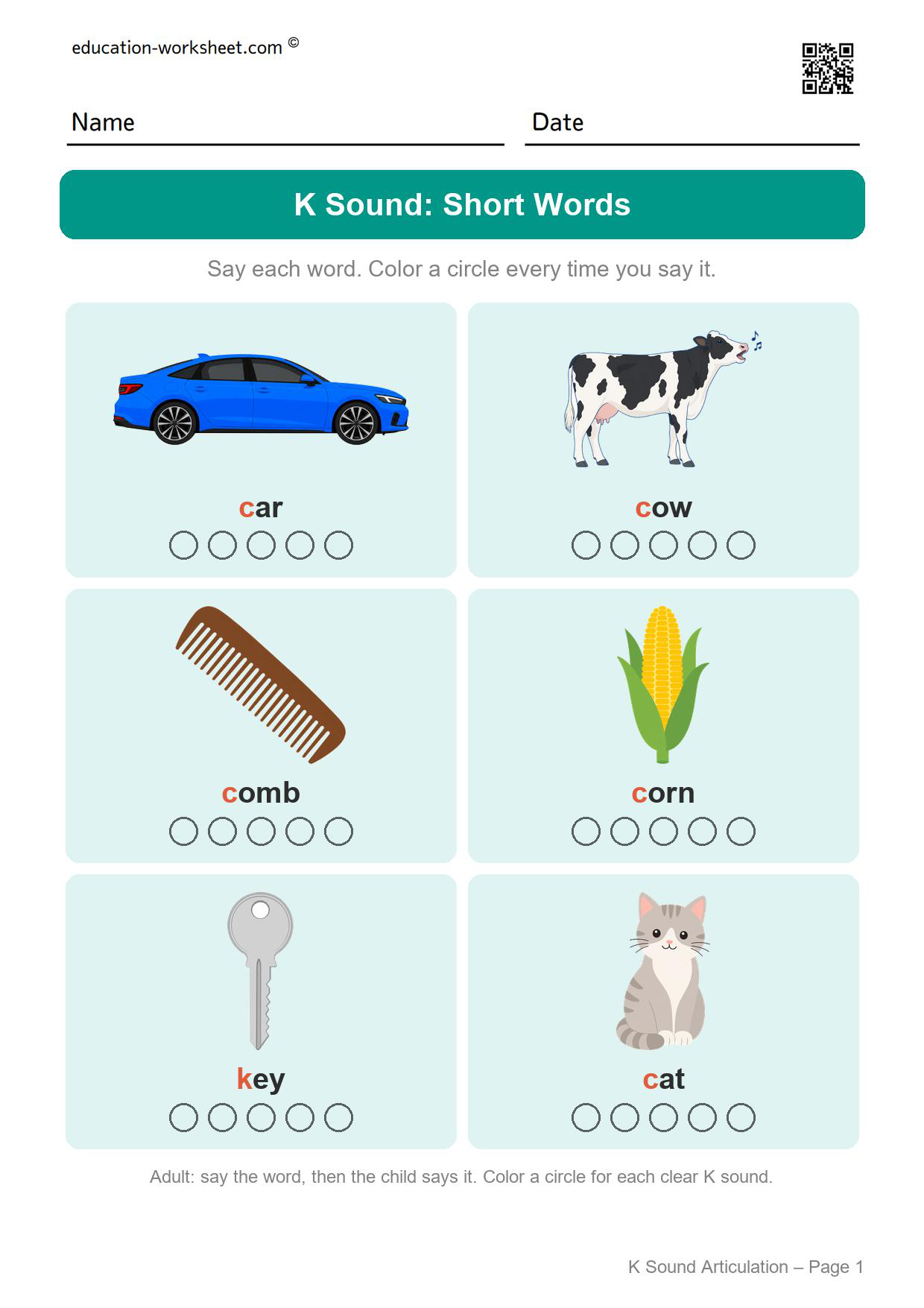
Six large pictures of one-syllable words, each with five circles to color. The first four (car, cow, comb and corn) have the K sound in front of a vowel made at the back of the mouth, which often helps, because the tongue is already near the right place. Key and cat follow, where the vowel pulls the tongue forward a little.
Say each word first and let the child copy you. Color a circle only when you hear a clear K, not every time the child tries.
Page 2 – Longer Words: candy, carrot, coffee, cupcake, kettle, kiwi
The same layout with two-syllable words: candy, carrot, coffee, cupcake, kettle and kiwi. A longer word gives the child more to plan, so a K that was clear on page 1 may slip here. Cupcake is a good one to listen to closely, because it has a second K sound in the middle.
Page 3 – All the Words
Twelve words in a mixed order, each with three circles. Ten come from pages 1 and 2, and two are new: computer, the only three-syllable word in the pack, and cabbage. Both pictures could be called something else (a laptop, a lettuce), so name them together first. They appear only on this page for that reason.
Page 4 – Two-Word Phrases with My
Twelve pictures labeled “my cat,” “my car,” “my key” and so on. The small word my comes first, so the K has to be said in the middle of a phrase rather than at the very start of a breath. Say each phrase smoothly, as one unit, without a pause between the two words.
Page 5 – Three-Word Phrases with Colors
Eight rows with a color in each phrase: a blue car, a brown comb, a gray key, a pink cupcake, an orange carrot, a green kettle, a gray cat and a green candy. Every color matches the picture, so the child can find the words by looking. Pink is a nice test, because it ends in a K sound of its own just before cupcake.
Page 6 – Sentences with the K Word at the End
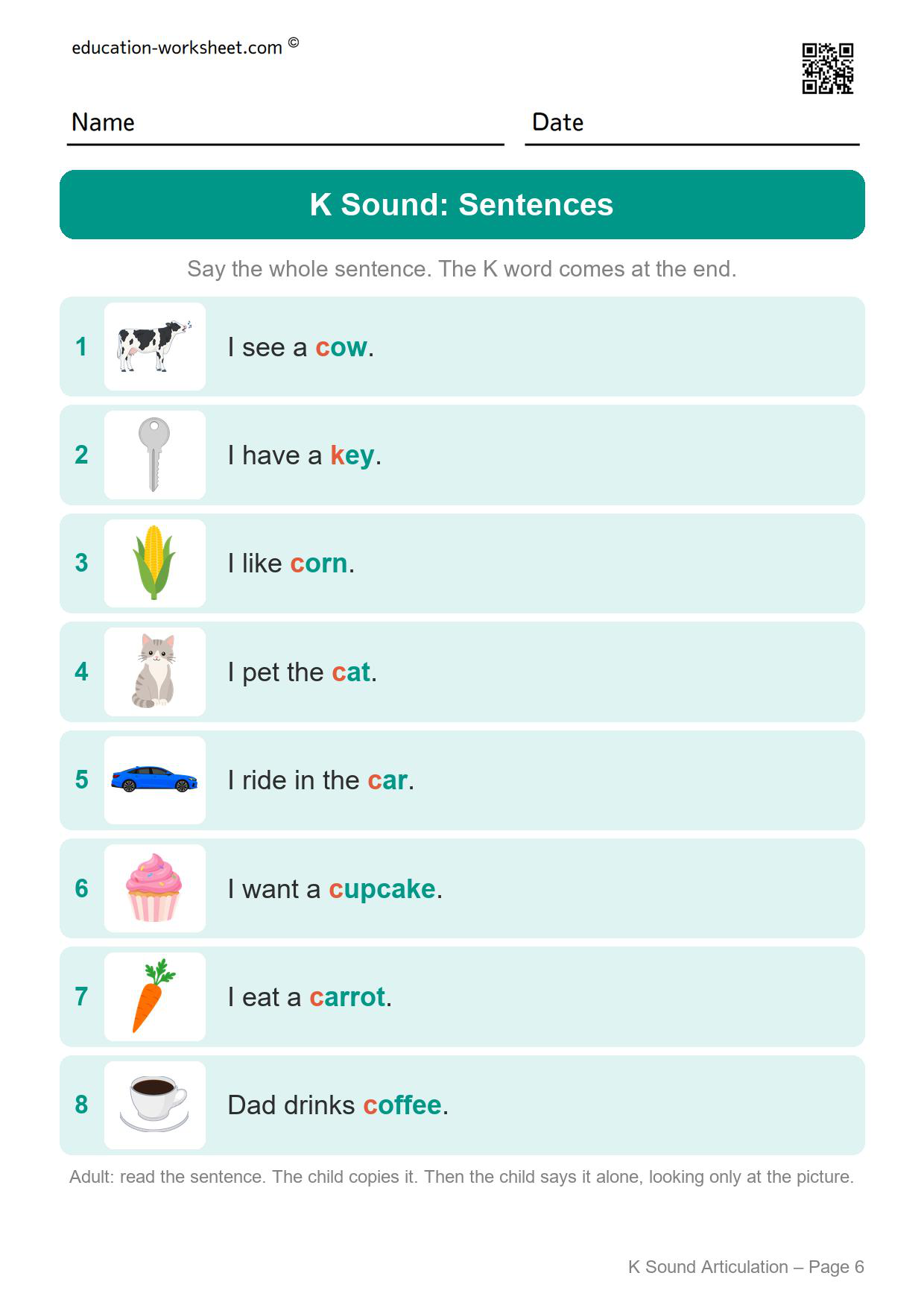
Eight short sentences, and in each one the K word comes last: “I see a cow,” “I like corn,” “I ride in the car,” “Dad drinks coffee.” Every sentence has only one K word, so you know exactly which sound to listen for. When the child can say a sentence after you, cover the words and let them say it from the picture alone.
Page 7 – Two K Words in One Sentence
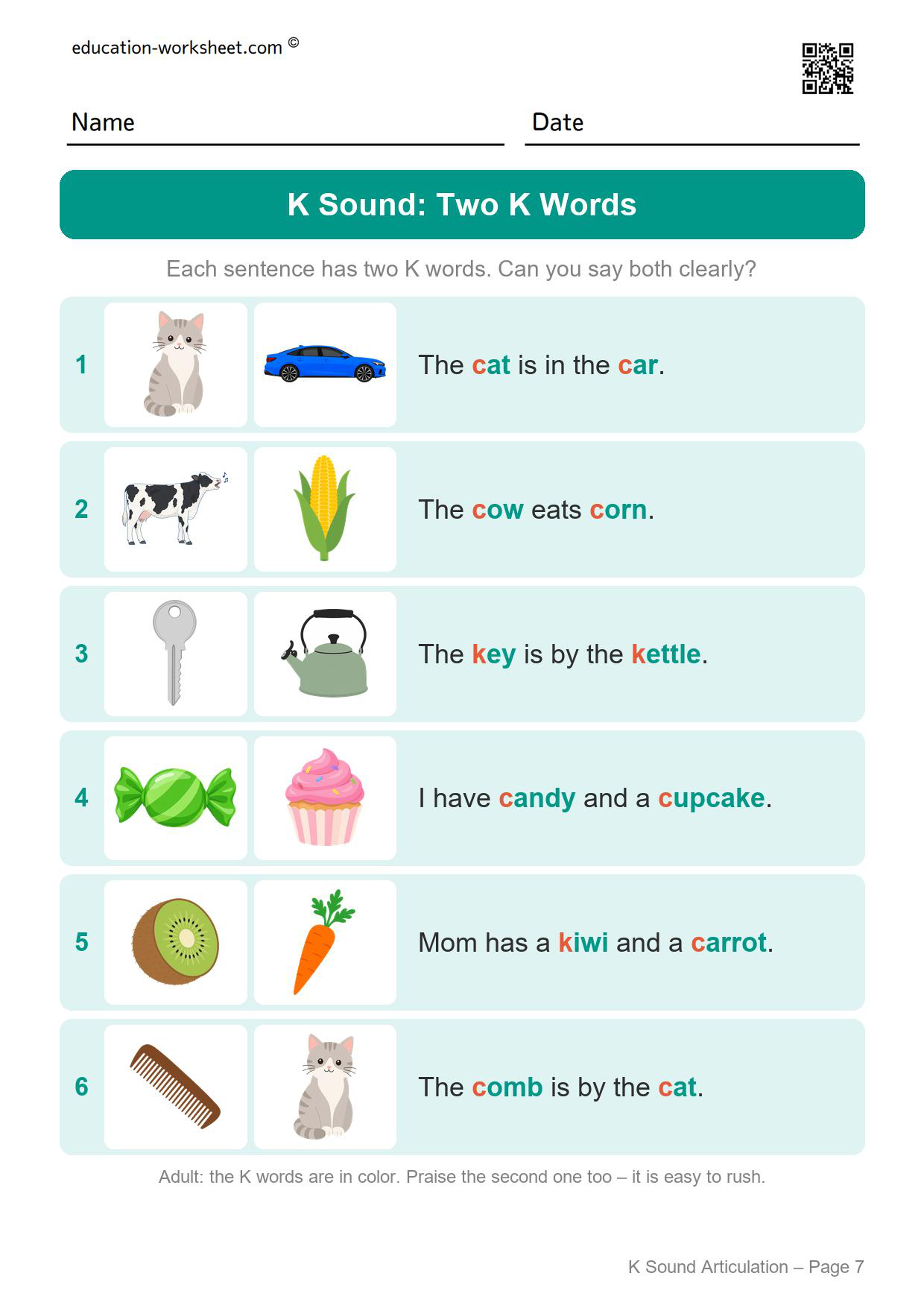
Six sentences, each with exactly two K words shown as two pictures: “The cat is in the car,” “The cow eats corn,” “The key is by the kettle,” “I have candy and a cupcake,” “Mom has a kiwi and a carrot” and “The comb is by the cat.”
Children often get the first K and then hurry the second. Listen to both, and praise the second one by name when it comes out clearly.
Page 8 – K Sound Riddles
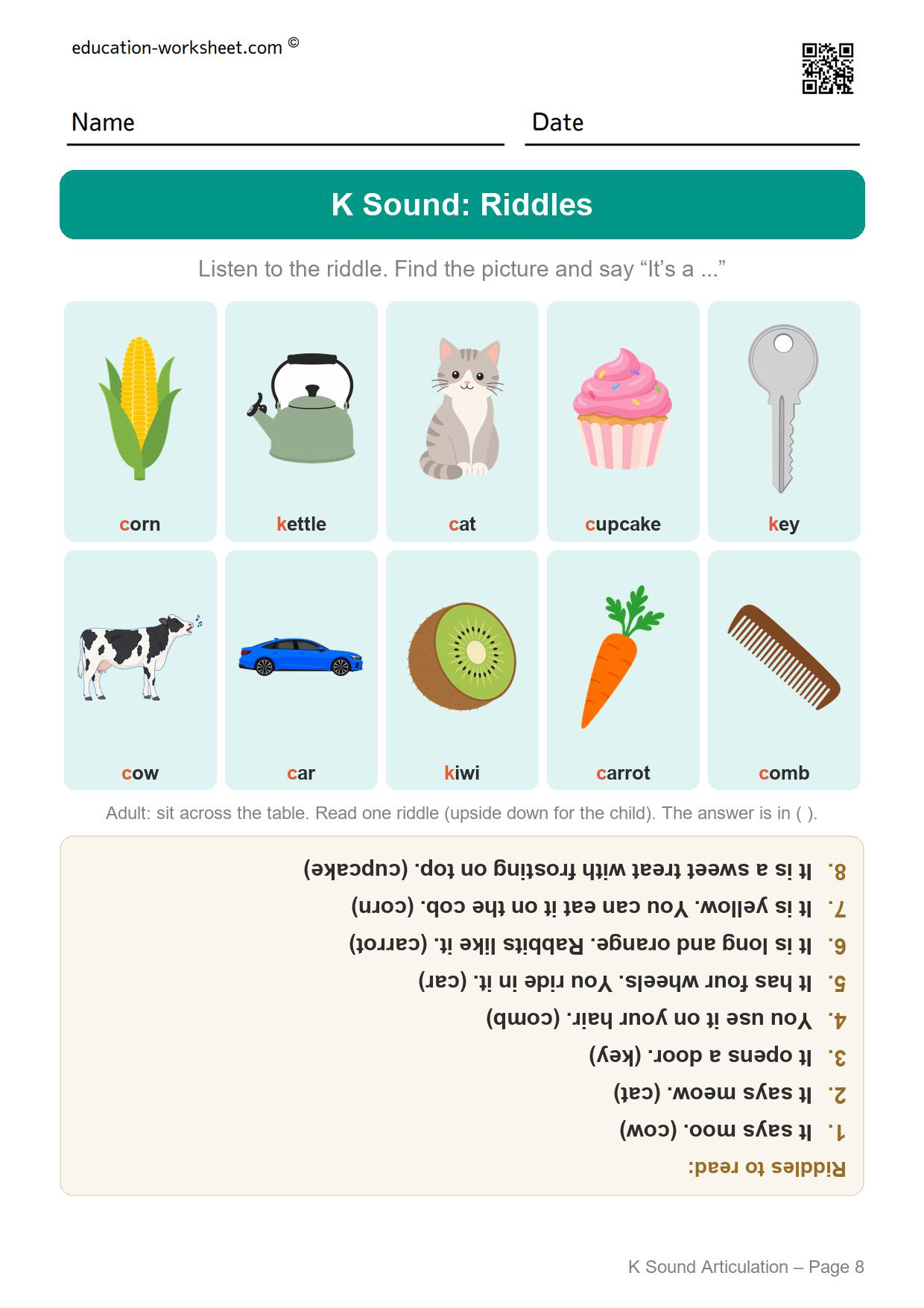
Ten pictures across the top and eight riddles at the bottom, printed upside down so an adult sitting across the table can read them. The child listens, finds the picture and answers in a sentence, such as “It’s a cow!” for “It says moo,” or “It’s a key!” for “It opens a door.”
Two of the ten pictures, the kettle and the kiwi, are not the answer to any riddle, so the last answers cannot be found by elimination. The answer to each riddle is printed in brackets for the adult.
Page 9 – Story Time: Kate’s Day at the Farm
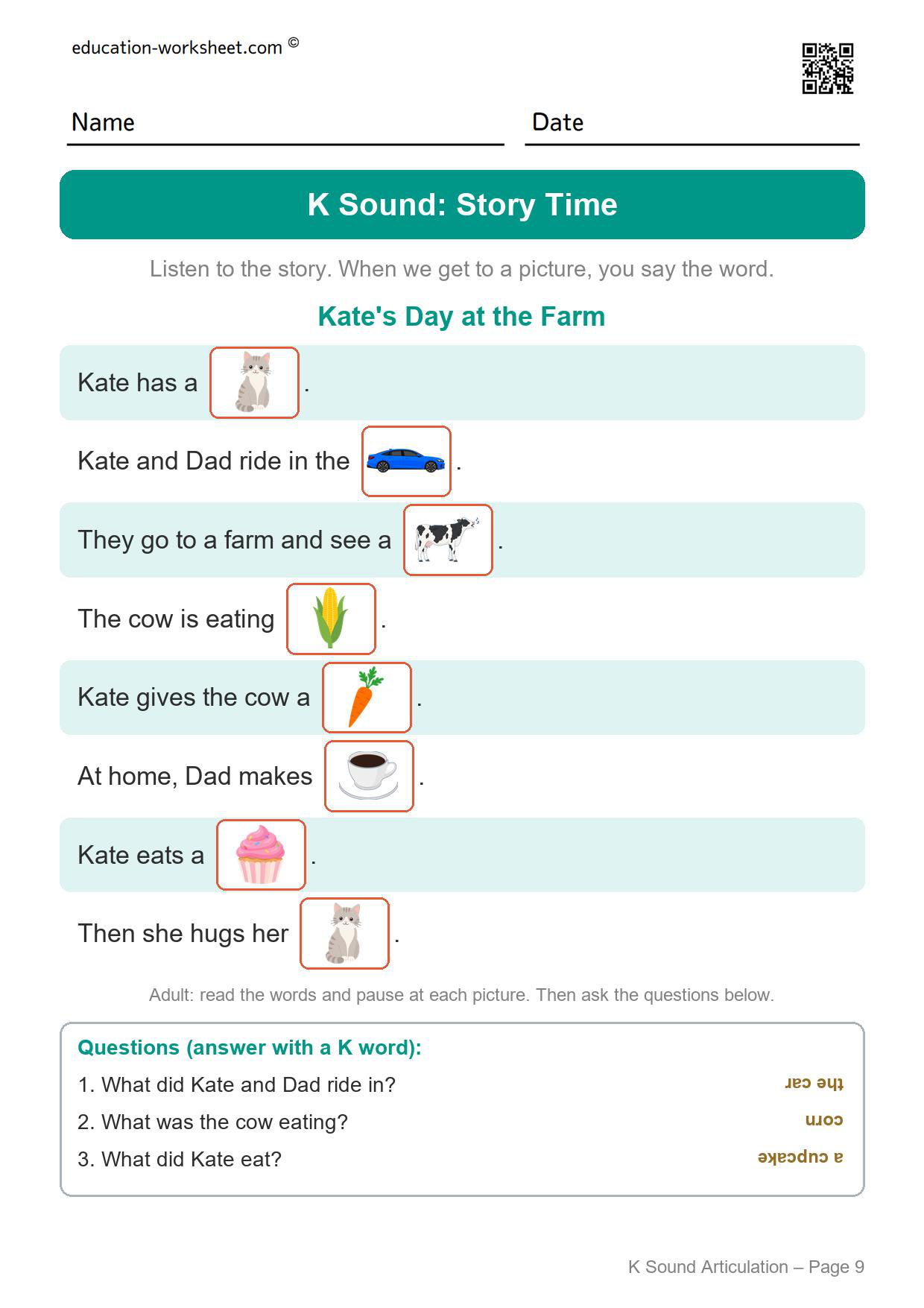
A short story in eight lines. You read the words and stop at each picture, and the child fills in the word: Kate has a cat, she rides in the car, sees a cow eating corn, gives the cow a carrot, watches Dad make coffee, eats a cupcake and hugs her cat. Three questions follow, and each answer is a K word (the car, corn and a cupcake), printed upside down for you.
This is the step closest to everyday talk. The child has to think about the story and the sound at the same time.
Page 10 – K Sound Board Game
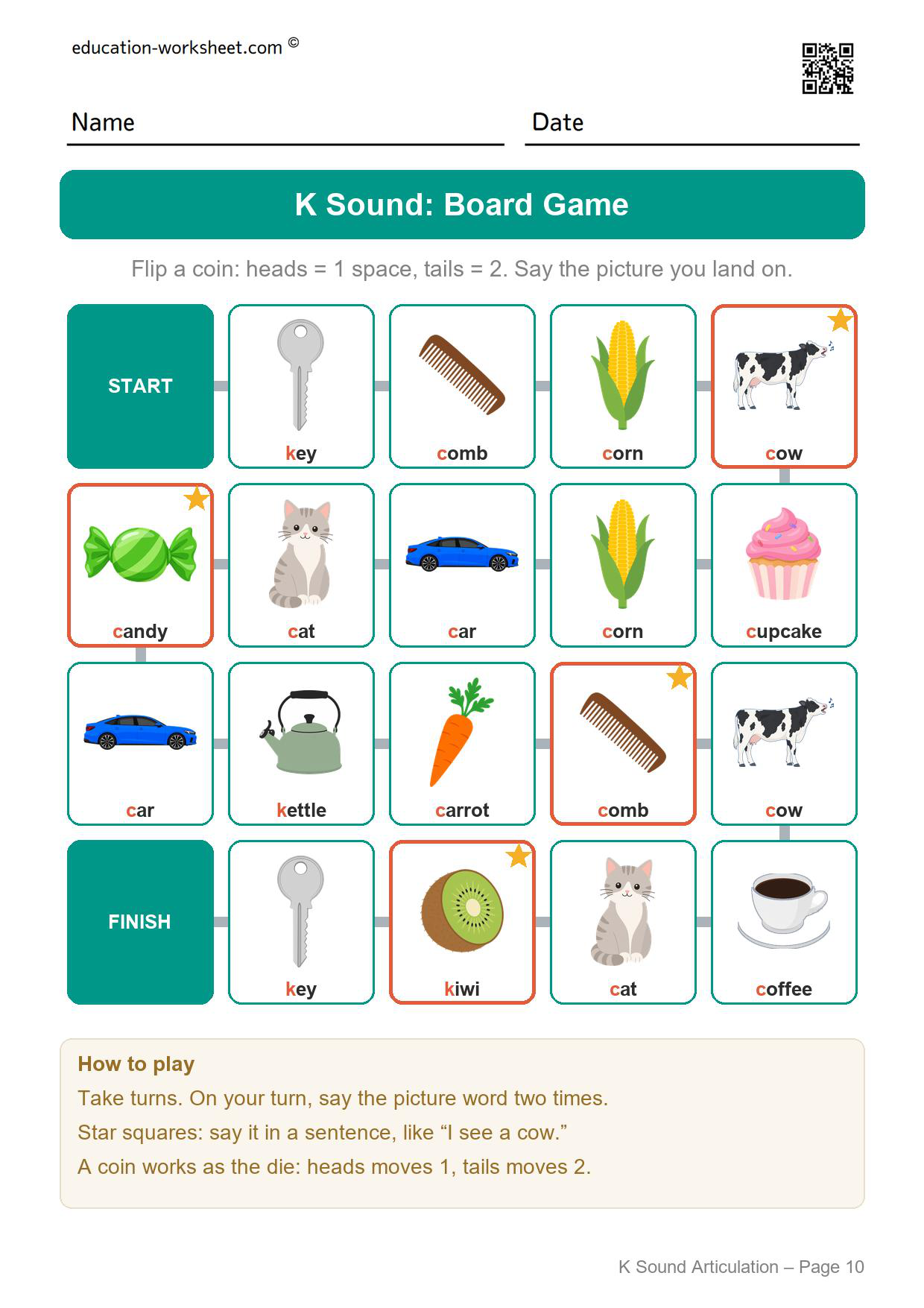
A winding path of eighteen picture squares. You need only a coin and two small tokens: heads moves one space, tails moves two. On each square the player says the word twice. Four squares have a star, and there the player makes up a sentence instead. The same picture never sits next to itself, so every move brings a different word.
Page 11 – K Sound Bingo with Calling Cards
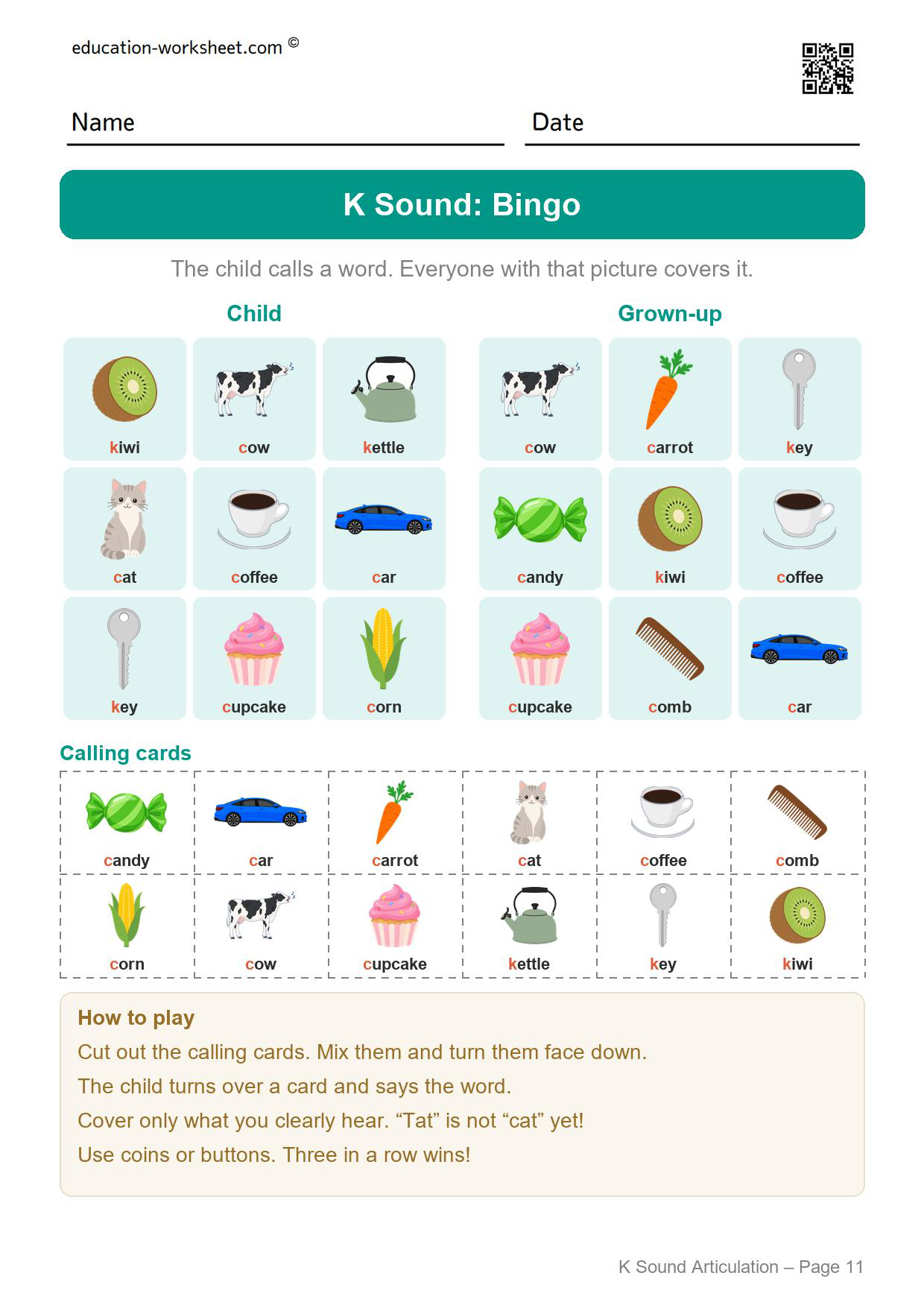
Two bingo boards, one for the child and one for the grown-up, and a row of twelve calling cards to cut out. The child turns over every card and says the word, so the child does all the talking. You cover only what you clearly hear, which turns the game into honest, friendly feedback: if you heard “tat,” you have nothing to cover yet.
Page 12 – Home Practice for One Week
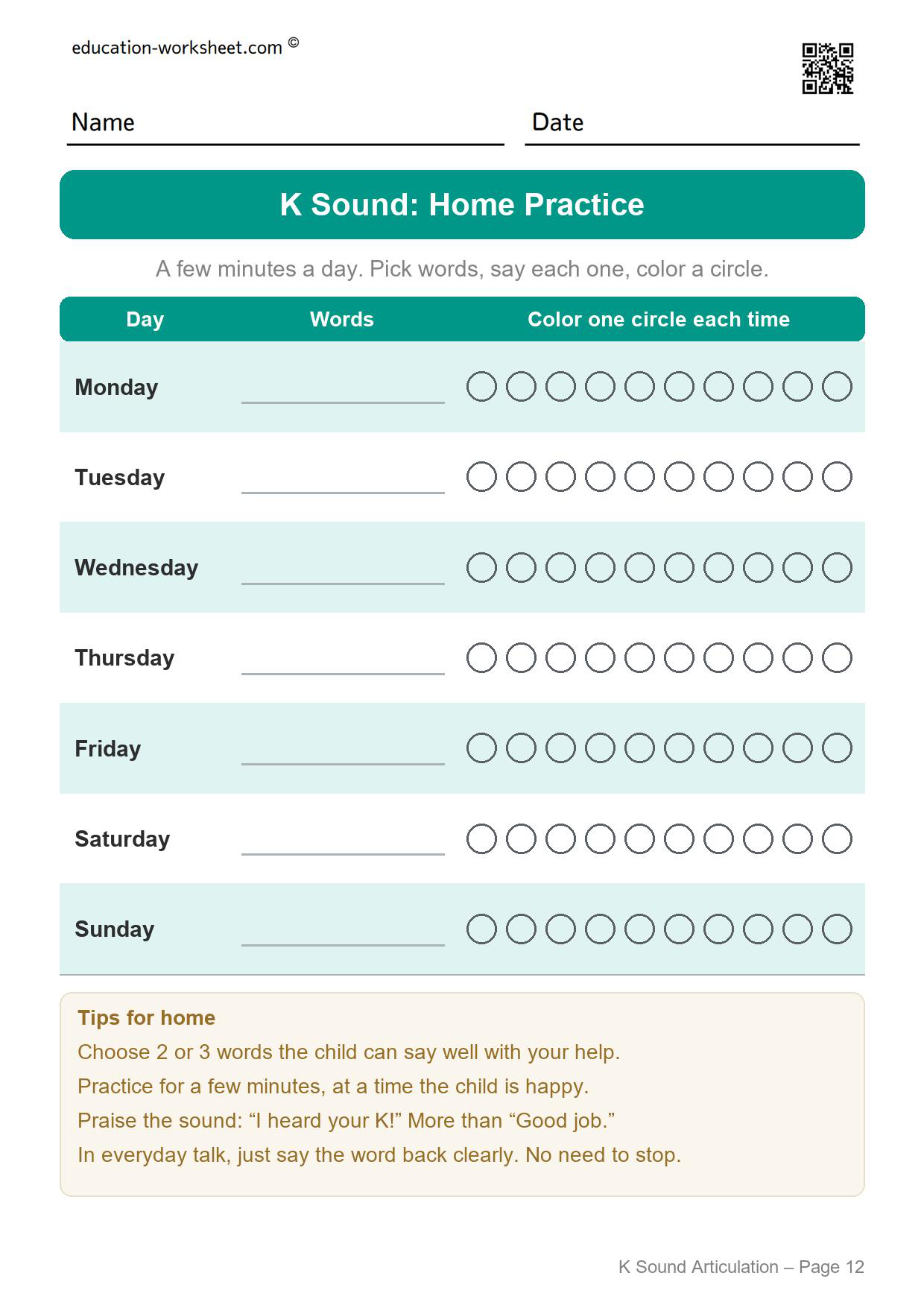
A one-week chart with a line for the day’s words and ten circles for each day, plus four tips for families. Choose two or three words the child can already say well with help, and keep each session short.
Progress Record
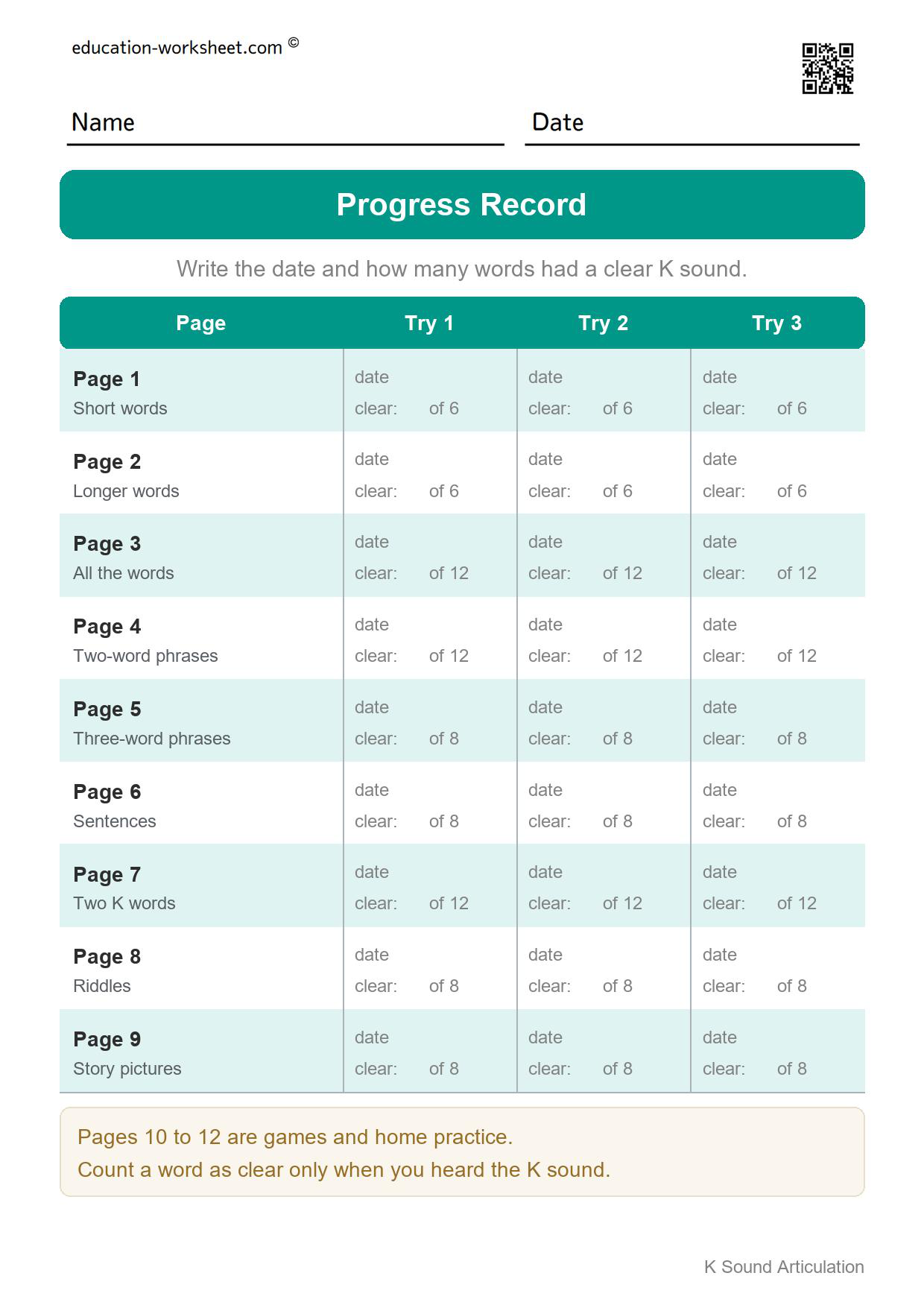
A table for pages 1 to 9 with room for three tries each. Write the date and how many words had a clear K sound, out of the number printed on the row (for example 6 on pages 1 and 2, and 12 on page 7, where each of the six sentences has two K words).
How These Pages Were Put Together
A small computer program built the pages and checked them against a list of rules. If a rule was broken, the program stopped and nothing was saved.
- Only one K sound at the start of every target word. Words that begin with cl, cr or ch were kept out, and so were any other words in the sentences that start that way. Saying K inside a blend is a different and harder skill.
- One syllable before two, and two before three. Page 1 has only one-syllable words, page 2 only two-syllable words, and the three-syllable computer waits until page 3.
- One K word per sentence on page 6, exactly two on page 7. On page 6 the K word is always the last word of the sentence, so it is easy to hear and easy to praise.
- Riddles with one answer. Each riddle fits only one of the ten pictures, the answer word never appears inside the riddle, and two pictures are not answers at all.
- Colors that match the pictures. Every color phrase on page 5 was checked against the picture: the car really is blue, and the comb really is brown.
- No repeats side by side. On the board game, the same picture never appears on two squares in a row, or with only one square between them.
How to Help a Child Make the K Sound
The K sound is made at the back of the mouth. The back of the tongue lifts and presses against the soft part of the roof of the mouth, then lets go with a small puff of air. The voice is off, which is the only difference between K and G. The tip of the tongue does nothing at all and stays resting behind the bottom front teeth.
That last point is the key for many children. When the tongue tip pops up to the ridge behind the top teeth, the sound comes out as T, and cat becomes “tat.” A short phrase such as “tip down, back up” gives the child something to hold on to. Some children also find it helpful to feel the sound by placing a hand lightly on the throat or to watch your mouth in a mirror as you say it.
Try the K sound on its own first, then in a simple syllable such as “ka” or “koo,” before moving to the words on page 1. If the child cannot make the K sound on its own even with these cues, the word pages will be frustrating. That is a good moment to ask a speech-language pathologist for help.
When the K Sound Stays Hard
Saying T for K is a common pattern in young children’s speech, and children reach the K sound at different times. Practice pages can help a child who is nearly there, but they cannot tell you whether the pattern is still part of typical development for a particular child.
If a child often seems not to hear clearly, arrange a hearing check first. A child who cannot hear the difference between sounds will find it very hard to change how they say them. If you are worried about how a child’s speech sounds, or the child is hard for others to understand, talk to the child’s doctor or a speech-language pathologist. A speech-language pathologist can look at all of the child’s speech sounds and tell you whether K is the right sound to work on now.
Who These Worksheets Are For
- Children: preschool and early elementary children who are working on the K sound at home, at school or in speech therapy.
- Ready to start when: the child can make the K sound on its own or in some words with your help, and knows most of the picture names.
- Adults: parents, teachers, speech-language pathologists and assistants. No special materials are needed beyond crayons, scissors, a coin and some small tokens.
- SL.K.6 – speak audibly and express thoughts, feelings and ideas clearly. Clear speech sounds are part of being understood.
- RF.K.3a – connects with letter-sound knowledge: the K sound in this pack is spelled two ways, with C (cat, car) and with K (key, kettle).
How to Use These Worksheets
- Read the guide page and practice the K sound on its own a few times.
- Name each picture together, using the word printed under it.
- On the word pages, say the word first and let the child copy you. Later, point to the picture and let the child say it alone.
- Color a circle only when you hear a clear K. If the K is not there yet, say the word again slowly and let the child try once more.
- Keep sessions short and end on a word the child can say well.
- Write the date and the number of clear words on the progress record now and then, so you can look back and see the change.
Three Things to Watch For
1. T in place of K. “Tat” for cat and “tey” for key are the most common slips. Do not just say “No.” Say what you heard, “I heard tat. Let’s try the back sound: cat,” and remind the child: tip down, back up.
2. An extra sound after the K. Children who try hard sometimes say “kuh-at” instead of cat, with a little vowel stuck between the K and the rest of the word. Model the word smoothly and a little faster, and praise the smooth version.
3. G in place of K. “Gow” for cow means the tongue is in the right place but the voice switched on too early. Whisper the word together: a whispered K is easy, and then add the voice back for the rest of the word.
Ideas to Keep It Playful
- K hunt. Walk around the kitchen and find real things that start with K: a cup, a cookie, a can, a kettle.
- Silly sentences. Mix two pictures from page 7 into a new sentence: “The cow is in the car!”
- Swap jobs in bingo. After a few rounds, let the child cover your words while you call, and make one mistake on purpose for the child to catch.
Printing Tips
- Choose actual size (100 percent) in the print window. The pages fit both US Letter and A4.
- Color printing helps on page 5, where the phrases name the colors of the pictures.
- Print page 11 twice if you want a second set of calling cards, and print page 12 again each week.
Frequently Asked Questions
What age are these K sound worksheets for?
They are made for preschool and early elementary children who are working on the K sound. Children reach this sound at different ages, so use the child’s speech, not their age, to decide where to start. If you are not sure whether to work on K yet, ask a speech-language pathologist.
Why are there no words like clock or crab?
They start with two consonants together (cl and cr), which is harder than a single K. Those blends are best practiced after the single K sound is steady.
Why do some words start with C and others with K?
English spells the same sound both ways. For speech practice, the sound is what matters, so cat and key are practiced together. For a child who is learning to read, it is a nice moment to point out that both letters can make this sound.
The child says the words well on the worksheet but not in conversation. Is that normal?
Yes. Using a new sound in everyday talk is usually the last step. Keep playing the games on pages 10 and 11, and in conversation simply repeat the word back clearly without stopping the child.
Can these pages show whether my child has a speech problem?
No. There are no scores or cut-offs here. A hearing check and a visit to a speech-language pathologist are the right first steps if something worries you.
Is there a sign-up or a fee?
Neither. Click Download under any page and the PDF is yours, with no account and no email address.
May speech therapists and teachers print these for their students?
Yes, print as many copies as you need for your own home, class or caseload. The files may not be sold or shared on other websites.
More Free Speech and Language Worksheets
- Free Final Consonant Deletion Worksheets – Minimal Pairs PDF
- Free Final Consonant Deletion Minimal Pairs Set 2 – S, Z and CH
- Free Auditory Memory Worksheets for Kids – Listen and Repeat
- Free Category Sorting Worksheets for Speech Therapy and Preschool
- Free Beginning Sounds Worksheets for Kindergarten – Phonics, 40 Words
- Free Syllables Worksheets for Kindergarten – Say It, Clap It, Count It