These free cluster reduction minimal pairs worksheets are for children who leave out one of two consonants at the start of a word, saying “no” for snow, “tea” for tree or “top” for stop. The 14-page PDF uses five picture pairs in which that one missing sound changes the word completely, and it moves from listening, to saying single words, to short sentences, and then to bingo and card games.
A speech-language-hearing therapist with over 16 years of experience wrote these pages with parents, preschool teachers, kindergarten teachers and speech therapists in mind. Use them as practice. There is no score and no pass mark, and diagnosing a speech sound disorder is a job for a professional, not for a worksheet.
Why pairs? When a child says “no” for snow, adults usually understand anyway, so the child has no reason to change. Minimal pairs remove that safety net for a few minutes. If the child says “no” while looking at the snowflake, you point to the head-shaking picture, and the child finds out for themselves that the s matters.
- What Is in the Pack
- The Cluster Reduction Worksheets, Page by Page
- Start Here – The Five Pairs and How to Use Them
- Page 1 – Meet the Pairs
- Page 2 – Listen and Point, Set 1
- Page 3 – Listen and Point, Set 2
- Page 4 – Listen and Point, Set 3
- Page 5 – Say It, I’ll Point, Set 1
- Page 6 – Say It, I’ll Point, Set 2
- Page 7 – Say It, I’ll Point, Set 3
- Page 8 – Say It in a Sentence, Set 1
- Page 9 – Say It in a Sentence, Set 2
- Page 10 – Minimal Pairs Bingo, Board 1
- Page 11 – Minimal Pairs Bingo, Board 2
- Page 12 – Picture Cards to Cut Out
- Progress Record
- How the Pairs Were Chosen
- Cluster Reduction or S Blends Practice?
- When It Does Not Go Smoothly
- Who It Is For and Skills Practiced
- A Simple Routine
- Three Things to Keep in Mind
- Printing Tips
- Frequently Asked Questions
- What is cluster reduction?
- Why does the cup have to be called tea?
- My child says twee for tree. Is that a mistake on these pages?
- Can these worksheets show whether my child needs speech therapy?
- How often should we use them?
- Do I need to sign up to download the PDF?
- Can I copy these for my class or caseload?
- More Free Speech and Language Worksheets
What Is in the Pack
- 14 pages: an adult guide, twelve pages for the child and a record sheet.
- Five pairs and ten pictures: no – snow, tea – tree, bed – bread, top – stop, nail – snail.
- Four clusters: SN (snow, snail), ST (stop), TR (tree) and BR (bread).
- Three listening pages, three saying pages, two sentence pages, two bingo boards and ten cut-out cards.
- Adult word lists printed upside down on the listening pages, for working face to face.
- A separate PDF for every page, in case you only want to reprint the bingo boards.
The Cluster Reduction Worksheets, Page by Page
The pages go from easy to harder. Listening comes first because a child who cannot yet hear the difference between tea and tree will find it hard to say it on purpose. After the first run-through you can go back to any level; many children like to finish a session with a round of bingo whatever level they are on.
Start Here – The Five Pairs and How to Use Them
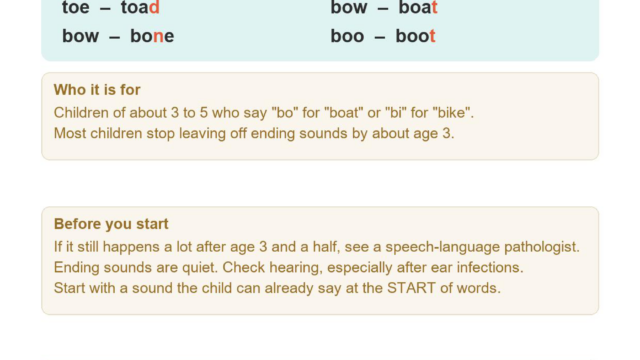
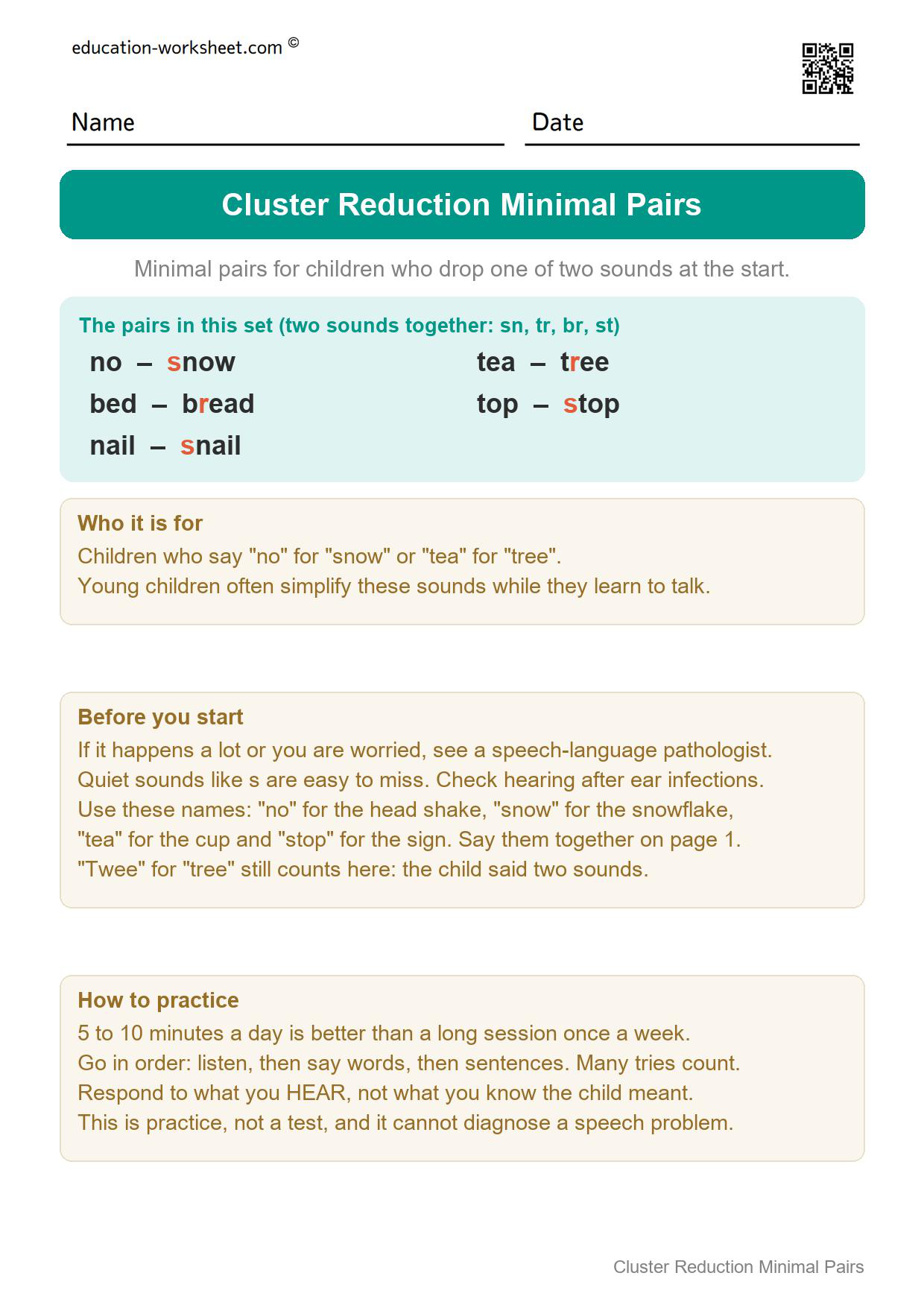
This page is for the adult. At the top are the five pairs with the added letter of each cluster word printed in red-orange: the s in snow, stop and snail, and the r in tree and bread. Under that are three short boxes: who the set is for, what to check before you start, and how to practice.
Pay special attention to the naming line. Four pictures could be called something else: the head shake is “no”, the snowflake is “snow”, the cup is “tea” and the stop sign is “stop”. Agree on these names before the first game, because a child who says “snowflake” is no longer choosing between snow and no.
Page 1 – Meet the Pairs
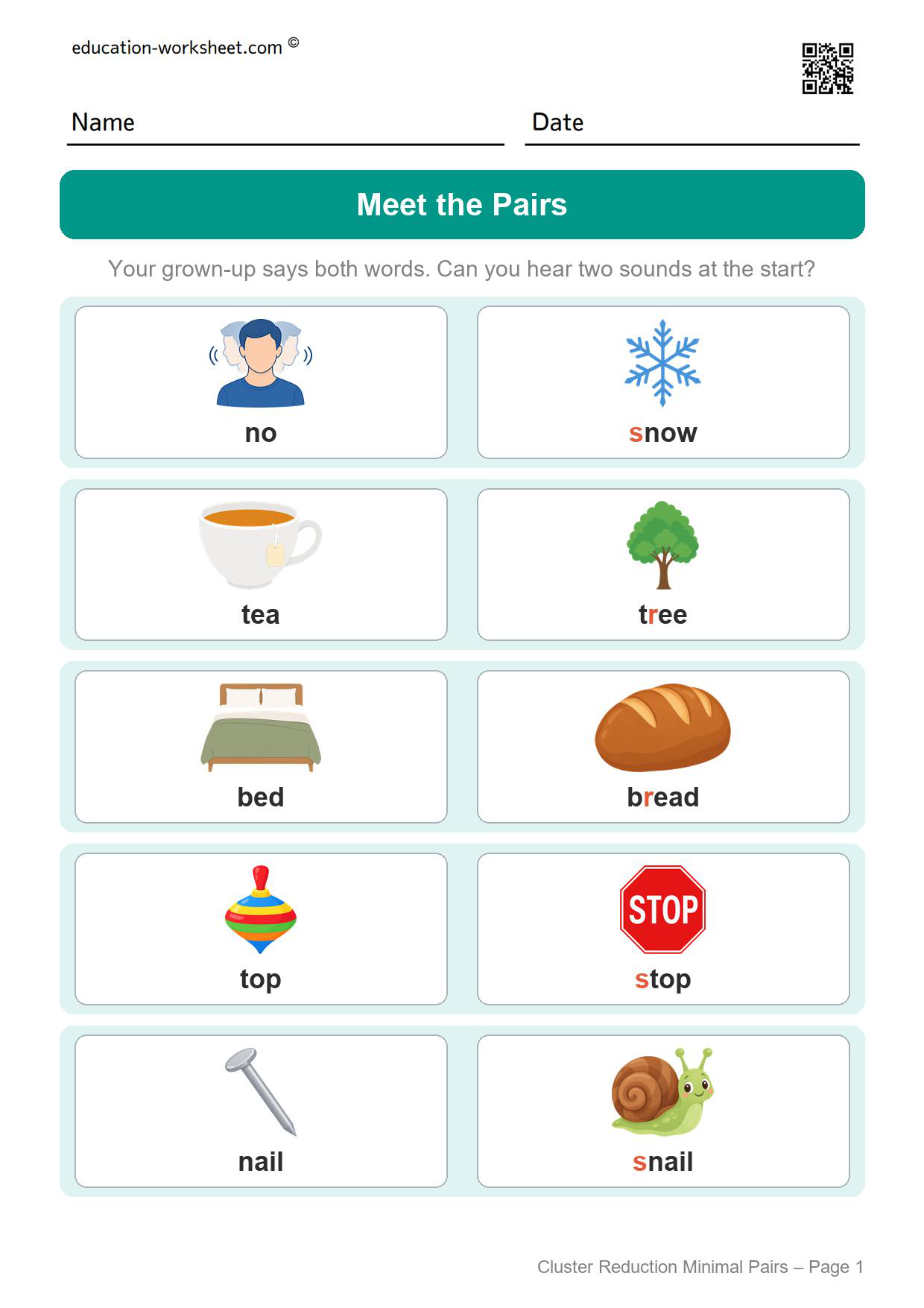
Five rows, one pair per row. The word with a single consonant at the start is always on the left (no, tea, bed, top, nail) and the word that begins with two consonants is on the right (snow, tree, bread, stop, snail). Nothing to circle or color here. You say each pair a few times, the child listens and looks, and you point out that the right-hand word has one more sound at the very beginning.
Keep your voice natural. Hissing the s for a long time or rolling the r makes the difference easier to hear today, but the child then has to relearn the word at normal speed later.
Page 2 – Listen and Point, Set 1
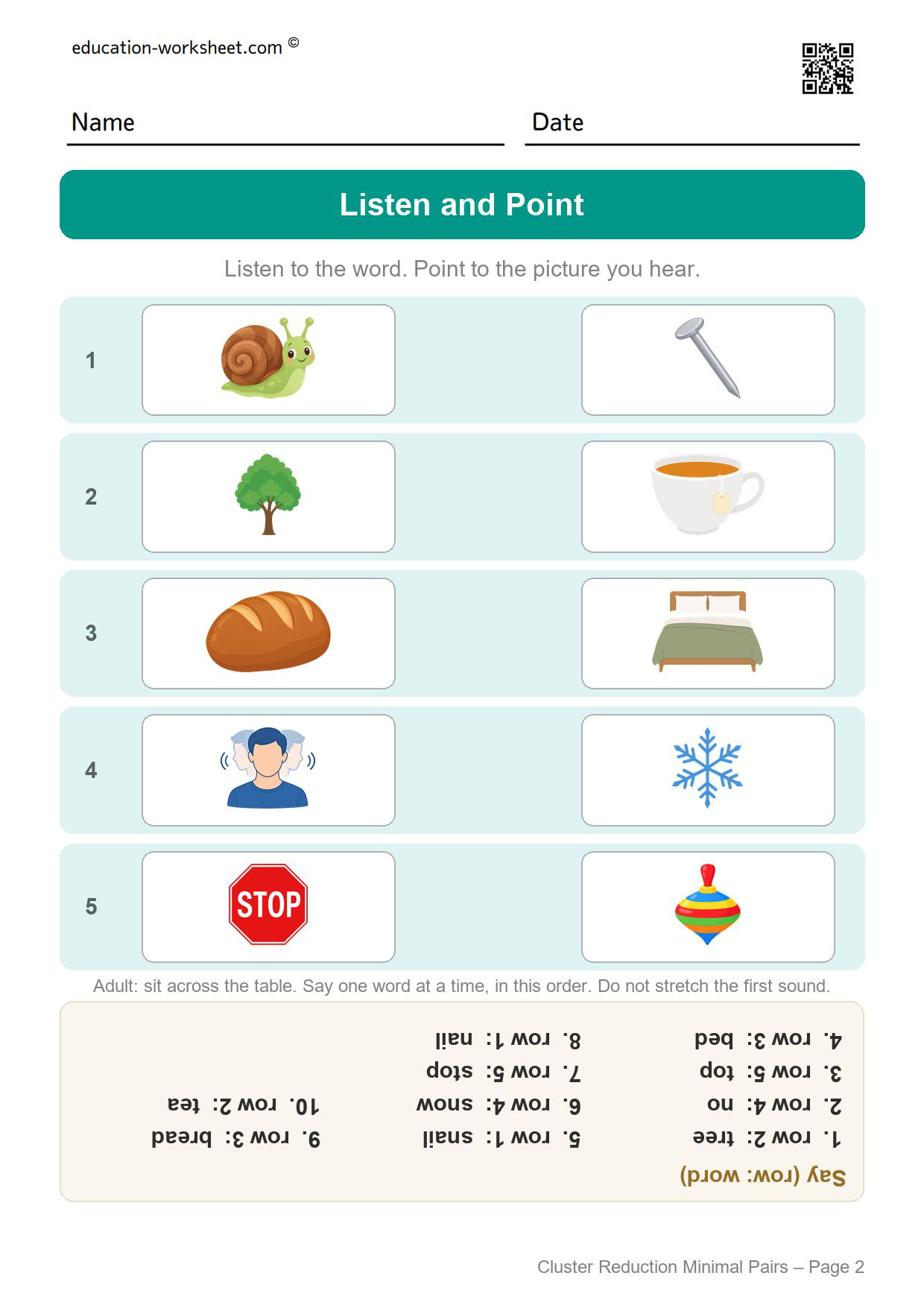
The first listening page. Five rows, two pictures in each, and no words printed under them, so the child has only your voice to go on. The ten words you say are printed upside down along the foot of the page, readable from your side of the table. The list on this page begins with row 2: tree, then row 4: no.
Every word is called exactly once, which means each row is asked about twice, once for each picture. The child only points. Nobody needs to talk yet.
Page 3 – Listen and Point, Set 2
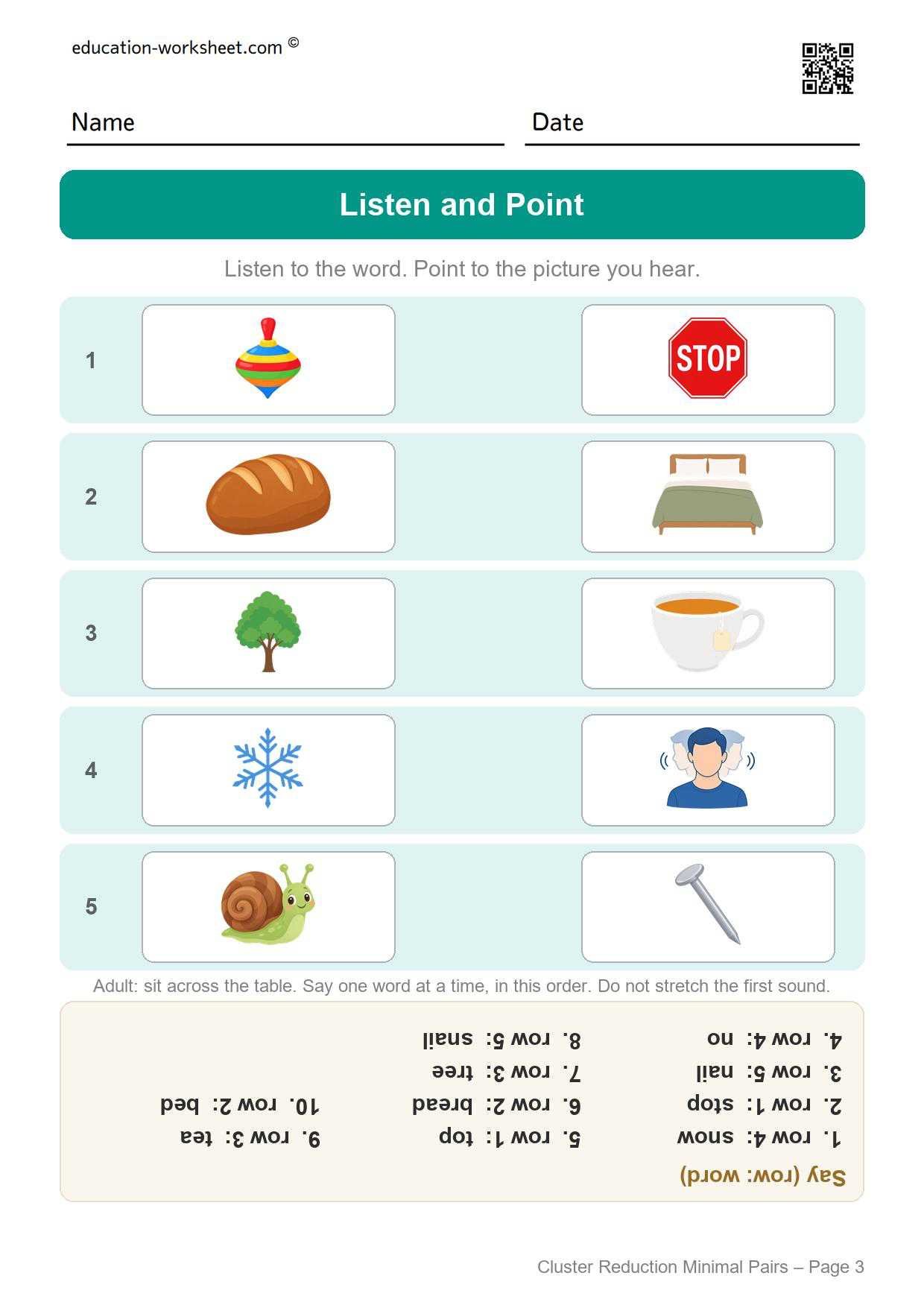
Same five pairs, new order. The rows are shuffled and the pictures in some rows have changed sides, so a child cannot rely on remembering where the snail was last time. This list starts with row 4: snow, then row 1: stop.
No row comes up two times back to back. Without that rule, a child could guess the second call in a row just by pointing to the picture that was not picked the first time.
Page 4 – Listen and Point, Set 3
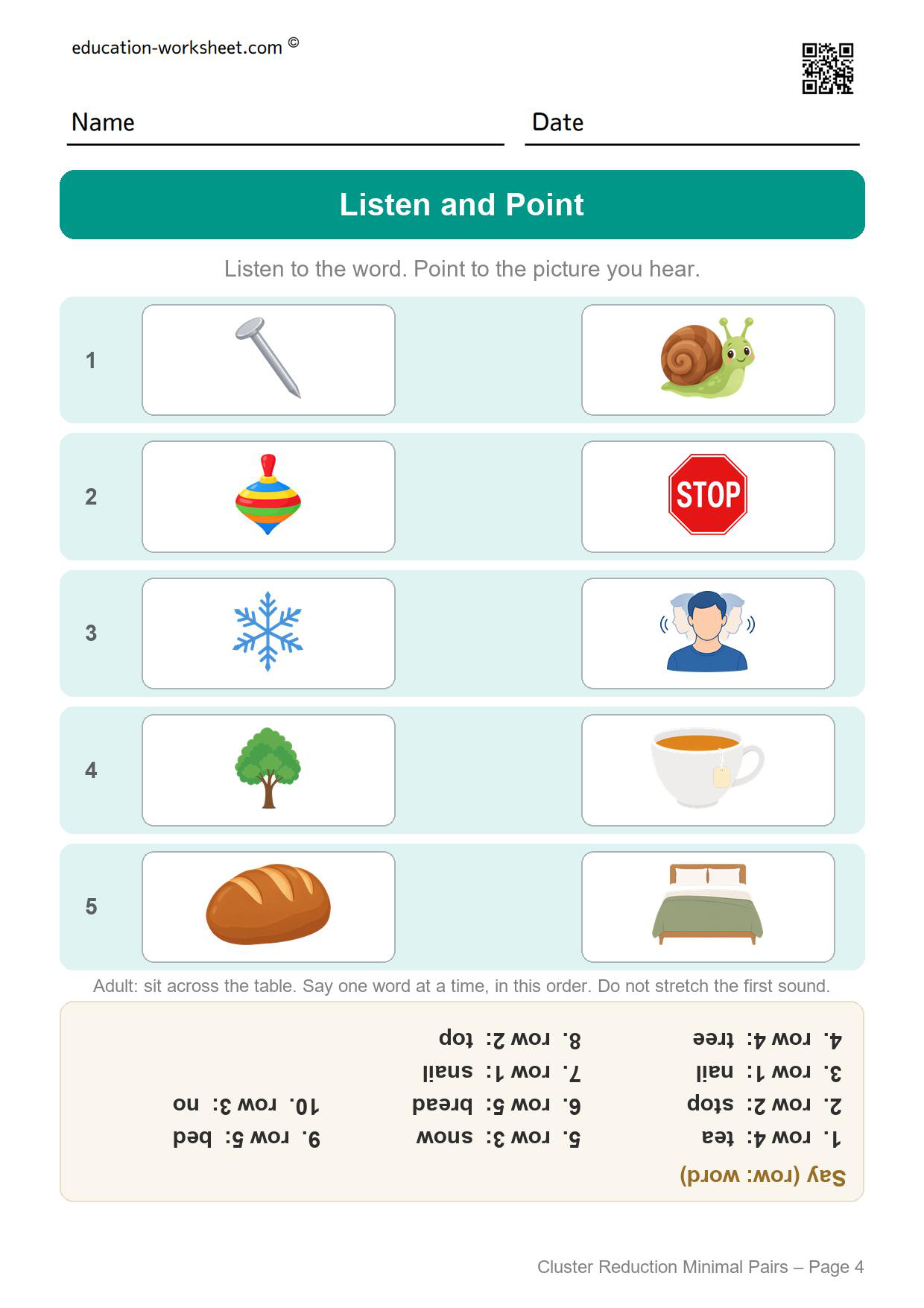
A third arrangement, starting with row 4: tea and row 2: stop. Use it on a different day from pages 2 and 3, or save it as a quick check before you move on to the saying pages.
Ten out of ten is not the goal for one session. Write the number on the progress record and look at how it changes over a week or two. When the child gets most of the words right without hesitating, it is a good time to try page 5.
Page 5 – Say It, I’ll Point, Set 1
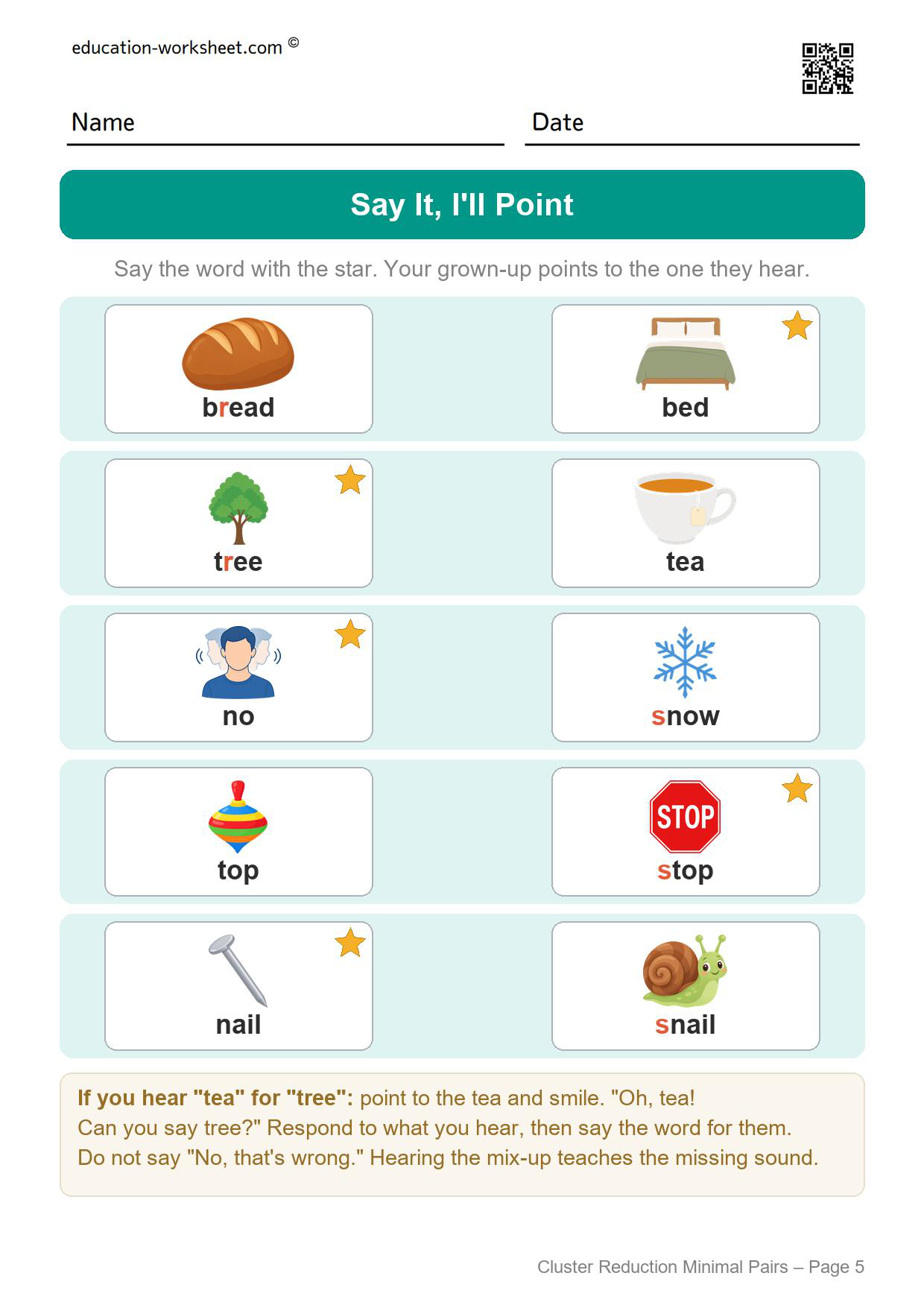
Now the child talks and you listen. In each row one picture has a gold star, and the child names that picture. Your finger then goes to whichever picture matches what came out. On this page the stars are on no, tree, bed, stop and nail, so the child says a mix of cluster words and one-consonant words.
The script at the bottom shows how to respond. If the child aims for tree and you hear “tea”, point to the cup and smile: “Oh, tea! Can you say tree?” This friendly mix-up is the heart of minimal pairs. The child finds out that the missing sound changes the meaning, which teaches far more than being told “that’s wrong”.
Page 6 – Say It, I’ll Point, Set 2
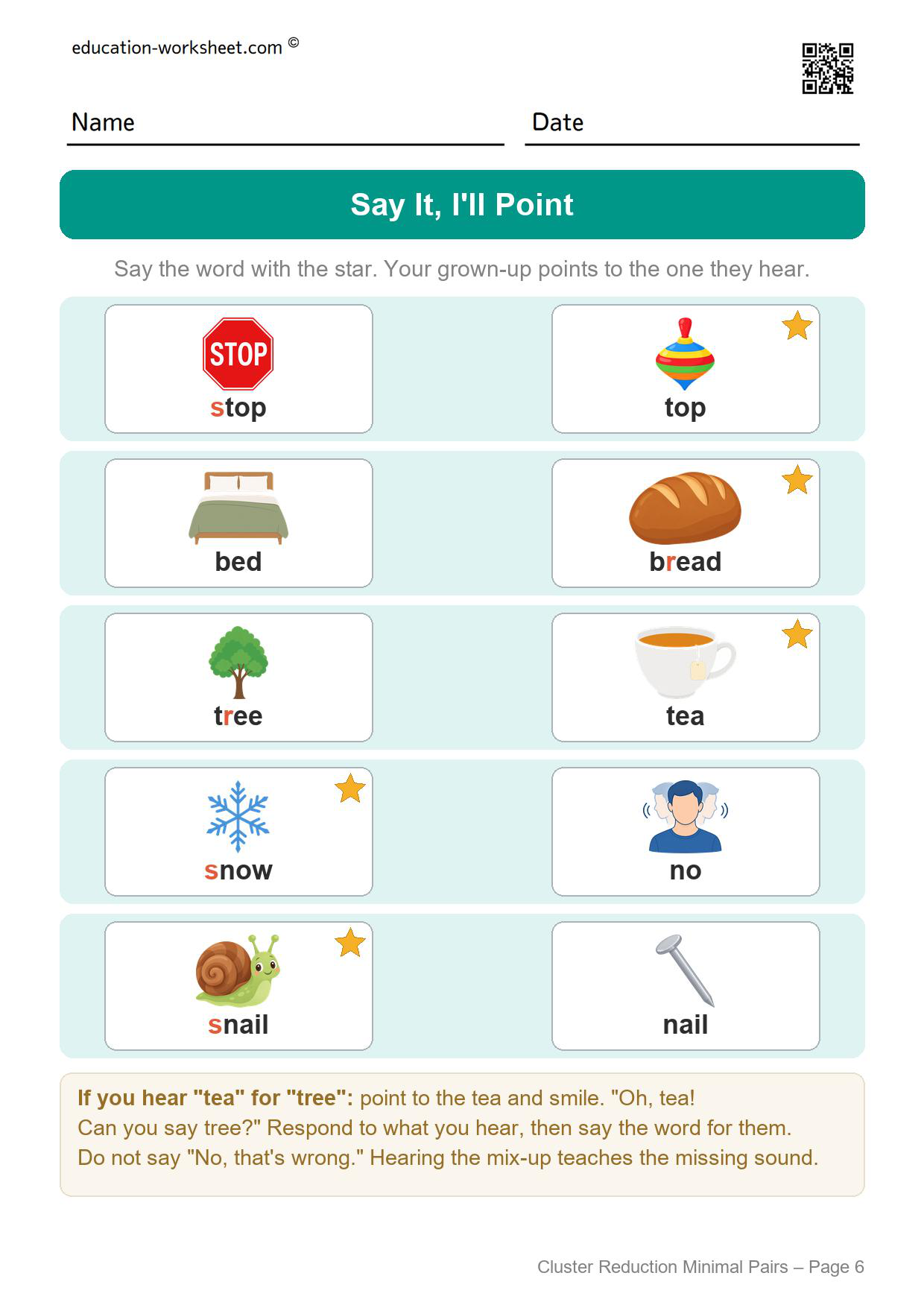
Page 6 moves every star to the other word of its pair: snow, tea, bread, top and snail. Together, pages 5 and 6 have the child say all ten words once. If page 5 went well but page 6 is harder, look at which kind of word is causing trouble. Often it is the cluster words, but sometimes a child who has just discovered the s starts adding it where it does not belong.
Page 7 – Say It, I’ll Point, Set 3
A new combination of stars: snow, tree, bed, top and snail. It is different from both earlier pages, so the child cannot work from memory. Three of the five are cluster words (snow, tree and snail) and two are one-consonant words (bed and top), so the child has to switch back and forth from row to row.
Page 8 – Say It in a Sentence, Set 1
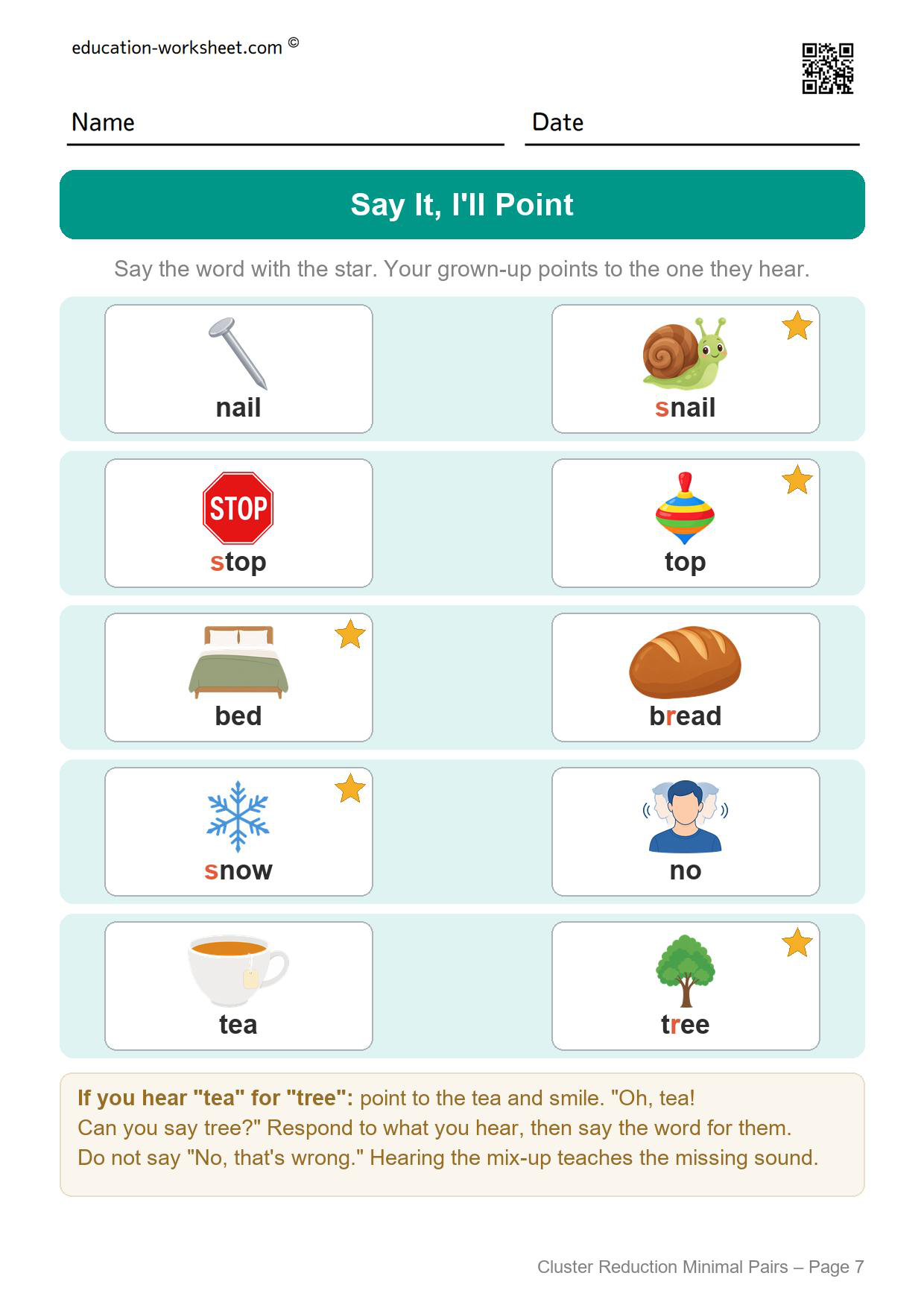
Five short sentences, one per row, each ending in the starred word: “I like the snow.”, “Mom has a cup of tea.”, “I go to bed.”, “The red sign says stop.”, “I hit the nail.” Use this page once the child says the single words clearly most of the time.
Apart from the target word, none of the other words in the sentences starts with two consonants. There is no “play” or “green” in any sentence, so you only listen for one cluster per line.
Page 9 – Say It in a Sentence, Set 2
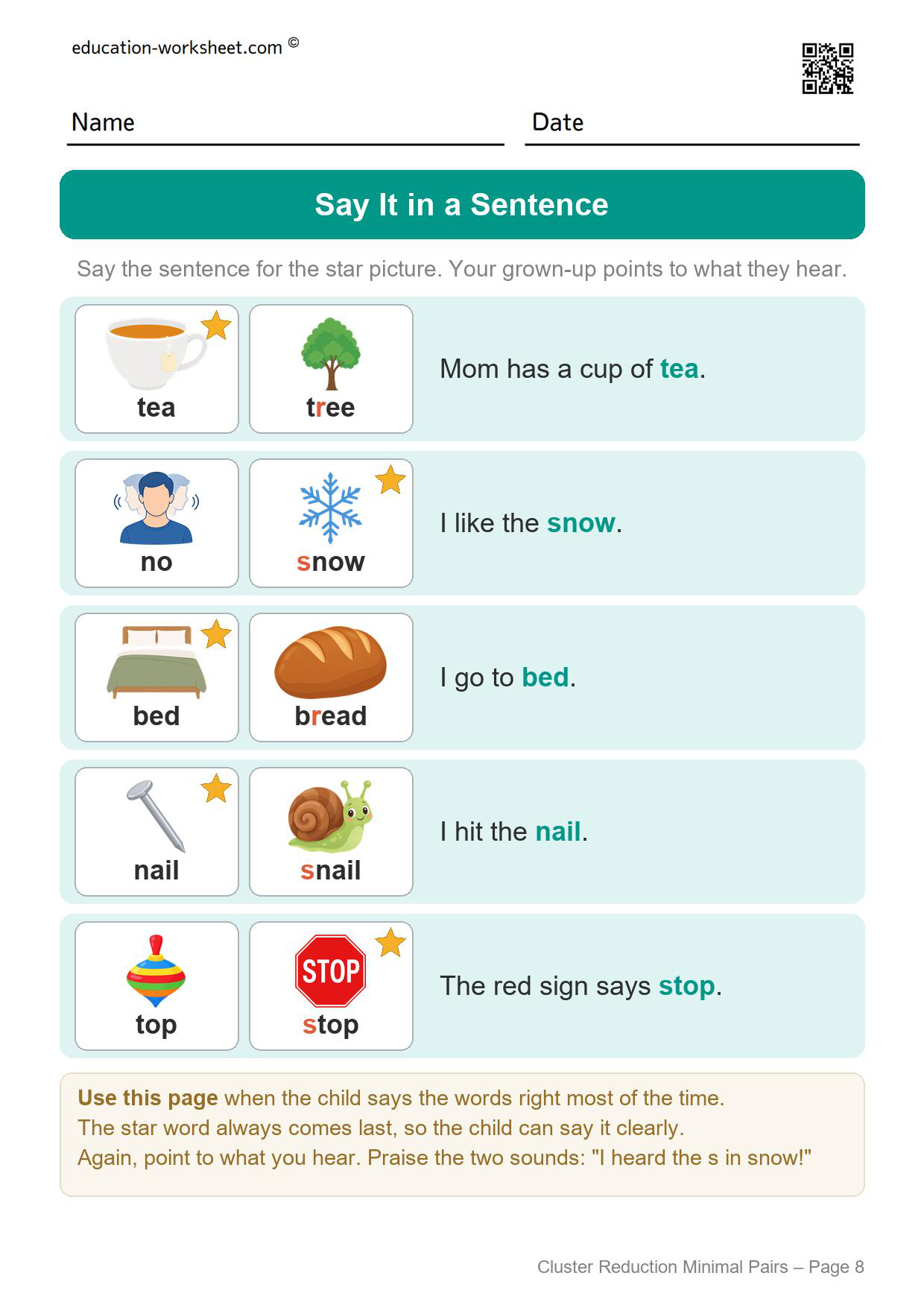
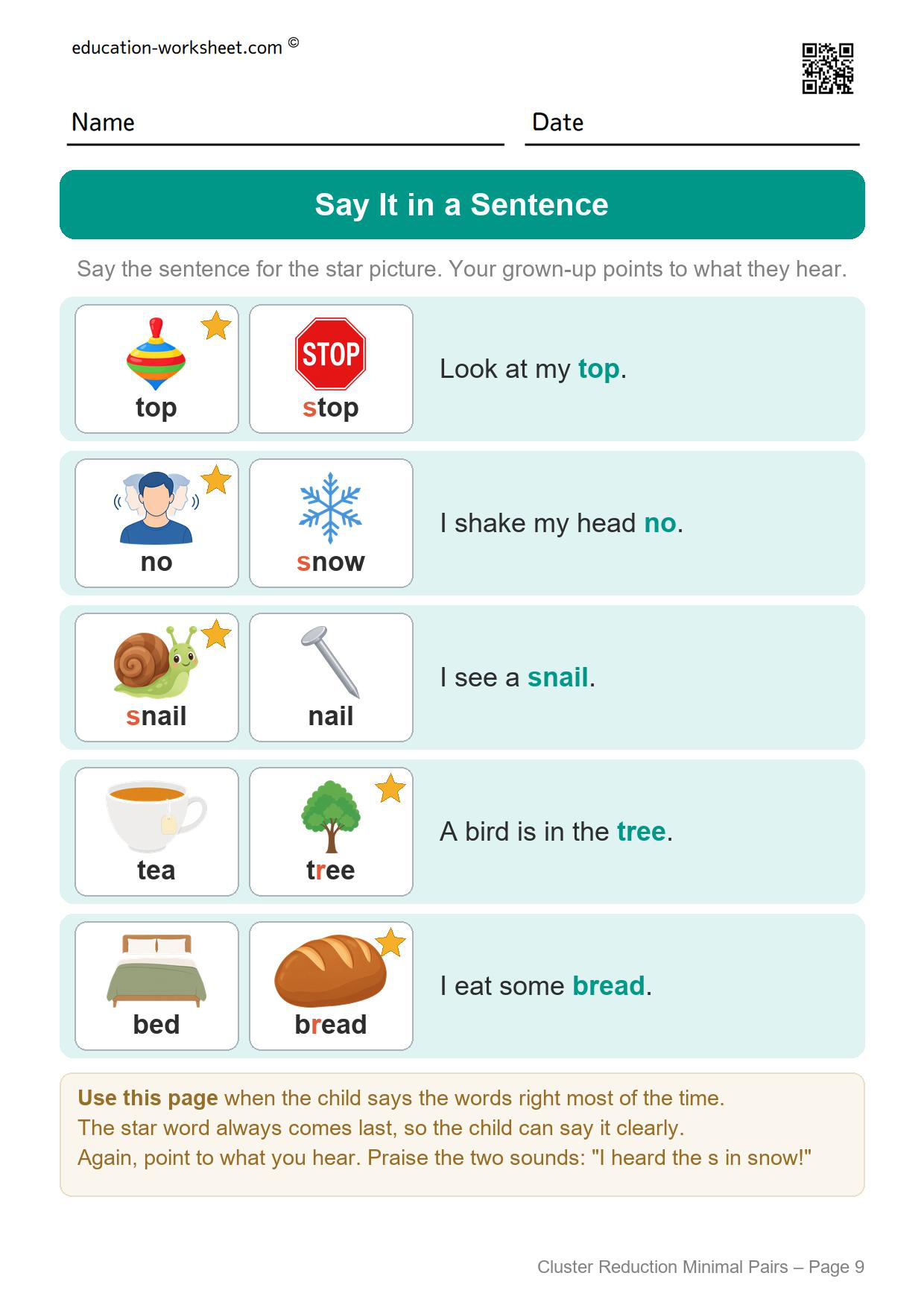
Page 9 stars the other word in each pair: “I shake my head no.”, “A bird is in the tree.”, “I eat some bread.”, “Look at my top.”, “I see a snail.” Two of the five targets (no and top) are the one-consonant words this time. That is on purpose. A child who has just learned to add an s sometimes starts adding it everywhere and says “snail” for nail or “stop” for top. The sentence page lets you hear whether the child can switch between the two forms on demand.
Page 10 – Minimal Pairs Bingo, Board 1
A 3 by 3 board with nine of the ten pictures, so one word is not on the board. Play it two ways. In the listening game you call words from the list and the child covers what they hear. In the talking game the roles switch: the child names a word, and you put a counter on whatever word reached your ears, even if it is not what the child had in mind. Most of the pairs have both pictures on the board, so a reduced cluster really does cover the wrong square.
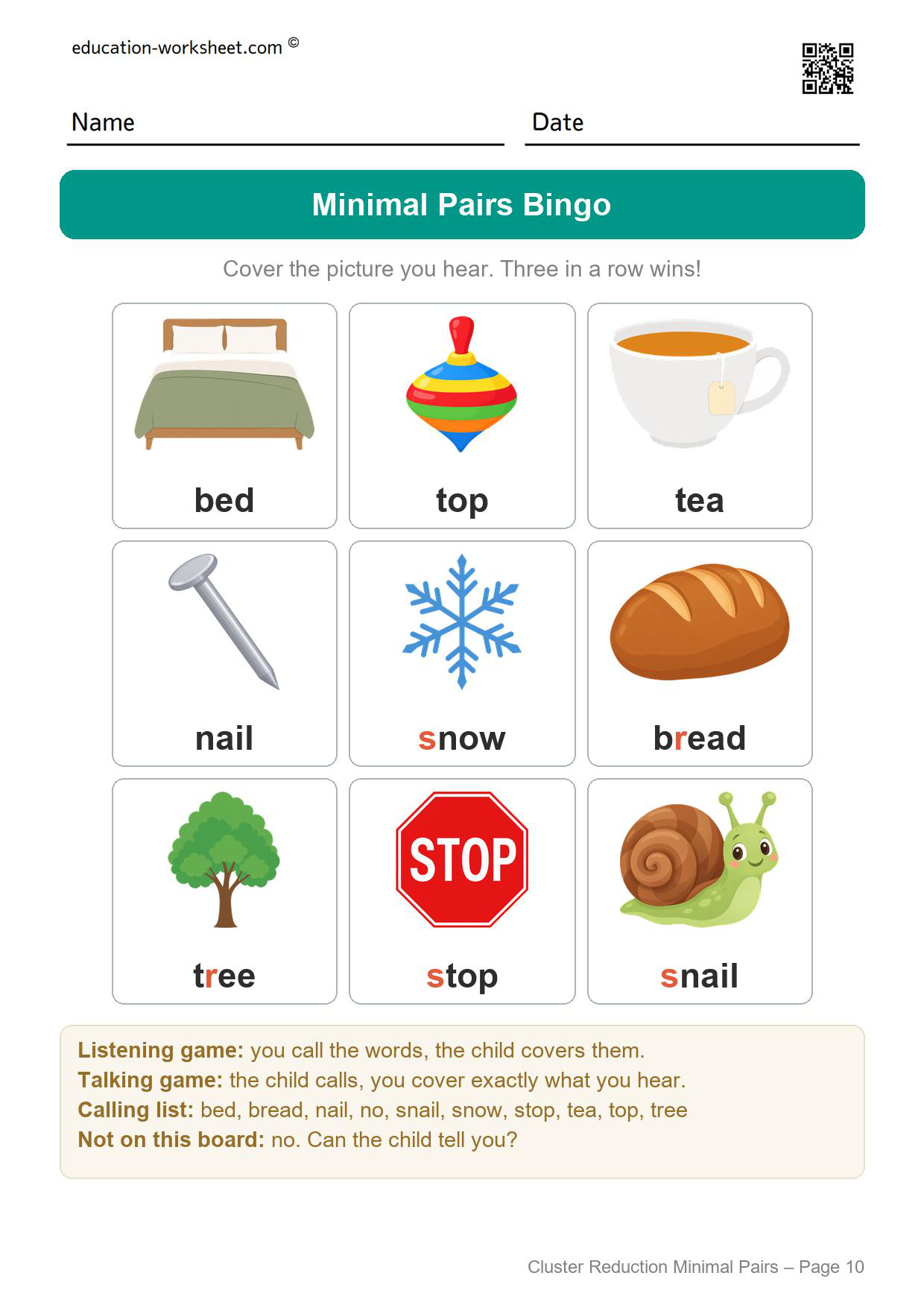
Page 11 – Minimal Pairs Bingo, Board 2
A second board with a different arrangement and a different word left off. Give one board to the child and keep one yourself, and take turns calling. When it is your turn to call, now and then say the wrong word of a pair on purpose and let the child catch you. Children enjoy correcting adults, and it is good listening practice.
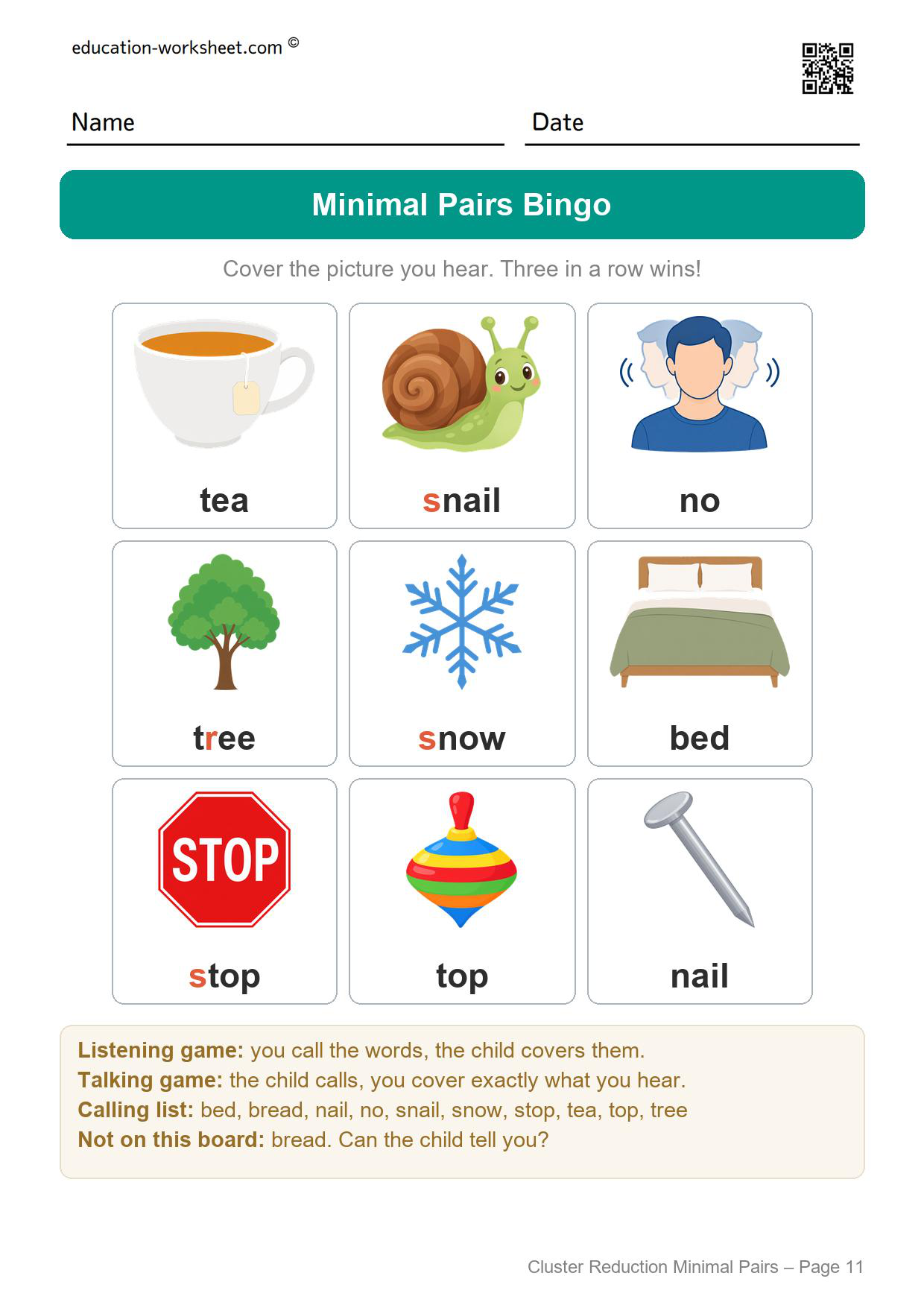
Page 12 – Picture Cards to Cut Out
Ten cards, two per pair, arranged in two columns with dashed cut lines. They work for memory (a match is the two words of a pair, not two copies of one picture), for Go Fish (“Do you have stop?”) and for a quick round of guess-which-one: lay down the two cards of a pair, say one of the words, and let the child pick it up.
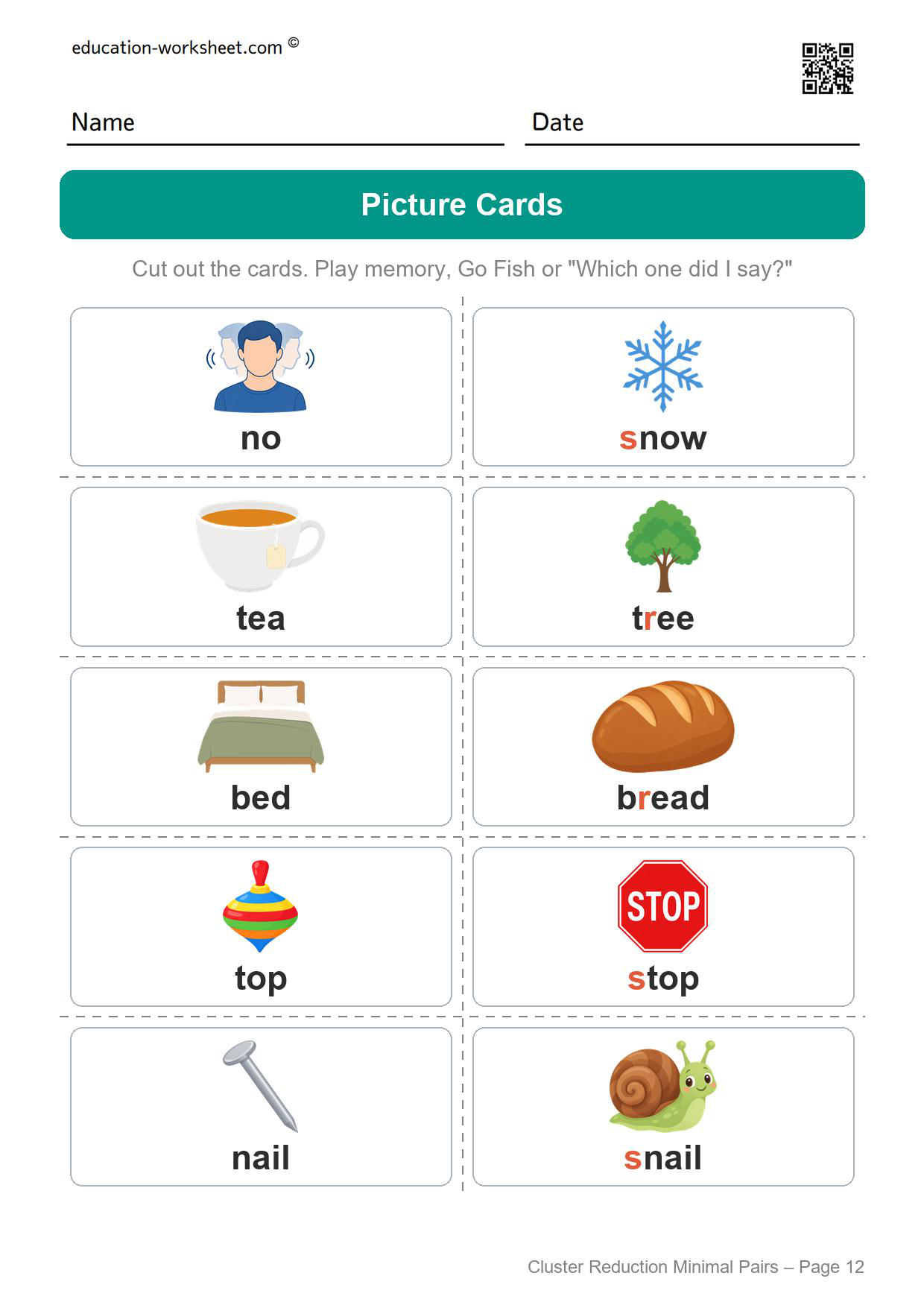
Progress Record
Pages 2 to 9 each get a row with room for three tries: the date and how many were right. The listening pages are out of 10 and the saying and sentence pages are out of 5. Write down what you heard, not what you think the child meant.
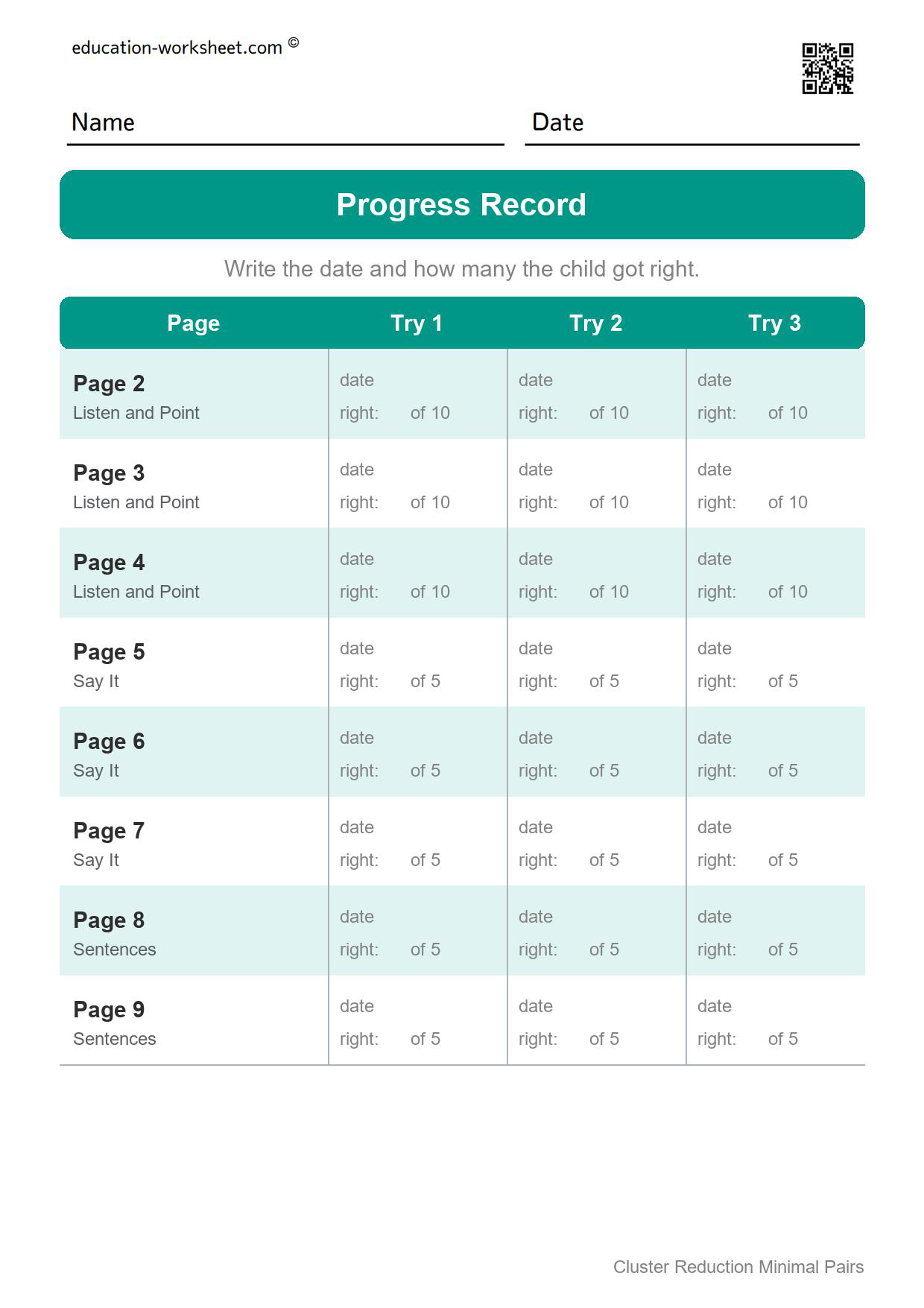
How the Pairs Were Chosen
A good minimal pair is harder to find than it looks. Each pair in this set had to pass the same checks, and a short program confirmed them before the pages were saved:
- Only one sound is different. Take the added sound out of the cluster word and you hear the other word exactly: snow without the s is no, tree without the r is tea. The check is done on the sounds, not the spelling, which is why tea and tree count as a pair even though they are spelled differently.
- The mistake is a likely one. Many children who reduce clusters drop the s in SN and ST clusters and the r in TR and BR clusters. Every pair here follows that pattern, so the one-consonant word is a word the child may really say by mistake.
- Both words can be drawn. A pair only works if a young child can point to both pictures and knows both words. Every word in this set is an everyday thing a preschooler is likely to have seen.
- Both pictures share one style. If one picture in a pair stood out, a child could choose by the look of the picture instead of by listening.
- The sentences hold one cluster each. The target word comes last and no other word in the sentence starts with two consonants.
Cluster Reduction or S Blends Practice?
This site also has S Blends worksheets, and the two packs work in different ways. The S Blends pack is drill practice: twelve words that all start with SP, ST, SK or SN, said again and again in words, phrases, sentences and games. It suits a child who already notices clusters and needs many good repetitions.
This pack is about contrast. Every cluster word sits next to a real word that sounds like the child’s mistake. It suits a child who does not yet seem to notice that “no” and “snow” are different words. Many children use both: pairs first, to make the difference matter, and then the blends pack for plenty of practice.
When It Does Not Go Smoothly
The child adds a vowel. Some children say “suh-now” or “buh-read”. That is a good sign: they have noticed there are two sounds. Praise the effort, then say the word yourself a little faster and let the child copy you.
The r comes out as a w. “Twee” for tree or “bwead” for bread still counts in this pack, because the child has put two sounds at the start. The r sound itself is one of the later sounds to develop and is a separate goal. Do not ask for a perfect r here.
Every word gets an s. After a few days, some children start saying “snail” for nail. This usually fades on its own. Every saying page stars both kinds of word, so you will hear it if it happens.
The child cannot hear the difference at all. Stay on pages 1 to 4 for longer, and keep it short and light. S is a quiet, high-pitched sound, and a child with a mild hearing loss can miss it completely. If the listening pages stay hard, ask for a hearing check. If you are worried about how clearly the child talks, or if teachers and other adults often ask what the child said, a speech-language pathologist can assess the child properly; a worksheet cannot.
Who It Is For and Skills Practiced
- Children: young children in preschool, kindergarten or the first school years who simplify clusters at the start of words.
- Good starting point: the child can say s, n, t and b on their own, or with a little help, and knows most of the ten pictures.
- Adults: parents, teachers, speech-language pathologists and therapy assistants. You need a pencil, scissors and some small counters for bingo.
- RF.K.2 – showing understanding of spoken words, syllables and sounds, here by hearing the first sounds of a word.
- SL.K.6 – speaking audibly and expressing thoughts, feelings and ideas clearly.
A Simple Routine
- Read the guide page, then go through page 1 together and agree on the picture names.
- Do one listening page. Write the score on the progress record.
- When most of the listening answers are right, move to pages 5 to 7. Point to what you hear, every time.
- Use the sentence pages once single words are clear most of the time.
- End with bingo or a card game, and stop while the child still wants to play.
- Five to ten minutes a day works better than a long session once a week.
Three Things to Keep in Mind
1. React to the sound, not the intention. It feels unkind to point at the cup when you know the child meant tree. But a friendly, playful mix-up is exactly what helps the child notice the missing sound. Smile, and give the child another try straight away.
2. Keep your own speech natural. Do not stretch the s or the r when you call the words. On the listening pages, the child should be able to tell the words apart at ordinary speed.
3. Do not keep practicing a sound that will not come. If the child cannot make an s or an r even on its own, the worksheets are not the right step yet. A speech-language pathologist can work on the sound first.
Printing Tips
- Choose actual size (100%) in the print box. Each page is laid out to suit US Letter as well as A4.
- Color helps on page 1, where the added letter is printed in red-orange, but the pictures are clear in black and white too.
- Print the cards on page 12 on card stock if you have it, so they cannot be seen through when they are face down.
Frequently Asked Questions
What is cluster reduction?
A consonant cluster is two or more consonants together, like the sn in snow. Cluster reduction means saying only one of them, so snow becomes “no”. It is a normal pattern while young children learn to talk. Whether it is still expected for one particular child is something a speech-language pathologist can judge.
Why does the cup have to be called tea?
The pair only works if the two words differ by one sound. If the child names the picture “cup”, there is nothing to contrast with tree. Naming the pictures together on page 1 takes a minute and saves a lot of confusion.
My child says twee for tree. Is that a mistake on these pages?
Not on these pages. The goal here is two sounds at the start of the word, and twee has two. A clear r is a different skill that often comes later.
Can these worksheets show whether my child needs speech therapy?
No. There are no scores, cut-offs or age tables. If you have concerns, start with a hearing check and an assessment by a speech-language pathologist.
How often should we use them?
Little and often. A few minutes most days, at a time when the child is rested and happy, tends to work best.
Do I need to sign up to download the PDF?
No. Every Download button opens the PDF straight away. There is no account and no email address to give.
Can I copy these for my class or caseload?
Yes. Print as many copies as your family, classroom or caseload needs. Please do not sell the files or upload them to another site.
More Free Speech and Language Worksheets
- Free S Blends Worksheets for Speech Therapy – SP, ST, SK, SN
- Free Final Consonant Deletion Worksheets – Minimal Pairs PDF
- Free Final Consonant Deletion Minimal Pairs Set 2 – S, Z and CH
- Free Consonant Blends Worksheets for Grade 1 – bl, cr, st
- Free Rhyming Words Worksheets for Kindergarten
- Free Auditory Memory Worksheets for Kids – Listen and Repeat