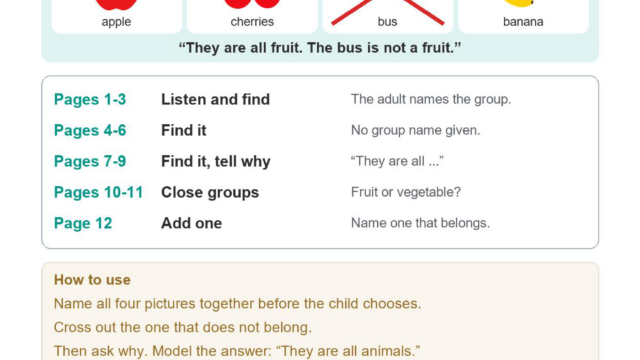
These free printable category sorting worksheets help children learn that words belong to groups: a lion is an animal, a banana is a fruit and a bus is a vehicle. Over twelve pages the child first listens and finds every picture in a group, then sorts pictures into two and then three groups, then says the group name, and finally names more members and explains why two things go together. There are 13 groups in all, from animals and fruit to tools, school supplies and community helpers.
A speech-language-hearing therapist designed this pack. Categories come up again and again in speech and language work with young children. When a child knows that a pot and a frying pan are both kitchen things, a new word like whisk has somewhere to go, and having a place to go makes a word easier to find again later. Use these pages at home, in a classroom or in therapy sessions. They are practice pages, not a test, and they cannot tell you whether a child has a language difficulty.
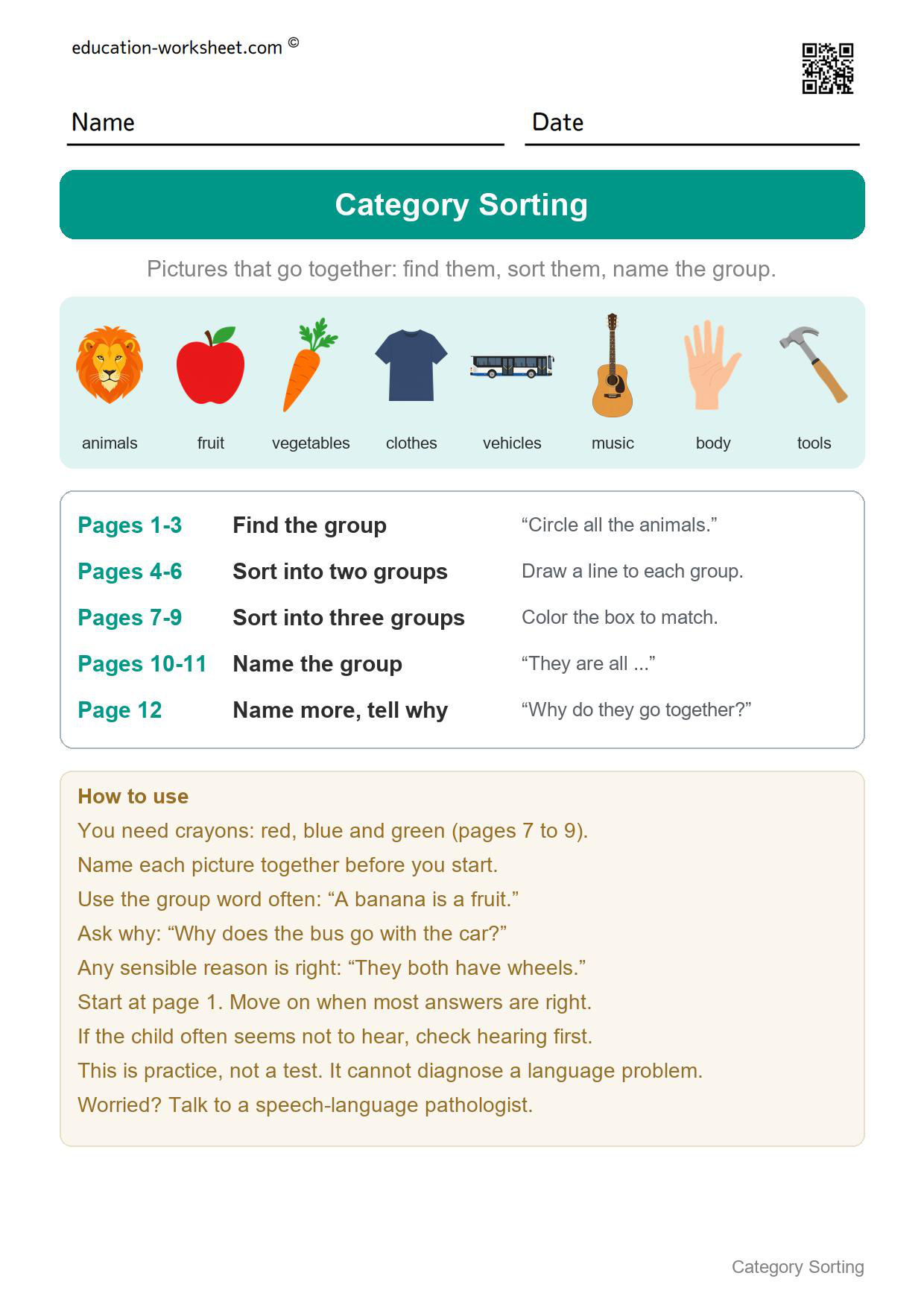
The pages move from understanding to talking. Marking every animal on a page only asks the child to recognize the group. Saying “They are all vehicles” asks the child to find the group word without help, and explaining why a hammer and a wrench go together asks for a reason. Many children manage the first long before the last, so start at page 1 even with an older child.
- What Is in This Free Category Sorting Pack
- The 12 Category Sorting Worksheets
- Start Here – Five Levels and Tips for Adults
- Page 1 – Find the Group: Animals and Fruit
- Page 2 – Find the Group: Clothes and Instruments
- Page 3 – Find the Group: Vegetables and Fruit
- Page 4 – Sort into Two Groups: Animals and Vehicles
- Page 5 – Sort into Two Groups: Body Parts and Clothes
- Page 6 – Sort into Two Groups: Vegetables and Fruit
- Page 7 – Sort into Three Groups: Animals, Vehicles and Clothes
- Page 8 – Sort into Three Groups: Instruments, Tools and School Supplies
- Page 9 – Sort into Three Groups: Fruit, Vegetables and Animals
- Page 10 – Name the Group
- Page 11 – Name the Group: Six Harder Groups
- Page 12 – Name More and Tell Why
- Answer Key
- How These Pages Were Put Together
- Sorting by Meaning, Not by Look
- When Categories Are Hard
- Who These Worksheets Are For
- How to Use These Worksheets
- Ideas to Keep It Playful
- Three Things to Watch For
- Printing Tips
- Frequently Asked Questions
- What age are these category worksheets for?
- Is a tomato a fruit or a vegetable?
- My child said “things that go” instead of “vehicles.” Is that right?
- Why are some words printed upside down?
- Can this pack show whether my child has a language disorder?
- Do I need an account or email address to download?
- Can I use these in a classroom or therapy room?
- More Free Listening and Language Worksheets
What Is in This Free Category Sorting Pack
- Twelve practice pages, a guide page for the adult and an answer key.
- 13 groups: animals, fruit, vegetables, clothes, vehicles, musical instruments, body parts, furniture, kitchen things, school supplies, tools, community helpers and food.
- Five levels: find the group (pages 1 to 3), sort into two groups (pages 4 to 6), sort into three groups (pages 7 to 9), name the group (pages 10 and 11), and name more and tell why (page 12).
- The name of every picture printed under it, so you and the child use the same word.
- Red, blue and green crayons needed for pages 7 to 9 only.
- Each page as its own free PDF, ready to print.
The 12 Category Sorting Worksheets
Inside each level, the groups start far apart and move closer together. Animals and vehicles are easy to tell apart. Fruit and vegetables are both foods that grow, so they come last. If a page feels hard, the previous page is usually the right place to go back to.
Start Here – Five Levels and Tips for Adults
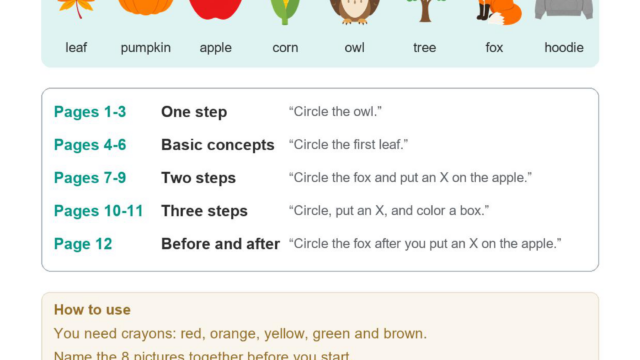
The guide page shows one picture from eight of the groups, the five levels with a short example of each, and a few tips. Read the tips once before you begin. They explain what counts as a right answer on the later pages, where the child talks instead of marking.
Page 1 – Find the Group: Animals and Fruit
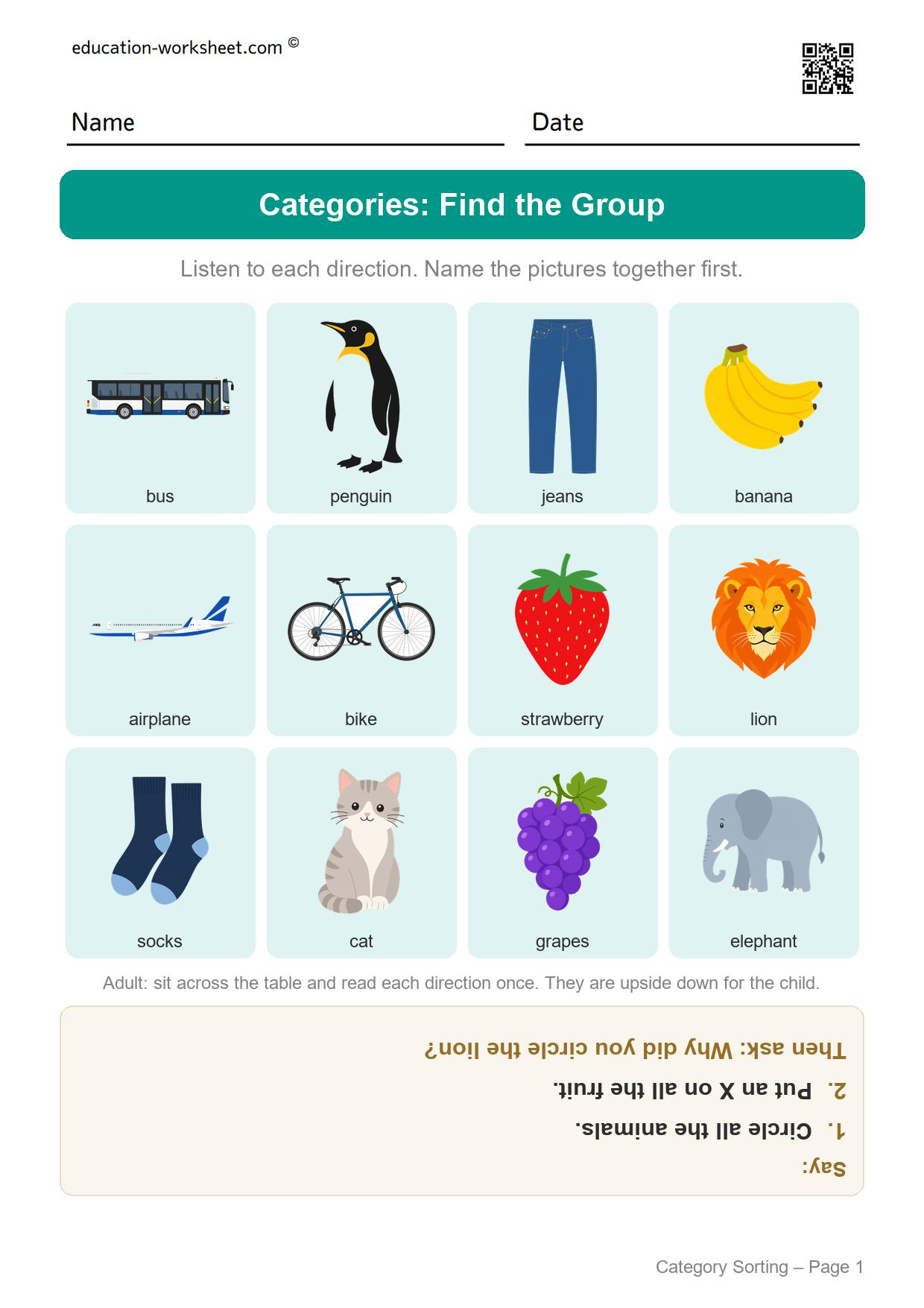
Twelve pictures and two directions, read by the adult: “Circle all the animals” and “Put an X on all the fruit.” Four animals (penguin, lion, cat and elephant) and three fruits (banana, strawberry and grapes) are mixed with a bus, an airplane, a bike, socks and jeans, which stay unmarked.
Listen for the word all. A child who circles one animal and stops has understood the group but not the whole direction. Afterwards, ask why the lion was circled. “It’s an animal” is a complete answer, and “it roars” shows the child is thinking about what animals do.
Page 2 – Find the Group: Clothes and Instruments
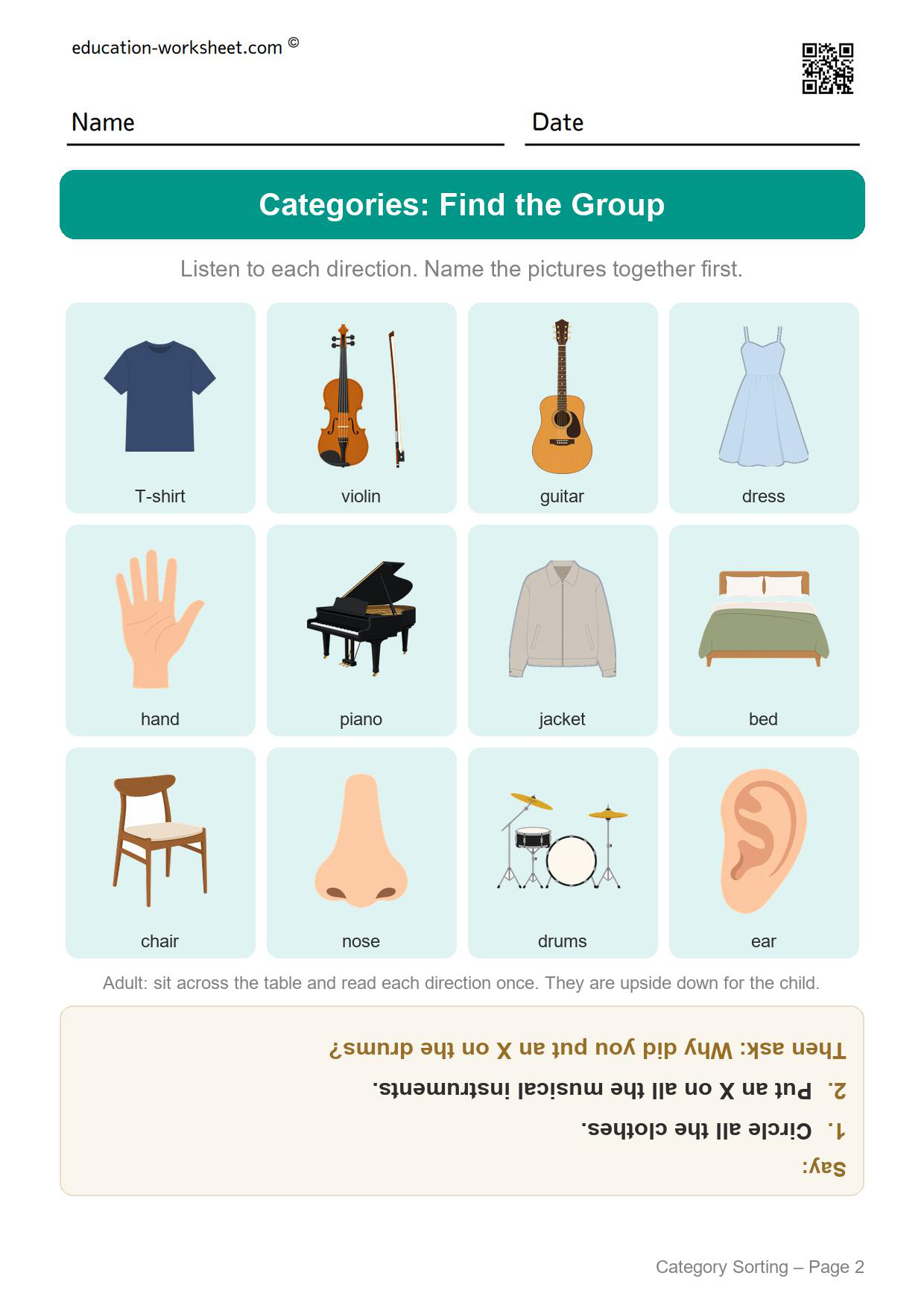
This time the child circles the clothes (T-shirt, dress and jacket) and puts an X on the musical instruments (violin, guitar, piano and drums). A hand, a nose, an ear, a bed and a chair stay unmarked. The question at the end is “Why did you put an X on the drums?”
Page 3 – Find the Group: Vegetables and Fruit
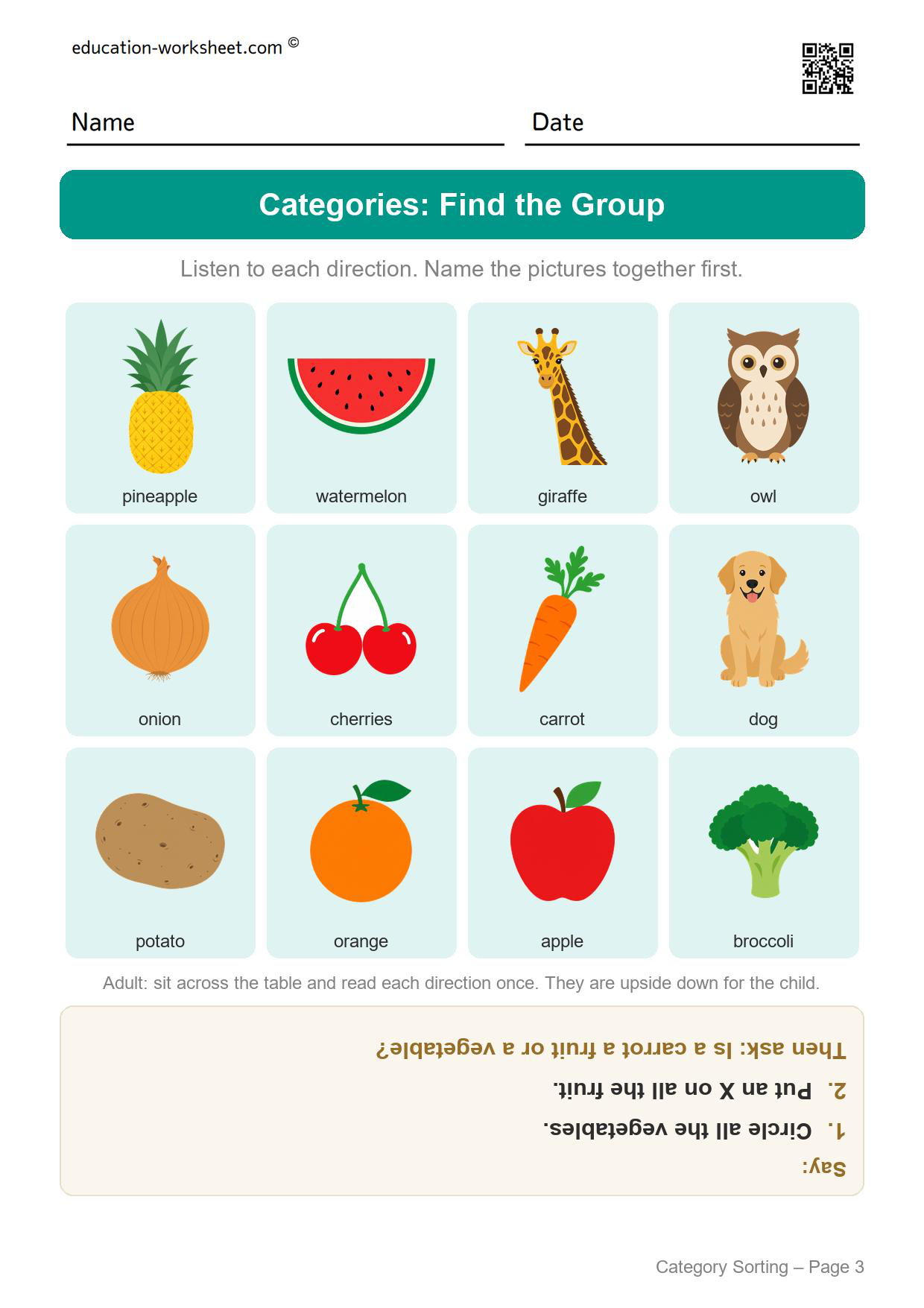
Both directions are about food, which makes this the hardest of the three find pages. The four vegetables (onion, carrot, potato and broccoli) get a circle, the five fruits (pineapple, watermelon, cherries, orange and apple) get an X, and a giraffe, an owl and a dog are left alone.
The closing question is “Is a carrot a fruit or a vegetable?” A child may say that fruit is sweet. That is a fair everyday reason, so accept it and talk about it.
Page 4 – Sort into Two Groups: Animals and Vehicles
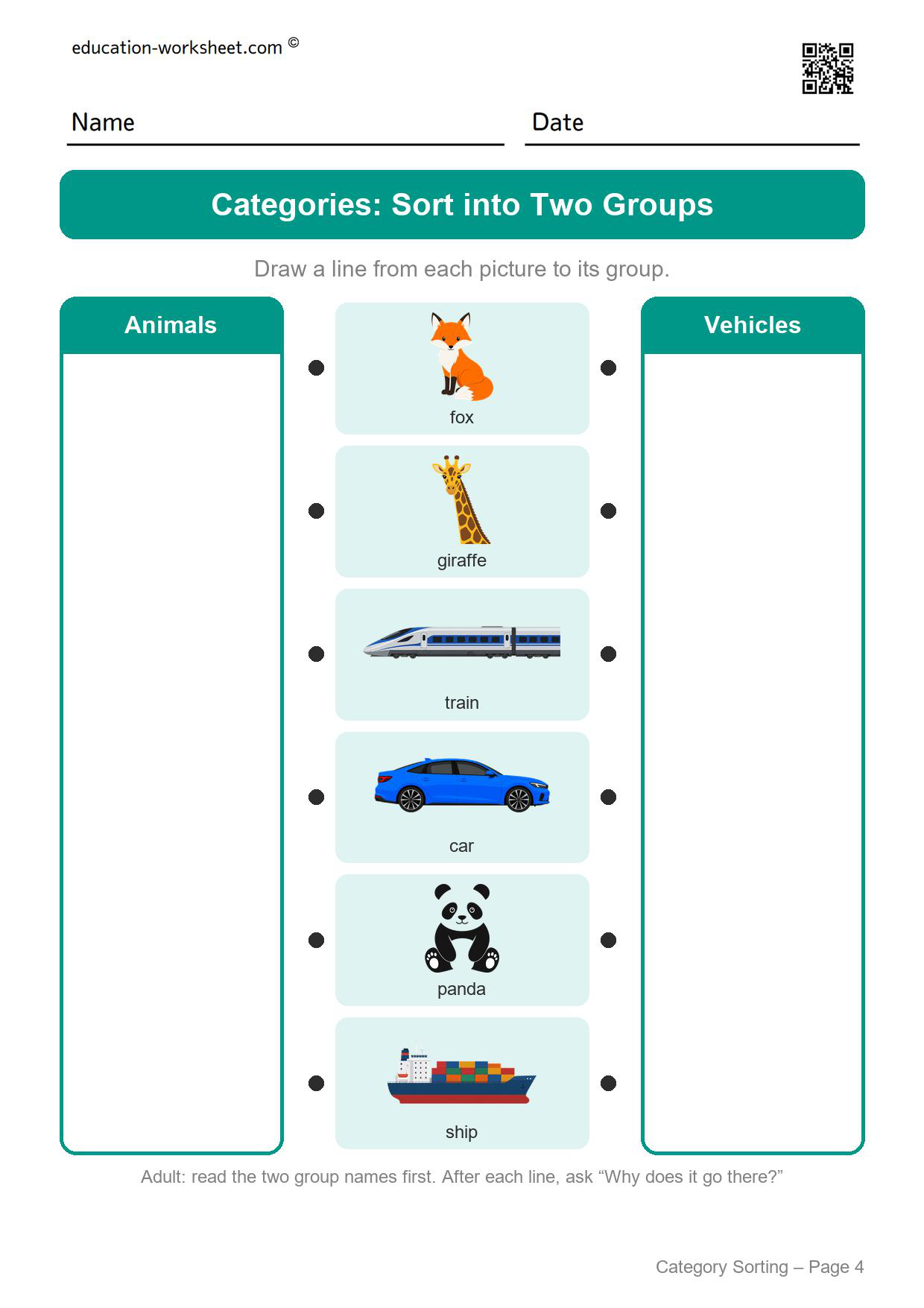
Six pictures run down the middle of the page, with an Animals panel on the left and a Vehicles panel on the right. The child draws a line from the dot beside each picture to the right panel: the fox, giraffe and panda to the animals, and the train, car and ship to the vehicles. Because the two groups sit on opposite sides, the lines never cross.
Page 5 – Sort into Two Groups: Body Parts and Clothes
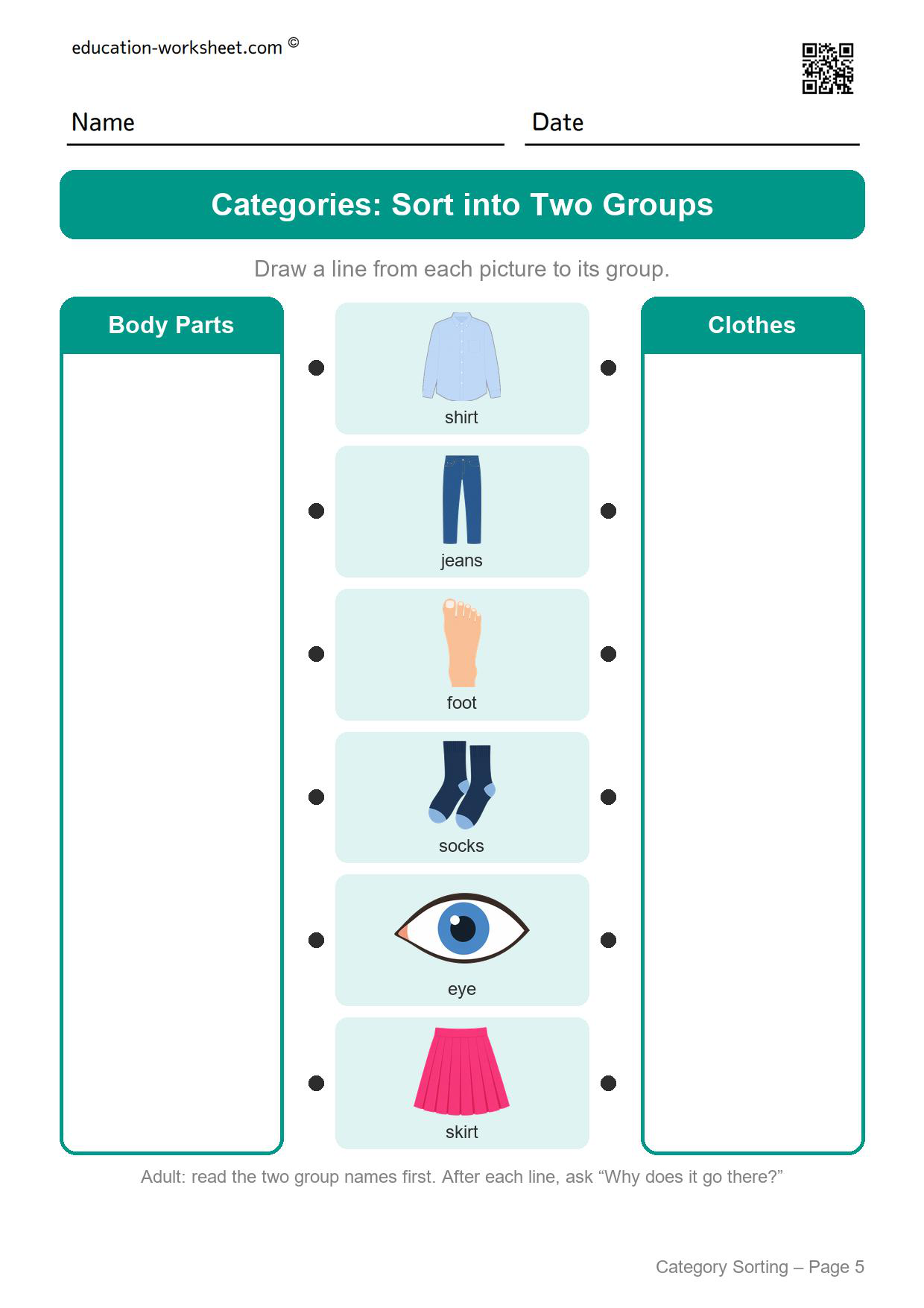
Body Parts on the left, Clothes on the right, and a small puzzle in the middle: a foot and a pair of socks. Socks go on feet, so some children want to send them to the same side. That link makes sense, but socks are something you wear, and a foot is part of you. Talking through that one pair often teaches more than the other four pictures (eye, shirt, jeans and skirt).
Page 6 – Sort into Two Groups: Vegetables and Fruit
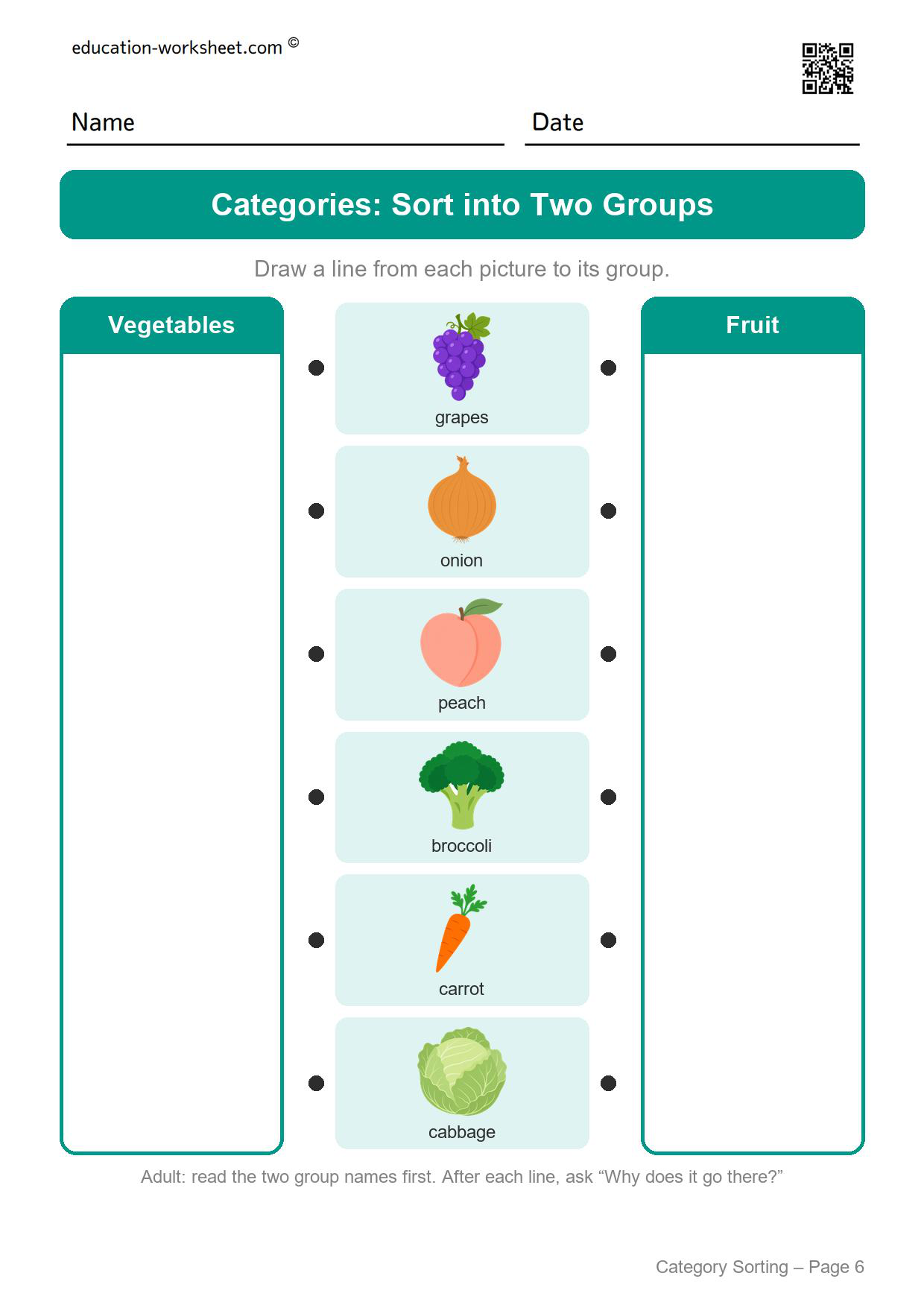
The two closest groups in the pack: onion, broccoli, carrot and cabbage go to Vegetables, and grapes and a peach go to Fruit. The split is four and two, so a child who simply alternates sides will not get it right by luck.
Page 7 – Sort into Three Groups: Animals, Vehicles and Clothes
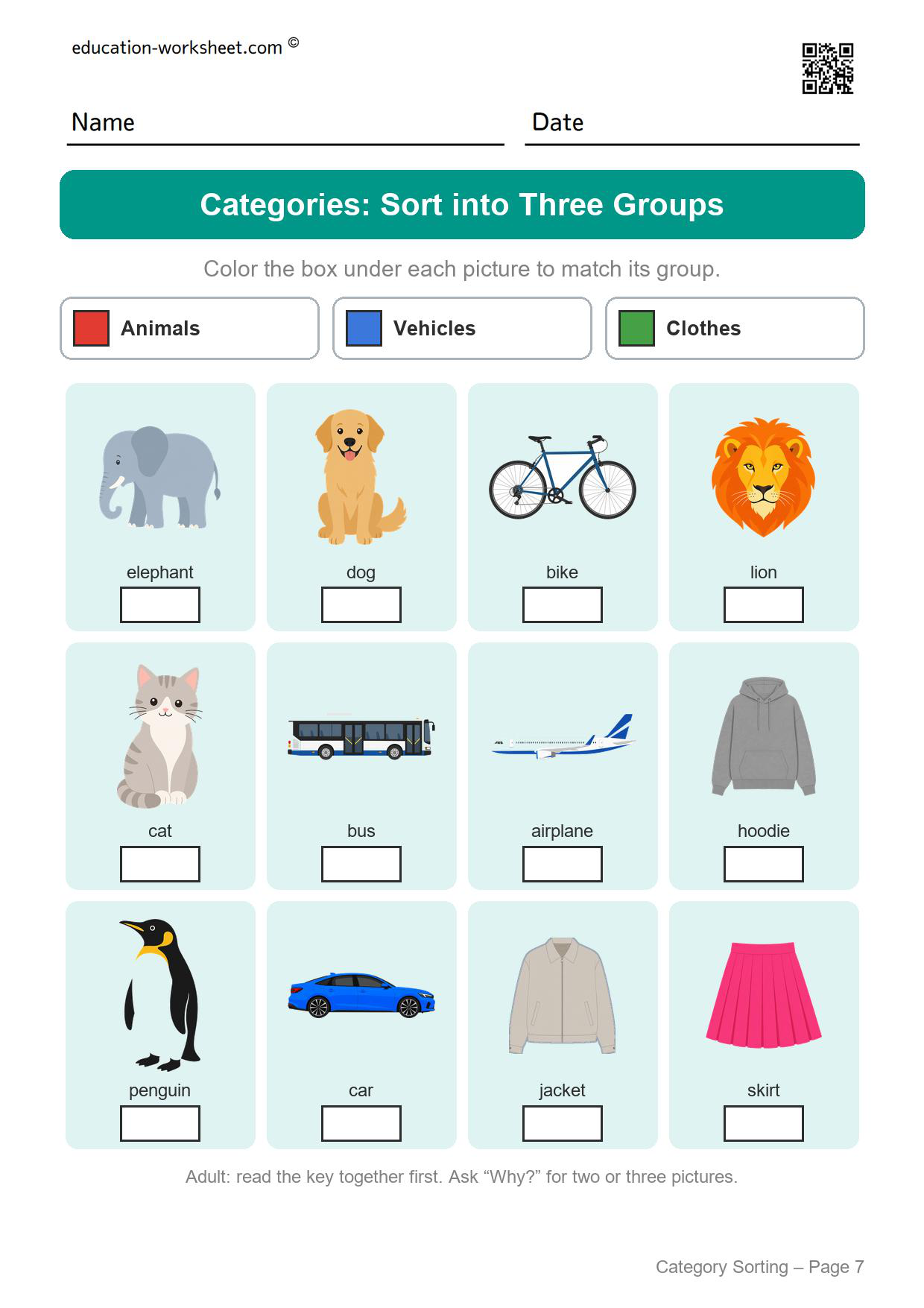
A color key at the top takes the place of the side panels: red for animals, blue for vehicles and green for clothes. The child colors the small box under each picture to match its group. There are five animals (elephant, dog, lion, cat and penguin), four vehicles (bike, bus, airplane and car) and three clothes (hoodie, jacket and skirt), so counting does not give the answer away.
Page 8 – Sort into Three Groups: Instruments, Tools and School Supplies
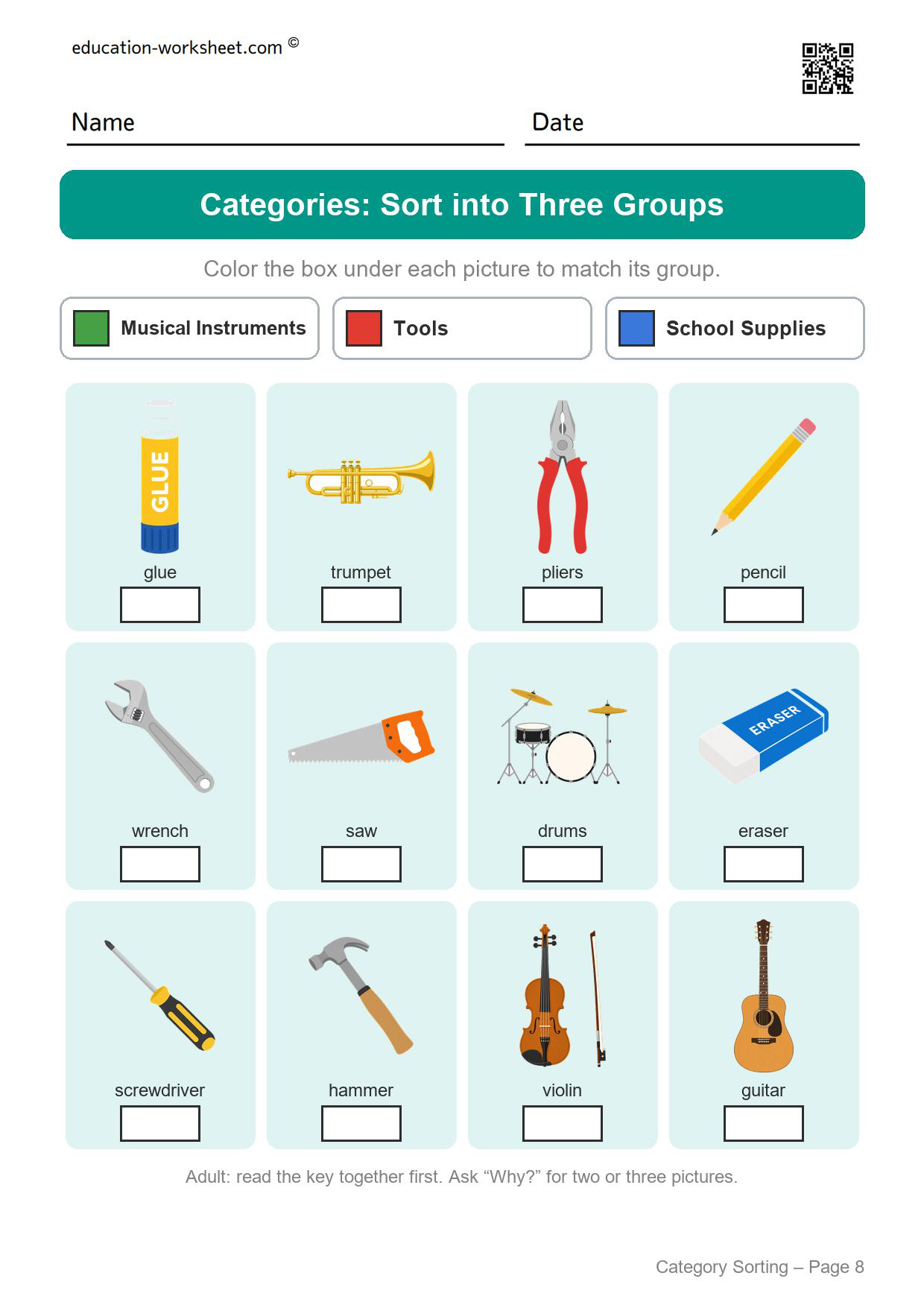
Three groups of things people hold and use: musical instruments in green (trumpet, drums, violin and guitar), tools in red (pliers, wrench, saw, screwdriver and hammer) and school supplies in blue (glue, pencil and eraser). Scissors are not on this page, because they could fairly go with the tools as well as with the school supplies.
Page 9 – Sort into Three Groups: Fruit, Vegetables and Animals
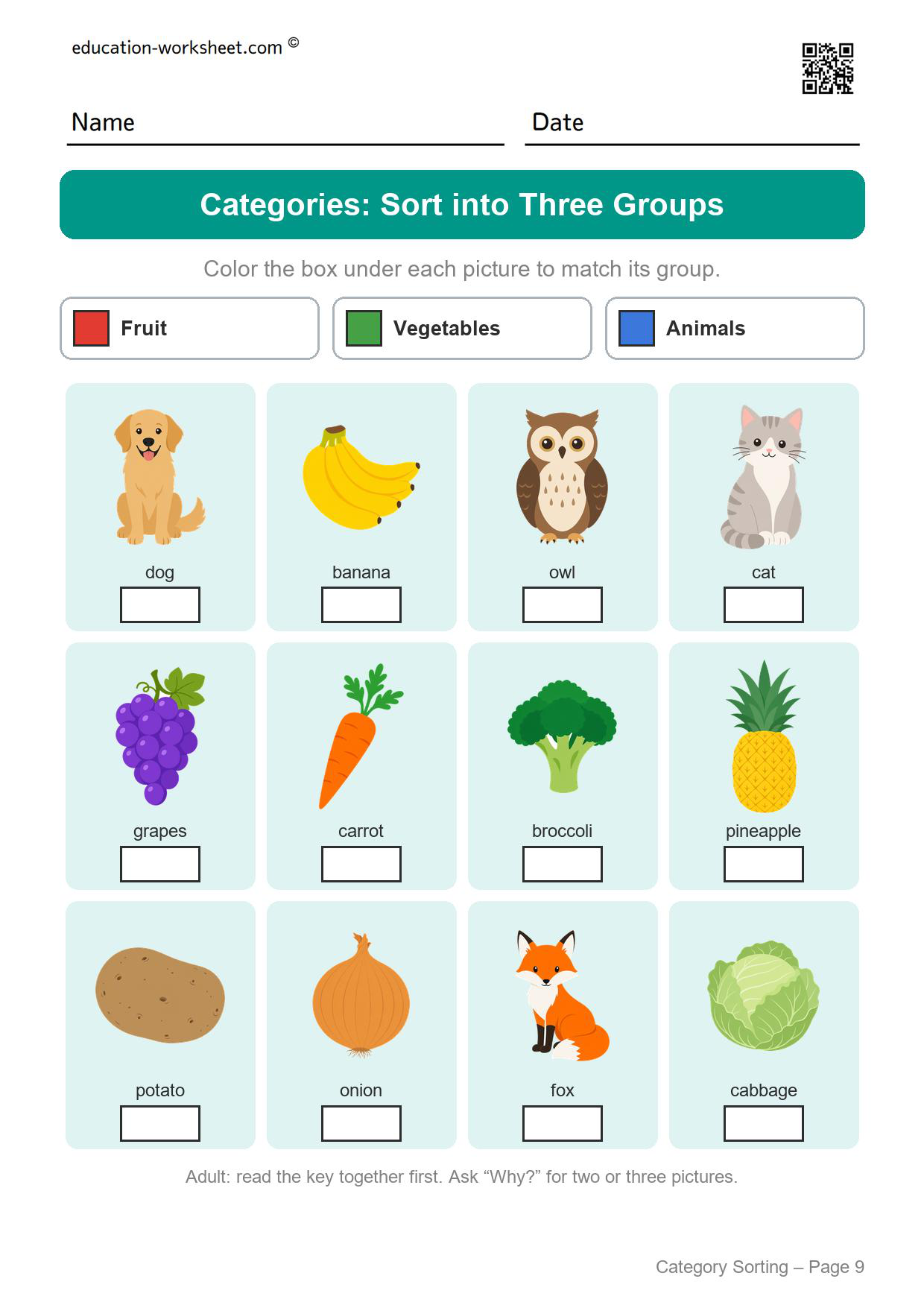
Fruit and vegetables return with a third group: red for fruit (banana, grapes and pineapple), green for vegetables (carrot, broccoli, potato, onion and cabbage) and blue for animals (dog, owl, cat and fox). There is no red apple or strawberry on this page. Next to a red key square, a red fruit would let the child color by the picture’s own color instead of by its group.
Page 10 – Name the Group
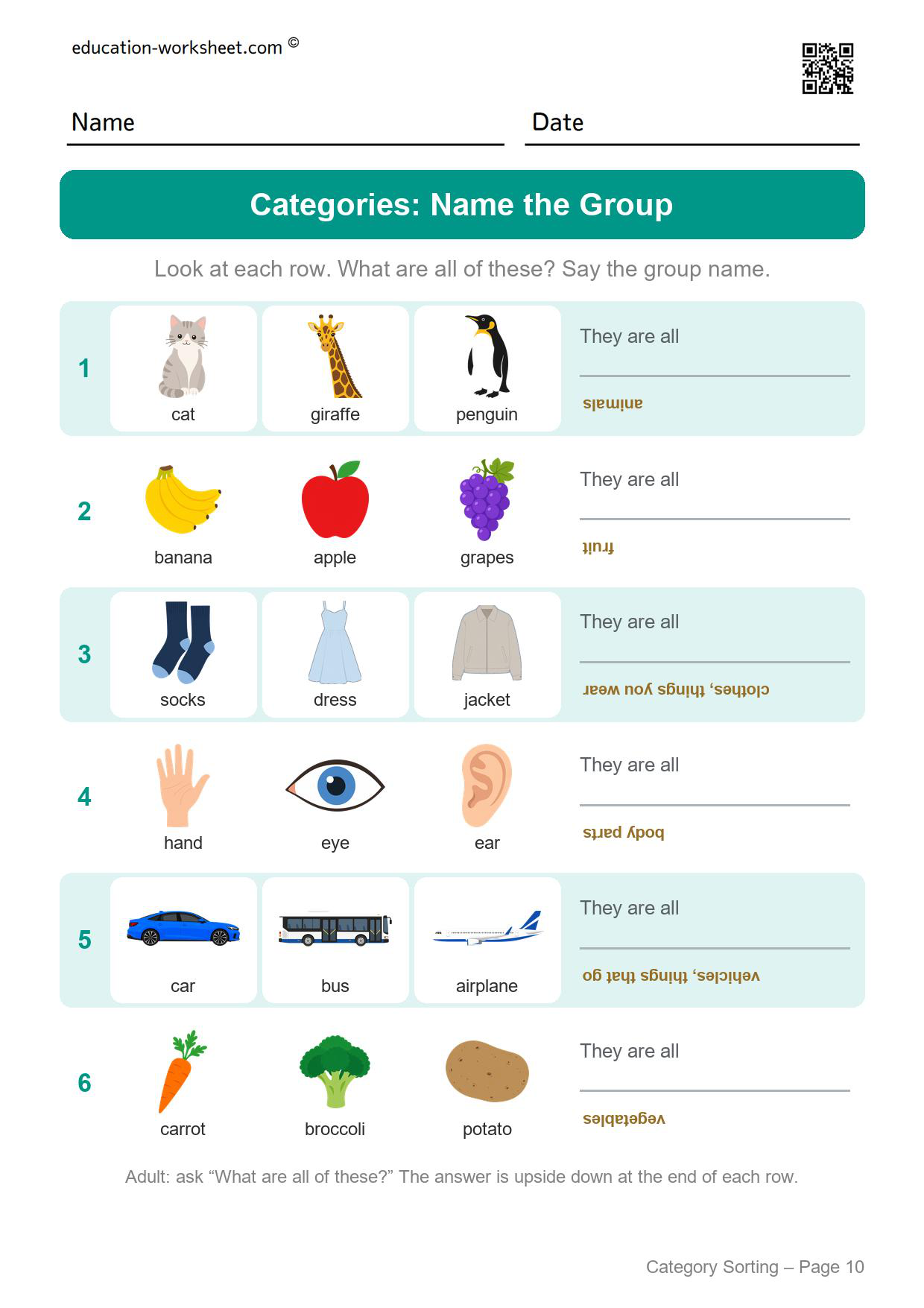
Now the child does the talking. Each of the six rows shows three pictures from one group, and you ask, “What are all of these?” The answer for each row is printed upside down at the end of the row, so you can read it from across the table: animals, fruit, clothes, body parts, vehicles and vegetables. Write the child’s answer on the line, word for word.
Page 11 – Name the Group: Six Harder Groups
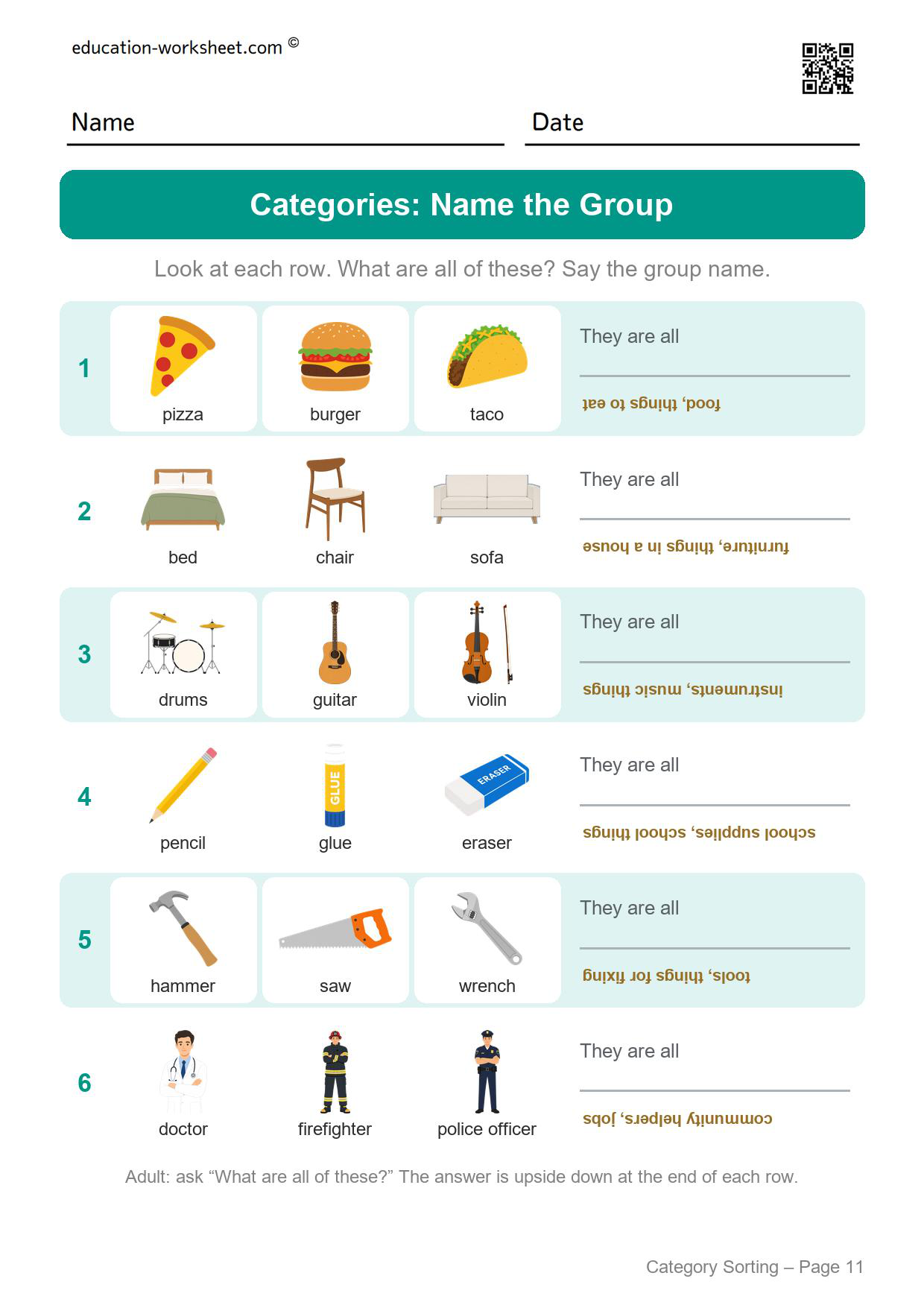
Six groups whose names come up less often in everyday talk: food (pizza, burger and taco), furniture (bed, chair and sofa), musical instruments (drums, guitar and violin), school supplies (pencil, glue and eraser), tools (hammer, saw and wrench) and community helpers (doctor, firefighter and police officer).
Expect answers such as “music things” or “jobs.” They show the child has found the group without the formal word, and the upside-down answers list them as correct.
Page 12 – Name More and Tell Why
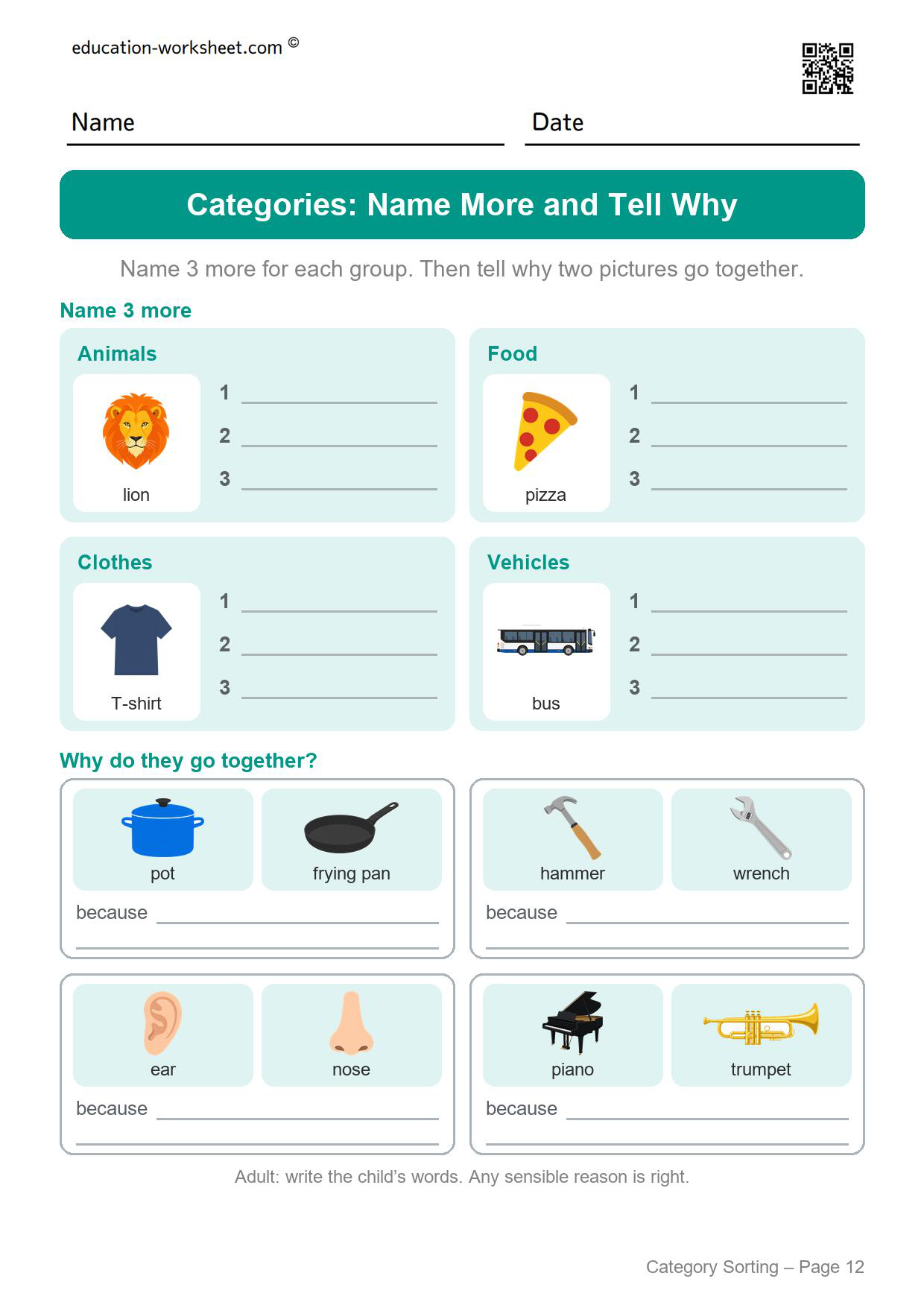
Two tasks on one page. At the top, the child names three more animals, foods, clothes and vehicles, starting from a lion, a pizza, a T-shirt and a bus, while you write the answers down.
At the bottom, four pairs of pictures each ask “Why do they go together?”: a pot and a frying pan, a hammer and a wrench, an ear and a nose, and a piano and a trumpet. Any sensible reason counts.
Answer Key
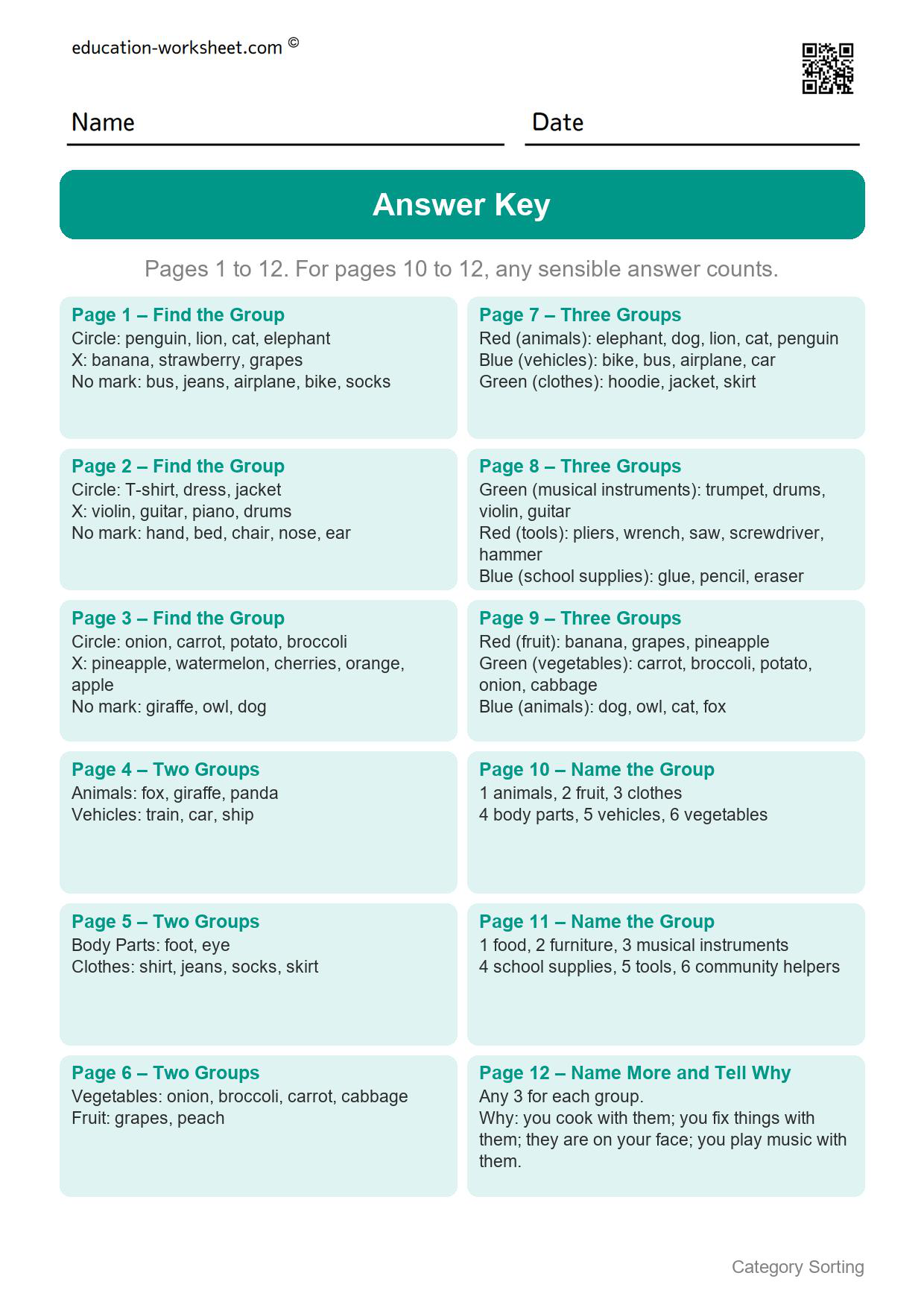
Every answer for pages 1 to 9, the group names for pages 10 and 11, and one example reason for each pair on page 12. On the talking pages the key is a guide rather than a rule.
How These Pages Were Put Together
A sorting task is only fair if every picture has one right group. Before the pages were saved, a small computer program checked each page against a list of rules and stopped whenever one was broken.
- Each picture has only one possible group on its page. Some pictures could fit two groups: an apple is fruit and also food, a table can be furniture or a kitchen thing, and scissors can be a school supply or a tool. None of these pictures ever shares a page with its second group.
- Disputed foods are left out. Tomatoes, pumpkins, corn, peppers and eggplant are fruit to a scientist and vegetables in the kitchen, so none of them appear. A kiwi could be a fruit or a bird, so it is not used either.
- The answers are spread out. No group is bunched into a single row, and the sides on pages 4 to 6 do not follow a simple pattern such as left, right, left, right.
- A picture’s own color never matches another group’s key color. On pages 7 to 9, a child who colors by what they see is not pulled toward a wrong group.
- The key colors change from page to page. Animals are red on page 7 and blue on page 9, so the child reads the key each time instead of remembering it.
- Group sizes are uneven, such as five, four and three, so the child cannot fill in the last group by counting.
Sorting by Meaning, Not by Look
If your child has already used our sorting worksheets for color and shape, this pack is a natural next step. Sorting by color asks what a thing looks like. Sorting into categories asks what a thing is and what it is for. A red apple and a red car look alike in one way, but only one of them is something you eat.
The same idea separates this pack from our same or different worksheets, where the child compares shapes and colors. Here the pictures in a group often look nothing alike: a piano and a trumpet share no shape or color, yet both make music.
When Categories Are Hard
Some children sort well with the pictures in front of them but cannot name the group, and others can name the group but run out of members after one. Both patterns are common. Go back a level, model the group word yourself (“A carrot, a potato, an onion: these are all vegetables”), and let the child say it after you.
If a child often seems not to hear the directions, arrange a hearing check first. If learning new words or finding the right word seems to be a struggle, or you have other worries about language, talk to the child’s teacher or a speech-language pathologist. These pages are a way to practice; they cannot find the reason behind a difficulty.
Who These Worksheets Are For
- Age: roughly four to seven, from preschool through first grade. Start at page 1 at any age.
- Ready to start when: the child knows most of the picture names and can draw a circle, an X and a line.
- L.K.5a – sort common objects into categories, such as shapes and foods, to gain a sense of the concepts the categories represent.
- L.1.5a – sort words into categories, such as colors and clothing, to gain a sense of the concepts the categories represent.
- SL.K.2 and SL.1.2 – understand information presented orally, as practiced on pages 1 to 3.
How to Use These Worksheets
- Look at the guide page together and name a few of the pictures.
- On pages 1 to 3, sit across from the child so the upside-down directions face you, and read each direction once.
- On pages 4 to 9, read the group names aloud before the child starts. Most young children cannot read them yet.
- After a few answers, ask why. Praise the reason as well as the answer.
- On pages 10 to 12, write down exactly what the child says. Their own words show you how they are thinking.
- Move up a level when most of a page is right without help.
Ideas to Keep It Playful
- Sort real things. After page 6, empty a shopping bag and sort the fruit from the vegetables on the kitchen table.
- Play “I’m thinking of an animal.” Take turns giving one clue at a time until the other person guesses.
- Name and pass. Pick a group and take turns naming a member. When nobody can think of another one, the last person to name one picks the next group.
Three Things to Watch For
1. Sorting by color or size. Some children put the red things together or the big things together. That is real sorting, just not by meaning. Ask what each thing is for, then try again.
2. Putting together things that are used together. Socks with a foot, or a pencil with paper, is a different kind of link: things that go together in use. It is a useful way of thinking, but it is not a category. Point out the difference gently: socks and a foot go together, but socks are clothes and a foot is a body part.
3. Naming one picture instead of the group. Asked “What are all of these?”, a child may say “a cat” or list every picture. Model the answer: “Yes, a cat, a giraffe and a penguin. They are all animals.”
Printing Tips
- Print at 100 percent, actual size, on US Letter or A4 paper.
- Print pages 7 to 9 in color so the key squares match the crayons.
- For a hands-on version, print pages 4 to 6 twice and cut out the pictures for the child to sort into two piles.
Frequently Asked Questions
What age are these category worksheets for?
About four to seven. Younger children can stay with pages 1 to 6, where they only mark pictures or draw lines. Pages 10 to 12 ask the child to talk and explain, and usually come later.
Is a tomato a fruit or a vegetable?
Both answers can be defended, which is exactly why there are no tomatoes in this pack. Tomatoes, pumpkins, corn, peppers and eggplant were left out so that every page has one clear answer.
My child said “things that go” instead of “vehicles.” Is that right?
Yes. The child has found the group. Repeat it back with the word: “Yes, things that go. They are vehicles.”
Why are some words printed upside down?
On pages 1 to 3 and 10 to 11, the directions and answers are upside down so an adult sitting across the table can read them, while the child has to listen and think, even if they can read.
Can this pack show whether my child has a language disorder?
No. These are practice pages without scores. If you are worried, check hearing first and talk to a speech-language pathologist.
Do I need an account or email address to download?
No. Every PDF downloads straight away, free, with no sign-up.
Can I use these in a classroom or therapy room?
Yes. You are welcome to print them for home, classroom and therapy use. Please do not sell them or upload the files to another site.
More Free Listening and Language Worksheets
- Free Fall Following Directions Worksheets – 1, 2 and 3 Steps
- Free Auditory Memory Worksheets for Kids – Listen and Repeat
- Free Rapid Automatic Naming Worksheets – RAN Letters and Numbers
- Free Sorting Worksheets for Kindergarten – Sort by Color and Shape
- Free Same or Different Worksheets for Kindergarten – Odd One Out by Shape or Color
- Free Living and Non-Living Things Worksheets for Kindergarten
- Free P Sound Articulation Worksheets – Initial /p/ Words
- Free Where Questions Worksheets – WH Questions with Pictures
- Free Cluster Reduction Minimal Pairs Worksheets – SN, ST, TR, BR
- Free What Goes Together Worksheets – Associations with Pictures