These free printable number line addition worksheets give kindergarten and first grade children forty addition problems, four to a page, with the answer drawn on a number line every time. A green dot marks the starting number, red arcs show the jumps, and the child counts the arcs and writes the total in the number sentence underneath.
Every number line in the pack runs from 0 to 10, whatever the problem is. A problem starting at 8 still shows the whole line, so children get used to finding their starting point on a line that does not begin where the question does. That one design choice is what turns this from a counting exercise into a number line exercise.
The jumps are always drawn to the right, one tick at a time, and the last arrowhead lands on the answer. The sheet is therefore self-correcting: a child who miscounts can look at where the arrow actually stopped.
- What Is in This Free Number Line Addition Worksheet Pack
- The 11 Number Line Addition Worksheets
- Worksheet 1 – Sums to 4, the Gentlest Start
- Worksheet 2 – The Smallest Problem in the Pack
- Worksheet 3 – The Last Page That Starts at Zero
- Worksheet 4 – Every Answer Is 5 or More
- Worksheet 5 – The Same Answer Twice, Two Different Ways
- Worksheet 6 – Mixed Starts, Mixed Jumps
- Worksheet 7 – A Five-Jump Problem
- Worksheet 8 – Reaching 10
- Worksheet 9 – Starting High
- Worksheet 10 – Everything Together
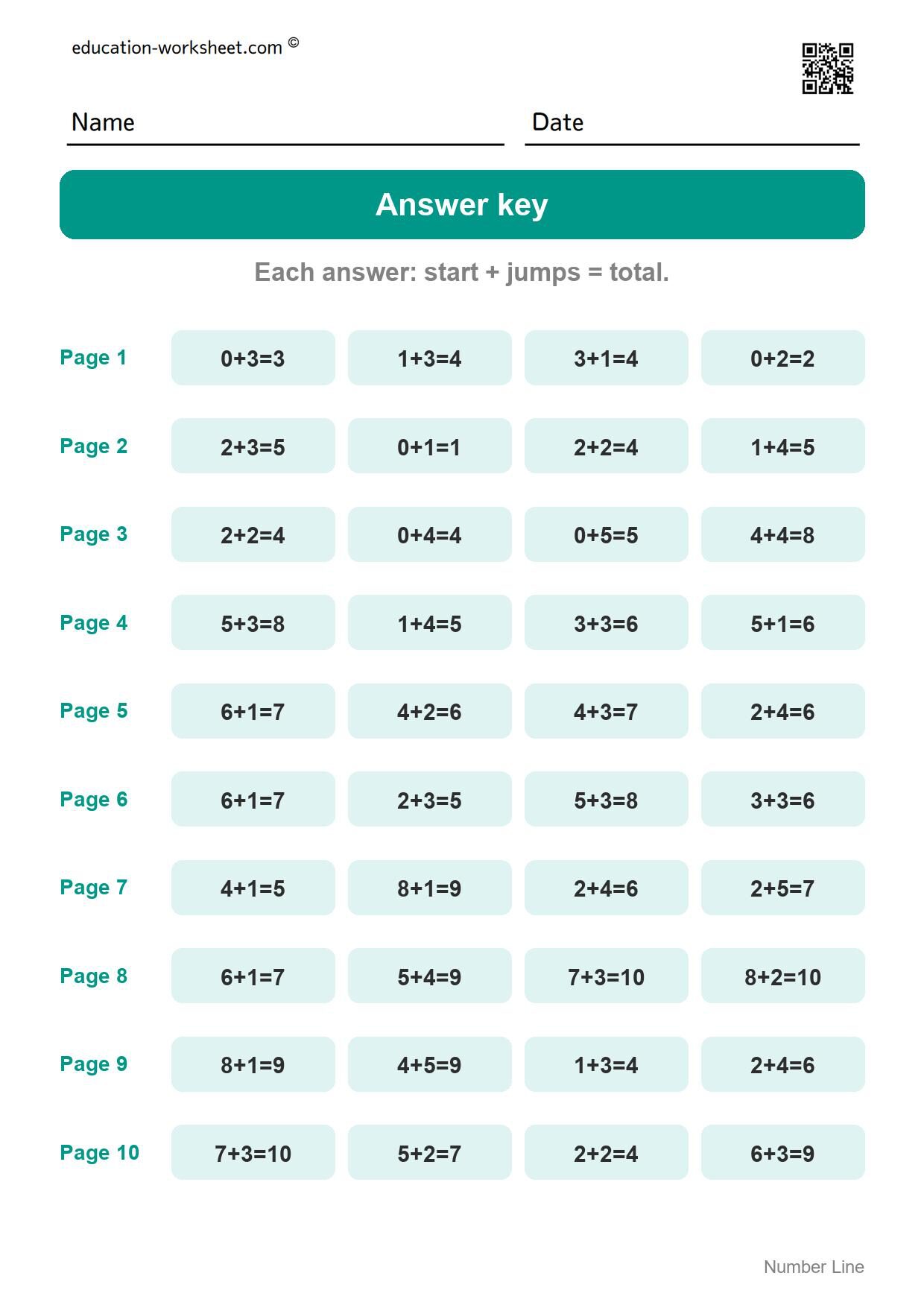
- Answer Key – All 40 Problems
- What the Jumps Are Doing
- When Children Are Ready for Number Line Addition
- How to Use These Worksheets
- Three Things to Watch For
- Printing Tips
- Frequently Asked Questions
- More Free Addition Worksheets
What Is in This Free Number Line Addition Worksheet Pack
- Ten printable worksheets with four problems on each page – forty problems in all.
- An eleventh page with the full answer key.
- Every number line runs 0 to 10, and no answer is ever more than 10.
- Between one and five jumps per problem, never more.
- Starting numbers from 0 to 8, and after page 3 never 0 again.
- A separate PDF for every page, free to download and print.
The 11 Number Line Addition Worksheets
The pack is graded, and the grading is in the starting numbers rather than in the answers. Pages 1 to 3 include problems that start at zero, where a child can count from the left-hand end of the line. From page 4 onwards, not one problem starts at zero. The child has to find a number in the middle of the line and count on from there, which is the harder and more useful skill.
Forty problems, twenty-seven of them different. Thirteen are repeats of a problem seen on an earlier page – 6+1, 2+2 and 2+4 each come round three times. The repeats are spaced pages apart, so they feel familiar rather than new, and that is where fluency comes from.
Worksheet 1 – Sums to 4, the Gentlest Start
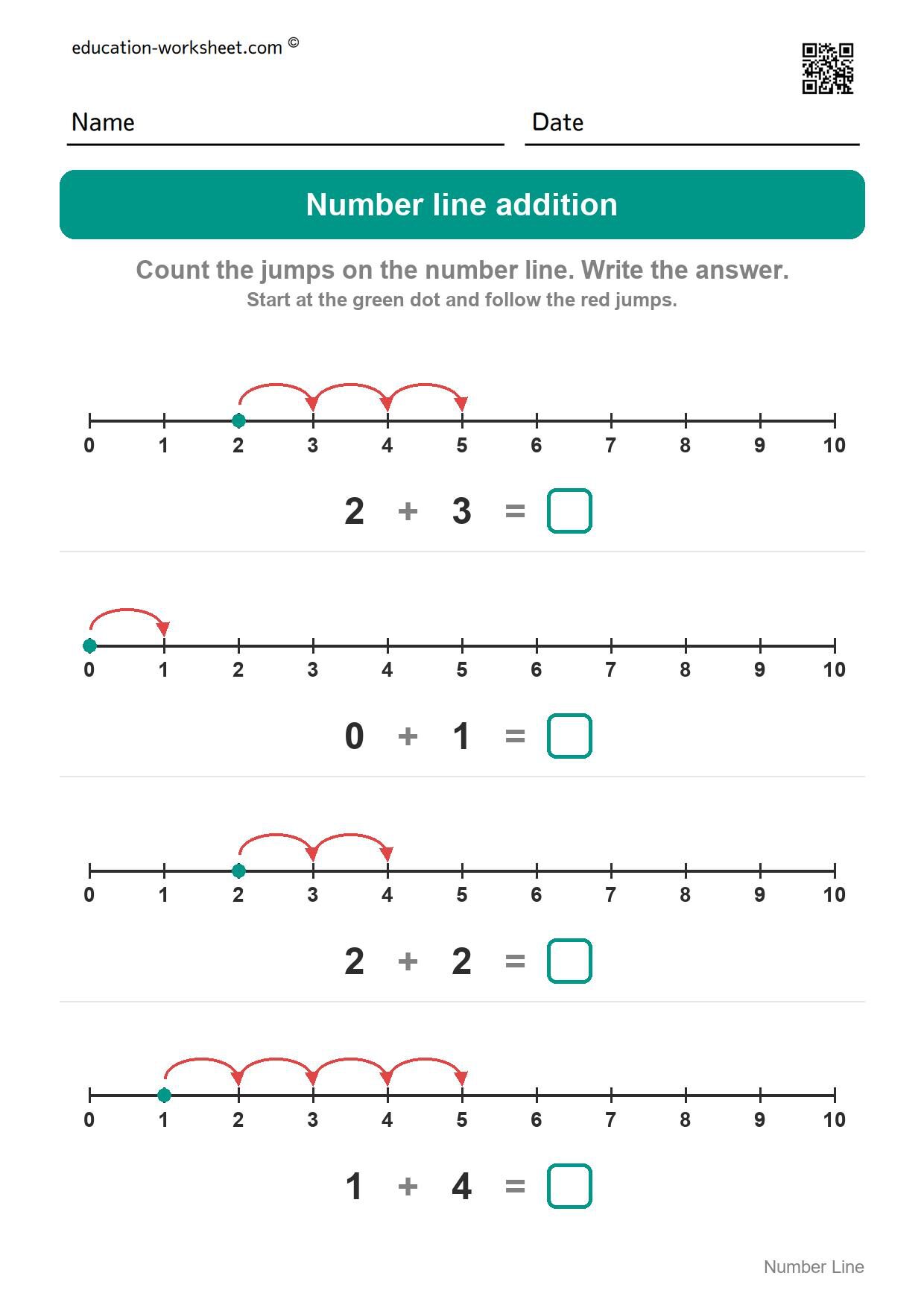
The four problems are 0+3, 1+3, 3+1 and 0+2. Two of them start at zero, so the green dot sits at the very left end of the line and the child can count from the beginning.
Look at rows two and three. They are 1+3 and 3+1. The answer is 4 both times, but the pictures look nothing alike: three long hops from 1, then one short hop from 3. That pair is worth stopping on, because it is the clearest picture of why 1+3 and 3+1 give the same total that a five-year-old will ever see.
Worksheet 2 – The Smallest Problem in the Pack
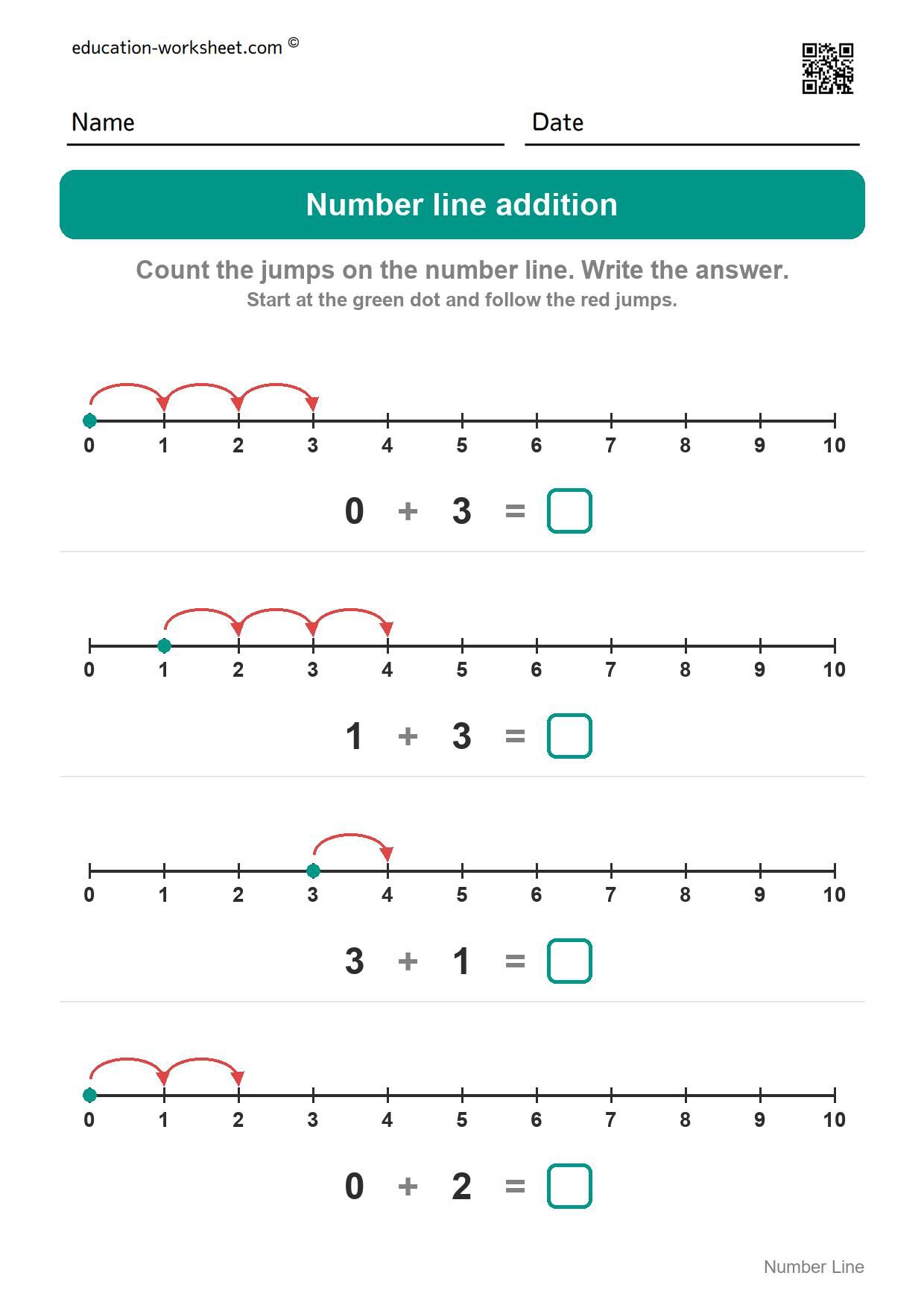
2+3, 0+1, 2+2 and 1+4. The second row is 0+1: one jump, from 0 to 1. It is the smallest problem in the whole pack, and it is there to show a child who is still unsure that one arc means one step.
2+2 is the first double. Doubles turn up six times across the ten pages, and children usually spot them before they spot anything else.
Worksheet 3 – The Last Page That Starts at Zero
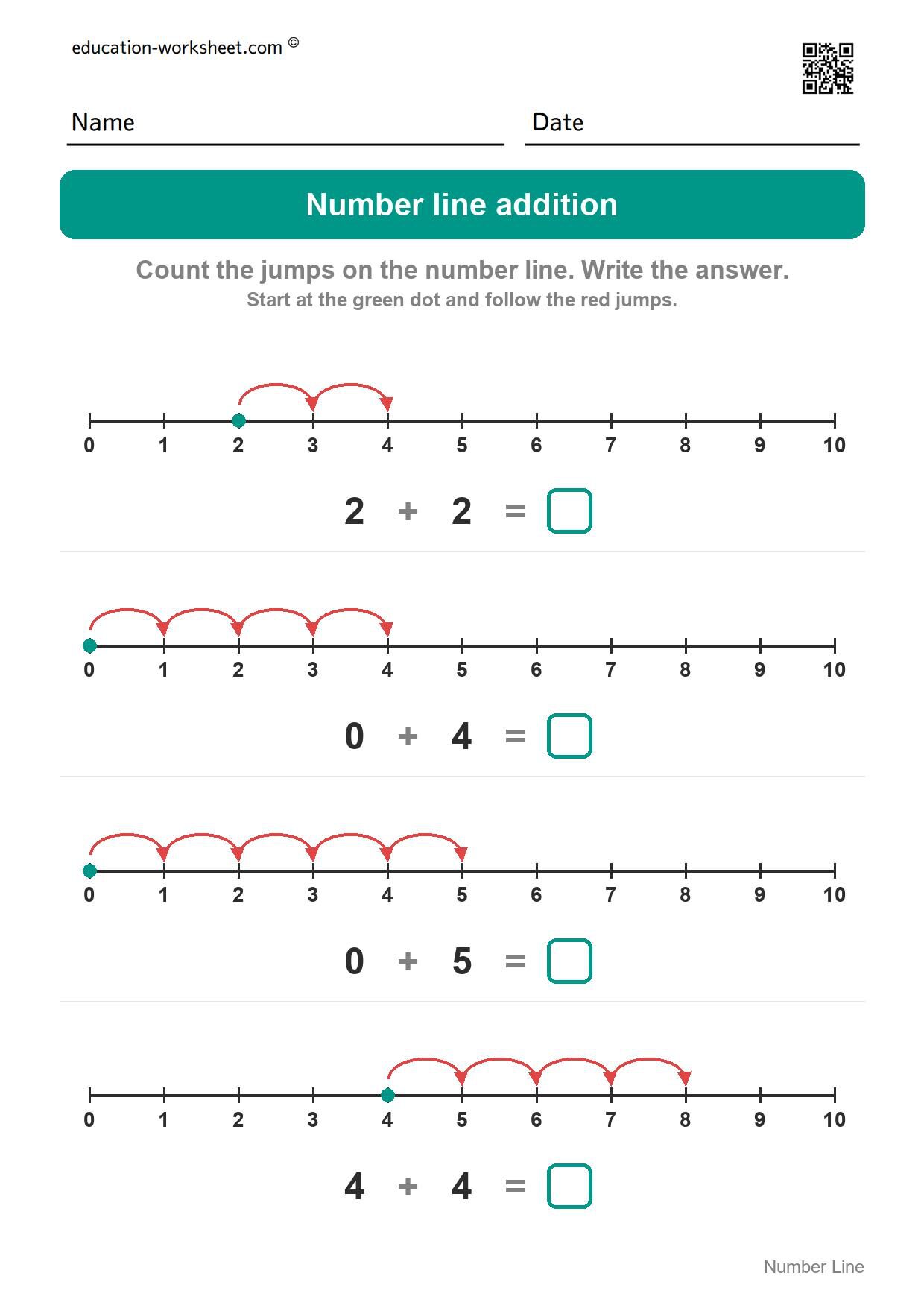
2+2, 0+4, 0+5 and 4+4. This is the third and last page on which any problem begins at zero. From page 4 onwards every green dot sits somewhere in the middle of the line.
0+5 is one of only three problems in the pack with five jumps, the longest run of arcs anywhere. The answers on this page rise 4, 4, 5, 8, which makes it one of just two pages where the answers happen to climb in order.
Worksheet 4 – Every Answer Is 5 or More
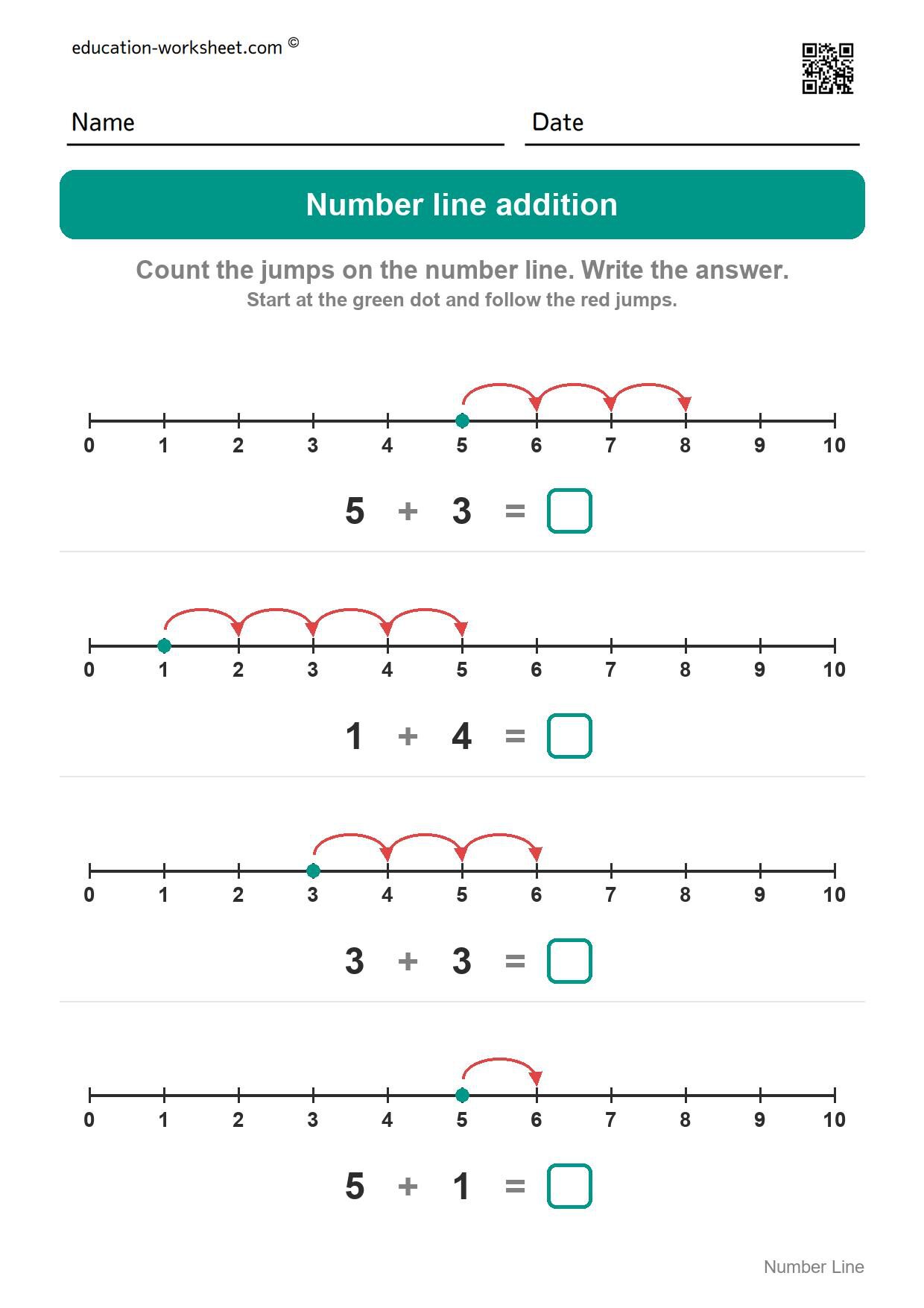
5+3, 1+4, 3+3 and 5+1. Two problems start at 5, the halfway point of the line and the place where most children slow down.
From here to page 8, every answer on every page is 5 or more. That is the real step up in this pack, and it happens quietly between pages 3 and 4.
Worksheet 5 – The Same Answer Twice, Two Different Ways
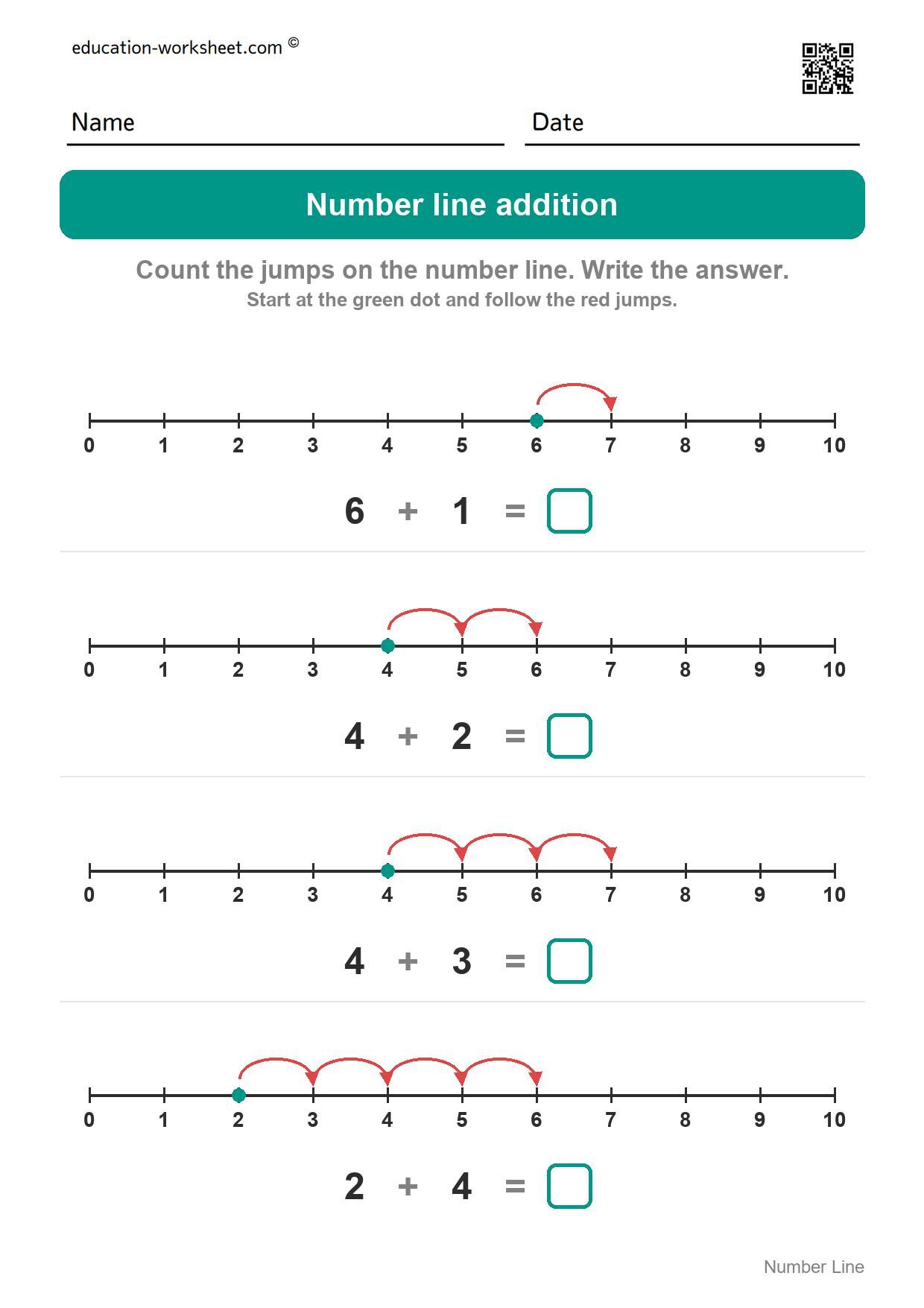
6+1, 4+2, 4+3 and 2+4. The answers are 7, 6, 7 and 6. Two sixes and two sevens on one page means a child cannot guess by looking for a number that has not been used yet.
Rows two and four are 4+2 and 2+4, the second commutative pair in the pack after page 1. Ask which one was quicker to count. Starting at 4 and jumping twice is quicker than starting at 2 and jumping four times, and noticing that is the beginning of choosing the larger number to count on from.
Worksheet 6 – Mixed Starts, Mixed Jumps
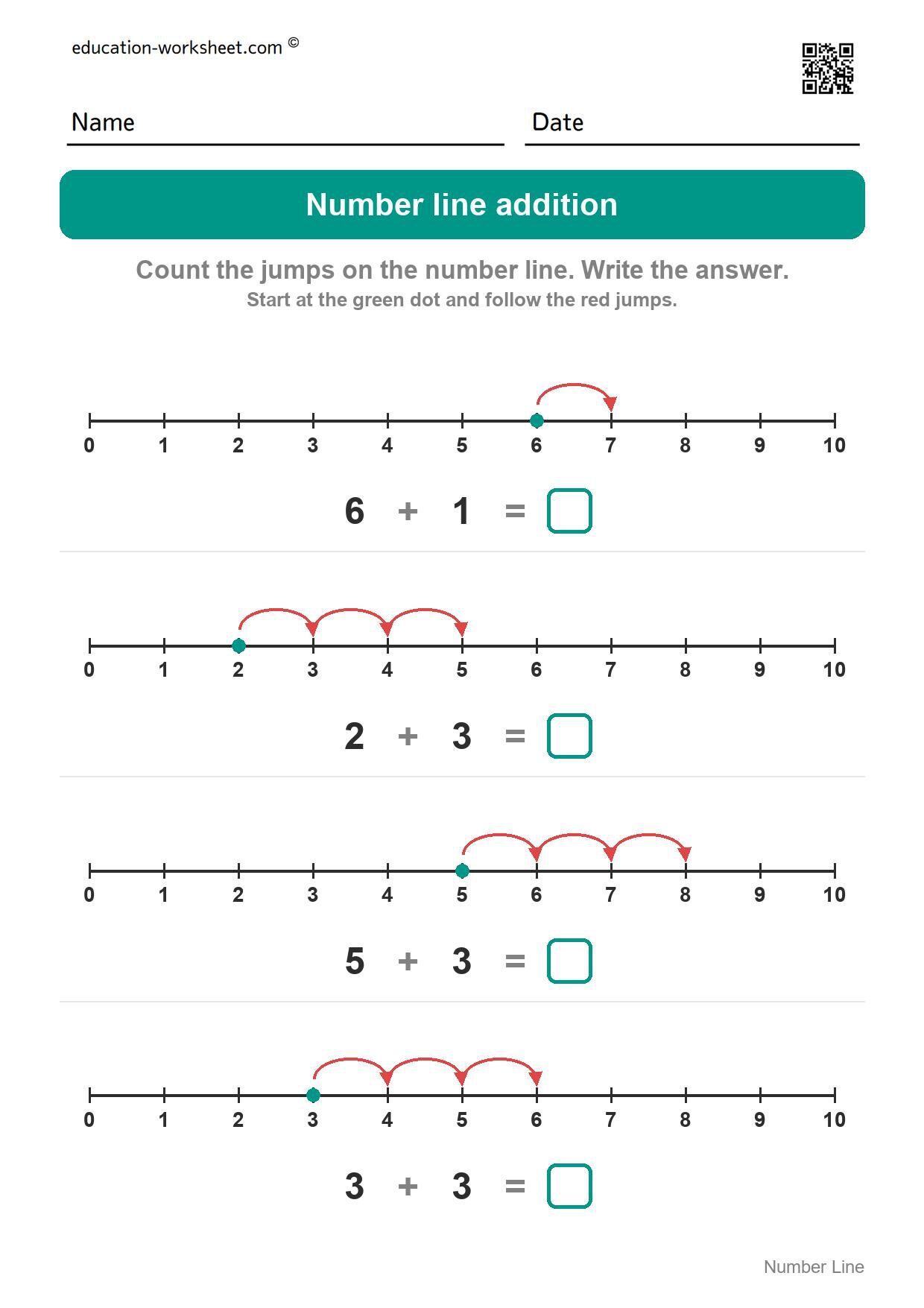
6+1, 2+3, 5+3 and 3+3. Three of the four problems have three jumps, which makes this a good page for a child who has started counting the arcs reliably and now needs the practice to become automatic.
3+3 is the second appearance of that double; it was also on page 4.
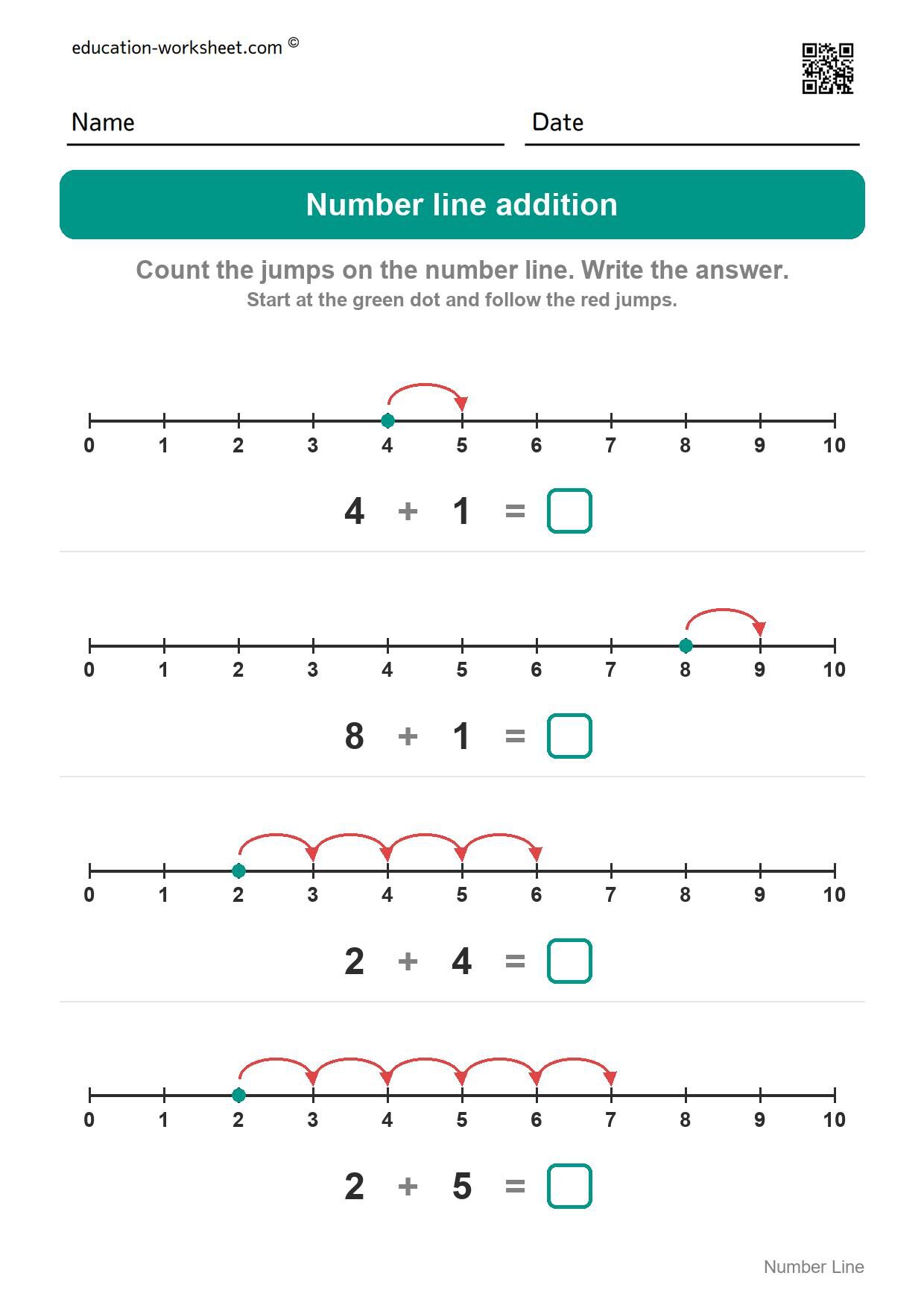
Worksheet 7 – A Five-Jump Problem
4+1, 8+1, 2+4 and 2+5. The last row is 2+5, one of the three five-jump problems. Long runs of arcs are where miscounting starts, so this is the page to slow down on and touch each arrow.
8+1 is the opposite: the start is high and one jump finishes it. Put those two problems side by side and a child can see that it is the number of jumps, not the size of the starting number, that decides how much work there is.
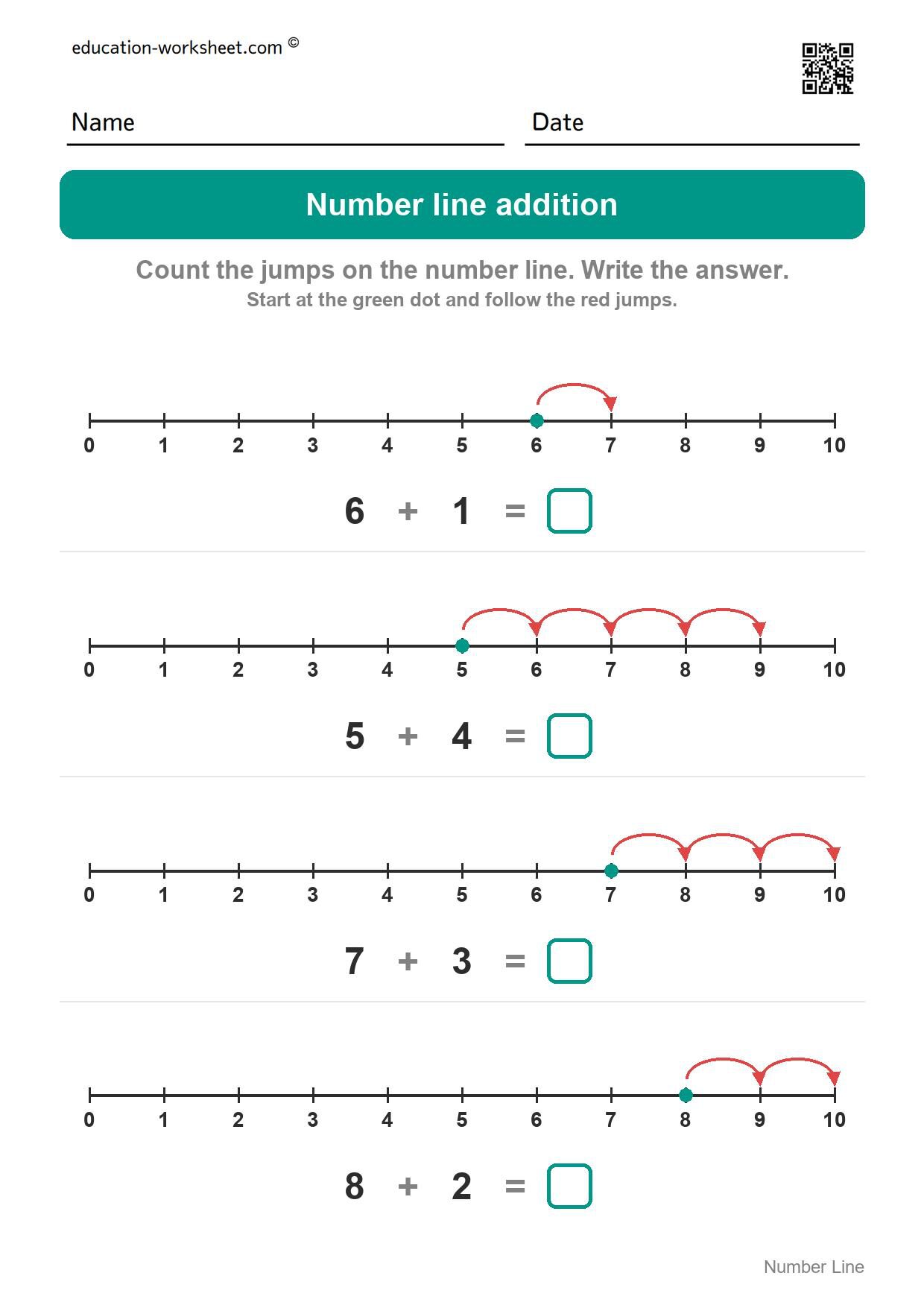
Worksheet 8 – Reaching 10
6+1, 5+4, 7+3 and 8+2. Two problems land exactly on 10, and every answer on the page is 7 or more. By the numbers, this is the hardest page in the pack.
7+3 and 8+2 are both ways of making ten, and the last arrow stops at the end of the line. Children who are working on number bonds to 10 will recognize them.
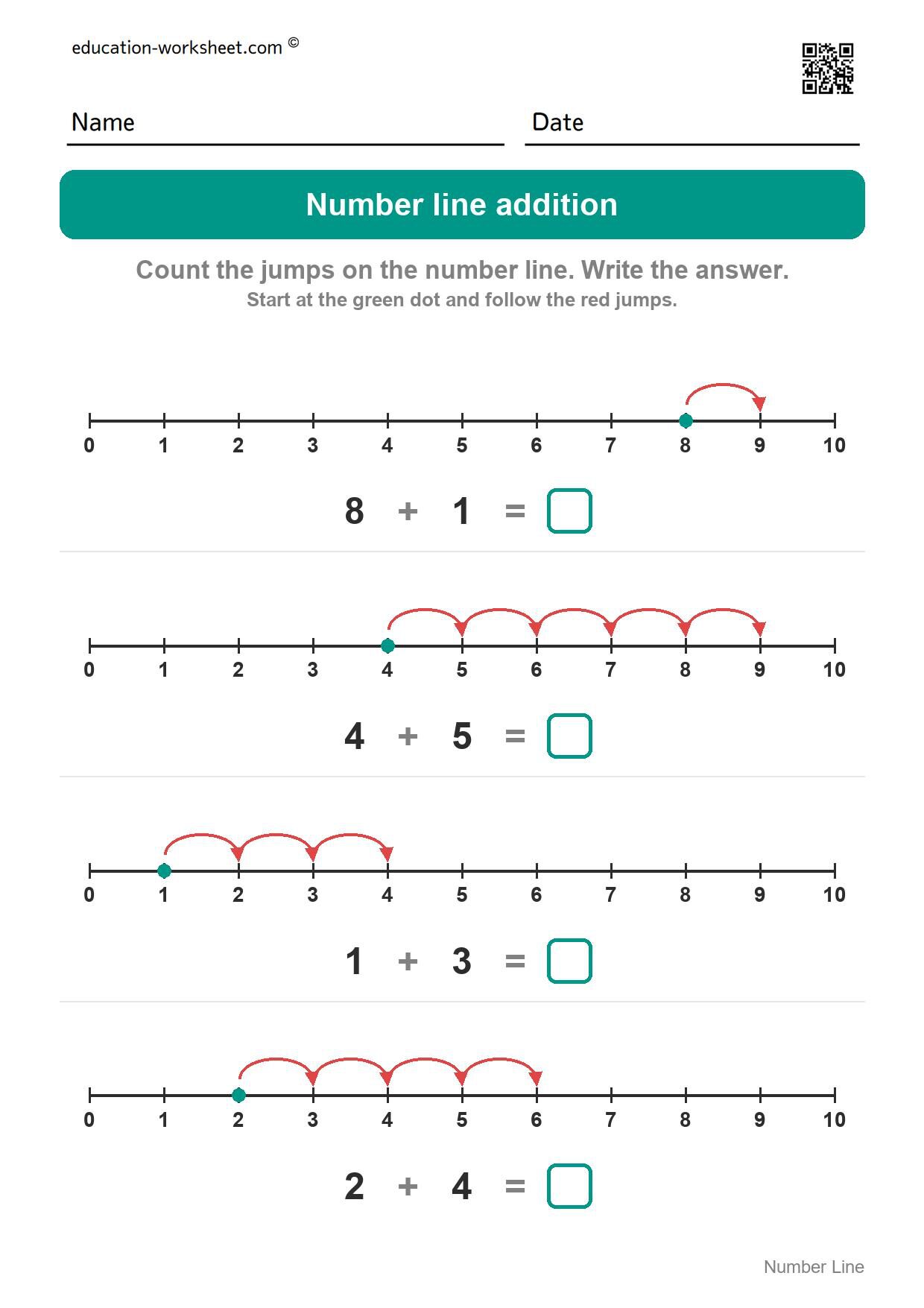
Worksheet 9 – Starting High
8+1, 4+5, 1+3 and 2+4. The page opens at 8, the highest starting number in the pack, and 4+5 is the third and last of the five-jump problems.
Then it drops back to 1+3 and 2+4. That fall in difficulty inside a single page is useful: it gives a child who has just worked hard two problems they can finish quickly.
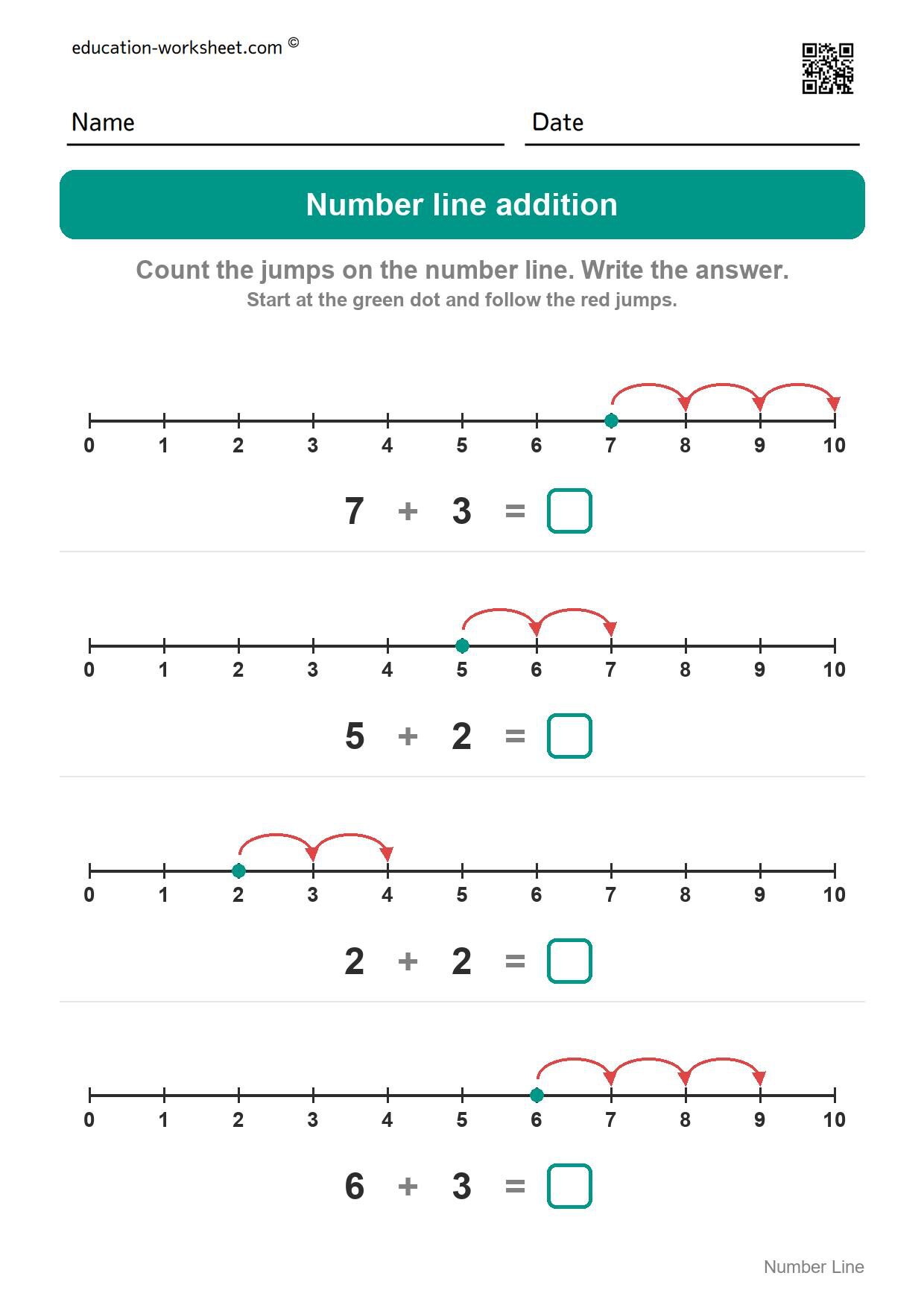
Worksheet 10 – Everything Together
7+3, 5+2, 2+2 and 6+3. A high start, a middle start, a double and a three-jump problem: the four kinds of question the pack has been building toward, on one sheet.
The answers are 10, 7, 4 and 9, in no particular order, which is how every page except pages 3 and 8 is arranged.
Answer Key – All 40 Problems
The last sheet lists all forty problems, four to a row, page by page, written out as start plus jumps equals total.
You will rarely need it. The last red arrowhead points straight at the answer on the line itself, so a child who has followed the jumps correctly can check their own work without asking anyone.
What the Jumps Are Doing
Counting on is the skill this pack is built around. A child who solves 6+1 by saying “one, two, three, four, five, six, seven” is counting all of it. A child who touches the 6 and says “seven” is counting on, and that is the step the number line makes visible.
The number of jumps is deliberately kept small. Thirteen of the forty problems have three jumps, nine have one, eight have four, seven have two, and only three have five. Nothing in the pack asks a child to count more than five arcs in a row, because past five the counting itself becomes the hard part and the addition disappears behind it.
The pack also plants two commutative pairs where a child can find them. Page 1 has 1+3 and 3+1; page 5 has 4+2 and 2+4. The answer is the same and the two pictures look completely different. Nothing on the sheet points this out, so if you want the child to notice it, you have to ask.
One more detail worth knowing: the answers within a page are almost never in order. Only pages 3 and 8 happen to climb. On every other page, a child who tries to guess the pattern instead of counting the jumps will get it wrong.
When Children Are Ready for Number Line Addition
- Age: about five to seven – the end of kindergarten and the start of first grade.
- Before starting: the child should be able to count to ten and recognize the written numerals.
- K.OA.A.1 – represent addition with objects, fingers, drawings, sounds or equations.
- K.OA.A.2 – solve addition problems and add within 10.
- 1.OA.C.5 – relate counting to addition, for example by counting on 2 to add 2. This is the standard the pack is really aimed at.
- Drawing and labeling number line diagrams in their own right comes later, in 2.MD.B.6.
How to Use These Worksheets
- Print page 1 and do the first row together. Put a finger on the green dot and say that number out loud before counting anything.
- Count the arcs, not the ticks. Touch each red arc and say “one, two, three”, then read the number under where the last arrow lands.
- Read the whole number sentence aloud once the box is filled in: “zero plus three equals three.”
- Work through the pages in order. The jump from page 3 to page 4 is where starting at zero stops, so expect that page to take longer.
- Check with page 11 only if you need to. The line itself already shows the answer.
- When the pack is finished, hand back page 1 with the arcs covered and ask the child to draw the jumps. Drawing them is harder than reading them.
Three Things to Watch For
1. Counting the starting number as the first jump. This is the classic error, and it gives an answer one too small: the child touches the 6, says “one”, and lands on 6 for 6+1. The fix is a habit – say the starting number first, then count only the arrows.
2. Counting the tick marks instead of the arcs. On the longer problems the ticks and the arcs are easy to confuse. Ask the child to put a fingertip on each arrow, not on the line.
3. Expecting the line to start where the question starts. After page 3 nothing begins at 0, and a child who has learned “start at the far left” will count from the wrong place. Before each row, ask where the green dot is.
Printing Tips
- Print at 100 percent, actual size, on A4 or US Letter. Do not use fit-to-page – the tick marks are evenly spaced and scaling can pull them out of line.
- Black and white printing works, but the green dot and the red arcs are much easier to follow in color.
- Print a second copy of any page you want the child to try again later; they will remember the answers from the first attempt.
Frequently Asked Questions
What age are these number line addition worksheets for?
About five to seven years old. They suit the second half of kindergarten and the first months of first grade, and they are useful for older children who are still counting all instead of counting on.
Is there an answer key?
Yes, page 11 lists all forty problems with their answers. The number line also shows the answer where the last red arrow lands, so most children can check their own work.
How many jumps do the problems have?
Between one and five. Three jumps is the most common, and only three problems in the whole pack ask for five.
Do the pages get harder?
Yes. Pages 1 to 3 include problems that start at zero; from page 4 onwards none do, and pages 8 and 10 reach 10. Work through them in order.
Can I use these for subtraction?
Not as printed. Every arc in this pack jumps to the right, which is addition. Subtraction on a number line means jumping back, which is a different sheet.
Do I need to sign up to download these?
No. Every PDF downloads immediately, with no account, no email address and no cost.
Can I use these in my classroom?
Yes, they are free to print for home and classroom use. Please do not sell them or re-host the files elsewhere.
More Free Addition Worksheets
- Free Addition Worksheets for Kindergarten – Add Up to 10
- Free Number Bonds Worksheets for Kindergarten – Numbers to 10
- Free Doubles Worksheets for Kindergarten – Doubles Addition Facts to 20
- Free Near Doubles Worksheets for Kindergarten – Doubles Plus One
- Free Missing Addend Worksheets for Kindergarten – Sums to 20
- Free Addition to 20 Worksheets for Grade 1 – Make Ten