These free printable where questions worksheets give children a gentle, step-by-step way to practice one of the first WH questions they meet. With pictures of 13 rooms and places, the child moves from circling a room at home to finding places in town, matching, telling what people do in each place, naming a place from a description, solving small problems and answering where questions about a short story.
A speech-language-hearing therapist designed this pack. “Where” questions come up all day long: Where are your shoes? Where are we going? Where did you play today? To answer them, a child has to know that the word asks for a place, know the names of places, and link each place with what happens there. These pages break that down into small, clear steps. Think of them as practice: there are no scores, and nothing here can say whether a child’s language is on track.
Most of the pack is about knowing places: which room has the stove, where a family goes to borrow books, where to wait for the bus. The last pages ask the child to use that knowledge, first to solve a small problem and then to follow a story, which is closer to how where questions are asked in real conversation.
- What Is in This Free Where Questions Pack
- The 12 Where Questions Worksheets
- Start Here – The Steps and Tips for Adults
- Page 1 – Which Room?
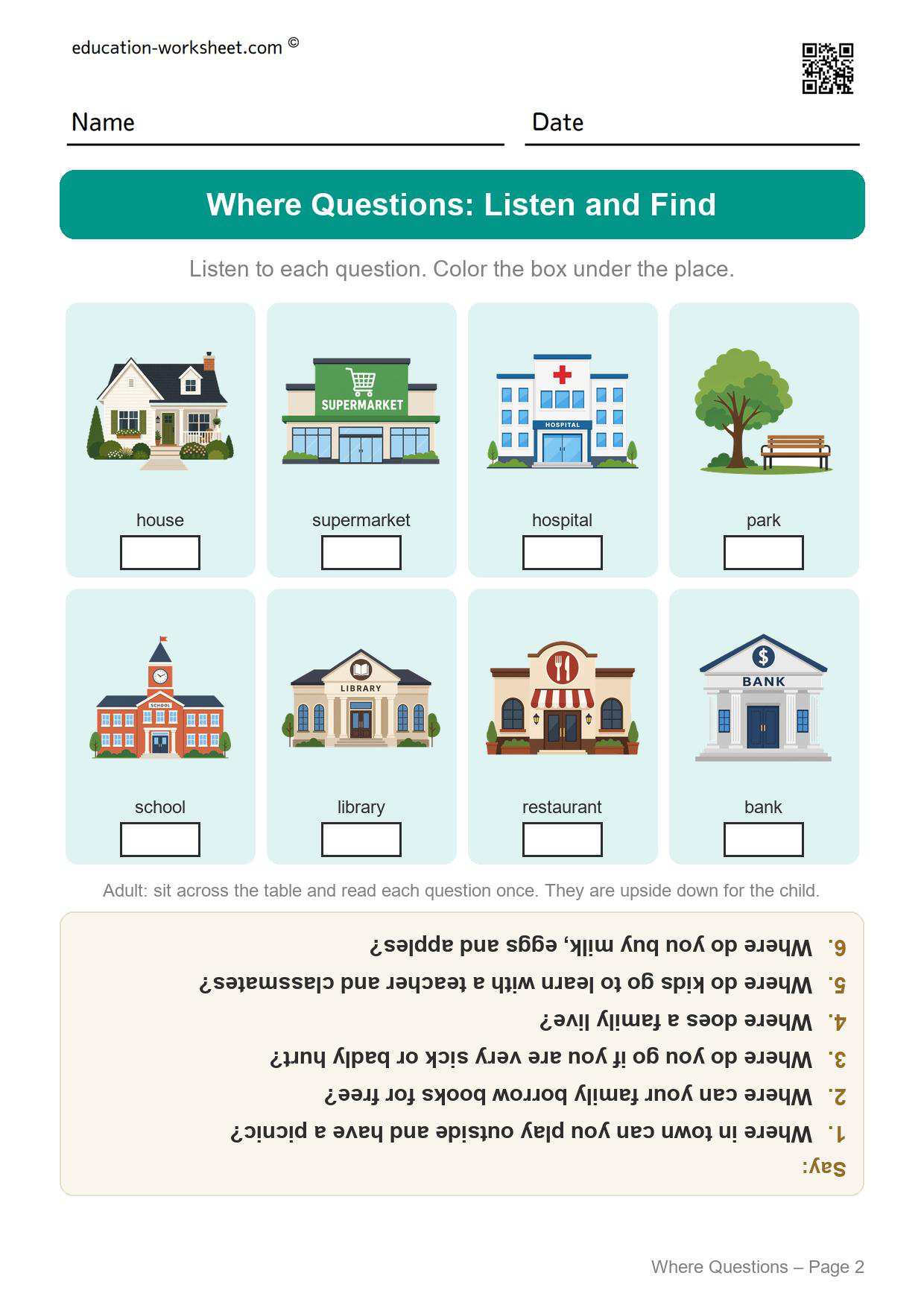
- Page 2 – Listen and Find: Places in Town
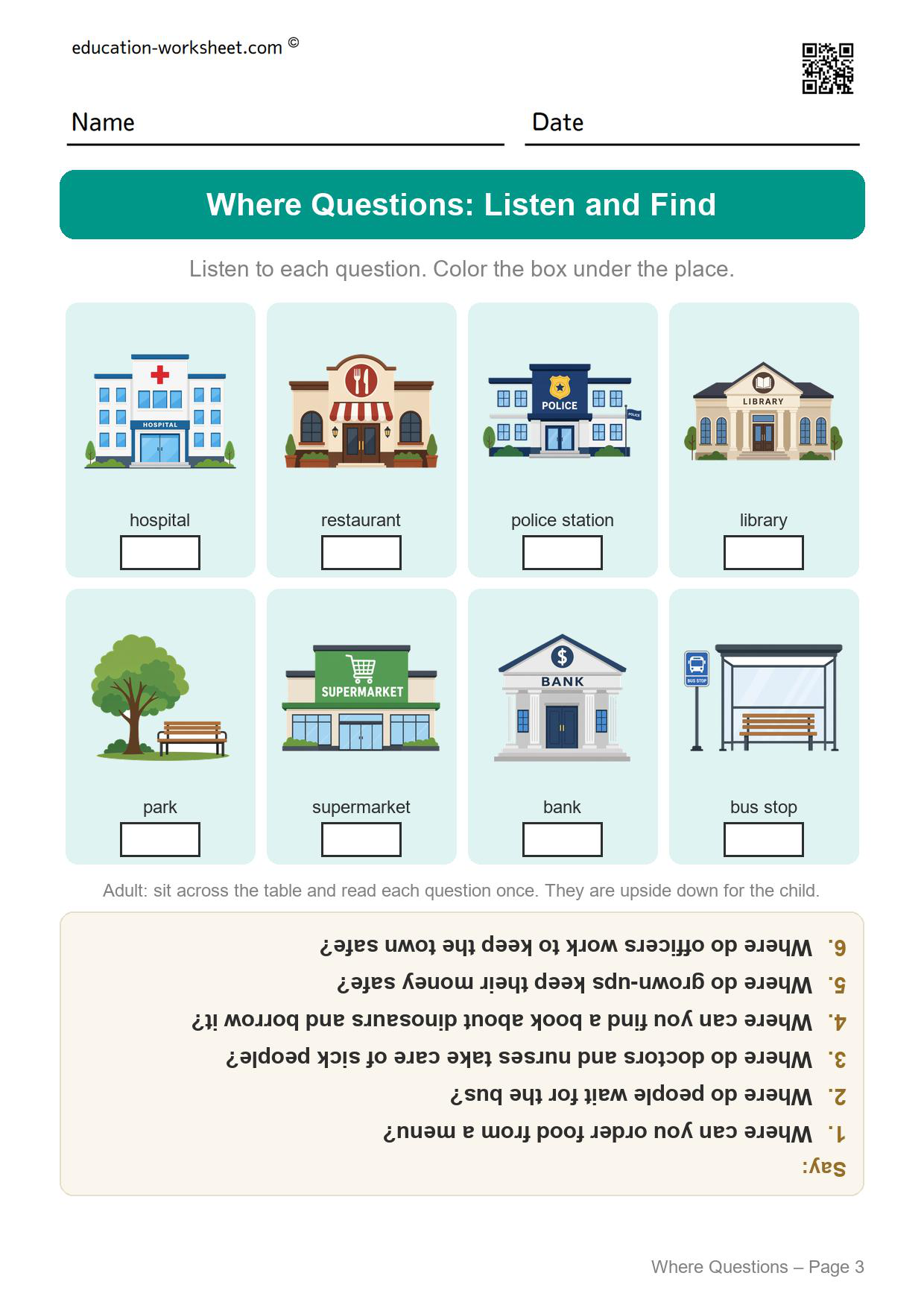
- Page 3 – Listen and Find: More Places
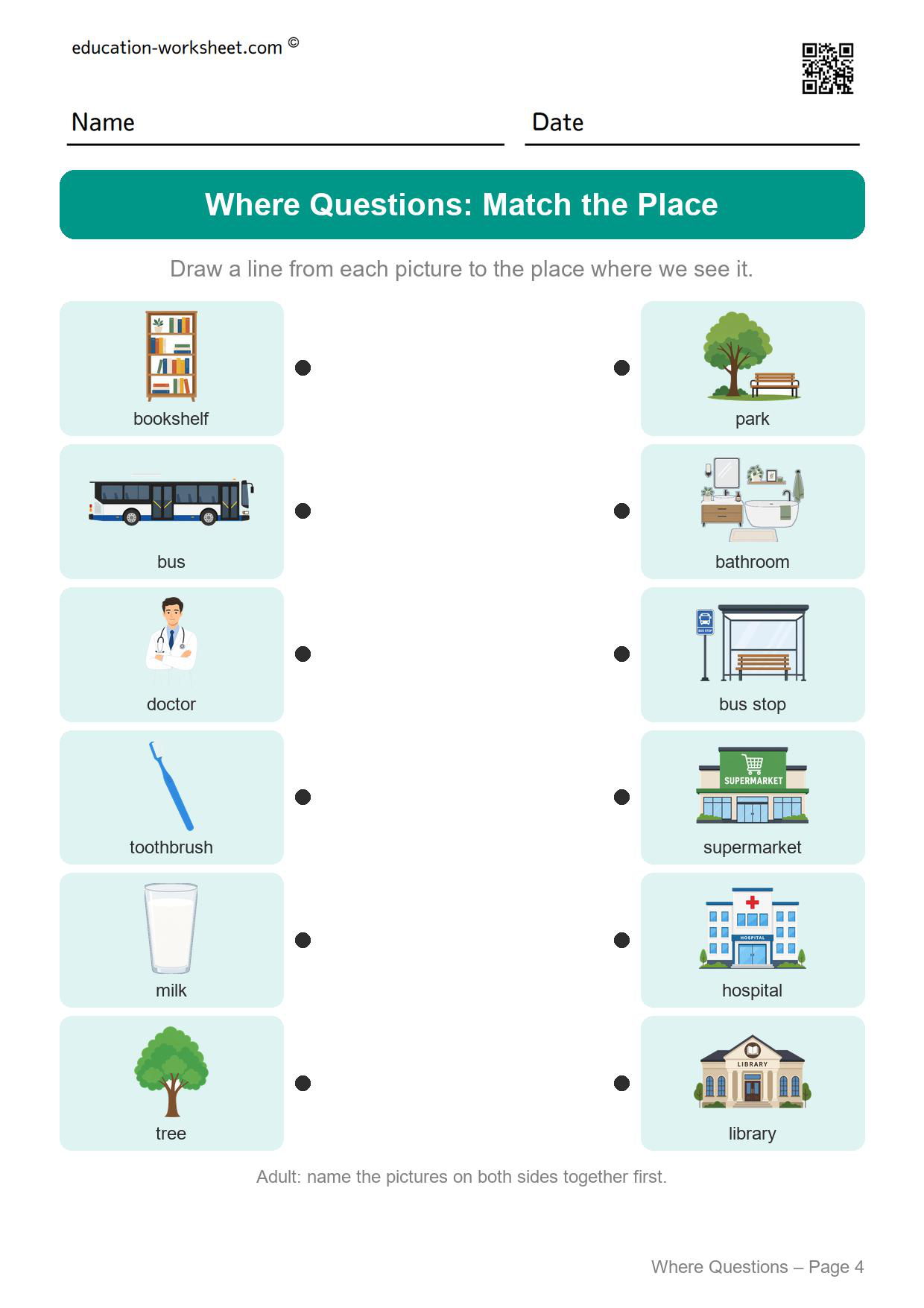
- Page 4 – Match the Place: Things You See There
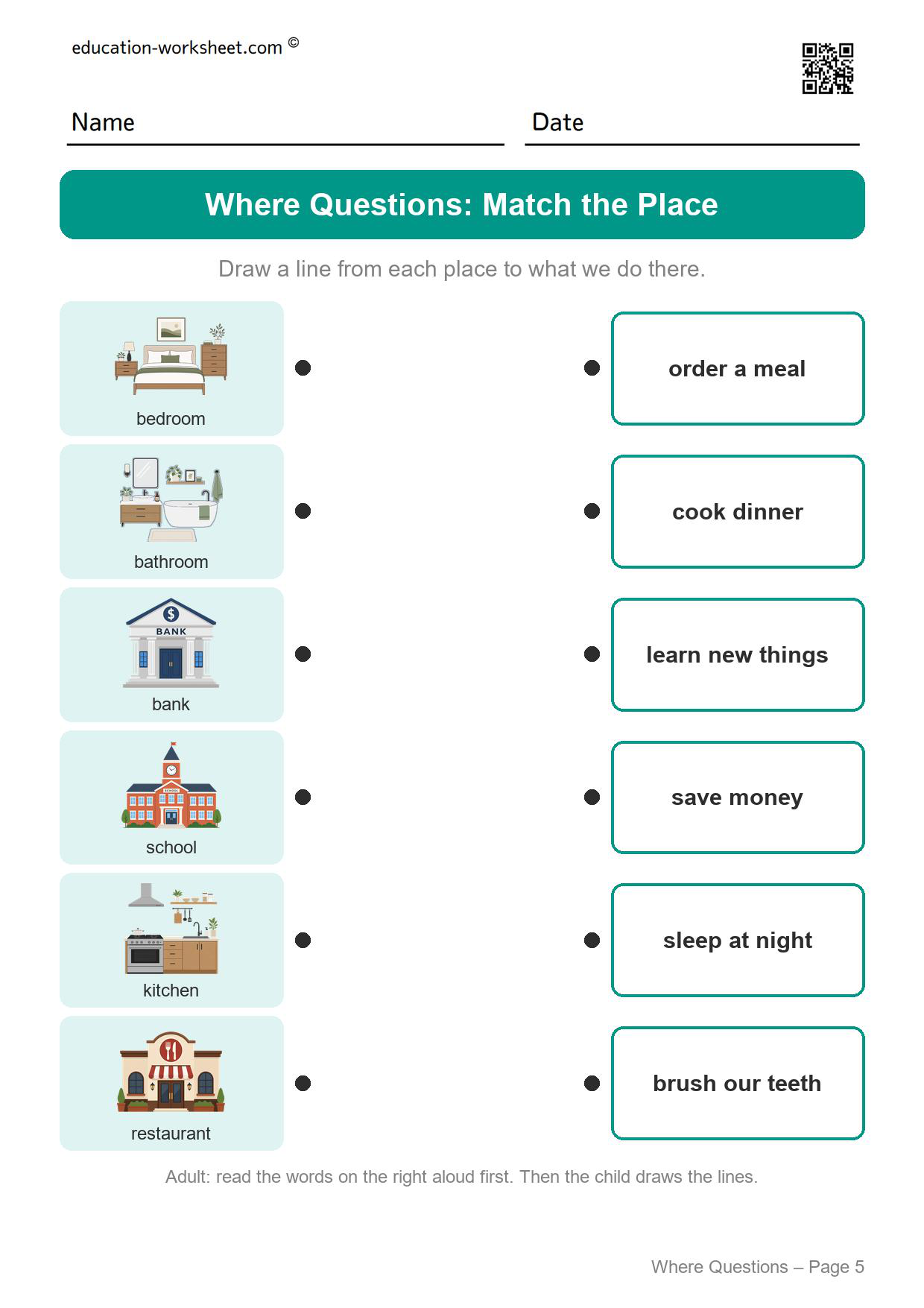
- Page 5 – Match the Place: What We Do There
- Page 6 – Tell What We Do: Finish the Sentence
- Page 7 – Tell What We Do: Answer the Question
- Page 8 – Name the Place
- Page 9 – Name and Draw
- Page 10 – Solve It: Where Should You Go?
- Page 11 – Story Time
- Page 12 – Where Did We Go?
- Answer Key
- How the Questions Were Checked
- Why Where Questions Come Early
- When a Child Answers With the Wrong Kind of Word
- Who These Worksheets Are For
- How to Use These Worksheets
- Ideas for Car Rides and Walks
- Three Things to Watch For
- Printing Tips
- Frequently Asked Questions
- What age are these where questions worksheets for?
- My child answered with a place that is not in the answer key. Is it wrong?
- Why are some of the questions so long?
- Why are some words printed upside down?
- Can this pack show whether my child has a language delay?
- Do I need an account or email address to download?
- Can I use these in a classroom or therapy room?
- More Free Listening and Language Worksheets
What Is in This Free Where Questions Pack
- Twelve practice pages, a guide page for the adult and an answer key.
- Pictures of 13 places: three rooms at home, a house, and nine places in a town, from the library and the park to the bank and the bus stop.
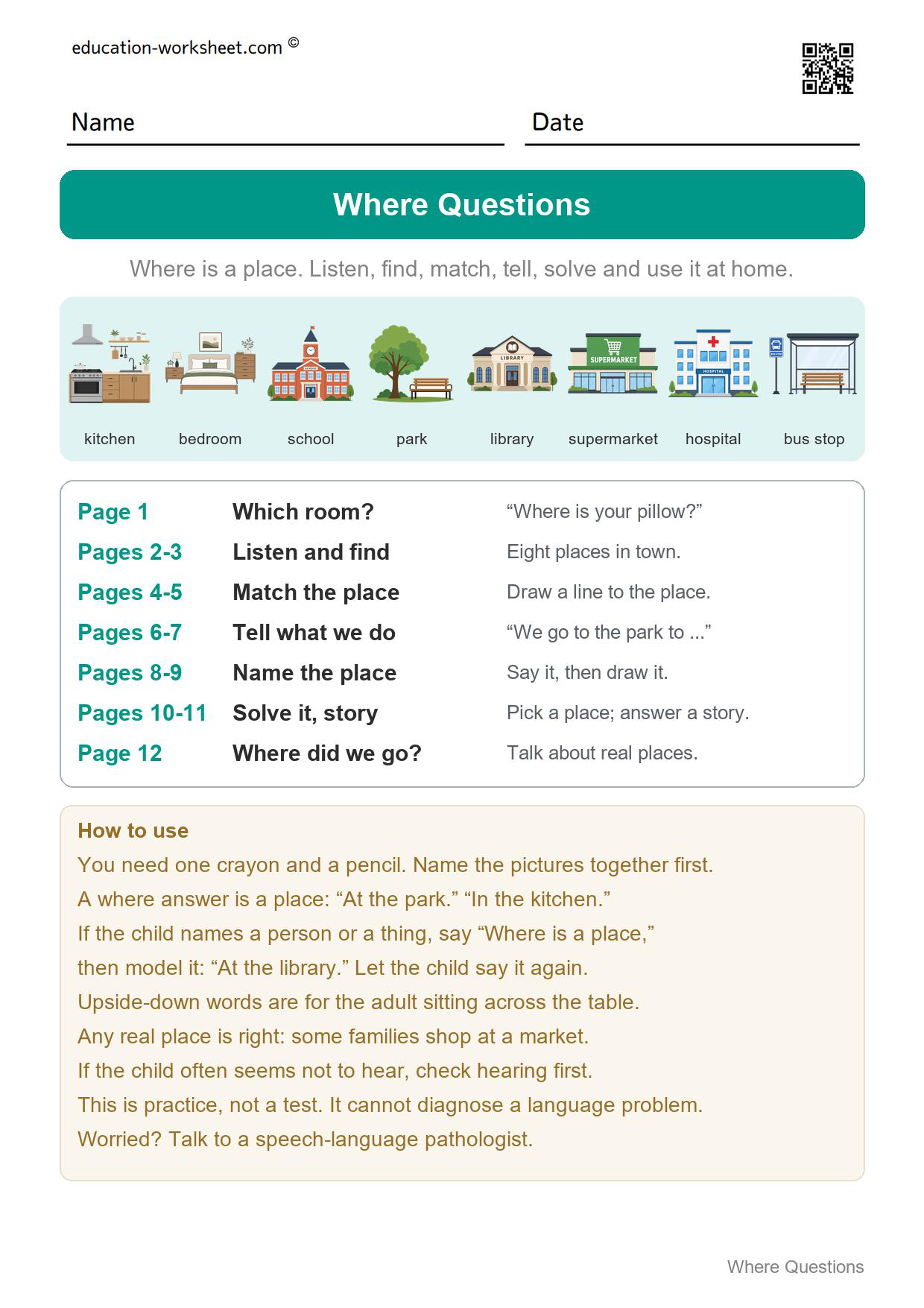
- Seven steps: which room (page 1), listen and find (pages 2 and 3), match the place (pages 4 and 5), tell what we do (pages 6 and 7), name the place (pages 8 and 9), solve it and story time (pages 10 and 11) and where did we go (page 12).
- Questions and example answers printed upside down, for the adult reading from across the table.
- A crayon for the coloring and circling pages and a pencil for the drawing page.
- Each page as its own free PDF, ready to print.
The 12 Where Questions Worksheets
The places were chosen because most young children in the United States know them from everyday life. Places that look very different from one country to another, such as a post office or a train station, were left out, and nothing on a page asks the child to know a brand or a shop name.
Start Here – The Steps and Tips for Adults
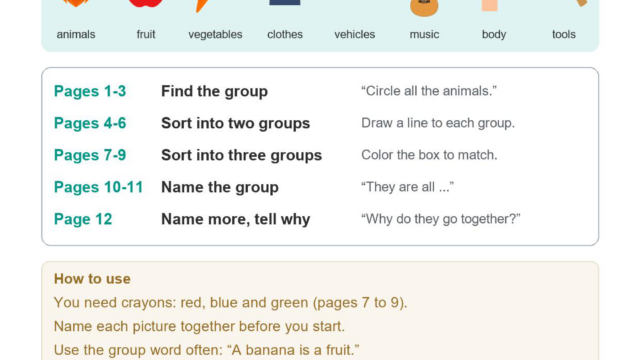
The guide page lists the steps of the pack with a short example of each and gives the adult a few rules of thumb. The one to remember is the second line: a where answer is a place, such as “At the park” or “In the kitchen.”
Page 1 – Which Room?
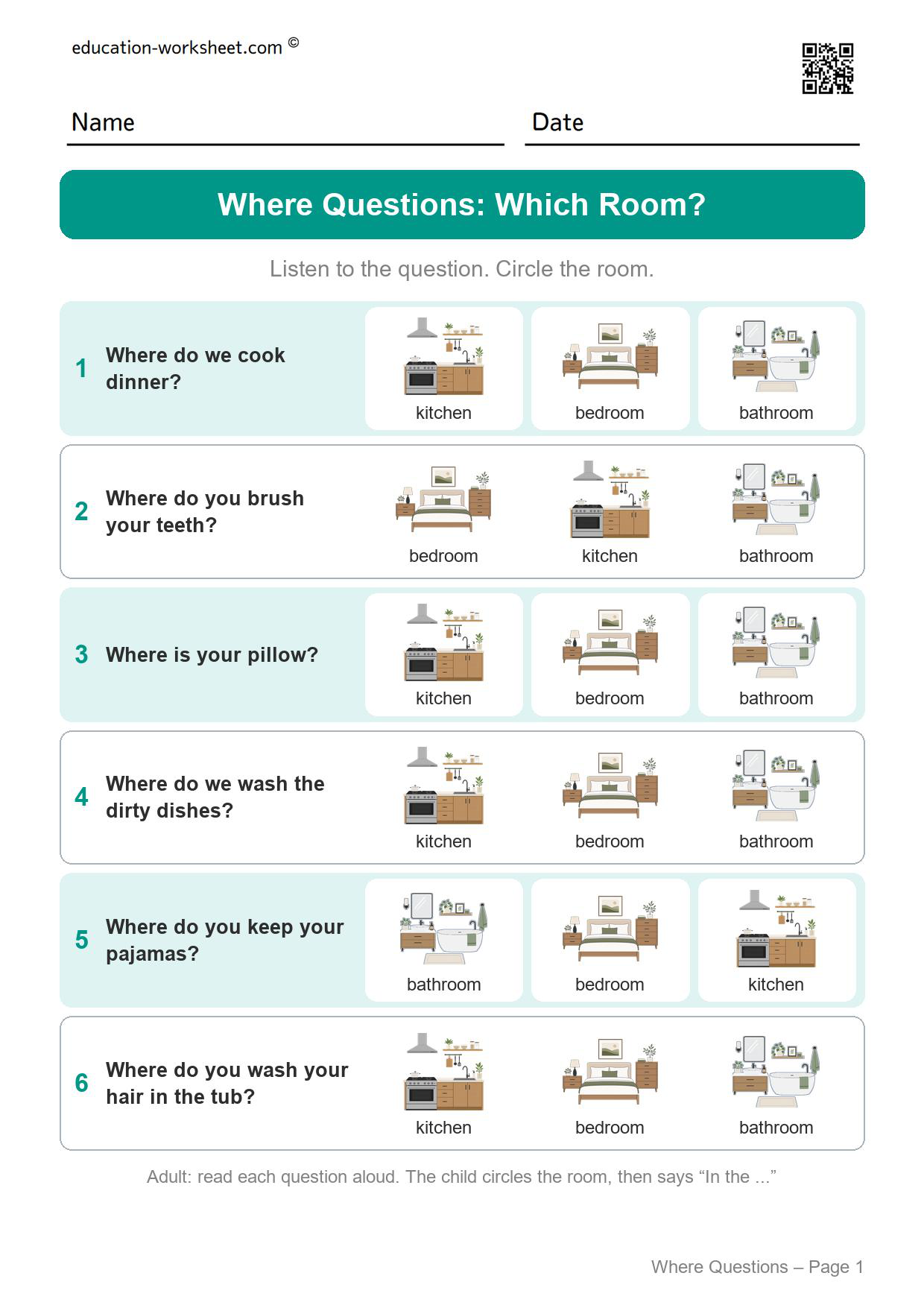
The pack starts at home, with only three choices in every row: the kitchen, the bedroom and the bathroom. You read six questions, from “Where do we cook dinner?” to “Where do you wash your hair in the tub?”, and the child circles a room. Each room is the answer twice, and the right picture moves between the left, middle and right place, so a child who always circles the same spot will not get far.
Rooms at home make a gentle start because the child has been in every one of them that very day. Encourage a short spoken answer as well as the circle: “In the bedroom.”
Page 2 – Listen and Find: Places in Town
Now there are eight pictures on the page and the child colors the small box below the right place. The six questions lead to the park, the library, the hospital, the house, the school and the supermarket. The restaurant and the bank are never asked about, so the last answer cannot be worked out just by crossing off the others.
Page 3 – Listen and Find: More Places
A second listening page with new questions and two new places, the police station and the bus stop. The answers are the restaurant, bus stop, hospital, library, bank and police station, while the park and the supermarket are the extra pictures this time. The hospital and the library come back with new wording, “Where do doctors and nurses take care of sick people?” instead of the page 2 question, so the child has to think about the place rather than remember a sentence.
Page 4 – Match the Place: Things You See There
A bookshelf, a bus, a doctor, a toothbrush, a glass of milk and a tree on the left; six places on the right. The child draws a line from each picture to the place where we would see it: the library, the bus stop, the hospital, the bathroom, the supermarket and the park. Talk about each line as it is drawn, “Where do we see a doctor? At the hospital.”
Page 5 – Match the Place: What We Do There
This time the right side is made of short phrases for the adult to read aloud: sleep at night, brush our teeth, save money, learn new things, cook dinner and order a meal. They match the bedroom, the bathroom, the bank, the school, the kitchen and the restaurant. No phrase sits straight across from its place, so every line has to be thought about.
Page 6 – Tell What We Do: Finish the Sentence
Now the child does the talking. You read “We go to the library to …” and the child finishes the sentence. The six places are the library, the park, the supermarket, the hospital, the bus stop and the police station. An example ending, such as “borrow books,” is printed upside down for the adult.
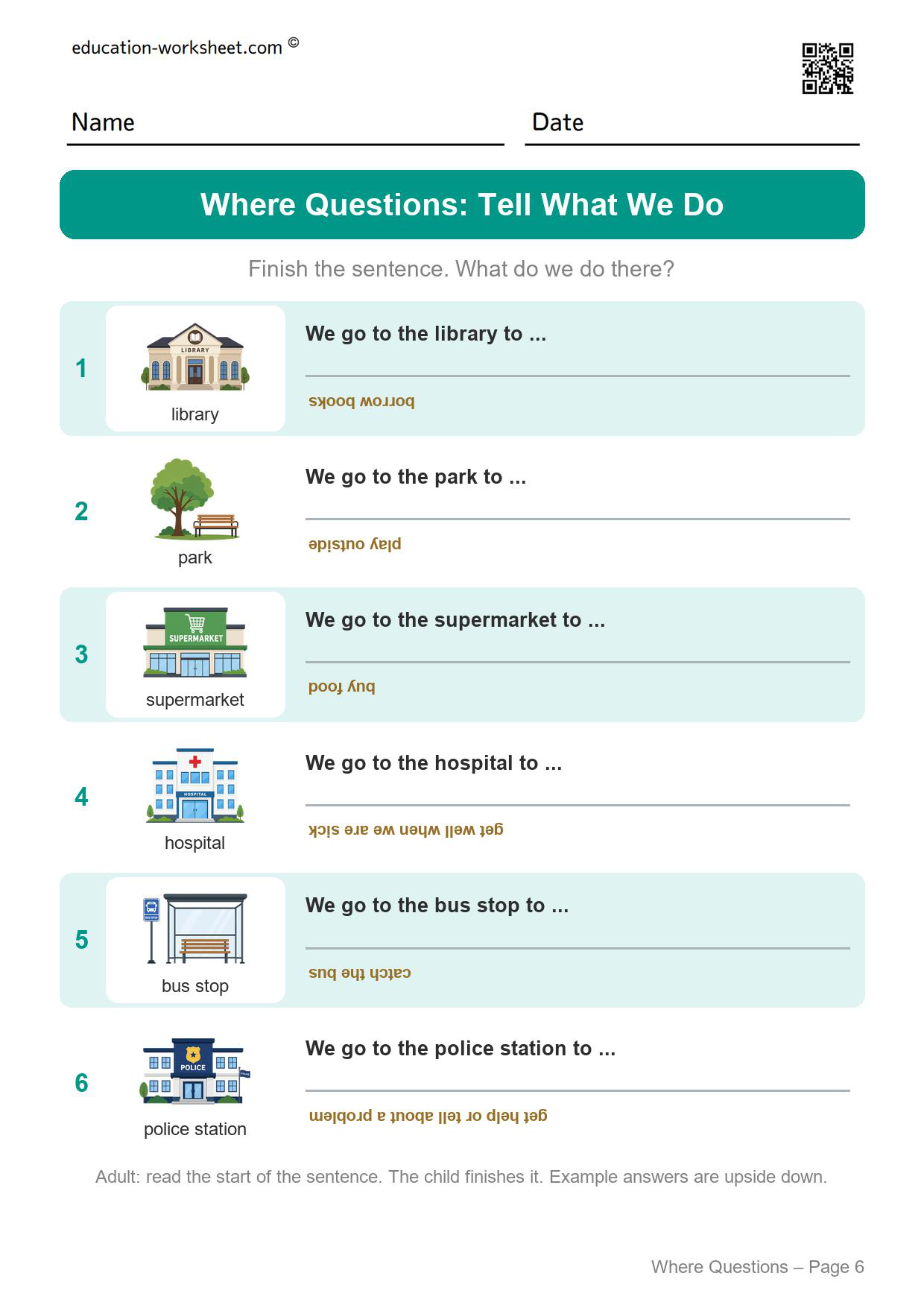
Page 7 – Tell What We Do: Answer the Question
The same idea without the sentence starter: “What do people do at school?” The places are the school, a restaurant, the bathroom, the kitchen, the bedroom and a house. Most of them have many right answers, so write down whatever the child says and add one more idea of your own.
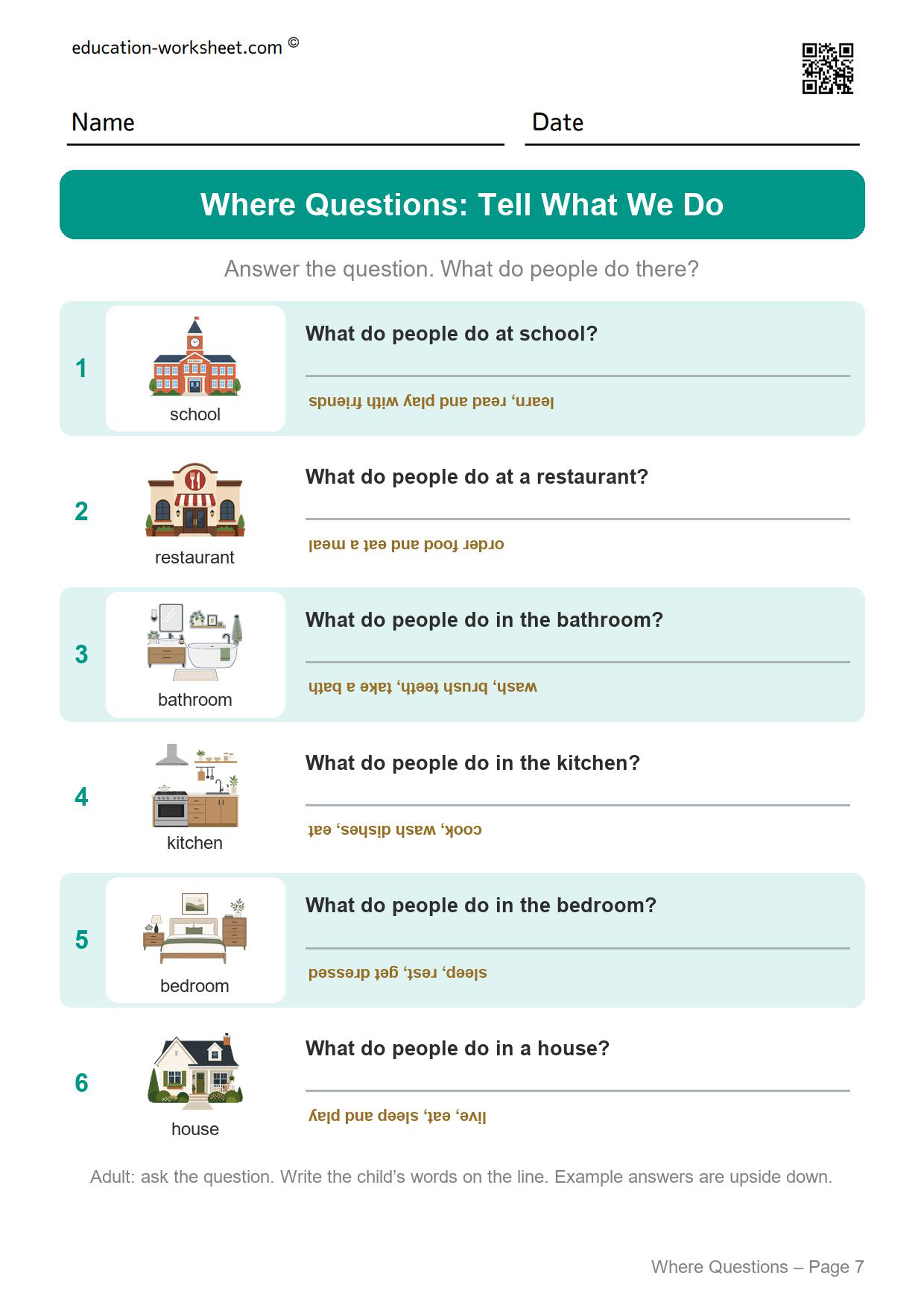
Page 8 – Name the Place
Here the child has to come up with the word. You ask, for example, “Which room at home has the stove and the fridge?”, and the child says “the kitchen.” The names are left off the six pictures on purpose, and only pictures without any printed words were used, which means even an early reader has to pull the word from memory. The answers are the kitchen, bedroom, restaurant, bathroom and park; the house is not asked.
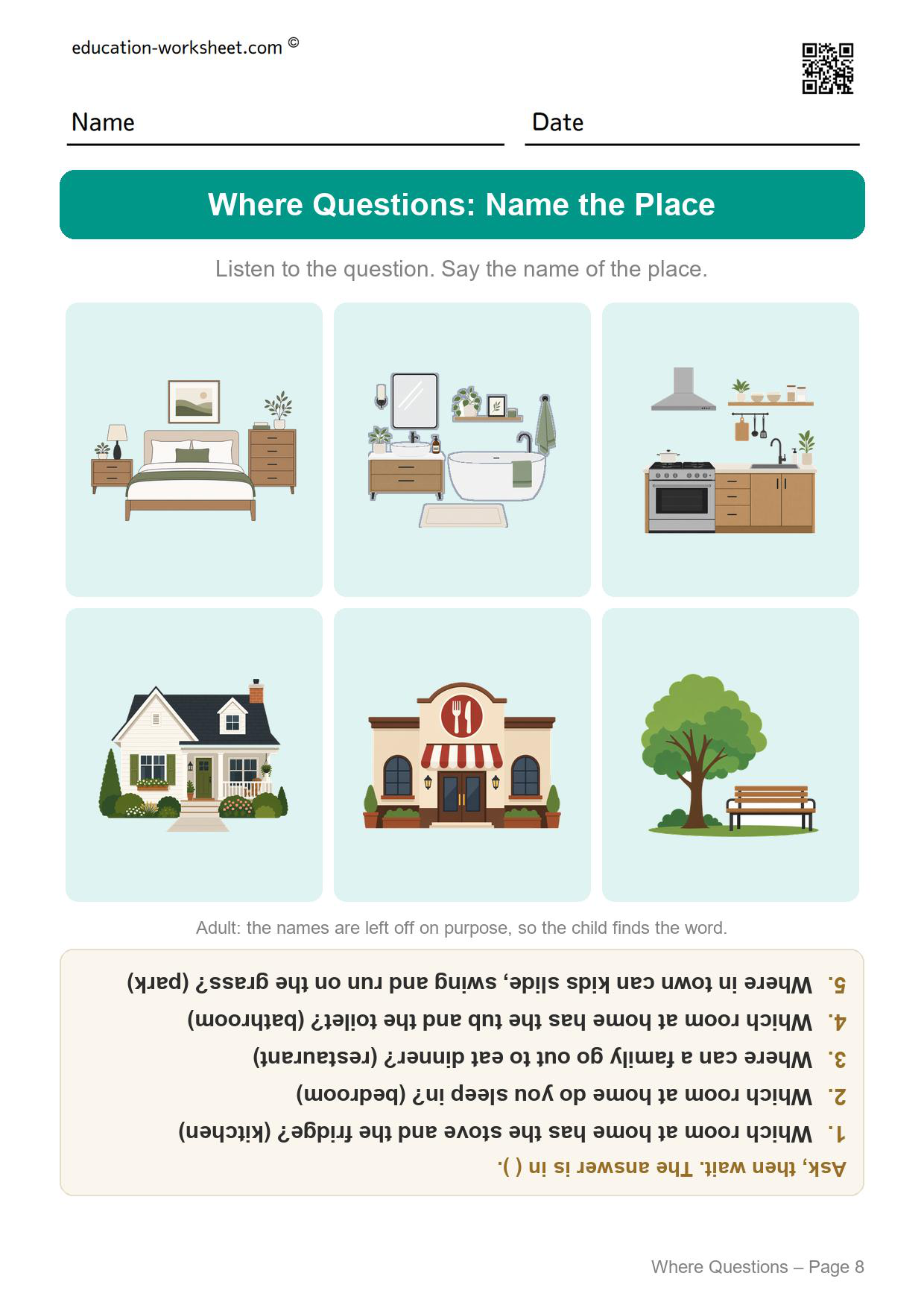
Page 9 – Name and Draw
This page has nothing to look at but empty boxes. You ask, the child says the place out loud and then draws it. The answers are the supermarket, the school, the bus stop, the police station, the bank and home. For the last question, “Where does your family live?”, any home is right, a house, an apartment or anywhere else the child lives.
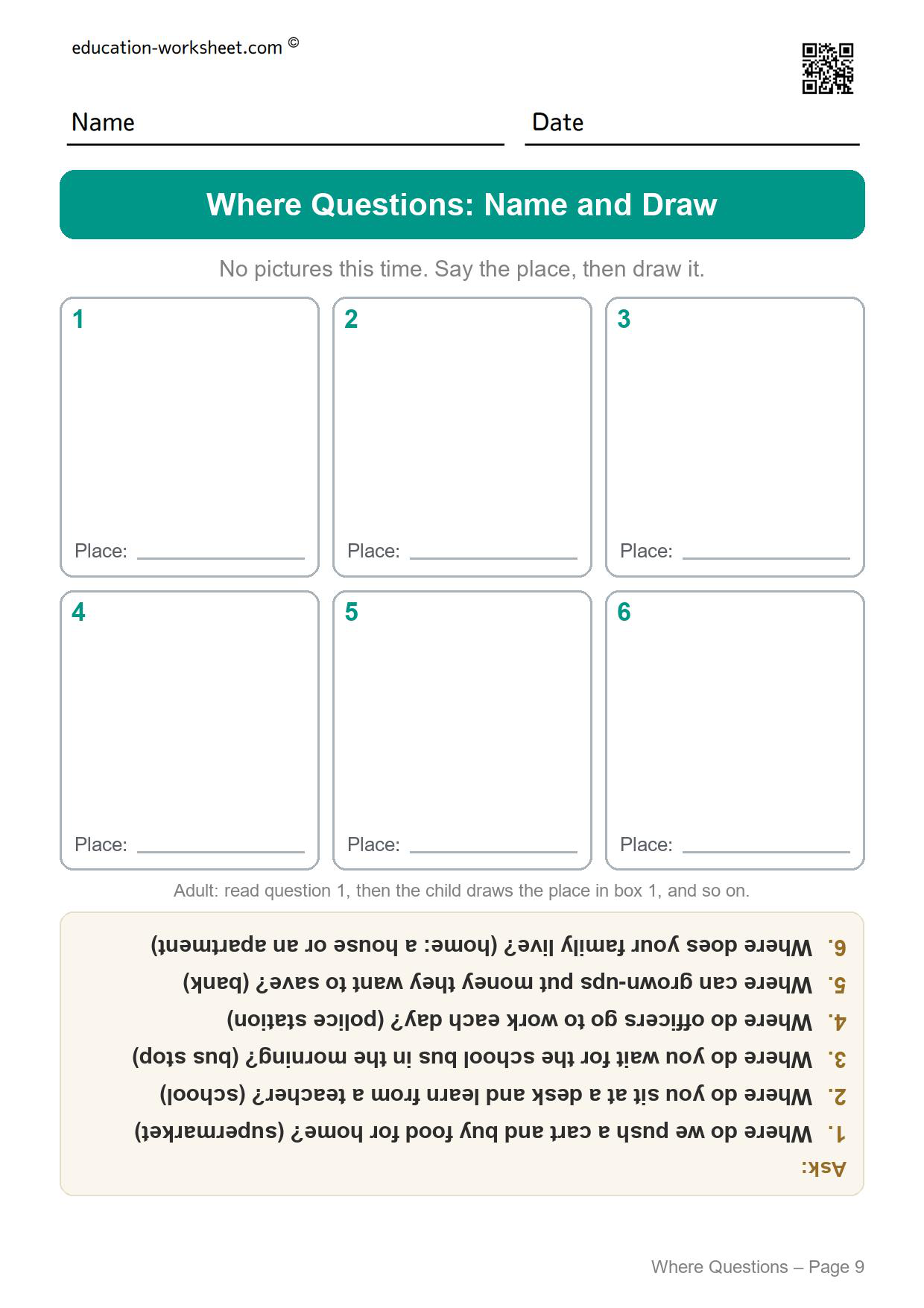
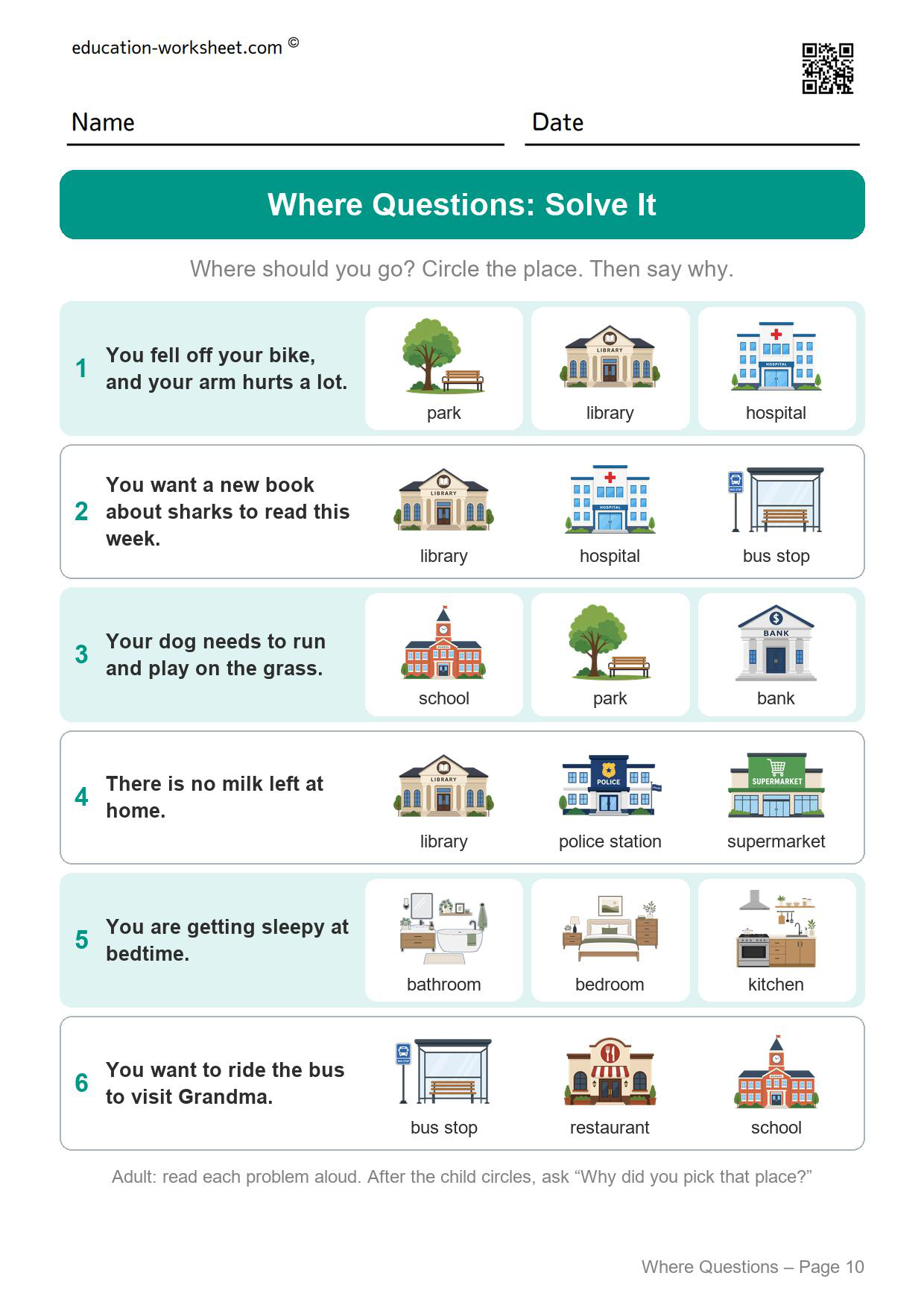
Page 10 – Solve It: Where Should You Go?
Six everyday problems, each with three places to choose from. “You fell off your bike, and your arm hurts a lot” comes with a park, a library and a hospital. The others are a new book about sharks, a dog that needs to run, no milk at home, getting sleepy at bedtime and a bus ride to visit Grandma. After each choice, ask the child why; the reason is the most valuable part of this page.
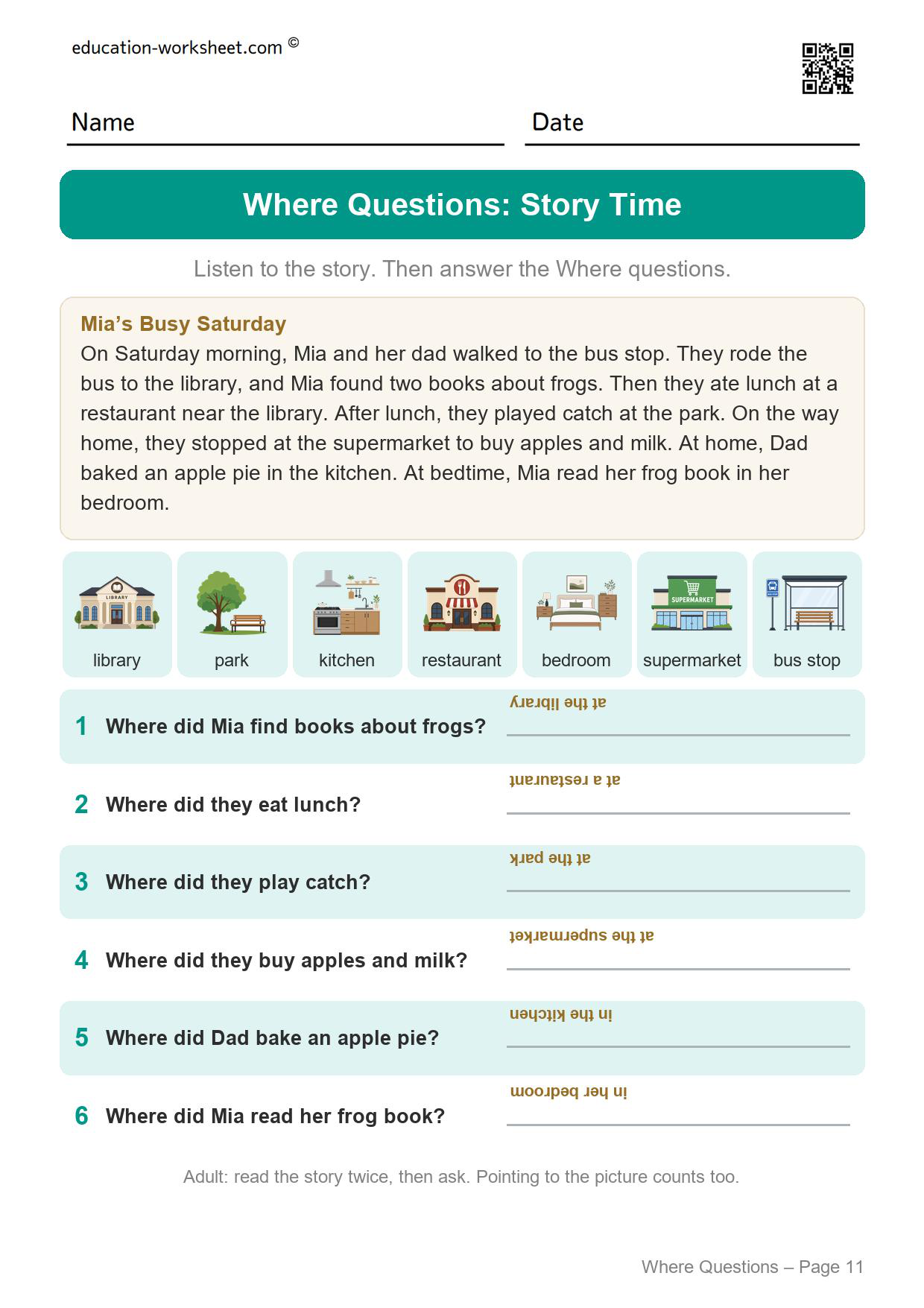
Page 11 – Story Time
A short story, “Mia’s Busy Saturday,” follows Mia and her dad from the bus stop to the library, a restaurant, the park and the supermarket, and then home to the kitchen and her bedroom. Read it twice, then ask the six where questions. The answers are at the library, at a restaurant, at the park, at the supermarket, in the kitchen and in her bedroom. Small pictures of the places sit under the story, so a child who is not ready to say the word can point.
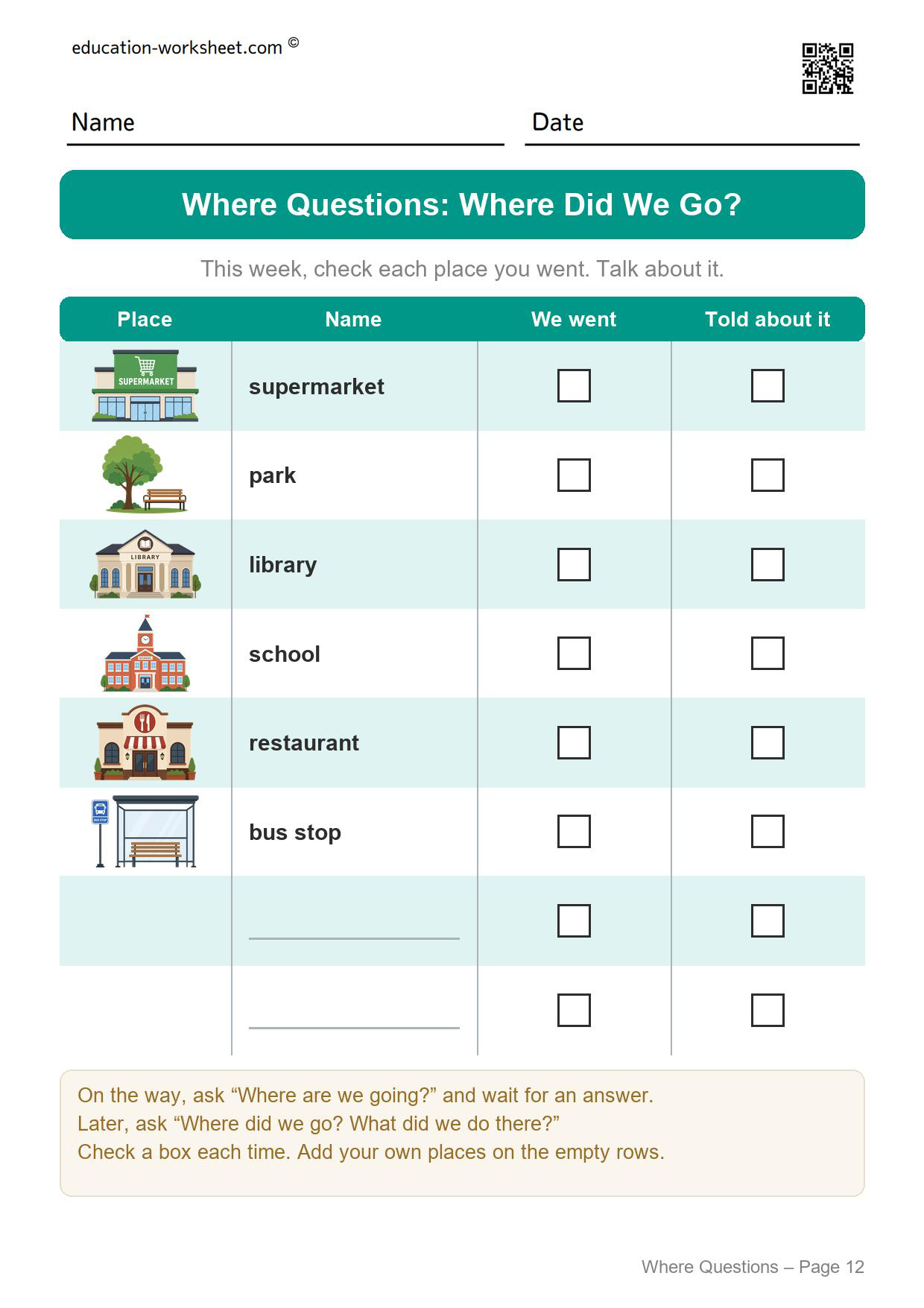
Page 12 – Where Did We Go?
A checklist for the week: the supermarket, the park, the library, the school, a restaurant and the bus stop, plus two empty rows for your own places. Check the first box when you go there and the second when the child tells someone about it afterwards. Real outings are where where questions matter most, so this page carries the practice out of the house.
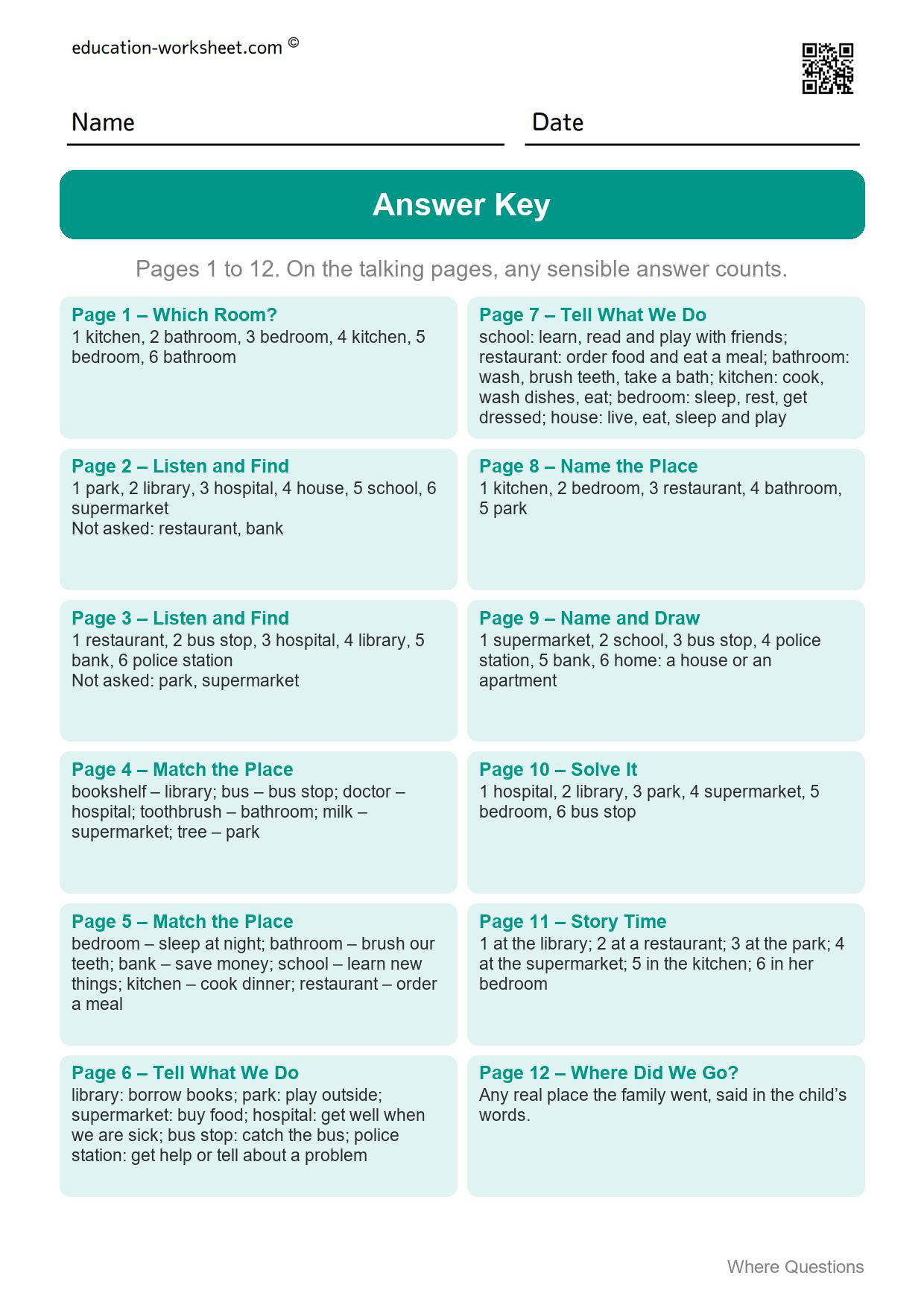
Answer Key
All answers for the circling, coloring, matching and naming pages, with example answers for the talking pages. Treat the examples on pages 6, 7 and 10 as a guide rather than a script.
How the Questions Were Checked
A where question is only fair if one place on the page clearly fits it. Asked “Where do you buy food?”, a child could honestly point to a supermarket, a restaurant or a kitchen, so questions like that were rewritten. A small computer program checked every page before it was saved.
- One place per question. Each question was written with a list of every place that could fairly answer it, and on each page only one of those places appears. “Where can you find a book about dinosaurs and borrow it?” could also mean a school library, so it is only asked on a page without the school.
- No name in the question. The question never contains the name of a picture on the page, so the bathroom question talks about washing hair in the tub, not taking a bath. The one exception is the bus stop, because “Where do people wait for the bus?” is simply the natural way to ask.
- No question twice. Every question in the pack is different. Places that come back are asked about in new words.
- Answers spread out. The listening questions jump around the page instead of going picture by picture, and on the circling pages the right picture moves around and never sits in the same place twice in a row.
- No reading shortcuts. Several buildings have their name printed on the sign, so the page where the names are hidden uses only pictures without printed words.
Why Where Questions Come Early
Of all the WH questions, where is one of the easiest to show. You can point to a place, walk to it and look at a picture of it, while a why or a when question is about something you cannot see. That is why many children answer where questions before they can answer why or when. This pack uses that: every answer is something the child can see on the page, until the last few pages.
Where questions also link closely to position words. “Where is the cat?” can be answered with a place, “In the kitchen,” or with a position, “Under the table.” Our position words worksheets practice the second kind. If you use both, point out that the same question can have both kinds of answer.
When a Child Answers With the Wrong Kind of Word
A very common reply to “Where do you sleep?” is “Mommy” or “Night-night.” The child has understood that the question is about sleep but not yet that where asks for a place. Do not mark it wrong. Say, “Where is a place. In your bedroom,” and let the child say “In my bedroom” after you. A child who names the place but leaves out the little word, “bedroom,” has given a correct answer; you can simply model the fuller one.
Hearing comes first. A child who often asks “What?” or misses spoken questions should have a hearing check before anything else. If where questions stay confusing for a long time, or other parts of talking and understanding worry you, a speech-language pathologist or the child’s teacher is the right person to ask. A worksheet can give practice, but it cannot explain why something is hard.
Who These Worksheets Are For
- Children: preschool through first grade, and older children who are still working on WH questions. Start at page 1 whatever the age.
- Ready to start when: the child can point to a picture when asked and knows the names of most rooms at home.
- SL.K.2 and SL.1.2 – ask and answer questions about key details in information presented orally, as practiced on pages 1 to 3 and 11.
- SL.K.3 and SL.1.3 – ask and answer questions to get information, as practiced in the talking pages and in everyday use of page 12.
- L.K.5c – identify real-life connections between words and their use, such as noting places at school, as practiced on pages 4 to 7.
How to Use These Worksheets
- Look at the guide page together and name the places in the top row.
- Do page 1 first, even with an older child. It shows the child what kind of answer you are looking for.
- On pages 2 and 3, sit opposite the child so that you can read the upside-down questions, and read each one once. Repeat it only if the child asks.
- When the child has to talk, count to five in your head before you help. Still stuck? Offer a choice: “At the park or at the bank?”
- On page 11, read the story through once just to enjoy it, then read it again before the questions.
- Keep page 12 for a different day and use it on real outings.
Ideas for Car Rides and Walks
- Where are we going? Before you leave, ask the child. On the way back, ask “Where did we go?”
- Guess the place. Give one clue at a time, “You need a ticket … you wait on a bench … a big vehicle stops there,” until the child guesses.
- Swap roles. Let the child ask you where questions about your day. Asking a clear question is a skill of its own.
Three Things to Watch For
1. Answering what instead of where. Asked where we buy apples, a child may say “apples.” Repeat the question word with a little stress, “Where do we buy them?”, and give two places to choose from.
2. Family words for places. Many families say “the store” or “the market” rather than “the supermarket,” and some children ride a school bus from the end of the driveway rather than a bus stop. Accept the family’s word. The aim is the idea of a place, not one label.
3. Remembering the order instead of listening. On page 11 the questions follow the story in order. If a child answers well, try asking two questions out of order to see whether the child is listening for the detail or simply remembering the sequence.
Printing Tips
- Print at 100 percent, actual size, on US Letter or A4 paper.
- Print in color if you can. The buildings are easier to tell apart in color, especially the library and the bank, which both have columns.
- Page 12 works well on the fridge or in the car for the week.
Frequently Asked Questions
What age are these where questions worksheets for?
They are made for preschool through first grade, and many older children who are still learning WH questions use them too. The best starting point is page 1, whatever the child’s age.
My child answered with a place that is not in the answer key. Is it wrong?
Not if it makes sense. A family might buy milk at a corner store or eat dinner at a grandparent’s house. On the talking pages, any real, sensible place counts.
Why are some of the questions so long?
Short questions such as “Where do you buy food?” can fit more than one picture, which is unfair to the child. The extra words make sure only one place on the page fits.
Why are some words printed upside down?
The questions are for the adult. Printed upside down, they face you when you sit opposite the child, and a child who can read does not see the answer before hearing the question.
Can this pack show whether my child has a language delay?
No. These are practice pages without scores or norms. If you are worried, check hearing first and talk to a speech-language pathologist.
Do I need an account or email address to download?
No. Every PDF downloads straight away, free, with no sign-up.
Can I use these in a classroom or therapy room?
Yes. You are welcome to print them for home, classroom and therapy use. Please do not sell them or upload the files to another site.
More Free Listening and Language Worksheets
- Free Object Function Worksheets – What Do We Use It For?
- Free Category Sorting Worksheets for Speech Therapy and Preschool
- Free Position Words Worksheets for Kindergarten – In, On, Under, Next To
- Free Auditory Memory Worksheets for Kids – Listen and Repeat
- Free Winter Following Directions Worksheets – 1, 2 and 3 Steps
- Free Kitchen Words Worksheets for Kindergarten – Read and Write