These free printable object function worksheets help children answer one of the most useful questions about any word: what do we use it for? Over twelve pages the child listens and finds the object for a job, matches objects to actions and job words, tells what objects are for, names an object from its job, explains why we need things, solves small everyday problems and finally finds real objects at home.
A speech-language-hearing therapist designed this pack. Knowing a word well means more than knowing its name. A child who can say that scissors cut, a shovel digs and a lamp gives light has a richer store of meaning to draw on, both for understanding and for explaining. When the name of a thing will not come, being able to say what it is for is also a useful way around the gap. Use these pages at home, in a classroom or in therapy sessions. They are practice pages, not a test, and they cannot tell you whether a child has a language difficulty.
The order of the pages follows the way this skill is usually built up. First the child only has to recognize the right object when someone else describes its job. Then the child draws lines to connect objects and jobs, and only after that is asked to put the job into words, to name an object from a description and to give reasons.
- What Is in This Free Object Function Pack
- The 12 Object Function Worksheets
- Start Here – Six Steps and Tips for Adults
- Page 1 – Listen and Find: Things Around the House
- Page 2 – Listen and Find: Tools for Every Day
- Page 3 – Listen and Find: Kitchen and Bathroom
- Page 4 – Match the Job: Pictures of Actions
- Page 5 – Match the Job: Words
- Page 6 – Tell the Job: Finish the Sentence
- Page 7 – Tell the Job: Answer the Question
- Page 8 – Name the Thing
- Page 9 – Name and Draw
- Page 10 – Tell Why
- Page 11 – Solve It
- Page 12 – Find It at Home
- Answer Key
- How the Questions Were Checked
- Function, Category and Description
- When Talking About Function Is Hard
- Who These Worksheets Are For
- How to Use These Worksheets
- Ideas to Keep It Playful
- Three Things to Watch For
- Printing Tips
- Frequently Asked Questions
- What age are these object function worksheets for?
- My child gave a different answer from the example. Is it wrong?
- Why are there no knives or saws in the pack?
- Why are some words printed upside down?
- Can this pack show whether my child has a language disorder?
- Do I need an account or email address to download?
- Can I use these in a classroom or therapy room?
- More Free Listening and Language Worksheets
What Is in This Free Object Function Pack
- Twelve practice pages, a guide page for the adult and an answer key.
- 28 everyday objects from home, school and the garden, from a toothbrush and a key to a shovel and a frying pan.
- Six steps: listen and find (pages 1 to 3), match the job (pages 4 and 5), tell the job (pages 6 and 7), name the thing (pages 8 and 9), tell why and solve it (pages 10 and 11) and find it at home (page 12).
- Questions and example answers printed upside down, so the adult can read them from across the table.
- One crayon for pages 1 to 3 and a pencil for the drawing page.
- Each page as its own free PDF, ready to print.
The 12 Object Function Worksheets
Every page uses objects that most young children see and handle every day. Nothing sharp is used as an answer: there are no knives or saws, and the only cutting tool in the pack is a pair of scissors for paper.
Start Here – Six Steps and Tips for Adults
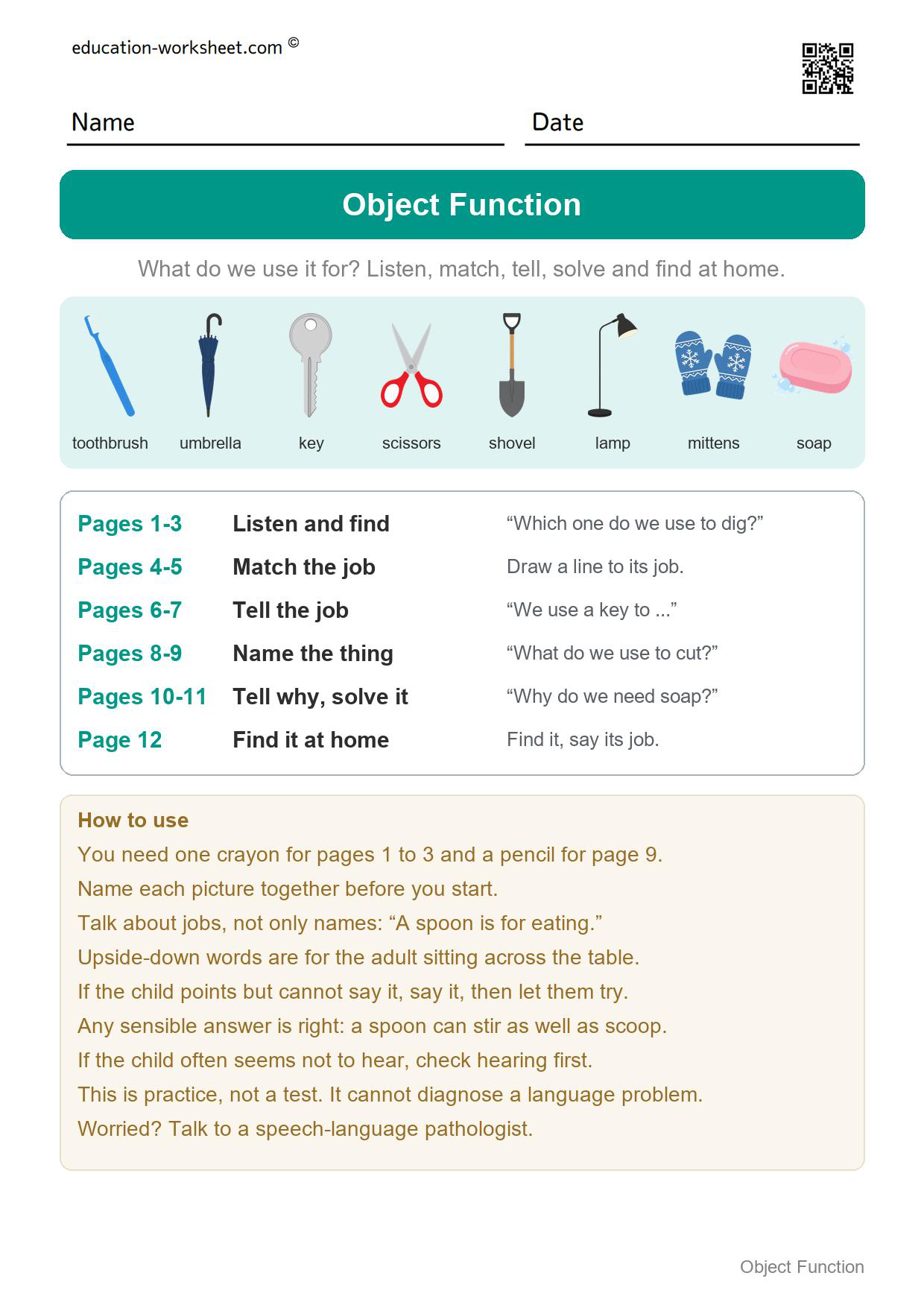
The guide page shows eight of the everyday objects, the six steps of the pack with a short example of each, and tips for the adult. The most important tip is the first one on the list: talk about what things are for, not only what they are called.
Page 1 – Listen and Find: Things Around the House
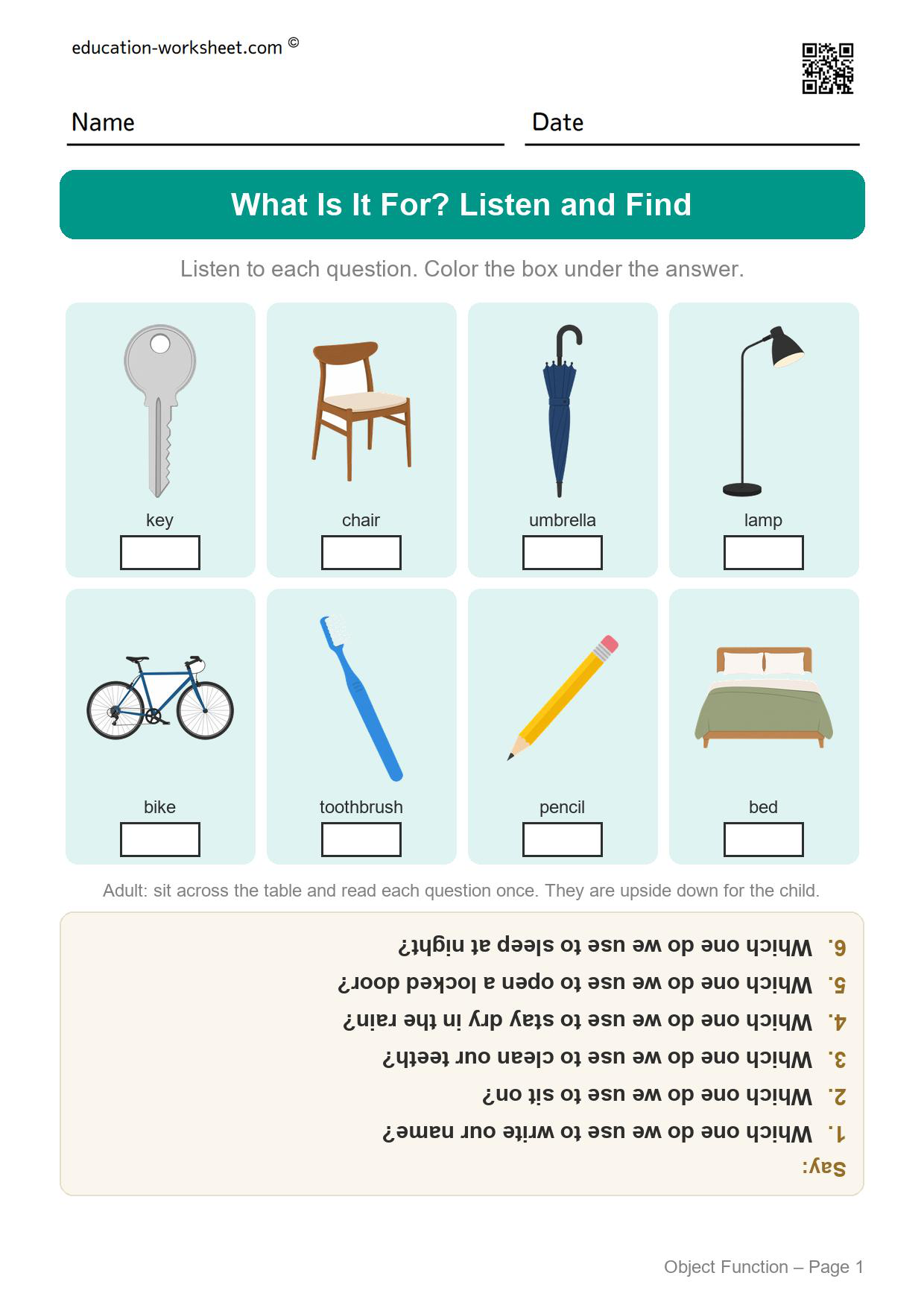
Eight pictures and six questions read by the adult, such as “Which one do we use to open a locked door?” The child colors the box under the answer. The answers are the pencil, chair, toothbrush, umbrella, key and bed. The lamp and the bike are never asked about, so the last question is not answered by elimination.
Notice that no question gives away the name. The toothbrush question says “clean our teeth,” not “brush,” because hearing part of the word would let a child match sounds instead of thinking about the job.
Page 2 – Listen and Find: Tools for Every Day
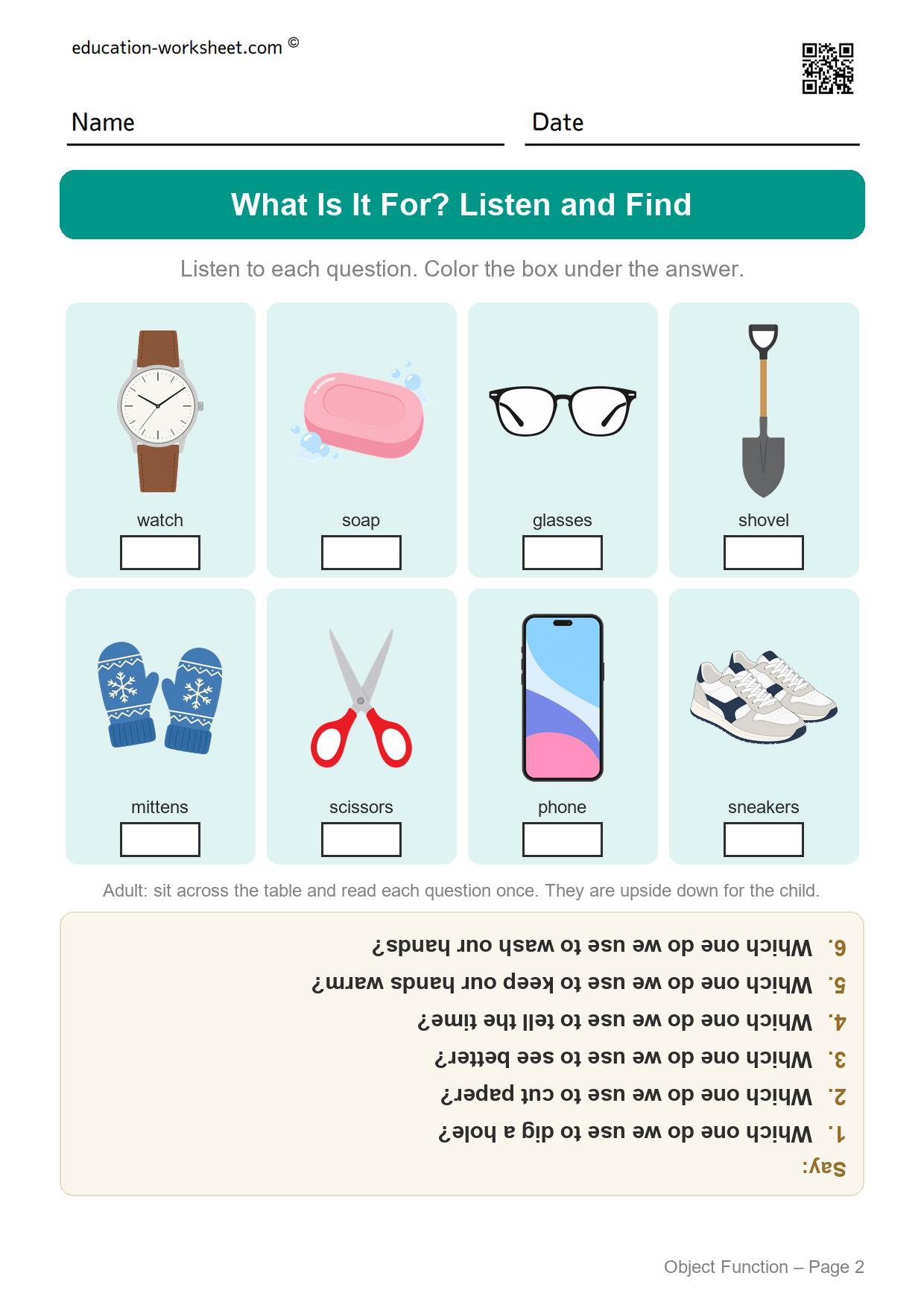
Six new questions: dig a hole, cut paper, see better, tell the time, keep our hands warm and wash our hands. The answers are the shovel, scissors, glasses, watch, mittens and soap, while the phone and the sneakers stay as extra pictures.
Page 3 – Listen and Find: Kitchen and Bathroom
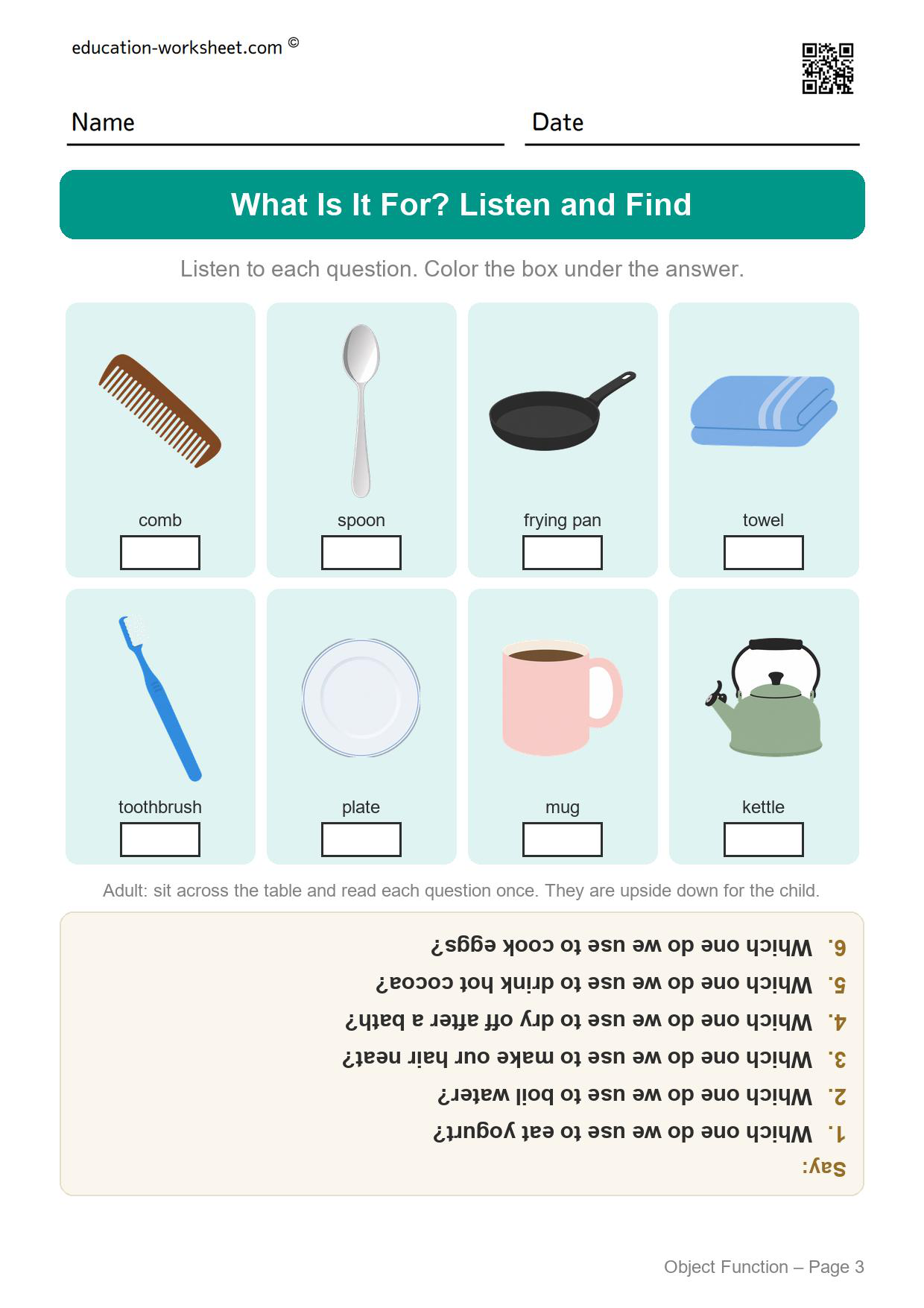
The hardest listening page, because the pictures come from just two rooms. A spoon, a kettle, a mug and a frying pan all belong in the kitchen, so the child has to listen to the exact job: eat yogurt, boil water, drink hot cocoa or cook eggs. The comb and the towel answer the bathroom questions, and the toothbrush and the plate are the extra pictures.
Page 4 – Match the Job: Pictures of Actions
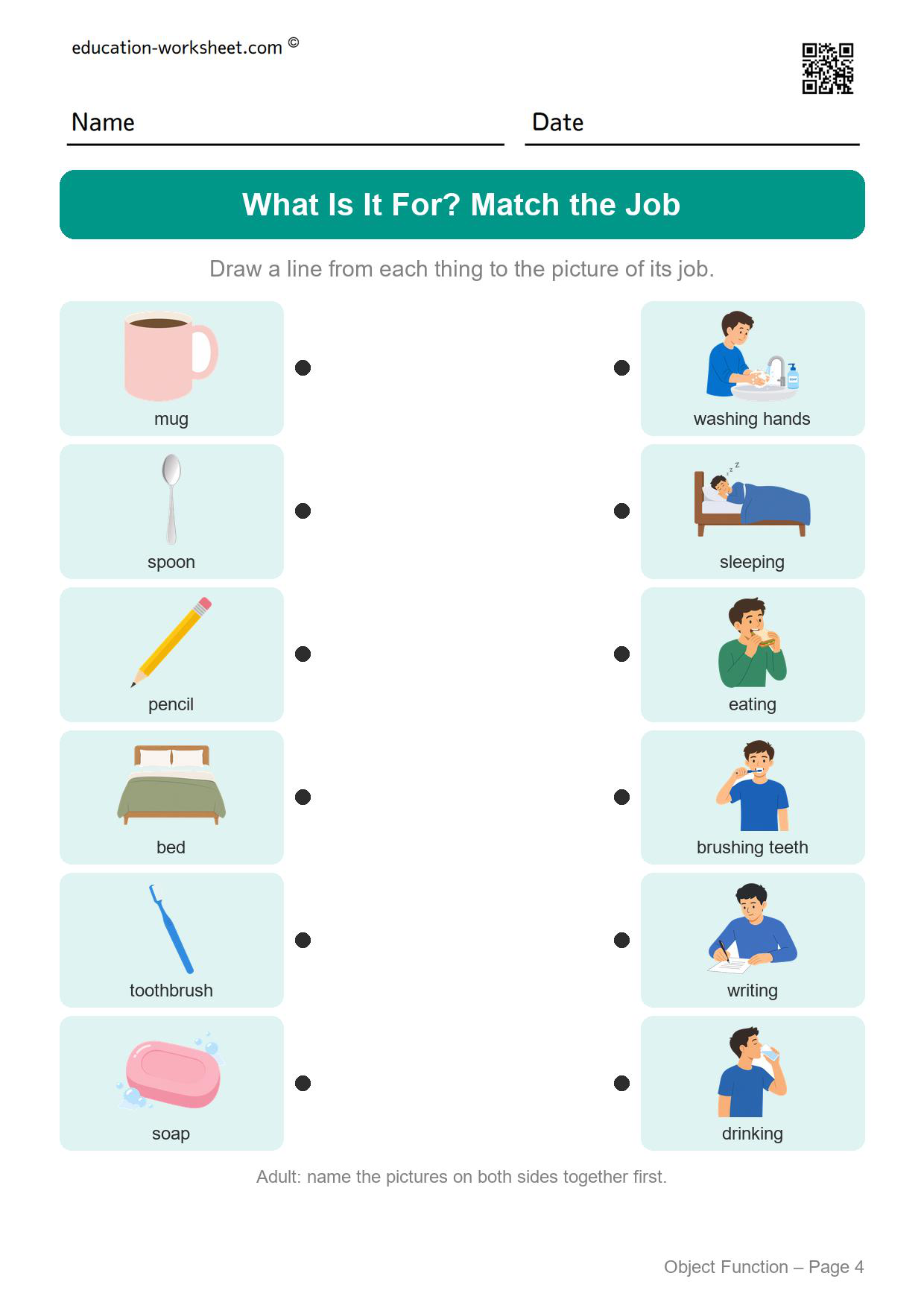
Objects on the left, people doing things on the right. The child draws a line from the mug to the person drinking, the spoon to eating, the pencil to writing, the bed to sleeping, the toothbrush to brushing teeth and the soap to washing hands. No answer sits straight across from its object, so the child cannot just draw six flat lines.
Page 5 – Match the Job: Words
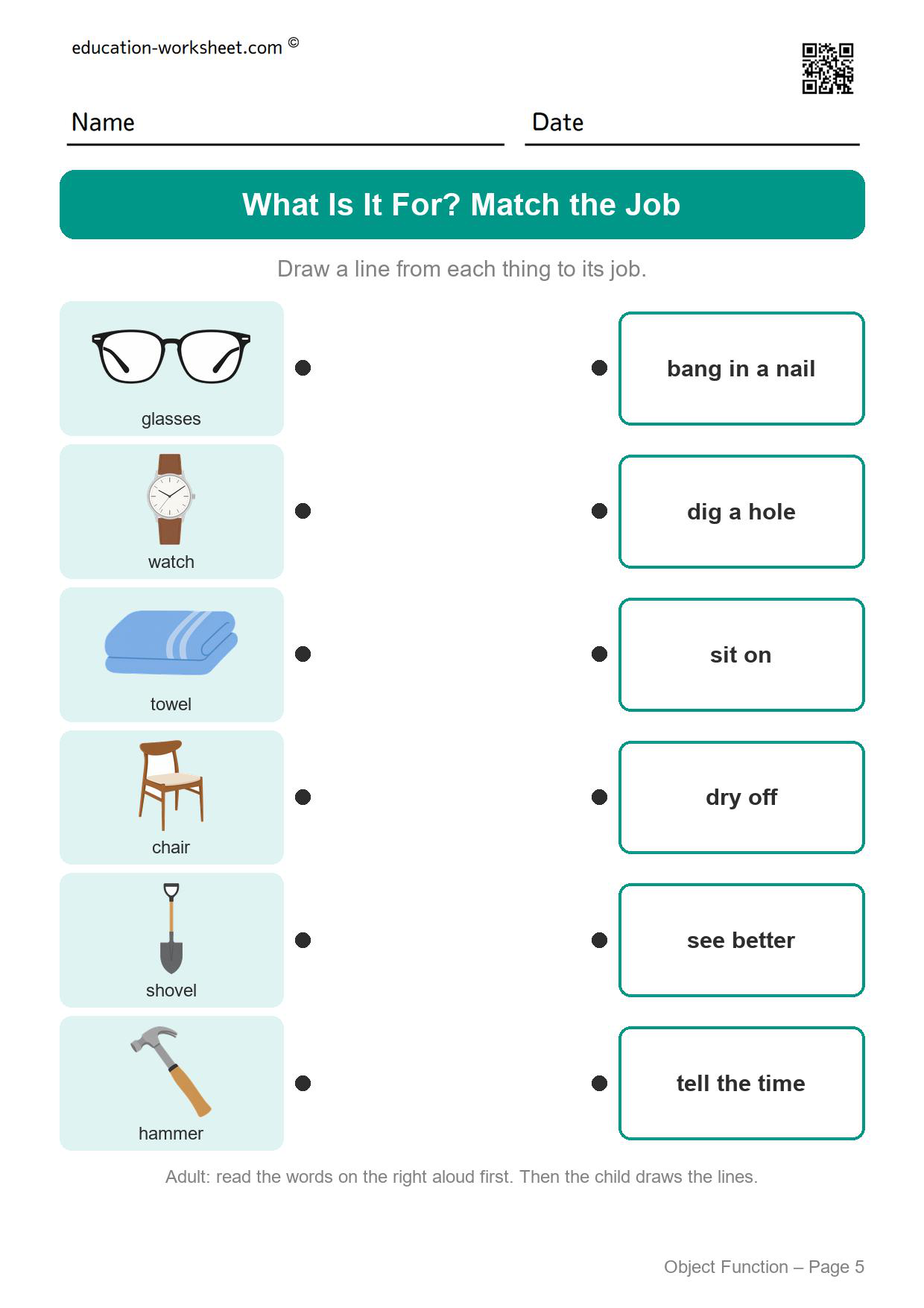
This time the right side has short phrases instead of pictures. Read them aloud first: bang in a nail, dig a hole, sit on, dry off, see better and tell the time. The glasses, watch, towel, chair, shovel and hammer each match one of them. This page moves the child from pictures of actions toward the words that describe them.
Page 6 – Tell the Job: Finish the Sentence
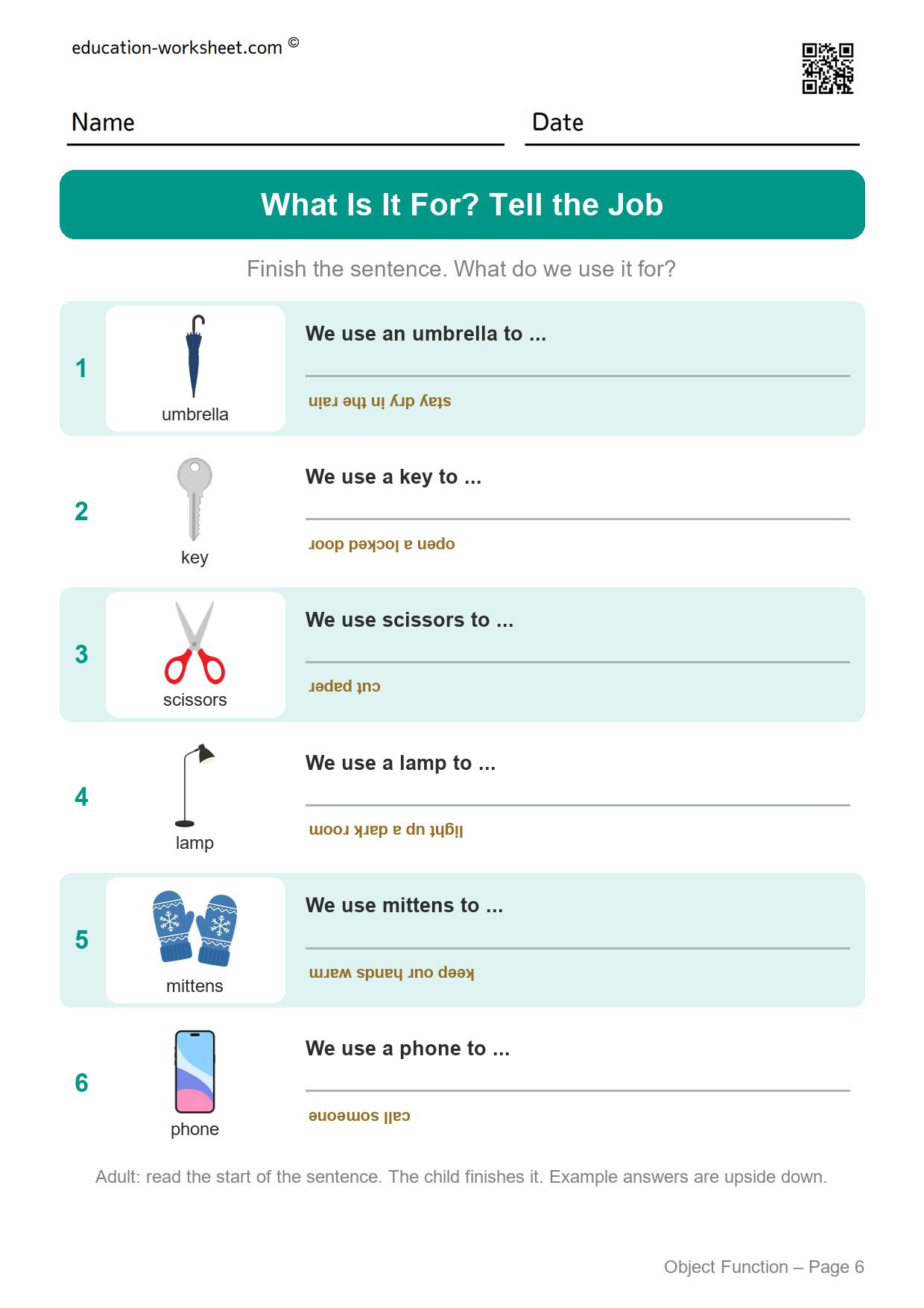
Now the child talks. You read the start of a sentence, “We use a key to …”, and the child finishes it. The objects are an umbrella, a key, scissors, a lamp, mittens and a phone. An example ending is printed upside down at the end of each row for the adult.
Page 7 – Tell the Job: Answer the Question
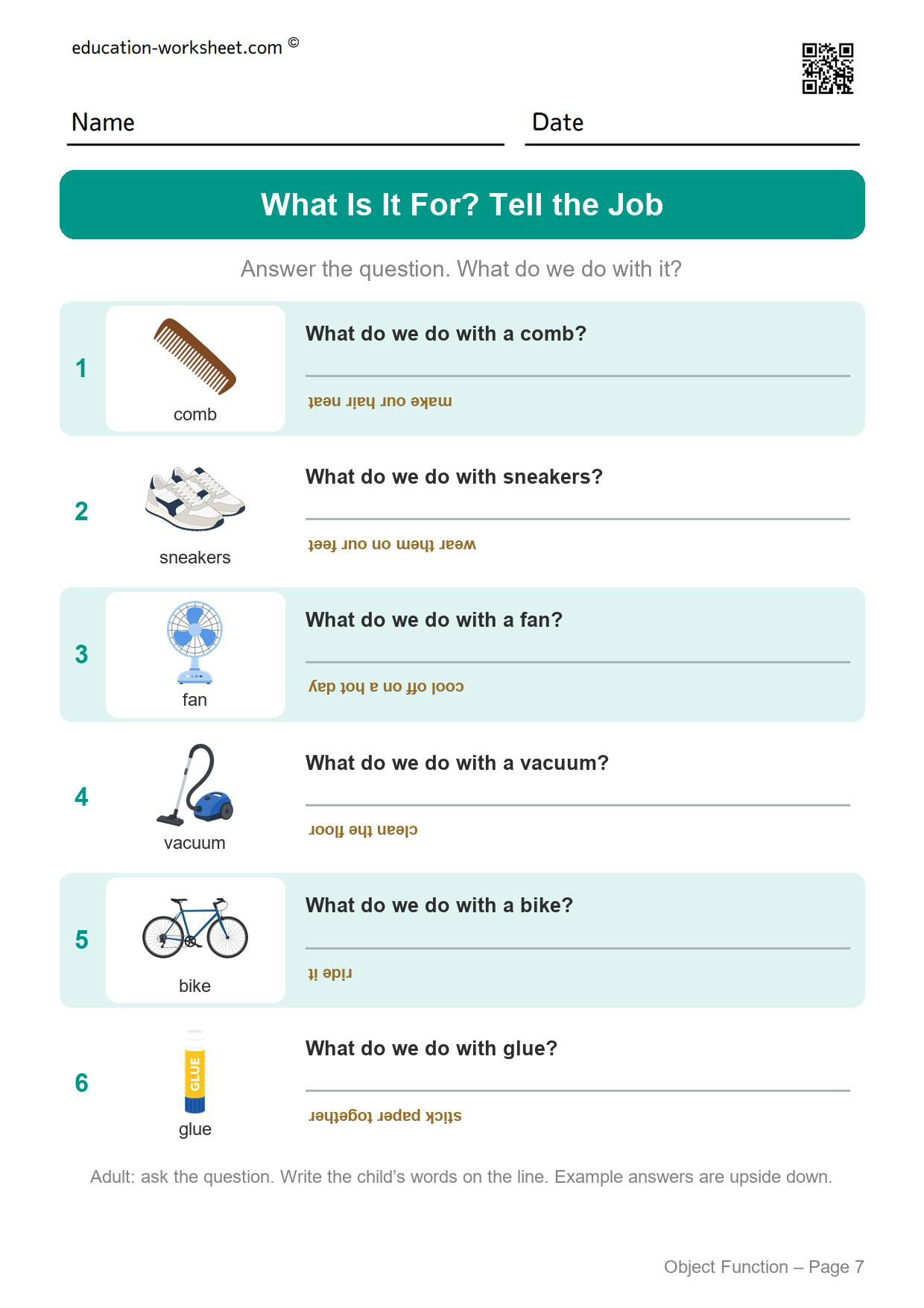
The same task without the sentence starter: “What do we do with a comb?” The objects are a comb, sneakers, a fan, a vacuum, a bike and glue. Write the child’s words on the line. A short answer such as “ride it” is complete; you can model a longer one afterwards.
Page 8 – Name the Thing
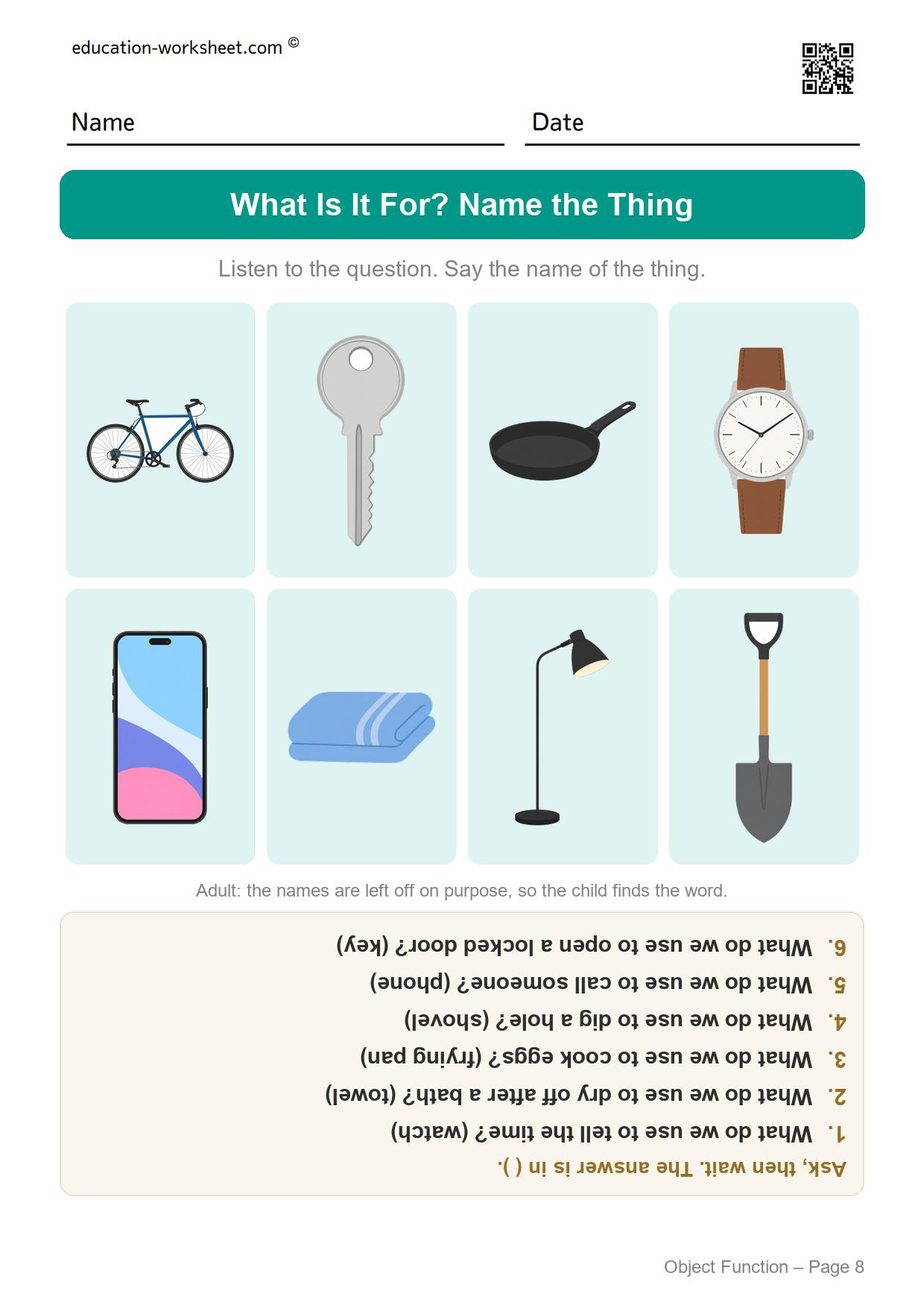
The question is turned around. You describe the job, “What do we use to cook eggs?”, and the child says the name. The eight pictures are there to help, but their names are left off on purpose so that a child who reads still has to find the word. The answers are the watch, towel, frying pan, shovel, phone and key.
Page 9 – Name and Draw
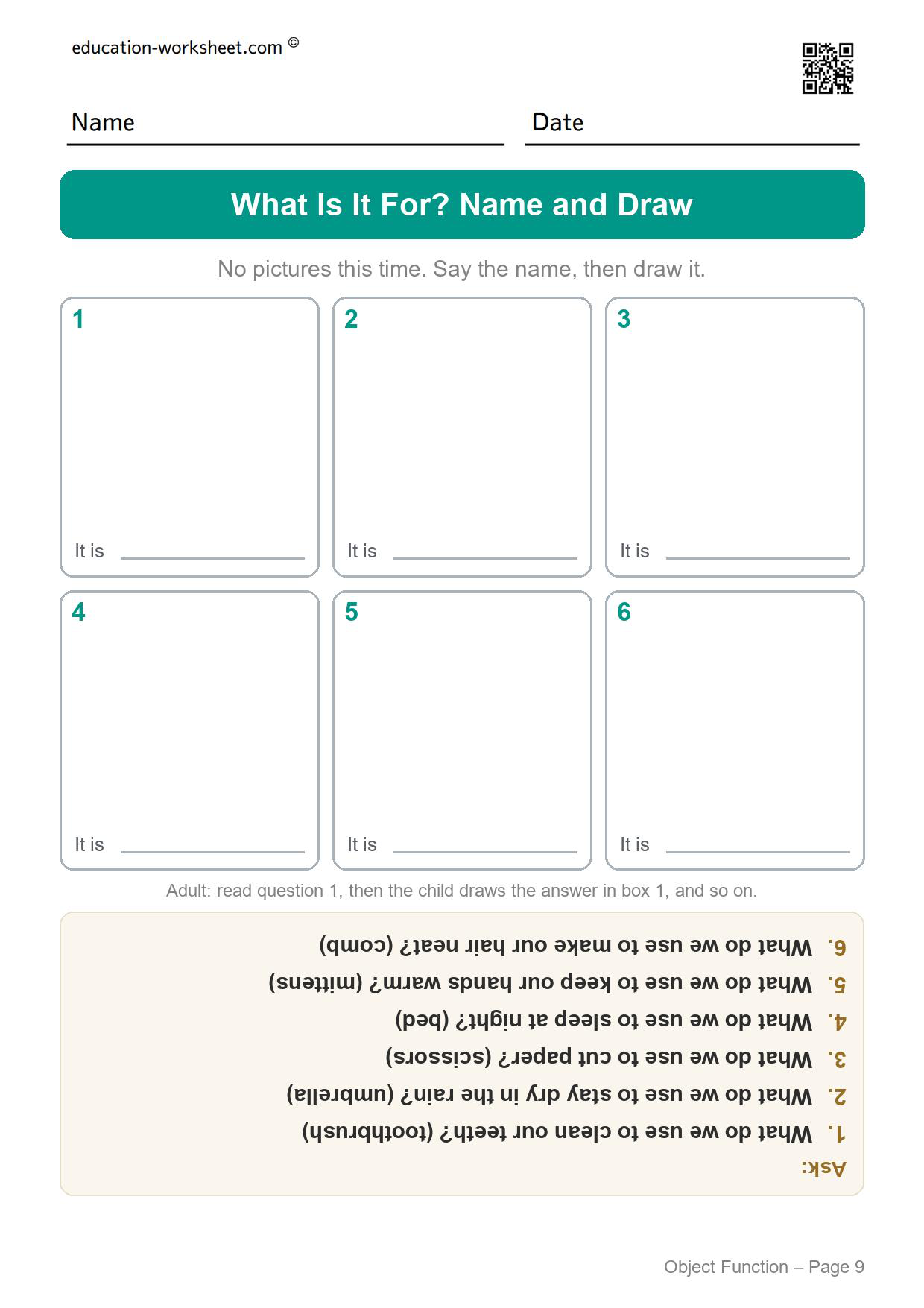
No pictures at all. The child hears a job, names the object and draws it in a box. The six answers are the toothbrush, umbrella, scissors, bed, mittens and comb, all of which appeared earlier in the pack, so the child is recalling familiar words rather than meeting new ones.
Page 10 – Tell Why
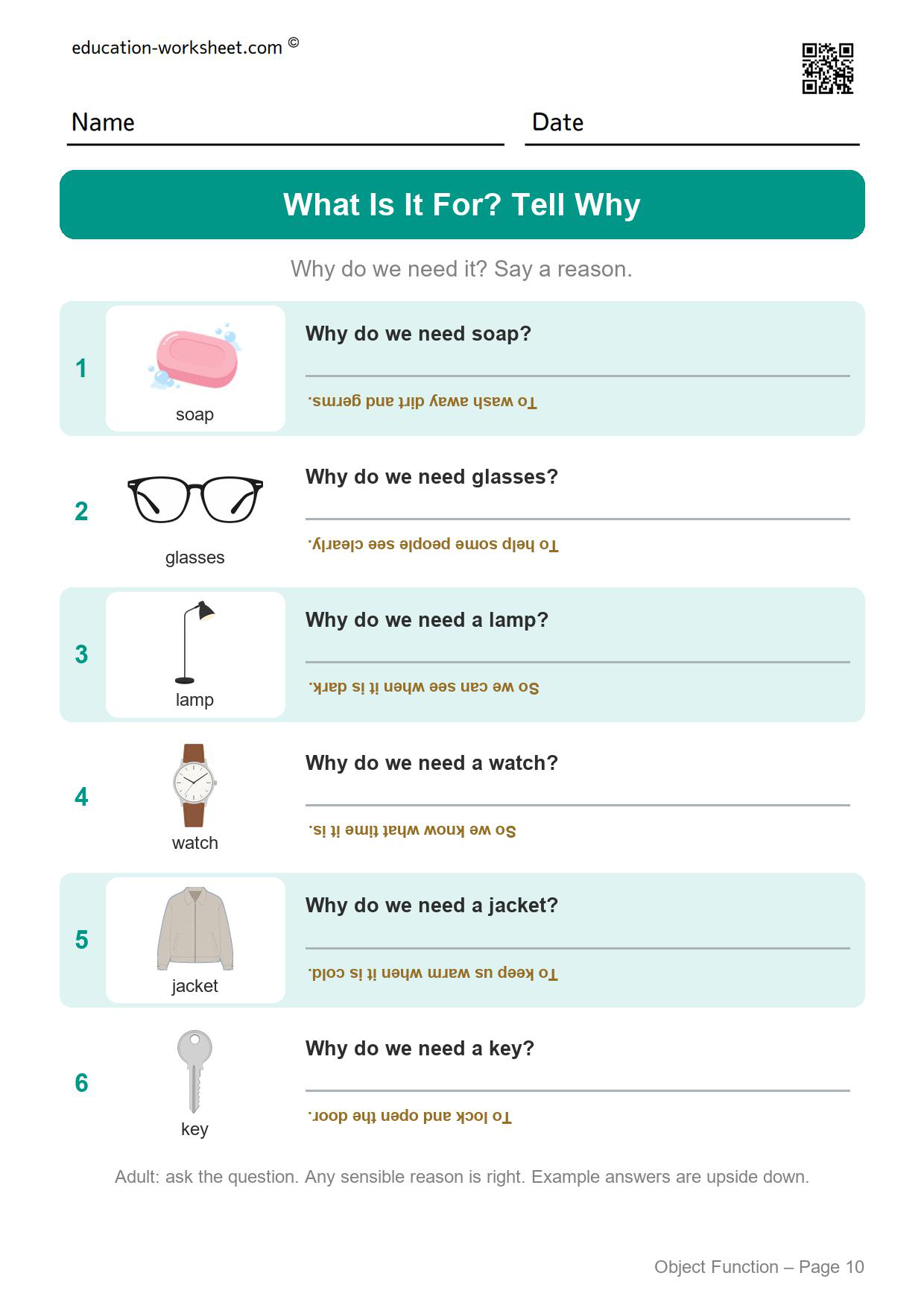
“Why do we need soap?” is a harder question than “What do we use soap for?”, because it asks for a reason. The six objects are soap, glasses, a lamp, a watch, a jacket and a key. Example answers are printed upside down, but any sensible reason is right.
Page 11 – Solve It
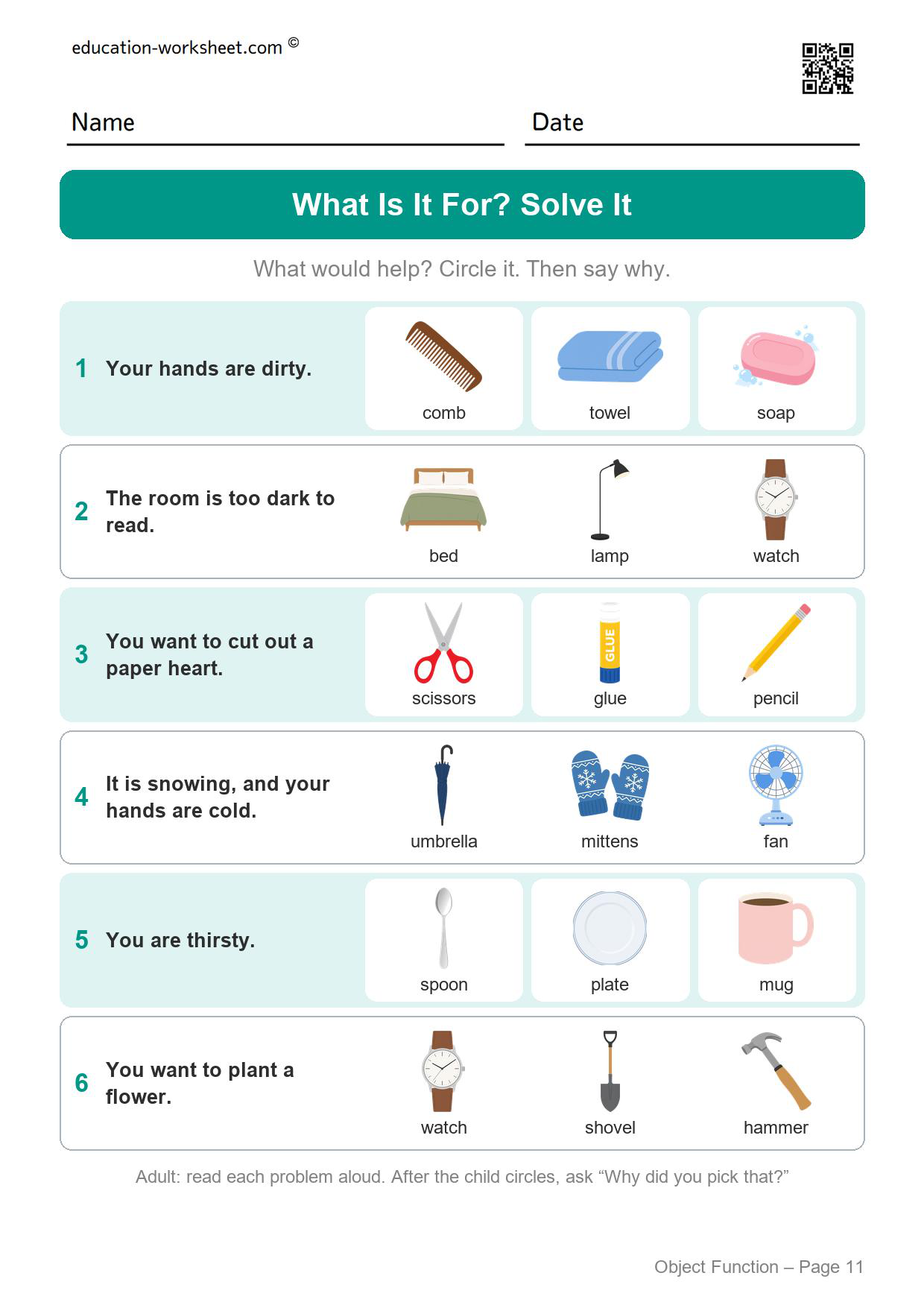
Six small problems, each with three pictures. “Your hands are dirty” comes with a comb, a towel and soap. The towel is a deliberate near miss: it belongs in the same room and does help with clean hands, but it does not make them clean. The other problems are a dark room, cutting out a paper heart, cold hands in the snow, being thirsty and planting a flower. After each choice, ask the child why.
Page 12 – Find It at Home
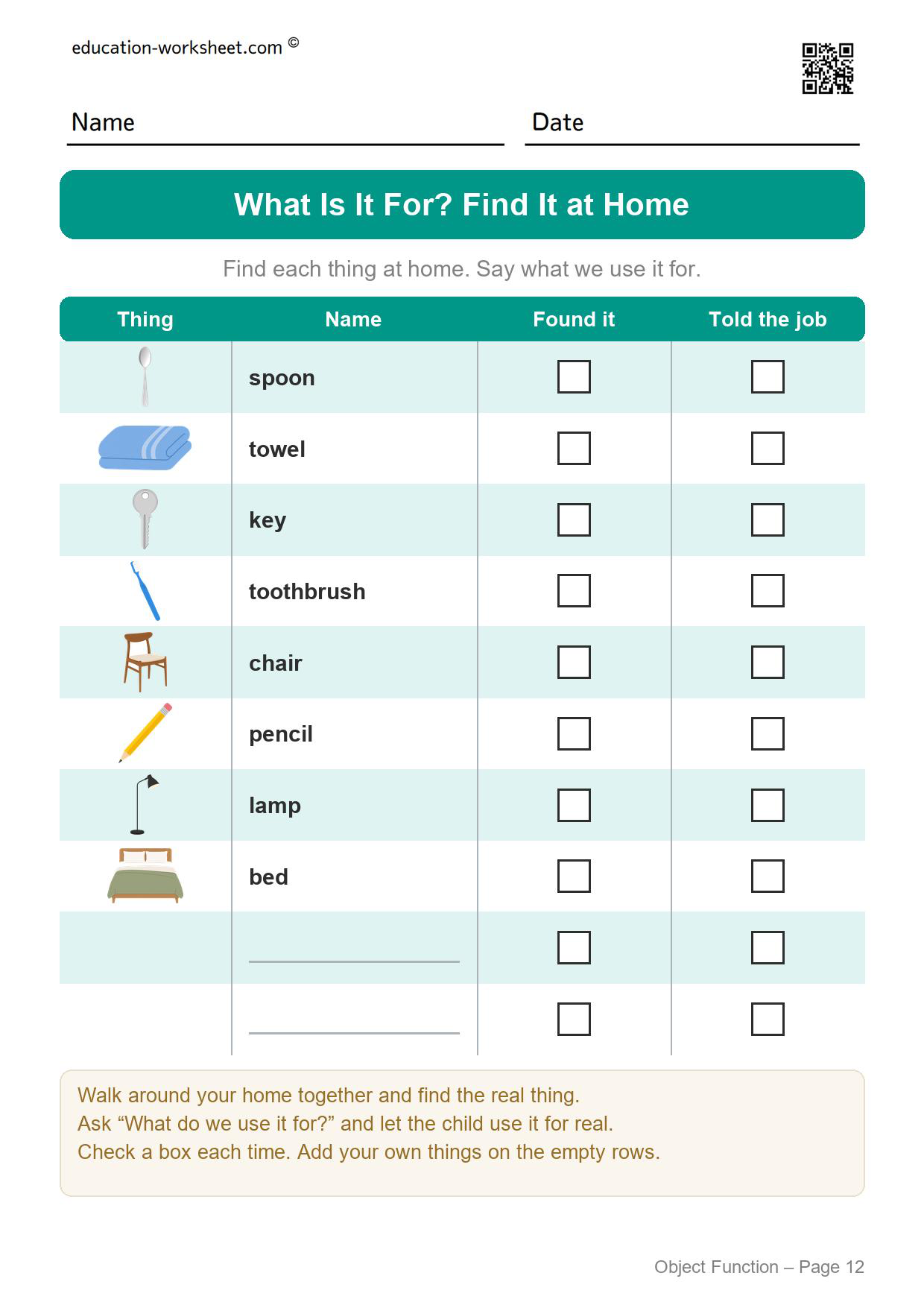
A checklist for a walk around the house: a spoon, a towel, a key, a toothbrush, a chair, a pencil, a lamp and a bed, plus two empty rows for your own ideas. The child finds each real object, says what we use it for and, where it is safe, uses it. Words learned on paper become much more useful once they are tied to the real thing.
Answer Key
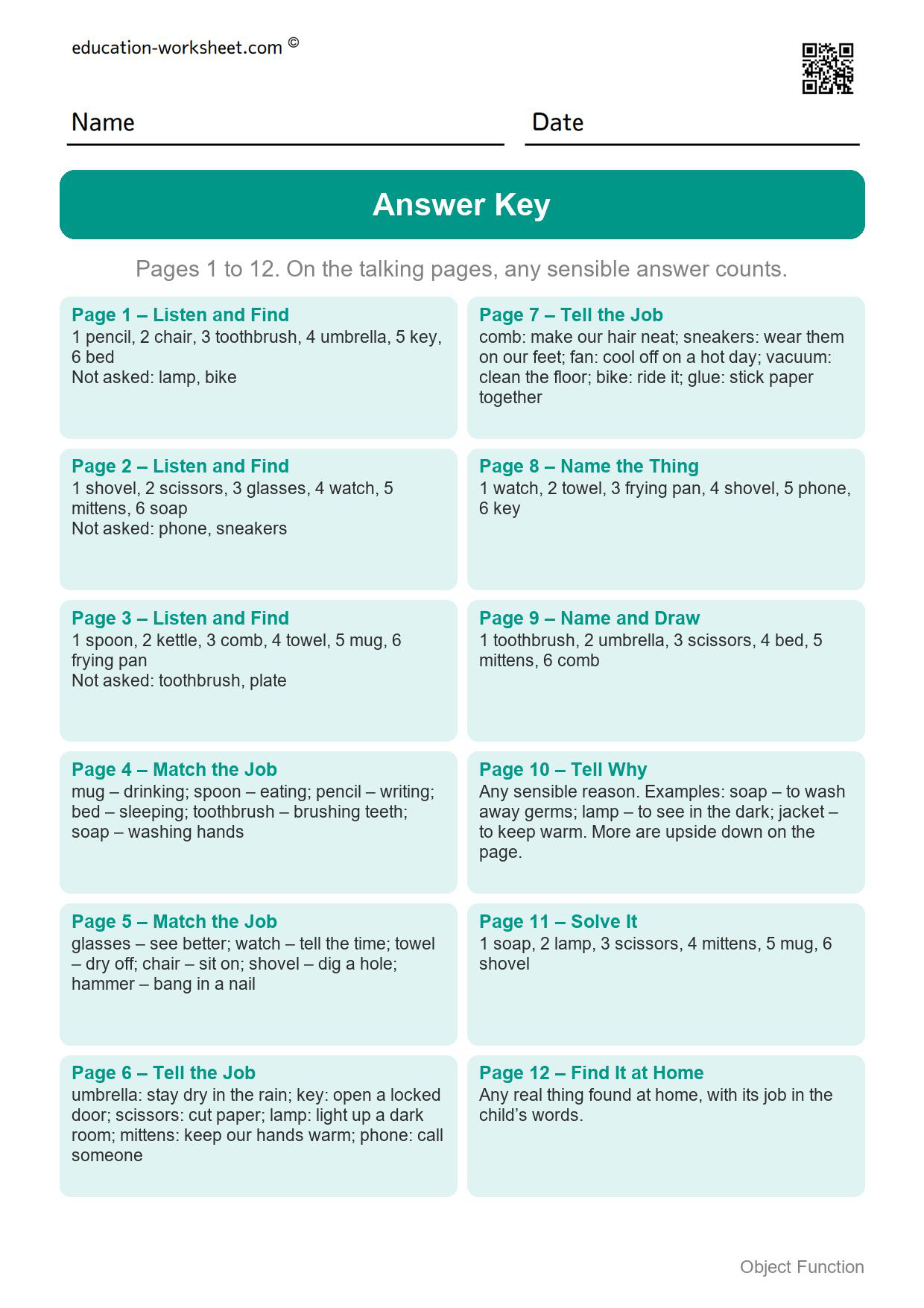
All answers for the listening, matching and naming pages, with example answers for the talking pages. On pages 6, 7, 10 and 11, treat the examples as a guide: a child who says a spoon is “for stirring” is right too.
How the Questions Were Checked
A question about function is only fair if it fits one object on the page. Before the pages were saved, a small computer program checked each page against a short list of rules.
- One job, one object. Every object has a job tag, such as clean, dry or warm. On the listening pages no other picture shares a tag with the object being asked about, so soap and a vacuum cleaner, which both clean, never appear on the same page.
- The question never gives away the name. No word from a picture name on the page appears in the question. That is why the comb question is about making hair neat rather than combing it.
- The order is mixed. On the listening pages the questions do not follow the order of the pictures, and two pictures side by side are never asked about one after the other.
- No straight lines on the matching pages. No answer sits directly across from its object, and the answers are not simply shifted down by one place.
- The right answers are spread out. On the problem-solving page the correct picture moves between the first, second and third place and never sits in the same place twice in a row.
Function, Category and Description
Function is one of several ways to describe a word. Our category sorting worksheets ask which group a thing belongs to, and our what doesn’t belong worksheets ask which thing is not in the group. This pack asks what a thing does. A spoon is a kitchen thing, it is not a vegetable, and it is used for eating; each answer adds something different to the child’s understanding of the word.
If you use the packs together, try mixing the questions in everyday talk: “What is it? What group is it in? What do we use it for?” Each answer gives the child one more way to hold on to the word.
When Talking About Function Is Hard
Some children point to the right object without any trouble but cannot say what it is for. Others give the name again (“a toothbrush is for toothbrushing”) or describe what it looks like (“it’s blue”). These are common steps on the way. Model a short answer, “We use it to clean our teeth,” let the child say it after you, and go back to the matching pages for a while.
If a child often seems not to hear the questions, arrange a hearing check first. If understanding or using words seems to be a struggle in daily life, or you have other worries about language, talk to the child’s teacher or a speech-language pathologist. These pages are a way to practice; they cannot find the reason behind a difficulty.
Who These Worksheets Are For
- Age: roughly four to seven, from preschool through first grade. Start at page 1 at any age.
- Ready to start when: the child knows the names of most of the objects and can color a box and draw a line.
- L.K.5c and L.1.5c – identify real-life connections between words and their use, as practiced on page 12.
- SL.K.2 and SL.1.2 – understand information presented orally, as practiced on pages 1 to 3.
- SL.K.6 – express thoughts and ideas clearly; SL.1.6 – produce complete sentences when appropriate, as practiced on pages 6 to 11.
How to Use These Worksheets
- Look at the guide page together and name the objects in the top row.
- On pages 1 to 3, sit across from the child so the upside-down questions face you. Read each question once.
- On page 5, read the job words aloud before the child draws any lines.
- On the talking pages, wait a few seconds before helping. If the child is stuck, give the first word of the answer.
- Write down what the child says. Comparing the words from week to week shows progress better than a score.
- Finish with page 12, ideally on a different day, so the words are used in a real place.
Ideas to Keep It Playful
- Mystery bag. Put three real objects from the pack in a bag. Describe the job of one, and let the child pull it out.
- Silly uses. Ask, “Can we use a spoon to brush our hair?” Children love saying no, and they have to explain why.
- Swap roles. Let the child describe a job while you guess the object. Describing clearly is the harder half of the skill.
Three Things to Watch For
1. Naming instead of telling. Asked what we do with a comb, a child may simply say “comb.” Accept it, then model the job: “Yes, we comb our hair with it.”
2. Describing the look. “It’s round and white” is a good description of a plate, but it does not say what the plate is for. Ask, “And what do we do with it?”
3. Choosing the near miss. On page 11, a child who circles the towel for dirty hands is thinking about hand washing but has missed the exact problem. Ask, “Will the towel get the dirt off?” This kind of question builds careful listening as well as reasoning.
Printing Tips
- Print at 100 percent, actual size, on US Letter or A4 paper.
- Print in color if you can. The pictures are easier to recognize in color, especially the soap, towel and mittens.
- Print page 12 on its own and stick it to the fridge for the week.
Frequently Asked Questions
What age are these object function worksheets for?
About four to seven. Younger children can stay with the listening and matching pages, while pages 8 to 11 suit children who are already talking in full sentences.
My child gave a different answer from the example. Is it wrong?
Usually not. Many objects have more than one job: a spoon can stir as well as scoop, and a towel can dry hands as well as a whole body. If the answer makes sense, count it as right.
Why are there no knives or saws in the pack?
Sharp tools are not something young children should be practicing with, so they are never the answer. Scissors appear only for cutting paper.
Why are some words printed upside down?
So an adult sitting across the table can read the questions and example answers while the child listens and thinks, even if the child can already read.
Can this pack show whether my child has a language disorder?
No. These are practice pages without scores. If you are worried, check hearing first and talk to a speech-language pathologist.
Do I need an account or email address to download?
No. Every PDF downloads straight away, free, with no sign-up.
Can I use these in a classroom or therapy room?
Yes. You are welcome to print them for home, classroom and therapy use. Please do not sell them or upload the files to another site.
More Free Listening and Language Worksheets
- Free Category Sorting Worksheets for Speech Therapy and Preschool
- Free What Doesn’t Belong Worksheets – Odd One Out Categories
- Free Fall Following Directions Worksheets – 1, 2 and 3 Steps
- Free Auditory Memory Worksheets for Kids – Listen and Repeat
- Free Position Words Worksheets for Kindergarten – In, On, Under, Next To
- Free Kitchen Words Worksheets for Kindergarten – Read and Write