These free printable winter following directions worksheets give children short listening tasks with a snowy, cozy theme. You read a direction such as “Circle the penguin” or “Color the box under the snowman blue,” and the child does it on a page of eight winter pictures. Twelve pages and 52 directions lead from one step to two and three steps, with first, last, top, bottom, next to and between along the way.
The set was designed by a speech-language-hearing therapist. Following spoken directions is one of the skills speech-language pathologists work on most with young children, because it depends on hearing, vocabulary, concepts and memory all at once. Use the pages for practice at home, in class or in therapy. They are not a test and cannot diagnose a language difficulty.
Winter is a good time for this kind of practice. Days are short, children spend more time indoors, and the weeks around the holidays bring breaks from school when a ten-minute listening game can keep skills ticking over. The pictures fit December to February, with one Christmas tree among the snowmen and penguins.
- What Is in This Free Winter Following Directions Pack
- The 12 Winter Following Directions Worksheets
- Start Here – Eight Winter Pictures and Five Levels
- Page 1 – One Step
- Page 2 – One Step
- Page 3 – One Step
- Page 4 – Basic Concepts: First and Last
- Page 5 – Basic Concepts: Top and Bottom
- Page 6 – Basic Concepts: Next To and Between
- Page 7 – Two Steps
- Page 8 – Two Steps with Concepts
- Page 9 – Two Steps
- Page 10 – Three Steps
- Page 11 – Three Steps with Concepts
- Page 12 – Before and After
- Answer Key – Every Page Finished
- What Makes a Good Direction
- When a Child Finds Directions Hard
- Who These Worksheets Are For
- How to Use These Worksheets
- Three Things to Watch For
- Printing Tips
- Frequently Asked Questions
- What age are these winter following directions worksheets for?
- Are these Christmas worksheets?
- Why are the directions printed upside down?
- What do first and last mean on these pages?
- Is this a test for a language disorder?
- Do I need to sign up to download these?
- Can I use these in my classroom or therapy room?
- More Free Listening and Concept Worksheets
What Is in This Free Winter Following Directions Pack
- Twelve printable pages with 52 directions and 78 actions in all.
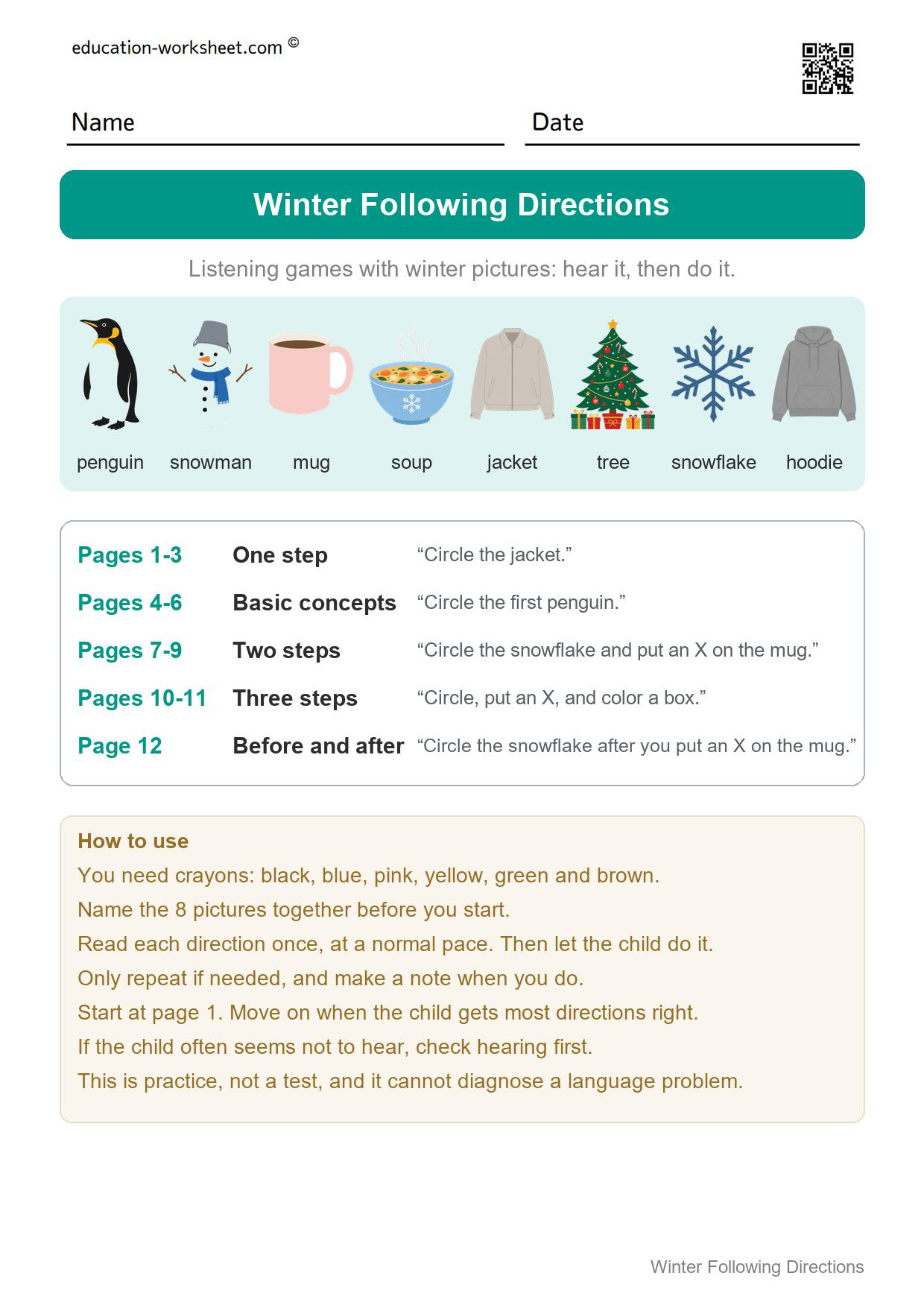
- Eight winter pictures: penguin, snowman, mug, soup, jacket, tree, snowflake and hoodie.
- One step (pages 1 to 3), basic concepts (pages 4 to 6), two steps (pages 7 to 9), three steps (pages 10 and 11) and before and after (page 12).
- A guide page for adults and an answer key that shows every finished page as a picture.
- Six crayon colors: black, blue, pink, yellow, green and brown.
- A separate PDF for every page, free to download and print.
The 12 Winter Following Directions Worksheets
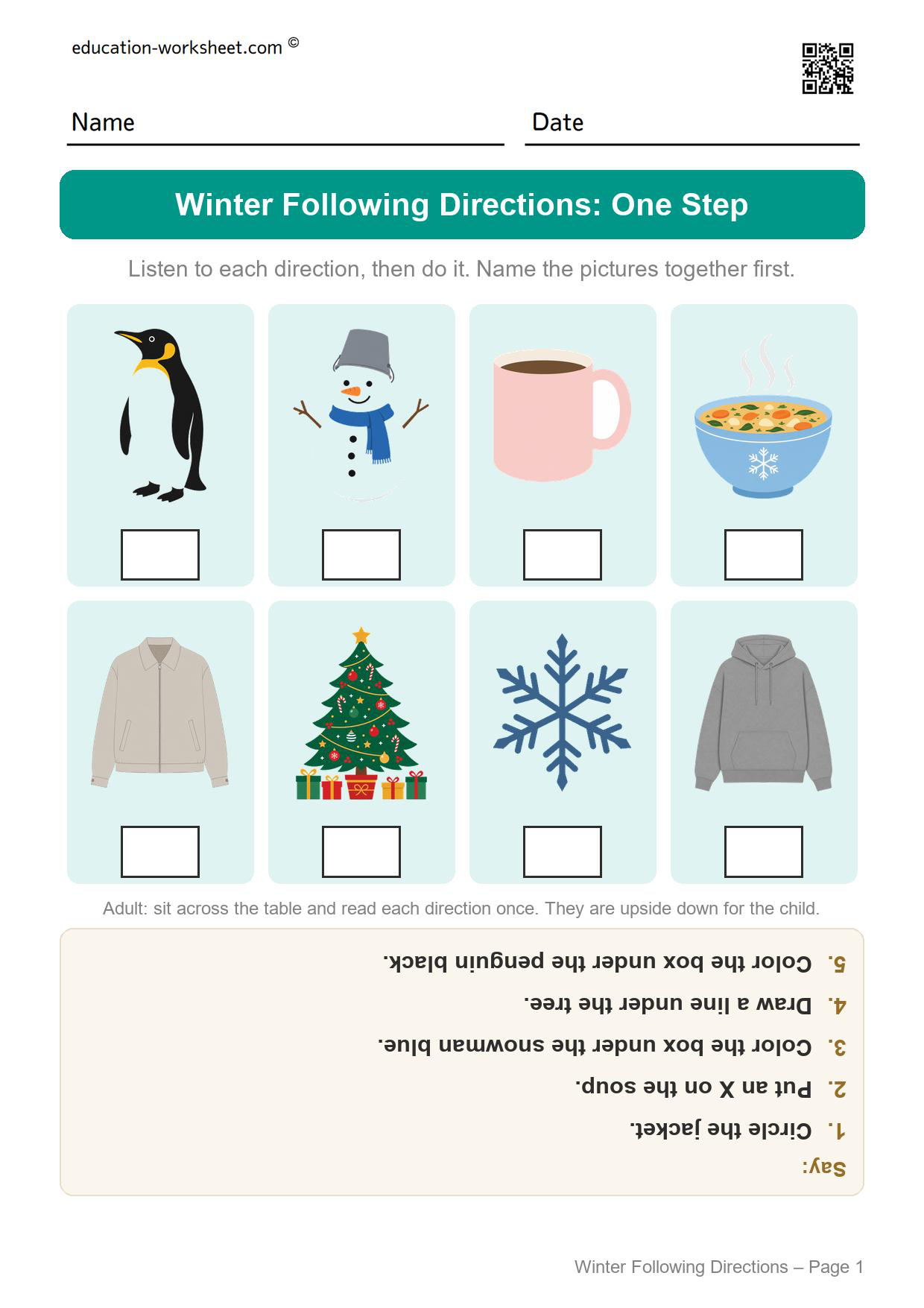
The directions are printed upside down along the bottom of each page. Sit across the table and they read the right way up for you, while a child who can read is not tempted to read ahead. The child only hears the direction, which keeps this a listening task.
Start Here – Eight Winter Pictures and Five Levels
The guide page introduces the eight winter pictures – a penguin, a snowman, a mug, a bowl of soup, a jacket, a Christmas tree, a snowflake and a hoodie – and shows the five levels of the pack. Say the names together first. In this pack the tree is simply called “the tree”, so tell the child that before you begin.
Page 1 – One Step
Five short directions to warm up: “Circle the jacket,” “Put an X on the soup,” “Color the box under the snowman blue.” Each one uses a single action and a single picture.
The pictures are already in color, so all coloring happens in the small box under each picture.
Page 2 – One Step
The same eight pictures in a different order. The snowflake that sat near the end of the bottom row on page 1 now starts the top row, so the child has to look again rather than remember.
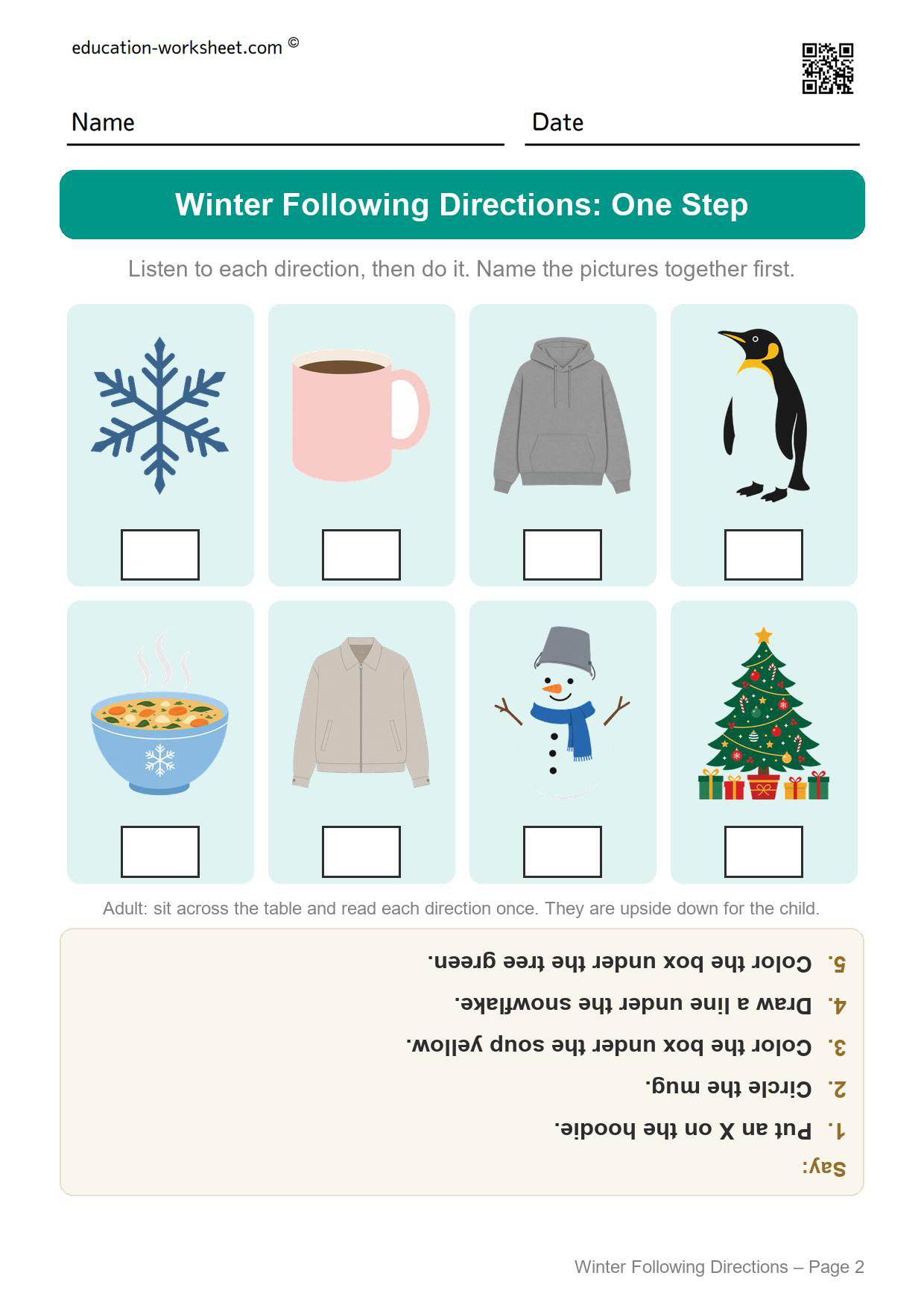
Page 3 – One Step
The third and last one-step page, with all four actions in play: circle the penguin, put an X on the tree, draw a line under the snowman, and color two boxes.
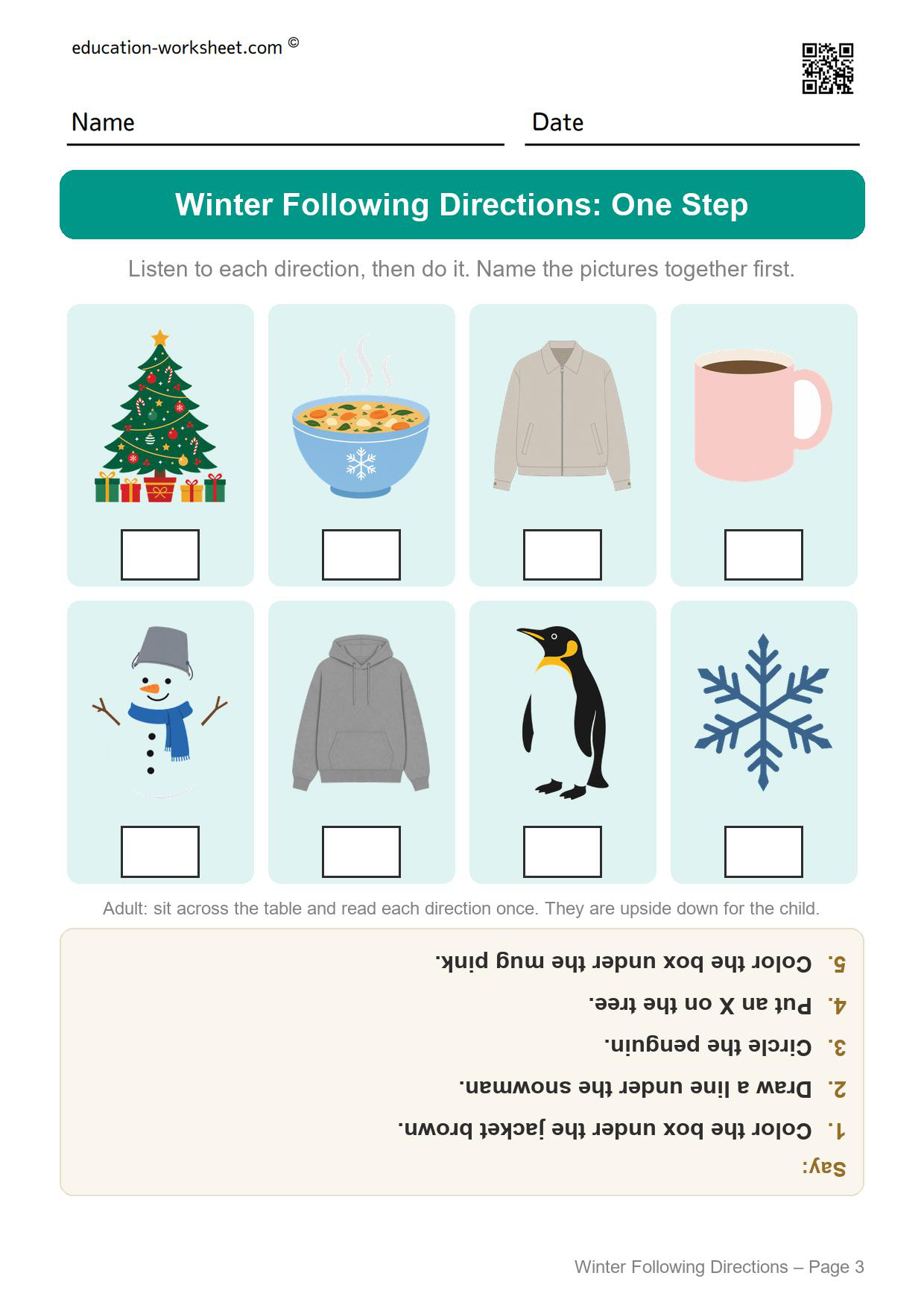
Page 4 – Basic Concepts: First and Last
Three penguins in the top row and three snowmen in the bottom row. With more than one of each, “circle the penguin” no longer has one answer, so every direction about a penguin or a snowman says first or last.
First and last mean reading order, left to right. Each group of repeated pictures stays inside one row, so there is never a question of which row to start from.
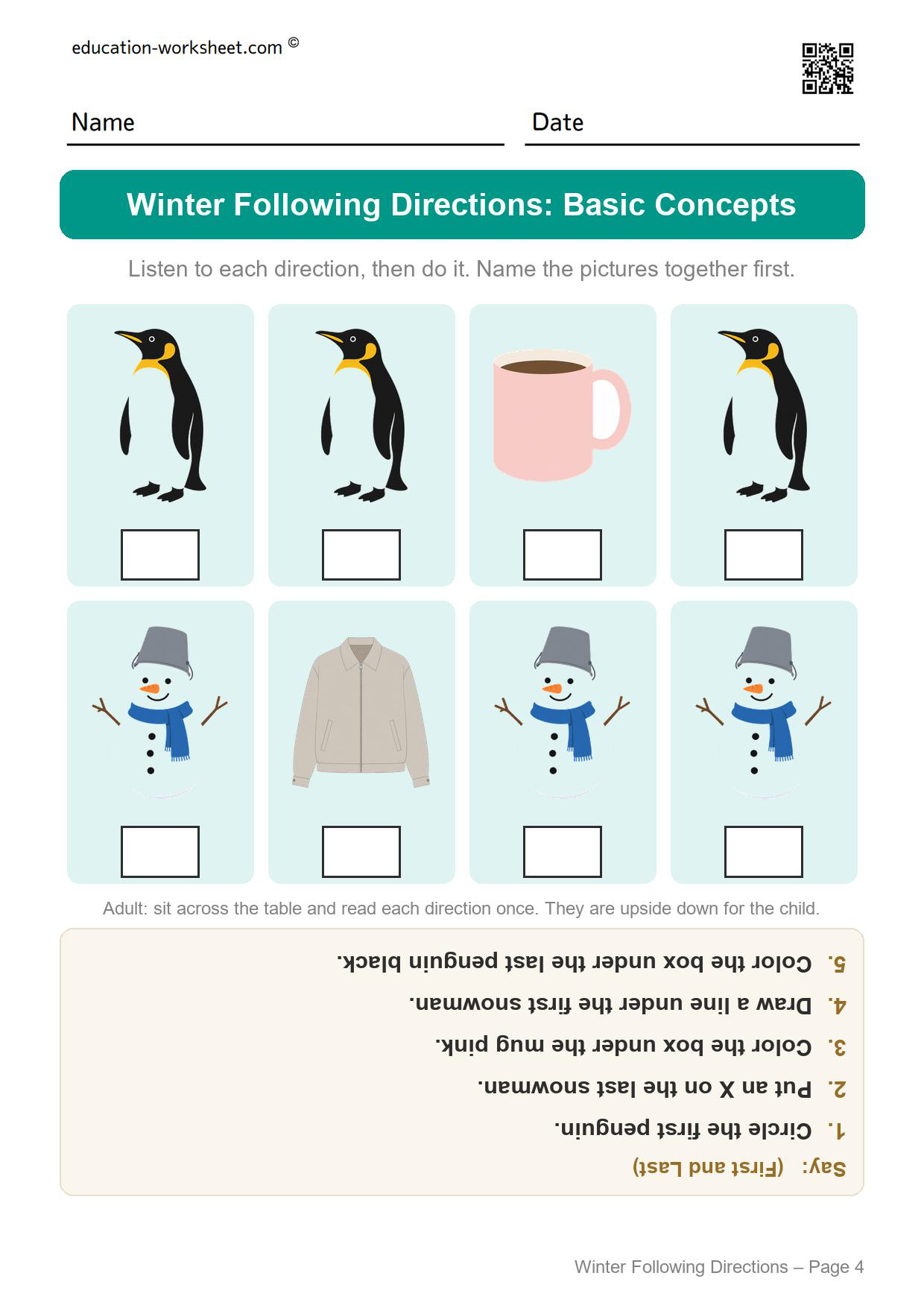
Page 5 – Basic Concepts: Top and Bottom
Two mugs, two bowls of soup and two snowflakes, one of each in each row. “Put an X on the snowflake in the bottom row” asks the child to hold a picture and a place in mind together.
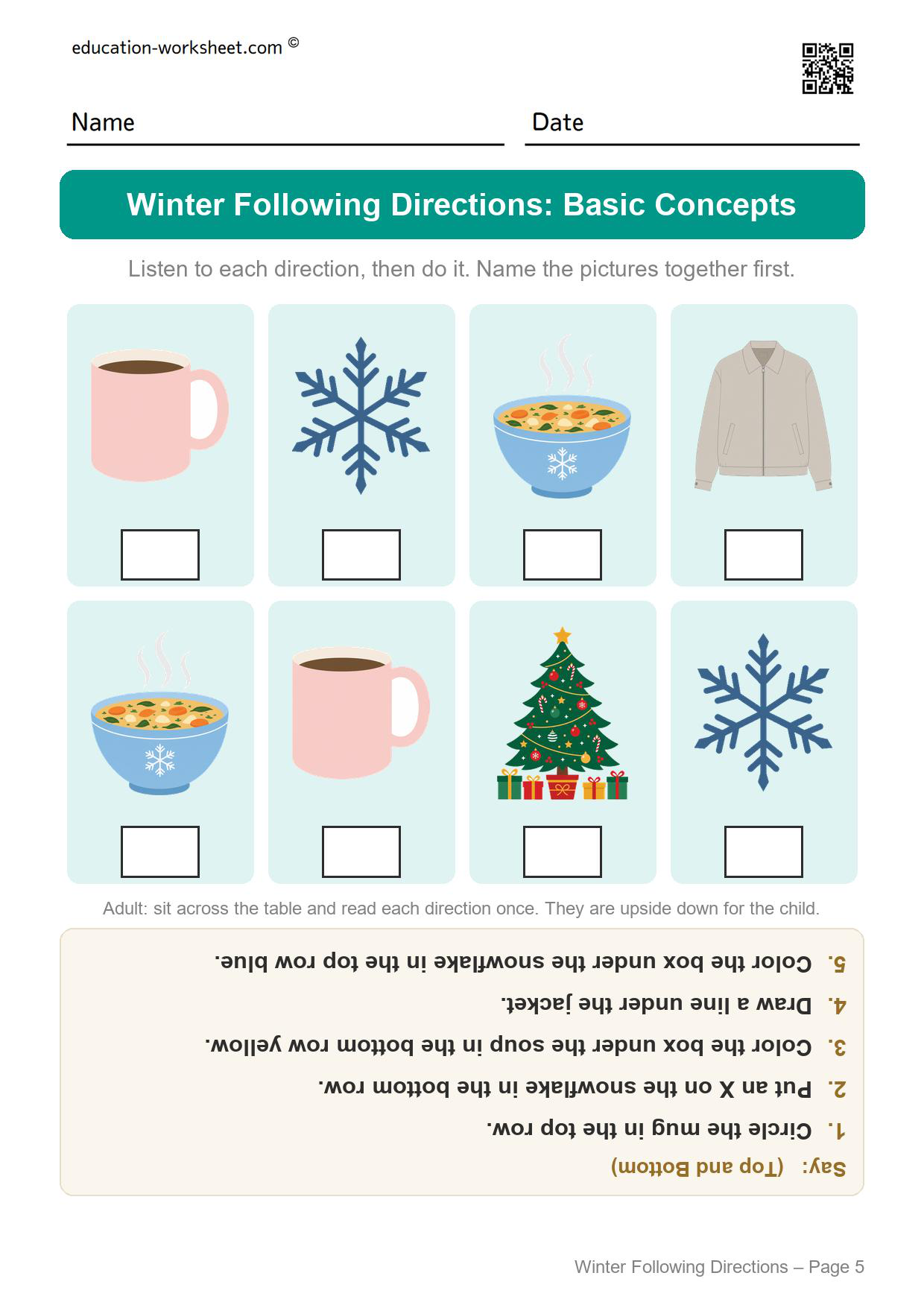
Page 6 – Basic Concepts: Next To and Between
A Christmas tree stands between two jackets in the top row, and two mugs sit in the bottom row. “Color the box under the mug next to the snowman pink” points to only one of them, because next to always means side by side in the same row.
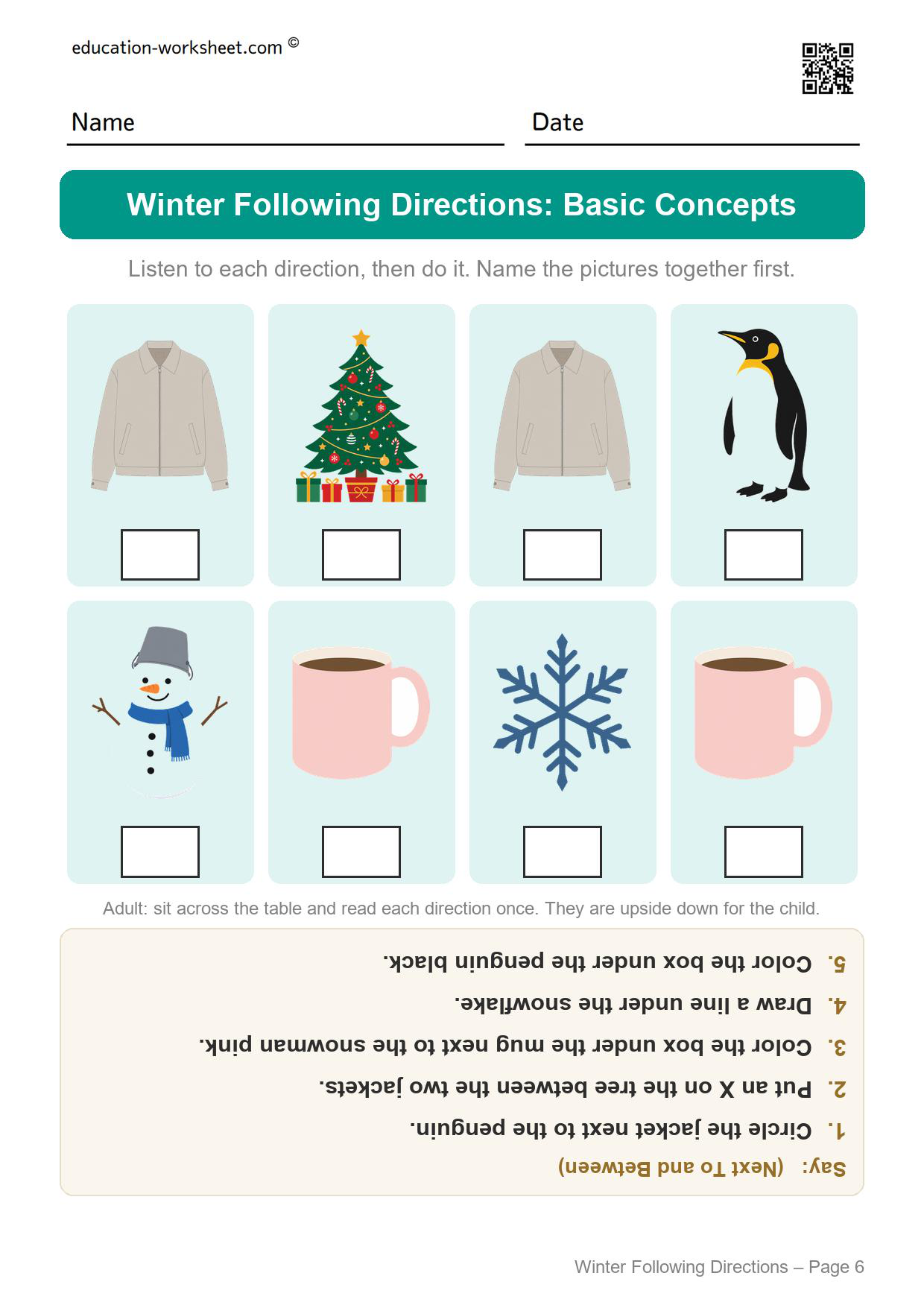
Page 7 – Two Steps
Two actions in each direction, for example “Circle the snowflake and put an X on the mug.” From here on, every one of the eight pictures is used exactly once per page.
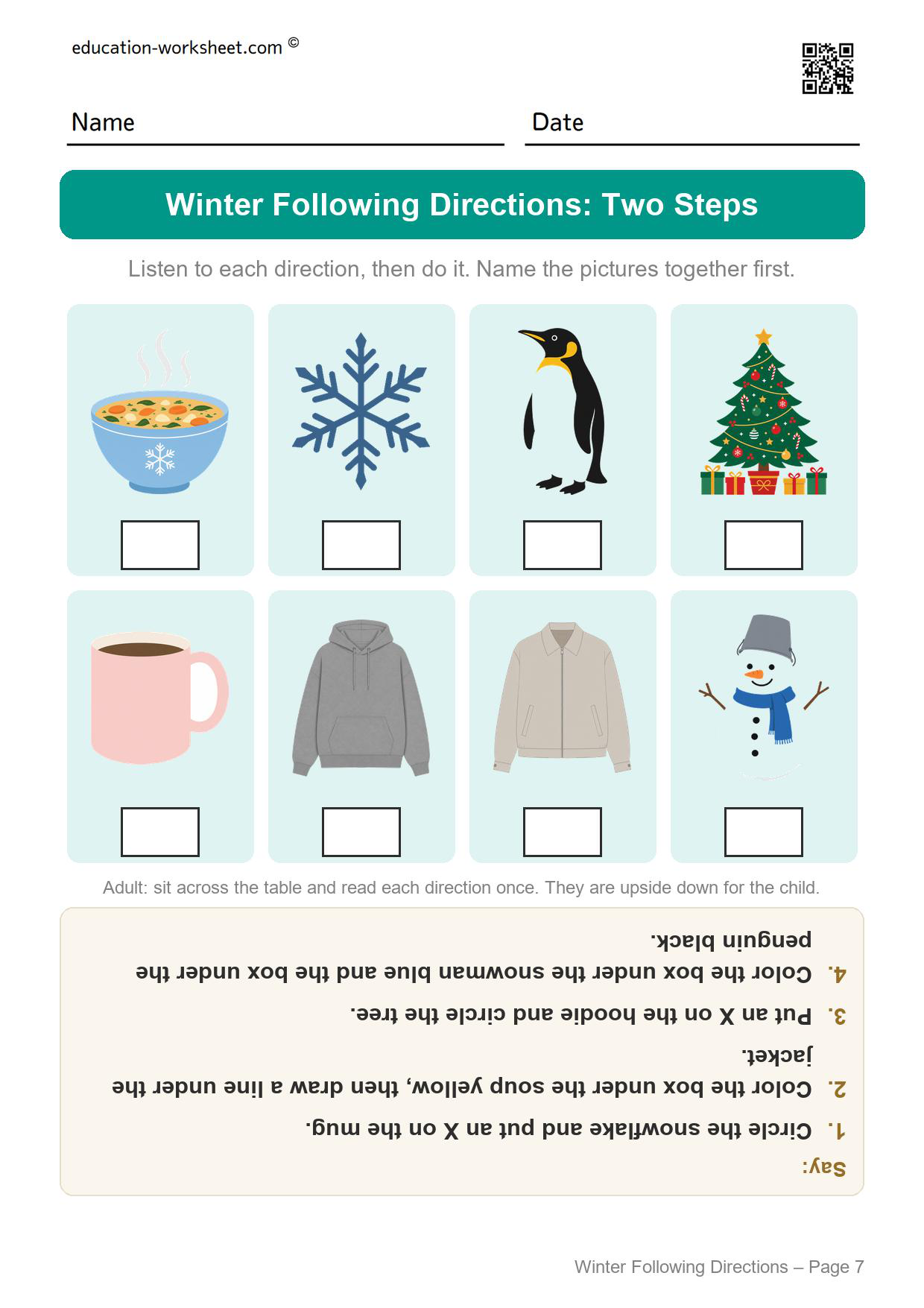
Page 8 – Two Steps with Concepts
Two steps plus the concepts from pages 4 and 5: “Put an X on the last mug and circle the snowflake.” Expect this page to need a few more repeats than page 7.
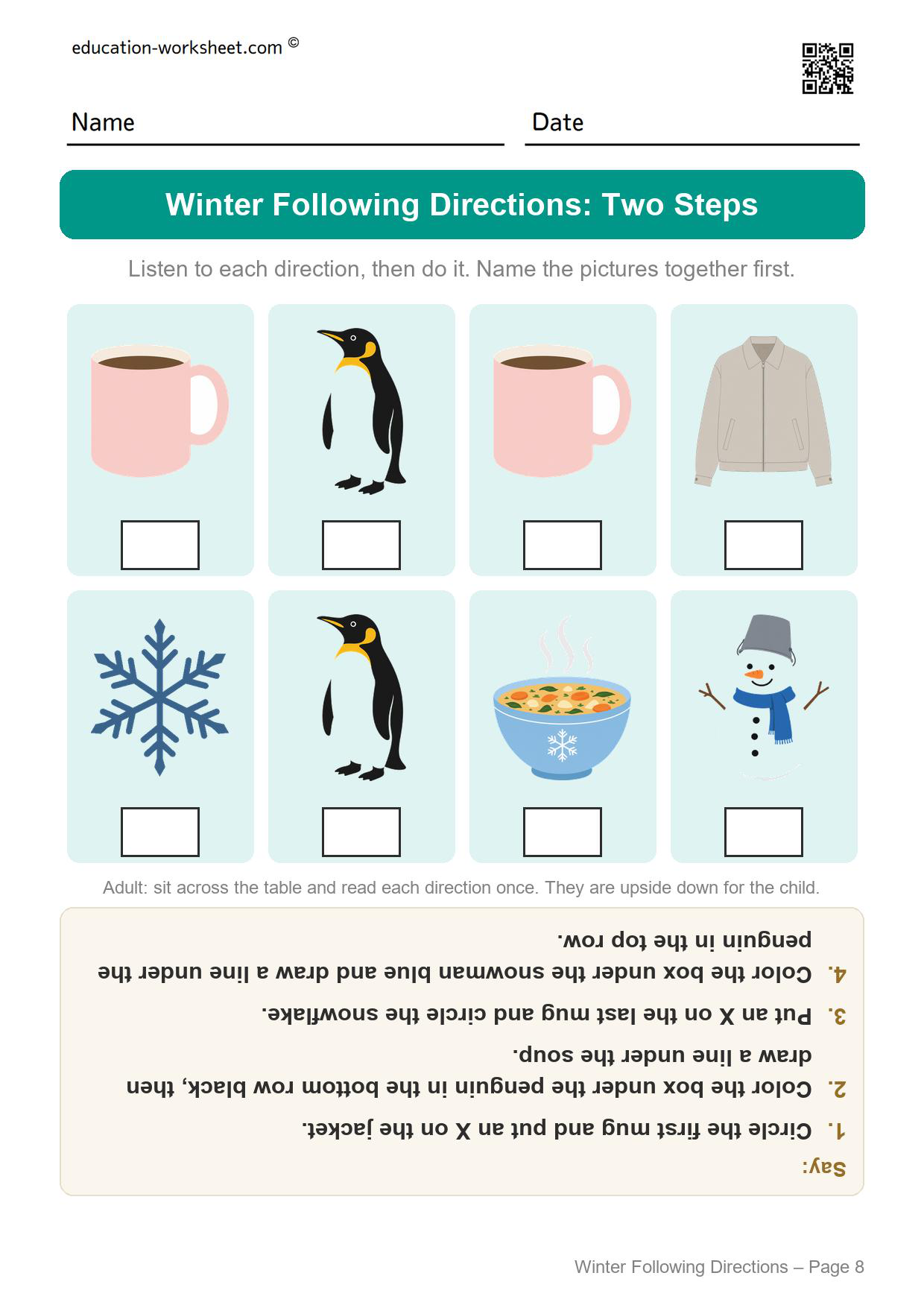
Page 9 – Two Steps
One of each picture again and four new two-step directions. A good check that two steps are secure before the three-step pages.
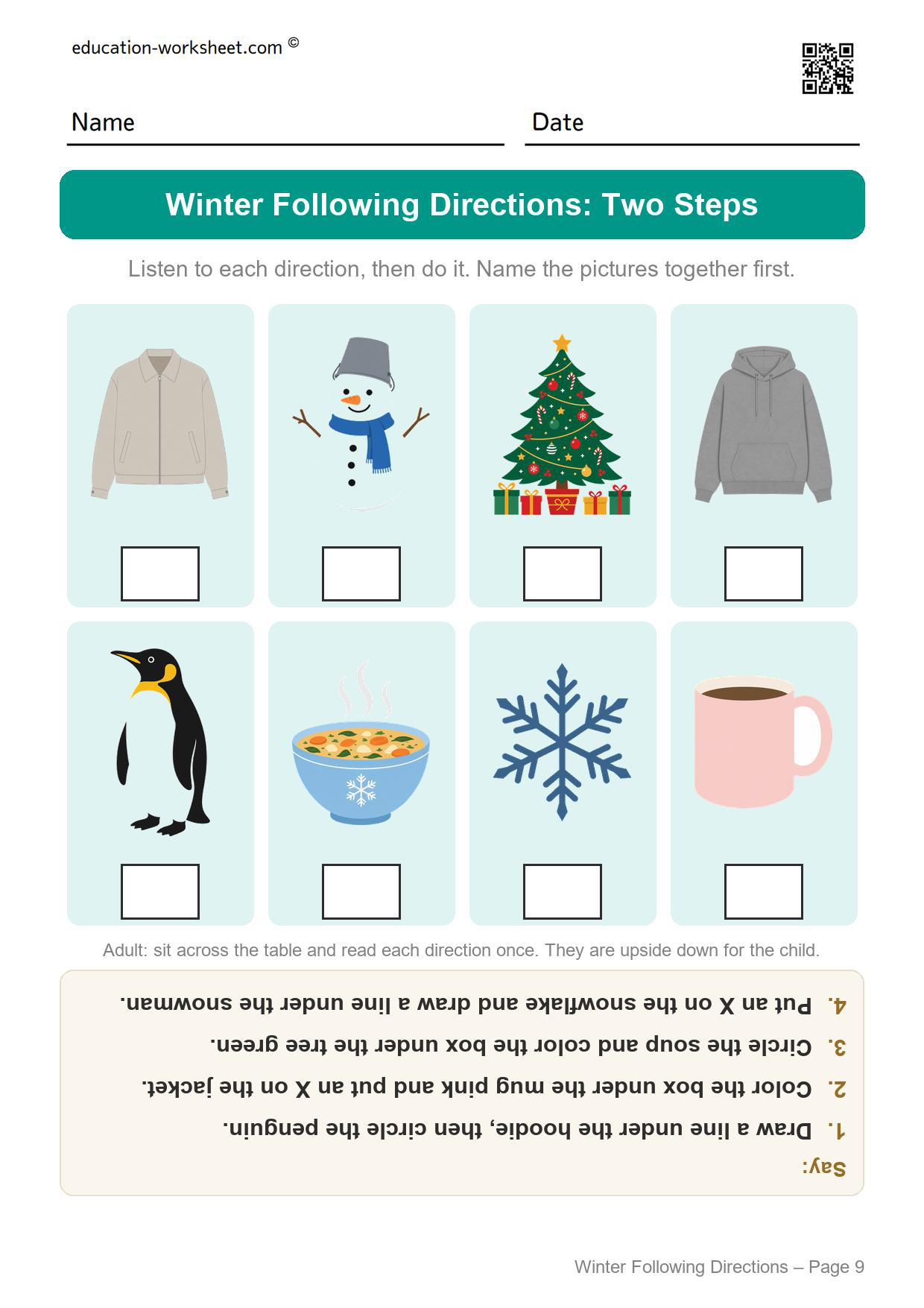
Page 10 – Three Steps
Three actions to hold at once: “Circle the jacket, put an X on the soup, and color the box under the penguin black.” Many young children manage two of the three at first, and that is a normal place to be.
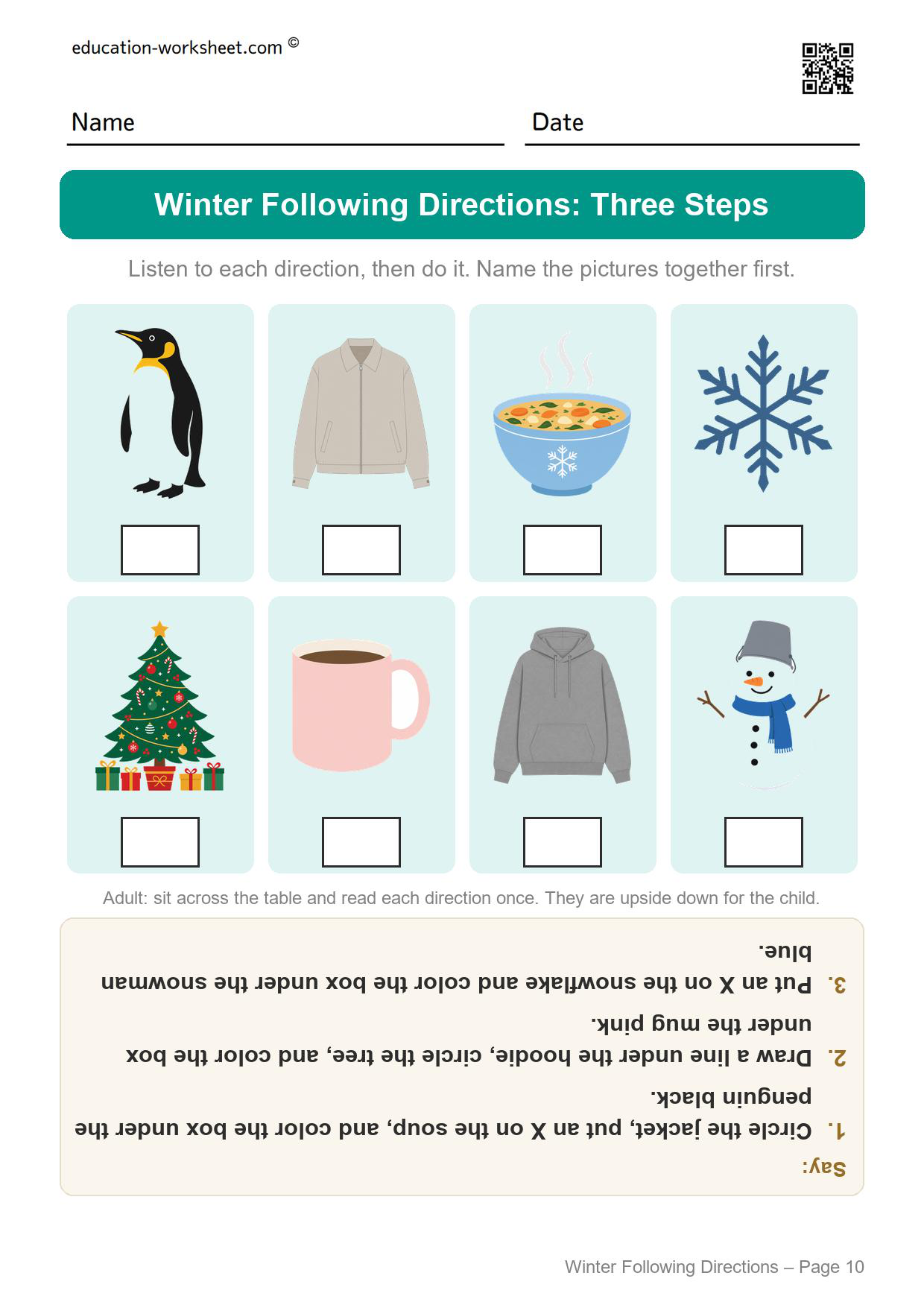
Page 11 – Three Steps with Concepts
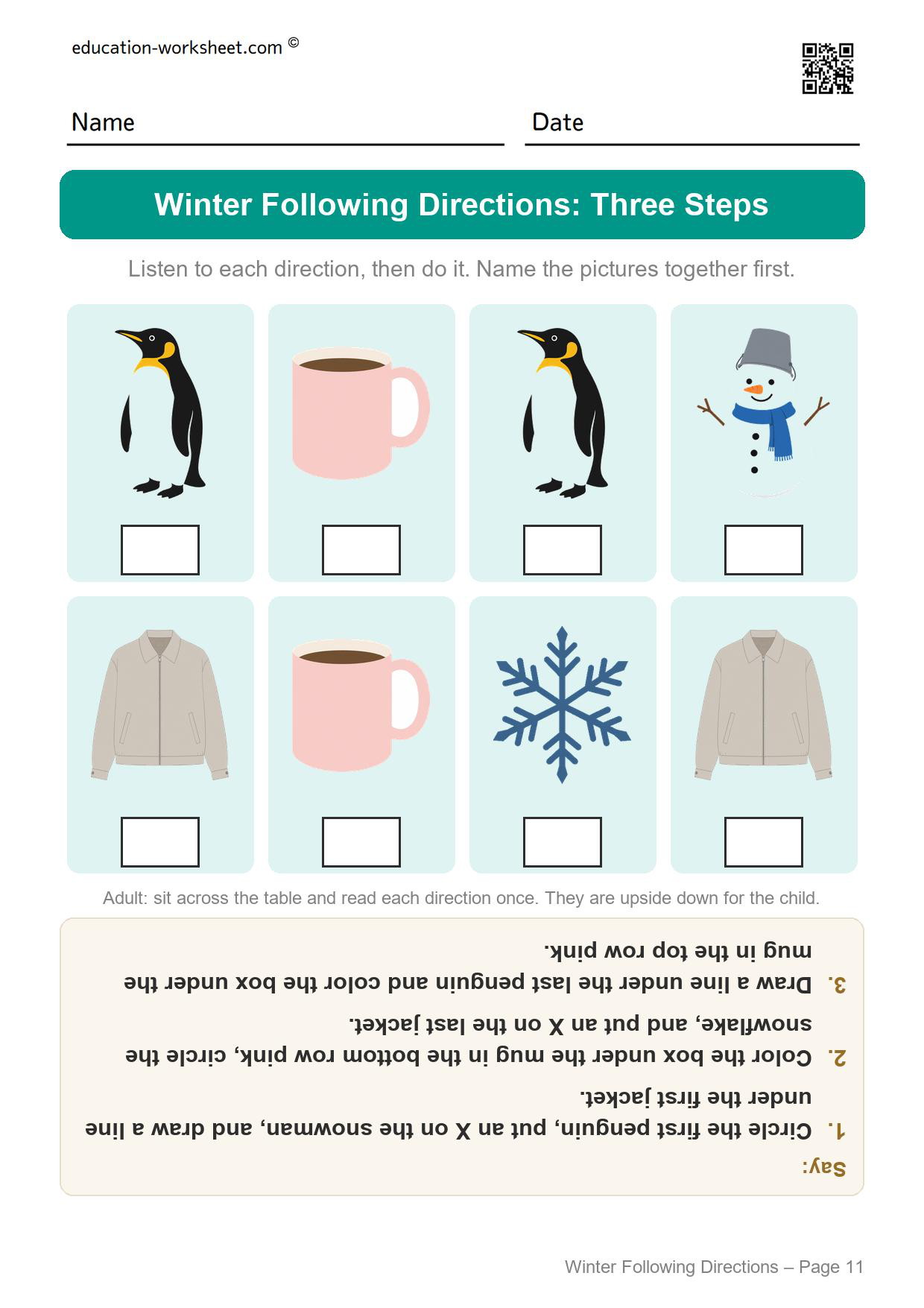
Three steps with first, last, top row and bottom row. Two penguins, two mugs and two jackets share the page, so every word in the direction matters.
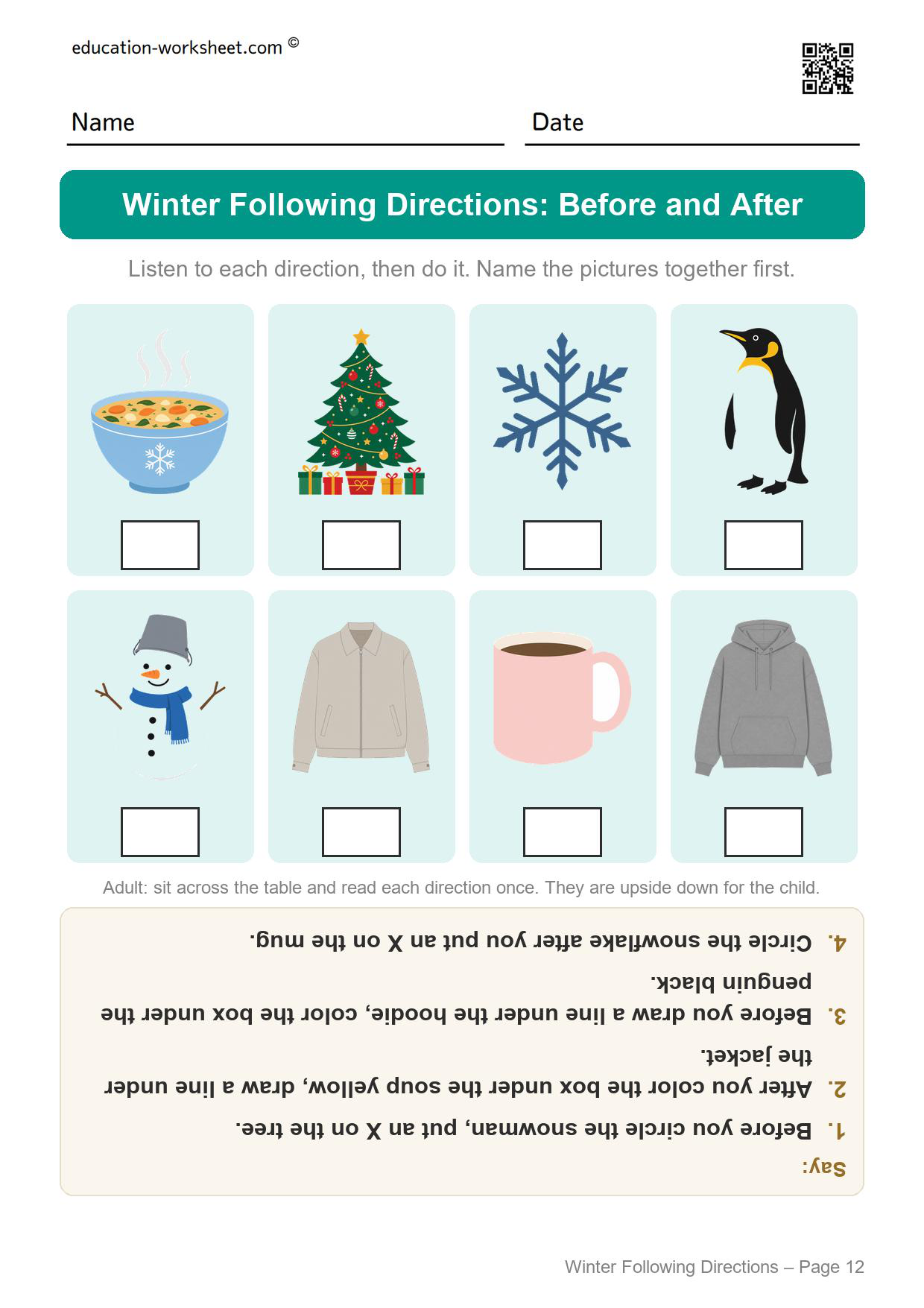
Page 12 – Before and After
The order of the words is not the order of the actions. “Before you circle the snowman, put an X on the tree” means the tree comes first. Watch which picture the child marks first, not only the finished page.
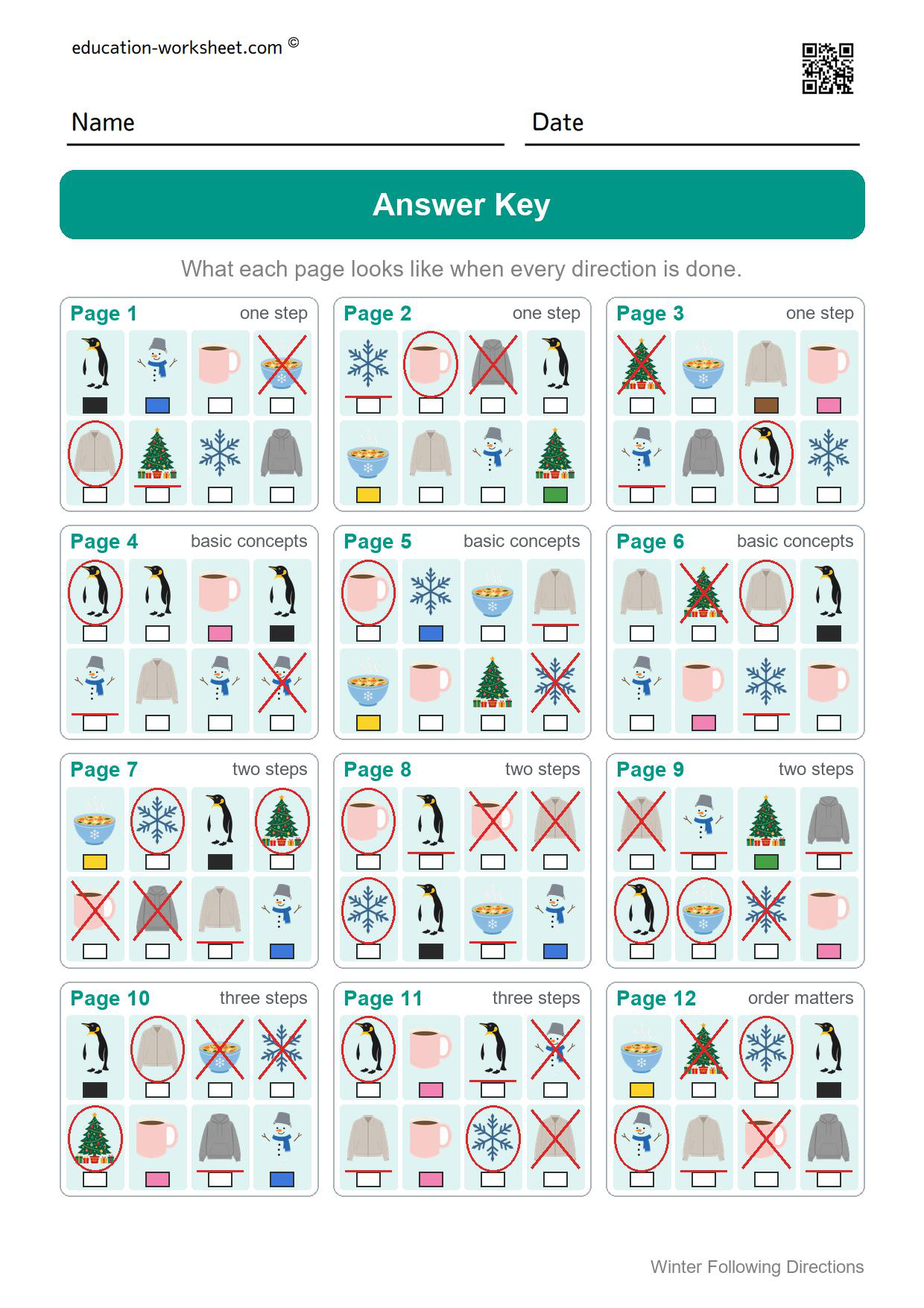
Answer Key – Every Page Finished
A small picture of each page with every direction done, so checking takes seconds. For page 12, the order matters as well as the marks.
What Makes a Good Direction
A child can only practice listening if the direction has exactly one right answer. Before these pages were printed, a small program read every direction and checked it against the pictures on its page.
- One picture per description. Whenever there are two or three of the same picture, the direction names which one: first, last, top row, bottom row, next to or between.
- One mark per picture. No picture is ever asked to be circled and crossed out on the same page.
- Four simple actions: circle, put an X on, draw a line under, and color the box under. Children learn them on page 1 and then use their attention for listening.
- Colors that make sense: a black box under the penguin, a blue box under the snowman with its blue scarf, a pink box under the pink mug.
- Pictures that move: the order changes on every page, so remembering where something was does not help.
When a Child Finds Directions Hard
When a direction goes wrong, look at what went wrong. Did the child miss a word such as between? Do the first step and forget the second? Mark the right picture but in the wrong order on page 12? Each points to a different kind of help: teaching a concept, practicing shorter directions, or simply more time.
Check hearing first if a child often seems not to hear, especially in winter when colds and ear infections are common and can affect hearing for weeks. If following directions is hard at home and at school, talk to the child’s teacher or a speech-language pathologist. A worksheet can support practice but cannot explain why the difficulty is there.
Who These Worksheets Are For
- Age: about four to seven, from preschool to first grade. Start on page 1 whatever the age.
- Before starting: the child should know the eight picture names and be able to draw a circle and an X.
- SL.K.2 and SL.1.2 – understand information that is read aloud or presented orally.
- K.G.A.1 – describe where objects are using words such as next to, above and below, as practiced on pages 4 to 6.
How to Use These Worksheets
- Name the eight pictures together on the guide page, including “tree” for the Christmas tree.
- Sit across the table so you can read the upside-down directions.
- Read one direction at a normal speed and wait until the child has finished before reading the next.
- Avoid repeating. If you do repeat, note it, because fewer repeats over time is a sign of progress.
- Go up a level when the child gets most of a page right without help.
- Compare the finished page with the answer key, and on page 12 check the order too.
Three Things to Watch For
1. Only the last step gets done. On longer directions, the most recent words are the easiest to remember. If the child keeps doing just the final action, spend longer on the one- and two-step pages.
2. Following the order of the words. “Circle the snowflake after you put an X on the mug” mentions the snowflake first but asks for it second. Mixing these up is very common and shows that before and after are still settling in.
3. Rushing. Some children reach for a crayon the moment they hear a picture name. A simple rule helps: hands on the table until the direction is finished.
Printing Tips
- Print at 100 percent, actual size, on A4 or US Letter.
- Print in color. The pictures are part of the task, and the snowflake, snowman and penguin are much easier to tell apart in color.
- Keep a second copy for yourself if you would rather read the directions the right way up.
Frequently Asked Questions
What age are these winter following directions worksheets for?
About four to seven. Younger children can start with the one-step pages, and older children can work up to three steps and before and after.
Are these Christmas worksheets?
They are winter worksheets with one Christmas tree among the pictures, so they work through December, January and February in any classroom.
Why are the directions printed upside down?
So an adult across the table can read them while the child, even one who can read, only listens. If you sit beside the child, turn the page around to read.
What do first and last mean on these pages?
Reading order: left to right along a row. Repeated pictures always sit in the same row, so first and last always point to one picture.
Is this a test for a language disorder?
No. These are practice pages with no scores. If you are concerned, check hearing first and talk to a speech-language pathologist.
Do I need to sign up to download these?
No. Every PDF downloads immediately, with no account, no email address and no cost.
Can I use these in my classroom or therapy room?
Yes, they are free to print for home, classroom and therapy use. Please do not sell them or re-host the files elsewhere.
More Free Listening and Concept Worksheets
- Free Fall Following Directions Worksheets – 1, 2 and 3 Steps
- Free Auditory Memory Worksheets for Kids – Listen and Repeat
- Free Position Words Worksheets for Kindergarten – In, On, Under, Next To
- Free Ordinal Numbers Worksheets for Kindergarten – First, Second, Third, Fourth and Fifth
- Free Four Seasons Worksheets for Kindergarten – Science
- Free Final Consonant Deletion Worksheets – Minimal Pairs PDF