
These free printable tall and short worksheets give preschool and kindergarten children forty height comparisons, four to a page. Trees, buildings and towers of stacked blocks, two or three to a box, and one question at the top of each sheet.
Everything stands on a printed ground line. That line is the whole reason the comparison works: both objects start at the same level, so the tops are the only thing to look at. It is the first rule of measuring, and here it is drawn onto the page rather than explained.
The pack moves through four questions: the taller of two, the shorter of two, the tallest of three, the shortest of three. Then it makes the last pages close.
- What Is in This Free Tall and Short Worksheet Pack
- The 11 Tall and Short Worksheets
- Worksheet 1 – Circle the Taller One
- Worksheet 2 – Circle the Taller One
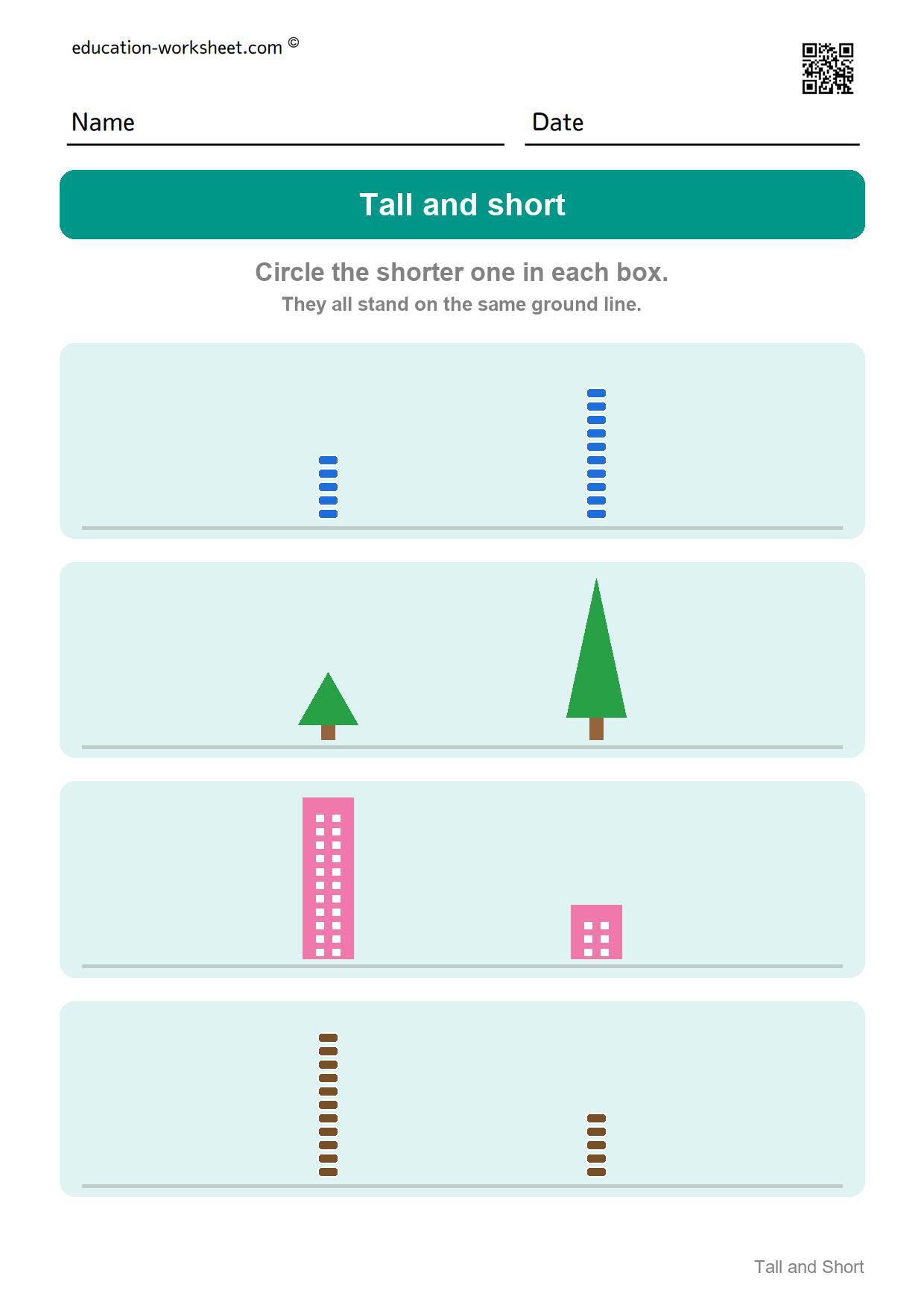
- Worksheet 3 – Circle the Shorter One
- Worksheet 4 – Circle the Shorter One
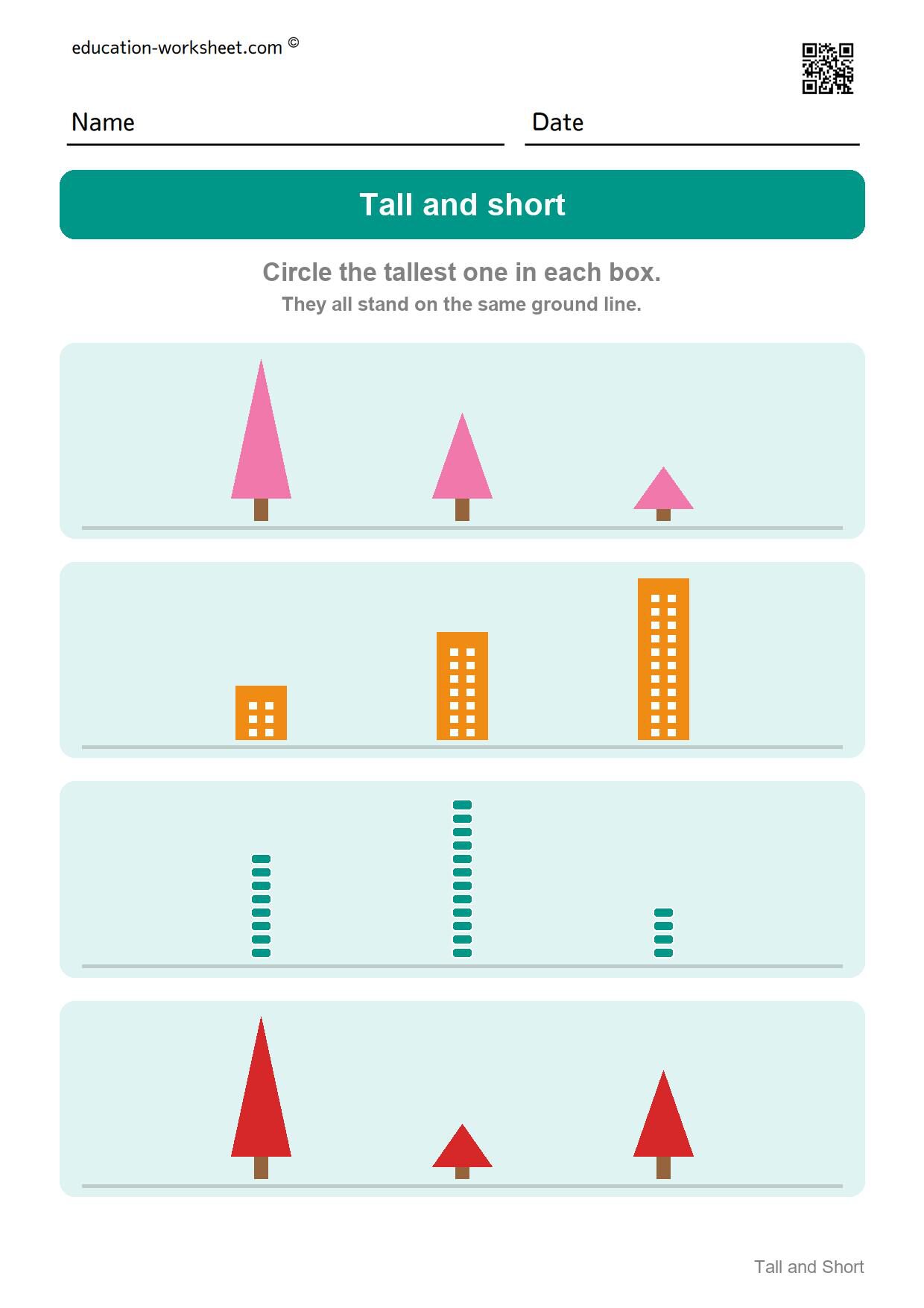
- Worksheet 5 – Circle the Tallest One
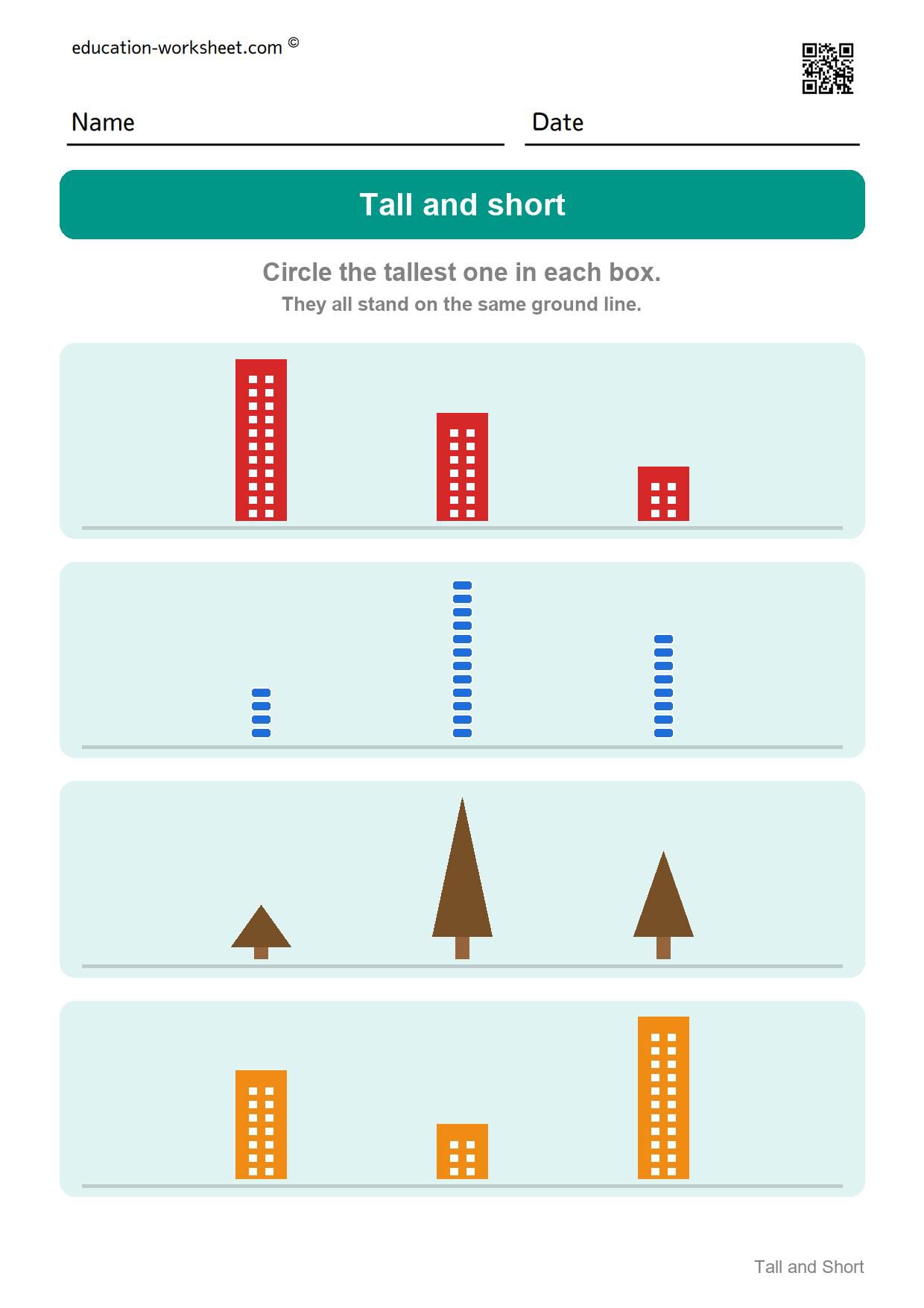
- Worksheet 6 – Circle the Tallest One
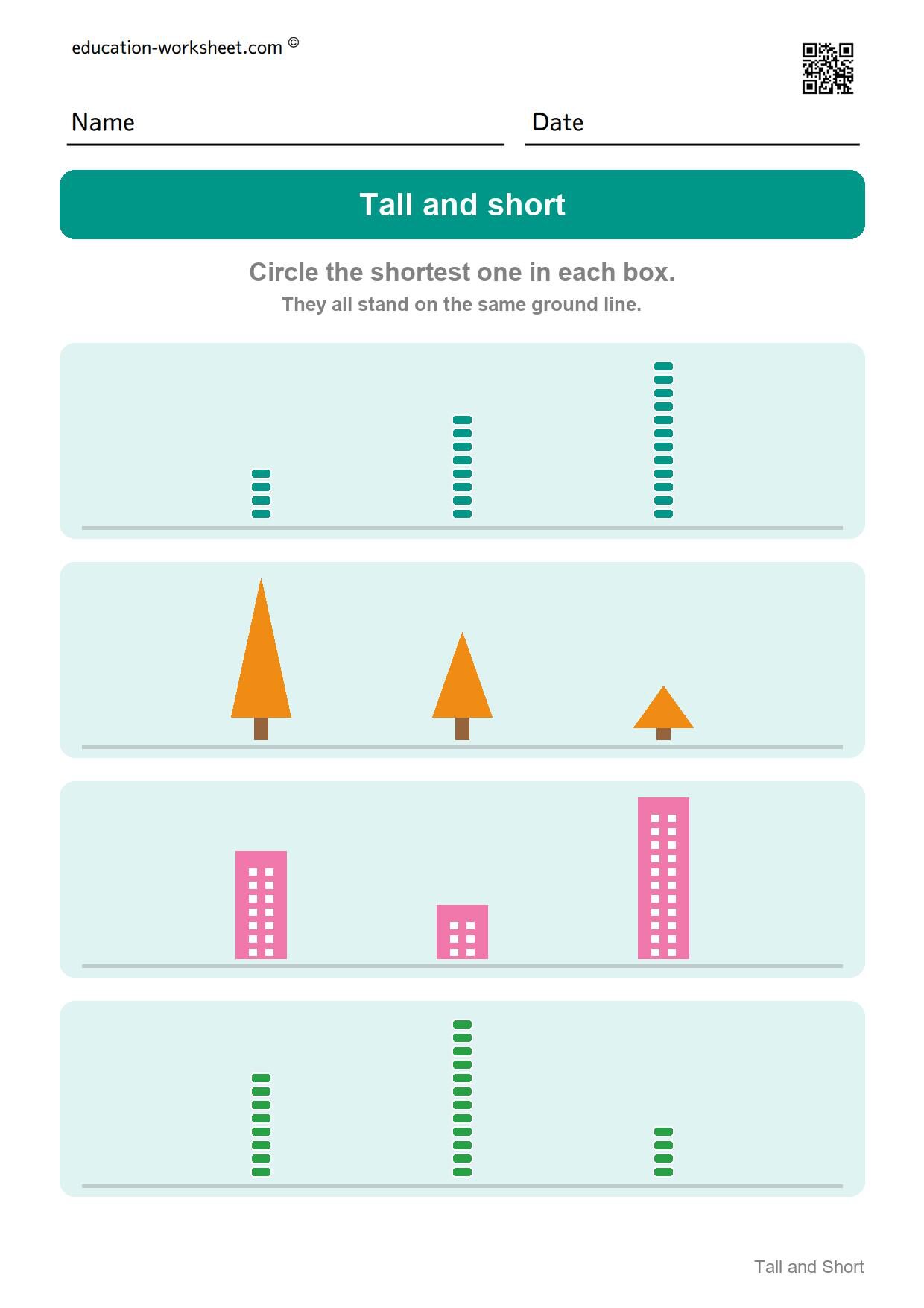
- Worksheet 7 – Circle the Shortest One
- Worksheet 8 – Circle the Shortest One
- Worksheet 9 – Circle the Tallest One
- Worksheet 10 – Circle the Shortest One
- Answer Key – All 40 Boxes
- Why the Block Towers Matter
- When Children Are Ready for Tall and Short
- How to Use These Worksheets
- Three Things to Watch For
- Printing Tips
- Frequently Asked Questions
- More Free Comparing Worksheets
What Is in This Free Tall and Short Worksheet Pack
- Ten printable worksheets with four boxes on each – forty questions in all.
- Two objects per box on pages 1 to 4, three per box from page 5 onwards.
- Three kinds of object: trees, buildings with windows, and towers of equal-sized blocks.
- Heights from about 1 centimeter to about 3.7 centimeters on the printed page.
- An eleventh page with the full answer key.
- A separate PDF for every page, free to download and print.
The 11 Tall and Short Worksheets
We measured every object in the pack and checked all forty answers against the key. They agree in every box. That also lets the difficulty be described in millimeters rather than in adjectives.
On pages 1 to 8 and page 10, the winning object is ahead by a centimeter or more – a gap a four-year-old can see from across the table. On page 9, two of the four boxes come down to about six millimeters. That one page is where the pack stops being a looking exercise and becomes a comparing one.
Worksheet 1 – Circle the Taller One
Two things in each of the four boxes: a tower of orange blocks, two trees, two buildings, a tower of blue blocks. Measured on the page the pairs run 2.7 against 1.4 centimeters, 2.2 against 3.7, 2.2 against 3.7, and 3.3 against 1.4.
Every pair here is decided by at least a centimeter and a half, which at this size is unmistakable. The ground line under each box is the thing to point at: both objects start there, so only the tops need comparing.
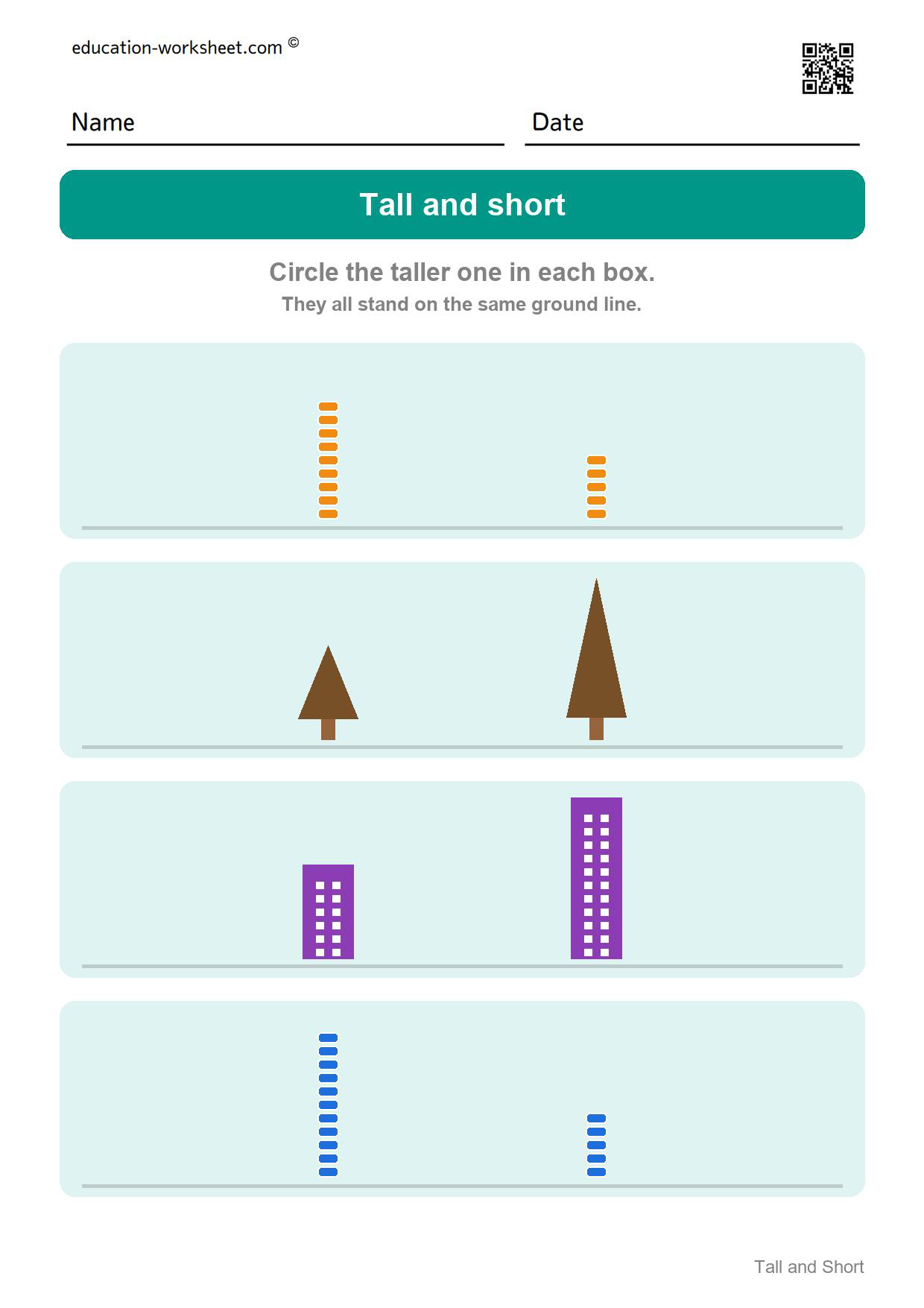
Worksheet 2 – Circle the Taller One
Four more pairs, and the answer is on the right in three of the four boxes. Page 1 had it on the left twice, so a child who has settled into a side is about to be caught.
The block towers are worth a word. Every block in a tower is the same size, so a child can count blocks instead of comparing heights, and they will get the same answer. That is measuring by units, and it is a perfectly good way to do it.
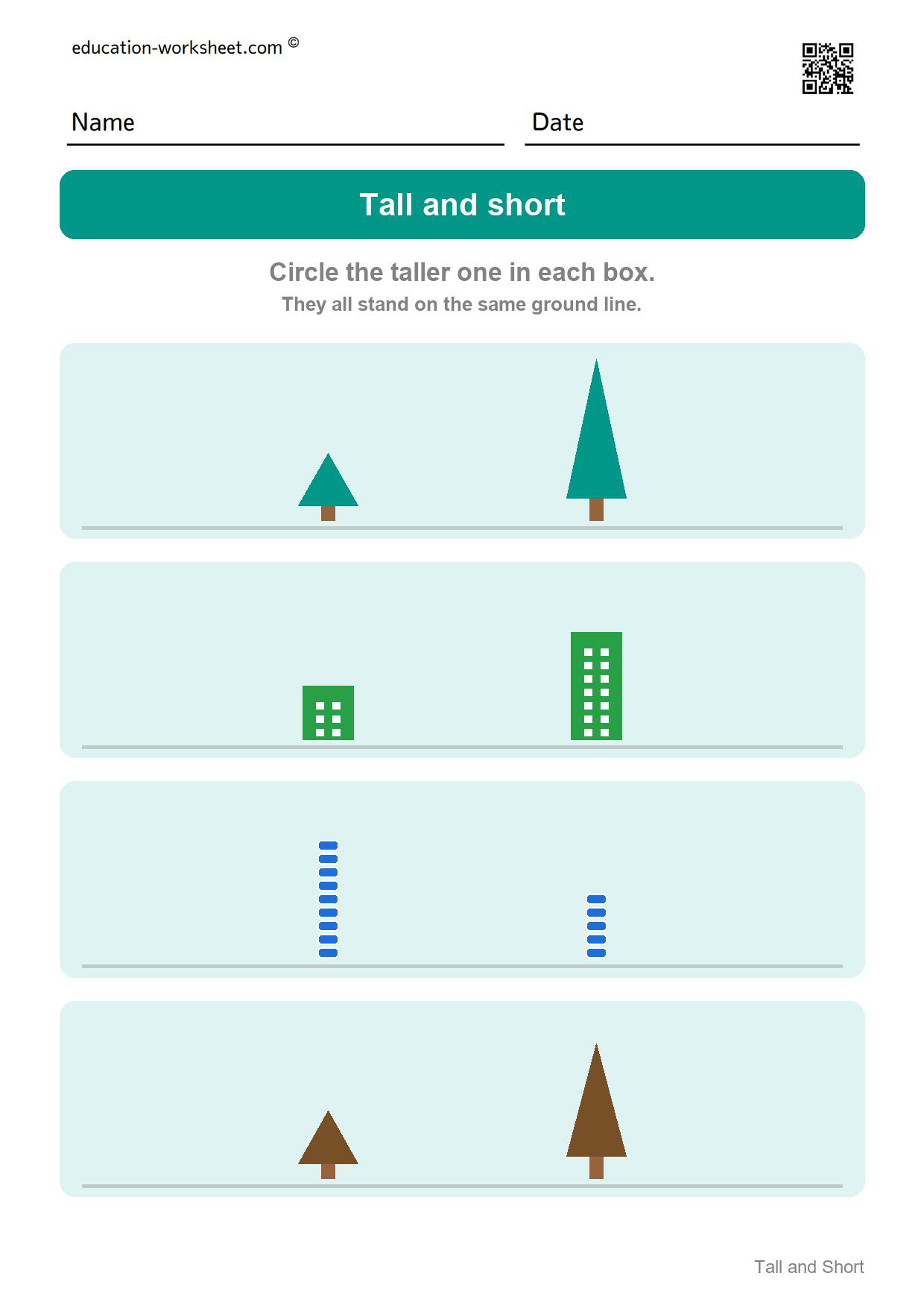
Worksheet 3 – Circle the Shorter One
The question turns over here, and this is the page where most children lose a mark or two. Two pages of taller is enough to build a habit.
Read the instruction at the top out loud before the first box, then again at the third. The pictures give no hint at all about which question is being asked.
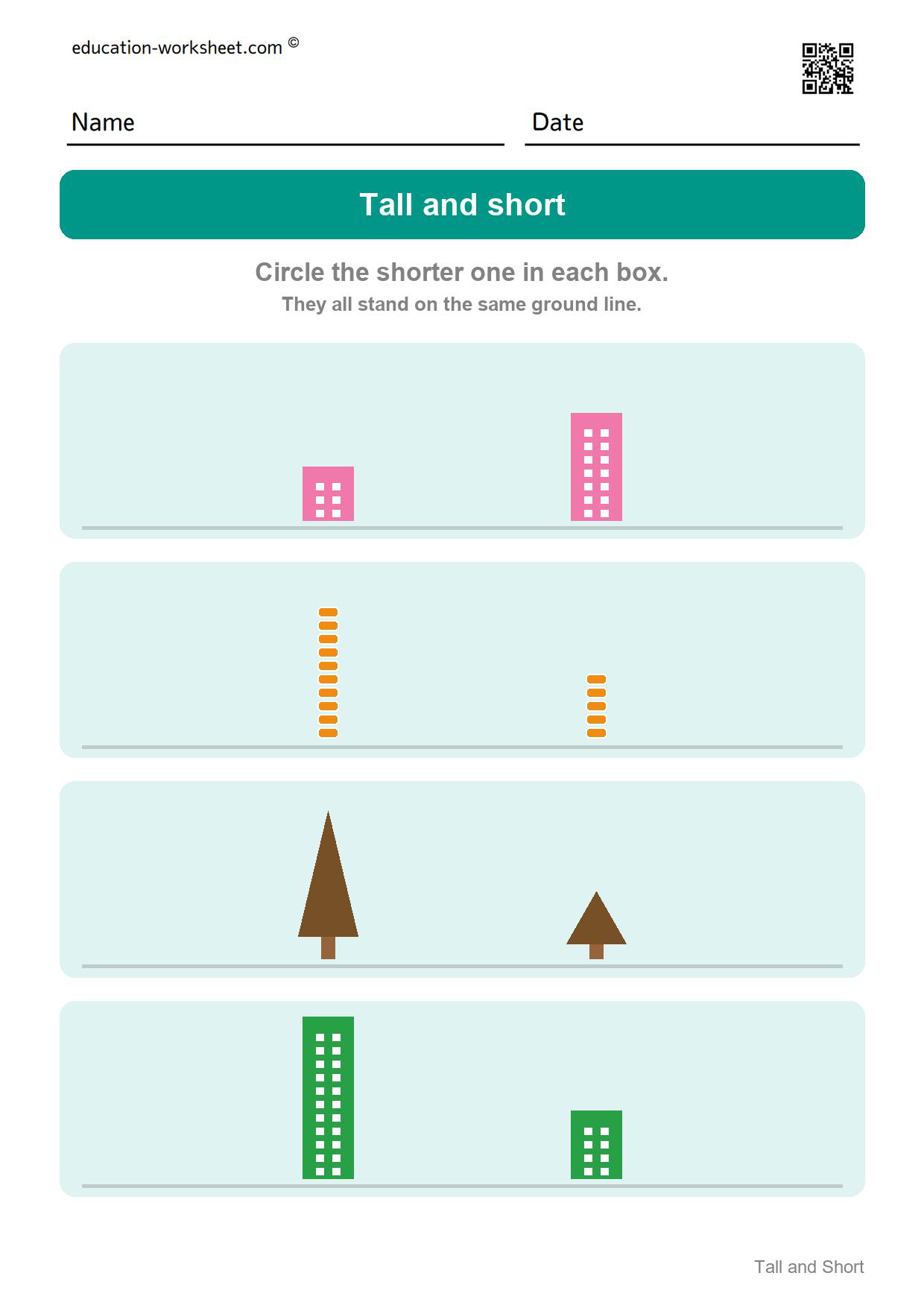
Worksheet 4 – Circle the Shorter One
The last page with only two objects in a box, and the clearest gaps in the pack: one box pairs 3.7 centimeters against 1.2.
From page 5 onwards there are three objects in every box, and the word changes from shorter to shortest.
Worksheet 5 – Circle the Tallest One
Three objects in every box now. All four boxes on this page are built to the same ratio – the middle one is about two thirds of the tallest, and the shortest about a third.
That makes the page feel orderly, and it is the gentlest possible introduction to comparing three things. The answer sits in a different place in each box, so the order has to be read rather than remembered.
Worksheet 6 – Circle the Tallest One
The same even spacing as page 5, with the tallest object moved around: left, middle, middle, right.
Two of the four answers are in the middle. Children reach for the ends of a row first, so middle answers are the ones that get missed.
Worksheet 7 – Circle the Shortest One
The second turn of the question, and the harder one. Finding the shortest of three means ignoring the object that catches the eye.
The gaps here are wide again – the shortest is usually about half the next one up – so the difficulty is entirely in the word at the top of the page.
Worksheet 8 – Circle the Shortest One
Four more boxes of three, with the answer in the middle once and on the right twice.
This is the last comfortable page. On page 9 the heights start to close up.
Worksheet 9 – Circle the Tallest One
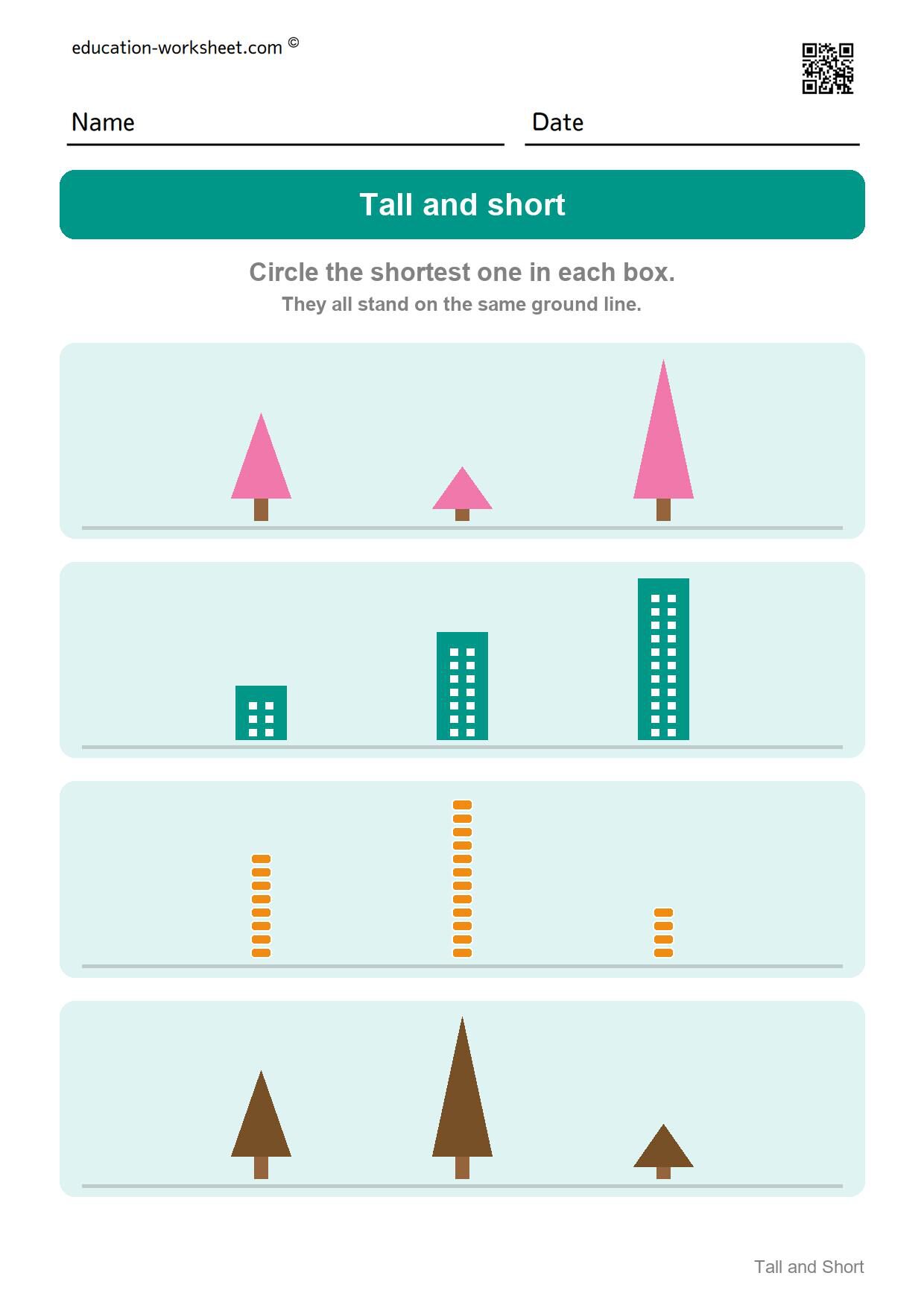
This is the hardest page in the pack, and it is hard for a measurable reason. In two of the four boxes the tallest object leads the next one by about six millimeters – 2.8 against 3.4 centimeters in one, 3.1 against 3.7 in the other.
Everywhere else in the pack the winner is ahead by a centimeter or more. Six millimeters is close enough that a child has to look along the tops rather than glance at the box, and that is exactly the habit the page is for.
Worksheet 10 – Circle the Shortest One
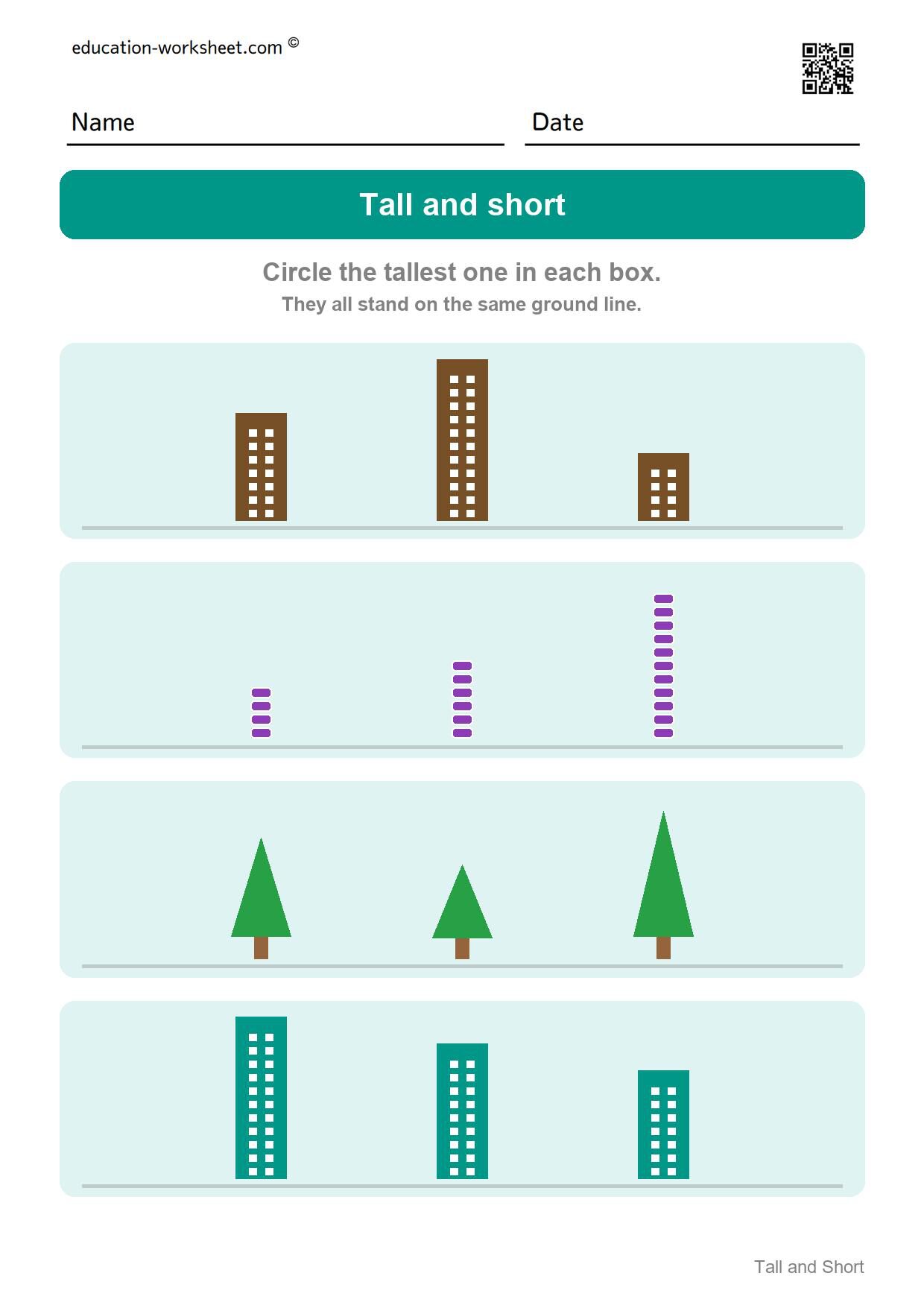
The pack closes on shortest, with the answer in the middle in two of the four boxes.
The gaps open up again after page 9, so the last page is a place to finish confidently rather than a final test.
Answer Key – All 40 Boxes
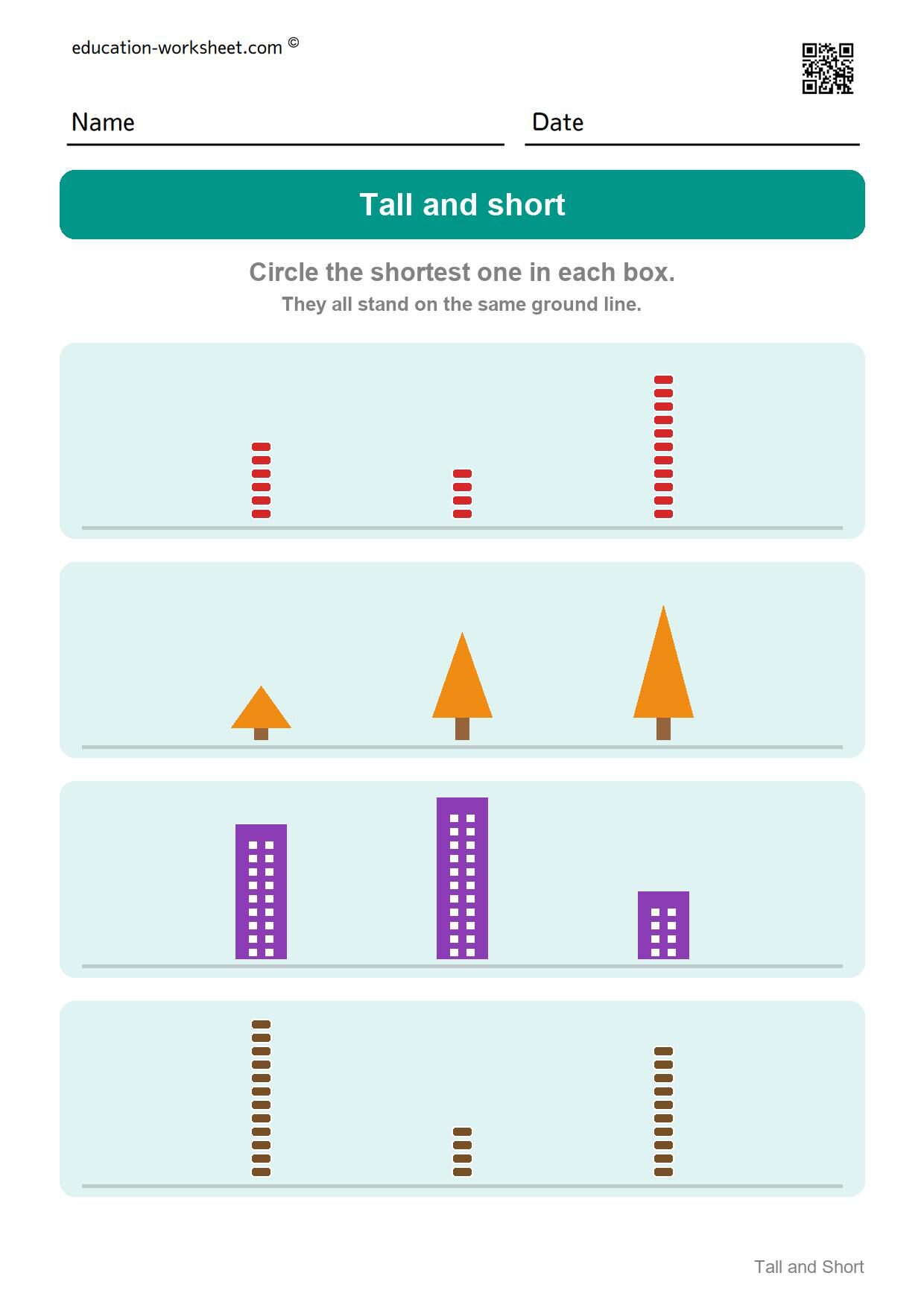
The eleventh sheet gives every answer as left, middle or right, four to a page, with a reminder of which question each page asked.
Across the forty boxes the answer is on the right 19 times, on the left 13 times and in the middle 8 times. The middle is the rarest answer and the one children check last.
Why the Block Towers Matter
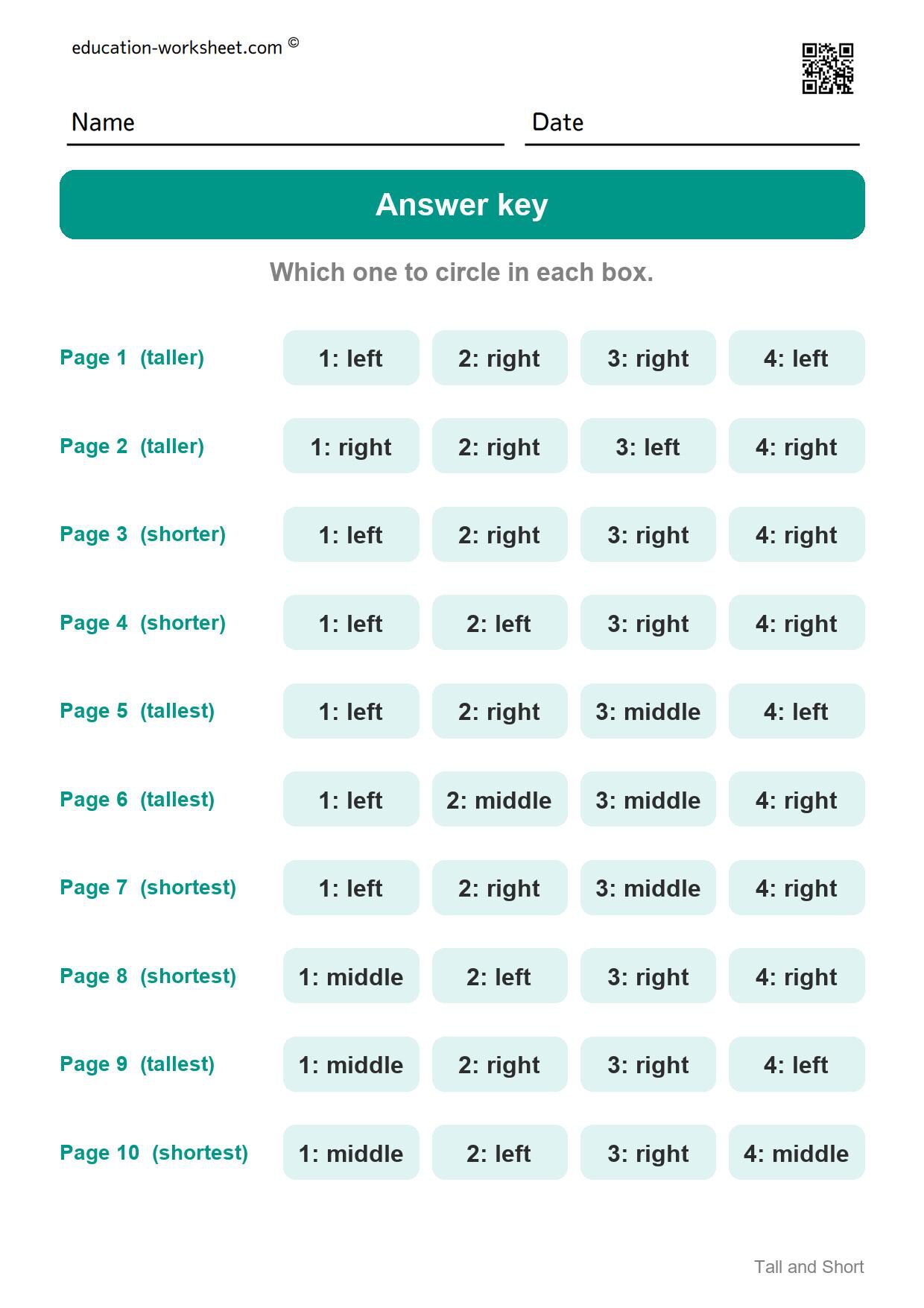
Three kinds of object appear in the pack, and the towers of blocks are the ones that do something the others cannot. Every block in a tower is the same size, so the taller tower always has more blocks in it, and a child can answer by counting rather than by comparing.
Both routes are real measuring. Comparing two tops directly is what K.MD.A.2 asks for; counting equal units is what a ruler does. A child who counts blocks on one box and eyeballs a tree on the next has used both methods on the same page, which is worth pointing out to them.
The trees and the buildings give no units at all. Those are the boxes where a finger laid along the top of one object and carried across to the other is the only honest way to check.
When Children Are Ready for Tall and Short
- Age: about three to six – preschool through kindergarten, with page 9 useful for a while longer.
- Before starting: nothing at all. No reading, no counting, no writing.
- K.MD.A.1 – describe measurable attributes of objects, such as height.
- K.MD.A.2 – directly compare two objects with a measurable attribute in common. That is pages 1 to 4.
- 1.MD.A.1 – order three objects by length or height. That is pages 5 to 10, and it is first grade work.
How to Use These Worksheets
- Read the question at the top out loud every time. It changes four times across the pack and nothing in the pictures signals it.
- Point at the ground line before the first box and say why it is there. Two things can only be compared fairly if they start in the same place.
- Lay a finger or a strip of paper across the top of the tallest object and carry it sideways. On page 9 this is the only reliable method.
- Count the blocks when the objects are towers, and say the two numbers out loud.
- Split the pack in two sittings: pages 1 to 4, then pages 5 to 10. Going from two objects to three is a bigger step than it looks.
- Finish by asking the child to put all three in order, shortest to tallest, rather than only finding one. That is the next skill along.
Three Things to Watch For
1. Answering the last page’s question. Pages 3, 7 and 10 all flip the word. A child who gets the first box of a new page wrong and the rest right has not misunderstood height – they read the old instruction.
2. Ignoring the middle. Across the forty boxes the answer is in the middle only eight times, and children check the two ends first. Page 6 has two middle answers in a row, which is the page to slow down on.
3. Glancing instead of comparing. It works for nine pages, because the gaps are large. Then page 9 arrives with two boxes decided by six millimeters and the same child starts getting them wrong. That is the page doing its job.
Printing Tips
- Print at 100 percent, actual size, on A4 or US Letter. Fit-to-page changes every height on the sheet.
- Black and white is fine. The colors separate the objects but carry no information.
- Print page 9 twice and keep one copy for a week later. It is the page worth repeating.
Frequently Asked Questions
What age are these tall and short worksheets for?
About three to six years old. There is nothing to read or write, so a child who can hold a crayon can start; the three-object pages suit children who are already comfortable comparing two.
Why do all the objects stand on a line?
So the comparison is fair. Two things can only be compared for height if they start at the same level, and drawing the ground line makes that visible instead of leaving it to be explained.
Is there an answer key?
Yes, page 11 gives all forty answers as left, middle or right.
Which page is hardest?
Page 9. Two of its four boxes are decided by about six millimeters, where the rest of the pack uses gaps of a centimeter or more.
Can my child count the blocks instead of comparing?
Yes, and it is worth encouraging. The blocks in a tower are all the same size, so counting them gives the same answer and it is how a ruler works.
Do I need to sign up to download these?
No. Every PDF downloads immediately, with no account, no email address and no cost.
Can I use these in my classroom?
Yes, they are free to print for home and classroom use. Please do not sell them or re-host the files elsewhere.
More Free Comparing Worksheets
- Free Long and Short Worksheets for Kindergarten – Compare Lengths
- Free Heavy and Light Worksheets for Kindergarten – Compare Weight
- Free Size Ordering Worksheets for Kindergarten – Smallest to Biggest
- Free Measuring Length Worksheets for Kindergarten – How Many Cubes Long?
- Free Big and Small Worksheets for Kindergarten – Compare Sizes
- Free Wide and Narrow Worksheets for Kindergarten – Compare Width