These free printable what doesn’t belong worksheets give children 60 rows of four pictures. In each row, three pictures belong to the same group and one does not: a cat, a dog, an elephant and a car; a bed, a chair, a sofa and an orange. The child crosses out the odd one, and on later pages explains the choice with a full sentence such as “They are all animals.”
A speech-language-hearing therapist designed this pack. Odd one out is a favorite task in speech and language sessions because it asks for two things at once. The child has to know what each picture is, and has to hold a group idea in mind while checking every picture against it. It also gives a natural reason to say a group word out loud. These are practice pages for home, school and therapy, not a test, and they cannot tell you whether a child has a language difficulty.
Unlike a matching or sorting page, the child never sees the group named on the paper. On pages 1 to 3 the adult says it; after that, the child has to find it. That small change is what makes the task useful for practicing reasoning and explaining, and it is why the pack has five levels instead of twelve pages of the same thing.
- What Is in This Free Odd One Out Pack
- The 12 What Doesn’t Belong Worksheets
- Start Here – A Sample Row, Five Levels and Tips
- Page 1 – Listen and Find: Animals, Fruit, Vehicles, Clothes, Food
- Page 2 – Listen and Find: Instruments, Body Parts, Furniture
- Page 3 – Listen and Find: Tools, Helpers, Kitchen Things
- Page 4 – Find It Without Help
- Page 5 – Find It: Food, Furniture, Tools, Helpers
- Page 6 – Find It: A Little Closer
- Page 7 – Tell Why: They Are All …
- Page 8 – Tell Why: Tools, Furniture, Helpers
- Page 9 – Tell Why: Fruit and Vegetables Meet
- Page 10 – Close Groups
- Page 11 – Close Groups: Kitchen, Body, Instruments
- Page 12 – Cross Out and Add One
- Answer Key
- How the Rows Were Checked
- Odd One Out by Meaning, Not by Look
- When the Child Finds It Hard
- Who These Worksheets Are For
- How to Use These Worksheets
- Three Things to Watch For
- Printing Tips
- Frequently Asked Questions
- What is a what doesn’t belong worksheet?
- What age are these odd one out worksheets for?
- My child gave a different answer with a good reason. Is it wrong?
- Why does the adult say the group name on pages 1 to 3?
- If my child gets many rows wrong, does that mean something is wrong?
- Do I have to register or pay?
- May teachers and therapists print these for a group?
- More Free Listening and Language Worksheets
What Is in This Free Odd One Out Pack
- Twelve practice pages, a guide page for the adult and an answer key: 14 pages in all.
- 60 rows of four pictures, with the name of every picture printed under it.
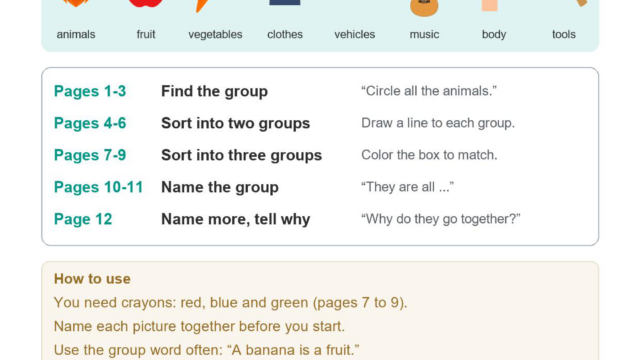
- Pictures from 13 groups: animals, fruit, vegetables, clothes, vehicles, musical instruments, body parts, furniture, kitchen things, school supplies, tools, community helpers and food.
- Five levels: listen and find (pages 1 to 3), find it (pages 4 to 6), find it and tell why (pages 7 to 9), close groups (pages 10 and 11), and cross out and add one (page 12).
- Upside-down directions on pages 1 to 3 for an adult sitting across the table.
- Only a pencil or crayon needed. Every page is its own free PDF.
The 12 What Doesn’t Belong Worksheets
Inside the pack, the distance between the group and the odd picture shrinks page by page. On page 1, a car among animals stands out at a glance. On page 11, a chair among kitchen things belongs in the same house and a wrench among instruments is held in the hand just like a violin, so the child has to think. If a page is too hard, the page before it is usually the right place to practice.
Start Here – A Sample Row, Five Levels and Tips
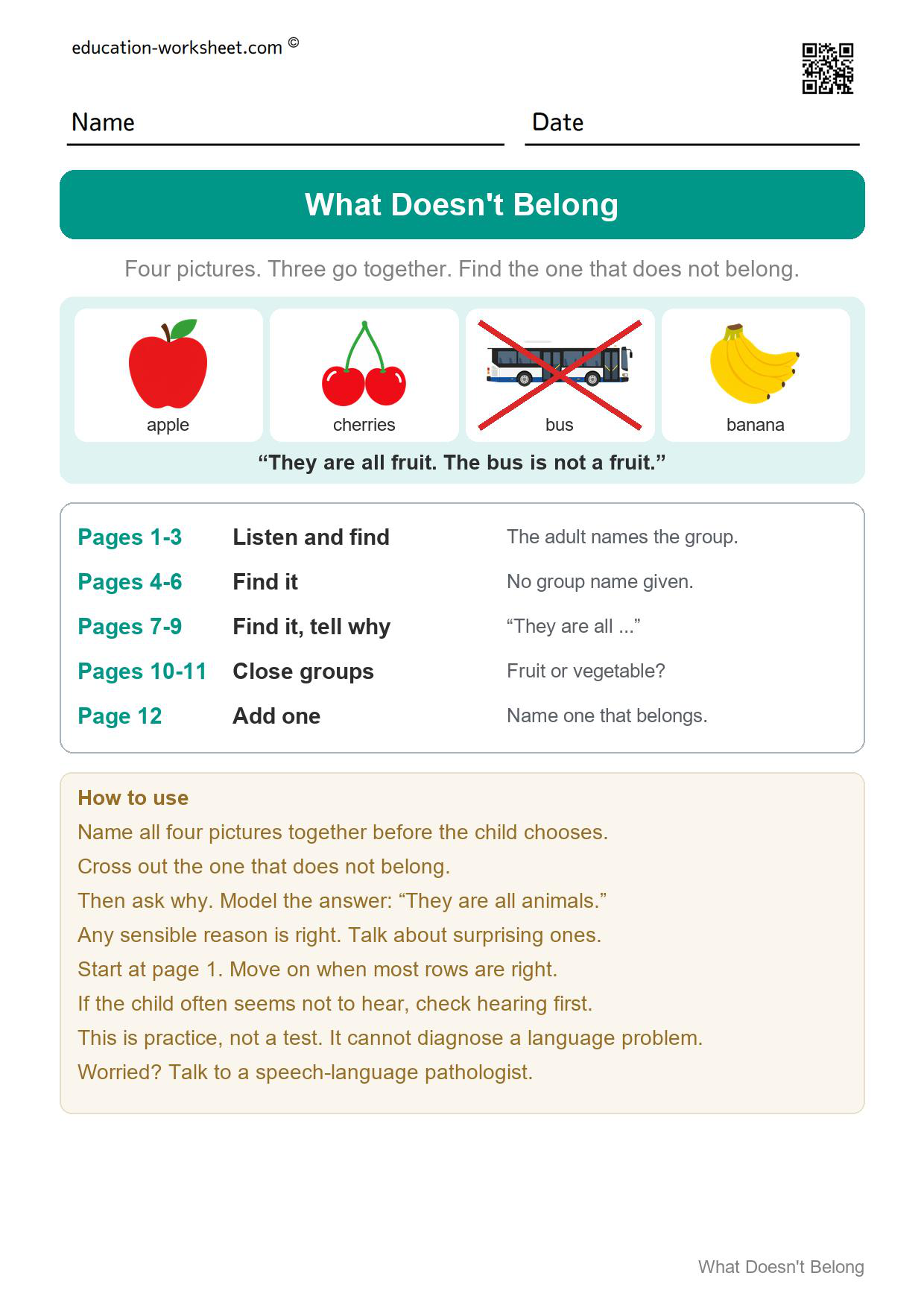
The guide page opens with one finished row: an apple, cherries, a bus and a banana, with the bus crossed out and the sentence “They are all fruit. The bus is not a fruit.” under it. That one sentence is the model for the whole pack. Below it are the five levels and a short list of tips for the adult.
Page 1 – Listen and Find: Animals, Fruit, Vehicles, Clothes, Food
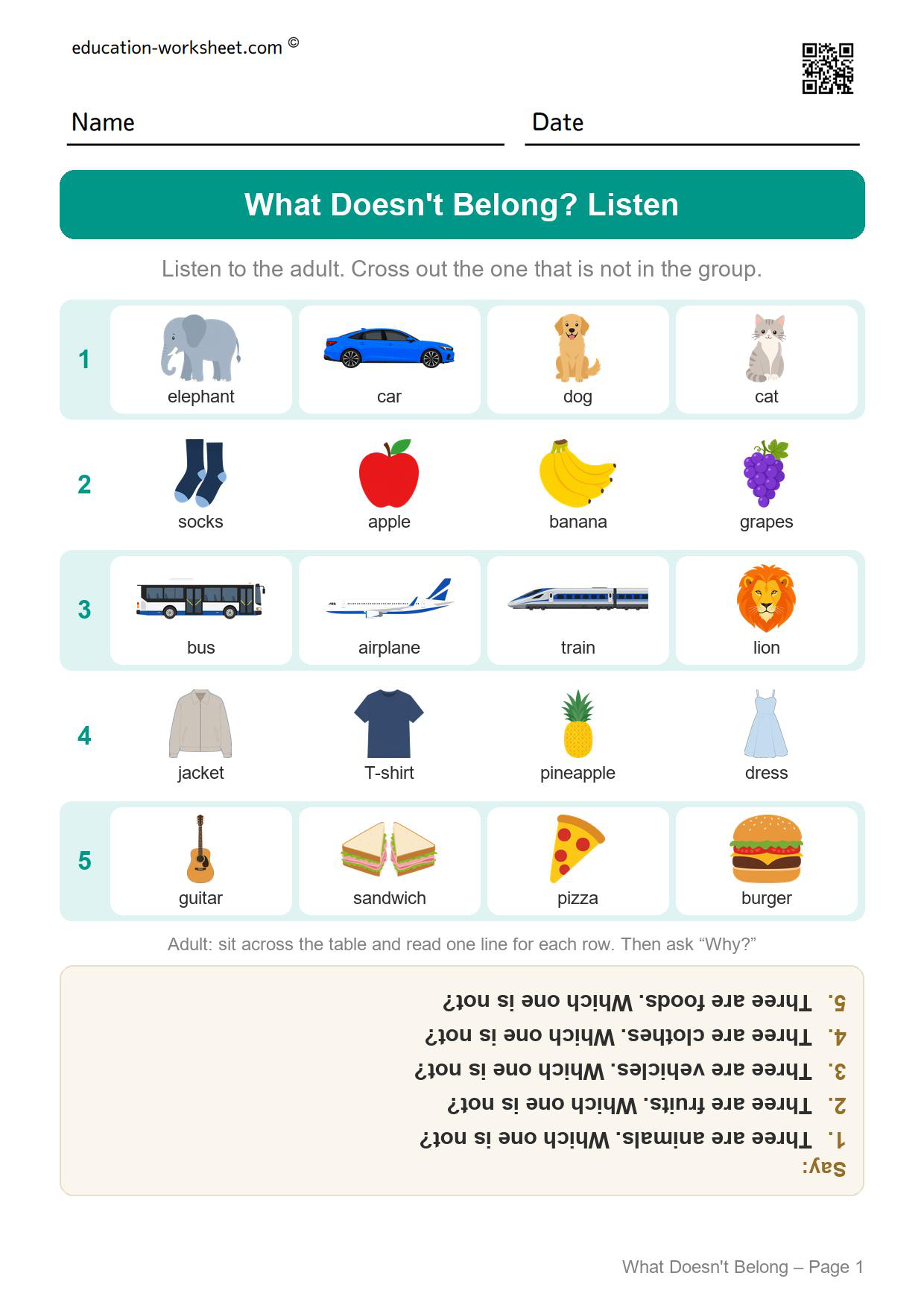
Five rows of four pictures. On this first level the adult gives the group away: “Three are animals. Which one is not?” In row 1 the cat, dog and elephant are animals and the car is the one to cross out. The last row puts a guitar next to a pizza, a burger and a sandwich.
The directions are printed upside down in a box at the bottom of the page, so an adult sitting across the table reads them the right way up.
Page 2 – Listen and Find: Instruments, Body Parts, Furniture
New groups with the same kind of help. A bus sits beside a hand, a foot and an eye (“Three are body parts”), and an orange sits beside a bed, a chair and a sofa. For furniture the adult says “pieces of furniture,” because “three are furniture” is not something English speakers say.
Page 3 – Listen and Find: Tools, Helpers, Kitchen Things
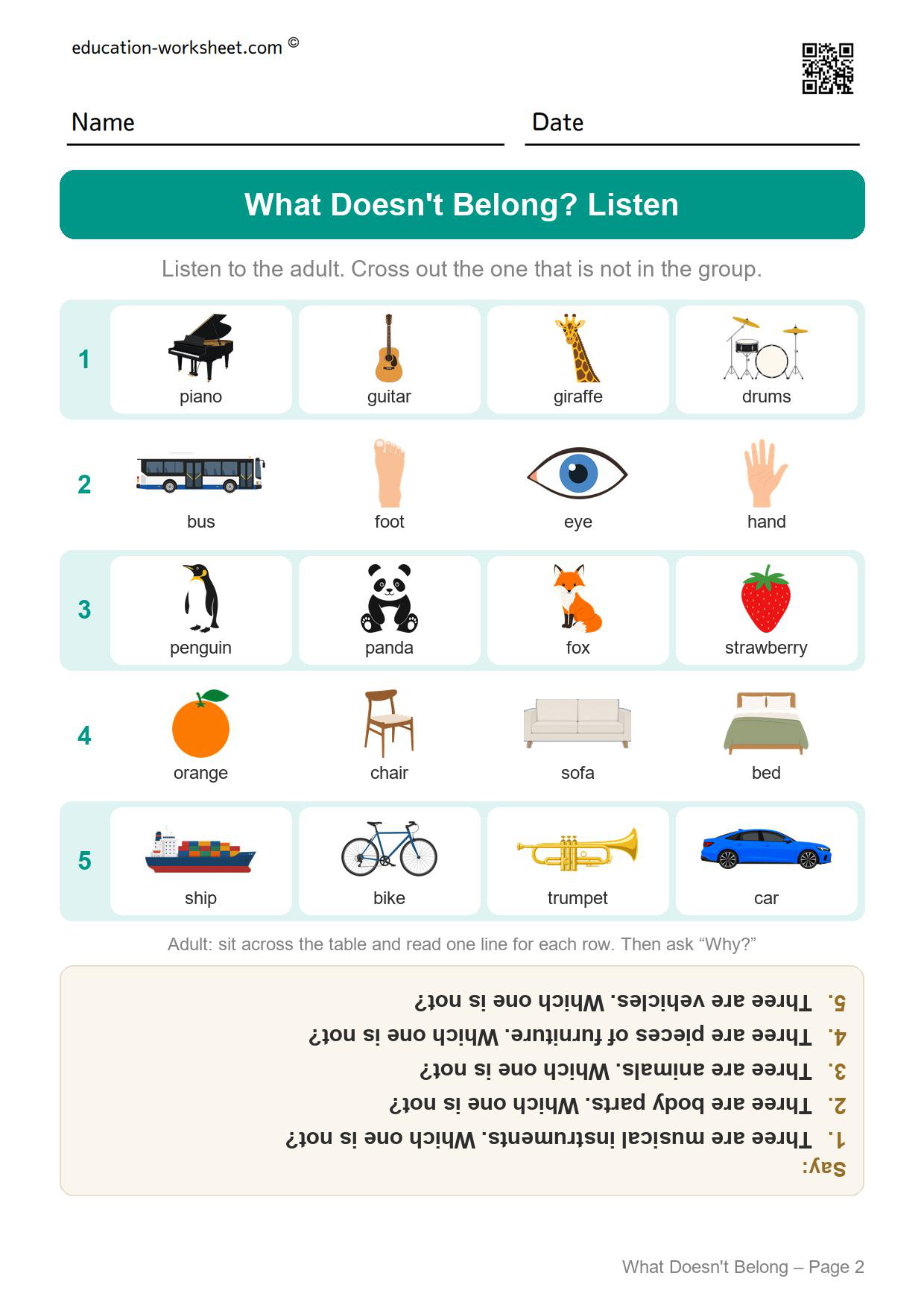
The groups on this page are less common words: tools, community helpers and kitchen things. In row 3 an airplane is mixed with a doctor, a firefighter and a teacher, and in row 5 a violin is mixed with a pot, a mug and a whisk. If the group word itself is new, say it again while you point: “A pot, a mug, a whisk. These are kitchen things.”
Page 4 – Find It Without Help
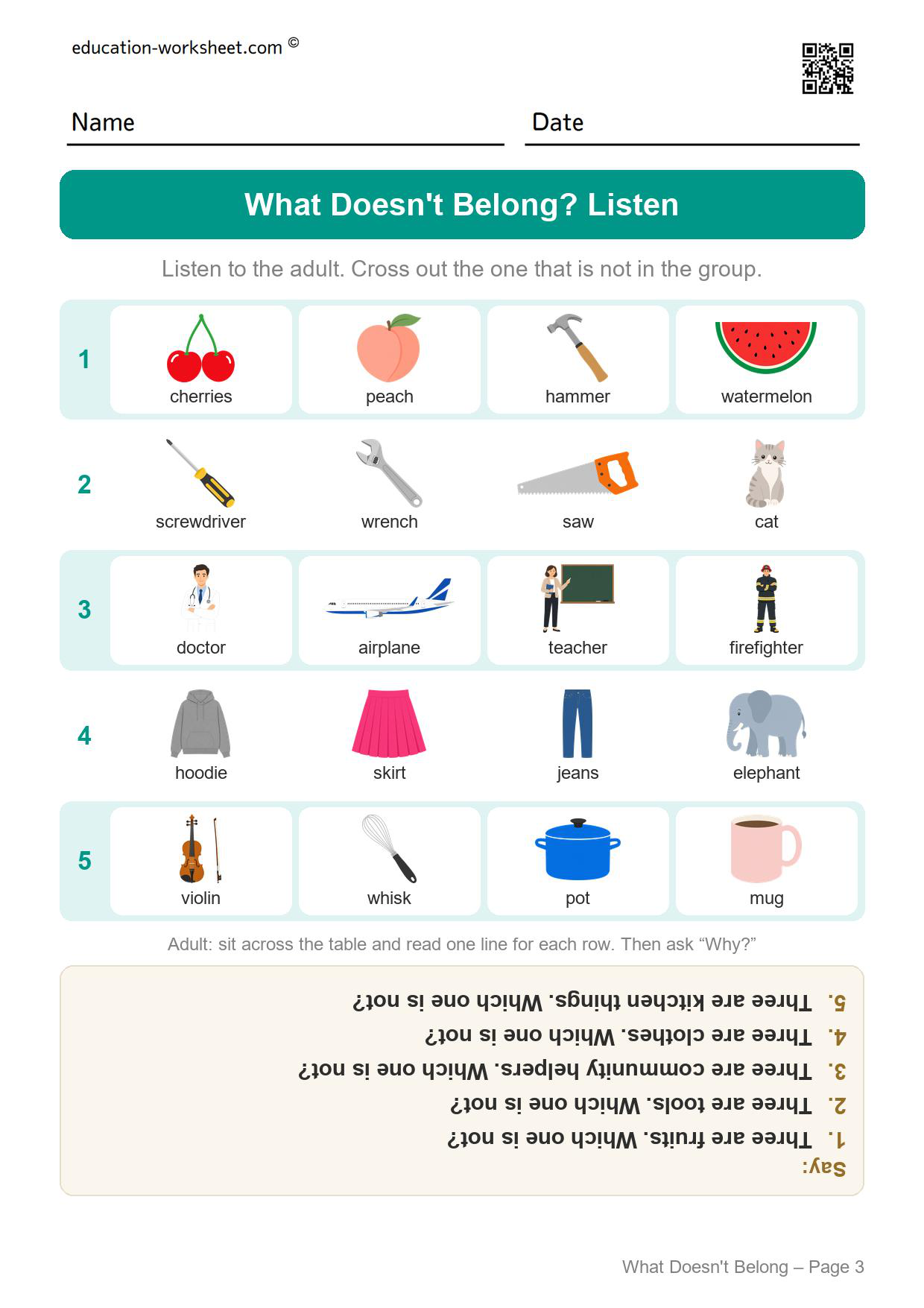
From here on, nobody names the group. The child has to look at four pictures and work out on their own which three go together. Page 4 keeps the groups far apart so the step stays small: a pizza with a giraffe, a lion and an owl, or a burger with socks, a shirt and jeans.
Page 5 – Find It: Food, Furniture, Tools, Helpers
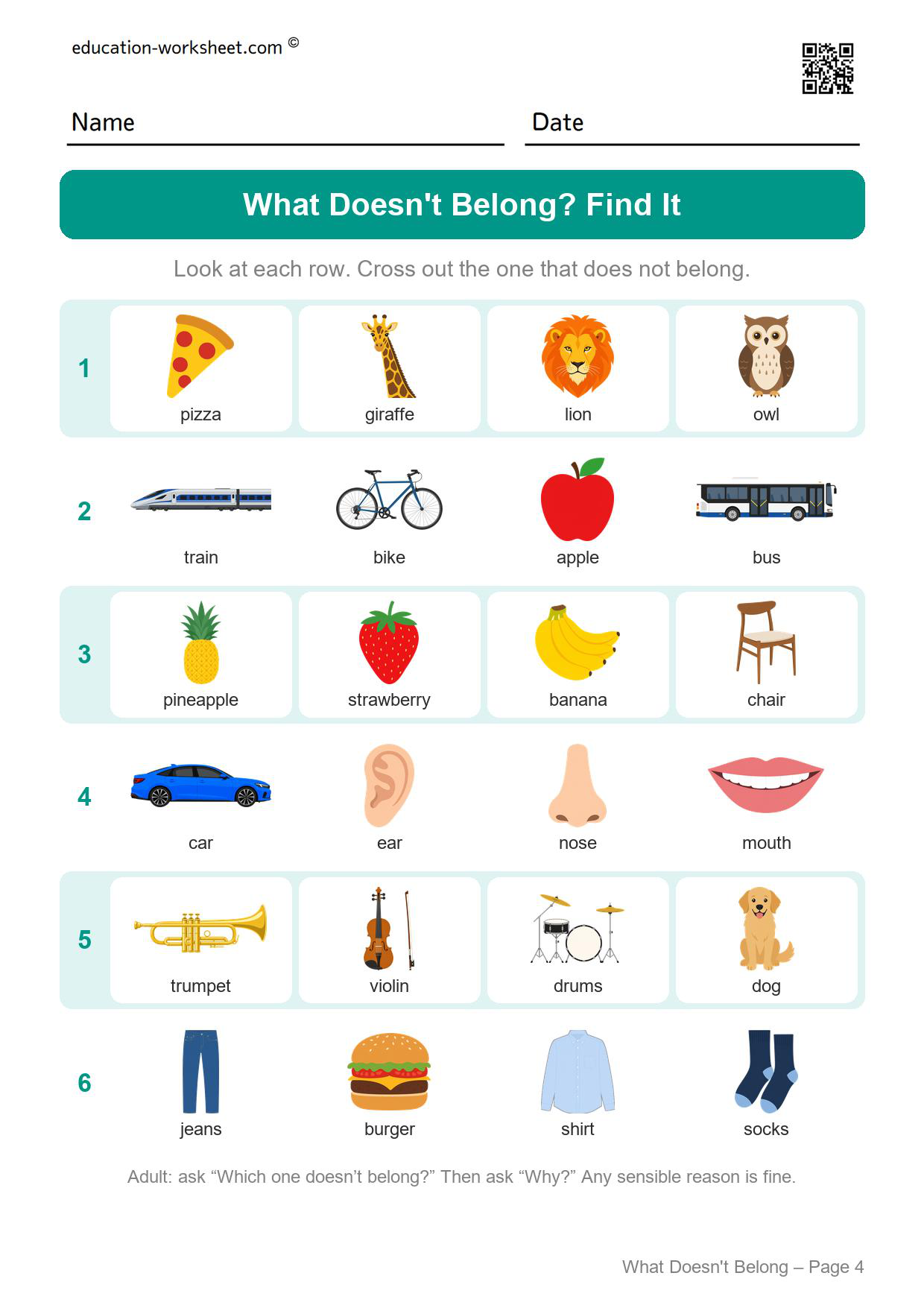
Six more rows. Row 2 puts a guitar with a bed, a bookshelf and a table, and row 6 puts a violin with scissors, a pencil and glue. Ask “Why?” after a few rows, not after every one, so the page keeps moving.
Page 6 – Find It: A Little Closer
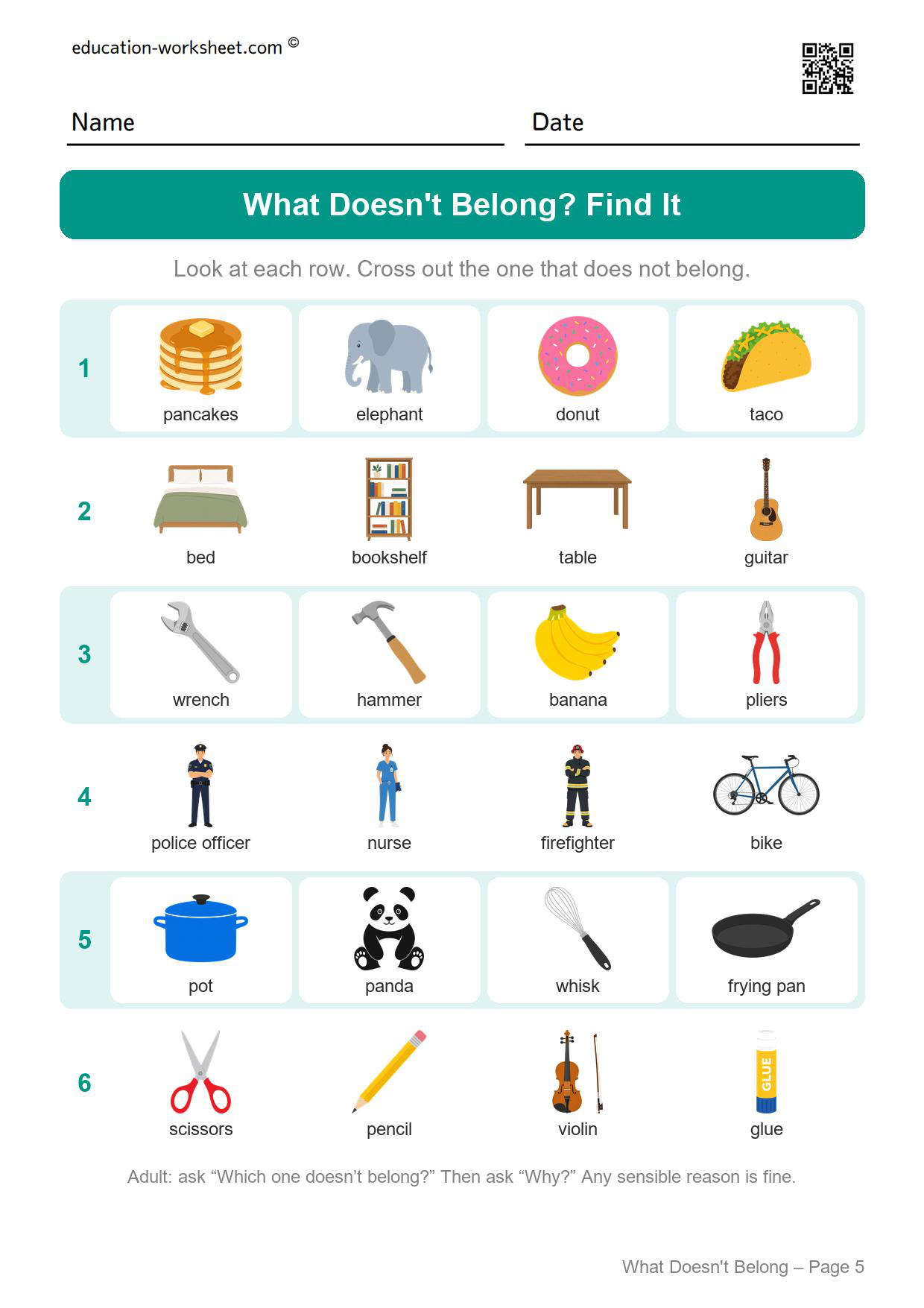
The odd picture now sits closer to the group. A doctor appears with a cat, a dog and a fox: people and animals are both living things, so the child has to think about which three are animals. A foot appears with a jacket, a dress and a skirt. Things you wear and the body you wear them on are easy to mix up, and that is the point of the row.
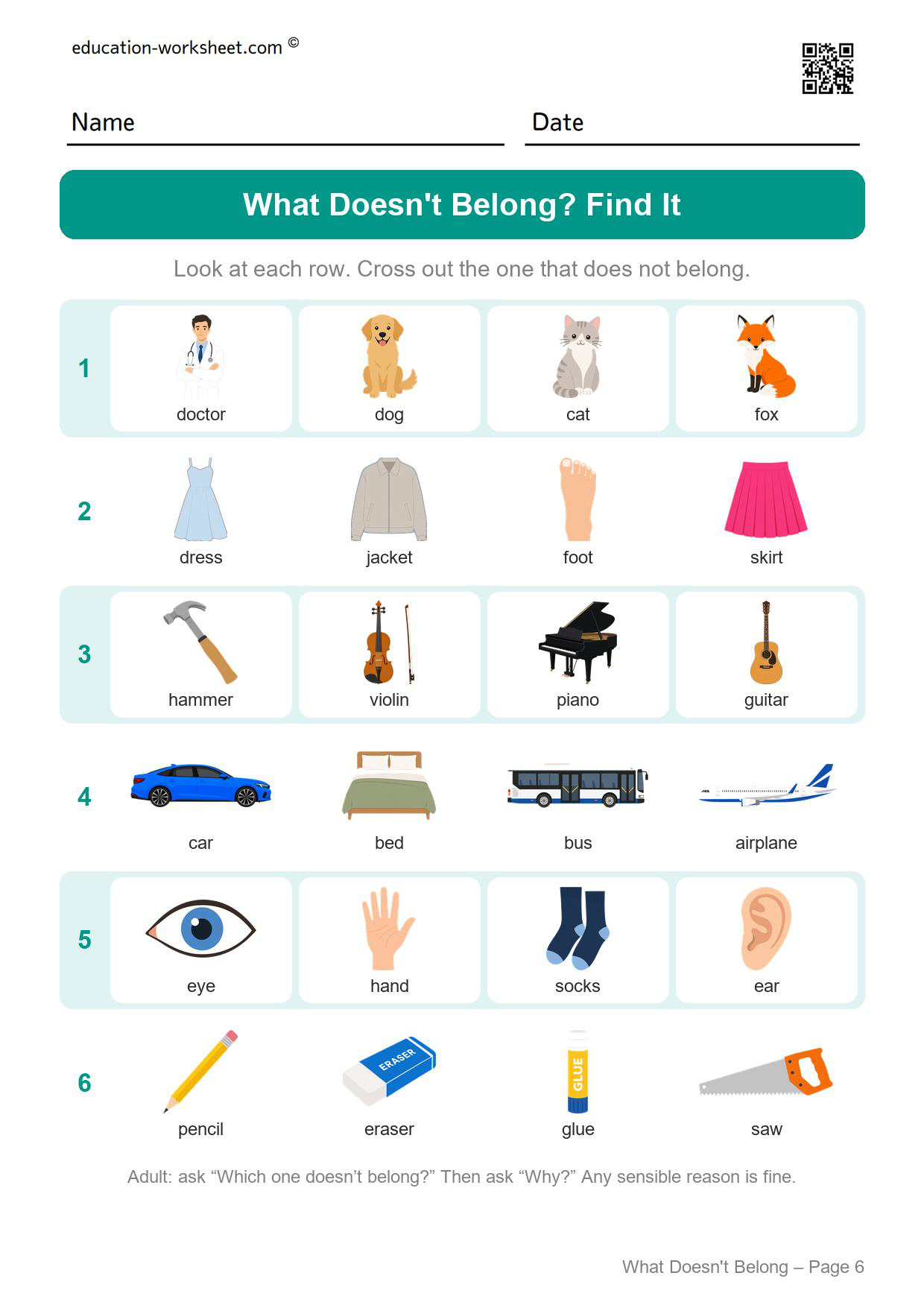
Page 7 – Tell Why: They Are All …
Each of the four rows now has a sentence frame under it: “They are all ____. It is not.” The child crosses out the odd picture and then says the group name. Row 2 has a hammer with a frying pan, a whisk and a mug, so the answer is “They are all kitchen things.” Row 3 has a hand with a T-shirt, jeans and a hoodie.
Write the child’s words on the line, even if they are not the group name. “You wear them” is a good reason; you can add the word afterwards.
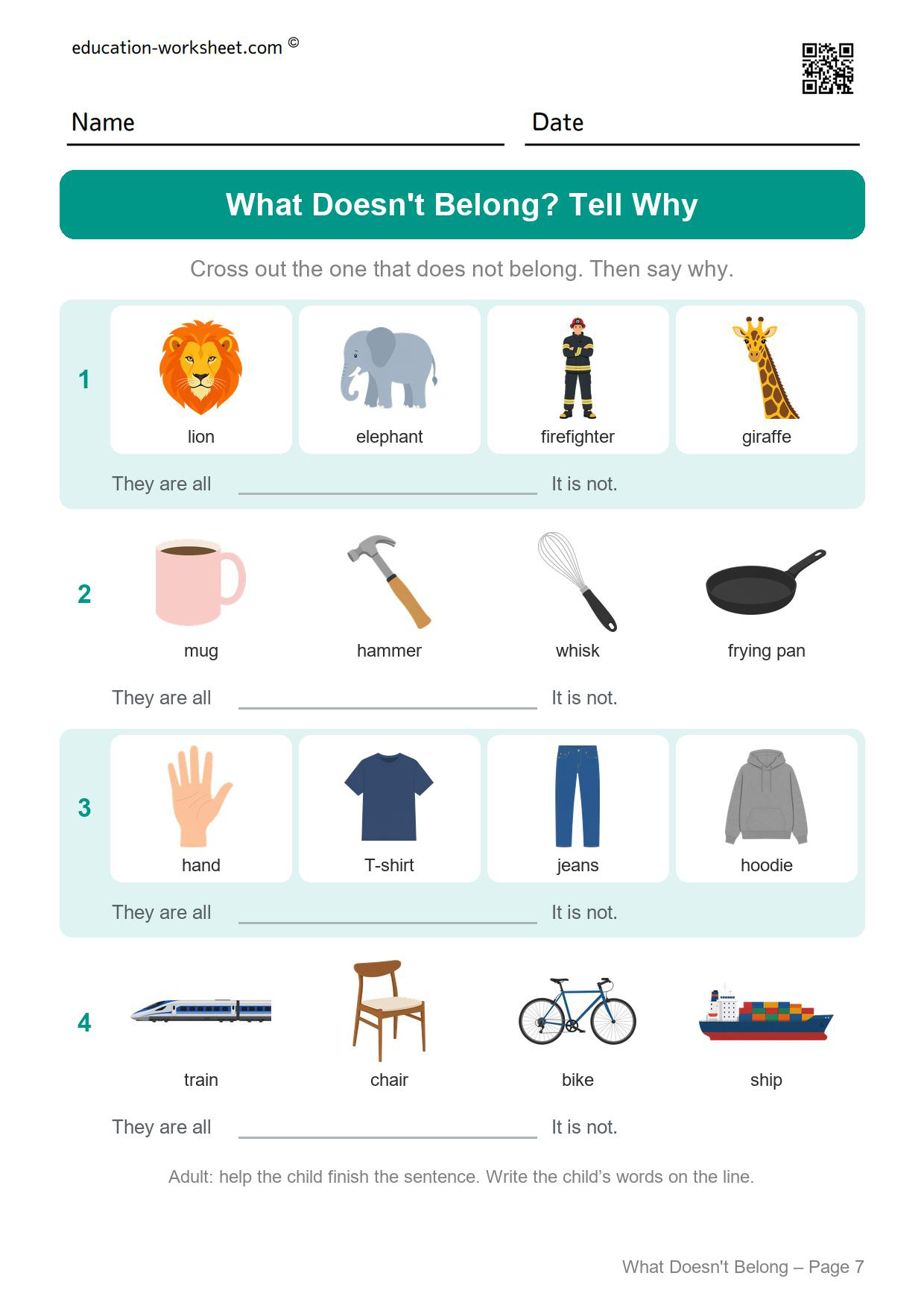
Page 8 – Tell Why: Tools, Furniture, Helpers
A pencil with a screwdriver, pliers and a saw asks the child to separate two kinds of things people hold in their hands. A penguin with a teacher, a doctor and a police officer is easier, and gives a confident answer in the middle of the page.
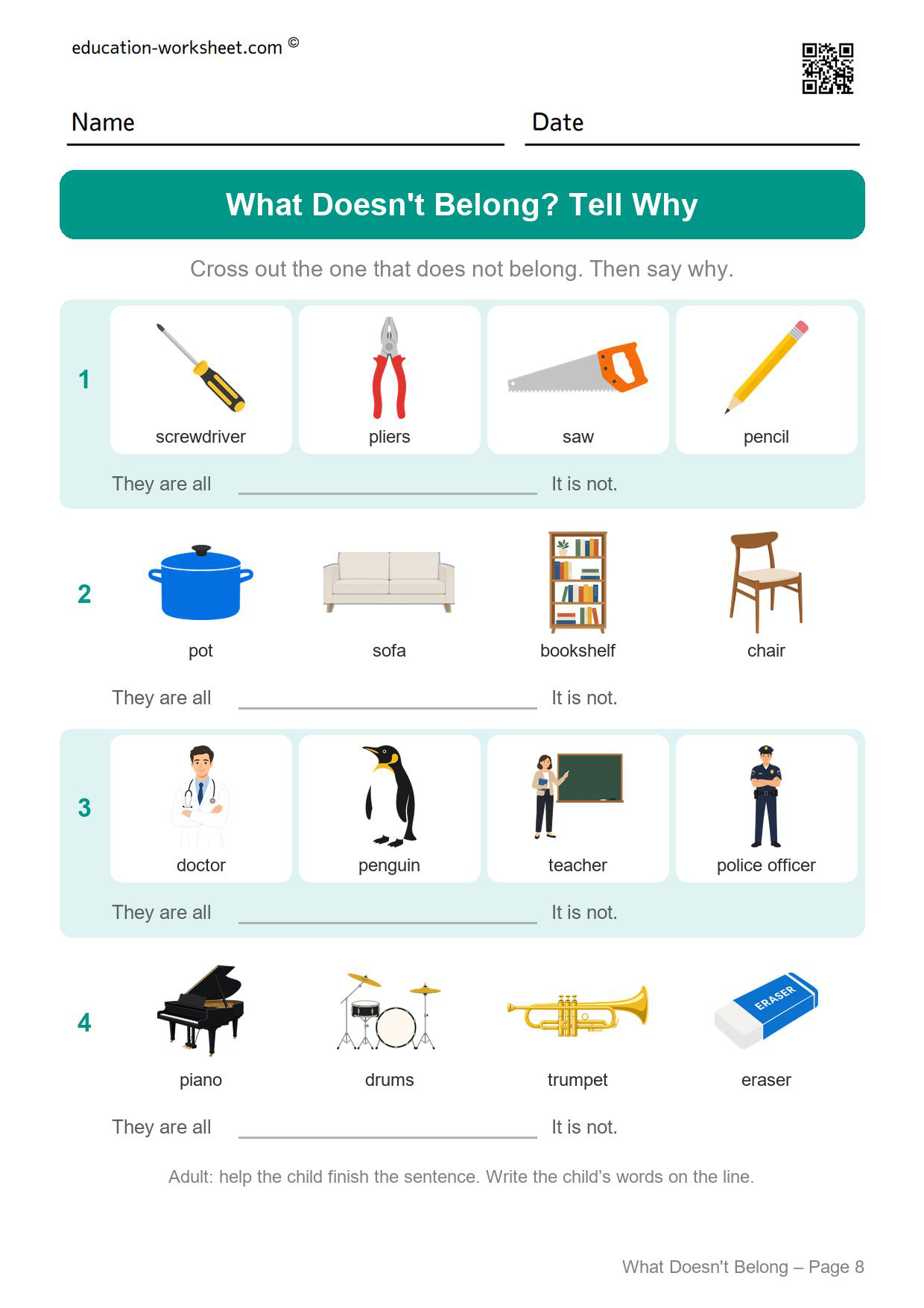
Page 9 – Tell Why: Fruit and Vegetables Meet
Fruit and vegetables appear in the same row for the first time. A banana sits with a carrot, a potato and an onion, and broccoli sits with a peach, cherries and a pineapple. A child who says “they are all food” is right, but has not found the odd one yet. Ask, “Yes, all food. Which kind of food is the banana?”
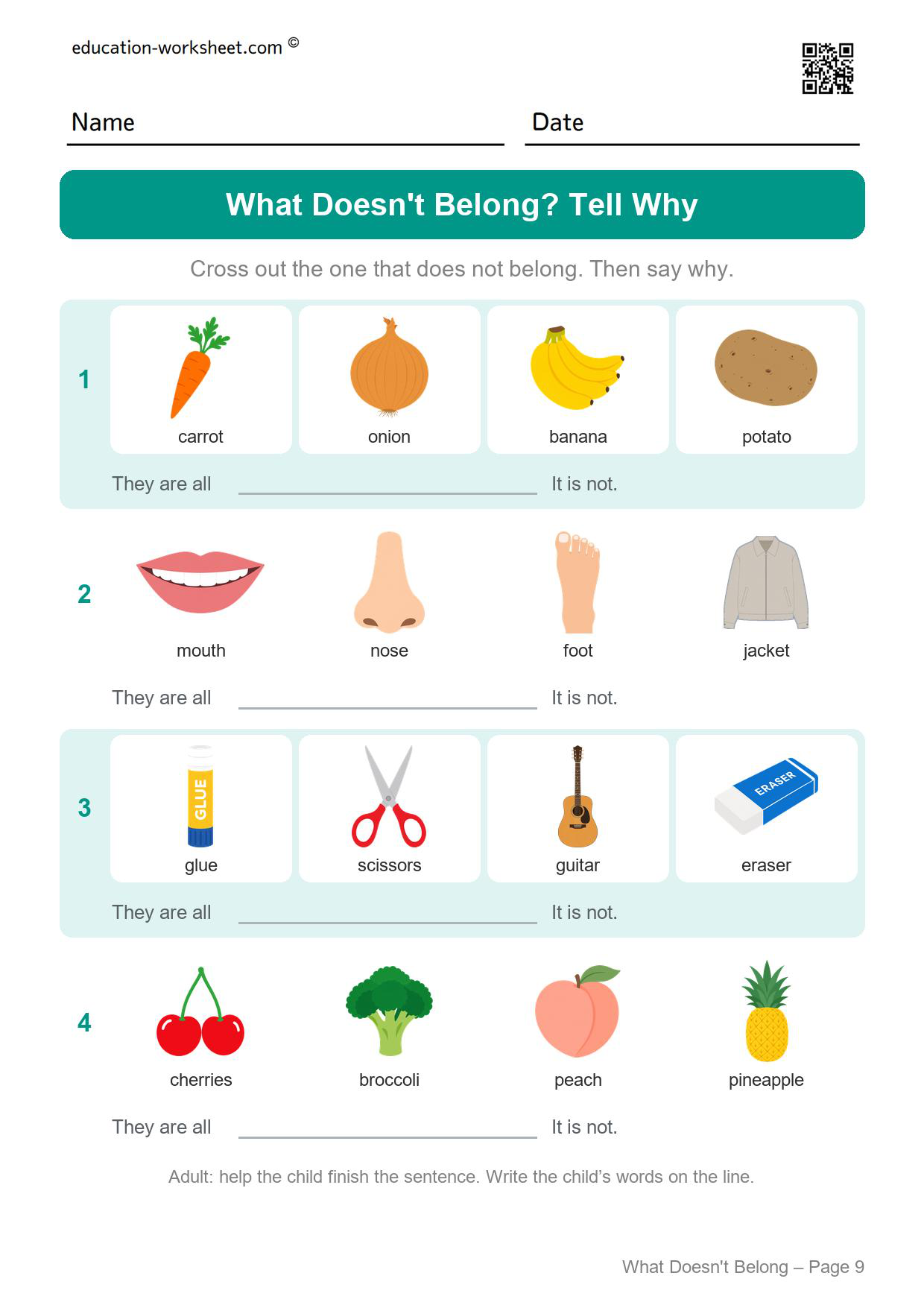
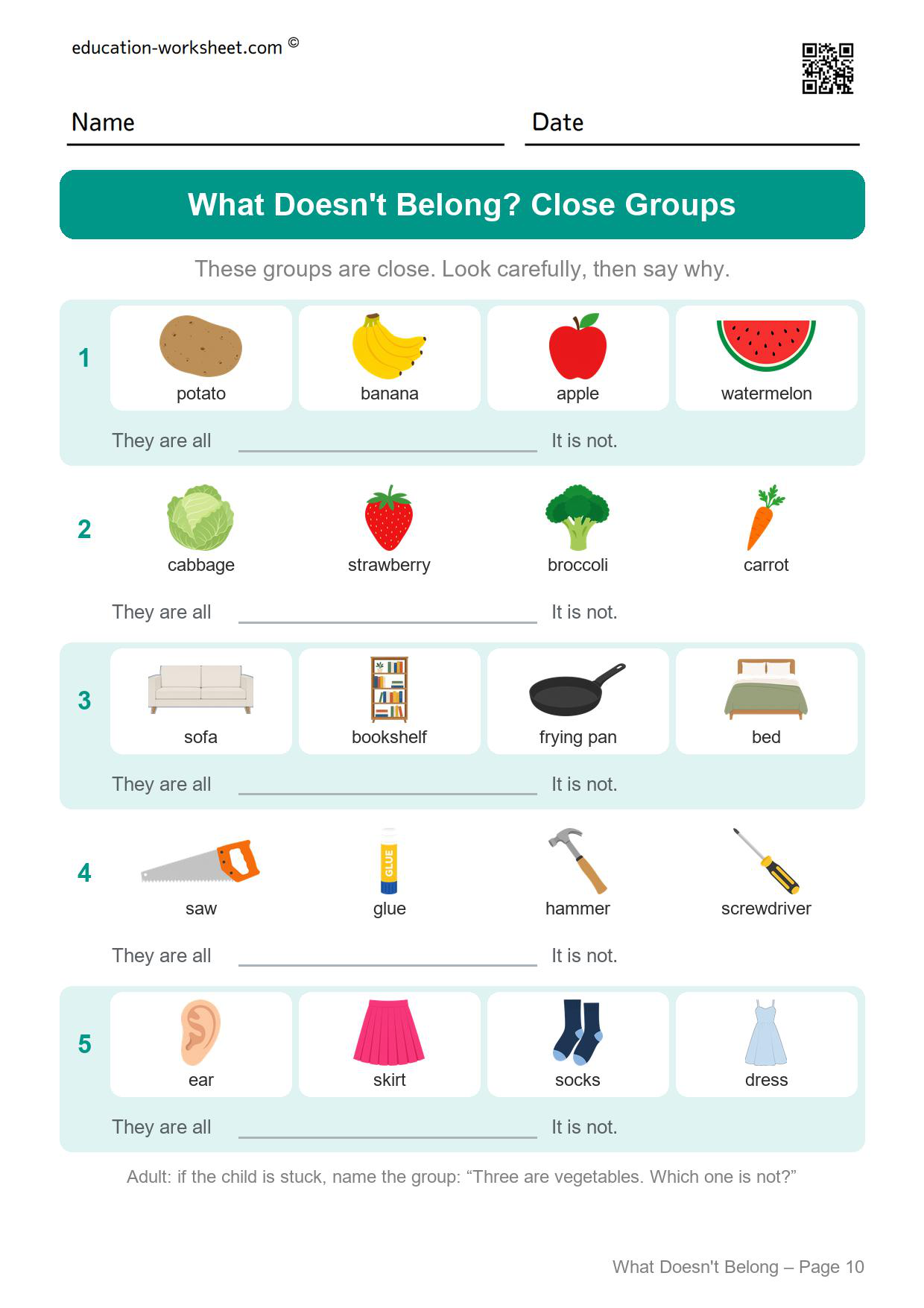
Page 10 – Close Groups
Every row on pages 10 and 11 uses two groups that are close in meaning. A potato hides among a banana, an apple and a watermelon. A frying pan hides among a bed, a bookshelf and a sofa: both are things in a house, but only three are furniture. Glue hides among a hammer, a saw and a screwdriver.
If the child gets stuck, go back one level and name the group, exactly as on pages 1 to 3: “Three are tools. Which one is not?”
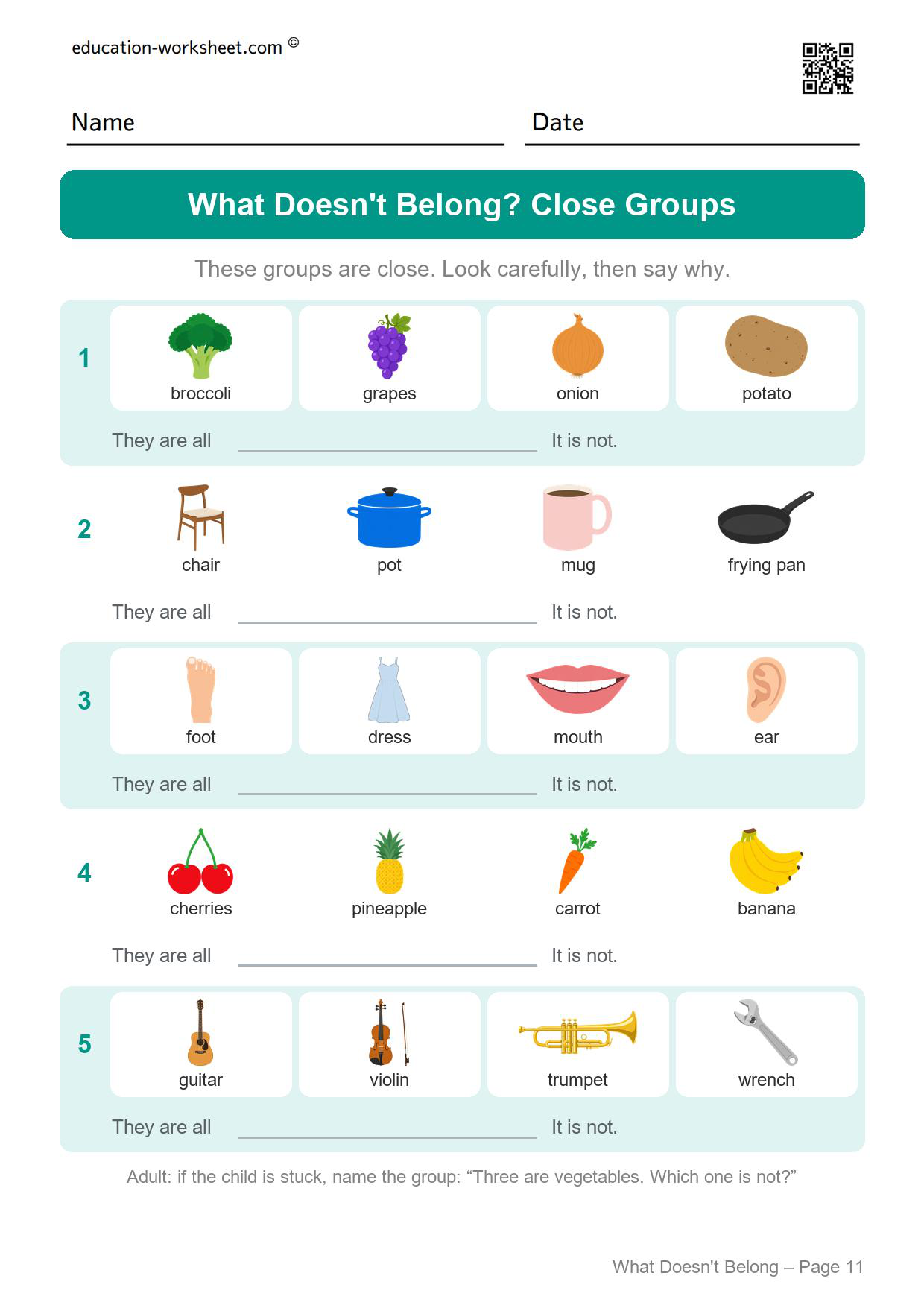
Page 11 – Close Groups: Kitchen, Body, Instruments
A chair with a pot, a frying pan and a mug. A dress with a mouth, an ear and a foot. A wrench with a guitar, a violin and a trumpet. These rows are hard because the odd picture belongs in the same room or is held the same way, so the child has to think about what each thing is, not where it is or what it looks like.
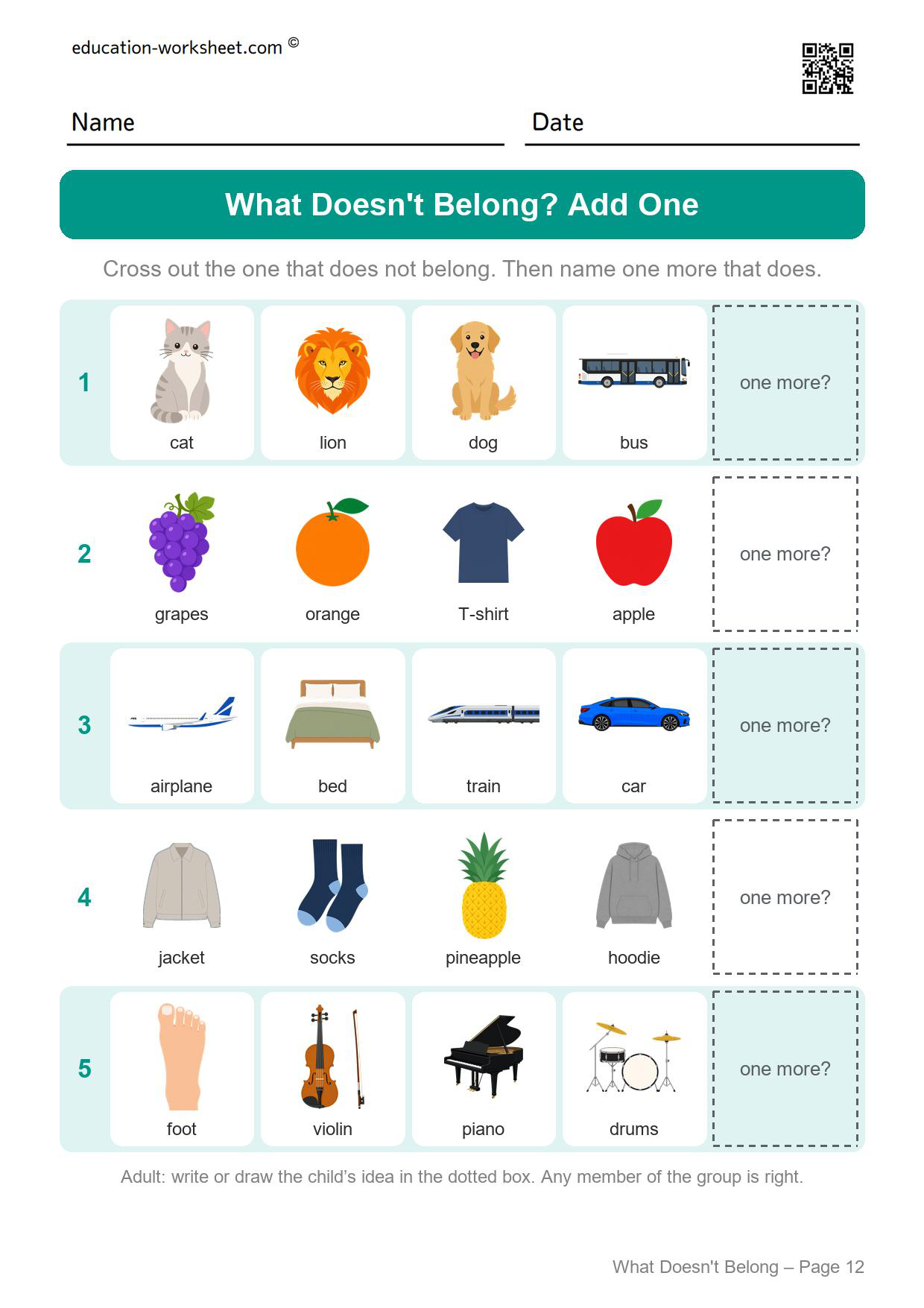
Page 12 – Cross Out and Add One
The last page turns the task around. After crossing out the odd picture, the child names one more thing that belongs, and you write or draw it in the dotted box at the end of the row. Row 1 is a cat, a dog and a lion with a bus; row 5 is a piano, drums and a violin with a foot. Any animal or any instrument is right.
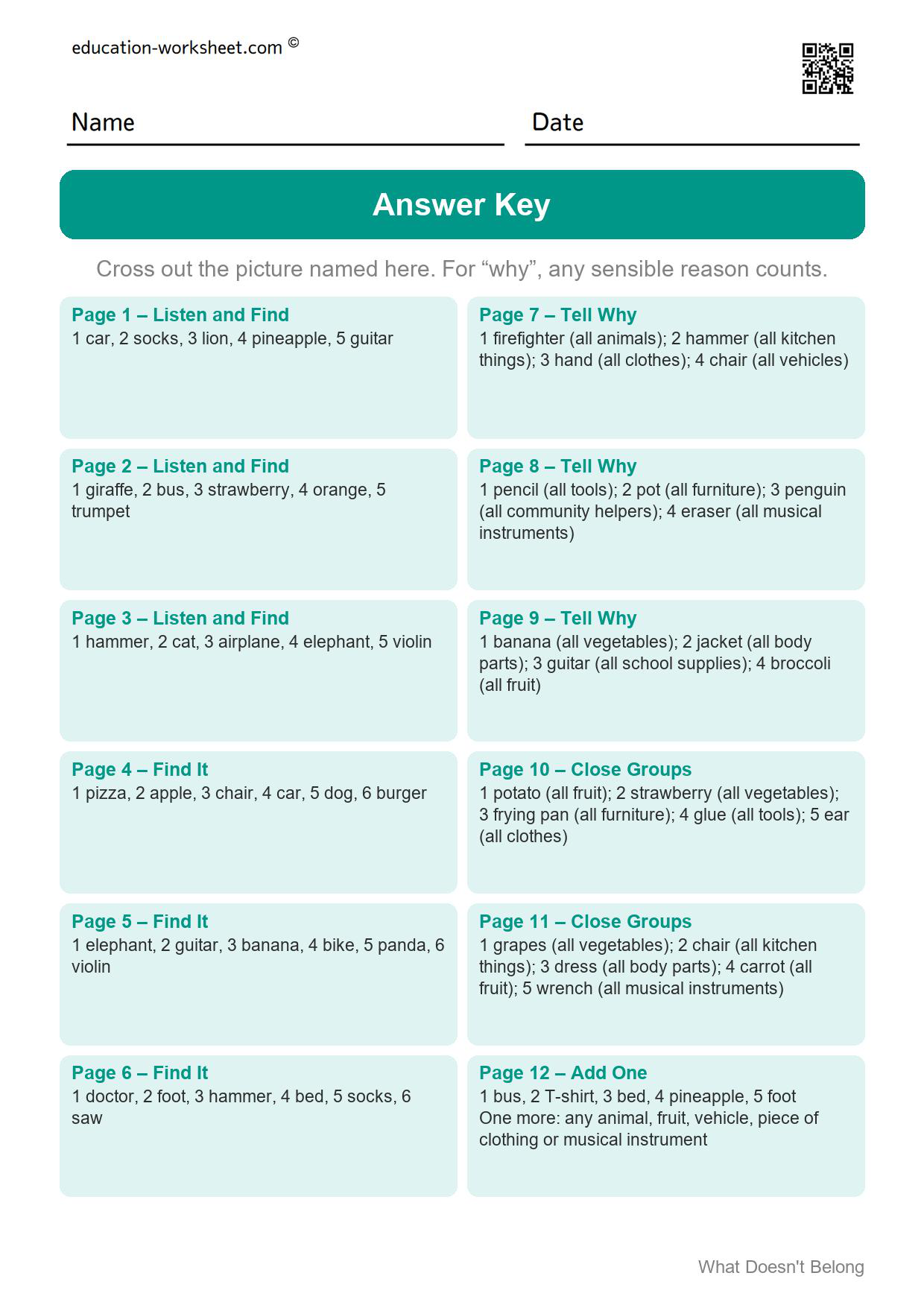
Answer Key
The picture to cross out in every row, and on pages 7 to 11 the group the other three share. For “why” questions, the key gives the group name, but any sensible reason counts.
How the Rows Were Checked
An odd one out row only works if there is one fair answer. A row like a red apple, red cherries, a red car and a banana goes wrong quickly: is the car odd because it is not food, or the banana because it is not red? Before the pages were saved, a short computer program checked every row against these rules and refused to build the pack if one was broken.
- No picture fits both groups. An apple is a fruit and also a food, so an apple never appears as the odd one next to pizza, burgers and tacos. Scissors can be a school supply or a tool, so scissors never share a row with tools.
- Color never points to a different answer. Each picture was given its main color by eye. If one of the three group pictures was the only one with a different color while the other three matched, the row was rejected. That rule removed an orange, a peach and cherries with an onion, where the red cherries would look like the odd one.
- Other shortcuts are blocked too. The owl never shares a row with the airplane, so “these two fly” cannot compete with the real answer.
- No row is repeated. The same three group pictures are never used twice, and no picture appears twice on a page.
- The answer moves around. On each page, the odd picture is never in the same position twice in a row, and no position is used more than twice.
- Disputed foods are left out. Tomatoes, pumpkins and corn are not in the pack, so the fruit and vegetable rows have one clear answer.
Odd One Out by Meaning, Not by Look
Our same or different worksheets are also odd one out pages, but there the odd picture has a different shape or color. That is visual comparison, and children can do it without knowing a single word for the pictures. This pack works the other way round. The pictures inside a group often look nothing alike (a piano, drums and a violin), and the odd one can share a color with the group. The answer comes from what things are, not from what they look like.
If the child has not yet tried our category sorting worksheets, they make a good first step. Sorting shows the group name on the page; odd one out asks the child to find it alone.
When the Child Finds It Hard
Some children choose the odd picture quickly but cannot say why. Others give a reason about one picture (“a car has wheels”) instead of a reason about the group. Both are normal steps. Say the full answer for them and let them repeat it: “A cat, a dog, an elephant. They are all animals. The car is not an animal.”
If a child often picks a different picture than you expected, ask before you correct. A reason like “the sofa is soft and the others are hard” is real thinking, even if it is not about categories.
If the child often seems not to hear the directions, arrange a hearing check first. If understanding or using words seems to be a struggle in daily life, or you have other worries about language, talk with the child’s teacher or a speech-language pathologist. These pages are for practice; they cannot explain the reason behind a difficulty.
Who These Worksheets Are For
- Age: about ages four to seven (preschool, kindergarten and first grade). Children develop at different speeds, so start at page 1 and follow the child.
- Ready to start when: the child can name most of the pictures and cross out a picture with a pencil.
- L.K.5a – sort common objects into categories to gain a sense of the concepts the categories represent.
- L.1.5a – sort words into categories to gain a sense of the concepts the categories represent.
- SL.K.2 – confirm understanding of information presented orally, as on the listen and find pages.
How to Use These Worksheets
- Name all four pictures in a row together before the child chooses. A child who calls the mug a cup is still right; agree on one word and go on.
- On pages 1 to 3, sit opposite the child and read the upside-down line for each row once.
- On pages 4 to 6, ask only “Which one doesn’t belong?” and wait. Give the group name only if the child is stuck.
- On pages 7 to 11, help the child finish “They are all …” and write their words on the line.
- On page 12, accept any member of the group, even an unusual one. A child who adds “a dinosaur” to the animals has the idea.
- Move to the next level when most rows on a page are right without help.
Three Things to Watch For
1. Choosing by look. If the child crosses out the only blue picture or the biggest picture, they are sorting by color or size. Point to each picture and ask what it is and what we do with it, then try the row again.
2. Choosing by story. “The dog goes with the doctor because the doctor has a dog” is a story link, not a group. Children make these links often. Praise the idea, then ask which three are the same kind of thing.
3. Naming the odd picture, not the group. Asked why, a child may say “because it’s a car.” That names the odd picture but not the group. Ask, “And what are the other three?”
Printing Tips
- Print at 100 percent, actual size, on US Letter or A4 paper.
- Color printing helps children recognize the pictures, but the pages also work in black and white because every picture is named.
- For a game, cut the rows apart and let the child pick a strip from a bag.
Frequently Asked Questions
What is a what doesn’t belong worksheet?
A page where each row shows several pictures, all from one group except one. The child finds the odd one and, ideally, says why. It is also called odd one out or which one doesn’t belong.
What age are these odd one out worksheets for?
About four to seven. Younger children can stay on pages 1 to 6, where the task is to cross out one picture. The tell-why pages and the close groups usually come later.
My child gave a different answer with a good reason. Is it wrong?
Not if the reason makes sense. The answer key lists the category answer, but the aim is thinking and talking, so a sensible reason deserves praise. Then show the category answer as a second way to look at the row.
Why does the adult say the group name on pages 1 to 3?
Knowing the group in advance makes the task smaller: the child only has to check each picture against one idea. It is the easiest way in, and it is the help to return to whenever a later row is too hard.
If my child gets many rows wrong, does that mean something is wrong?
Not on its own. A row can go wrong because a picture is unfamiliar, because the child was tired, or because they found a different, sensible link. The pages have no score and no pass mark. If you have ongoing worries about how your child understands or uses words, a hearing check and a talk with a speech-language pathologist are the right next steps.
Do I have to register or pay?
Neither. Click any PDF button on this page and the file opens, ready to print.
May teachers and therapists print these for a group?
Yes, print as many copies as your class, caseload or family needs. The pages may not be sold, and the files should be shared by linking to this page rather than uploading them elsewhere.
More Free Listening and Language Worksheets
- Free Category Sorting Worksheets for Speech Therapy and Preschool
- Free Same or Different Worksheets for Kindergarten – Odd One Out by Shape or Color
- Free Auditory Memory Worksheets for Kids – Listen and Repeat
- Free Winter Following Directions Worksheets – 1, 2 and 3 Steps
- Free Rapid Automatic Naming Worksheets – RAN Letters and Numbers
- Free Living and Non-Living Things Worksheets for Kindergarten