These free printable final consonant deletion worksheets help children who leave the last sound off words, saying “bo” for boat or “bi” for bike. They use minimal pairs: two words that are the same except for the ending sound, such as bow and boat. There are six pairs, twelve practice pages, a guide for adults and a progress record.
The pack was designed by a speech-language-hearing therapist and follows the steps used in speech therapy: listen to the difference, say the words, then use them in sentences and games. It is built for practice at home or in class alongside professional advice, not instead of it.
Final consonant deletion is one of the patterns young children use while their speech is developing. Most children stop leaving off ending sounds by about age three. When it carries on, it makes speech much harder to understand, because so many English words differ only in their last sound.
- What Is in This Free Final Consonant Deletion Worksheet Pack
- The 12 Minimal Pairs Worksheets
- Start Here – A Guide for the Adult
- Page 1 – Meet the Pairs
- Page 2 – Listen and Point, Set 1
- Page 3 – Listen and Point, Set 2
- Page 4 – Listen and Point, Set 3
- Page 5 – Say It, I’ll Point, Set 1
- Page 6 – Say It, I’ll Point, Set 2
- Page 7 – Say It, I’ll Point, Set 3
- Page 8 – Say It in a Sentence, Set 1
- Page 9 – Say It in a Sentence, Set 2
- Page 10 – Minimal Pairs Bingo, Board 1
- Page 11 – Minimal Pairs Bingo, Board 2
- Page 12 – Picture Cards to Cut Out
- Progress Record
- Why These Six Pairs
- How to Respond When the Child Leaves Off the Sound
- When to Get Help
- Who These Worksheets Are For
- How to Use These Worksheets
- Three Things to Watch For
- Printing Tips
- Frequently Asked Questions
- More Free Speech and Language Worksheets
What Is in This Free Final Consonant Deletion Worksheet Pack
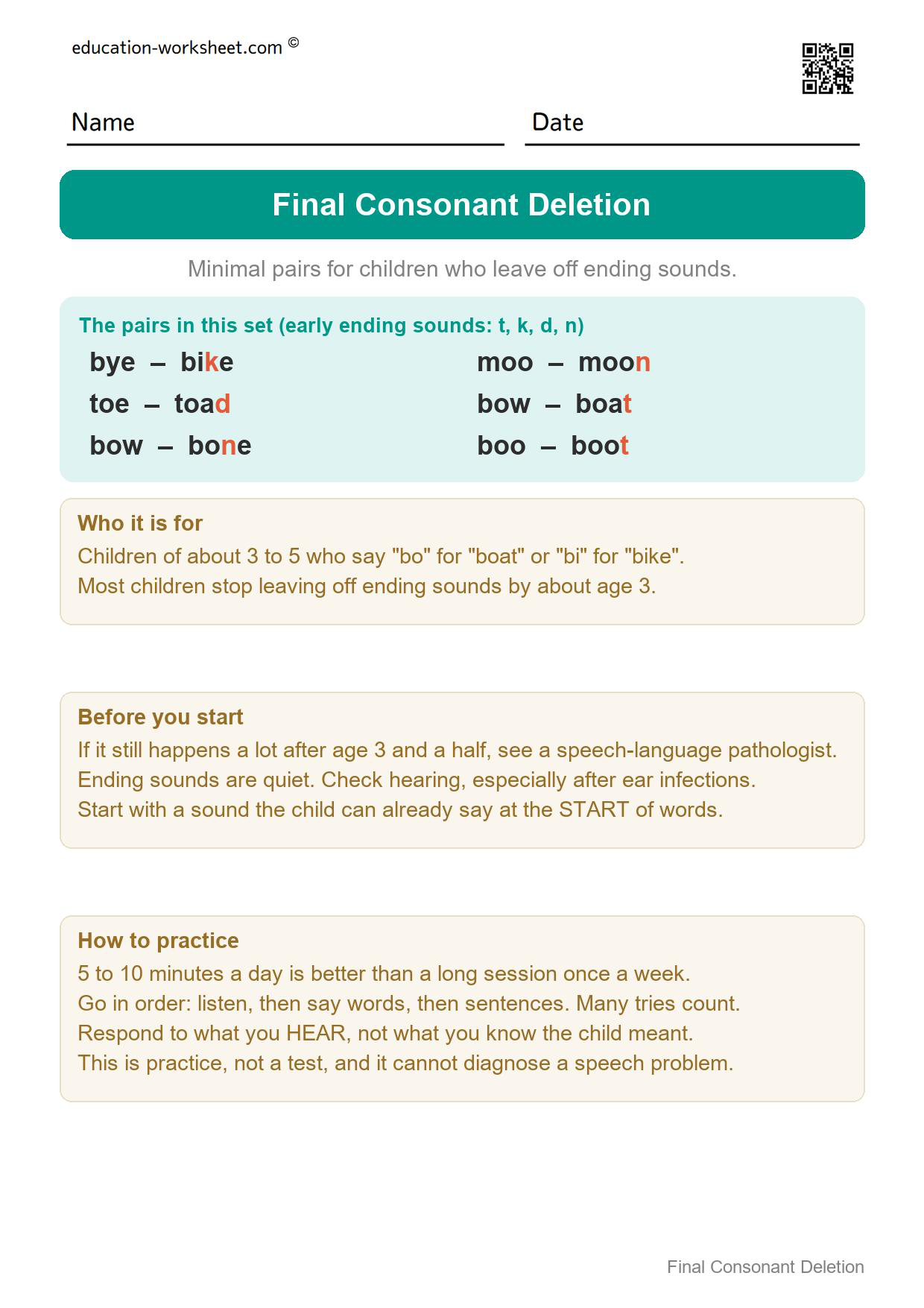
- Six minimal pairs: bye – bike, moo – moon, toe – toad, bow – boat, bow – bone, boo – boot.
- A guide page for adults on age, hearing, how long to practice and how to respond.
- Meet the Pairs (page 1) and three Listen and Point pages with twelve words each (pages 2 to 4).
- Three Say It, I’ll Point pages (pages 5 to 7) and two sentence pages (pages 8 and 9).
- Two bingo boards, twelve picture cards to cut out, and a progress record.
- A separate PDF for every page, free to download and print.
The 12 Minimal Pairs Worksheets
Work through the pages in order. Listening comes first, then single words, then sentences. Each step uses the same six pairs, so the child is never learning new pictures at the same time as a new skill.
Start Here – A Guide for the Adult
The first page lists the six pairs and answers the questions parents ask most: who these sheets are for, when to see a speech-language pathologist, and how long to practice. Read it once before you start.
Page 1 – Meet the Pairs
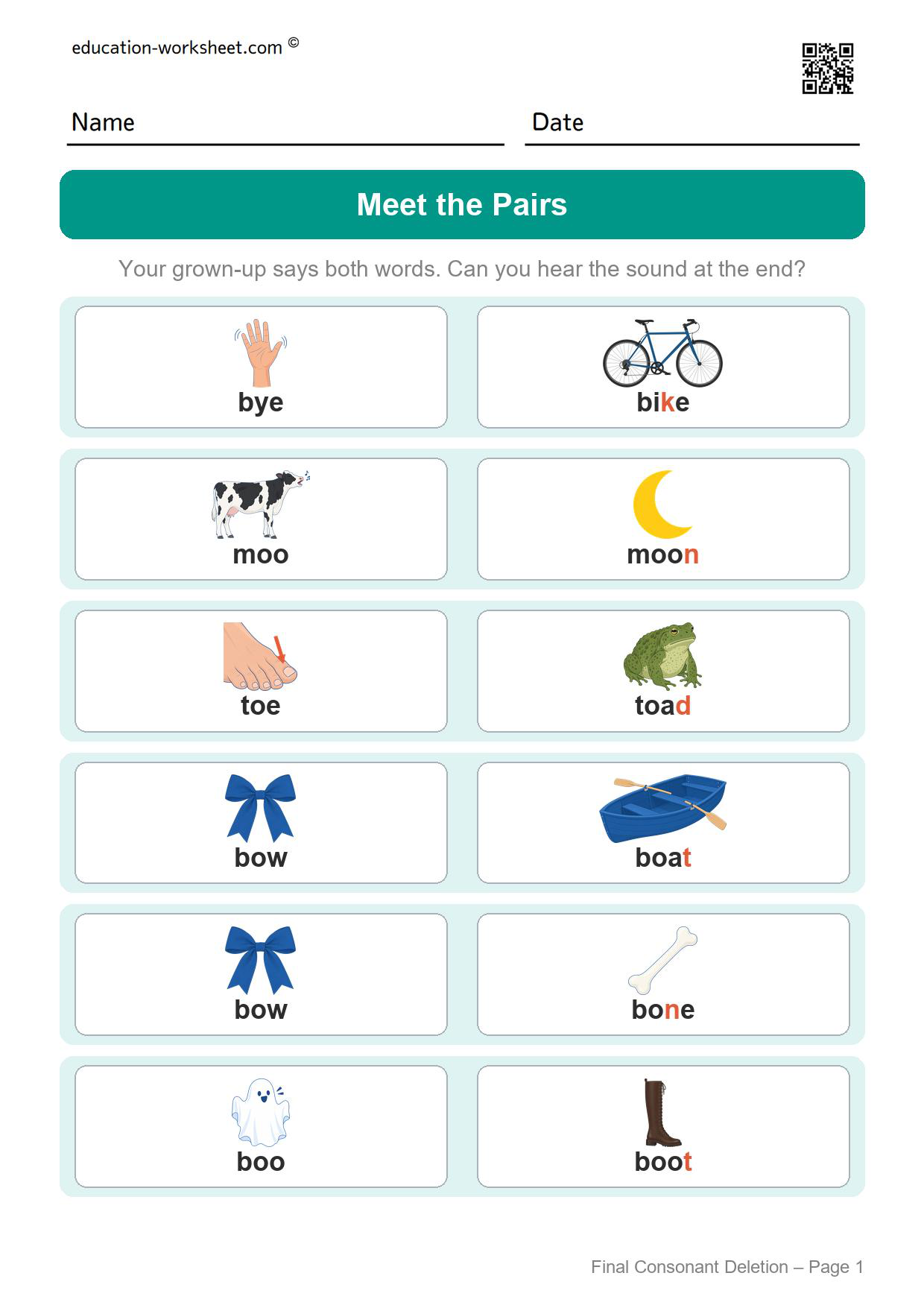
All six pairs side by side: bye – bike, moo – moon, toe – toad, bow – boat, bow – bone and boo – boot. On this page the child only listens. You say both words in each row and ask whether they sound the same. Hearing the difference comes before saying it.
The letter that makes the ending sound is printed in red: the k in bike, the n in moon, the d in toad, the t in boat. A silent e is left black, because it makes no sound.
Page 2 – Listen and Point, Set 1
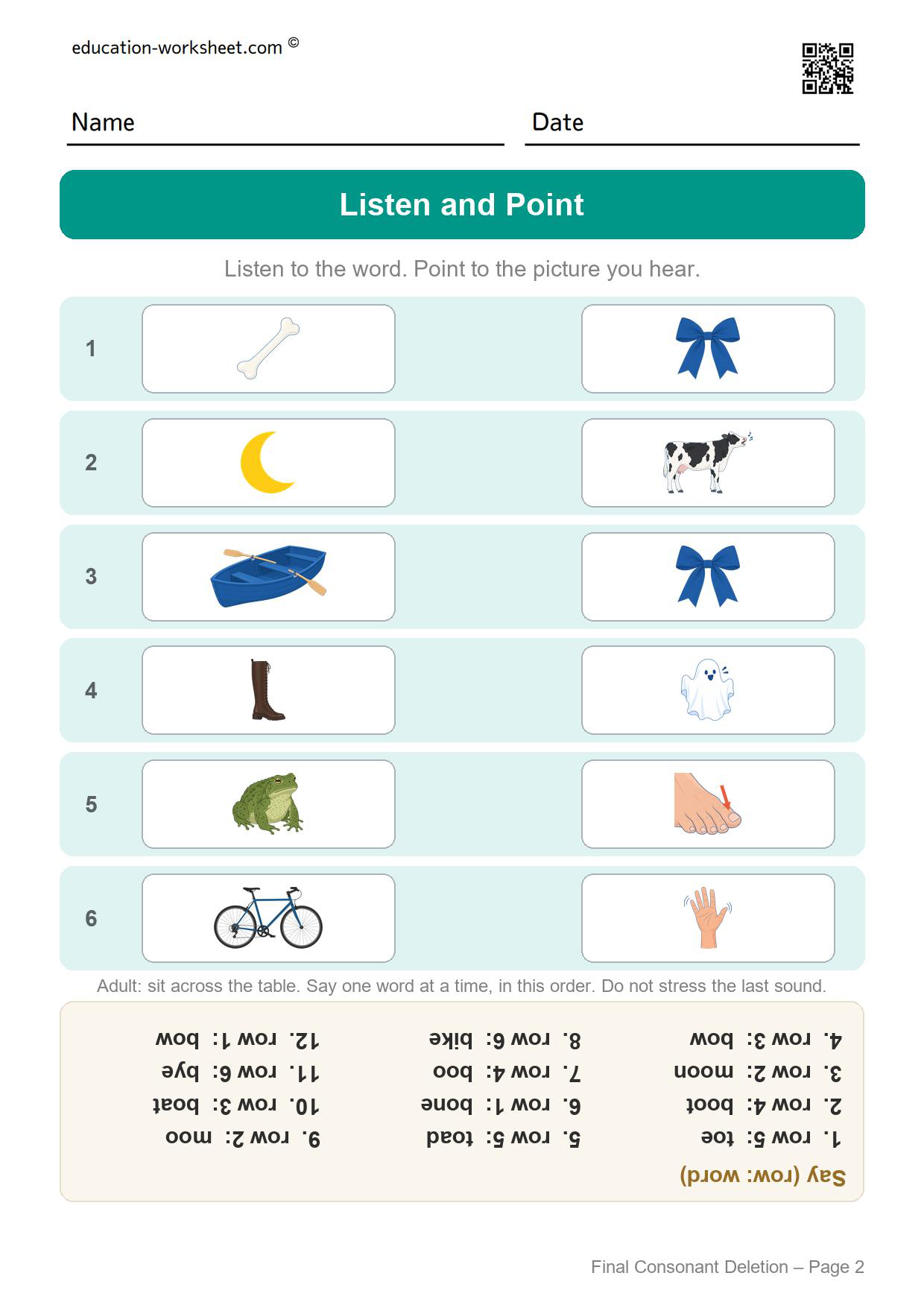
Six rows of picture pairs and twelve words for the adult to say. Every pair is asked twice, once for each word, so a child cannot get through the page by always choosing the same kind of picture.
The adult’s list is printed upside down at the bottom, so it reads the right way for an adult sitting across the table. The same row is never called twice in a row.
Page 3 – Listen and Point, Set 2
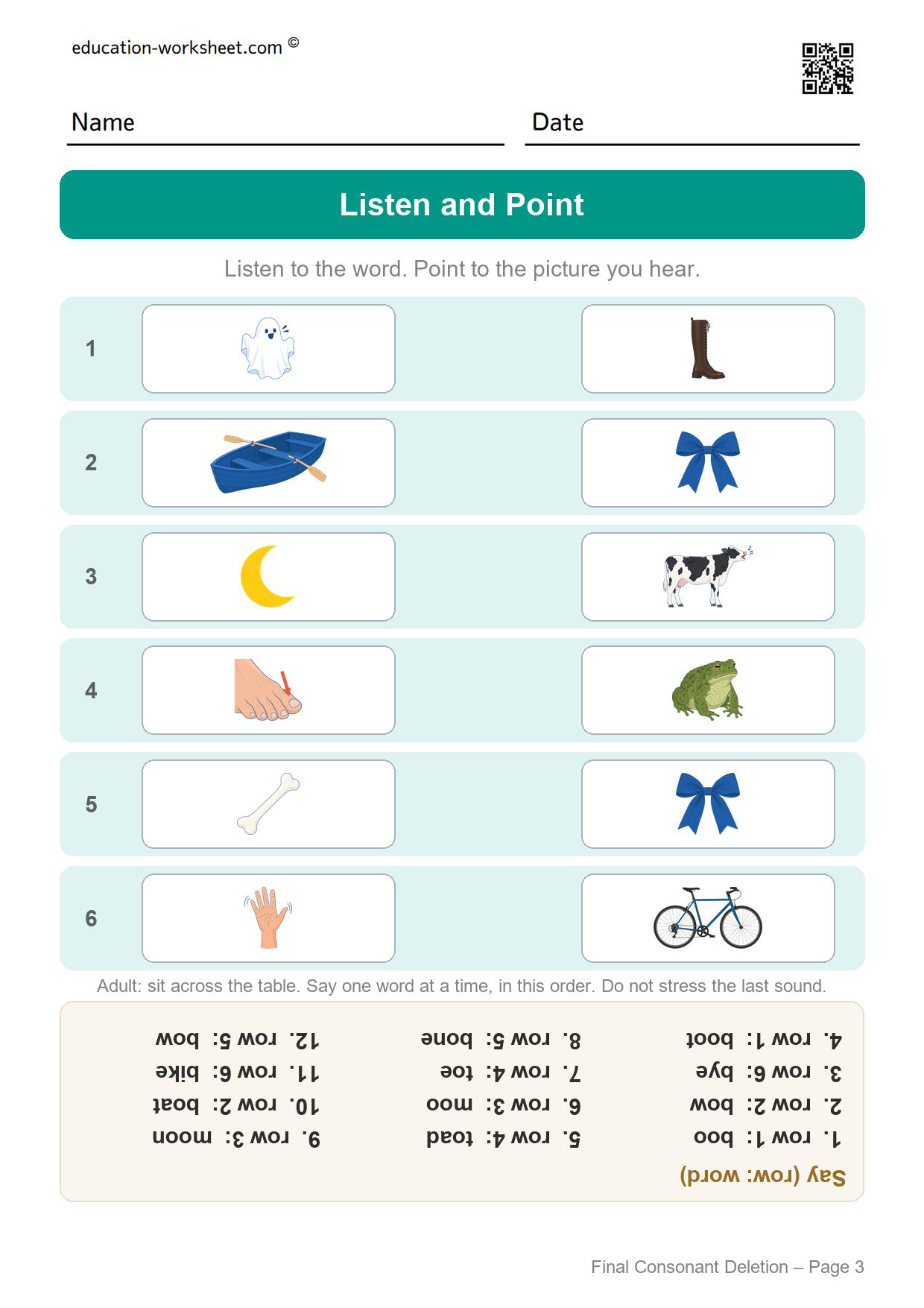
The same six pairs in a new order, with the pictures in new positions, and a new list of twelve words. A child who has memorized where the pictures were on page 2 has to listen again.
Page 4 – Listen and Point, Set 3
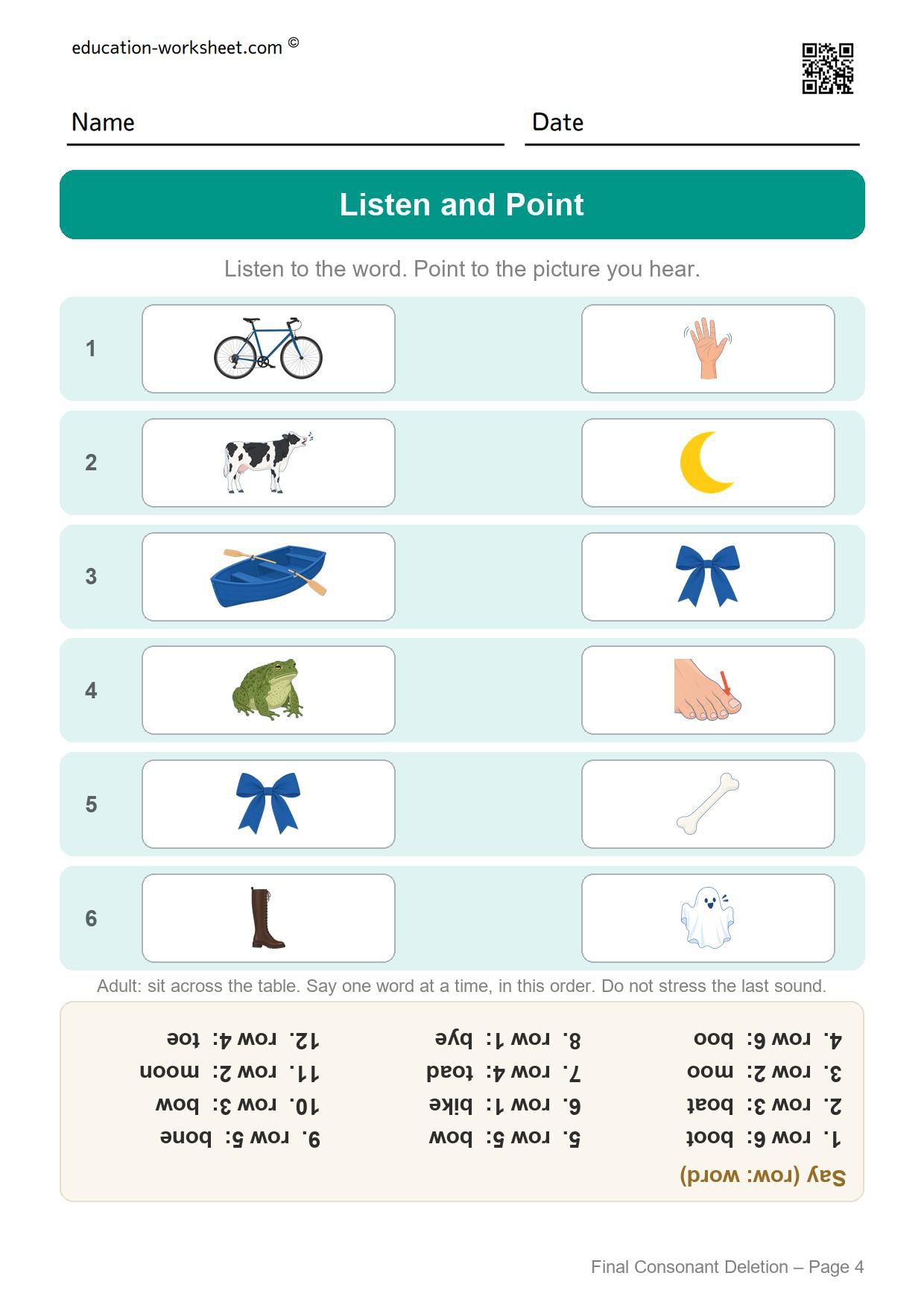
The last listening page. If the child is pointing to the right picture almost every time by now, they can hear the ending sound clearly and are ready to start saying the words.
Page 5 – Say It, I’ll Point, Set 1
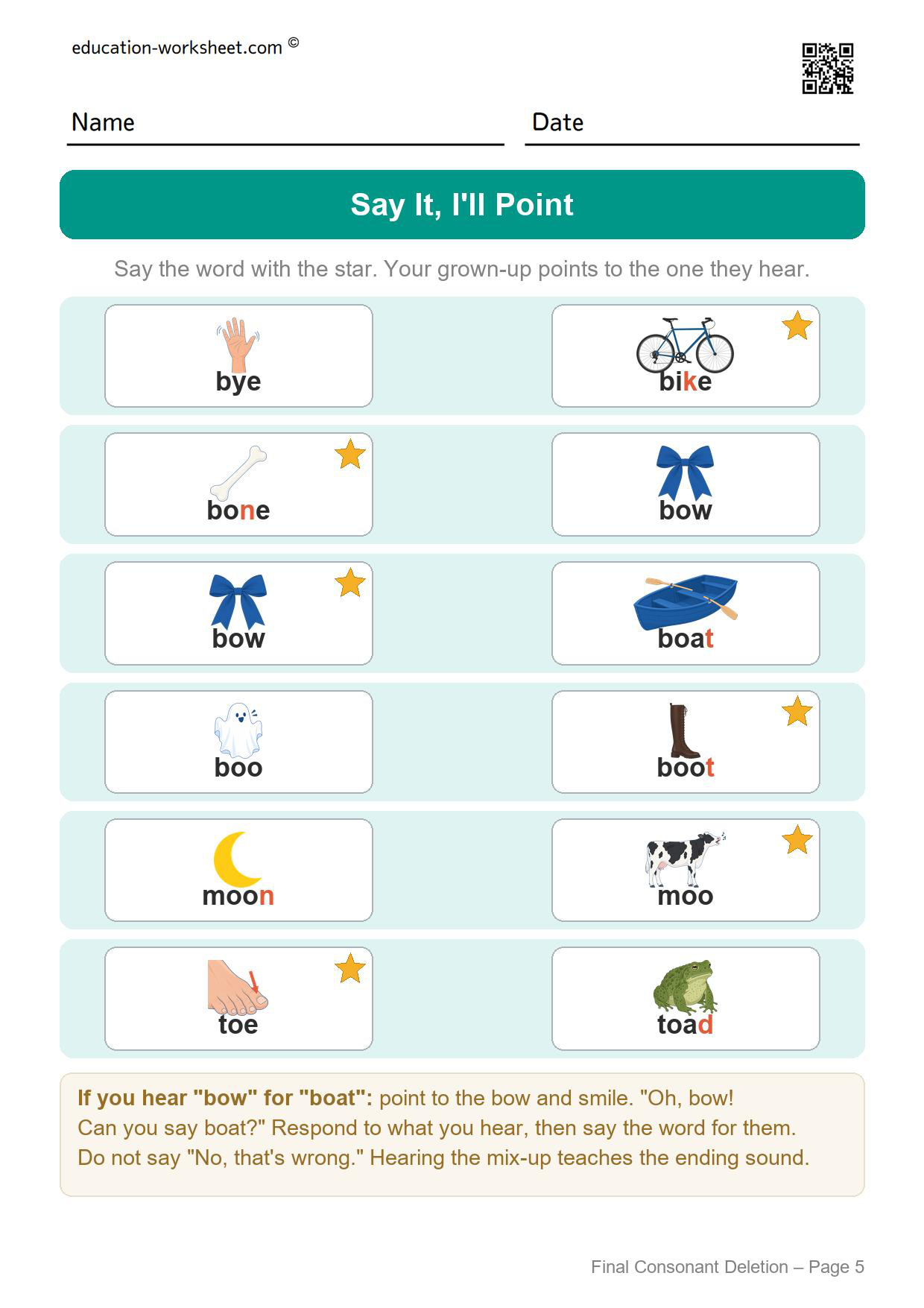
This is the heart of the pack. One picture in each row has a star. The child says that word, and you point to the picture you actually heard. If the child says “bow” for boat, you point to the bow.
That small mix-up is the lesson. The child wanted the boat and got the bow, and discovers for themselves that the ending sound changes the word. On this page the star words are bike, moo, toe, bow, bone and boot.
Page 6 – Say It, I’ll Point, Set 2
Page 6 asks for the other word in every pair from page 5: bye, moon, toad, boat, bow and boo. Together, the two pages give the child a turn at all twelve words.
Page 7 – Say It, I’ll Point, Set 3
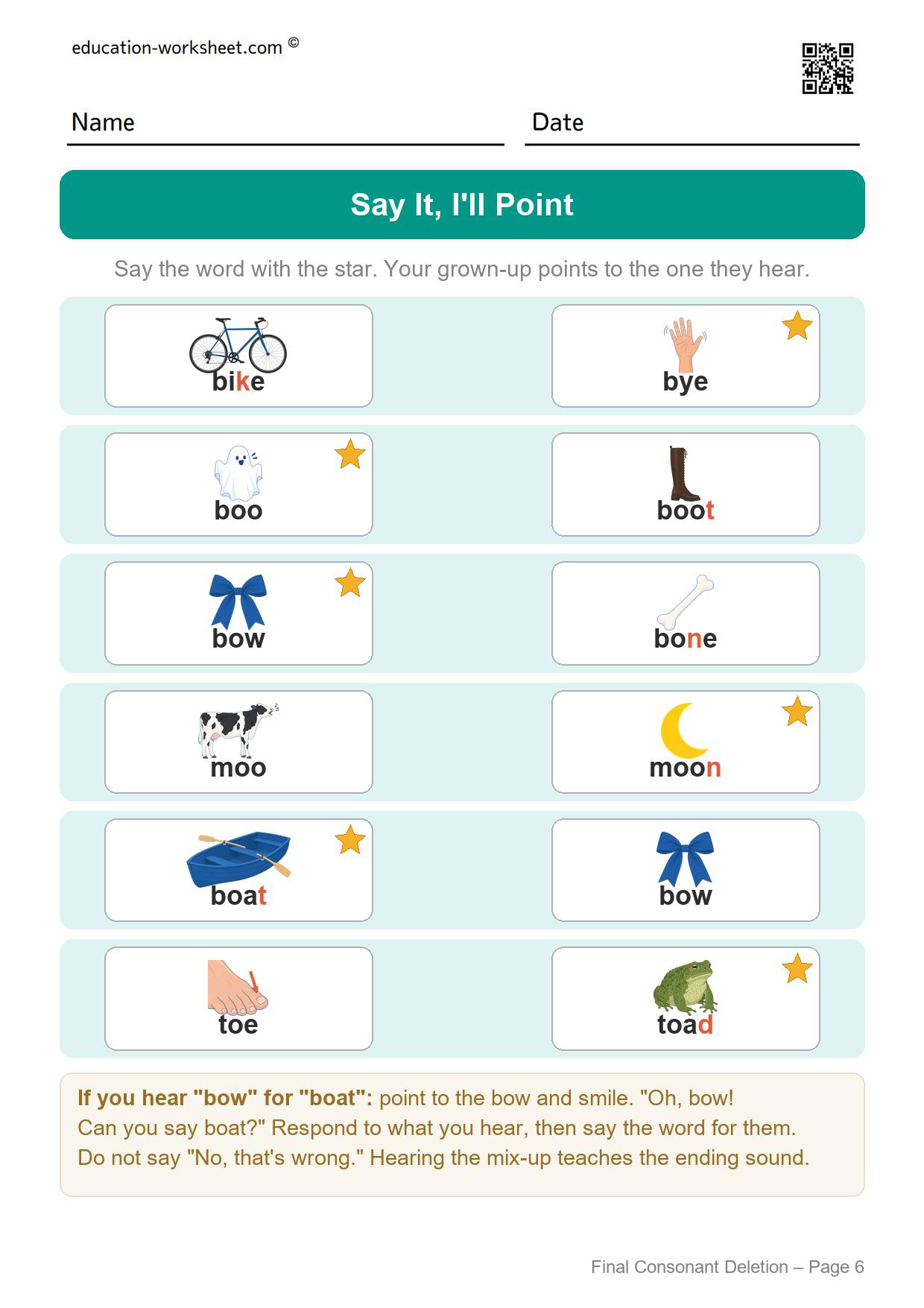
A fresh mix for more practice, in a new order and with the stars moved. Short, frequent practice matters more than anything else, so this page is worth printing more than once.
Page 8 – Say It in a Sentence, Set 1
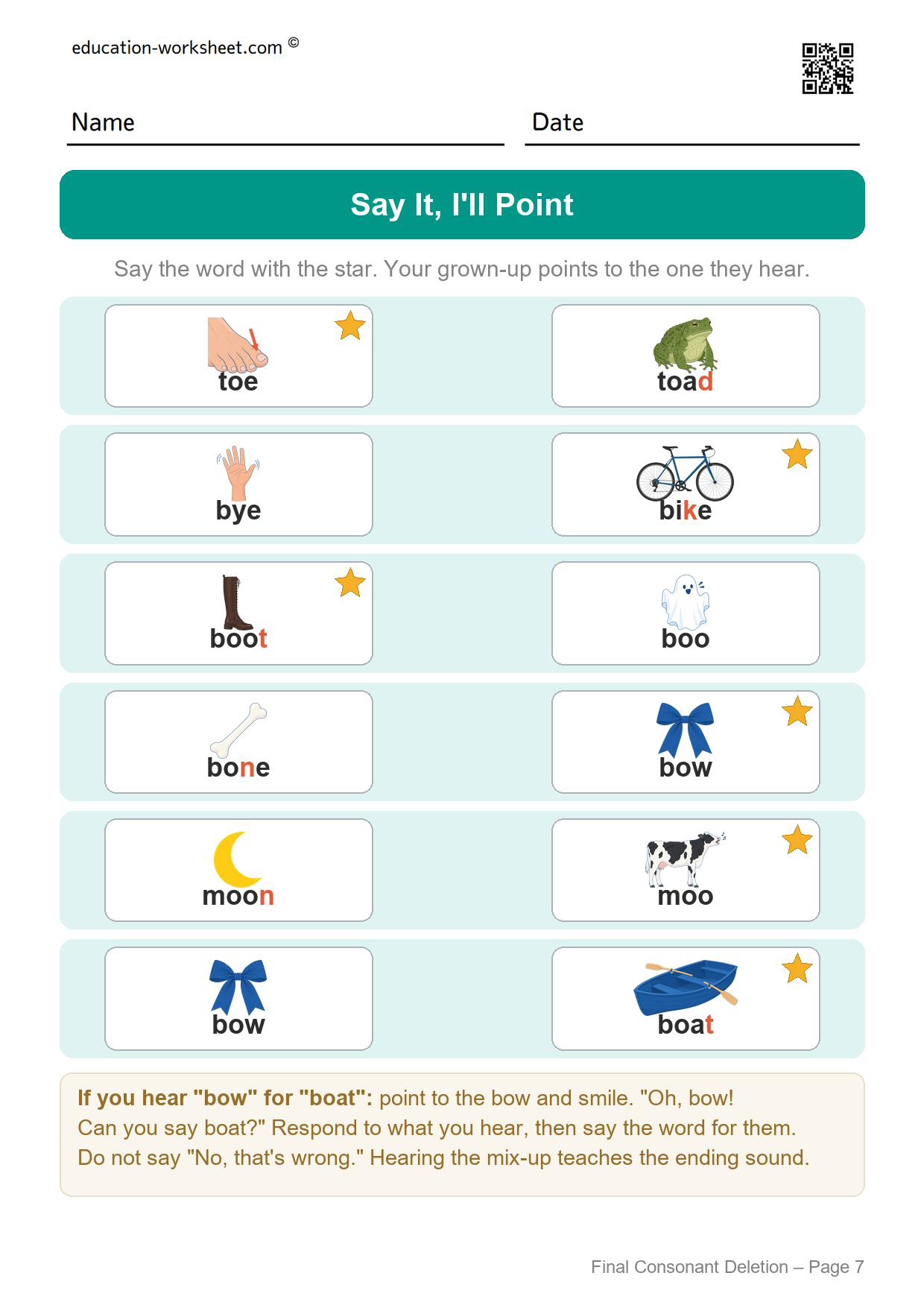
Short sentences such as “I ride my bike.” and “The dog has a bone.” The star word always comes last, where the ending sound is easiest to hear. In the middle of a sentence, the next word often swallows a final sound.
Move on to this page only when the child says the single words correctly most of the time.
Page 9 – Say It in a Sentence, Set 2
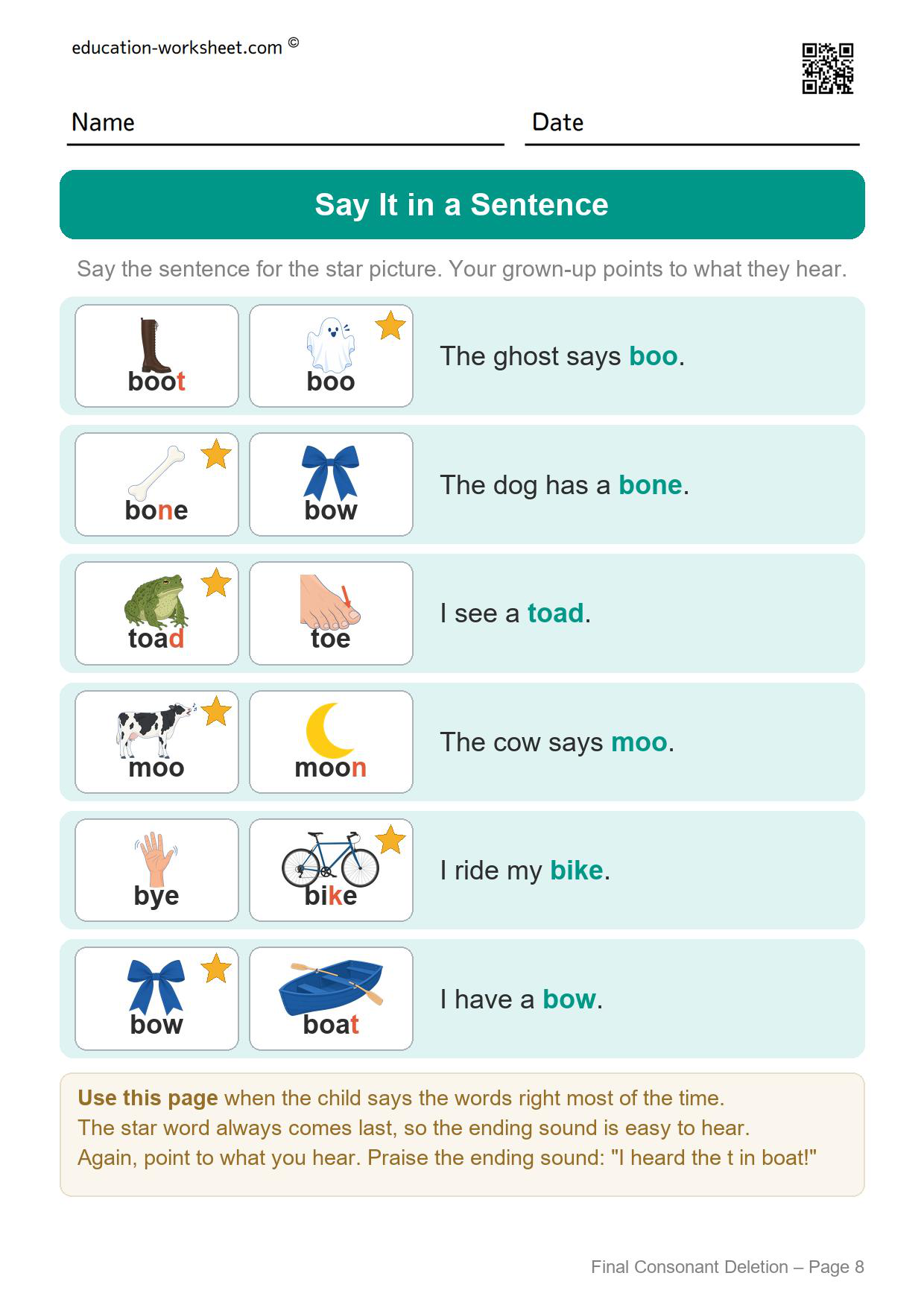
The partner sentences to page 8, for the other word in each pair: “I wave bye,” “I see the moon,” “I wiggle my toe” and so on.
Page 10 – Minimal Pairs Bingo, Board 1
Nine pictures from the eleven words in the pack. At least four complete pairs are always on the board, so covering the right picture means listening for the ending sound, not just the start of the word.
Play it two ways: you call and the child covers, or the child calls and you cover exactly what you hear. Two words on the calling list are not on the board, and spotting them is part of the game.
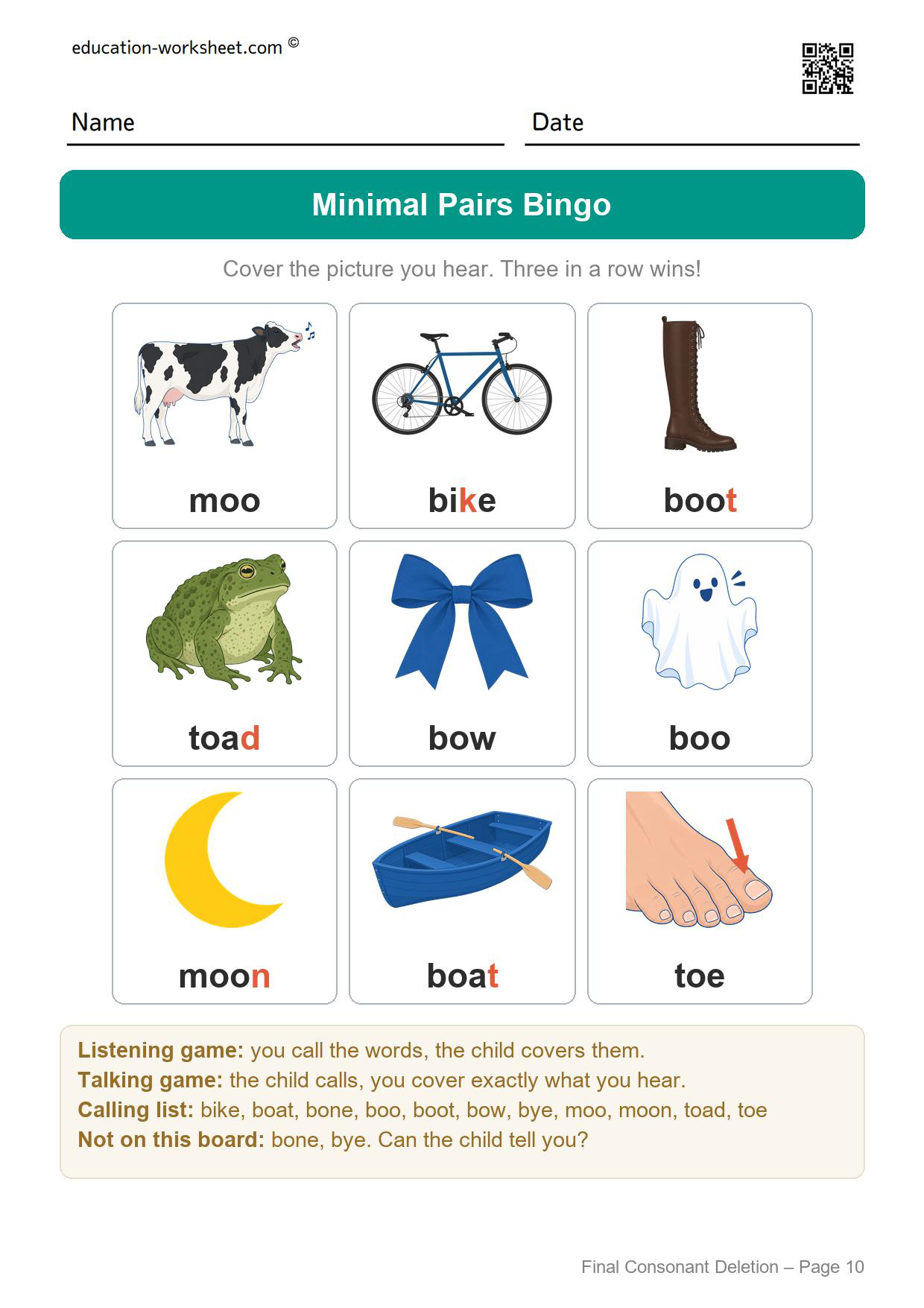
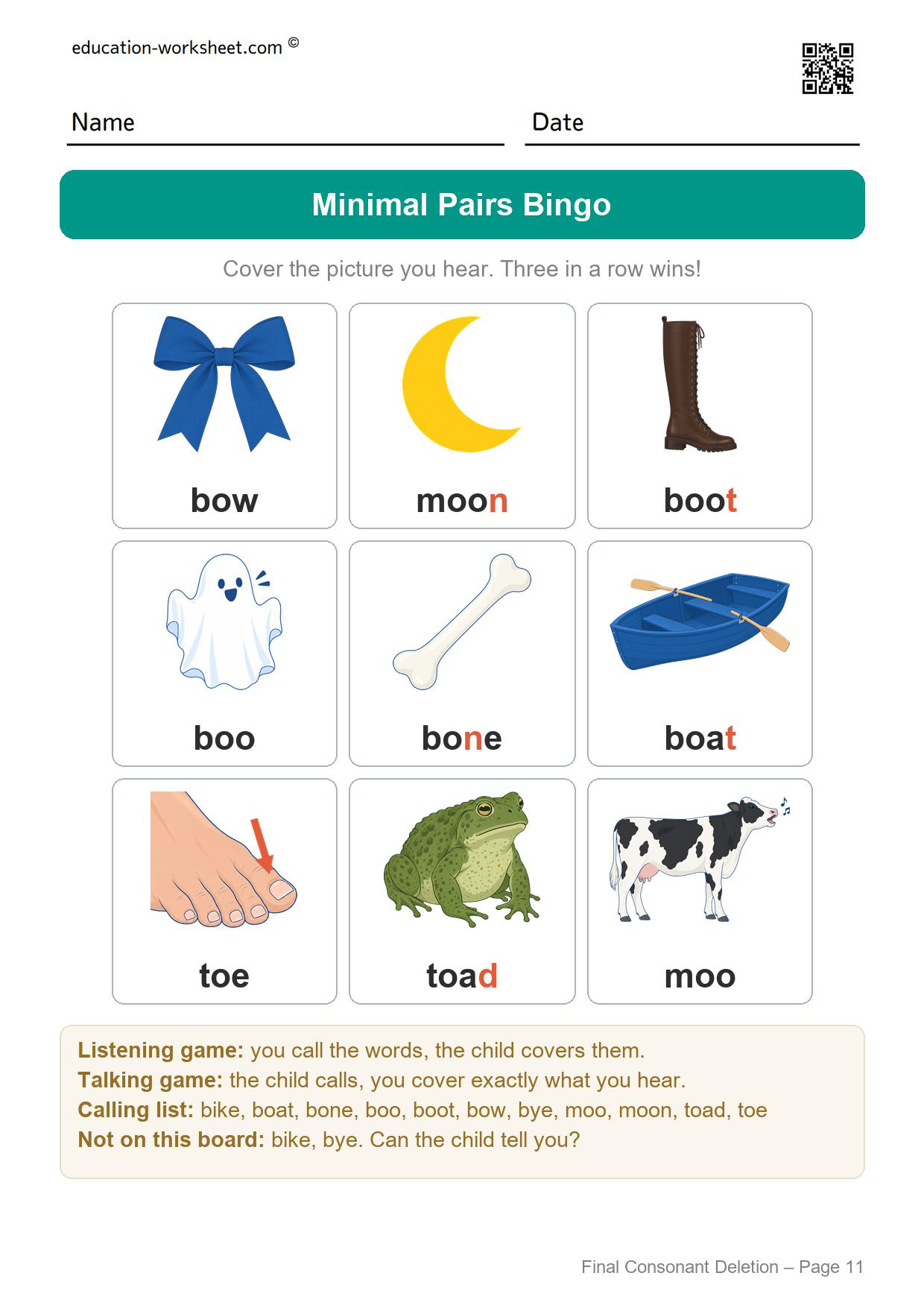
Page 11 – Minimal Pairs Bingo, Board 2
A second board with a different set of pictures, so two people can play against each other.
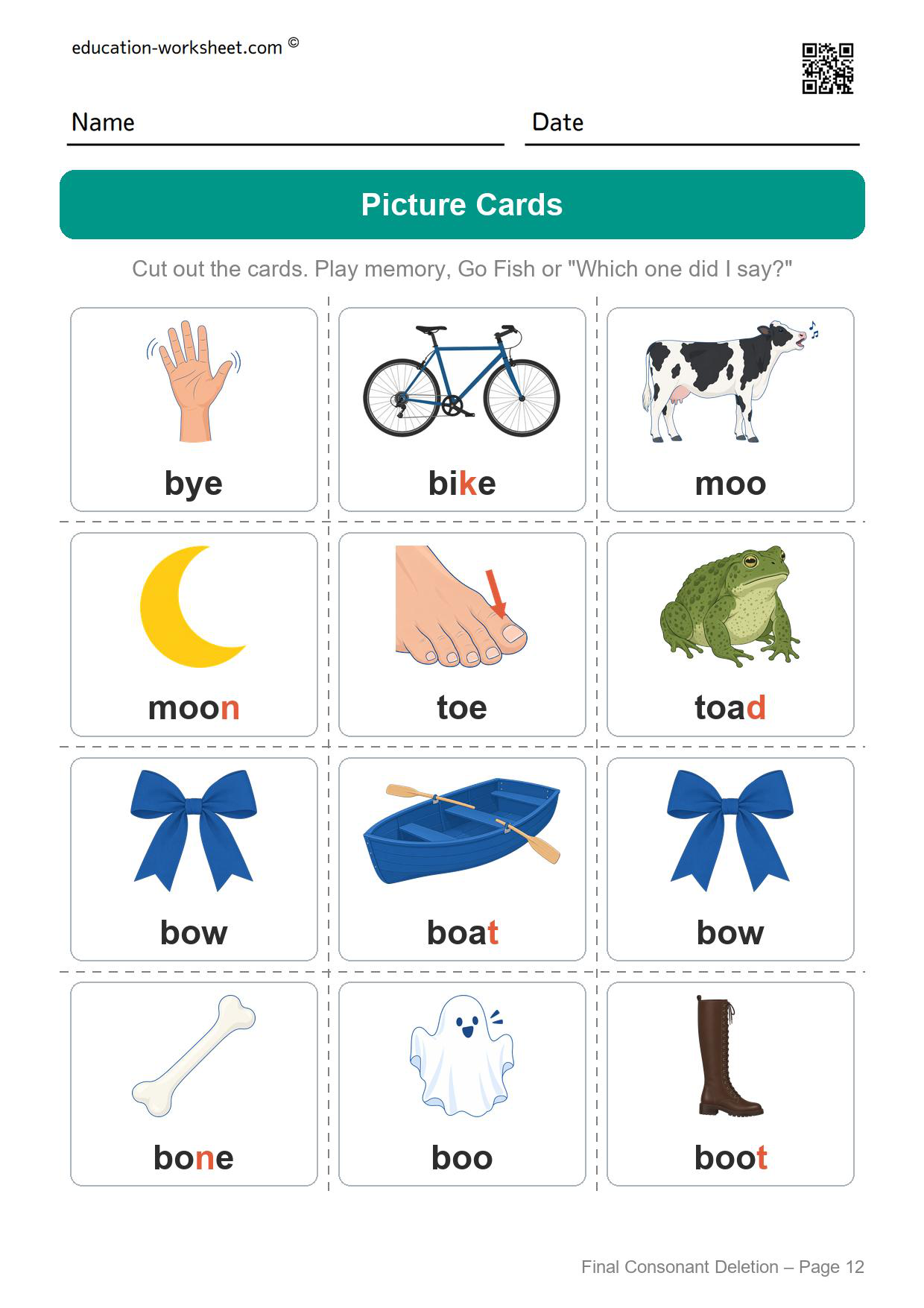
Page 12 – Picture Cards to Cut Out
Twelve cards to cut out, one for every word in every pair. The bow appears twice because it belongs to two pairs. Use them for memory, Go Fish (“Do you have the boat?”) or a quick “Which one did I say?” game with two cards on the table.
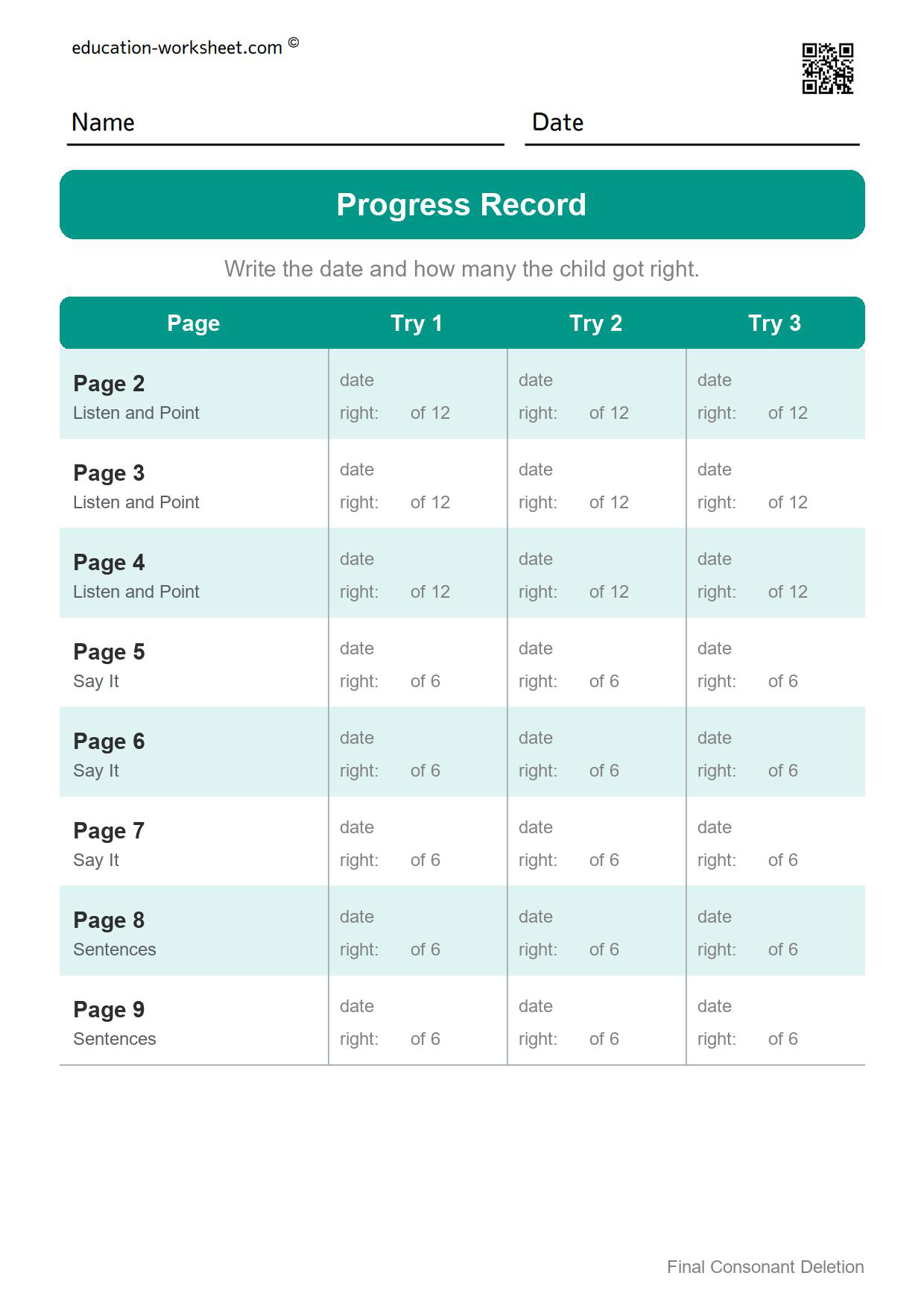
Progress Record
A record for the eight practice pages, with room for three tries on each. Write the date and how many the child got right: out of 12 on the listening pages and out of 6 on the saying pages.
Why These Six Pairs
Every pair ends in an early sound: t, d, k or n. These are among the first consonants children learn to say. A child who leaves off ending sounds often has a small set of sounds overall, and asking for a late sound at the end of a word would turn one problem into two: putting a sound at the end, and making a sound they cannot yet make anywhere.
That is why some well-known pairs are not in this set. Eye and ice, no and nose, and pea and peach end in s, z and ch, sounds that usually develop later. Car and card is left out because in American English car already ends in an r sound, so card ends in two consonants, not one.
The pictures were also chosen so each has one obvious name. The toe picture is a close-up of the toes with an arrow on the big toe, because a whole foot would simply be called a foot. The two pictures in every pair are drawn in the same style, so a child cannot choose by how a picture looks.
How to Respond When the Child Leaves Off the Sound
This is the most important thing in the pack. Respond to what you hear, not to what you know the child meant. If the child says “bow” while looking at the boat, point to the bow and say, kindly, “Oh, bow! Can you say boat?” Then say boat yourself, clearly but without stretching the t.
Avoid “No, that’s wrong.” The point is not to correct the child but to let them notice that the listener got a different word. That surprise is what makes the ending sound matter to them. When they get it right, praise the sound itself: “I heard the t in boat!”
When to Get Help
If a child is still leaving off ending sounds often after about age three and a half, or if family and teachers often cannot understand them, talk to a speech-language pathologist. These worksheets can support therapy, but they cannot tell you why a child is making the error or whether other patterns are involved.
Check hearing first. Ending sounds are some of the quietest sounds in speech, so they are the first to be missed when hearing is not quite clear, for example after ear infections or with fluid behind the eardrum.
Who These Worksheets Are For
- Age: about three to five, or older children who still leave off ending sounds.
- Before starting: check that the child can say the sound at the start of words. A child who says toe can usually learn the d in toad more easily.
- Related standard: RF.K.2.D asks kindergartners to isolate the final sound in three-sound words. Hearing the end of a word clearly is part of the same skill.
- Speech-language pathologists can use the pack as homework between sessions.
How to Use These Worksheets
- Read the guide page. Then start with page 1: say both words in each row and ask, “Do they sound the same?”
- On pages 2 to 4, sit across the table, read the upside-down list one word at a time and let the child point. Do not stress the last sound.
- When the child points correctly most of the time, move to pages 5 to 7. The child says the star word; you point to what you heard.
- When single words are right most of the time, try the sentences on pages 8 and 9.
- Finish with bingo or the picture cards. Games give many extra tries without feeling like work.
- Keep sessions to 5 to 10 minutes a day, and write the results on the progress record.
Three Things to Watch For
1. Adults stretching the sound. Saying “boa-T” with a big puff of air seems helpful, but it adds an extra syllable and teaches the wrong thing. Say the word naturally, just clearly.
2. Adding a sound to every word. Some children learn that ending sounds matter and start putting one on everything, such as “bot” for bow. That is why half the star words are the short ones: the child needs to know when not to add a sound too.
3. Getting the word but not the sentence. It is common for a child to say boat perfectly on its own and drop the t in “I sit in a boat.” That is normal. Stay on the sentence pages longer rather than going back.
Printing Tips
- Print at 100 percent, actual size, on A4 or US Letter.
- Color printing is best, especially for the picture cards and bingo boards.
- Print the picture cards on card stock if you can, so they last longer and cannot be seen through.
Frequently Asked Questions
What is final consonant deletion?
It is a speech pattern in which a child leaves off the last consonant of a word, so boat sounds like bow and bike sounds like bye. It is common in toddlers and usually disappears by about age three.
What are minimal pairs?
Two words that differ in only one sound, such as bow and boat. Because changing that one sound changes the meaning, minimal pairs show a child why the sound matters.
What age are these worksheets for?
About three to five, or older children who are still leaving off ending sounds. If a child is still doing it often after three and a half, talk to a speech-language pathologist.
Why are some common pairs, like eye and ice, missing?
They end in sounds such as s and z that usually develop later. This first set sticks to early sounds so the child only has one new thing to learn.
Can these worksheets replace speech therapy?
No. They are practice materials. A speech-language pathologist can find out why a child is making the error and plan the right help.
Do I need to sign up to download these?
No. Every PDF downloads immediately, with no account, no email address and no cost.
Can I use these in my classroom or therapy room?
Yes, they are free to print for home, classroom and therapy use. Please do not sell them or re-host the files elsewhere.
More Free Speech and Language Worksheets
- Free Auditory Memory Worksheets for Kids – Listen and Repeat
- Free Rapid Automatic Naming Worksheets – RAN Letters and Numbers
- Free Ending Sounds Worksheets for Kindergarten – Phonics
- Free Beginning Sounds Worksheets for Kindergarten – Phonics, 40 Words
- Free Rhyming Words Worksheets for Kindergarten – Words That Rhyme
- Free CVC Word Building Worksheets for Kindergarten – Make Three Letter Words