These free printable auditory memory worksheets turn listening into four short games for children in kindergarten to second grade. An adult reads a line of numbers, words or picture names aloud, and the child says it back, says it backward, or points to the pictures in the same order. There are twelve pages and 120 lines in all, starting with two items and building up to five.
The pack was designed by a speech-language-hearing therapist, and it is built for practice, not testing. It gives no target scores and cannot diagnose a listening or learning difficulty. What it gives you is a set of carefully built lines, so that when a child succeeds, they have really listened and held what they heard rather than guessed, counted or followed a pattern.
Auditory memory is the ability to hold on to something you have just heard long enough to use it. Children lean on it all day: following a two-step instruction, remembering a new word long enough to say it, or keeping the start of a sentence in mind until it ends.
- What Is in This Free Auditory Memory Worksheet Pack
- The 12 Auditory Memory Worksheets
- Start Here – The Four Listening Games
- Page 1 – Listen and Repeat: 2 and 3 Numbers
- Page 2 – Listen and Repeat: 2 and 3 Words
- Page 3 – Listen and Point: Animals
- Page 4 – Listen and Repeat: 3 and 4 Numbers
- Page 5 – Listen and Repeat: 3 and 4 Words
- Page 6 – Listen and Point: Fruit
- Page 7 – Listen and Repeat: 4 and 5 Numbers
- Page 8 – Listen and Repeat: 4 and 5 Words
- Page 9 – Listen and Point: Things at Home
- Page 10 – Say It Backward: 2 and 3 Numbers
- Page 11 – Say It Backward: 3 and 4 Numbers
- Page 12 – Listen and Point: Mixed Pictures
- Progress Record – The Longest Line, Three Tries
- How the Lines Are Built
- What Listening Practice Can and Cannot Do
- When Children Are Ready for These Worksheets
- How to Use These Worksheets
- Three Things to Watch For
- Printing Tips
- Frequently Asked Questions
- What is auditory memory?
- What age are these auditory memory worksheets for?
- Is this a test for auditory processing disorder?
- How many numbers should my child be able to repeat?
- Why are the lines on the picture pages upside down?
- Do I need to sign up to download these?
- Can I use these in my classroom or therapy room?
- More Free Listening and Language Worksheets
What Is in This Free Auditory Memory Worksheet Pack
- Twelve printable pages with ten lines each – 120 lines and 410 items in all.
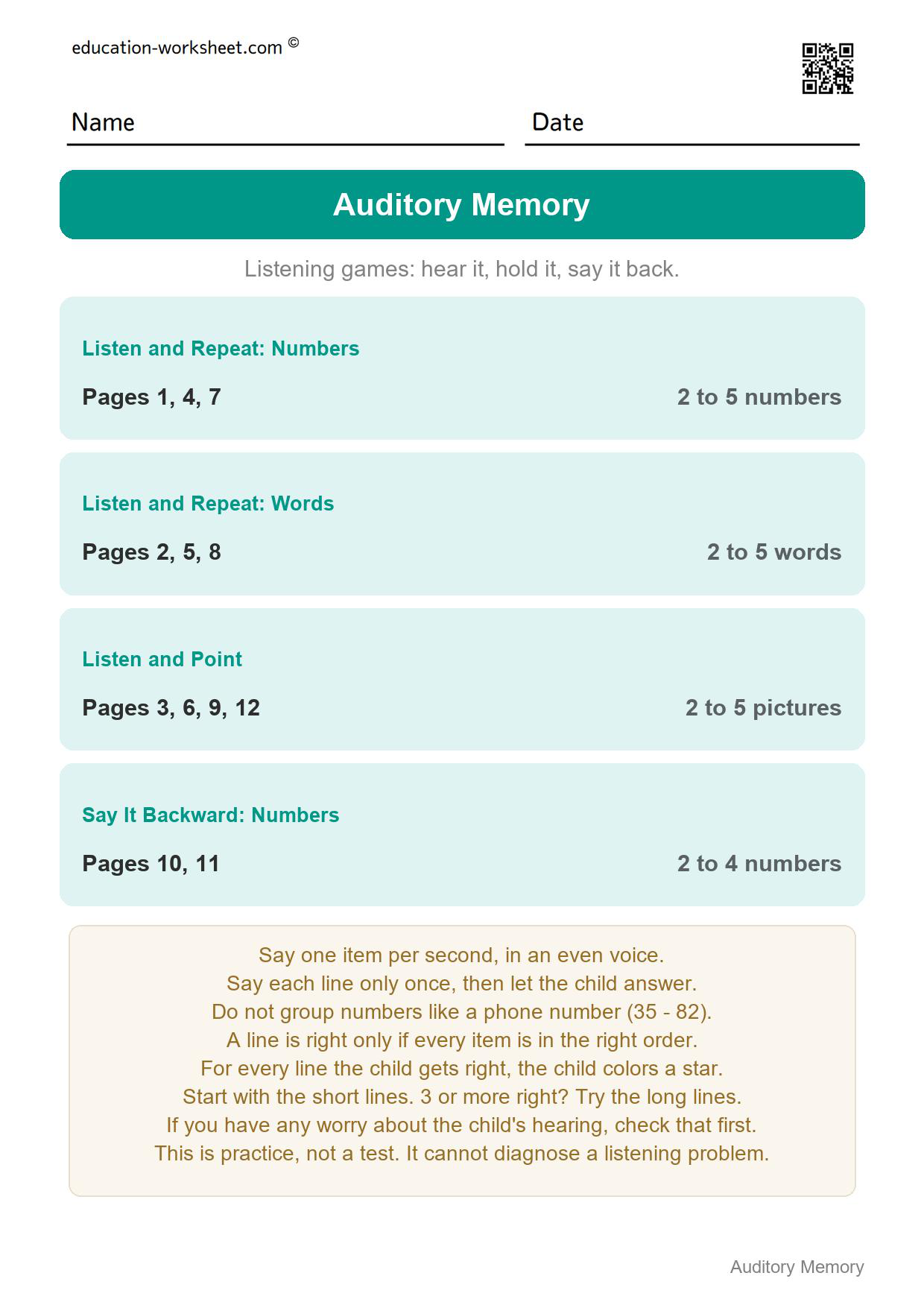
- Listen and Repeat: Numbers (pages 1, 4 and 7) and Words (pages 2, 5 and 8).
- Listen and Point with eight pictures per page: animals, fruit, things at home and mixed pictures (pages 3, 6, 9 and 12).
- Say It Backward: Numbers (pages 10 and 11).
- A star for the child to color on every line, an introduction page for adults and a progress record.
- A separate PDF for every page, free to download and print.
The 12 Auditory Memory Worksheets
Every page has five short lines and five long lines. Start with the short ones. If the child gets three or more of those right, move on to the long ones. The four games take turns, and each time a game comes around, its lines are one item longer.
Start Here – The Four Listening Games
The first page shows which pages hold which game and gives the adult seven short rules. The most important one is the first: say one item per second, in an even voice. Speed and rhythm change how hard a line is, so keeping them steady is what makes one try comparable with the next.
Page 1 – Listen and Repeat: 2 and 3 Numbers
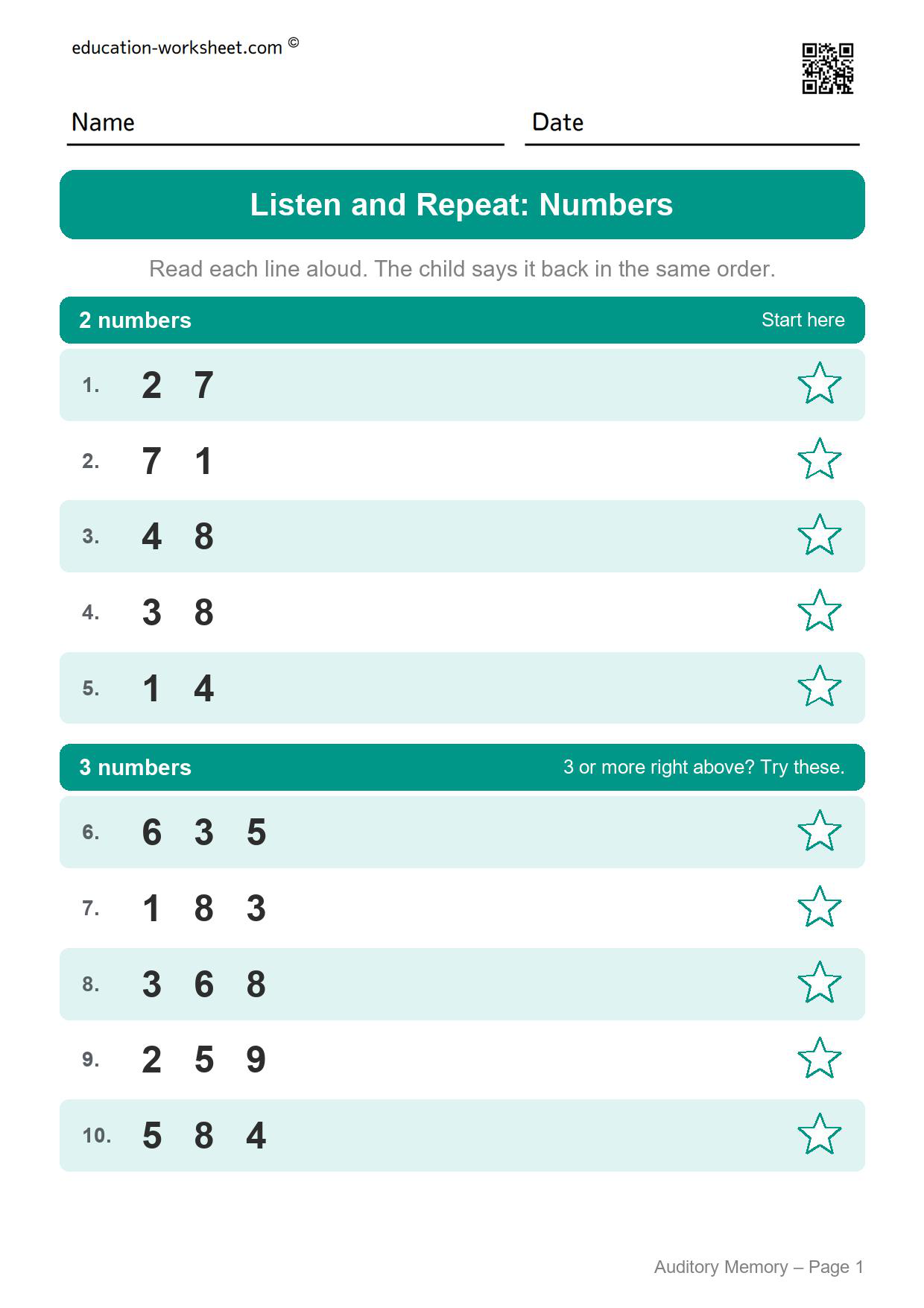
Five lines of two numbers, then five of three. The child listens to the whole line and says it back in the same order.
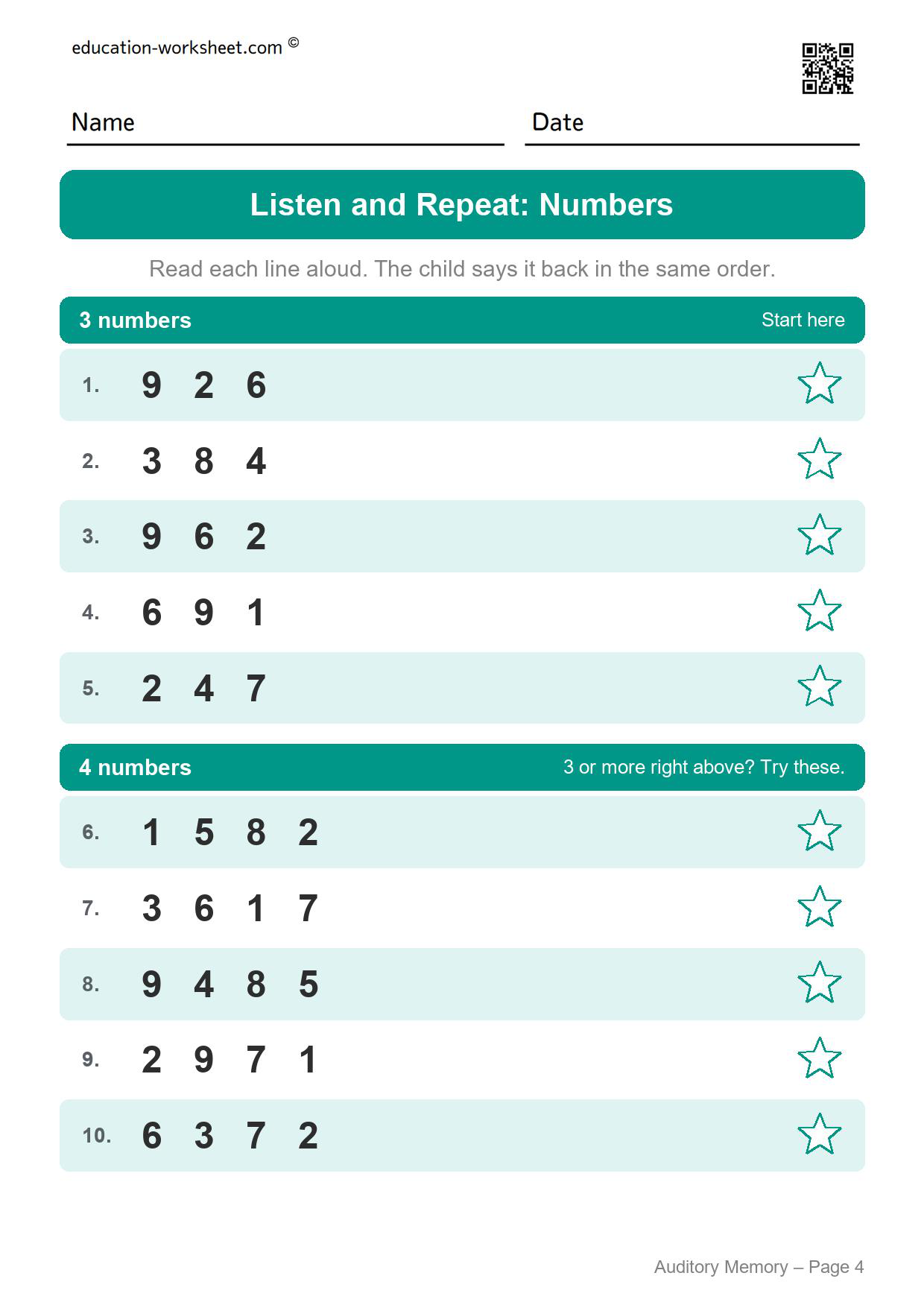
No line has two numbers that sit next to each other when you count, such as 3 and 4 or 7 and 6. A line like 3 4 can be remembered as part of counting rather than heard and held, so lines like that are left out.
Page 2 – Listen and Repeat: 2 and 3 Words
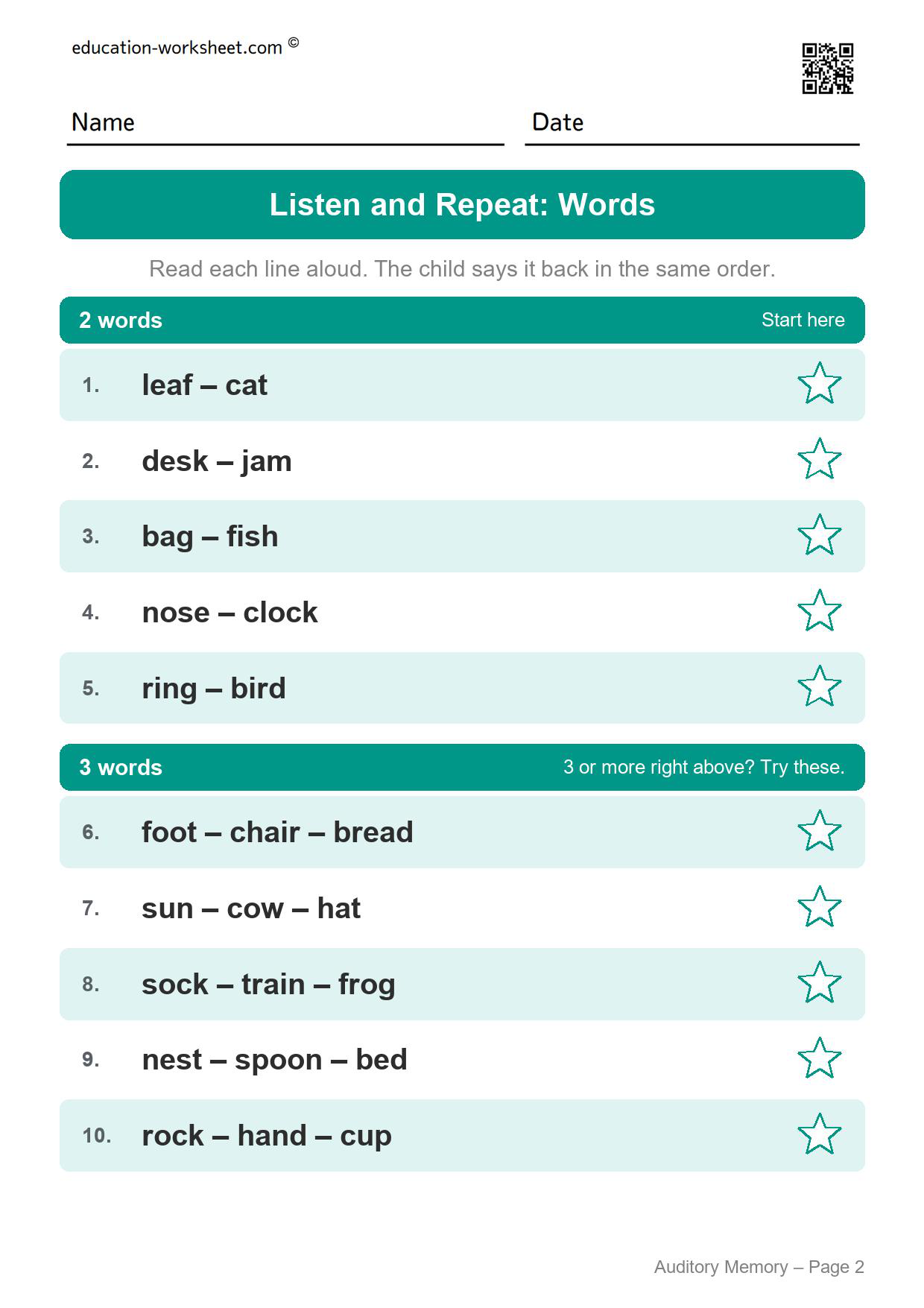
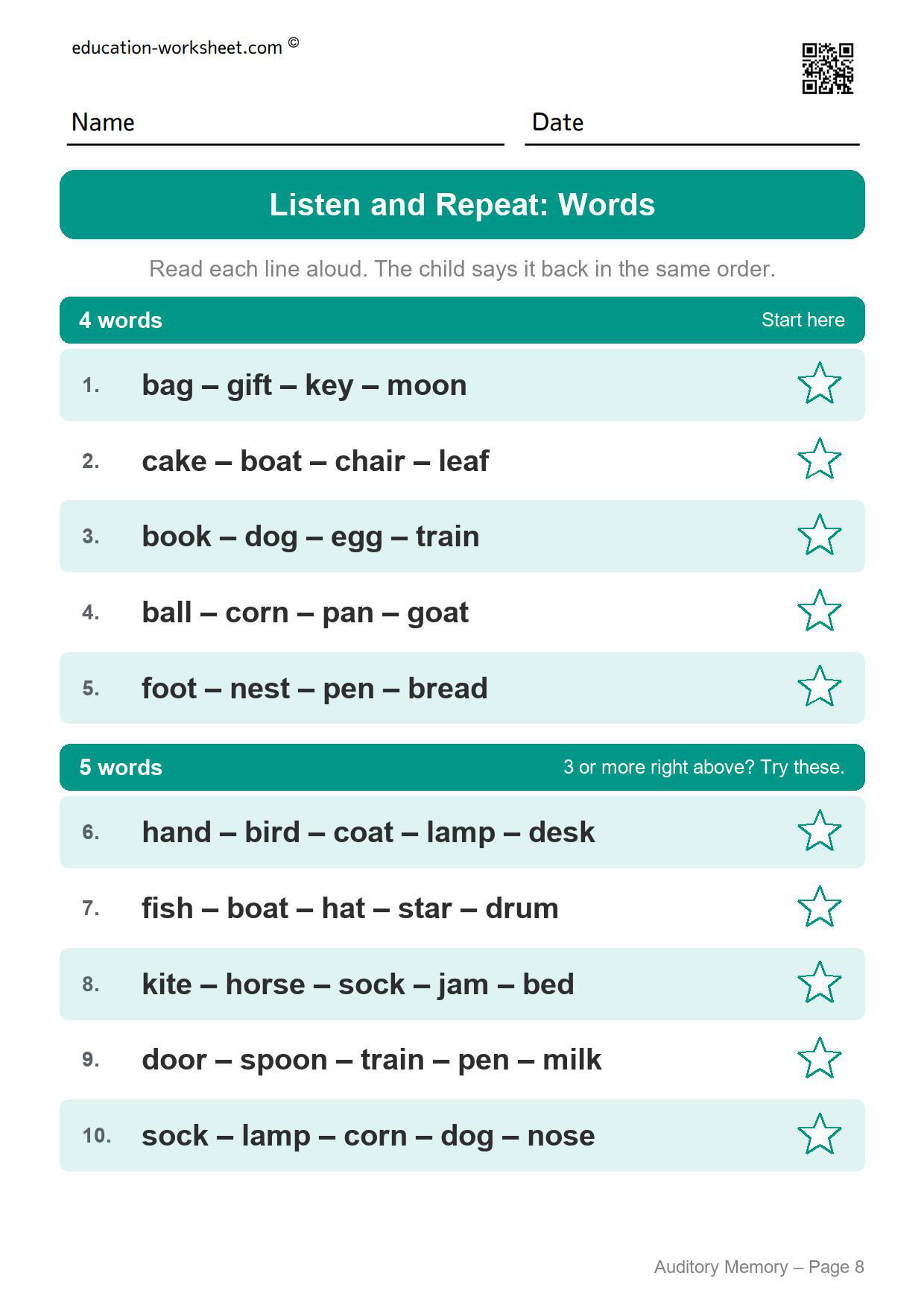
Short, everyday words: leaf – cat, desk – jam, foot – chair – bread. Every word in the pack has one syllable, so a line of three words is always about the same length to say.
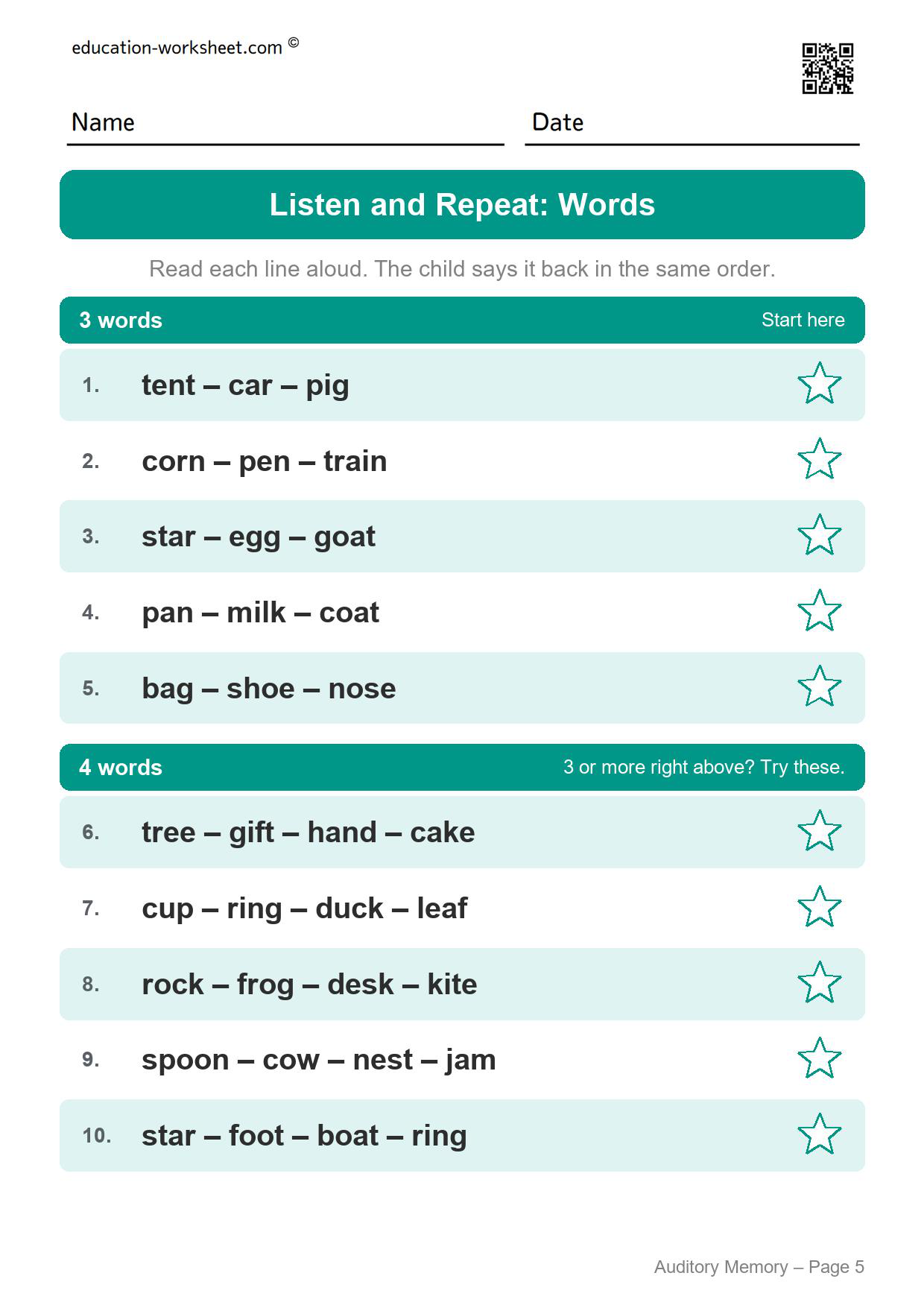
Inside any one line, no two words start with the same sound, no two words rhyme, and no two belong to the same group, such as two animals. Each of those would change the task: rhyming words are easy to mix up, and words from one group are easy to remember together.
Page 3 – Listen and Point: Animals
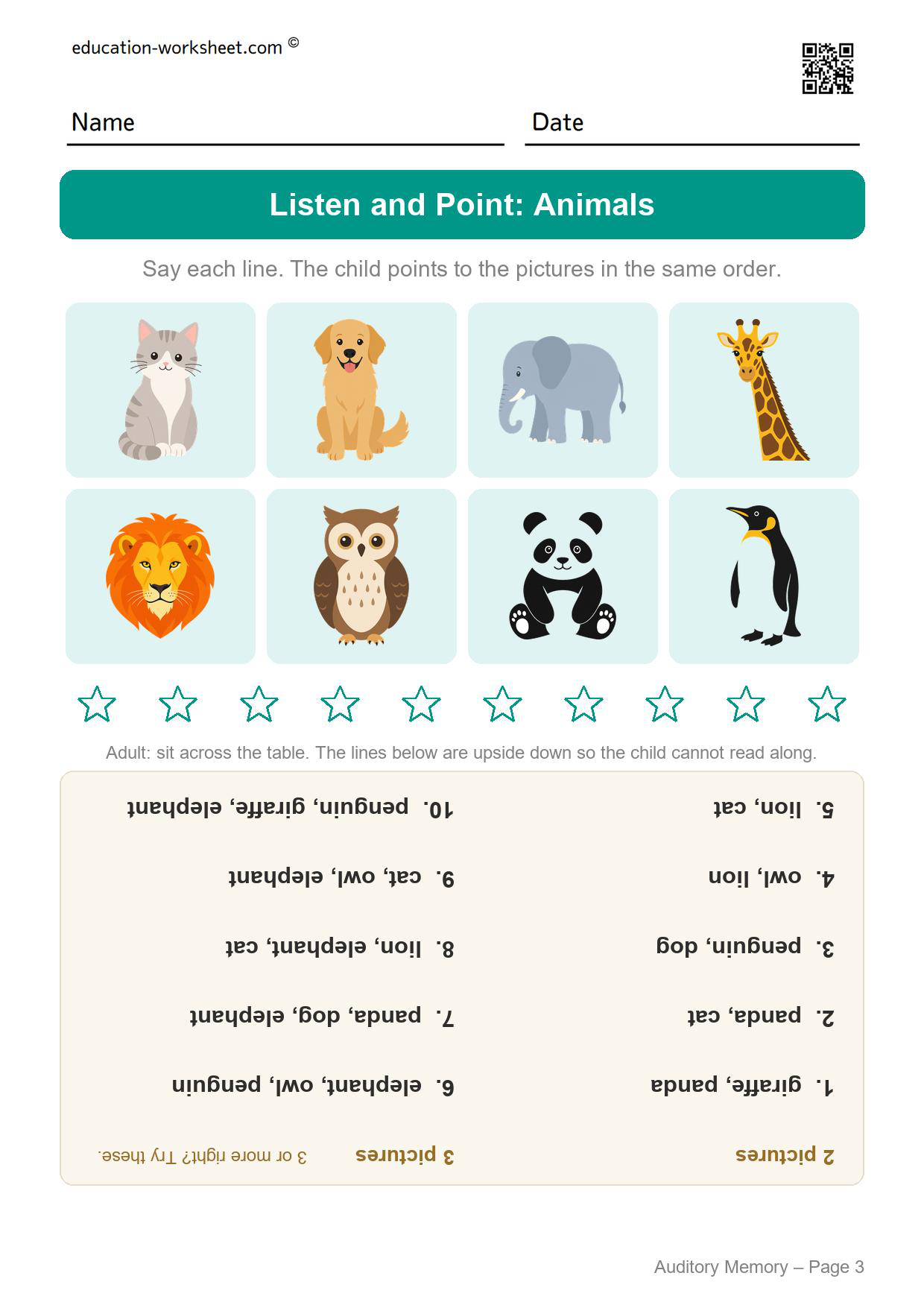
Eight animals in two rows. The adult says a line such as “owl, lion” and the child points to the pictures in the same order.
Pointing takes speech out of the task. A child whose speech is hard to understand, or who is shy about talking, can show exactly what they remembered. The adult’s lines are printed upside down at the bottom of the page, so an adult sitting across the table can read them and a child who reads cannot read ahead.
Page 4 – Listen and Repeat: 3 and 4 Numbers
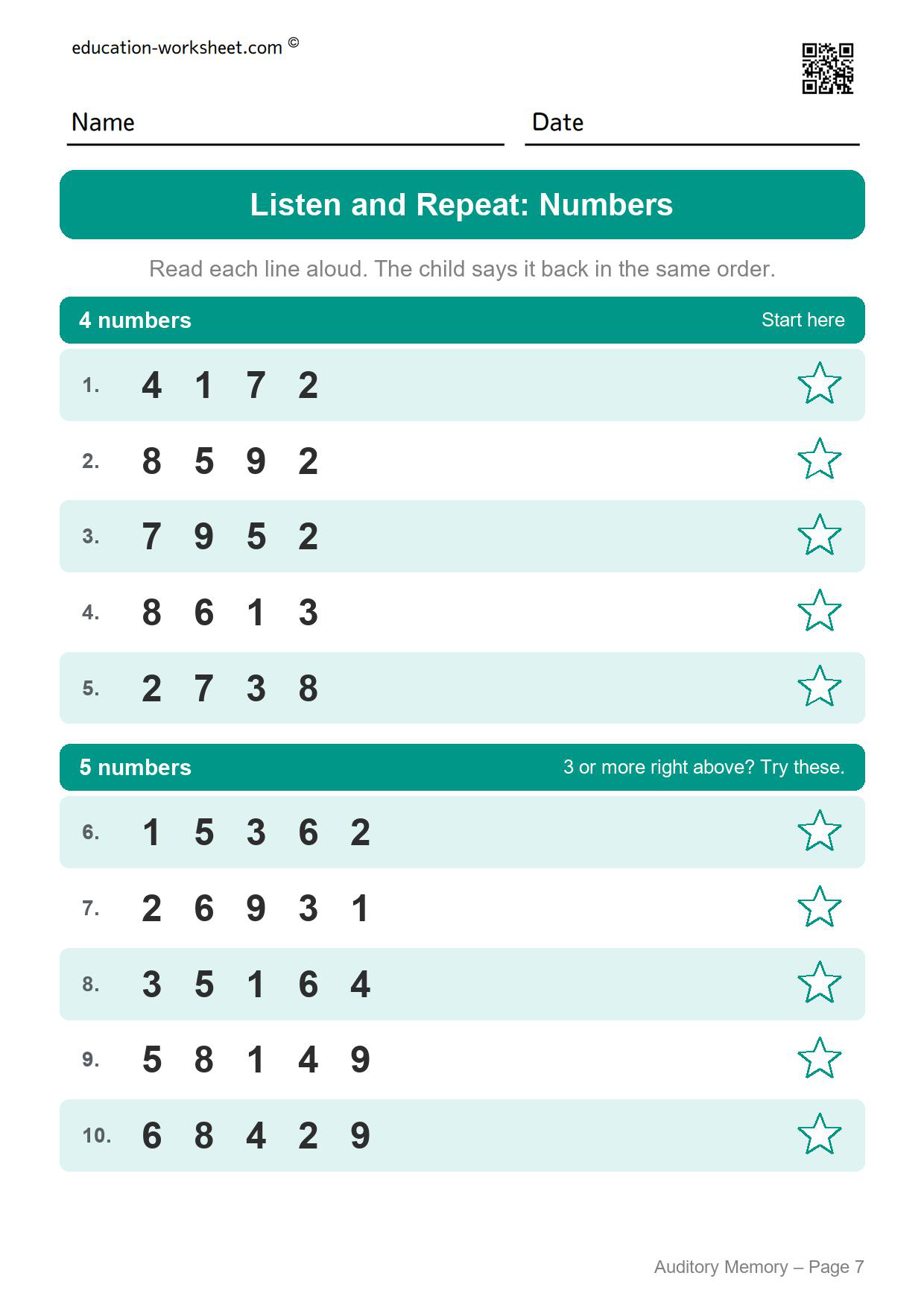
The lines grow to three and four numbers. As on every number page, the numbers never step evenly, so there is no 1, 3, 5 or 9, 6, 3 to fall back on as a pattern.
Page 5 – Listen and Repeat: 3 and 4 Words
Three and four words, for example tent – car – pig and tree – gift – hand – cake. No two words that sit side by side in one line ever sit side by side again in the same order on the same page, so one line never sounds like the start of another.
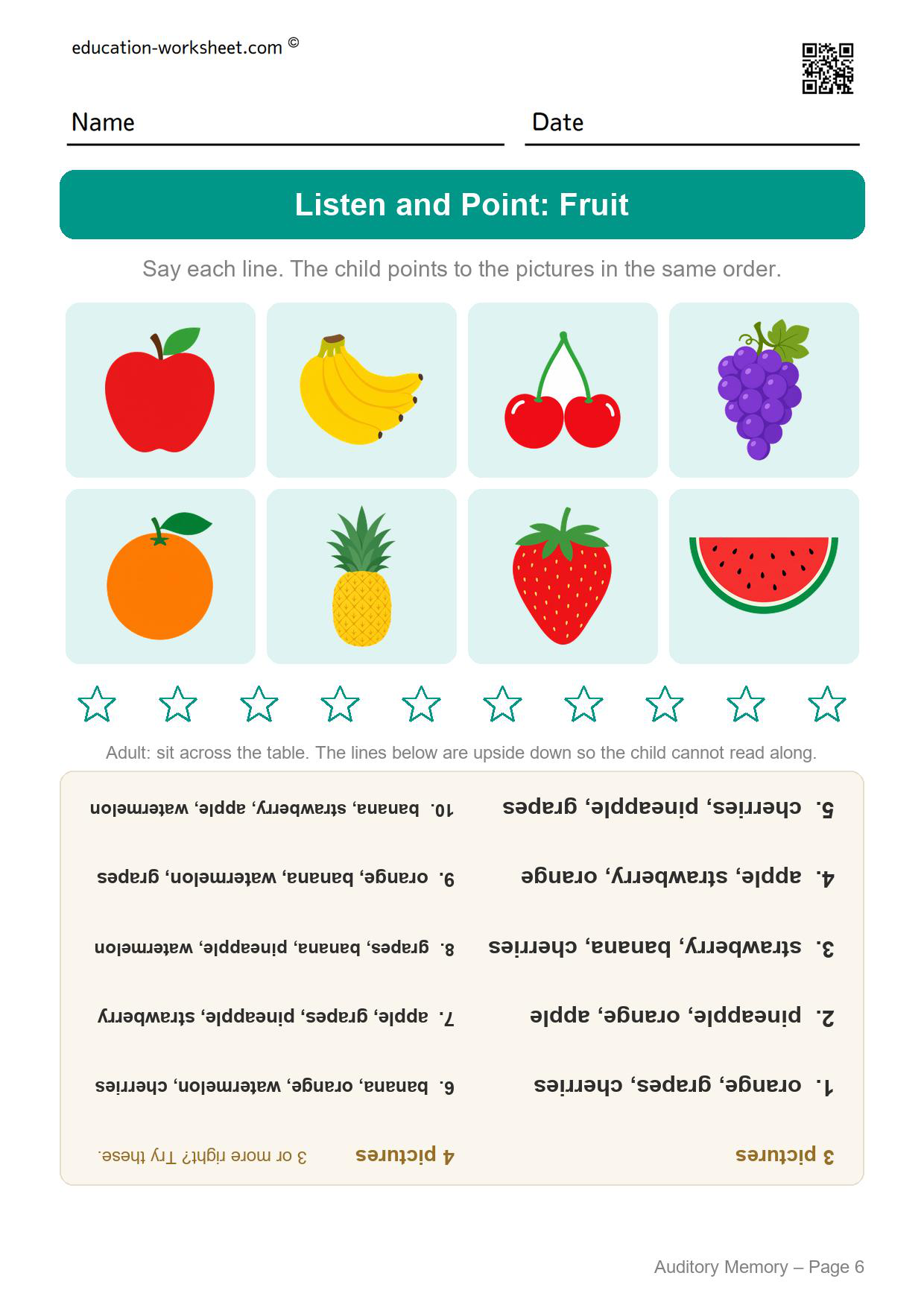
Page 6 – Listen and Point: Fruit
Eight kinds of fruit. Three of the names, pineapple, strawberry and watermelon, are long words, so a line on this page takes longer to say than a line of animals. Every fruit is used at least four times across the ten lines.
Page 7 – Listen and Repeat: 4 and 5 Numbers
The longest number lines in the pack. Five numbers in a row is a real stretch for many young children, and it is fine to stop at the four-number lines and come back to this page weeks later.
Page 8 – Listen and Repeat: 4 and 5 Words
Four and five words, such as fish – boat – hat – star – drum. Words are usually harder to hold than single numbers, because there are many more of them to choose from. Expect this page to be harder than page 7.
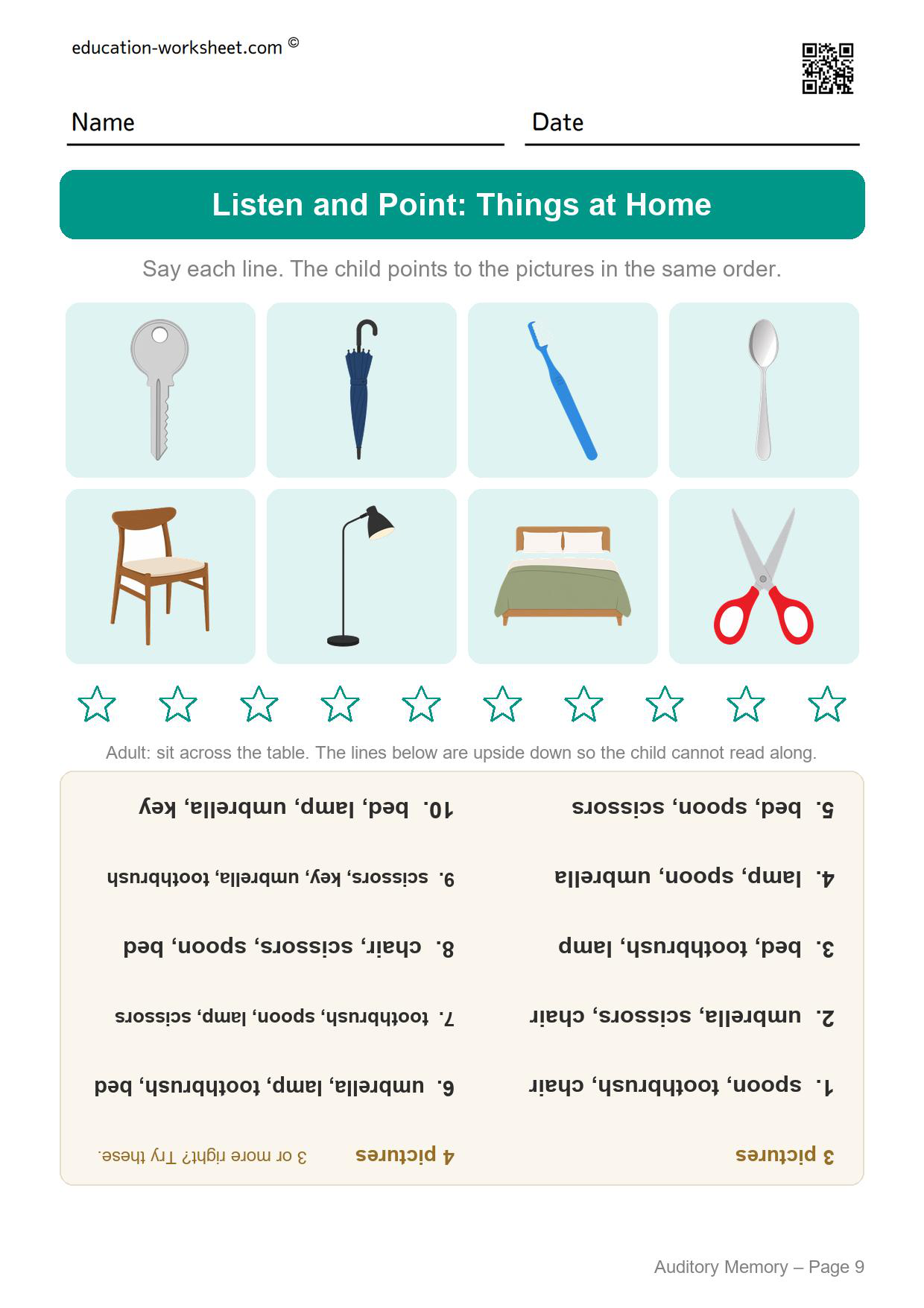
Page 9 – Listen and Point: Things at Home
A key, an umbrella, a toothbrush, a spoon, a chair, a lamp, a bed and scissors. Lines of three and four. Once a child is confident here, try saying a line and asking them to fetch the real objects in the same order.
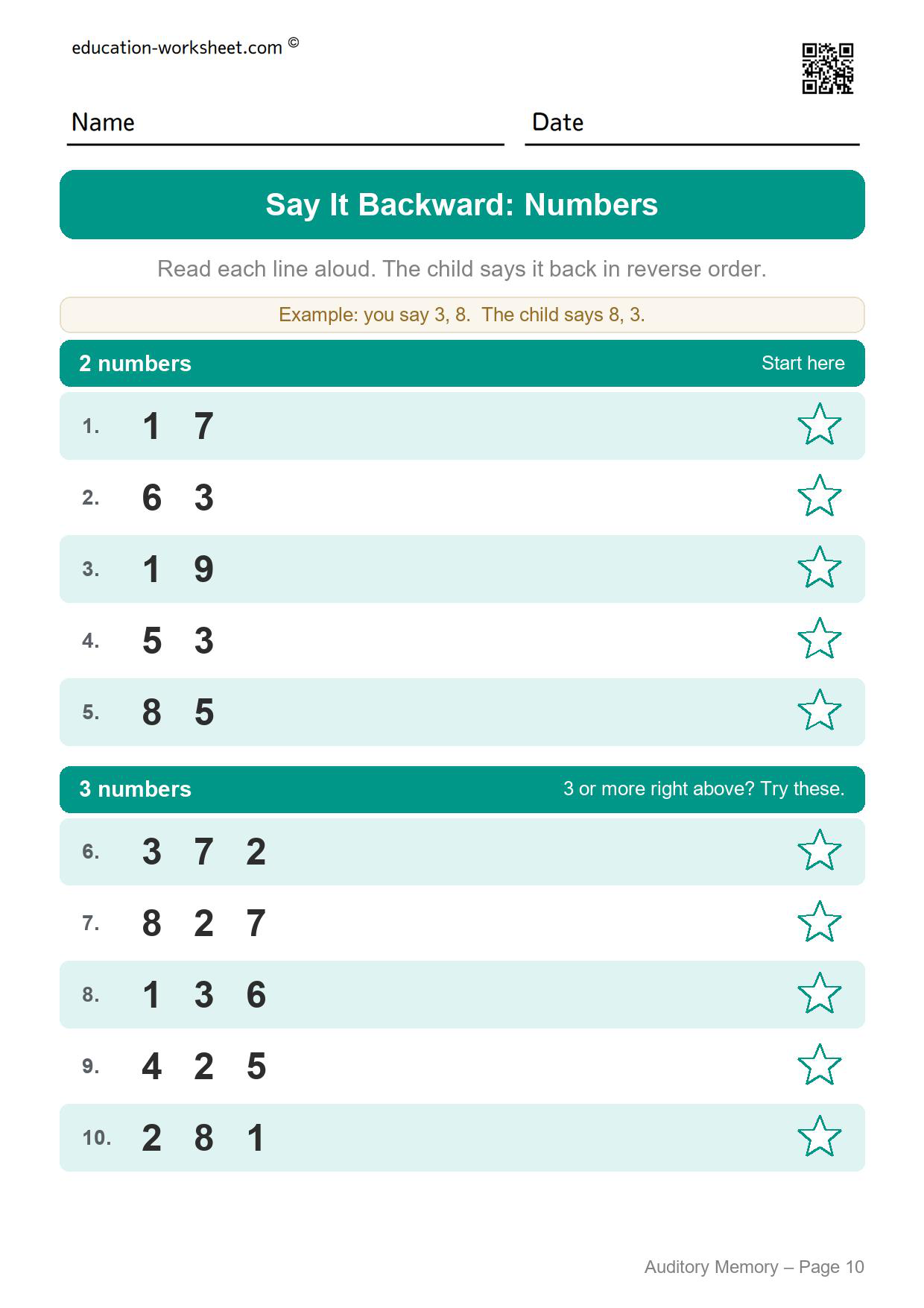
Page 10 – Say It Backward: 2 and 3 Numbers
Saying a line backward is a different job from repeating it. The child has to hold the numbers and turn them around at the same time, which is why researchers treat it as a working memory task. A worked example sits at the top of the page: you say 3, 8 and the child says 8, 3.
Lines are short on purpose. Many children who can repeat four numbers forward can manage only two or three backward.
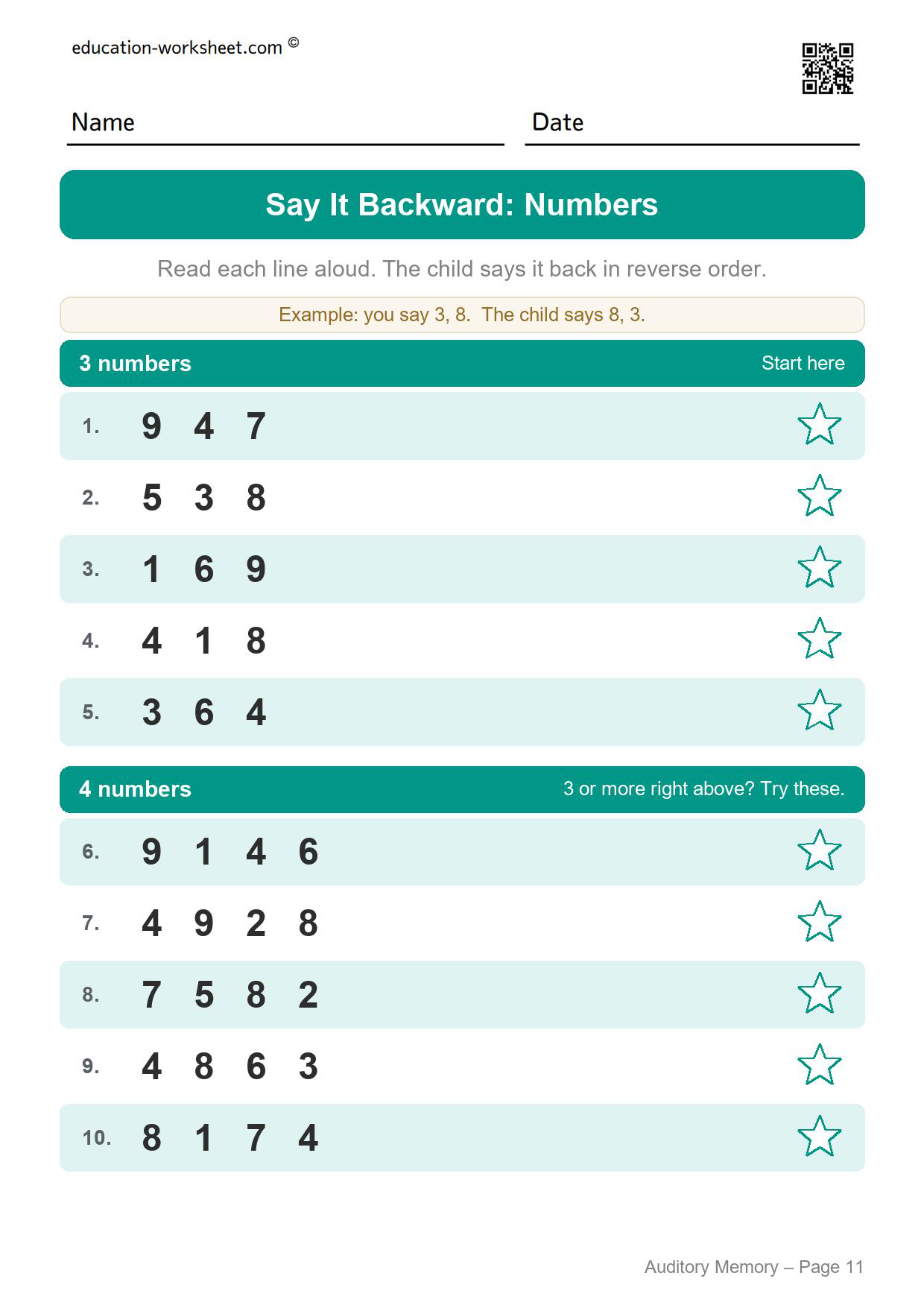
Page 11 – Say It Backward: 3 and 4 Numbers
The hardest numbers page. No line on this page is simply another line read in reverse, so a child cannot recognize the answer from an earlier line.
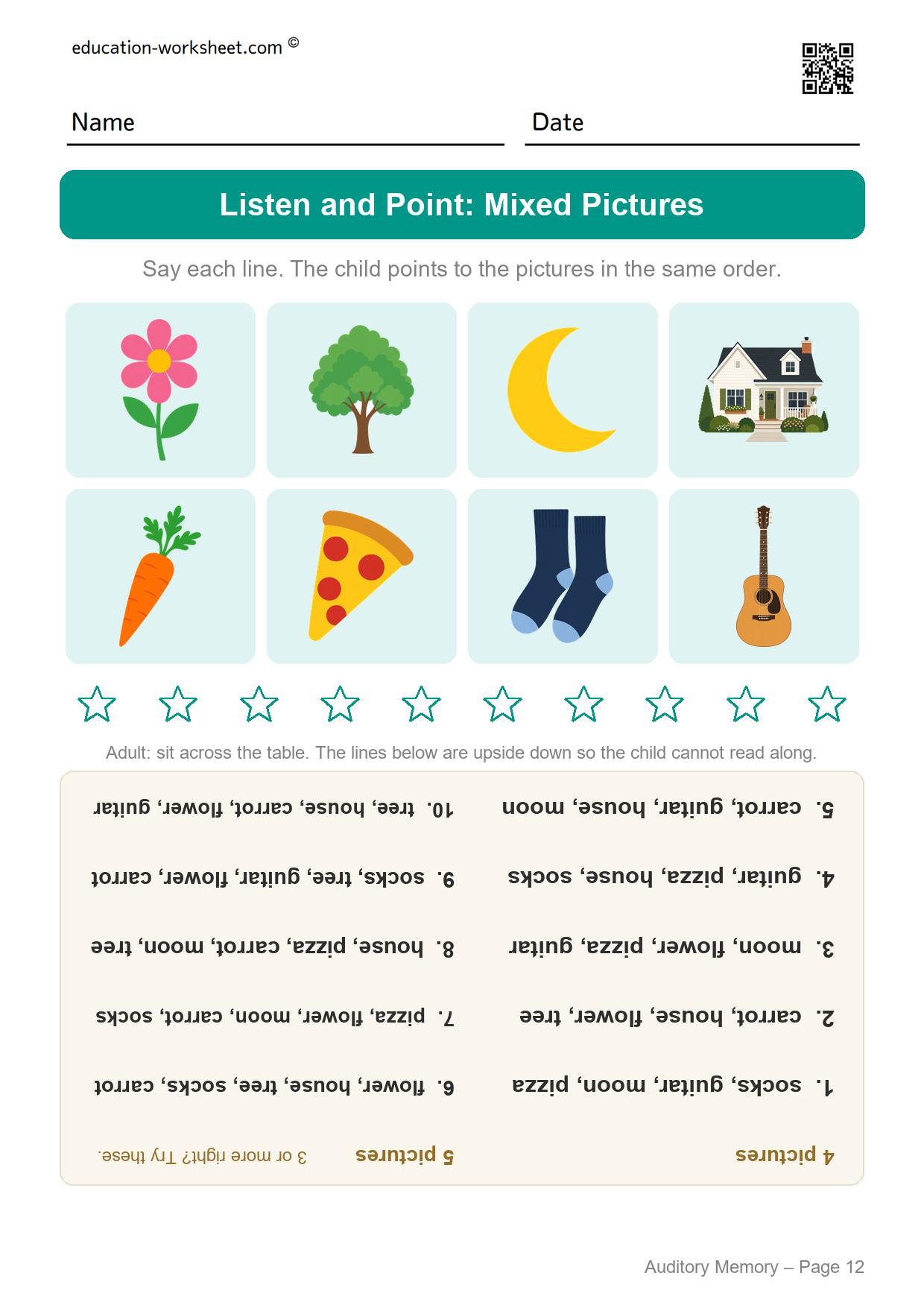
Page 12 – Listen and Point: Mixed Pictures
The last picture page and the longest lines: four and five pictures. Pages 3, 6 and 9 each show one kind of thing, so a child can at least hold a line as “some animals”. Here the pictures are a mix – a flower, the moon, a house, a guitar – and each item has to be held on its own.
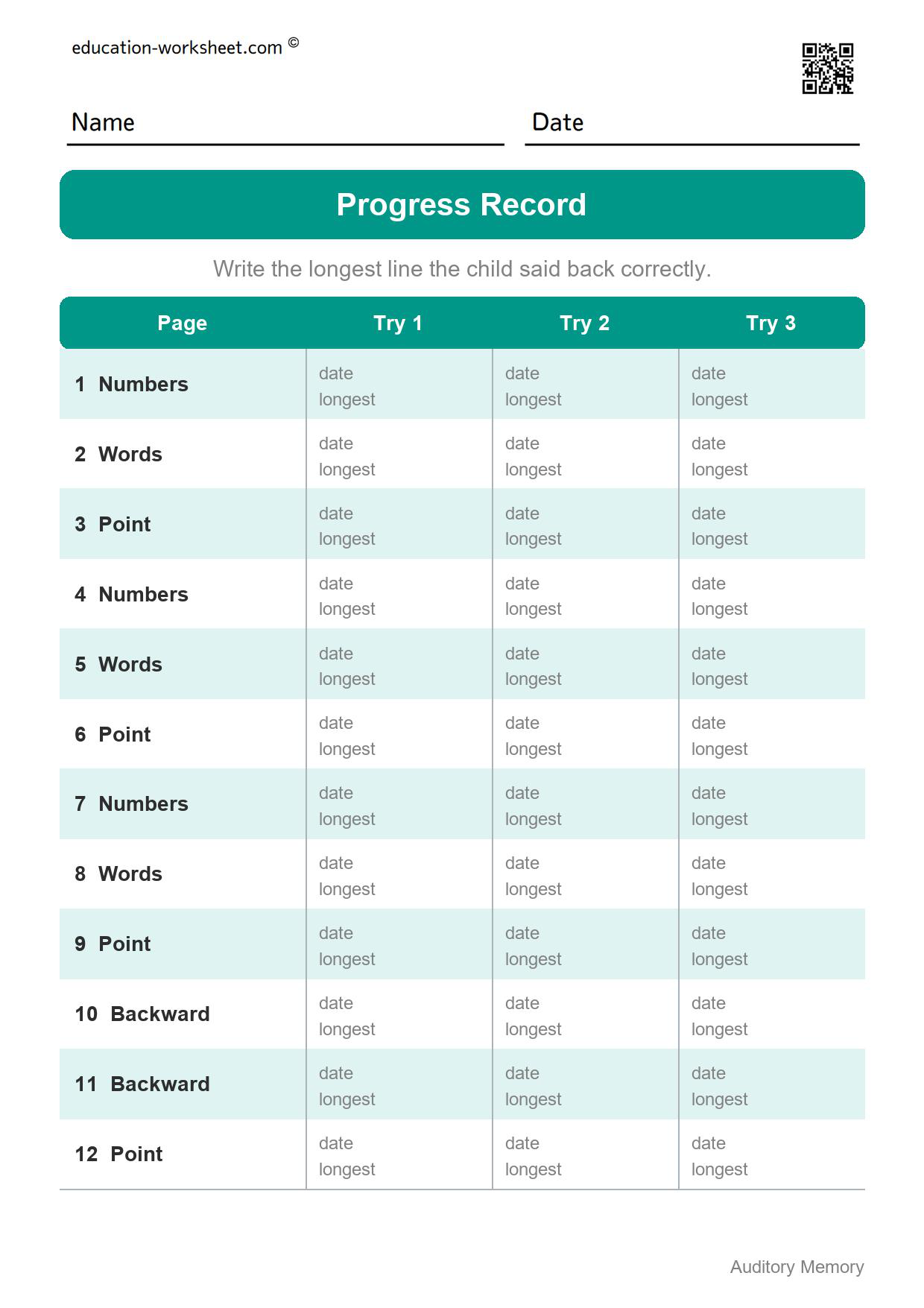
Progress Record – The Longest Line, Three Tries
There is no answer key, because every answer is printed on the page the adult reads from. The last sheet is a record instead: for each page, write the date and the longest line the child said back correctly, three times over the weeks.
How the Lines Are Built
A listening line only practices memory if it cannot be solved some other way. Every line in this pack was generated by a small program and then checked against these rules.
- Numbers 1 to 9 only. Zero is left out, because some children say “zero” and some say “oh”. Across the five number pages, each number from 1 to 9 is used between 15 and 22 times.
- No counting runs. Two numbers next to each other in a line are never neighbors on the number line, such as 4 and 5.
- No even steps. There is no 1, 3, 5 or 8, 6, 4 anywhere, because a pattern can be remembered as a rule.
- One-syllable words with nothing in common. In any one line, no two words share a first sound, rhyme or belong to the same group. The three word pages use 52 different words.
- Nothing repeated in pieces. On a page, the same two items never appear side by side in the same order in more than one line, and no line is another line turned backward.
- Pictures with one obvious name. Each picture page uses all eight of its pictures, each at least twice.
What Listening Practice Can and Cannot Do
It can give a child a playful reason to listen carefully, show you how many items they can hold today, and let both of you see that number grow. Many children like coloring the stars and trying the longer lines.
It cannot diagnose an auditory processing disorder, a language disorder or ADHD, and practicing these lines will not, on its own, fix a listening difficulty. Those are assessed by audiologists, speech-language professionals and doctors who look at much more than memory.
Check hearing first. If a child often says “what?”, turns the TV up, or seems to listen better on some days than others, a hearing check is the right first step. At this age, fluid behind the eardrum after a cold is common and can make hearing come and go without anyone noticing.
When Children Are Ready for These Worksheets
- Age: about four to eight – preschool to second grade. Start younger children on the picture pages, which need no speech at all.
- Before starting: the child should know the numbers 1 to 9 by name and the names of the pictures on a page. Name the eight pictures together before the first line.
- SL.K.2 and SL.1.2 – understand key details in a text read aloud or information presented orally. There is no standard for auditory memory itself, but every listening standard depends on holding what was said.
- SL.K.3 and SL.1.3 – ask and answer questions to clarify what a speaker says. Children who can hold a whole sentence are far better placed to do this.
How to Use These Worksheets
- Sit where the child cannot see the lines you are reading. For the picture pages, sit across the table: the lines are upside down for the child and the right way up for you.
- Say “Listen carefully. When I stop, say it back to me.” Then read the first line at one item per second, in an even voice.
- Say each line once. Do not repeat it, even if the child asks. If they ask, simply move on to the next line.
- Count a line as right only if every item is there and in the right order. The child colors the star for each line they get right.
- If the child gets three or more of the five short lines right, try the five long lines.
- Write the longest line they managed on the progress record, and try the same page again another day.
Three Things to Watch For
1. Answering before the line has finished. Some children start talking as soon as they hear the first item and lose the rest. Hold up a hand while you read and lower it when it is their turn.
2. The right items in the wrong order. This is still counted as a miss, but it is worth noticing. A child who keeps the items but loses the order needs different practice from a child who forgets the items altogether.
3. Adults speeding up or grouping. Without meaning to, adults often read faster as lines get longer, or group numbers like a phone number: “thirty-five, eighty-two”. Both make lines easier. Keep to one item per second, and say each number on its own.
Printing Tips
- Print at 100 percent, actual size, on A4 or US Letter.
- The picture pages are best printed in color. The number and word pages work just as well in black and white.
- Print one copy of each page per child if they will color the stars; the adult can reuse their own copy for reading.
Frequently Asked Questions
What is auditory memory?
It is the ability to hold on to what you have just heard, such as a list of numbers, a few words or an instruction, long enough to repeat it or act on it. It is one part of listening, alongside hearing clearly and understanding words.
What age are these auditory memory worksheets for?
About four to eight. Younger children can start with the picture pages, where they point instead of talking. Older children can try the backward pages.
Is this a test for auditory processing disorder?
No. These are practice sheets with no scores or comparison data. Auditory processing disorder is diagnosed by an audiologist, and a hearing check should always come first.
How many numbers should my child be able to repeat?
These sheets do not give a target, because it depends on age, the day and the kind of item. Compare the child with their own earlier tries on the same page.
Why are the lines on the picture pages upside down?
So that an adult sitting across the table can read them while a child who can read cannot read ahead. If you sit beside the child instead, turn the page around while you read.
Do I need to sign up to download these?
No. Every PDF downloads immediately, with no account, no email address and no cost.
Can I use these in my classroom or therapy room?
Yes, they are free to print for home, classroom and therapy use. Please do not sell them or re-host the files elsewhere.
More Free Listening and Language Worksheets
- Free Rapid Automatic Naming Worksheets – RAN Letters and Numbers
- Free Rhyming Words Worksheets for Kindergarten – Words That Rhyme
- Free Syllables Worksheets for Kindergarten – Say It, Clap It, Count It
- Free Beginning Sounds Worksheets for Kindergarten – Phonics, 40 Words
- Free Position Words Worksheets for Kindergarten – In, On, Under, Next To
- Free Ordinal Numbers Worksheets for Kindergarten – First, Second, Third, Fourth and Fifth
- Free Final Consonant Deletion Worksheets – Minimal Pairs PDF